

North America Serum Free Media Market Size & Forecast:
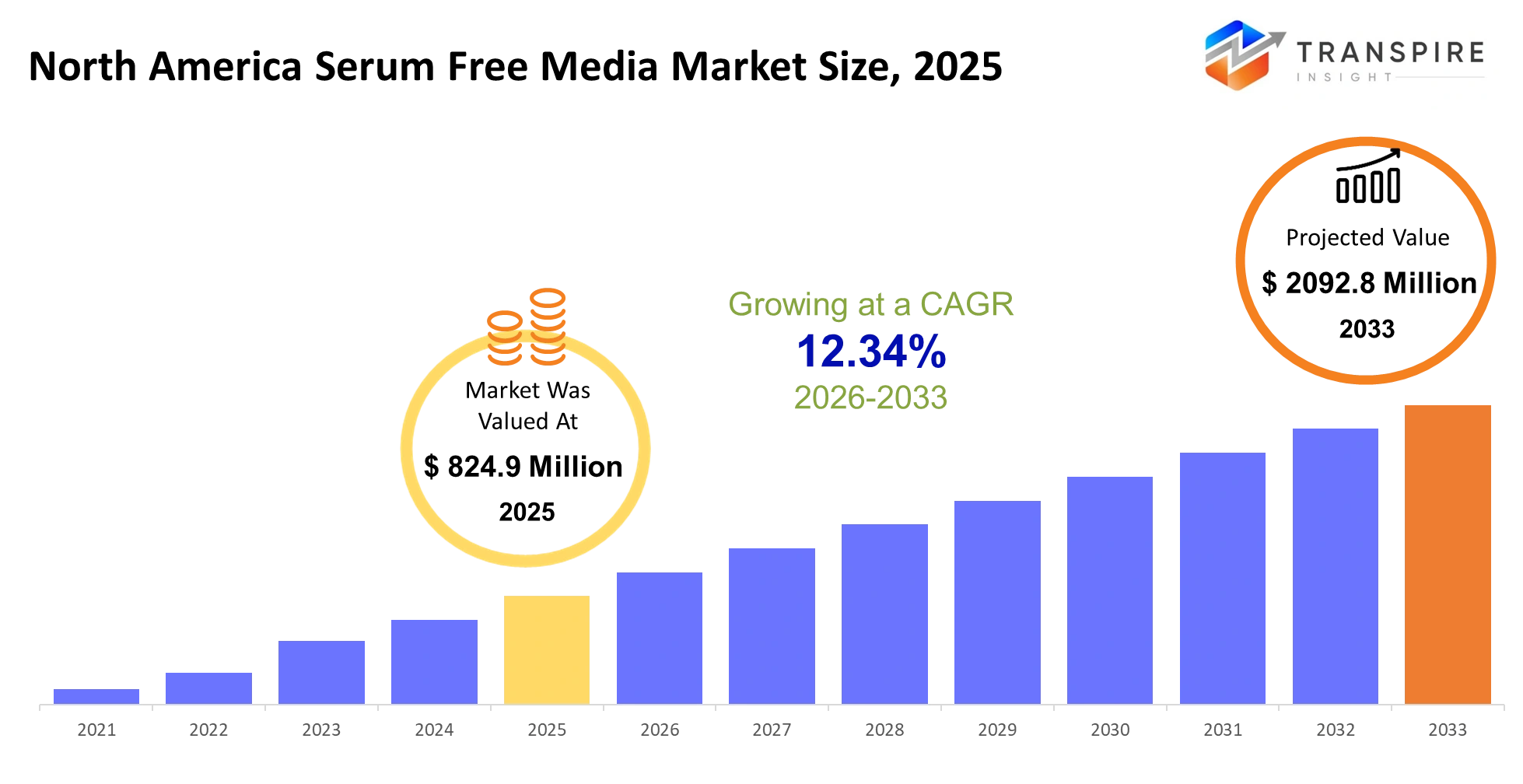
- North America Serum Free Media Market Size 2025: USD 824.9 Million
- North America Serum Free Media Market Size 2033: USD 2092.8 Million
- North America Serum Free Media Market CAGR: 12.34%
- North America Serum Free Media Market Segments: By Product Type (CHO Media, HEK Media, Stem Cell Media, Hybridoma Media, Insect Cell Media, Others); By Application (Biopharmaceutical Production, Cell Therapy, Vaccine Production, Regenerative Medicine, Research Applications, Others); By End User (Biotechnology Companies, Pharmaceutical Companies, Academic Institutes, CROs, Others); By Form (Liquid Media, Powder Media, Customized Media, Others).
To learn more about this report,  Download Free Sample Report
North America Serum Free Media Market Summary
The North America Serum Free Media Market was valued at USD 824.9 Million in 2025. It is forecast to reach USD 2092.8 Million by 2033. That is a CAGR of 12.34% over the period.
The North America serum-free media market provides nutrient-rich solutions that help grow mammalian and microbial cells in biomanufacturing, it sort of swaps out traditional animal serum for processes that generate biologics, vaccines and advanced cell or gene therapies. In day to day use, it lets pharma and biotech teams scale cell culture with tighter oversight over consistency, safety, and regulatory compliance, which is kind of the whole point. Over the last 3–5 years, the market has moved more noticeably toward recombinant and chemically defined formulations as biologics and personalized treatments go from niche to more standard pipelines. The COVID-19 pandemic, meanwhile, worked as a major accelerant, it revealed weak spots in serum supply chains and pushed adoption of serum-free setups for quicker, more predictable manufacturing runs. So, naturally, companies are putting money into improved media designs to cut down batch variability and shorten development timelines, this then boosts throughput and strengthens production networks across North American bioprocessing facilities, overall.
Key Market Insights
- The United States is basically leading the North America Serum Free Media Market, with almost 70% of share in 2025, and it looks like this is backed by advanced biomanufacturing, plus really solid biologics capacity , overall.
- Canada meanwhile feels like the fastest-growing area for 2025 to 2030 in the same market, with momentum coming from biotech funding, bigger R&D pushes and also academic industry collaboration , that kind of thing.
- Serum-free basal media ends up holding the biggest slice, because it is widely used in monoclonal antibody and vaccine production workflows , pretty much everywhere.
- After that, supplemented plus specialty media take the second place segment, helping with things like optimized cell growth, better stability and improved bioprocess efficiency , in practice.
- Chemically defined media is growing the quickest from 2025–2030 , since it cuts down batch variability and supports regulatory compliance stronger for advanced therapies.
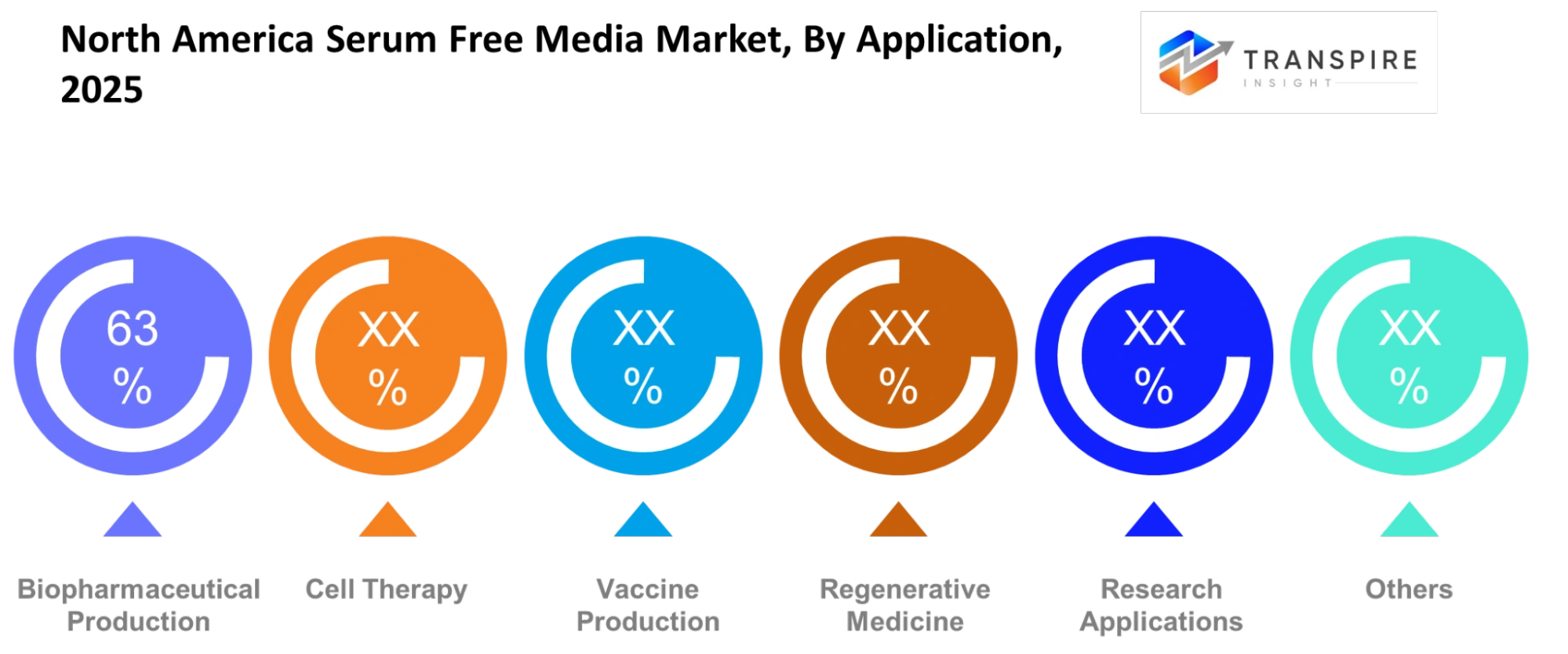
- On the application side, biopharmaceutical production dominates the North America Serum Free Media Market, taking more than 55% share, mainly pulled by big scale biologics manufacturing demand.
- And cell and gene therapy is the fastest-growing applications segment, fueled by personalized medicine pipelines, plus expanding clinical trial activity.
- Pharmaceutical and biotechnology companies are leading the market with around 60% share, supported by high-volume biologics, and vaccine production that keeps running.
- Contract development and manufacturing organizations, CDMOs , are also increasing fast, benefiting from outsourcing trends and the need for flexible bioprocessing.
- Finally, ongoing upgrades in cell culture systems boost scalability, improve reproducibility, and help reduce production variability across biomanufacturing facilities , consistently.
What are the Key Drivers, Restraints, and Opportunities in the North America Serum Free Media Market?
The North America Serum Free Media Market is mainly pushed by the fast expansion of biologics and i guess especially monoclonal antibodies, vaccines and cell based therapies. That momentum started when regulatory agencies made expectations tighter about repeatability and contamination risk, mainly from animal derived components , so companies moved toward chemically defined alternatives. Then as biopharma scaled COVID-19 vaccine output , and later branched into mRNA and cell therapy pipelines, serum free systems went from being an “extra” upgrade to kind of a manufacturing norm. This boosts adoption rates too because serum free media tends to cut batch failure risk and can shrink the process tuning window, so CDMOs and drug developers get to commercial production sooner, with better revenue throughput, overall
The biggest brake in practice is the heavy formulation complexity along with the expensive optimization effort tied to serum free media customization. Compared with serum containing systems, these require a careful balancing of growth factors for each specific cell line, and that part increases development timelines, plus creates a stronger reliance on supplier know-how. Because of that, smaller and mid sized biotech firms often hesitate or slow down switching, mostly if they do not have solid process engineering capability internally. So some organizations keep waiting, even though regulators may prefer the approach, which ends up suppressing short term market penetration and also lifts upfront R&D spend across the North America Serum Free Media Market.
One real chance for growth is AI-driven media optimization platforms, paired or even integrated with high throughput bioprocessing. Companies like Thermo Fisher Scientific are already putting money into predictive formulation tools, that can cut down on those experimental cycles and speed up cell line-specific media design a bit more than before. At the same time, Canada seems to be turning into a sort of testing ground for next generation cell therapy manufacturing hubs, which are being propped up by government biotech funding programs. So when you look at it this way, the mix of digital bioprocessing plus regional investment is expected to open up the next growth phase for the North America Serum Free Media Market, and honestly it feels like a logical push forward in practice.
What Has the Impact of Artificial Intelligence Been on the North America Serum Free Media Market?
Artificial intelligence and advanced analytics are, kind of slowly but surely, reshaping marine emission control systems in North America by changing how scrubber performance systems are watched, tuned, and maintained across fleets. In practice operators use AI-enabled automation platforms to keep an ongoing eye on exhaust gas cleaning technology parameters like sulfur output, pressure differentials, and washwater quality. That helps reduce the whole manual inspection rhythm and it also improves fleet-wide compliance tracking, even as IMO and regional emissions standards keep tightening up.
Alongside that, machine-learning-powered predictive models are increasingly used for predictive maintenance, spotting early signals of fouling, pump degradation, or catalyst inefficiency before something actually breaks. They also make emissions forecasting easier by simulating operating conditions across different routes. Then vessels can adjust fuel consumption and scrubber settings in pursuit of better compliance, while still chasing cost efficiency. In real-world day-to-day operations, shipping companies often report higher uptime and fewer unplanned maintenance events, plus measurable improvements in fuel efficiency and reduced exposure to regulatory penalties because the compliance picture is more accurate.
Still, take note that adoption is not fully smooth, since real-time connectivity at sea is often limited, so continuous data streaming from onboard systems to shore-based AI platforms is difficult. On top of that, the integration costs for retrofitting older vessels can be high which slows deployment, especially for mid-sized fleet operators. Even with those roadblocks though, AI adoption keeps expanding because digitalization is now becoming central to operational efficiency within marine emission control systems.
Key Market Trends
- Biopharma manufacturers have kind of moved away from serum based media and gone toward chemically defined media, starting around 2021. This shift seems to reduce batch variation, too, and it can help increase regulatory approval success rates.
- After 2020, supply chains got wobbly, so many companies ended up localizing serum free media sourcing. That, in turn, reduced the extent to which they relied on imported animal-derived materials across North American sites, which was probably a big deal for continuity.
- From 2022 through 2025, monoclonal antibody producers increased their use of serum free platforms. In practice, this helped speed up standardized large scale biologics manufacturing, with fewer annoying deviations.
- Then, between 2023 and later, cell and gene therapy developers leaned more into serum free media. The usual reasons they cite are faster movement through the clinical pipeline and tighter quality-control rules, so the timing and documentation stay cleaner.
- Thermo Fisher Scientific and Merck KGaA have also been investing more in AI assisted media formulation tools since 2024. The goal is basically to shorten development cycles, because waiting around is expensive.
- Meanwhile CDMOs have shifted toward customized serum free media offerings since 2022. This lines up with outsourced biomanufacturing demand coming from smaller biotech firms that want tailored inputs without building everything in-house.
- Regulators, meanwhile, got stricter—FDA and Health Canada included—which increased the demand for chemically defined media. Since 2021, this has accelerated compliance driven purchasing decisions, like procurement teams moving sooner rather than later.
- On the equipment side, single-use bioreactor integration expanded alongside serum free adoption. This helps with scalability and it also reduces cross contamination risks between production facilities.
- And after 2023, digital bioprocess monitoring tools became more common. Those tools improved process reproducibility, so yields of high-value biologics are more consistent, not just once but more often.
North America Serum Free Media Market Segmentation
By Product Type
CHO media keeps the leading position in the North America Serum Free Media Market , mostly because it is used widely for monoclonal antibody production and it already has solid regulatory acceptance. Large scale biologics manufacturing tends to stick with CHO systems because they support stable protein expression and scalable output across industrial bioreactors. That kind of long standing usage creates big switching barriers and it keeps CHO reinforced among commercial biopharma producers, even when alternatives exist.
HEK and stem cell media appear to grow faster, largely because cell and gene therapy pipelines have shifted more toward viral vector and regenerative work since 2022. Hybridoma media still pulls in moderate demand, but the pace feels slower since monoclonal antibody work is moving toward recombinant platforms, so the fit isnt as strong. Insect cell media is more limited overall, though it helps in niche vaccine efforts and protein expression use cases, which means large-scale adoption is not really happening.
Going forward, growth will likely concentrate in stem cell and HEK-based systems as advanced therapies scale clinically. Product developers will keep pushing for chemically defined and animal free formulations to satisfy regulatory expectations, and honestly also to reduce variability during production. Investors , meanwhile will increasingly prefer platforms that allow multi platform compatibility across different therapeutic pipelines, not just one narrow use.
By Application
Biopharmaceutical production dominates application demand, mainly driven by large scale monoclonal antibody work and recombinant protein manufacturing. Industrial biologics expansion has helped expand the use of controlled serum free systems, since those can improve batch consistency and also lower contamination risk. This area typically benefits from long term supply contracts plus established manufacturing infrastructure, which makes it harder for new entrants to displace incumbents.
Applications for cell therapy show the strongest acceleration, mostly when you look at the clinical pipelines for CAR-T and regenerative therapies, and then you see how they kind of expanded after 2023. Vaccine production also keeps steady demand after those pandemic driven manufacturing capacity upgrades, even when budgets tighten a bit. On the research side there is still solid early-stage innovation, but it tends to add less commercial volume than production-scale use cases.
In the future direction, you can expect more allocation toward advanced therapy applications as commercialization ramps up. Manufacturers will likely concentrate on scalable GMP-compliant formulations, designed for personalized medicine, with a bit less room for improvisation. Buyers will prioritize media that supports quick process transfer from research to clinical manufacturing, and this is something they keep emphasizing.
To learn more about this report, Download Free Sample Report
By End User
Biotechnology companies are the largest end-user group, mainly because investment is concentrated in biologics innovation, and their manufacturing models are more flexible. Pharmaceutical companies come next, aided by large production facilities and integrated supply chains designed for commercial drugs. Together, these two groups act like the anchor, keeping demand relatively stable across industrial bioprocessing ecosystems.
CROs and CDMOs are growing faster, as outsourcing strategies have increased after 2022, partly to reduce capital expenditure and shorten time to market. Academic institutions still drive steady demand, though it remains smaller and tends to focus on early-stage research and protocol development. Smaller biotech startups lean more on external manufacturing partners, so their dependence on standardized media solutions keeps rising, quietly but consistently.
Future trends suggest a steadily rising role for CDMOs, as outsourced biomanufacturing keeps expanding in every direction at once. In that context suppliers are going to put more emphasis on media platforms that are customizable and easily scaled, especially to handle multi-client production setups. Investors, meanwhile, are likely to treat contract manufacturing-linked demand as one of those key growth stabilizers that smooth out the bumps.
By Form
Liquid media still takes the biggest share, mostly because it is immediately ready, and works well with automated bioprocessing systems. In big production sites they tend to prefer liquid formats, simply because they shorten prep time and keep day-to-day process behavior more consistent. This lead is reinforced by long standing supply routes and standardized industrial workflows, without much fuss.
Powder media, on the other hand, offers clear cost benefits for storage and shipping. That makes it a logical choice for remote sites or places where budgets are tighter. At the same time customized media formulations are growing quickly. The reason is straightforward: there is more demand for application-specific performance in cell therapy and for recombinant protein production. Plus, some specialized research settings rely on tailored formulations for better experimental tuning, so they can see what changes actually do.
Looking ahead, growth will likely tilt toward customized, ready-to-use liquid systems as process intensification keeps picking up across biomanufacturing. Suppliers are expected to invest in hybrid options that blend flexibility with scalability. Buyers will likely pursue media formats that reduce operational hassle while remaining aligned with regulatory requirements.
What are the Key Use Cases Driving the North America Serum Free Media Market?
Biopharmaceutical manufacturing is seeing the strongest uptake of serum-free media, mostly in monoclonal antibody and recombinant protein work. Bigger biologics sites rely on it so that cell growth stays steady, the risk of contamination is lower, and everything meets the tighter regulatory validation requirements set by agencies like the FDA.
Meanwhile, cell therapy and vaccine production are growing rapidly, especially within biotechnology firms and CDMOs that run outsourced clinical pipelines. In these situations, the teams want very controlled and animal-free settings, because they’re supporting viral vector manufacturing, plus immunotherapy production that can scale up while still giving more consistent results from batch to batch
There are newer directions, too, such as regenerative medicine and more advanced 3D cell culture models used in academic institutions and translational research groups. You can also see early-stage movement in organoid development and precision medicine platforms, as budget trends shift toward personalized care development and next generation therapeutic discovery.
|
Report Metrics |
Details |
|
Market size value in 2025 |
USD 824.9 Million |
|
Market size value in 2026 |
USD 926.7 Million |
|
Revenue forecast in 2033 |
USD 2092.8 Million |
|
Growth rate |
CAGR of 12.34% from 2026 to 2033 |
|
Base year |
2025 |
|
Historical data |
2021 - 2024 |
|
Forecast period |
2026 - 2033 |
|
Report coverage |
Revenue forecast, competitive landscape, growth factors, and trends |
|
Regional scope |
North America (Canada, The United States, and Mexico) |
|
Key company profiled |
Thermo Fisher Scientific, Merck KGaA, Sartorius AG, Lonza Group, FUJIFILM Irvine Scientific, Cytiva, HiMedia Laboratories, Corning, STEMCELL Technologies, PromoCell, Takara Bio, Miltenyi Biotec, Eppendorf, Bio-Techne, Danaher Corporation. |
|
Customization scope |
Free report customization (country, regional & segment scope). Avail customized purchase options to meet your exact research needs. |
|
Report Segmentation |
By Product Type (CHO Media, HEK Media, Stem Cell Media, Hybridoma Media, Insect Cell Media, Others); By Application (Biopharmaceutical Production, Cell Therapy, Vaccine Production, Regenerative Medicine, Research Applications, Others); By End User (Biotechnology Companies, Pharmaceutical Companies, Academic Institutes, CROs, Others); By Form (Liquid Media, Powder Media, Customized Media, Others). |
Which Regions are Driving the North America Serum Free Media Market Growth?
North America is kind of led by the United States, which dominates the regional demand because it has a dense biopharmaceutical manufacturing base and also a more advanced regulatory framework, yes. Strong FDA oversight has largely pushed manufacturers to switch to serum-free and chemically defined media to meet strict quality and reproducibility standards. There’s a mature ecosystem of CDMOs, plus biotech clusters around Boston and San Diego, and large-scale production facilities that keep adoption moving forward, continuously. A big investment in monoclonal antibodies, vaccines, and cell therapy manufacturing reinforces long-term consumption across industrial bioprocessing workflows.
Canada is a stable secondary contributor. It’s more shaped by consistent public funding and academic–industry collaboration than by large-scale commercial manufacturing volumes. Unlike the US, growth here isn’t driven so much by production output, but by the steady expansion of research institutes and medium-sized biotech firms. Health Canada’s structured regulatory alignment with international standards supports predictable product approvals and helps maintain continuity of adoption. This kind of stability makes Canada a dependable market, but one with lower volume that supports early-stage innovation and also clinical trial material development.
Mexico is emerging as the fastest-growing regional contributor. That’s mainly because of recent investments in pharmaceutical manufacturing infrastructure and government-backed biomanufacturing initiatives. In practice, the expansion of industrial parks and trade-linked supply chains under the USMCA has improved access to advanced cell culture technologies. Also, the recent upgrades in contract manufacturing capacity have pulled in foreign biotech partnerships that are hunting for cost-efficient production bases. Over the 2026–2033 period, this momentum puts Mexico forward as an attractive entry point for suppliers targeting nearshoring–driven growth and diversified manufacturing footprints.
Who are the Key Players in the North America Serum Free Media Market and How Do They Compete?
Competition is still pretty, like moderately consolidated, mostly driven by a small set of global life science suppliers who kind of control formulation standards AND the GMP-grade supply chain, so it feels hard for others to squeeze in. The incumbents tend to defend their position with proprietary chemically defined formulations, plus services that focus on cell-line specific optimization, and they back that up using long-term CDMO contracts. Most of the competition is about technology differentiation, not so much about pricing—think AI-assisted media development, regulatory paperwork, and documentation readiness. New entrants have a tougher time because validation costs are high, and the switching barriers in already-validated bioprocesses are basically stubborn.
Thermo Fisher Scientific bundles media with bioreactors and analytics, and that workflow grouping across bioprocess stages is how they tend to keep customers. Merck KGaA (MilliporeSigma) promotes chemically defined media and pairs them with robust regulatory documentation, primarily aimed at biopharma compliance, along with consistent global supply reliability. Cytiva leans into bioprocess scalability, and also leans on CDMO partnerships to help larger scale biologics adoption spread into industrial manufacturing networks.
Sartorius highlights single-use bioprocess systems combined with optimized media, they frame it as a scalability improvement for cell therapy workflows. Lonza differentiates through custom media development services that align with gene therapy manufacturing realities, as well as contract development pipelines in general. Corning continues to advance with more cost-effective serum-free formulations, and it keeps gaining traction in academic and early-stage research markets, which in turn reinforces demand for upstream innovation.
Company List
- Thermo Fisher Scientific
- Merck KGaA
- Sartorius AG
- Lonza Group
- FUJIFILM Irvine Scientific
- Cytiva
- HiMedia Laboratories
- Corning
- STEMCELL Technologies
- PromoCell
- Takara Bio
- Miltenyi Biotec
- Eppendorf
- Bio-Techne
- Danaher Corporation
Recent Development News
“In January 2025, FUJIFILM Irvine Scientific announced the sale of its Medical Media Business Unit to Astorg. The restructuring refocuses operations on core life science and serum-free media production, strengthening its bioprocessing product pipeline.”
Source: https://www.fujifilm.com
“In April 2024, Thermo Fisher Scientific launched CTS OpTmizer One Serum-Free Medium. The product was designed to enhance scalability and consistency in cell therapy manufacturing workflows across North American biomanufacturers.
Source: https://www.thermofisher.com
What Strategic Insights Define the Future of the North America Serum Free Media Market?
North America Serum Free Media Market is moving toward a kind of structurally integrated precision-driven bioprocessing model, where chemically defined and application-specific formulations become the default standard across commercial biologics, and advanced therapies too. The main reason is not just one thing; it’s mostly the convergence of regulatory tightening, the expansion of cell and gene therapy pipelines, and the fact that more companies now lean on scalable CDMO networks that want reproducible upstream processes. Over the next 5 to 7 years, demand is expected to cluster around high-performance, digitally optimized media systems that are tightly coupled with automated biomanufacturing platforms.
There is also a less visible risk that people don’t always notice. Supplier concentration among a few global life science firms can create exposure to pricing rigidity and potential disruption if manufacturing bottlenecks arise or quality deviations occur. Another constraint is the growing complexity of regulatory harmonisation for next-generation engineered media, which could delay approval cycles for new formulations, even when the science is ready.
On the other hand, there is an emerging opportunity that seems pretty realistic. The integration of AI-guided media design platforms inside cell therapy manufacturing hubs in the United States and Canada could make customization faster, even at a clinical scale. Market participants should therefore push modular, data-driven media platforms that plug into automated bioreactor systems, so they can capture longer-term contracts and reduce switching risk across biomanufacturing ecosystems.
North America Serum Free Media Market Report Segmentation
By Product Type
- CHO Media
- HEK Media
- Stem Cell Media
- Hybridoma Media
- Insect Cell Media
- Others
By Application
- Biopharmaceutical Production
- Cell Therapy
- Vaccine Production
- Regenerative Medicine
- Research Applications
- Others
By End User
- Biotechnology Companies
- Pharmaceutical Companies
- Academic Institutes
- CROs
- Others
By Form
- Liquid Media
- Powder Media
- Customized Media
- Others
Frequently Asked Questions
Find quick answers to common questions.
The North America Serum Free Media Market size is USD 2092.8 Million in 2033.
Key segments for the North America Serum Free Media Market are By Product Type (CHO Media, HEK Media, Stem Cell Media, Hybridoma Media, Insect Cell Media, Others); By Application (Biopharmaceutical Production, Cell Therapy, Vaccine Production, Regenerative Medicine, Research Applications, Others); By End User (Biotechnology Companies, Pharmaceutical Companies, Academic Institutes, CROs, Others); By Form (Liquid Media, Powder Media, Customized Media, Others).
Major North America Serum Free Media Market players are Thermo Fisher Scientific, Merck KGaA, Sartorius AG, Lonza Group, FUJIFILM Irvine Scientific, Cytiva, HiMedia Laboratories, Corning, STEMCELL Technologies, PromoCell, Takara Bio, Miltenyi Biotec, Eppendorf, Bio-Techne, Danaher Corporation.
The North America Serum Free Media Market size is USD 824.9 Million in 2025.
The North America Serum Free Media Market CAGR is 12.34% from 2026 to 2033.
- Thermo Fisher Scientific
- Merck KGaA
- Sartorius AG
- Lonza Group
- FUJIFILM Irvine Scientific
- Cytiva
- HiMedia Laboratories
- Corning
- STEMCELL Technologies
- PromoCell
- Takara Bio
- Miltenyi Biotec
- Eppendorf
- Bio-Techne
- Danaher Corporation
Recently Published Reports
-
Apr 2026
Cord Blood Banking Services Market
Cord Blood Banking Services Market Size, Share & Analysis Report By Type of Service (Collection, Processing, Storage), By Bank Type (Private Banks, Public Banks, and Hybrid Banks), By Component (Cord Blood, and Cord Tissue), By End User (Hospitals, Research Institutions, Biotechnology Companies, and Others) and Geography (North America, Europe, Asia-Pacific, Middle East and Africa, South and Central America), 2021 - 2031
-
Apr 2026
ELISA Processors Market
ELISA Processors Market Size, Share & Analysis Report By Type (Optical Filter ELISA Analyzer, and Optical Grating ELISA Analyzers), By Mode (Automated ELISA Analyzers, and Semi-Automated ELISA Analyzers), By Applications (Immunology, Vaccine development, Drug Monitoring, and Others), By End Users (Biotechnology Companies, Pharmaceutical Companies, Contract Research Organization, and Diagnostic Laboratories) and Geography (North America, Europe, Asia-Pacific, Middle East and Africa, South and Central America), 2021 - 2031
-
May 2026
Microscope Slide Scanner Market
Microscope Slide Scanner Market Size, Share & Analysis Report By Type (Portable Microscope Slide Scanner, and Desktop Microscope Slide Scanner), By Application (Biological Research, Medicine, Veterinary, and Other) and Geography (North America, Europe, Asia-Pacific, Middle East and Africa, South and Central America), 2021 - 2031
-
Apr 2026
Microwave Cookware Market
Microwave Cookware Market Size, Share & Analysis Report By Material Type (Plastic, Glass, Ceramic, Silicone, and Metal), By Application (Cooking, Reheating, and Defrosting), By End User (Household, Commercial (Restaurants, Hotels, and Cafes), and Food Service Industry), By Sales Channel (Online Retail, Offline Retail (Supermarkets, Hypermarkets, Specialty Stores), and Direct Sales (Company Outlets)) and Geography (North America, Europe, Asia-Pacific, Middle East and Africa, South and Central America), 2021 - 2031