

North America Chemical Gas Sterilizers Market Size & Forecast:
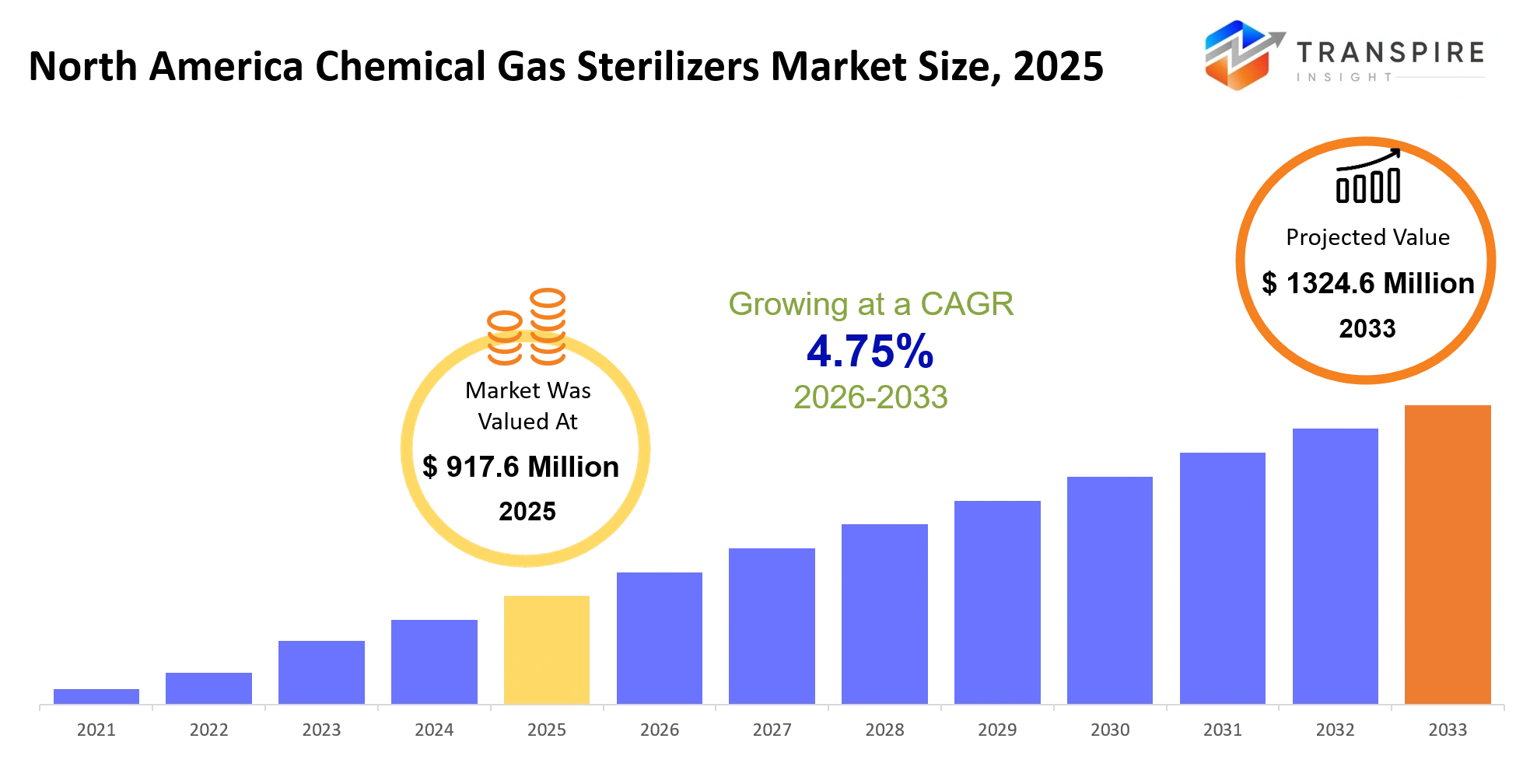
- North America Chemical Gas Sterilizers Market Size 2025: USD 917.6 Million
- North America Chemical Gas Sterilizers Market Size 2033: USD 1324.6 Million
- North America Chemical Gas Sterilizers Market CAGR: 4.75%
- North America Chemical Gas Sterilizers Market Segments: By Sterilizer Type (Ethylene Oxide Sterilizers, Hydrogen Peroxide Sterilizers, Ozone Sterilizers, Formaldehyde Sterilizers, Others), By Application (Medical Device Sterilization, Pharmaceutical Sterilization, Laboratory Sterilization, Others), By End User (Hospitals, Pharmaceutical Companies, Medical Device Manufacturers, Others), By Technology (Low-temperature Sterilization, Automated Sterilization Systems, Smart Sterilizers, Others).
To learn more about this report,  Download Free Sample Report
North America Chemical Gas Sterilizers Market Summary:
The North America Chemical Gas Sterilizers Market size is estimated at USD 917.6 Million in 2025 and is anticipated to reach USD 1324.6 Million by 2033, growing at a CAGR of 4.75% from 2026 to 2033.The North America chemical gas sterilizers market has been kind of a big deal for healthcare and life sciences, mostly because it helps with sterilization of medical devices that are heat- and moisture sensitive, so they can’t just use standard steam based processes. You can see this need across hospitals, contract sterilization providers , pharmaceutical manufacturers and medical device companies. Basically they use these systems to keep products safe while also maintaining the structural integrity of complicated instruments implants and diagnostic equipment.
In the last five years, the market has seen a noticeable shift, toward lower emission sterilization technologies, and also toward more tightly controlled sterilization workflows. When regulators started watching ethylene oxide, or EtO , emissions even harder, manufacturers and service providers had to put more resources into stronger containment systems, better monitoring, and in some cases alternative sterilization solutions. This whole move seemed to pick up after environmental worries got louder, and after regulatory actions focused on sterilization facility emissions began to raise day to day compliance expectations across North America.
Right now, market growth also mirrors the ongoing rise in the number and, honestly, the growing complexity of minimally invasive and single use medical devices. As device designs keep becoming more sophisticated and more material sensitive, healthcare orgs and manufacturing teams are asking for specialized sterilization approaches. That demand creates new revenue angles for equipment suppliers, service providers, and the vendors that are focused on compliance related technology.
Key Market Insights
- In 2025, the United States is practically in charge of the North America Chemical Gas Sterilizers Market with something like a 78% share , pushed forward by large surgical procedure volumes.
- Canada meanwhile shows up as the speedier regional contributor, growing steadily all the way to 2030 because hospitals keep modernizing their sterilization compliance systems , yeah.
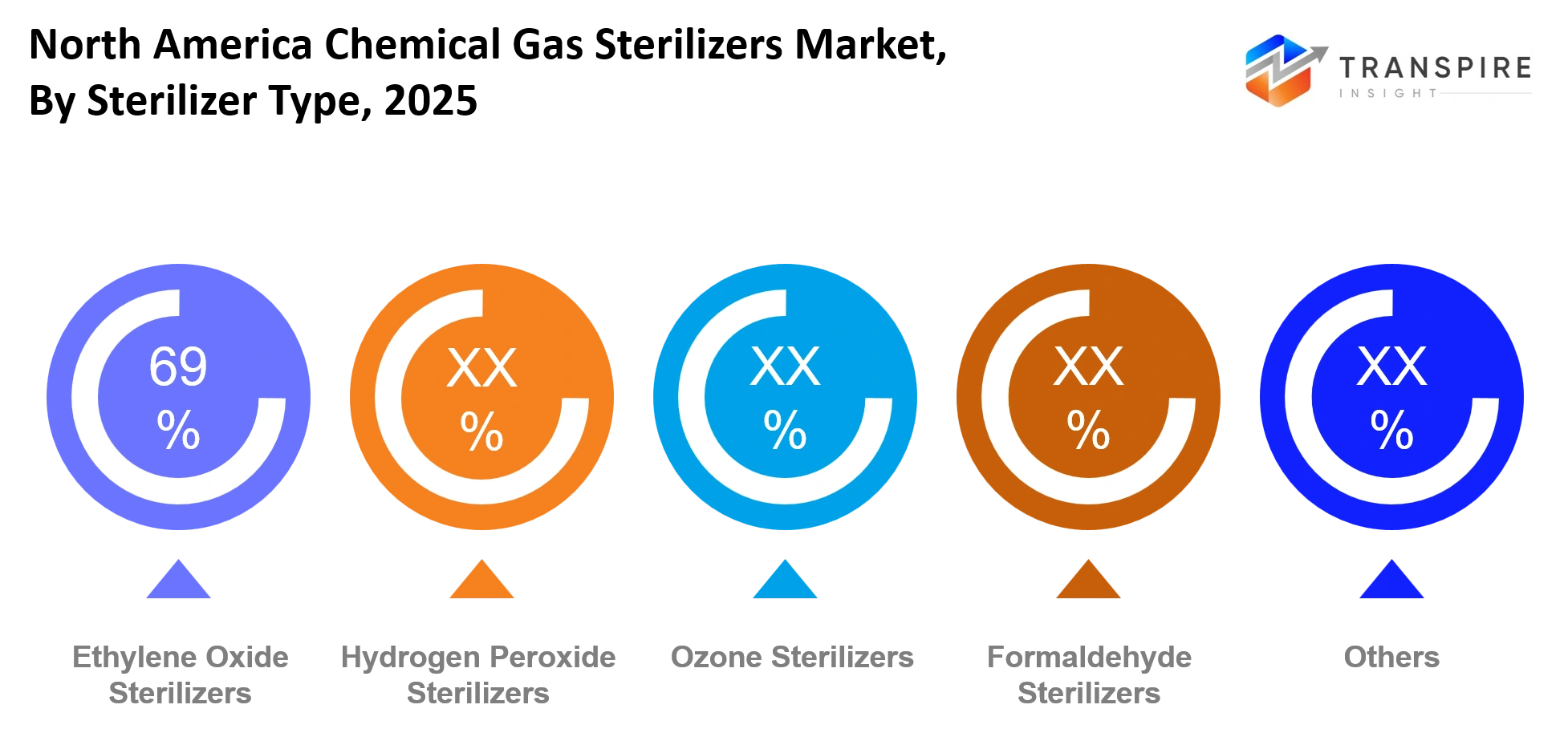
- When it comes to technology, Ethylene oxide sterilizers dominate the North America Chemical Gas Sterilizers Market, holding around 55% of the share since they work well with heat-sensitive devices.
- Contract sterilization services sit as the second-largest slice, and this is mostly tied to the outsourcing trend across medical device manufacturing ecosystems.
- Low-temperature gas plasma and hybrid systems are the fastest growing segment through 2030 , mainly because of sustainability goals and safety upgrades.
- On the application side, medical device sterilization takes the lead with more than 60% share in the North America Chemical Gas Sterilizers Market, largely due to implant and catheter demand.
- Pharmaceutical packaging sterilization is the fastest-growing use case , helped by biologics expansion and tougher contamination control standards that keep getting stricter.
- For end users, hospitals and surgical centers lead adoption with about 45% share , since they need sterilization for procedures all the time.
- Medical device manufacturers are the fastest-growing end-user group, as production outsourcing increases and regulatory validation requirements keep rising too.
What are the Key Drivers, Restraints, and Opportunities in the North America Chemical Gas Sterilizers Market?
The strongest force pushing the North America Chemical Gas Sterilizers Market is basically the growing amount of complex, heat-sensitive medical devices coming into healthcare systems, and this keeps on happening. Over the past ten years, manufacturers have ramped up production of minimally invasive surgical instruments, implantable devices, catheters and combination products that just can not handle steam sterilization. Because of that change in how devices are built, chemical gas sterilization methods have become more relied on, especially ethylene oxide systems. And as device portfolios get more sophisticated, sterilization providers end up handling higher volumes of products that need specialized treatment which in turn supports equipment sales, contract sterilization revenues, and even facility expansion investments.
Now the biggest limit, sort of the real constraint, is the regulatory weight around ethylene oxide emissions. Environmental compliance basically means a huge pile of facility upgrades, emissions-control infrastructure, permitting procedures, and even ongoing surveillance systems. Those changes tend to stretch across years to finish and they also require serious capital spending, so the trouble feels kinda structural, not just a short-term thing. Smaller operators can get stuck with steeper operating costs, plus longer approval timeframes. So capacity expansion gets delayed and the availability of sterilization services can drop, which then suppresses market revenue potential.
As for where growth could show up , a major opportunity is in more advanced low-temperature sterilization technologies, for example hydrogen peroxide gas plasma systems. Healthcare providers and device manufacturers are looking at alternatives that can reduce regulatory exposure while still keeping sterilization performance solid. If these technologies keep gaining broader validation across a wider range of medical devices, they may unlock new adoption .
What Has the Impact of Artificial Intelligence Been on the North America Chemical Gas Sterilizers Market?
Artificial intelligence and advanced digital technologies are becoming, more and more important in chemical gas sterilization operations across North America . In practice, sterilization facilities are starting to deploy AI-enabled monitoring platforms in order to automate a bunch of critical tasks like gas concentration control, chamber pressure management, temperature regulation and emissions abatement system monitoring . These platforms keep sampling sensor information, then they adjust operating settings in real time, which cuts back on manual meddling and also helps the whole process stay more steady.
On top of that, machine learning models are showing up in predictive maintenance programs . Rather than waiting for obvious failures, operators look at past equipment performance, vibration signatures, valve actions and cycle history, so they can spot a likely breakdown ahead of time . In bigger sterilization facilities, predictive analytics tends to improve how equipment is used, it lowers the chance of sudden, unplanned downtime and it can extend the useful life of assets. At the same time advanced forecasting tools are helping emissions management too, because they can anticipate when ethylene oxide containment and abatement performance might drift , that supports stronger regulatory compliance .
The operational outcome is pretty noticeable . Facilities often report higher chamber utilization, fewer cycle interruptions, smoother maintenance scheduling, and lower operating costs, largely due to fewer equipment failures and less wasted energy . Digital batch tracking combined with automated compliance documentation also makes validation and audit work easier, less time consuming, and less prone to last minute scramble.
Still, there is a limitation with AI adoption . Many sterilization facilities run legacy equipment that was never built for modern data integration, so the rollout can get expensive and it restricts the amount of reliable operational data needed to train accurate predictive models .
Key Market Trends
- Since 2020, stricter ethylene oxide emission rules kinda pushed sterilization providers to put serious money into containment, abatement, and monitoring systems, not just a little either.
- Between 2021 and 2025 hospitals more and more shifted toward outsourcing sterilization services , which helped with capacity flexibility and also took away some capital equipment weight.
- Over the past five years medical device manufacturers started rolling out more heat sensitive items , so the industry leaned further on chemical gas sterilization approaches.
- After 2022, AI-enabled monitoring platforms showed up across a bunch of major facilities, and they basically automated cycle control, emissions tracking, and the compliance documentation style work, in a way that feels almost invisible when it runs.
- Companies like STERIS, Getinge, and Advanced Sterilization Products expanded investments in low temperature sterilization technologies too, kind of to diversify away from the older conventional systems.
- Then during 2020–2022, supply chain disruptions revealed sterilization capacity pinch points , so operators reacted by expanding regional processing networks, plus they built redundancy plans that weren’t just theory.
- After 2021 predictive maintenance really took off, it helped facilities cut down on unexpected equipment failures , and chamber utilization rates went up.
- At the same time regulatory agencies intensified environmental oversight , which made permitting timelines drag longer and raised hurdles for new entrants.
- Since 2022 contract sterilization providers have been chasing acquisitions and strategic partnerships , aiming to lock in processing capacity and strengthen geographic coverage.
- And more recently digital batch records replaced manual documentation in many facilities, which sped up audit readiness and made traceability better across day to day sterilization operations.
North America Chemical Gas Sterilizers Market Segmentation
By Sterilizer Type
By Sterilizer type, ethylene oxide sterilizers keep dominating because they fit amazingly well with heat and moisture sensitive medical devices, especially catheters, implants, and those intricate surgical instruments. Hydrogen peroxide sterilizers are getting more traction bit by bit since many healthcare systems want briefer cycle times, also less toxic residue left behind. Ozone and formaldehyde systems stay more niche , mainly due to material limitations and extra regulatory scrutiny.
The market position is still clearly leaning toward ethylene oxide systems, since the validated hospital and contract sterilization infrastructure already exists at scale. The growth logic is also being shaped by expanding minimally invasive device production, plus stricter emissions controls that push facilities toward upgrades, not full replacements. Looking ahead , the future direction suggests gradual diversification toward hybrid and low temperature alternatives, where manufacturers emphasize emission compliant designs and modular systems that help cut retrofit costs for existing facilities.
To learn more about this report, Download Free Sample Report
By Application
By application, medical device sterilization takes the lead overall because there’s still steady, almost relentless demand for implants , diagnostic tools and those single use surgical instruments that really need high sterility assurance. Pharmaceutical sterilization is growing fast too , especially with biologics and injectable therapies, and also due to stricter contamination control expectations across manufacturing spaces. Laboratory sterilization and other narrow uses are still smaller , though they matter for research organizations and specialized testing labs.
The market position is still sort of concentrated in medical device workflows, mainly because outsourcing to contract sterilization providers gives scalability and keeps regulatory compliance on track. The growth momentum comes from product designs getting more intricate and from tighter regulatory validation cycles throughout healthcare manufacturing in North America. Looking ahead, the future implications suggest even higher reliance on centralized sterilization hubs, where scale advantages and stronger compliance resources limit operational fragmentation and help manufacturers and healthcare providers push throughput efficiency further.
By End-User
By end user, hospitals still act as the dominant segment because surgical volumes stay consistent and there is a continued reliance on sterilization for reusable tools and critical care equipment. Medical device makers are seeing the quickest expansion too, mainly since production outsourcing keeps increasing, and sterilization validation gets more complicated when you look at FDA and ISO compliance. Pharmaceutical firms also keep showing steady involvement, especially in aseptic processing and the packaging of injectable drugs. Overall market standing is influenced by hospitals trying to keep certain capabilities in house for faster turnaround, while many manufacturers start shifting toward outside sterilization partners for scalability, which sounds a bit counterintuitive but it happens.
The growth logic follows rising procedural volumes, more device pipeline activity, and tighter regulatory demands around validated sterilization cycles. Looking ahead the direction seems to lean toward more consolidation around contract sterilization providers, which in turn reduces the internal hospital workload and increases dependence on specialized service networks. Those networks tend to bring advanced compliance systems and digital tracking infrastructure, and that changes the whole workflow, even for something as routine as sterilization.
By Technology
So like, By Technology, low temperature sterilization systems kinda take the lead, mostly because they work well with sensitive medical devices and they lower the risk of thermal harm. Automated sterilization systems are also moving fast, as more facilities roll out robotics, sensor based controls and integrated monitoring platforms, to keep each cycle more consistent… you know. Then there are smart sterilizers, which are starting to show up more in the high-growth lane, using data analytics, connectivity features, and all that, especially in big contract sterilization networks. Market position still feels anchored in low temperature systems, since the established infrastructure already supports high volume processing, in practice.
The growth push seems tied to regulatory pressure that keeps getting stronger for traceability, the need for operational efficiency, and also workforce optimization across sterilization facilities. Looking ahead, the future implications point toward fully digitized sterilization ecosystems where predictive maintenance, remote monitoring, and automated compliance reporting reduce downtime quite a lot, and help operators plus regulatory bodies stay audit-ready, without as much scramble.
What are the Key Use Cases Driving the North America Chemical Gas Sterilizers Market?
Medical device sterilization is still kinda the core use case, mostly because of high volume processing of implants, surgical kits, and diagnostic tools that really cannot stand heat or moisture, even a little. Contract sterilization providers end up handling most of this work because the validated ethylene oxide cycles keep delivering consistent sterility assurance levels, but only when everything is under strict regulatory supervision.
On the side, pharmaceutical packaging sterilization and hospital instrument reprocessing are growing too, sort of like adjacent work that sort of rubs against the same workflows. Biologic injectables, and prefilled syringes, are now asking for tighter contamination control, while hospitals also increasingly outsource high turnover instrument sterilization to cut down in-house load , and to keep compliance consistency steadier.
Newer use cases are starting to show up as well, like sterilization for advanced combination products and next generation wearable diagnostic devices. These need ultra low temperature processes, plus more careful residue handling standards. That is especially true with the evolving FDA validation frameworks, and with stricter North American environmental compliance rules that keep tightening up over time.
|
Report Metrics |
Details |
|
Market size value in 2025 |
USD 917.6 Million |
|
Market size value in 2026 |
USD 957.3 Million |
|
Revenue forecast in 2033 |
USD 1324.6 Million |
|
Growth rate |
CAGR of 4.75% from 2026 to 2033 |
|
Base year |
2025 |
|
Historical data |
2021 - 2024 |
|
Forecast period |
2026 - 2033 |
|
Report coverage |
Revenue forecast, competitive landscape, growth factors, and trends |
|
Country scope |
North America (Canada, The United States, and Mexico) |
|
Key company profiled |
Steris, Getinge, 3M, ASP, Belimed, Matachana Group, Tuttnauer, Steelco, Andersen Products, E-BEAM Services, Cosmed Group, MMM Group, Cardinal Health, Ecolab, Shinva Medical. |
|
Customization scope |
Free report customization (country, regional & segment scope). Avail customized purchase options to meet your exact research needs. |
|
Report Segmentation |
By Sterilizer Type (Ethylene Oxide Sterilizers, Hydrogen Peroxide Sterilizers, Ozone Sterilizers, Formaldehyde Sterilizers, Others), By Application (Medical Device Sterilization, Pharmaceutical Sterilization, Laboratory Sterilization, Others), By End User (Hospitals, Pharmaceutical Companies, Medical Device Manufacturers, Others), By Technology (Low-temperature Sterilization, Automated Sterilization Systems, Smart Sterilizers, Others). |
Which Regions are Driving the North America Chemical Gas Sterilizers Market Growth?
North America kind of leads the chemical gas sterilizers market, and the United States is still in the dominant spot, because it has a dense network of hospitals, contract sterilization facilities and a fairly strict regulatory enforcement setup by agencies such as the FDA and EPA. The stronger compliance style around ethylene oxide emissions has pushed a lot of facilities into continuous upgrades to their infrastructure, so the machinery demand keeps moving at a steady pace, for the long term. Also, there is a mature base for medical device manufacturing, which tends to lift utilization rates across sterilization hubs. With integrated logistics networks and more advanced healthcare supply chains, turnaround times for high-volume sterilization runs are faster. Taken together, that whole ecosystem basically locks in North America’s leadership in global sterilization capacity and technology adoption.
Canada, though, is a more stable and policy-consistent participant in the market, backed by publicly funded healthcare systems, and a gradual but structured regulatory alignment with North American sterilization standards. In contrast to the United States, growth there is less about sheer size and more about predictable hospital infrastructure upgrades, plus centralized procurement channels. Medical device imports drive much of the sterilization demand, so utilization stays fairly consistent across regional service providers. Environmental and occupational safety rules also tend to change at a measured pace, and that gives operators room to plan capital spending with lower swings. This steadiness means operators can keep generating consistent revenue even when capacity expansion cycles aren’t happening quickly.
In the Asia Pacific, things sort of emerge as the fastest-growing region, with rapid expansion of domestic medical device manufacturing in China, India, and Southeast Asia, along with stricter sterilization compliance adoption. At the same time, recent investments in hospital infrastructure and export oriented medtech production have upped demand for validated gas sterilization systems, a lot. Governments have also rolled out stronger quality certification frameworks for pharmaceutical and device exports, and that basically accelerates technology upgrades. So this shift is opening chances for global equipment suppliers and service providers to set up regional partnerships and manufacturing footprints too. Between 2026 and 2033, this growth path suggests solid entry potential for investors who are targeting outsourced sterilization capacity, plus localized compliance driven service models.
Who are the Key Players in the North America Chemical Gas Sterilizers Market and How Do They Compete?
In the North America Chemical Gas Sterilizers Market, competition looks like its somewhat consolidated, sort of, with a smaller cluster of technology providers plus sterilization service firms holding a good chunk of the installed capacity, not totally everything but a lot. Who leads the market usually isn’t decided by price alone. Instead it comes down to regulatory alignment, the ability to do process validation properly, strong emissions management, and the skill to handle complicated medical device sterilization needs. The older companies keep defending their share by doing facility upgrades and expanding service coverage. Meanwhile newer entrants tend to hit heavier obstacles, like permitting hurdles, environmental compliance and, the more annoying part, customer qualification steps. So in practice, the tech performance plus the compliance backbone are still the biggest competitive gaps.
STERIS tends to lean into both equipment manufacturing and contract sterilization at the same time. In other words, its vertically integrated and it gives customers both the hardware and the processing capacity, which helps keep them around longer. It also creates more stable, recurring service income. Getinge stands out by offering advanced low-temperature sterilization systems meant for sensitive medical devices, and for healthcare settings that want a viable substitute for the traditional ethylene oxide method. Advanced Sterilization Products goes with hydrogen peroxide based approaches, and it frames itself around faster sterilization cycles and fewer worries about chemical residue, at least compared to certain alternatives.
Ecolab uses know how in contamination control plus healthcare compliance, to really strengthen relationships with pharmaceutical and healthcare customers. Lately, their expansion plan seems to lean more on digital monitoring tools, emissions control technologies, and facility modernization programs , which in turn help customers satisfy the shifting regulatory standards. In addition, strategic partnerships with hospitals, medical device manufacturers, and contract sterilization networks, are getting more common—mainly so companies can lock in longer term processing volumes and extend their geographic reach across North America. Sometimes it feels like everything is linked together kind of fluidly, even if the details vary.
Company List
- Steris
- Getinge
- 3M
- ASP
- Belimed
- Matachana Group
- Tuttnauer
- Steelco
- Andersen Products
- E-BEAM Services
- Cosmed Group
- MMM Group
- Cardinal Health
- Ecolab
- Shinva Medical
Recent Development News
In May 2026, Steris forecasts 2027 profit above estimates, banks on procedure-driven demand: STERIS announced fiscal 2026 fourth-quarter results showing continued growth in its Applied Sterilization Technologies (AST) segment, a key provider of ethylene oxide and other sterilization services. The company reported higher sterilization revenue driven by healthcare demand and procedure volumes, reinforcing its position in North America's sterilization infrastructure.
Source: https://firstwordpharma.com
In May 2026, Sotera Health Delivers Strong First-Quarter 2026 Results and Reaffirms 2026 Outlook: Sotera Health reported strong first-quarter 2026 results, with its Sterigenics sterilization division delivering nearly 10% revenue growth. The company cited favorable pricing and improved demand for sterilization services, highlighting sustained utilization of chemical gas sterilization across North American medical-device supply chains.
Source: https://investors.soterahealth.com
What Strategic Insights Define the Future of the North America Chemical Gas Sterilizers Market?
The North America Chemical Gas Sterilizers Market is kind of structurally moving, toward a more technology intensive and compliance driven operating model over the next five to seven years. One big driver behind this change is that there’s a growing mismatch between medical devices that are getting more and more complex, and the older sterilization infrastructure. As manufacturers keep bringing in advanced materials, combo products and miniaturized components , sterilization providers will need higher process precision. They’ll also need digital monitoring ability , plus other low temperature technologies, if they want to stay competitive.
There is also a less visible risk, and it is market concentration. A relatively small group of big sterilization facilities handles a major share of North American processing volumes. If anything disrupts them, like regulatory action, facility closures, or even simple capacity constraints it can trigger bottlenecks across medical device and pharmaceutical supply chains, and that could dent revenue generation across the whole ecosystem.
At the same time there is an emerging opportunity. It’s about next generation low temperature sterilization platforms being commercialized, especially systems that reduce the dependence on ethylene oxide while still satisfying strict validation requirements. Market participants should put priority on investments in digital process control, emissions management, and alternative sterilization technologies, to improve resilience and to keep a long term competitive position secured.
North America Chemical Gas Sterilizers Market Report Segmentation
By Sterilizer Type
- Ethylene Oxide Sterilizers
- Hydrogen Peroxide Sterilizers
- Ozone Sterilizers
- Formaldehyde Sterilizers
- Others
By Application
- Medical Device Sterilization
- Pharmaceutical Sterilization
- Laboratory Sterilization
- Others
By End User
- Hospitals
- Pharmaceutical Companies
- Medical Device Manufacturers
- Others
By Technology
- Low-temperature Sterilization
- Automated Sterilization Systems
- Smart Sterilizers
- Others
Frequently Asked Questions
Find quick answers to common questions.
The approximate North America Chemical Gas Sterilizers Market size for the market will be USD 1324.6 Million in 2033.
The key segments of the North America Chemical Gas Sterilizers Market are By Sterilizer Type (Ethylene Oxide Sterilizers, Hydrogen Peroxide Sterilizers, Ozone Sterilizers, Formaldehyde Sterilizers, Others), By Application (Medical Device Sterilization, Pharmaceutical Sterilization, Laboratory Sterilization, Others), By End User (Hospitals, Pharmaceutical Companies, Medical Device Manufacturers, Others), By Technology (Low-temperature Sterilization, Automated Sterilization Systems, Smart Sterilizers, Others).
Major players in the North America Chemical Gas Sterilizers Market are Steris, Getinge, 3M, ASP, Belimed, Matachana Group, Tuttnauer, Steelco, Andersen Products, E-BEAM Services, Cosmed Group, MMM Group, Cardinal Health, Ecolab, Shinva Medical.
The current market size of the North America Chemical Gas Sterilizers Market is USD 917.6 Million in 2025.
The North America Chemical Gas Sterilizers Market CAGR is 4.75%.
- Steris
- Getinge
- 3M
- ASP
- Belimed
- Matachana Group
- Tuttnauer
- Steelco
- Andersen Products
- E-BEAM Services
- Cosmed Group
- MMM Group
- Cardinal Health
- Ecolab
- Shinva Medical
About the Authors

Pankaj Ghogare Patil
I am Pankaj Ghogare Patil, a Senior Research Analyst at Transpire Insight, specializing in the Pharmaceutical, Chemicals & Materials, Healthcare IT, and Biotechnology industry. My expertise lies in conducting comprehensive market research, analyzing industry trends, evaluating competitive landscapes, and translating complex data into actionable insights. At Transpire Insight, I closely follow emerging technologies, regulatory developments, and market innovations to create accurate, well-researched, and informative content that helps businesses and professionals make informed decisions. I am committed to producing credible, evidence-based articles that reflect industry best practices while making technical topics accessible and valuable for a broad audience.

Chakradhar Khansole
Chakradhar serves as the Research Director at Transpire Insight, bringing over 8 years of experience in technology, innovation, and strategic market intelligence. He specializes in transforming complex market data into actionable business insights that enable organizations to make informed, growth-oriented decisions. Recognized for his strategic vision and analytical expertise, Chakradhar leads high-impact research initiatives, delivering comprehensive market assessments, competitive intelligence, and forward-looking industry analysis.
Recently Published Reports
-
Apr 2026
AI in Diabetic Retinopathy Market
AI in Diabetic Retinopathy Market Size, Share & Analysis Report By Type (Screening AI Systems, Diagnostic AI Systems, and Predictive AI Models), By Application Segment (Hospitals, Ophthalmology Clinics, Diagnostic Centers, and Research and Development), and Geography (North America, Europe, Asia-Pacific, Middle East and Africa, South and Central America), 2021 - 2031
-
Apr 2026
Psychometric Tests Market
Psychometric Tests Market Size, Share & Analysis Report By Type (Personality Tests, Ability/Aptitude Tests, Skill/Knowledge Tests, and Others), By Application (Talent Acquisition and Talent Management), and Geography (North America, Europe, Asia-Pacific, Middle East and Africa, South and Central America), 2021 – 2031
-
Apr 2026
Rare Biological Sample Collection Market
Rare Biological Sample Collection Market Size, Share & Analysis Report By Type (Isolation Kits & Reagent, Blood Collection Tubes, and Others), By Application (Oncology, Transcriptomics, Pharmacogenomics, and Others), and Geography (North America, Europe, Asia-Pacific, Middle East and Africa, South and Central America), 2021 – 2031
-
Jul 2026
Diabetic Retinopathy Market
Diabetic Retinopathy Market Size, Share & Analysis Report By Type (Proliferative Diabetic Retinopathy, and Diabetic Macular Edema (DME)), By Treatment Type (Anti VEGF Drug, Steroid Implants, Laser Surgeries, and Vitrectomy), and Geography (North America, Europe, Asia-Pacific, Middle East and Africa, South and Central America), 2021 – 2031
Our Clients







