
North America ATP Monitoring Consumables Market Size & Forecast:
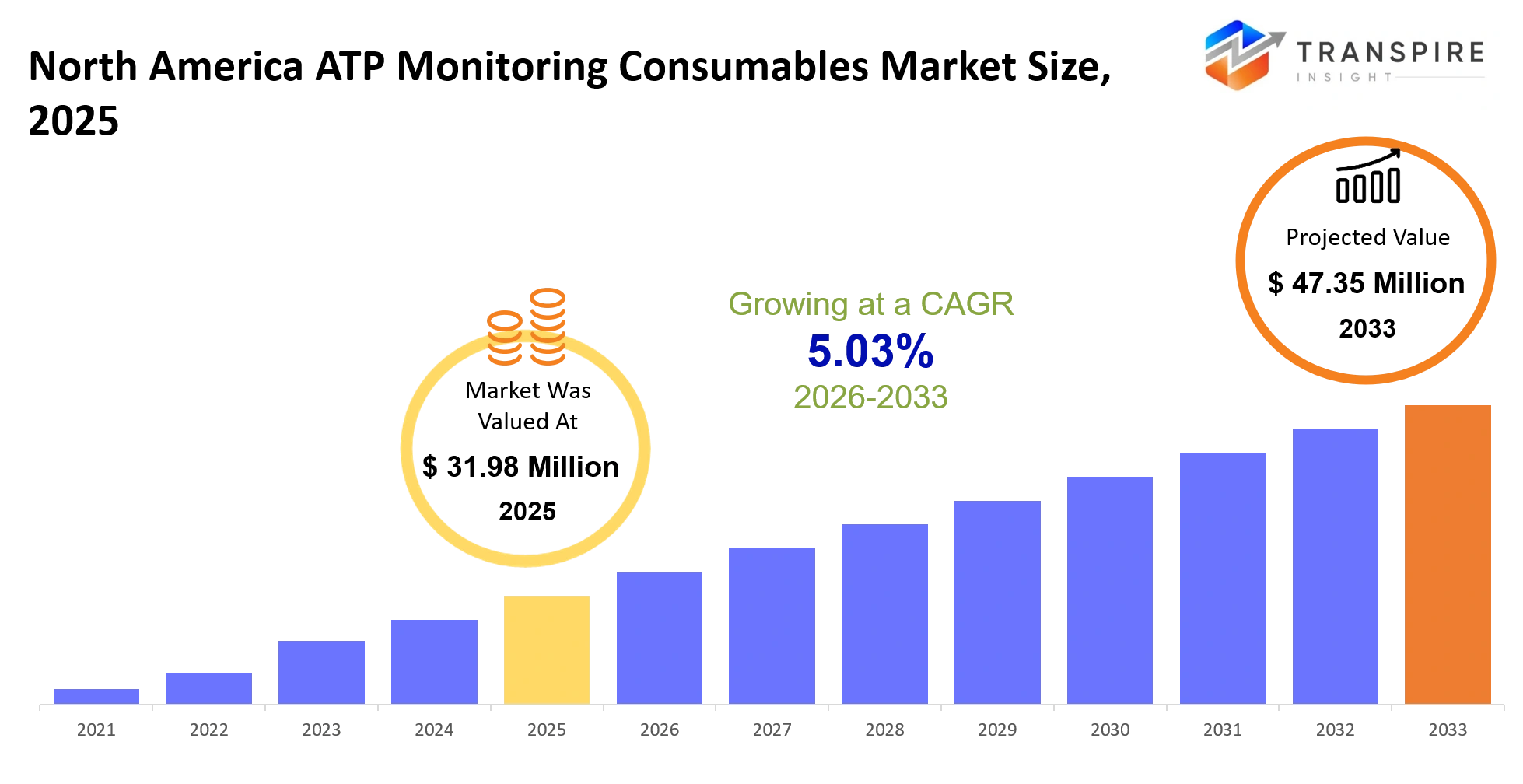
- North America ATP Monitoring Consumables Market Size 2025: USD 31.98 Million
- North America ATP Monitoring Consumables Market Size 2033: USD 47.35 Million
- North America ATP Monitoring Consumables Market CAGR: 5.03%
- North America ATP Monitoring Consumables Market Segments: By Product Type (ATP Test Swabs, Reagents, Calibration Standards, ATP Test Kits, Others), By Application (Food Safety Monitoring, Healthcare Hygiene Monitoring, Water Testing, Pharmaceutical Cleanroom Monitoring, Others), By End User (Hospitals, Food & Beverage Companies, Pharmaceutical Companies, Laboratories, Others), By Technology (Bioluminescence-based Testing, Fluorescence-based Testing, Others).
To learn more about this report,  Download Free Sample Report
North America ATP Monitoring Consumables Market Summary:
The North America ATP Monitoring Consumables Market size is estimated at USD 31.98 Million in 2025 and is anticipated to reach USD 47.35 Million by 2033, growing at a CAGR of 5.03% from 2026 to 2033.The North America ATP monitoring consumables market supports one of those very practical challenges that show up across food processing, healthcare, pharmaceuticals, and industrial manufacturing, like figuring out whether cleaning procedures have really removed biological contamination before production gets started again. ATP swabs, test kits, and other related consumables help operators get fast hygiene validation results. That means the risk of product recalls, regulatory violations, and expensive downtime drops, even when schedules are tight.
Over the last five years, the market has seen a sort of structural shift, from periodic laboratory based checks to routine real time sanitation monitoring that gets folded into quality assurance workflows. This change really picked up after the COVID-19 pandemic. It made weaknesses in hygiene management obvious, and many organizations decided to toughen contamination control protocols across major facilities, not just one-off areas.
Right now, the market growth feels more like a day to day operational need, not just “keeping up with compliance”. As manufacturers pursue higher production throughput and stricter quality controls, rapid ATP testing helps shorten sanitation verification cycles. It also supports audit readiness. Together these productivity benefits, and the risk reduction side, increase how often consumables get used. As a result recurring revenue becomes more stable, and adoption deepens across industrial and healthcare settings, sort of more broadly than before.
Key Market Insights
- The United States is basically leading the North America ATP Monitoring Consumables Market, with more than 75% of the regional money, largely because there s strong regulatory oversight and wide industrial adoption.
- Canada meanwhile, is showing the quickest momentum through the forecast period. This is mostly tied to expanding food processing work and pharmaceutical manufacturing investments, which is kinda giving it a steady lift.
- At the same time, tough regulatory compliance expectations keep reinforcing North America’s large presence in the global ATP hygiene monitoring industry, so the share stays solid.
- ATP test swabs take the top spot, making up over 60% of the market, and that s mostly driven by routine sanitation verification efforts across food, healthcare, and pharmaceutical facilities.
- ATP reagent kits land as the second-largest segment too, mostly because they play a critical part in contamination detection and quality assurance routines, day to day.
- The high-sensitivity ATP consumables category is growing the fastest between 2025 and 2032. Facilities are, quite simply, pushing for faster validation and more precise hygiene checks, so demand keeps climbing.
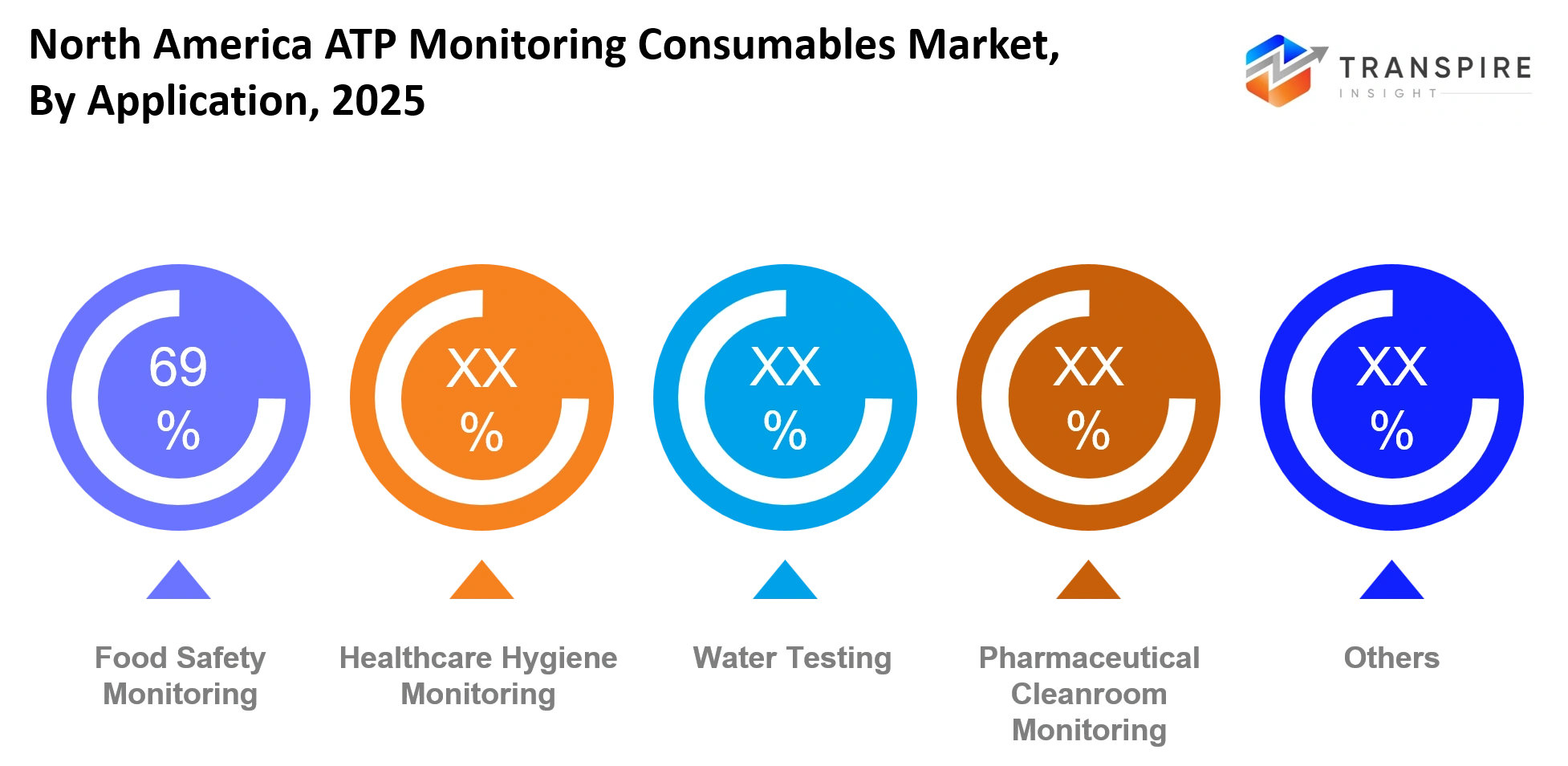
- When it comes to use cases, food and beverage processing stays dominant, bringing in around 40% of North America ATP Monitoring Consumables Market revenue.
- For faster growth though, healthcare facilities are the quickest-moving application segment. They face more infection prevention pressure and tighter environmental monitoring requirements, so they’re buying more.
- Pharmaceutical manufacturing is also starting to act like a major demand driver. Companies there are rolling out stricter contamination control standards, and that naturally pulls more consumables.
- On the end-user side, food manufacturers hold the leading share, above 35%. This is supported by demanding sanitation audits, plus product safety expectations that are hard to ignore.
- Hospitals and healthcare networks represent the fastest-growing end-user category across the forecast period, with uptake increasing in a pretty steady way.
What are the Key Drivers, Restraints, and Opportunities in the North America ATP Monitoring Consumables Market?
The strongest growth driver in the North America ATP Monitoring Consumables Market is, basically the increasing tightening of sanitation verification requirements across food processing, healthcare , and pharmaceutical facilities. Regulatory bodies and even big retailers are now more and more asking for documented proof that cleaning procedures are actually effective, not just finished. That change has pushed ATP testing away from being a periodic quality checkpoint and into something like a routine operational obligation. Since each test typically needs a fresh swab or reagent, higher testing frequency means, pretty directly, recurring consumable buying . In other words the revenue engine is linked to day to day activities rather than one-time equipment sales, and that keeps feeding sustained market expansion.
The biggest restraint is the fragmented way hygiene monitoring is practiced across smaller and mid sized facilities. A lot of organizations still lean on visual inspections or older microbiological testing methods because switching to ATP based programs means changing workflows, training staff, and maintaining ongoing consumable spending. This is a structural friction point, because it touches operational culture, procurement rules , and validation procedures, and those things cannot be adjusted quickly. So adoption ends up uneven, which limits market penetration and, delays revenue chances in several end user segments too.
A major future opportunity is in the integration of ATP monitoring with digital quality management platforms. Facilities are, more and more, looking for real time sanitation data that can be automatically stored, analyzed and audited. Cloud connected ATP systems that tie together consumable usage and compliance reporting could turn hygiene monitoring into something more like a predictive quality tool. This push is starting to gather speed in North American pharmaceutical manufacturing, where digital compliance investments keep speeding up.
What Has the Impact of Artificial Intelligence Been on the North America ATP Monitoring Consumables Market?
Artificial intelligence and advanced digital tools are quietly, and more and more, reshaping ATP monitoring routines across food processing, healthcare, pharmaceutical production , and also laboratory environments. These days the modern ATP monitoring setups blend cloud-based software, automated capture of data, and AI focused analytics. In practice this combination removes a lot of the manual paper trail, and it speeds up sanitation verification. A facility can, for example, track ATP test results across production lines, spot the same contamination hotspots again and again, and then push out compliance reporting with far less human involvement than before.
Machine learning models are helping too, but not in a simple way. They dig through older ATP values plus cleaning timetables, how equipment is being used, and even environmental conditions. From that, the system can foresee where sanitation failures are most likely to pop up. Then quality managers can tweak cleaning protocols ahead of time, so contamination events don’t cause disruptions in the middle of production. This method, the more predictive style, tends to cut product waste, reduce the chances of unplanned downtime, and make audits feel less like a last minute scramble. In both food manufacturing and pharmaceutical operations, AI-assisted monitoring can shorten investigation cycles and keep operations more consistent across different sites.
There’s also the fact that ATP testing information can be paired with wider quality management platforms, which boosts regulatory compliance and helps with resource planning. Still, AI adoption hits a real ceiling. A lot of plants and labs have fragmented datasets, gathered from different monitoring tools, so it’s hard to train predictive models that are actually precise. On top of that, integration expenses and data standardization headaches continue to delay rollout, especially for small to mid-sized organizations.
Key Market Trends
- Since around 2020, a lot of food manufacturers have increased ATP testing frequency, kind of moving away from batch based verification toward a shift-by-shift sanitation validation program or so.
- Healthcare facilities also expanded environmental monitoring protocols after COVID 19, which then pushed broader use of ATP consumables for routine cleanliness verification, you know, the whole “is it actually clean” angle.
- Big buyers started to prefer integrated ATP platforms more and more, where consumables and software analytics and audit documentation kinda sit in one workflow.
- From 2021 to 2025, pharmaceutical manufacturers ramped up contamination-control investments, and they leaned harder on faster ATP testing instead of slower lab methods.
- Companies like Hygiena, Neogen, and 3M improved their competitive position through digital reporting tools , plus cloud connected monitoring ecosystems.
- Procurement strategies shifted as well, from buying mostly capital equipment toward recurring consumable contracts that make sanitation verification costs feel more predictable.
- Also, regulatory inspections have been putting more stress on documented cleaning effectiveness, so facilities are more willing to replace visual inspections with quantitative ATP measurement programs.
- Multi-site manufacturers are now standardizing ATP testing protocols across plants and locations, which helps with benchmarking and also reduces quality inconsistencies between sites.
- After 2022, AI-enabled quality management systems showed up as a noticeable trend, helping teams identify contamination patterns before operational disruptions, get ahead of it sort of.
- And during the supply chain disruptions from 2020 to 2022, organizations responded by diversifying ATP consumable suppliers and tightening up inventory management practices.
North America ATP Monitoring Consumables Market Segmentation
By Product Type
By product type, ATP test swabs kinda hold the top spot because each monitoring event really needs a new consumable, so you end up with this repeating buying rhythm across a bunch of regulated industries. ATP test kits also grab a big slice, since many facilities like bundled solutions that make sanitation verification steps feel simpler. Reagents stay important for test accuracy and steady output, while calibration standards help with quality assurance and make instrument validation possible. Other consumables exist for more specialized use cases but they only take a smaller share of the total spend.
Demand is moving more toward high sensitivity swabs and kits that can deliver quicker results, and even mesh with digital monitoring systems. Cost pressure pushes buyers to standardize suppliers, and trim testing complexity, which ends up helping the more established manufacturers. Looking ahead, growth probably sits with premium consumables that boost traceability, strengthen automation compatibility and protect data integrity, so suppliers have openings to pair performance upgrades with regulatory compliance support.
By Application
For application level, food safety monitoring kinda shows up as the biggest segment because the sanitation rules are strict across food processing plants, packaging locations, and even distribution networks. ATP testing lets manufacturers confirm that the cleaning was actually effective, before production comes back on, so consumable usage turns into a routine operational must. After that, healthcare hygiene monitoring sits pretty close, since hospitals and clinical facilities keep ramping up infection prevention protocols. Pharmaceutical cleanroom monitoring has also picked up a lot of steam, mainly because contamination control directly touches product quality and regulatory compliance, so it is not something they can relax on. Water testing and a few other niche uses are still widening, as organizations chase quicker microbial risk assessments.
Each application ends up with its own buying habits, like food processors tending to favor higher testing frequency, while pharmaceutical operators lean toward exactness and proper documentation. In the future, growth will probably be driven by wider integration of ATP testing into quality management systems, so end users can pull real-time sanitation insights and make better operational choices, in a more immediate way.
To learn more about this report, Download Free Sample Report
By End-User
End user , food and beverage companies account for the largest share, simply because production continuity really hinges on dependable sanitation verification and audit readiness ,and not on some random short term checks. There are frequent testing requirements too, which creates a steady stream of usable consumption ,so the sector ends up as a strong revenue contributor. Hospitals are another major user group, since environmental hygiene monitoring keeps becoming more methodical, more data driven, and honestly harder to ignore. Pharmaceutical companies keep moving toward ATP testing adoption , to reinforce contamination control approaches and to be ready for regulatory inspections. Laboratories still show up with a solid footprint, because they supply validation, research, and analytical services ,not just one thing. Other industrial customers like personal care plants and biotechnology facilities add extra momentum and growth ideas.
Buying behavior is increasingly leaning toward longer term supplier relationships, those partnerships that help keep product consistency and prevent downtime in availability. Looking ahead, market development will mostly depend on vendors who can deliver scalable solutions that fit the compliance, reporting, and workflow needs of very different end user settings.
By Technology
Technology, in a way, bioluminescence based testing still seems to run the whole show, because it gives fast results that are reliable, and people have basically treated it as the established standard for ATP monitoring programs. There is a strong comfort level across the industry, plus proven performance, and wide regulatory acceptance, which all keep it out in front, kind of no surprise. Fluorescence based testing, meanwhile , takes up a smaller slice but it is growing, especially in niche use cases where you want extra sensitivity or a different analytical angle. The other technologies lag behind, mostly tied to higher costs, less standardization , or they just don’t get picked up as broadly in commercial settings.
Investment directions are also shifting, but more and more it’s about boosting detection accuracy, adding digital connectivity, and letting automated result interpretation do more of the heavy lifting. Manufacturers are working on technology platforms that link the consumables with cloud reporting systems, so the value isn’t only in the test itself. Going forward, competition will probably move toward bundled ecosystems that mix advanced detection with analytics features, so buyers can turn sanitation monitoring into something more predictive, and continuously tuned quality control, not just a one-off check.
What are the Key Use Cases Driving the North America ATP Monitoring Consumables Market?
Food processing facilities are basically the main real world use case for ATP monitoring consumables. Manufacturers grab ATP swabs, plus reagents, to check if sanitation is actually effective right before production starts again, it helps them stay within regulatory expectations and also reduce the chance of contamination related recalls… you know that kind of thing.
Healthcare and pharmaceutical settings are starting to show up as secondary uses too. Hospitals use ATP testing to confirm cleaning routines in patient-care zones. At the same time pharmaceutical manufacturers put ATP monitoring to work in cleanrooms for contamination control, and for regulatory inspection readiness.
More emerging use cases are showing up like automated sanitation verification that is tied to digital quality management platforms and ATP-based monitoring in biotechnology production facilities. These areas are still relatively small today but they are getting attention. Organizations want real-time hygiene results, better predictive quality control and stronger audit records across those highly regulated environments where everything has to be documented, precisely and consistently.
|
Report Metrics |
Details |
|
Market size value in 2025 |
USD 31.98 Million |
|
Market size value in 2026 |
USD 33.59 Million |
|
Revenue forecast in 2033 |
USD 47.35 Million |
|
Growth rate |
CAGR of 5.03% from 2026 to 2033 |
|
Base year |
2025 |
|
Historical data |
2021 - 2024 |
|
Forecast period |
2026 - 2033 |
|
Report coverage |
Revenue forecast, competitive landscape, growth factors, and trends |
|
Country scope |
North America (Canada, The United States, and Mexico) |
|
Key company profiled |
Hygiena, 3M, Merck KGaA, Thermo Fisher Scientific, Neogen Corporation, Bio-Rad Laboratories, Kikkoman Biochemifa, Charm Sciences, Ecolab, PerkinElmer, Danaher Corporation, Promega Corporation, Sartorius AG, Charles River Laboratories, BioControl Systems. |
|
Customization scope |
Free report customization (country, regional & segment scope). Avail customized purchase options to meet your exact research needs. |
|
Report Segmentation |
By Product Type (ATP Test Swabs, Reagents, Calibration Standards, ATP Test Kits, Others), By Application (Food Safety Monitoring, Healthcare Hygiene Monitoring, Water Testing, Pharmaceutical Cleanroom Monitoring, Others), By End User (Hospitals, Food & Beverage Companies, Pharmaceutical Companies, Laboratories, Others), By Technology (Bioluminescence-based Testing, Fluorescence-based Testing, Others). |
Which Regions are Driving the North America ATP Monitoring Consumables Market Growth?
The United States is still the top region in the market, largely because of its strict food safety rules, thick healthcare system, and a huge pharmaceutical manufacturing base. With federal oversight and those frequent compliance audits, sanitation checks tend to happen almost as a habit across production floors as well as clinical settings. There’s also this well-aged web of food processors , hospitals , labs, and contract manufacturers that basically keeps consumable use consistent. On top of that, strong spending on digital quality management systems keeps pushing the leadership position, and it also makes demand feel pretty steady for ATP monitoring products.
Canada comes in second, and yeah the ranking is real but the growth story feels more “operational consistency” than “big market scale.” Food makers and healthcare organizations have kept expanding their hygiene monitoring programs to match changing quality expectations. In comparison with the United States, adoption tends to move with slower implementation cycles, plus a longer view on compliance planning, which is different. With stable economic conditions, predictable regulatory structures, and continued investment in pharmaceutical production, Canada keeps looking like a dependable source for repeat market revenue.
Mexico is getting recognized as the fastest-growing area too, since food processing, medical device manufacturing and pharmaceutical production keep widening. New investment in export focused manufacturing sites has made internationally accepted sanitation verification practices more important. Businesses that supply North American chains are increasingly using ATP monitoring to satisfy customer audit demands and to reinforce their quality assurance routines. All this momentum opens up solid opportunities for suppliers , distributors, and technology providers who want new growth tracks through 2026–2033.
Who are the Key Players in the North America ATP Monitoring Consumables Market and How Do They Compete?
In the North America ATP Monitoring Consumables Market, the competitive situation is kind of moderately consolidated, it’s not wildly fragmented though. A smaller clump of specialized hygiene monitoring firms ends up controlling a big chunk of those recurring consumable purchases. In other words, the competition is a little less about lowering cost, and more about testing accuracy, how well the workflow fits in, what kind of regulatory backing is offered, and whether the consumables can be tied into digital reporting platforms. Established suppliers also seem to win because they already have customer validation initiatives in place, plus longer-term buying relationships. That combination quietly builds switching costs for end users, so moving away is not always simple. New entrants keep appearing, sure, but many of them lean toward narrow use cases or technology upgrades rather than trying to compete mainly on price.
Hygiena pushes an integrated setup where ATP consumables, monitoring instruments, and cloud based data management tools come together. Customers can then standardize sanitation verification across several sites while still keeping centralized audit logs. Neogen , on the other hand, differentiates with a wide food safety catalog, and it connects ATP testing with microbial detection plus quality assurance programs. In food processing settings, the cross promotion of related solutions helps keep customers more anchored and can increase consumable usage over time. Both players keep investing in software connectivity and data driven quality management features, so they can deepen engagement and make the ecosystem feel harder to replace.
3M has historically built competitive strength around proven testing solutions and deep relationships within healthcare and food manufacturing environments, sort of. Even after some changes in the food safety portfolio parts, the company still keeps solid brand recognition that links back to quality assurance uses. Kikkoman Biochemifa is more focused on high sensitivity ATP testing technologies, plus analytical precision, and it pulls in pharmaceutical and laboratory customers who want steady performance. Then Ecolab, it leans on its sanitation expertise by folding ATP monitoring into wider hygiene service programs, which makes it feel like a service first model, not just selling consumables. In the end that approach helps it grow long term contracts and keep the momentum.
Company List
- Hygiena
- 3M
- Merck KGaA
- Thermo Fisher Scientific
- Neogen Corporation
- Bio-Rad Laboratories
- Kikkoman Biochemifa
- Charm Sciences
- Ecolab
- PerkinElmer
- Danaher Corporation
- Promega Corporation
- Sartorius AG
- Charles River Laboratories
- BioControl Systems
Recent Development News
In April 2026, Neogen Reports Third Quarter Fiscal Year 2026 Financial Results: Neogen, a major supplier of food-safety and hygiene monitoring solutions including ATP-related testing products, reported third-quarter fiscal 2026 results. The company highlighted Food Safety revenue growth and provided updates on operational performance and cash flow, reflecting continued investment in testing and monitoring technologies used across North America.
Source: https://www.businesswire.com
In January 2026, Neogen Announces Second-Quarter 2026 Results: In its second-quarter fiscal 2026 results, Neogen reported growth in its Food Safety segment, noting particularly strong performance in indicator testing and sample collection products—categories closely tied to ATP hygiene monitoring workflows. The update provides insight into demand trends among food and industrial hygiene customers in North America.
Source: https://investors.neogen.com
What Strategic Insights Define the Future of the North America ATP Monitoring Consumables Market?
Over the next 5–7 years, the North America ATP Monitoring Consumables Market seems like it’s heading toward a more fundamentally different operating setup, more or less. ATP testing is gradually getting folded into continuous digital quality management systems, and it’s not really staying as a stand-alone sanitation check anymore. The real driver is kind of a convergence effect—stricter audit expectations, real time production monitoring, and the economic upside of stopping contamination related downtime before it happens. When facilities start feeding ATP results into cloud based quality platforms, consumables often end up working more like recurring data inputs, not just simple testing supplies.
There is also a less visible risk that people maybe don’t notice right away, which is market concentration in specialized reagent and swab manufacturing. If only a handful of suppliers run into production disruptions, quality drift, or pricing pressure, end users might hit procurement bottlenecks even with healthy, overall demand. At the same time, there’s an opportunity that’s beginning to stand out: AI assisted sanitation analytics in pharmaceutical and biotechnology manufacturing, where predictive contamination risk scoring is getting more attention, partly because regulators keep pushing for data integrity and stronger process control.
A practical strategic move would be to invest in interoperable digital ecosystems, the kind that connect consumables, instruments, and compliance software without friction. Firms that manage to pair recurring consumable sales with analytics and audit ready reporting may end up capturing outsized long term value, not just incremental revenue.
North America ATP Monitoring Consumables Market Report Segmentation
By Product Type
- ATP Test Swabs
- Reagents, Calibration Standards
- ATP Test Kits
- Others
By Application
- Food Safety Monitoring
- Healthcare Hygiene Monitoring
- Water Testing
- Pharmaceutical Cleanroom Monitoring
- Others
By End User
- Hospitals
- Food & Beverage Companies
- Pharmaceutical Companies
- Laboratories
- Others
By Technology
- Bioluminescence-based Testing
- Fluorescence-based Testing
- Others
Frequently Asked Questions
Find quick answers to common questions.
The approximate North America ATP Monitoring Consumables Market size for the market will be USD 47.35 Million in 2033.
The key segments of the North America ATP Monitoring Consumables Market are By Product Type (ATP Test Swabs, Reagents, Calibration Standards, ATP Test Kits, Others), By Application (Food Safety Monitoring, Healthcare Hygiene Monitoring, Water Testing, Pharmaceutical Cleanroom Monitoring, Others), By End User (Hospitals, Food & Beverage Companies, Pharmaceutical Companies, Laboratories, Others), By Technology (Bioluminescence-based Testing, Fluorescence-based Testing, Others).
Major players in the North America ATP Monitoring Consumables Market are Hygiena, 3M, Merck KGaA, Thermo Fisher Scientific, Neogen Corporation, Bio-Rad Laboratories, Kikkoman Biochemifa, Charm Sciences, Ecolab, PerkinElmer, Danaher Corporation, Promega Corporation, Sartorius AG, Charles River Laboratories, BioControl Systems.
The current market size of the North America ATP Monitoring Consumables Market is USD 31.98 Million in 2025.
The North America ATP Monitoring Consumables Market CAGR is 5.03%.
- Hygiena
- 3M
- Merck KGaA
- Thermo Fisher Scientific
- Neogen Corporation
- Bio-Rad Laboratories
- Kikkoman Biochemifa
- Charm Sciences
- Ecolab
- PerkinElmer
- Danaher Corporation
- Promega Corporation
- Sartorius AG
- Charles River Laboratories
- BioControl Systems
About the Authors

Pankaj Ghogare Patil
I am Pankaj Ghogare Patil, a Senior Research Analyst at Transpire Insight, specializing in the Pharmaceutical, Chemicals & Materials, Healthcare IT, and Biotechnology industry. My expertise lies in conducting comprehensive market research, analyzing industry trends, evaluating competitive landscapes, and translating complex data into actionable insights. At Transpire Insight, I closely follow emerging technologies, regulatory developments, and market innovations to create accurate, well-researched, and informative content that helps businesses and professionals make informed decisions. I am committed to producing credible, evidence-based articles that reflect industry best practices while making technical topics accessible and valuable for a broad audience.

Chakradhar Khansole
Chakradhar serves as the Research Director at Transpire Insight, bringing over 8 years of experience in technology, innovation, and strategic market intelligence. He specializes in transforming complex market data into actionable business insights that enable organizations to make informed, growth-oriented decisions. Recognized for his strategic vision and analytical expertise, Chakradhar leads high-impact research initiatives, delivering comprehensive market assessments, competitive intelligence, and forward-looking industry analysis.
Recently Published Reports
-
Apr 2026
AI in Diabetic Retinopathy Market
AI in Diabetic Retinopathy Market Size, Share & Analysis Report By Type (Screening AI Systems, Diagnostic AI Systems, and Predictive AI Models), By Application Segment (Hospitals, Ophthalmology Clinics, Diagnostic Centers, and Research and Development), and Geography (North America, Europe, Asia-Pacific, Middle East and Africa, South and Central America), 2021 - 2031
-
Apr 2026
Psychometric Tests Market
Psychometric Tests Market Size, Share & Analysis Report By Type (Personality Tests, Ability/Aptitude Tests, Skill/Knowledge Tests, and Others), By Application (Talent Acquisition and Talent Management), and Geography (North America, Europe, Asia-Pacific, Middle East and Africa, South and Central America), 2021 – 2031
-
Apr 2026
Rare Biological Sample Collection Market
Rare Biological Sample Collection Market Size, Share & Analysis Report By Type (Isolation Kits & Reagent, Blood Collection Tubes, and Others), By Application (Oncology, Transcriptomics, Pharmacogenomics, and Others), and Geography (North America, Europe, Asia-Pacific, Middle East and Africa, South and Central America), 2021 – 2031
-
Jul 2026
Diabetic Retinopathy Market
Diabetic Retinopathy Market Size, Share & Analysis Report By Type (Proliferative Diabetic Retinopathy, and Diabetic Macular Edema (DME)), By Treatment Type (Anti VEGF Drug, Steroid Implants, Laser Surgeries, and Vitrectomy), and Geography (North America, Europe, Asia-Pacific, Middle East and Africa, South and Central America), 2021 – 2031
Our Clients







