

Middle East and Africa Medical Equipment Maintenance Market Size & Forecast:
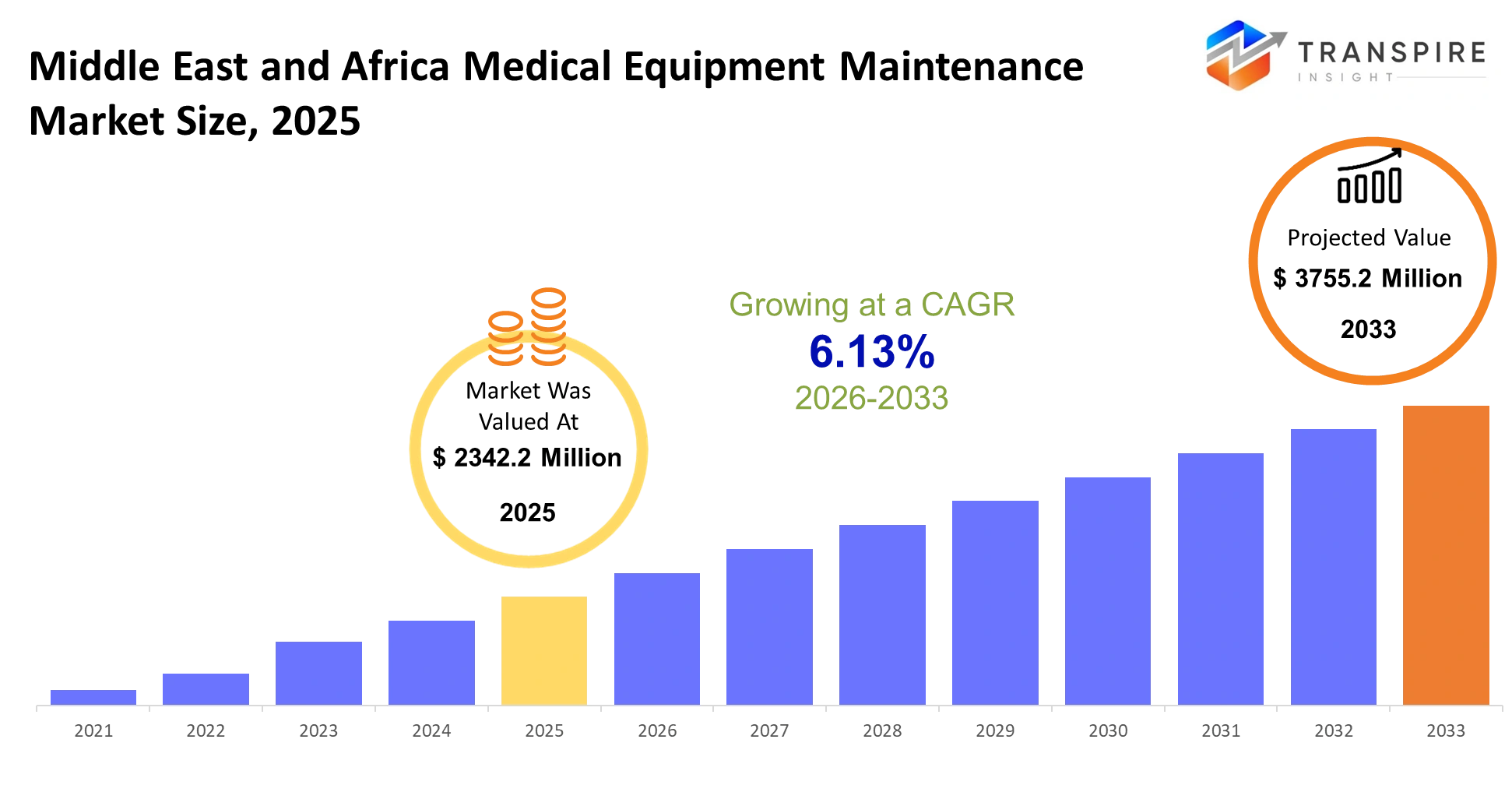
- Middle East and Africa Medical Equipment Maintenance Market Size 2025: USD 2342.2 Million
- Middle East and Africa Medical Equipment Maintenance Market Size 2033: USD 3755.2 Million
- Middle East and Africa Medical Equipment Maintenance Market CAGR: 6.13%
- Middle East and Africa Medical Equipment Maintenance Market Segments: By Service Type (Preventive, Corrective, Predictive, Calibration), By Equipment (Imaging, Surgical, Endoscopy, Monitoring), By Service Provider (OEM, Third-party, In-house), By End-User (Hospitals, Clinics, Diagnostic Centers, Labs)
To learn more about this report,  Download Free Sample Report
Middle East and Africa Medical Equipment Maintenance Market Summary:
The Middle East and Africa Medical Equipment Maintenance Market size is estimated at USD 2342.2 Million in 2025 and is anticipated to reach USD 3755.2 Million by 2033, growing at a CAGR of 6.13% from 2026 to 2033. The Middle East & Africa Medical Equipment Maintenance Services Market under the healthcare services sector is forecast to change with more emphasis on availability and patient safety over expenses due to the high cost of equipment ownership in hospitals. The focus will be shifted towards predictive maintenance services enabled by IoT technology. There will be pressure for shorter turnarounds from healthcare facilities as stringent regulations come into effect in Gulf and African countries. More private hospital chains will be using maintenance outsourcing services, while state-owned healthcare facilities will be upgrading their aging equipment stock.
Key Market Trends & Insights:
For South Africa, the use of medical device management technology that links biomedical instruments with an intuitive control dashboard will become more common. With such an approach, it will be easier for hospitals to predict failures of devices and thus plan the maintenance process. Hospitals interested in budgeting for their services will opt for contract services, which will combine maintenance, calibration, and compliance monitoring without compromising efficiency and safety.
As the number of healthcare establishments grows rapidly compared to the growth of internal technical skills in the rest of the Middle East and Africa, there will be a need for third-party companies offering maintenance services. Small clinics will turn to joint service networks so that they can benefit from the skills of certified professionals.
Technology adoption will be advanced through the adoption of artificial intelligence in diagnostics and equipment performance. Analytics will be used in detecting unusual performance patterns for timely action. In the course of digital transformation, there will be a move from the traditional methods of maintenance that focus on repair to a system of maintenance that is based on data analysis in terms of imaging machines, surgery machines, and intensive care machines.
The regulatory standards will be stringent when it comes to issues such as calibration, security of information, and compliance to patient safety regulations. There will be stringent measures in place, particularly in terms of keeping records. The facilities will have to install systems that facilitate proper documentation.
Middle East and Africa Medical Equipment Maintenance Market Segmentation
By Service Type
Preventive- Preventive services will include planned inspection, part changes, and equipment performance assessment. In future, hospitals will increasingly turn to maintenance scheduling to increase equipment longevity, prevent system interruptions, and sustain efficient operations. Medical institutions will adopt a structured service schedule to ensure continued effectiveness of medical technology.
Corrective- Services aimed at fixing broken equipment will target sudden equipment malfunctions requiring timely repair or replacement of faulty parts. Hospitals will still need quick action from service teams to resume normal operations when such problems arise. Corrective maintenance will focus on timely intervention and equipment quality.
Predictive- Predictive services will be based on using digital tools and sensors for equipment monitoring. Advanced technological solutions allow collecting information on equipment performance in real time. Predictive maintenance will enable facilities to minimize costs and avoid major malfunctions, which will be particularly useful for expensive medical equipment.
Calibration- Calibration services will ensure that equipment operates accurately by providing necessary settings adjustments. Calibration will play an important role in meeting health care regulations and accreditation standards. Calibrating medical technology is especially important for diagnosis and measurement, since small errors can have serious consequences.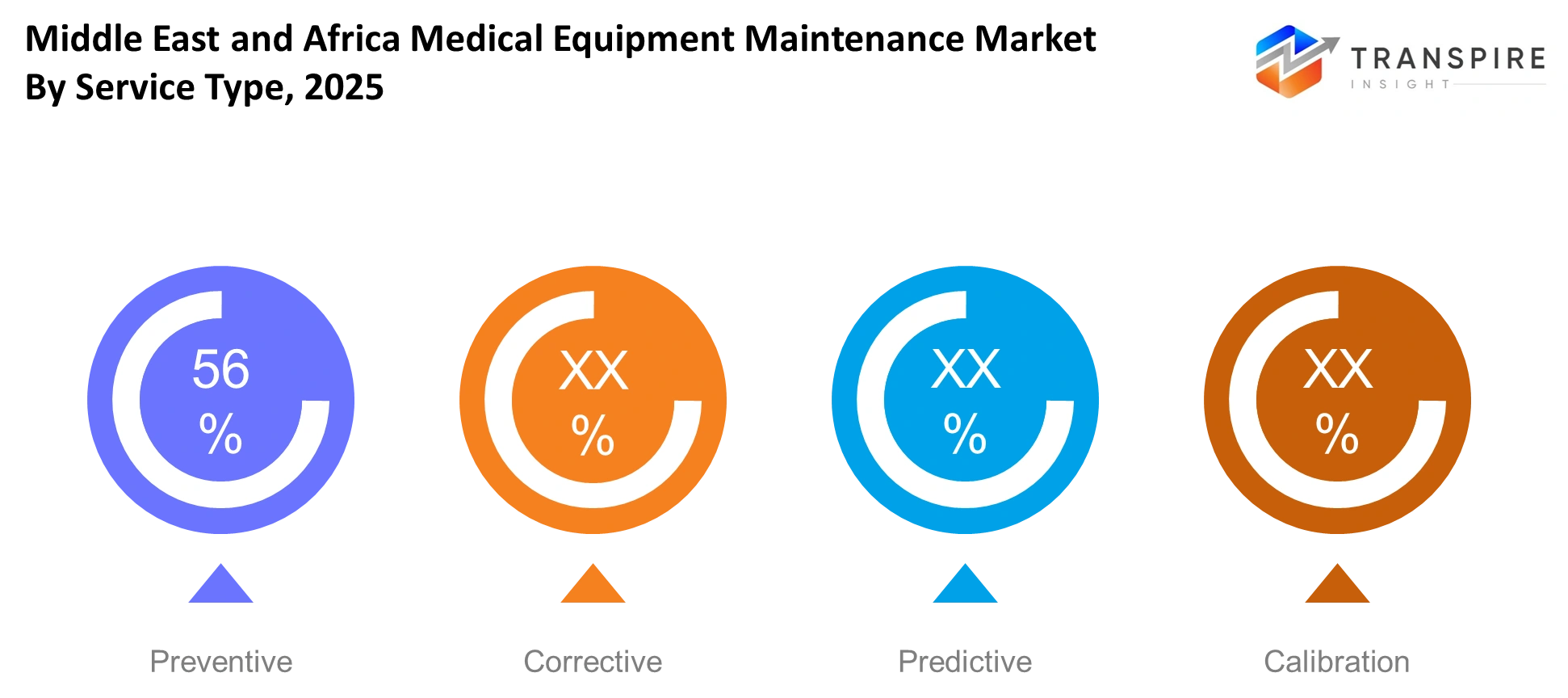
To learn more about this report, Download Free Sample Report
By Equipment
Imaging- The imaging machines like MRI, CT scan, and x-rays will need some special maintenance. In other words, the service providers will strive to make sure that the machines give high-quality images without any malfunctioning and possible radiation risks. As a result, the machinery will function properly in large hospitals and even specific imaging centers.
Surgical- The maintenance of surgical devices will include making sure that the tools are perfect and sterile to make sure that the operation will be a success. Besides, it will help healthcare facilities maintain the quality of surgical devices in order to avoid any possible problems during the process.
Endoscopy- Endoscopy is one of the most popular diagnostic tools among healthcare providers. In this regard, the maintenance of such devices will be a necessity due to the frequent use of endoscopy. Moreover, cleaning and sterilization will be required to avoid the infection and get accurate results.
Monitoring- Monitoring tools, including heart rate tracking devices, will receive attention from the service providers. They will concentrate on their sensors, software performance, and battery capacity, among other aspects. These devices will receive special attention since they play an important role in patients' life support systems.
By Service Provider
OEM- Original equipment manufacturers will provide highly specialized maintenance services that are supported by extensive knowledge about the products. The services will involve the use of specialized equipment, approved parts, and software upgrades. They will prefer the OEMs due to their specialization in dealing with complicated devices.
Third-party- The third parties will give flexible agreements and quicker service, which will make them ideal for institutions that operate on tight budgets. The third-party maintenance providers will ensure competitiveness within the industry without compromising on quality. Other service providers will provide cheaper solutions than those provided by the OEMs.
In-house- The in-house maintenance personnel will continue being relevant for big institutions with heavy machinery. The staff members will be responsible for routine maintenance and minor repairs, thereby offering prompt solutions to the emerging problems. The health care organizations will invest more in training and recruitment of personnel.
By End-User
Hospitals- The hospitals will be the greatest consumers of maintenance services because of the variety of equipment available in them. They will need constant servicing to facilitate their operations and ensure that the equipment is always working.
Clinics- The clinics will concentrate on servicing small amounts of equipment needed to diagnose and treat patients. The cost of maintenance will drive their decision-making process, and they may use external maintenance services to reduce costs.
Diagnostic Centers- The diagnostic centers will be highly dependent on the efficiency of the equipment used in their operations. Maintenance services will be important to guarantee the accuracy of the results obtained from the equipment and prevent downtime.
Labs- The laboratories will need to ensure that the equipment used in tests and analyses is accurate. Maintenance of the equipment will be necessary to achieve high levels of accuracy and maintain quality control.
Regional Insights
In Saudi Arabia, there is going to be continued improvement in the healthcare infrastructure, which means that there will be raised expectations regarding the reliability of equipment and service delivery. Maintenance strategies will be in line with the country's plan for healthcare reform. Long term contracts, digital record keeping of services, skilled labor and collaboration with international maintenance services will influence the provision of maintenance services in Saudi Arabia's health care facilities.
The United Arab Emirates will put emphasis on technology and modernization in healthcare. This is because of the adoption of high tech equipment in health facilities in the UAE. This will translate into increased adoption of maintenance practices that promote high level of performance in medical equipment by ensuring their optimal working conditions. Smart technologies to facilitate service diagnosis and quick turnaround will also be encouraged in maintenance practices.
In South Africa, a combination of the problem of managing older equipment along with the use of new technology would pose a challenge. The approach adopted by public healthcare facilities would be geared towards efficient maintenance techniques and may even involve outsourcing to third parties. Private healthcare facilities would take advantage of sophisticated service systems including predictive maintenance. Improvements in training and resource management would play an important role in this regard.
Progress within the rest of the Middle East and Africa would depend upon the economic conditions prevailing in different countries along with the extent to which the health sector is developed in each country. In countries where the health sector is underdeveloped, priority would be to provide basic maintenance services for the proper functioning of health equipment. There would gradually be a move towards standardization in equipment maintenance procedures as healthcare access increases.
Recent Development News
Delayed Maintenance Contracts Raise Concerns in Healthcare Systems
Date: April 7, 2026
A recent healthcare event demonstrated how late servicing contracts could affect the work of hospitals in case vital equipment remained inactive for a long period of time. It was noted that lengthy delays in repairs led hospitals to re-examine their dependency on external service providers. Healthcare facilities will now start relying more on the manufacturer and the terms of its contracts.
Growing Use of Predictive Maintenance Tools in Developing Countries
Date: January 2026
Recent trends suggest that hospitals and clinics in developing countries will embrace artificial intelligence-based diagnostics for their biomedical technicians. They will be useful in detecting equipment issues on the go, minimizing reliance on outside help. This advancement will increase equipment availability in areas lacking adequate resources, where equipment malfunction has traditionally had an impact on patient services.
Expansion of Government Tenders for Equipment Servicing in the Middle East
Date: Late 2025 – Early 2026
Public health care equipment servicing and maintenance tendering is becoming increasingly popular amongst governments in the Middle East region. This trend shall result in an organized tendering process as well as the participation of many international vendors. This way, health care facilities will benefit from greater competition and will be able to purchase more efficient maintenance services for their medical equipment.
|
Report Metrics |
Details |
|
Market size value in 2025 |
USD 2342.2 Million |
|
Market size value in 2026 |
USD 2475.6 Million |
|
Revenue forecast in 2033 |
USD 3755.2 Million |
|
Growth rate |
CAGR of 6.13% from 2026 to 2033 |
|
Base year |
2025 |
|
Historical data |
2021 – 2024 |
|
Forecast period |
2026 – 2033 |
|
Report coverage |
Revenue forecast, competitive landscape, growth factors, and trends |
|
Country scope |
Middle East and Africa (Saudi Arabia, United Arab Emirates, South Africa, Rest of Middle East and Africa) |
|
Key company profiled |
GE HealthCare, Siemens Healthineers, Philips, Canon Medical, Fujifilm, Hitachi, Carestream, Agfa, Dräger, Medtronic, Stryker, Hillrom, Baxter, Aramark Healthcare, ISS World |
|
Customization scope |
Free report customization (country, regional & segment scope). Avail customized purchase options to meet your exact research needs. |
|
Report Segmentation |
By Service Type (Preventive, Corrective, Predictive, Calibration), By Equipment (Imaging, Surgical, Endoscopy, Monitoring), By Service Provider (OEM, Third-party, In-house), By End-User (Hospitals, Clinics, Diagnostic Centers, Labs) |
Key Middle East and Africa Medical Equipment Maintenance Market Company Insights
Major organizations to participate in the Middle East & Africa (Saudi Arabia, UAE, South Africa, Rest of Middle East & Africa) medical equipment maintenance market would be industry majors like GE Healthcare, Siemens Healthineers, and Philips, along with regional service organizations providing customized biomedical services. The former would concentrate on diagnostic technology, lifecycle management, and regulatory compliance for medical equipment maintenance, whereas the latter would work towards providing tailored solutions and quick onsite assistance.
Company List
- GE HealthCare
- Siemens Healthineers
- Philips
- Canon Medical
- Fujifilm
- Hitachi
- Carestream
- Agfa
- Dräger
- Medtronic
- Stryker
- Hillrom
- Baxter
- Aramark Healthcare
- ISS World
Middle East and Africa Medical Equipment Maintenance Market Report Segmentation
By Service Type
- Preventive
- Corrective
- Predictive
- Calibration
By Equipment
- Imaging
- Surgical
- Endoscopy
- Monitoring
By Service Provider
- OEM
- Third-party
- In-house
By End-User
- Hospitals
- Clinics
- Diagnostic Centers
- Labs
Frequently Asked Questions
Find quick answers to common questions.
The Approximate Middle East and Africa Medical Equipment Maintenance Market size for the Market will be USD 3755.2 Million in 2033.
Key Segments for the Middle East and Africa Medical Equipment Maintenance Market By Service Type (Preventive, Corrective, Predictive, Calibration), By Equipment (Imaging, Surgical, Endoscopy, Monitoring), By Service Provider (OEM, Third-party, In-house), By End-User (Hospitals, Clinics, Diagnostic Centers, Labs).
Major Players in the Middle East and Africa Medical Equipment Maintenance Market are GE HealthCare, Siemens Healthineers, Philips, Canon Medical, Fujifilm, Hitachi, Carestream, Agfa, Dräger, Medtronic, Stryker, Hillrom, Baxter, Aramark Healthcare, ISS World
The Current Middle East and Africa Medical Equipment Maintenance Market size is USD 2342.2 Million in 2025.
The Middle East and Africa Medical Equipment Maintenance Market CAGR is 6.13%.
- GE HealthCare
- Siemens Healthineers
- Philips
- Canon Medical
- Fujifilm
- Hitachi
- Carestream
- Agfa
- Dräger
- Medtronic
- Stryker
- Hillrom
- Baxter
- Aramark Healthcare
- ISS World
Recently Published Reports
-
Apr 2026
Handling and Lifting Equipment Market
Handling and Lifting Equipment Market Size, Share & Analysis Report By Product (Cranes and Hoists, Forklifts, Conveyor Systems, Aerial Work Platforms, Others), By Application (E-Commerce, Automotive and Railway, Food and Beverages, Aviation, Others), and Geography (North America, Europe, Asia-Pacific, Middle East and Africa, South and Central America), 2021 - 2031
-
Apr 2026
HVAC Equipment Market
HVAC Equipment Market Size, Share & Analysis Report By Heating Equipment Type (Boilers and Furnaces, Heat Pumps, and Unitary Heaters), By Ventilation Equipment (Air Handling Units, Humidifiers and Dehumidifiers, Air Filters, and Fan Coiling Units), By Air Conditioning Equipment (Unitary Air Conditioners, Room Air Conditioners, Packaged Terminal Air Conditioners, and Chillers), By End User (Commercial, Residential, Industrial, and others), and Geography (North America, Europe, Asia-Pacific, Middle East and Africa, South and Central America), 2021 – 2031
-
Apr 2026
Refrigeration Valves Market
Refrigeration Valves Market Size, Share & Analysis Report By Type (Solenoid Valves, Expansion Valves, Check Valves, Service Valves, Others), By Application (Commercial Refrigeration, Industrial Refrigeration, Transport Refrigeration, Residential Refrigeration, Air Conditioning Systems), By End User (Food and Beverage Industry, Pharmaceutical Industry, HVAC Industry, Chemical Industry, Others), and Geography (North America, Europe, Asia-Pacific, Middle East and Africa, South and Central America), 2021 – 2031
-
Apr 2026
E-Commerce Packaging Materials Market
E-Commerce Packaging Materials Market By Material Type (Corrugated Boxes, Paper & Paperboard, Foam & Cushioning Materials, Plastic Packaging, Flexible Packaging, Protective Packaging, Others), By Product(Primary Packaging, Secondary Packaging, Tertiary Packaging), By Packaging Function (Protective Packaging, Branding & Presentation Packaging, Transit & Logistic Packaging, Sustainable Packaging, Tamper Evidence Packaging), By End-User (Retail & Consumer Goods, Electronic Appliances, Food & Beverages, Healthcare & Pharmaceutical, Fashion & Apparel, Home & Furnishing, Others); By Industry Analysis, Size, Share, Growth, Trends, and Forecasts 2021-2033