
Molded Fiber Pulp Packaging Market Summary:
According to Transpire Insights, a detailed research report on the market reflects that the Food & Beverage application segment dominates the Molded Fiber Pulp Packaging Market, accounting for approximately 41% of the total share worldwide. Huhtamaki Oyj leads the market with approximately (around USD 5.0 billion) in annual revenue and an estimated 12–15% market share, making it the leading contributor to market development, innovation, advanced molded fiber pulp packaging production, expanding manufacturing capabilities, sustainable packaging solutions, and growth dynamics.
Market Snapshot
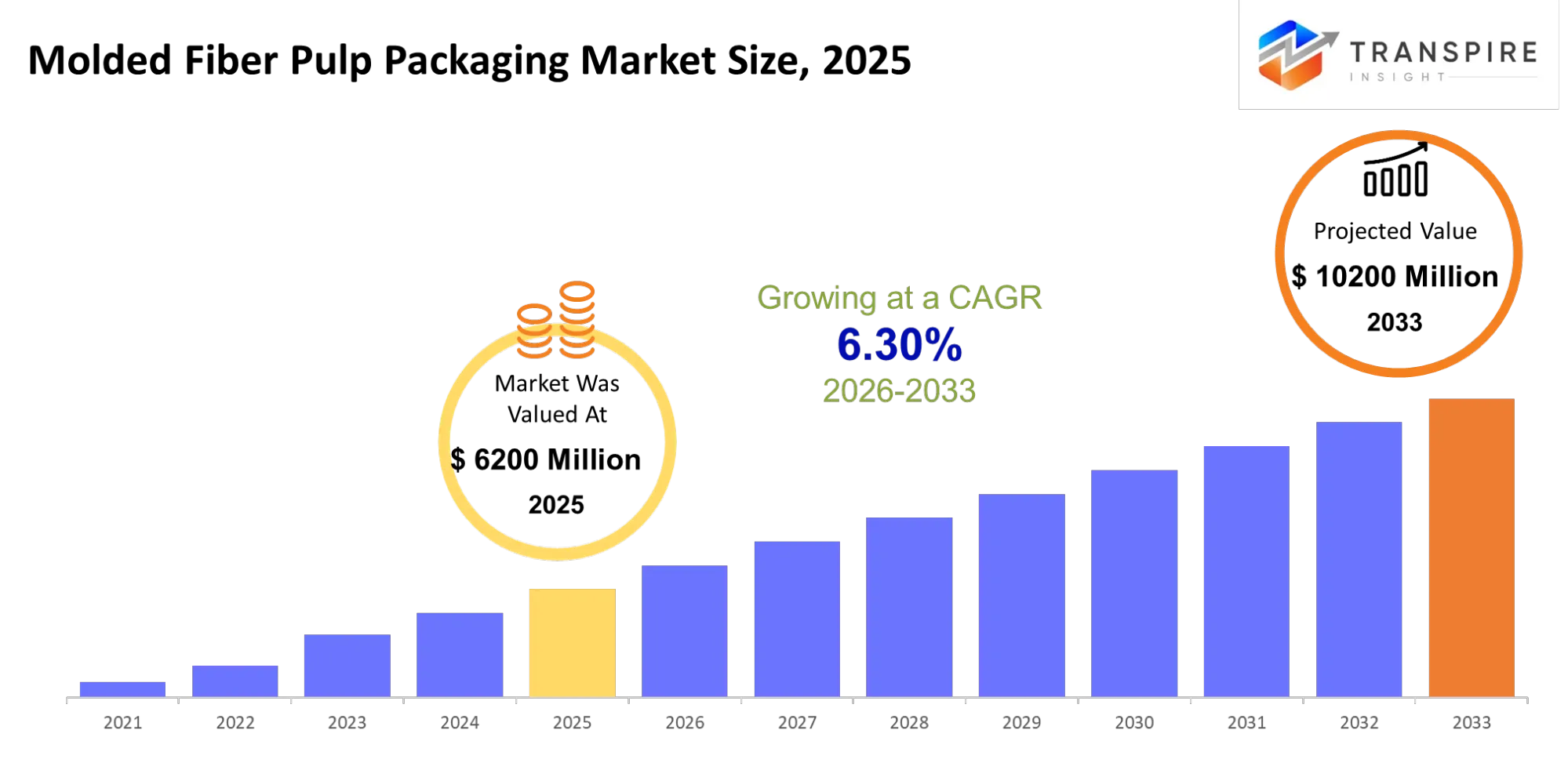
- Market Value (2025): USD 6200 Million.
- Expected Market Value (2026): USD 6700 Million.
- Estimated Market Value (2033): USD 10200 Million.
- Forecast CAGR (2026–2033): 6.30%.
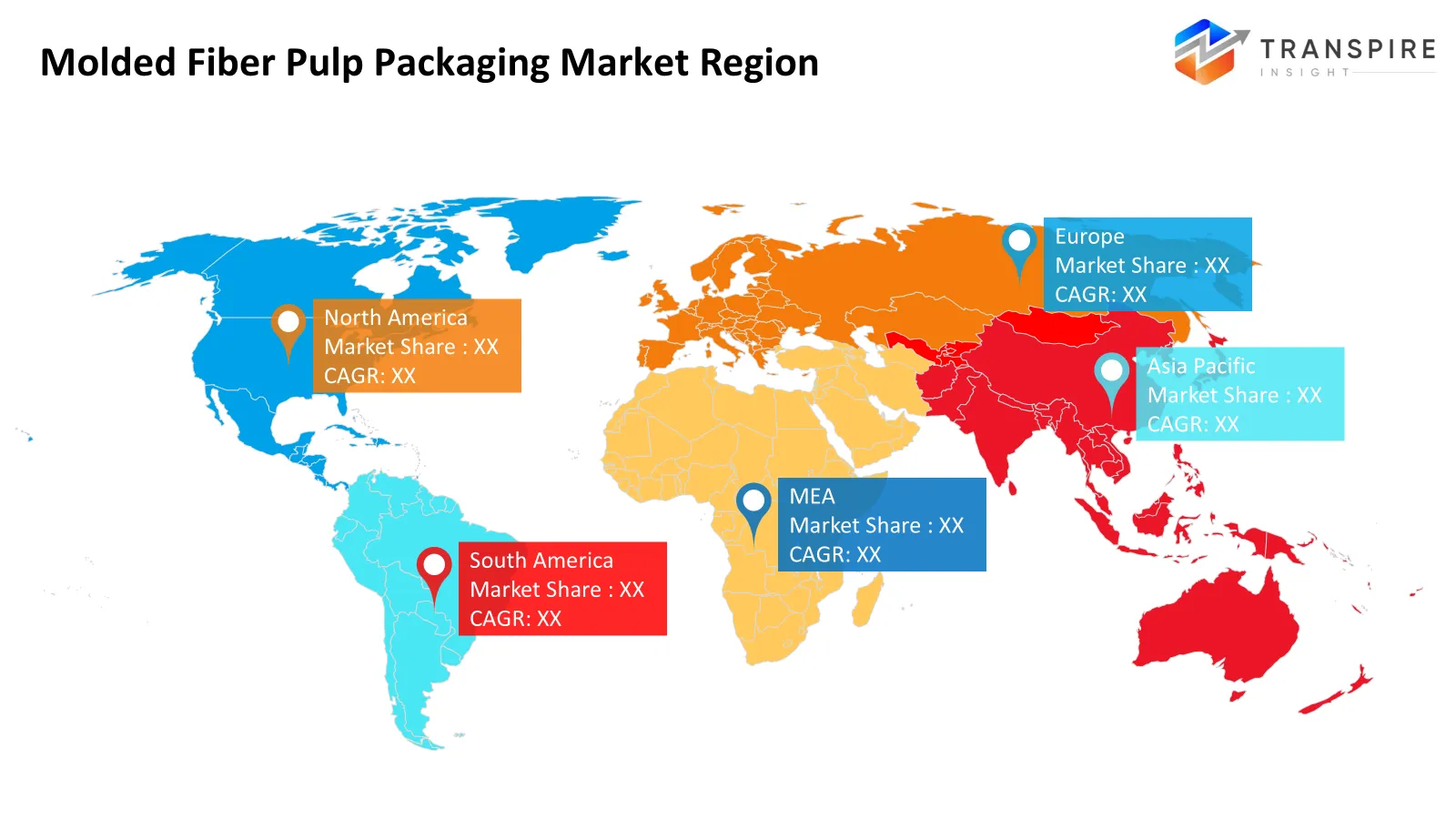
- Leading Region in 2025: Asia Pacific
- Second-largest Region: North America
- Fastest Growing Region: Europe
Introduction
The molded fiber pulp packaging industry comprises the production and provision of eco-friendly packaging materials, containers, and trays developed from recycling paper, cardboard, or other organic raw materials (for example, bamboo, flax straw, or sugar cane bagasse). Molded Fiber Pulp is an eco-friendly packaging material made from natural materials like recycled paper, cardboard, or other organic materials (such as bamboo, flax straw, or sugar cane bagasse), which are mixed with water, shaped into different forms using molds, and later dried. The Molded Fiber Pulp Packaging Market is growing as a result of its green, protective, and economical features. Molded fiber packaging is made of recycled paper pulp and renewable agricultural waste, thus representing a socially responsible alternative to common plastic technologies. It offers high cushioning, vibration damping, and compressive strength, providing effective protection for delicate products ranging from electronic devices to glassware and food products. Its lightweight composition also reduces transportation costs, increases efficiency, and provides for compliance with sustainability regulations and EPR. Enhanced thermoforming techniques allow for accurate tailoring of various shapes, dimensions, and wall thicknesses, meeting industrial, consumer, and e-commerce packaging demands with high performance and flexibility.
- For instance: Strict prohibitions on single-use plastics, growing expenditures in sustainable manufacturing, and strong demand from the food and electronics industries are driving the North American molded fiber pulp packaging industry. Pactiv Evergreen, Sabert Corporation, and Huhtamaki North America are important industry players expanding their business in the area.
Market Highlights: -
- Asia Pacific is anticipated to hold around 45% share of the Molded Fiber Pulp Packaging Market over the predicted timeframe.
- North America is expected to grow at a rapid CAGR in the Molded Fiber Pulp Packaging Market by holding roughly 30% of the share during the forecast period.
- Europe is anticipated to hold around 25% share of the Molded Fiber Pulp Packaging Market over the predicted timeframe.
- By product type, the Trays segment dominated the market and holds nearly 27% share in 2025 and is projected to grow at a substantial CAGR during the forecast period.
- By raw material, the Recycled Paper segment dominated the market and holds nearly 55% share in 2025 and is projected to grow at a substantial CAGR during the forecast period.
- By end user, the Food & Beverage segment dominated the market and holds nearly 41% share in 2025 and is projected to grow at a substantial CAGR during the forecast period.
- The transition from petroleum-based plastics to recyclable and biodegradable alternatives is being accelerated by national and regional sustainability rules, such as the European Union's plastic reduction initiatives and North American limitations on expanded polystyrene (EPS) packaging. By encouraging manufacturers and brands to use sustainable fiber-based packaging solutions, these regulations are generating significant growth prospects for the molded fiber pulp packaging market.
How is Technology Driving Growth in the Molded Fiber Pulp Packaging Market?
The development of advanced manufacturing technologies and innovative materials is improving the efficiency and popularity of molded pulp packaging solutions. Precision thermoforming revolutionizes the manufacturing process allowing the production of lighter, smoother, effective packaging materials with aesthetically pleasing surfaces. The automatic molding systems improve production efficiency, reduce costs of production, and decrease consumption of resources. Digital technologies enable flexible designs, variable branding, and accurate measurement in e-commerce. Moreover, special bio-based coatings allow improving the protection from moisture, grease, and temperature of molded pulp packaging materials used in food, beverages, and industry. Improved fiber technology and compression technology provide molded pulp packaging with high strength, durability, and shock absorption.
Market Drivers
The growth of the molded fiber pulp packaging market can be attributed to stricter norms about sustainability, evolving consumer tastes, and the rise of environmental concerns. Regulation concerning the use of single-use plastics and expanded polystyrene has pushed companies towards bio-degradable solutions. By virtue of the e-commerce boom, there is a growing need for lightweight and durable packaging solutions that reduce the chances of product damage during shipping. Adoption of molded fiber packaging is supported by findings on the growing application of recycling materials, both recycled paper and bagasse. Likewise, increasing consumption of packaged foods and products from supermarkets and eateries is driving the demand for molded fiber trays and clamshells. The Molded Fiber Pulp Packaging Market is growing in popularity due to its environmentally friendly, economical, and performance-oriented features. Molded fiber pulp packaging is eco-friendly as it is composed of biodegradable products that disintegrate naturally over a certain time period. It has excellent shock absorption, cushioning properties, and compression resistance, thus ensuring safety for sensitive goods including electronic devices, eggs, and glass containers. The inclusion of recyclable paper and renewable feedstock contributes to the effective production process of the product as well as helps to save money and reduce the negative impact on the environment. Besides, its light weight reduces transportation costs, fuel consumption and increases the efficiency of the logistics process compared to traditional packaging materials.
- For Instance: - The market for molded fiber pulp packaging in South Africa is growing gradually due to a regional trend away from polystyrene and single-use plastics and toward biodegradable substitutes. The main focus of investment potential is substituting local production capabilities for plastic trays.
- Strict EU single-use plastic bans, expanding circular economy frameworks, and significant corporate capacity investments are driving the European molded fiber pulp packaging industry. Eco-friendly changes in food service, electronics, and agriculture are the main growth drivers.
Restrain
There are many problems in the Molded Fiber Pulp Packaging Market. One such problem includes the expense of production as a result of the use of specific machinery. Another challenge is the performance issues with the use of fiber pulp in reference to moisture resistance, grease resistance, and grease resistance. These performance challenges sometimes cause manufacturers to use coatings. Additionally, the price of raw materials might change, affecting this market. Also, bioplastics become a strong competitor to molded fiber packaging.
Analysis of Prices and Consumer Behaviour
The food-grade type dominates the molded fiber pulp packaging market (around 41% of the market share, mainly due to high demand across food & beverage, takeaway, and consumer goods segments). The cost estimate for the premium molded fiber package with advanced barrier coatings and high moisture resistance features is expected to be around 25%–35% higher than that of conventional solutions since advanced technologies are required to create them. Around 45% of the overall sales volume in molded fiber pulp packaging is accounted for by trays and clamshells. Sales of these products are determined by their broad applications across food packaging, protective packaging, and eco-friendly product applications as well as light weight and recyclability. Almost 65% of the total demand for molded fiber pulp packaging belongs to the food & beverages and consumer goods industries. Consumer purchase choices prove that sustainability, recyclability, safety, and performance characteristics of molded fiber packaging are the priorities for 55% of consumers. About 33% of the companies rely on bulk purchasing agreements or long-term contracts to minimize procurement costs and guarantee a stable supply and availability of packaging products on overseas markets.
Top Companies in the Molded Fiber Pulp Packaging Market
- Huhtamaki
- Brødrene Hartmann
- UFP Technologies
- Pactiv Evergreen
- Sonoco Products
- Genpak
- Stora Enso
- Sabert Corporation
- CKF Inc.
- Henry Molded Products
- Eco-Products
- Nippon Molding
- Orcon Industries
- Keiding Inc.
- EnviroPAK
Market Segmentation
The Molded Fiber Pulp Packaging Market share is divided into five categories: By product type, raw material, end user, manufacturing process and distribution channel.
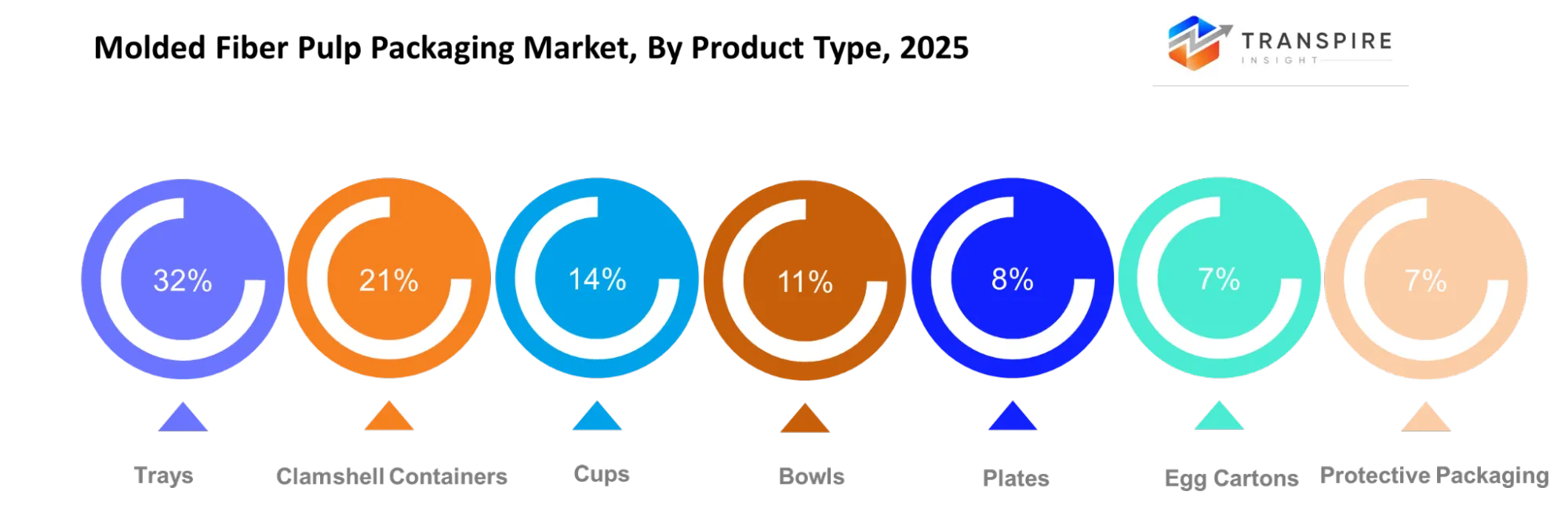
The Trays dominated the market, accounting for nearly 27% in 2025 and is expected to rise at a significant CAGR during the forecast period.
The Molded Fiber Pulp Packaging Market is segmented by product type into Trays, Clamshell Containers, Cups, Bowls, Plates, Egg Cartons, Protective Packaging, Others. Among these, the Trays segment dominated the market, accounting for nearly 27% in 2025 and expected to increase at a significant CAGR during the forecast period. In 2025, the Trays segment held the largest share in the industry in terms of revenues, accounting for almost 27% of the total share, which was attributed to higher usage in the packaging of food, medical, electronics, and consumer items. The Trays are beneficial because they offer better protection to products and are easy to handle, stack, and transport. Rising demand for eco-friendly, lightweight, and recyclable packaging will push the CAGR upwards greatly during the period in question.
The Recycled Paper dominated the market, accounting for nearly 55% in 2025, and is expected to rise at a significant CAGR during the forecast period.
The Molded Fiber Pulp Packaging Market is segmented by raw material into Recycled Paper, Virgin Pulp, Bamboo Fiber, Bagasse, Wheat Straw, Wood Pulp, Mixed Fibers, Others. Among these, the Recycled Paper segment dominated the market, accounting for nearly 55% in 2025 and expected to increase at a significant CAGR during the forecast period. The recycled paper segment led the market as a result of growing sustainability efforts, regulations regarding environmental safety, and an increase in demand for sustainable packaging options. It is expected that the increasing utilization across food, beverage, retail, and e-commerce markets, as a consequence of economic advantages and development in recycling technology, would significantly contribute towards growth in the forecast period.
The Food & Beverage dominated the market, accounting for nearly 41% in 2025 and is expected to rise at a significant CAGR during the forecast period.
The Molded Fiber Pulp Packaging Market is segmented by end user into Food & Beverage, Electronics, Healthcare, Consumer Goods, Agriculture, Industrial, Cosmetics, Others. Among these, the Food & Beverage segment dominated the market, accounting for nearly 41% in 2025 and expected to increase at a significant CAGR during the forecast period. The market was led by the Food & Beverage sector with approximately 41% share in 2025 owing to the rising demand for eco-friendly packaging products, convenience products, and packaging formats that are protective in nature. The adoption will be driven by the rapid growth of packaged food and beverages, e-commerce deliveries, as well as the new trend towards hygienic packaging. Continuous innovations in recyclable and light-weight materials are expected to contribute positively to the substantial CAGR.
Regional Segment Analysis of the Molded Fiber Pulp Packaging Market:
- North America (U.S., Canada, Mexico)
- Europe (Germany, France, U.K., Italy, Spain, Rest of Europe)
- Asia-Pacific (China, Japan, India, Rest of APAC)
- South America (Brazil and the Rest of South America)
- The Middle East and Africa (UAE, South Africa, Rest of MEA)
Asia Pacific is the fastest-growing region in the Molded Fiber Pulp Packaging Market during the period, holding around 45%share.
Asia Pacific is the fastest-growing region in the Molded Fiber Pulp Packaging Market during the forecast period, holding around 45% share during the forecast period. The Molded Fiber Pulp Packaging Market is experiencing its fastest development in the Asia Pacific region, which has approximately 45% market share. Reasons behind this trend include an increase in demand for eco-friendly solutions, rapid growth of the food and beverage industry, rising e-commerce activities, and strict regulations. Additionally, growing awareness about bio-degradable materials and increased investments in green manufacturing technologies are driving the growth of this market in the region.
North America is the fastest-growing region in the Molded Fiber Pulp Packaging Market during the period, holding roughly30%share.
North America is expected to grow at a rapid CAGR in the Molded Fiber Pulp Packaging Market holding roughly 30% share during the forecast period. North America shows strong growth in the Molded Fiber Pulp Packaging Market, accounting for approximately 30% share, driven by the growth in sustainability initiatives, the implementation of strict regulations against plastic packaging, and increasing need for biodegradable options. The booming food, beverage, healthcare, and e-commerce industries alongside advanced recycling capabilities keep supporting the growth of the regional market.
Europe is expected to grow at a rapid CAGR in theMolded Fiber Pulp Packaging Market, holding around25%of the share during the forecast period.
Europe is expected to grow at a rapid CAGR in the Molded Fiber Pulp Packaging Market holding around 25% share during the forecast period. It has been predicted that Europe will exhibit significant growth in the Molded Fiber Pulp Packaging Market, with an estimated share of around 25%. Various factors driving this rapid growth include stringent environmental rules, increased use of plastic substitutes, and a growing inclination towards sustainable packaging methods. The growth in the most demanding industries for sustainability will also positively influence this development.
Strategies for Market Growth in Non-Leading Regions:
By promoting innovative and high-efficient molded fiber pulp packaging production technologies in the underdeveloped areas, small and medium-sized players in the packaging market will benefit in their operations. The use of recycled fibers from local suppliers and the establishment of molded fiber pulp packaging production facilities in the respective regions would enable a significant decrease in the amount of imports, resulting in decreased costs of production. The establishment of strategic partnerships with suppliers, food and drink producers, retailers, and online distributors will improve the penetration of molded fiber pulp packaging solutions into the market. в To acquire competence in sustainable resources processing, product design, quality assurance, and advanced manufacturing technology, training and capacity development should be undertaken. Moreover, the availability of flexible funding schemes, long-term supplier contracts, and contract manufacturing contracts will make the production of molded fiber pulp packaging solutions cheaper and stimulate their wider use. The development of partnerships with governments and recycling companies, sustainability organizations, and packaging innovators, along with the introduction of digital sales channels, will enhance access to these technologies and support the growth of the industry in developing countries.
Future Market Trends for the Molded Fiber Pulp Packaging Market: -
1.Thermoforming and Thin Walls: The development of advanced manufacturing makes it possible to easily create thin-wall structures (less than 1.8 mm) which imitate plastic shapes for food service clams.
2.Dry-Molding Technology: Cutting-edge technologies such as dry molding reduce the process time to seconds and lower energy consumption, thus decreasing cost differences compared to plastics.
3.Alternative Fiber Blends: Making use of alternative materials for production of fiber blends is possible nowadays.
4.PFAS and Barrier Coatings: In terms of technological progress, the utilization of new natural grease/moisture barriers has become possible.
5.E-commerce and Electronics: New strong custom-made cushioning replaces EPS and decreases the percentage of products damaged during shipping.
Recent Development
- In March 2026: PulPac developed its innovative Dry Molded Fiber bottle caps, which provide a fiber-based sustainable solution to conventional plastic closures that makes it possible to broaden the application of molded fiber pulp in high-performance packaging for beverage and consumer goods industries.
- In April 2026: The company Hansol Paper came up with an invention Protego HS, which is a revolutionary packaging solution made of paper and helps in eliminating the necessity of traditional plastics packaging. The technology transforms the concept of sustainable packaging by offering superior barrier properties and eco-friendly solutions.
- In January 2026: Through the expansion of its PFAS-free PulpUltra line of molded fiber packaging, Sabert Corporation made its products available in Europe, UK, and Ireland. This innovative solution creates an impact in the Molded Fiber Pulp Packaging Market as it provides eco-friendly alternatives to traditional plastic food packaging solutions.
Market Segment
This study forecasts revenue at global, regional and country levels from 2020 to 2033. Transpire Insights has segmented the Molded Fiber Pulp Packaging Market based on the below-mentioned segments:
Molded Fiber Pulp Packaging Market, By Product Type
- Trays
- Clamshell Containers
- Cups
- Bowls
- Plates
- Egg Cartons
- Protective Packaging
- Others
Molded Fiber Pulp Packaging Market, By Raw Material
- Recycled Paper
- Virgin Pulp
- Bamboo Fiber
- Bagasse
- Wheat Straw
- Wood Pulp
- Mixed Fibers
- Others
Molded Fiber Pulp Packaging Market, By End User
- Food & Beverage
- Electronics
- Healthcare
- Consumer Goods
- Agriculture
- Industrial
- Cosmetics
- Others
Molded Fiber Pulp Packaging Market, By Manufacturing Process
- Thermoformed Fiber
- Thick Wall Process
- Transfer Molded
- Processed Molded Fiber
- Vacuum Forming
- Press Molding
- Wet Pressing
- Others
Molded Fiber Pulp Packaging Market, By Distribution Channel
- Direct Sales
- Packaging Distributors
- Online B2B
- OEM Supply
- Retail Packaging Suppliers
- Wholesalers
- Export Channels
- Others
Molded Fiber Pulp Packaging Market, By Regional Analysis
North America
- United States
- Canada
- Mexico
Europe
- Germany
- United Kingdom
- France
- Spain
- Italy
- Rest of Europe
Asia Pacific
- Japan
- China
- Australia & New Zealand
- South Korea
- India
- Rest of Asia Pacific
South America
- Brazil
- Argentina
- Rest of South America
Middle East & Africa
- Saudi Arabia
- United Arab Emirates
- South Africa
- Rest of the Middle East & Africa
Frequently Asked Questions
Find quick answers to common questions.
The market is driven by rising sustainability initiatives, plastic reduction regulations, increasing demand for biodegradable packaging, e-commerce growth, and adoption across food, beverage, electronics, and consumer goods industries.
Recycled paper dominates due to its cost-effectiveness, availability, recyclability, regulatory support, and growing preference for environmentally responsible packaging solutions across multiple industries.
The Food & Beverage segment leads the market due to increasing demand for sustainable trays, clamshells, and containers driven by packaged food consumption and eco-friendly packaging adoption.
Advanced thermoforming, dry molding technologies, bio-based coatings, and automated manufacturing systems are improving packaging strength, customization, moisture resistance, production efficiency, and sustainability performance.
Future trends include thin-wall thermoformed packaging, alternative fiber blends, PFAS-free barrier solutions, dry molding innovations, and increased adoption of molded fiber packaging in e-commerce and electronics protection applications.
- Huhtamaki
- Brødrene Hartmann
- UFP Technologies
- Pactiv Evergreen
- Sonoco Products
- Genpak
- Stora Enso
- Sabert Corporation
- CKF Inc.
- Henry Molded Products
- Eco-Products
- Nippon Molding
- Orcon Industries
- Keiding Inc.
- EnviroPAK
About the Authors

Kartik bhong
I am Kartik Bhong, a Senior Research Analyst at Transpire Insight, specializing in the Packaging, Manufacturing, and Construction industry. My work focuses on analyzing market trends, emerging technologies, industry regulations, and competitive landscapes to deliver accurate, data-driven insights. I am passionate about transforming complex industry information into clear, practical content that helps businesses, professionals, and decision-makers stay informed and make confident strategic decisions. Through continuous research and a strong commitment to accuracy, I strive to create reliable, well-researched content that reflects the latest developments across these dynamic industries and supports the vision of Transpire Insight in delivering valuable market intelligence.

Chakradhar Khansole
Chakradhar serves as the Research Director at Transpire Insight, bringing over 8 years of experience in technology, innovation, and strategic market intelligence. He specializes in transforming complex market data into actionable business insights that enable organizations to make informed, growth-oriented decisions. Recognized for his strategic vision and analytical expertise, Chakradhar leads high-impact research initiatives, delivering comprehensive market assessments, competitive intelligence, and forward-looking industry analysis.
Recently Published Reports
-
Apr 2026
Pharmaceutical Cold Chain Packaging Market
Pharmaceutical Cold Chain Packaging Market By Material (Plastic,(Polyethylene (PE), Polypropylene (PP), Polyethylene Terephthalate (PET), Expanded Polystyrene (EPS), Polyurethane (PU),Others), Paper, Metal, Others), By Product (Small Boxes, Pallets, Large Sized Pallet Containers, Others), By End Use (Biopharmaceutical Companies, Clinical Research Organizations, Hospitals, Research Institutes, Logistics and Distribution Companies, Others)”, By Industry Analysis, Size, Share, Growth, Trends, and Forecasts 2026-2033
-
Apr 2026
Active & Intelligent Packaging Market
Active & Intelligent Packaging Market By Type (Active Packaging, Smart Packaging), By Material (Polymer-Based, Paper & Board-Based, Metal-Based, Glass-Based), By Technology (Time-Temperature Indicators, Freshness Indicators, RFID, Antimicrobial Packaging, Modified Atmosphere Packaging), By Application (Food & Beverages, Pharmaceutical, Cosmetics & Personal Care, Electronics & Consumer Goods, Others), By Industry Analysis, Size, Share, Growth, Trends, and Forecasts 2026-2033
-
Apr 2026
Biodegradable Cut Flower Packaging Market
Biodegradable Cut Flower Packaging Market By Material Type (Paper & Paperboard, Biodegradable Plastics, Natural Fibers, Molded Pulp, Others), By Product Type (Sleeves, Wraps, Boxes & Cartons, Bags & Pouches, Inserts & Holders), By Application (Roses, Carnations, Tulips, Chrysanthemums, Mixed Flowers, Others) and By Distribution Channel (Direct Sales, Distributors & Wholesalers, Online Channels), By Industry Analysis, Size, Share, Growth, Trends, and Forecasts 2026-2033
-
May 2026
Pharmaceutical Packaging Market
Pharmaceutical Packaging Market By Material Type (Plastic, Glass, Metal, Paper & Paperboard, Others), By Packaging Type (Bottles, Blister Packs, Vials, Ampoules, Pouches & Sachets, Others) and By End User (Hospitals & Clinics, Retail Pharmacies, Online Pharmacies, Pharmaceutical Manufacturers), By Industry Analysis, Size, Share, Growth, Trends, and Forecasts 2026-2033