

Middle East and Africa White Spirits Market Size & Forecast:
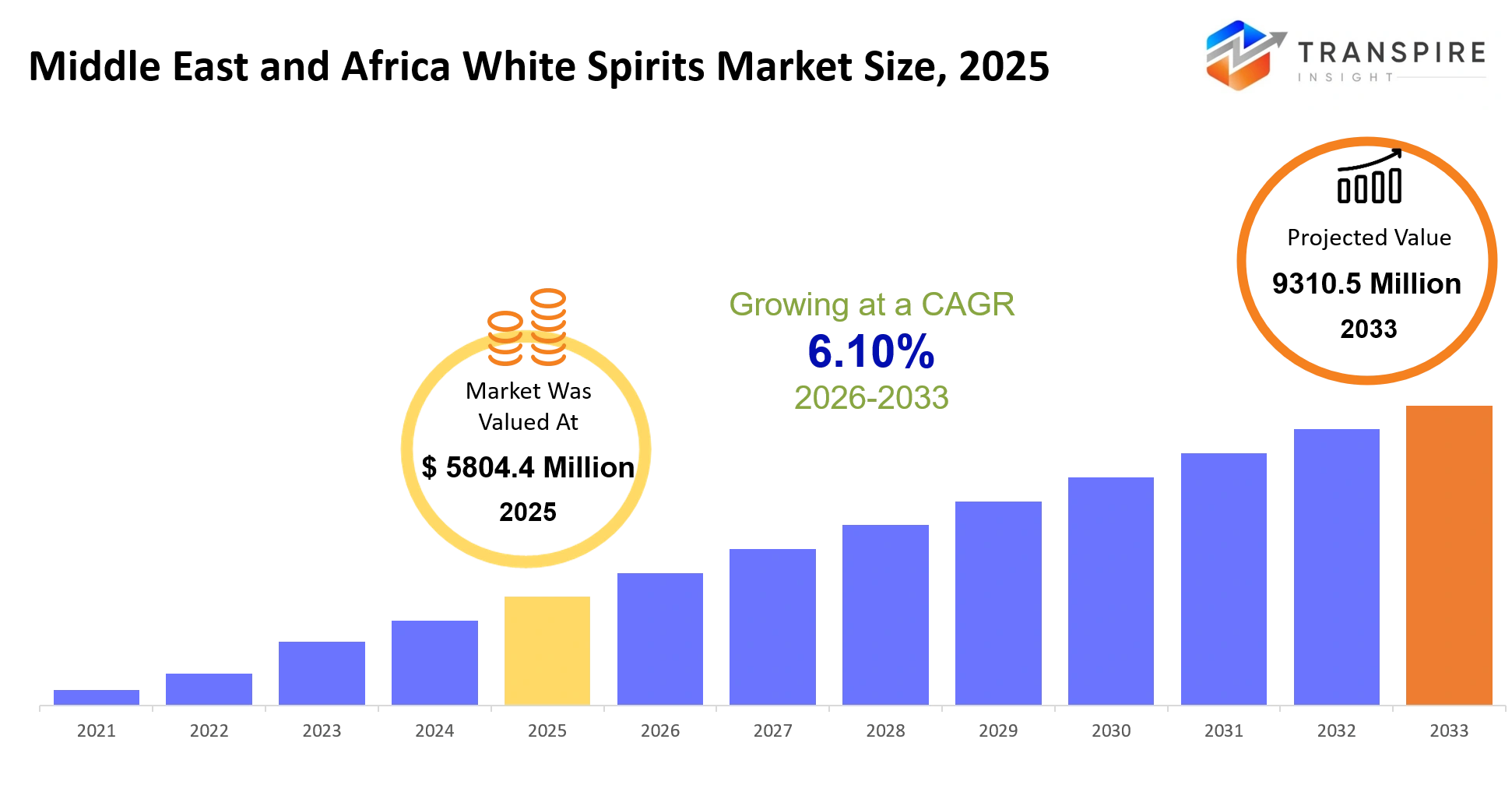
- Middle East and Africa White Spirits Market Size 2025: USD 5804.4 Million
- Middle East and Africa White Spirits Market Size 2033: USD 9310.5 Million
- Middle East and Africa White Spirits Market CAGR: 6.10%
- Middle East and Africa White Spirits Market Segments: By Type (Low Flash White Spirit, Regular Flash White Spirit, High Flash White Spirit, Dearomatized White Spirit, Others); By Application (Paint Thinners, Cleaning Solvents, Degreasers, Industrial Solvents, Fuel Additives, Others); By End User (Paint & Coatings, Automotive, Manufacturing, Construction, Chemicals, Others); By Distribution Channel (Direct Sales, Distributors, Retail, Others).
Middle East and Africa White Spirits Market Summary
The Middle East and Africa White Spirits Market was valued at USD 5804.4 Million in 2025. It is forecast to reach USD 9310.5 Million by 2033. That is a CAGR of 6.10% over the period.
White spirits kinda do a big job across industrial value chains by acting like solvents, for paint thinning, surface preparation, equipment cleanings, metal degreasing, and specialty chemical making. In practice these products support manufacturers in improving coating performance, keeping production equipment running, and getting steadier processing quality across construction, automotive and industrial operations. And as infrastructure projects plus industrial manufacturing keep expanding across the Middle East and Africa, white spirits stay a necessary input for paints, coatings, adhesives and those everyday maintenance needs.
Over the last five years, the whole market has shifted in a more structural way toward low-aromatic and de-aromatized formulations. Industrial buyers seem to respond to tougher workplace safety rules and environmental requirements. After the pandemic, supply chain disruptions, along with feedstock volatility in crude oil markets, basically pushed companies to diversify sourcing and refine solvent blends. This change also nudge manufacturers to put money into higher-value specialty grades with better performance profiles. With construction activity and industrial coatings demand still climbing, and manufacturing output remaining strong, consumption volumes are growing too. At the same time, the move toward premium products helps keep revenue generation solid across the regional solvent industry.
Key Market Insights
- Saudi Arabia and the UAE, sort of together, are estimated to make up about 35%+ of the regional market in 2025, backed by huge construction and industrial investments, you know the type.
- Gulf Cooperation Council countries still look like the main regional drivers, mainly because of refinery capacity, petrochemical linkages, and steady coatings demand that doesn’t really slow down.
- Sub-Saharan Africa is expected to be the fastest-growing regional cluster by 2033, supported by manufacturing ramp ups and urban infrastructure initiatives, all at once.
- Regular Flash White Spirit holds roughly 30%–35% market share, and it benefits from broad applicability for coatings plus cleaning formulations, which is pretty common in the field.
- Dearomatized White Spirit is the quickest-growing product group, pushed by workplace safety requirements, and also by low-odor solvent preferences that people actually care about.
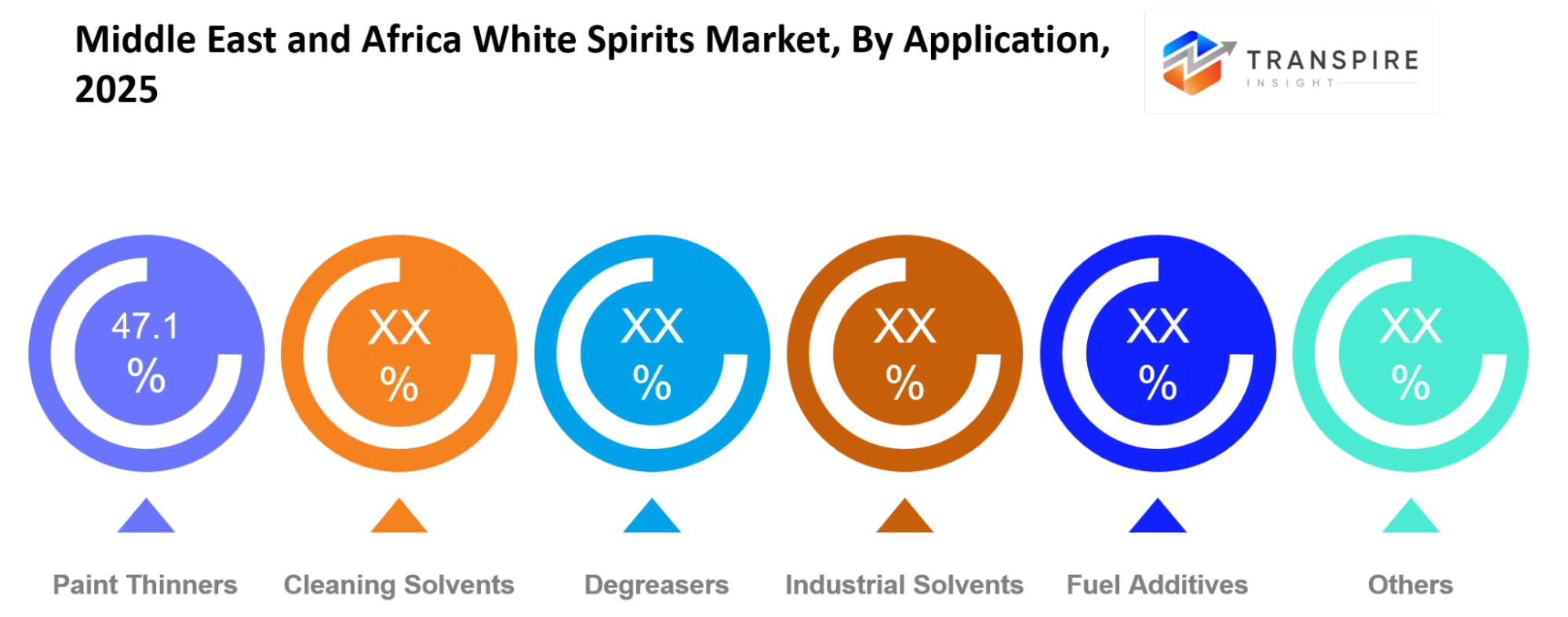
- Paint Thinners account for nearly 40% of total application demand, supported by construction coatings and industrial upkeep activities, especially where maintenance cycles run often.
- Industrial cleaning and degreasing uses are expanding, because manufacturing facilities are increasing equipment maintenance and operational efficiency programs.
- Paint & Coatings remains the leading end-user segment with an estimated 35%+ share, basically mirroring strong regional infrastructure spending.
- Automotive manufacturing along with aftermarket maintenance activities are becoming higher-growth consumption channels through 2033.
- Big suppliers like ExxonMobil, Shell, TotalEnergies, BP, Sasol, and Reliance Industries are strengthening their positions via specialty solvent portfolios, distribution partnerships,and ongoing product innovation.
What are the Key Drivers, Restraints, and Opportunities in the Middle East and Africa White Spirits Market?
The most powerful growth driver comes from continuing, sustained investment in construction, industrial manufacturing, and protective coatings across the Middle East , and Africa. Governments across Gulf economies keeps putting significant money into industrial zones, transportation infrastructure , commercial buildings and energy facilities. Every new project tends to raise consumption of paints, coatings, adhesives and maintenance chemicals that often rely on white spirits as solvents. And then there is the shift toward higher-performance coating systems, which has really pushed demand for premium solvent grades, creating more revenue avenues for suppliers and distributors. As industrial output grows, solvent consumption climbs not just during construction but also across full asset maintenance cycles, and that part matters a lot too.
The biggest structural headache is feedstock price volatility, plain and simple. White spirits are petroleum-derived products , so production costs track closely with crude oil dynamics and refinery economics. When feedstock prices jump around unexpectedly, it creates uncertainty for manufacturers, distributors and end users. Sure, long-term contracts can reduce exposure , but they cannot fully wipe out the volatility in the market. Because of that, pricing visibility stays limited, procurement decisions can get delayed, and margins often get squeezed when raw material costs rise quickly.
The strongest opportunity sits in expanding low-aromatic, and dearomatized solvent technologies. Industrial customers increasingly ask for formulations with a stronger safety stance, less sharp odor , and better alignment with regulations. For instance, suppliers are widening their portfolios of deep-hydrogenated solvent grades intended for coatings, printing inks, metal cleaning , and specialized chemical applications.
What Has the Impact of Artificial Intelligence Been on the Middle East and Africa White Spirits Market?
Artificial intelligence is slowly, but really, transforming solvent production, refinery operations, inventory management and industrial distribution networks across the Middle East and Africa. Refiners and petrochemical producers increasingly roll out AI enabled process control systems, to squeeze better distillation parameters, keep an eye on product quality, and trim energy usage during solvent manufacturing. Along the way, advanced analytics platforms continuously gauge production variables , so operators can hold steadier flash points, purity levels, and overall solvent characteristics.
Machine learning models are also getting better at predictive maintenance programs across refining and chemical processing sites. By scanning sensor information from pumps, compressors, heat exchangers, and storage systems, operators can spot equipment troubles before a failure even shows up. In practice, this helps reduce unplanned downtime, lifts asset utilization, and pushes maintenance costs down. At the same time demand forecasting tools help distributors with smarter expectations, forecasting purchasing patterns across construction, coatings, and manufacturing areas, which makes inventory planning and supply chain efficiency feel more controlled.
Operational improvements tend to show up as better production consistency, lower energy consumption, stronger inventory turnover, and more dependable supply reliability. Some facilities report real, measurable drops in maintenance related shutdowns, plus less process variability, after predictive analytics systems are put in place.
Still, AI adoption runs into limits. The integration expense can be high, legacy industrial infrastructure can be stubborn, and there is often limited access to high quality operational datasets, which complicates implementation. Smaller manufacturers in particular may not have the digital setup needed to fully benefit from these advanced analytics, and that can slow down widespread adoption, across the region
Key Market Trends
- Artificial intelligence is slowly, but really, transforming solvent production, refinery operations, inventory management and industrial distribution networks across the Middle East and Africa.
- Refiners and petrochemical producers increasingly roll out AI enabled process control systems, to squeeze better distillation parameters, keep an eye on product quality, and trim energy usage during solvent manufacturing.
- Along the way, advanced analytics platforms continuously gauge production variables , so operators can hold steadier flash points, purity levels, and overall solvent characteristics.
- Machine learning models are also getting better at predictive maintenance programs across refining and chemical processing sites.
- By scanning sensor information from pumps, compressors, heat exchangers, and storage systems, operators can spot equipment troubles before a failure even shows up.
- In practice, this helps reduce unplanned downtime, lifts asset utilization, and pushes maintenance costs down.
- At the same time demand forecasting tools help distributors with smarter expectations, forecasting purchasing patterns across construction, coatings, and manufacturing areas, which makes inventory planning and supply chain efficiency feel more controlled.
- Operational improvements tend to show up as better production consistency, lower energy consumption, stronger inventory turnover, and more dependable supply reliability.
- Some facilities report real, measurable drops in maintenance related shutdowns, plus less process variability, after predictive analytics systems are put in place.
- Still, AI adoption runs into limits. The integration expense can be high, legacy industrial infrastructure can be stubborn, and there is often limited access to high quality operational datasets, which complicates implementation.
- Smaller manufacturers in particular may not have the digital setup needed to fully benefit from these advanced analytics, and that can slow down widespread adoption, across the region
Middle East and Africa White Spirits Market Segmentation
By Type
Low Flash White Spirit shows up where you need faster evaporation, and also that quick drying kind of effect. Demand seems tied to industrial cleaning, paint preparation, and maintenance tasks where rapid solvent action helps keep things moving. Regular Flash White Spirit is widely used across coating, cleaning, and solvent blending work, mainly because the mix of performance and cost efficiency feels right for a lot of industrial needs. High Flash White Spirit tends to get chosen for settings that want more careful handling conditions and less volatility while it’s stored or being transported.
Then there is Dearomatized White Spirit, which keeps gaining attention in parts of the market that want lower odor characteristics, and generally improved workplace conditions. Adoption stays strong within specialty coatings and household products, plus it fits applications with strict quality specifications. The Others category is basically for customized solvent blends made for narrower industrial processes, and for specialized chemical formulations too. What gets selected depends on evaporation rate, flash point, safety needs, and what people expect for end-use performance across different industrial sectors, honestly it’s a pretty practical checklist.
By Application
Paint Thinners are a big application area, mostly because coatings that are solvent based need good viscosity tuning so the coating can spread smoothly. In real life, construction projects, industrial maintenance, and protective coating jobs, keep driving steady consumption here, even when schedules get weird. Cleaning Solvents stay important for equipment upkeep, machinery wash downs , and surface preparation steps where getting rid of residue is really non negotiable. Degreasers, meanwhile, support metal prep work and production setups that want clean surfaces before assembly, coating , or final finishing.
Industrial Solvents show up in chemical processing, formulation work, and day to day production where dependable solvent properties help product quality stay stable. Fuel Additives rely on white spirits as carriers and other blending ingredients in certain formulations, aiming to improve both handling and processing efficiency. The “Others” slice includes more niche uses like wax based formulations, adhesives, and treatment products that get used across several industrial fields. Overall growth across these categories lines up with more industrial activity and a wider manufacturing output across the regional markets, not just one narrow segment.
By End User
Paint & Coatings, honestly, account for major consumption, because solvent based formulations stay pretty important when it comes to infrastructure projects, industrial facilities, and all the maintenance operations that keep going. You can see it in the steady need for protective coatings, decorative paints, and industrial finishes, these keep solvent usage active through pretty much the whole value chain, even if it looks a bit fragmented on paper. In the automotive space, white spirits get used in refinishing, cleaning, maintenance, and component preparation. So, it’s not only one step, it’s more like a chain of quick needs that happen before or after assembly.
On the manufacturing side, facilities rely on solvent solutions for equipment cleaning, metal treatment, and various production related tasks that need efficient processing conditions. And then construction activity keeps adding pressure, because building projects, infrastructure development, and ongoing maintenance work all call for coatings and surface treatment products. Meanwhile, chemical producers use white spirits in formulation processes, in blending operations, and for specialty product manufacturing, which sounds straightforward but it really isn’t always. The “Others” category covers things like printing, packaging, and consumer product manufacturing, where solvents help meet different operational requirements, including cleaning and preparation steps that don’t get much attention. Finally, expansion of industrial and infrastructure investments continues to strengthen consumption across these end user groups, even when priorities shift from year to year.
By Distribution Channel
Direct Sales still remain a bit important for big industrial buyers, especially those who need stable supply agreements, strong technical support, and procurement arrangements that feel custom, not just generic. Chemical manufacturers, coating producers and major industrial operators often lean toward direct purchasing structures, mainly to boost supply reliability and to keep pricing visibility clearer. Distributors also matter a lot because they hold inventories, cover regional markets, and make it easier for small and medium sized businesses to get access to the products they need. In practice, distribution networks help extend market reach, across lots of different geographic places, and industrial sectors.
Retail channels are mostly for smaller commercial users, and maintenance operations that buy limited volumes, usually for routine applications. They’re useful because accessibility and convenience go together , so retail outlets tend to fit localized demand requirements better. The Others category covers things like online procurement platforms, specialized chemical suppliers, plus contract based supply arrangements that tackle specific customer needs. Using multiple distribution pathways can improve product availability and also support a smoother movement of solvents across industrial and commercial markets, even when demand shifts.
What are the Key Use Cases Driving the Middle East and Africa White Spirits Market?
Paint thinning is still the main thing people do across the region. Coating makers and construction contractors, they lean on white spirits to tweak viscosity, boost how well the stuff goes on, and keep the drying results steady for infrastructure, commercial, and industrial work. That’s basically where the biggest volume demand shows up, because paints and coatings never really stop being needed across building, and upkeep timelines.
At the same time, equipment cleaning plus metal degreasing keeps growing in manufacturing sites and automotive facilities. Industrial users employ solvent mixtures, to strip off oils, residues, and other contaminants from machinery, production equipment, and metal parts before assembly or before the coating step kicks in.
More recently, you can see opportunities opening up around specialty chemical formulations and low odor solvent systems, especially for premium consumer goods and more advanced industrial coatings. Also, dearomatized grades are getting a wider foothold in regulated industrial settings where workplace safety rules and product quality expectations are getting stricter all the time.
|
Report Metrics |
Details |
|
Market size value in 2025 |
USD 5804.4 Million |
|
Market size value in 2026 |
USD 6151.3 Million |
|
Revenue forecast in 2033 |
USD 9310.5 Million |
|
Growth rate |
CAGR of 6.10% from 2026 to 2033 |
|
Base year |
2025 |
|
Historical data |
2021 - 2024 |
|
Forecast period |
2026 - 2033 |
|
Report coverage |
Revenue forecast, competitive landscape, growth factors, and trends |
|
Regional scope |
United States; Canada; Mexico; United Kingdom; Germany; France; Italy; Spain; Denmark; Sweden; Norway; China; Japan; India; Australia; South Korea; Thailand; Brazil; Argentina; South Africa; Saudi Arabia; United Arab Emirates |
|
Key company profiled |
ExxonMobil, Shell, TotalEnergies, Chevron, BP, Phillips 66, Neste, SK Energy, Idemitsu Kosan, Sinopec, PetroChina, Indian Oil, Reliance Industries, Sasol, Calumet. |
|
Customization scope |
Free report customization (country, regional & segment scope). Avail customized purchase options to meet your exact research needs. |
|
Report Segmentation |
By Type (Low Flash White Spirit, Regular Flash White Spirit, High Flash White Spirit, Dearomatized White Spirit, Others); By Application (Paint Thinners, Cleaning Solvents, Degreasers, Industrial Solvents, Fuel Additives, Others); By End User (Paint & Coatings, Automotive, Manufacturing, Construction, Chemicals, Others); By Distribution Channel (Direct Sales, Distributors, Retail, Others). |
Which Regions are Driving the Middle East and Africa White Spirits Market Growth?
Gulf region leads the whole market revenue thing, especially across Saudi Arabia and the United Arab Emirates. There is lots of refining capacity, integrated petrochemical operations, and pretty heavy infrastructure spending, so it basically sets a solid base for solvent consumption. On top of that industrial diversification programs kind of push ongoing growth in manufacturing and construction, not just one area. Strong logistics networks, along with modern port facilities, also keep supply chains moving well and help distribute products across domestic channels and export routes.
South Africa shows up as the second biggest regional contributor, but it is different from the Gulf markets because it has a more varied industrial set up. Things like manufacturing, mining support services, automotive production, and chemical processing create steady solvent demand across several segments. Ongoing industrial investment and well known distribution networks, support long term market stability. Because of this, the demand profile looks balanced, so South Africa ends up being a dependable source for regional revenue generation.
For the rest of Sub-Saharan Africa, growth is expected to be the quickest all the way through 2033. Rising urbanization, industrial development programs, and infrastructure upgrades have opened up new chances for coatings, cleaning solutions, and industrial solvents. In multiple countries , spending has gone up on transportation, housing, and manufacturing projects over the last few years. That momentum should make it easier for suppliers, distributors, and investors to find good opportunities, especially those trying to expand into emerging industrial markets.
Who are the Key Players in the Middle East and Africa White Spirits Market and How Do They Compete?
Competition is still fairly consolidated, global energy and chemical groups hold a meaningful part of the supply, so yeah it’s not exactly fragmented. In practice, most market players push ahead mainly via production scale, product quality, refining integration, and distribution reach , plus the whole thing about being able to offer specialized solvent grades on demand. The big producers tend to have advantages from feedstock access and really broad refining infrastructure, while regional suppliers go harder on customer ties and localized distribution know-how, which helps in repeat buying and day-to-day reliability.
ExxonMobil keeps separating itself with vertically integrated refining plus chemical operations, which basically helps it keep product consistency steady and improve supply reliability. The firm also keeps expanding toward higher-value chemicals and specialty product capacity, that in turn tightens its position in industrial solvent markets. Shell leans into specialty hydrocarbon solvents and low-aromatic formulations, aimed at shifting industrial needs and also workplace safety expectations. With broad international distribution reach, Shell can still hold solid market access across multiple industries without too much friction.
TotalEnergies uses integrated refining assets along with global chemical networks, so it can support industrial customers through a more diversified solvent offering. Reliance Industries leans on large-scale refining operations and pretty competitive production economics, enabling cost-efficient supply across international markets. Sasol, meanwhile, stays distinct through specialty chemical expertise and continuing investments in advanced materials , along with improved chemical production capabilities. Put together these approaches help them strengthen customer retention, grow geographic footprint, and keep improving competitiveness in both standard solvent categories and the premium ones, where margins and specs tend to be tougher.
Company List
- ExxonMobil
- Shell
- TotalEnergies
- Chevron
- BP
- Phillips 66
- Neste
- SK Energy
- Idemitsu Kosan
- Sinopec
- PetroChina
- Indian Oil
- Reliance Industries
- Sasol
- Calumet
Recent Development News
In June 2026, Sasol announced an investment of €60 million in its Brunsbüttel facility. The investment expands advanced materials and specialty chemicals production capacity and strengthens long-term supply capabilities for industrial customers.
Source: http://www.polymerupdate.com
In March 2025, ExxonMobil announced plans to expand its high-purity isopropyl alcohol portfolio. The expansion supports growing demand from advanced manufacturing industries and strengthens specialty solvent supply capabilities.
Source: http://corporate.exxonmobil.com
In January 2026, ExxonMobil expanded higher-value chemical and specialty product capacity through ongoing investments in performance chemicals and advanced recycling facilities. The initiative strengthens specialty product availability and supports long-term growth across industrial applications.
Source: http://corporate.exxonmobil.com
What Strategic Insights Define the Future of the Middle East and Africa White Spirits Market?
In the next five to seven years, the market is likely to drift toward higher-value solvent formulations, not just leaning on volume expansion. What’s really pushing it is the shift to lower-aromatic and more specialized solvent products, which sync up with changing industrial safety rules and performance expectations. So yeah, differentiation and technical results should start mattering more than raw production capacity, kind of like the basics won’t be enough by themselves.
There’s also a risk that feels a little less visible, which is the substitution trend using water-based coatings and other alternative solvent technologies. Even though take-up is gradual, the ongoing improvements in these alternatives could shrink solvent intensity in certain uses and put pressure on older, traditional product lines. At the same time, the premium de-aromatized solvent formulations look like a real opening, especially for industrial segments with tighter operating standards and higher demands for product quality.
Market players should focus resources on specialty solvent development, strong regional distribution partnerships, and more application driven technical support. Firms that can build sturdier positions in premium product categories while still keeping feedstock flexibility should end up better placed to catch future growth and keep margins safer, even as competition and regulation get more intense.
Middle East and Africa White Spirits Market Report Segmentation
By Type
- Low Flash White Spirit
- Regular Flash White Spirit
- High Flash White Spirit
- Dearomatized White Spirit
- Others
By Application
- Paint Thinners
- Cleaning Solvents
- Degreasers
- Industrial Solvents
- Fuel Additives
- Others
By End User
- Paint & Coatings
- Automotive
- Manufacturing
- Construction
- Chemicals
- Others
By Distribution Channel
- Direct Sales
- Distributors
- Retail
- Others
Frequently Asked Questions
Find quick answers to common questions.
The expected Middle East and Africa White Spirits Market size for the market will be USD 9310.5 Million in 2033.
Key segments for the Middle East and Africa White Spirits Market are By Type (Low Flash White Spirit, Regular Flash White Spirit, High Flash White Spirit, Dearomatized White Spirit, Others); By Application (Paint Thinners, Cleaning Solvents, Degreasers, Industrial Solvents, Fuel Additives, Others); By End User (Paint & Coatings, Automotive, Manufacturing, Construction, Chemicals, Others); By Distribution Channel (Direct Sales, Distributors, Retail, Others).
Major Middle East and Africa White Spirits Market players are ExxonMobil, Shell, TotalEnergies, Chevron, BP, Phillips 66, Neste, SK Energy, Idemitsu Kosan, Sinopec, PetroChina, Indian Oil, Reliance Industries, Sasol, Calumet.
The Middle East and Africa White Spirits Market size is USD 5804.4 Million in 2025.
The Middle East and Africa White Spirits Market CAGR is 6.10% from 2026 to 2033.
- ExxonMobil
- Shell
- TotalEnergies
- Chevron
- BP
- Phillips 66
- Neste
- SK Energy
- Idemitsu Kosan
- Sinopec
- PetroChina
- Indian Oil
- Reliance Industries
- Sasol
- Calumet
About the Authors

Pankaj Ghogare Patil
I am Pankaj Ghogare Patil, a Senior Research Analyst at Transpire Insight, specializing in the Pharmaceutical, Chemicals & Materials, Healthcare IT, and Biotechnology industry. My expertise lies in conducting comprehensive market research, analyzing industry trends, evaluating competitive landscapes, and translating complex data into actionable insights. At Transpire Insight, I closely follow emerging technologies, regulatory developments, and market innovations to create accurate, well-researched, and informative content that helps businesses and professionals make informed decisions. I am committed to producing credible, evidence-based articles that reflect industry best practices while making technical topics accessible and valuable for a broad audience.

Chakradhar Khansole
Chakradhar serves as the Research Director at Transpire Insight, bringing over 8 years of experience in technology, innovation, and strategic market intelligence. He specializes in transforming complex market data into actionable business insights that enable organizations to make informed, growth-oriented decisions. Recognized for his strategic vision and analytical expertise, Chakradhar leads high-impact research initiatives, delivering comprehensive market assessments, competitive intelligence, and forward-looking industry analysis.
Recently Published Reports
-
May 2026
Healthcare Polymer Packaging Market
Healthcare Polymer Packaging Market Size, Share & Analysis Report By Packaging Type (Syringes, IV Bottles and Pouches, Clamshells, Blisters, Bottles & Jars, Containers, Tubes, IV Parental Packaging, Others), By Type (Regulated, Non-regulated), By Polymer Type (LDPE (Low-Density Polyethylene), HDPE (High-Density Polyethylene), Homo-polymer (Homo), Random Copolymer (Random), Block Copolymer (Block), PET, Polystyrene, Polyvinyl Chloride, Polyamide/EVOH, Others), and Geography (North America, Europe, Asia-Pacific, Middle East and Africa, South and Central America), 2021 - 2031
-
Apr 2026
Hydrophilic Tape (Waterstop) Market
Hydrophilic Tape (Waterstop) Market Size, Share & Analysis Report By Type (Bentonite-Based Hydrophilic Tape, Rubber-Based Hydrophilic Tape), By Application (Residential Buildings, Commercial Buildings, Infrastructure Projects), and Geography (North America, Europe, Asia-Pacific, Middle East and Africa, South and Central America), 2021 - 2031
-
Apr 2026
Metalens Market
Metalens Market Size, Share & Analysis Report By Type (Visible Light Metalens, and Infrared Metalens), By Application (Consumer Electronics, Automotive Electronics, Industrial, Medical, and Others), and Geography (North America, Europe, Asia-Pacific, Middle East and Africa, South and Central America), 2021 - 2031
-
Apr 2026
PBT Resin Market
PBT Resin Market Size, Share & Analysis Report By Type (Reinforced PBT Resin, Unreinforced PBT Resin), By Processing Method (Injection Molding, Extrusion, Blow Molding, Others), By End-User (Automotive, Electrical & Electronics, Consumer Appliances, Industrial Machinery, Medical Devices, Packaging, Others), and Geography (North America, Europe, Asia-Pacific, Middle East and Africa, South and Central America), 2021 - 2031