

Middle East and Africa Vaccine Market Size & Forecast:
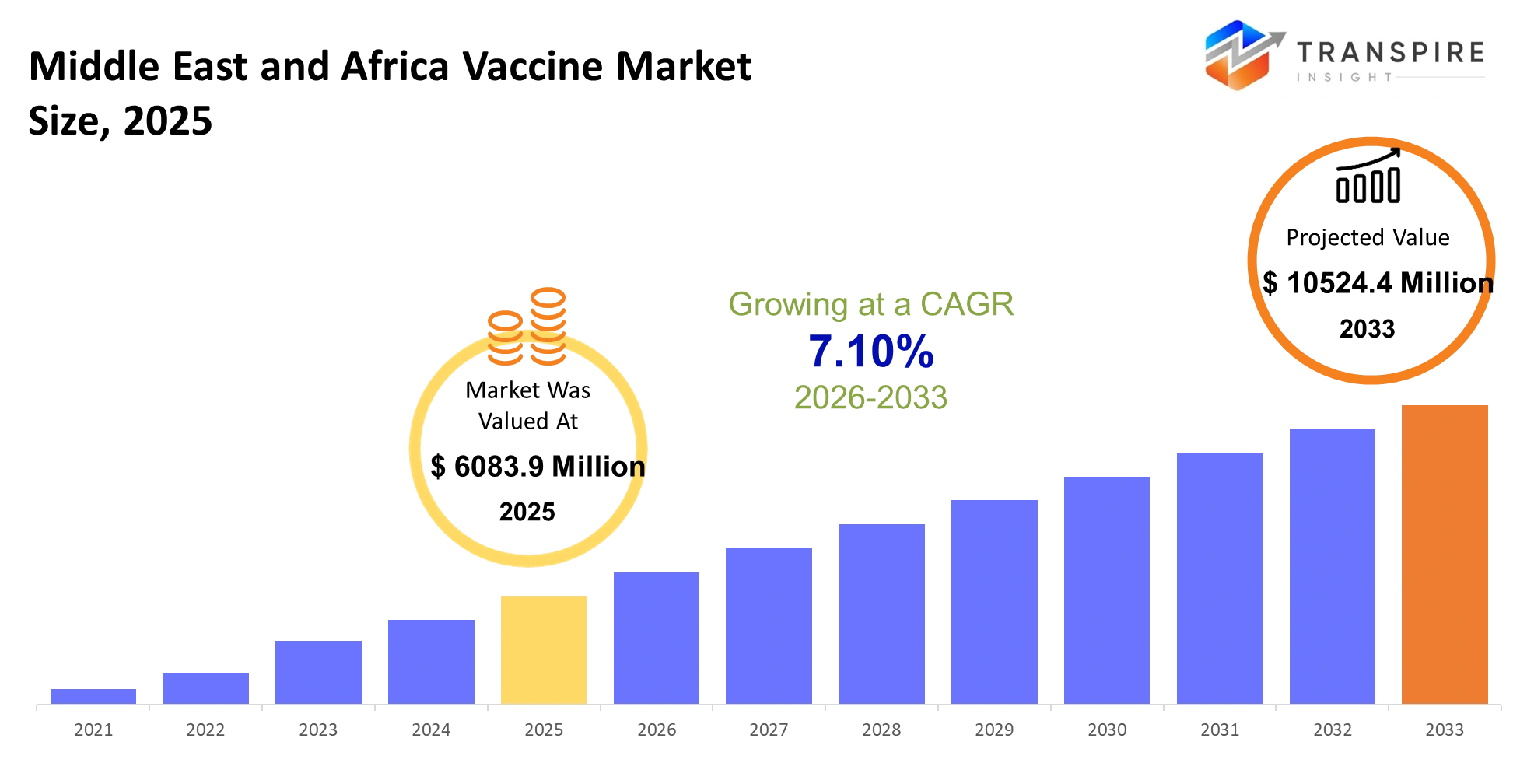
- Middle East and Africa Vaccine Market Size 2025: USD 6083.9 Million
- Middle East and Africa Vaccine Market Size 2033: USD 10524.4 Million
- Middle East and Africa Vaccine Market CAGR: 7.10%
- Middle East and Africa Vaccine Market Segments: By Vaccine Type (Routine Vaccines, COVID-19 Vaccines, Pneumococcal Vaccines, Meningococcal Vaccines, Others); By Technology (Live Attenuated, Inactivated, mRNA, Recombinant, Others); By End User (Hospitals, Clinics, Government Programs, Others); By Age Group (Pediatric, Adult, Geriatric, Others)
To learn more about this report,  Download Free Sample Report
Middle East and Africa Vaccine Market Summary
The Middle East and Africa Vaccine Market was valued at USD 6083.9 Million in 2025. It is forecast to reach USD 10524.4 Million by 2033. That is a CAGR of 7.10% over the period.
Vaccines play a pretty central role in stopping infectious diseases, cutting down hospitalization rates , and also helping public health systems in the Middle East and Africa keep moving. In practice, national immunization programs, hospital driven vaccination campaigns, and outbreak response actions all lean on steady vaccine supplies , so that vulnerable people get protected, and so the economic hit from outbreaks doesn’t spiral too far. Over the last five years, the market kind of seems to drift away from so much dependence on imported vaccines, and toward more regional manufacturing strength plus better supply resilience, it’s noticeable. The COVID-19 pandemic felt like a major trigger, it really showed the weak spots in the supply chain and it made governments push to fund local production capability, and keep strategic stockpiles ready. After that, the fresh cash outlays for vaccine production facilities, plus expanded immunization schedules and wider access pushes, have kind of pushed the market along. Even now, while countries keep upgrading healthcare infrastructure and rolling in newer vaccines for respiratory, meningococcal and pneumococcal conditions, uptake is still moving up wards a bit. Broadly speaking this wave backs larger purchasing volumes, helps raise immunization coverage, and it also creates longer-term revenue pathways for manufacturers and healthcare providers too.
Key Market Insights
- The Middle East and Africa Vaccine Market is forecast to hit USD 10.52 billion by 2033, basically mirroring steady healthcare spend and immunization rollout getting broader.
- Gulf Cooperation Council nations make up an estimated 35%+ of the market share,largely because healthcare budgets stay stronger and procurement programs are more consistent.
- Sub-Saharan Africa looks like the fastest-growing regional cluster through 2033 ,enabled by manufacturing localization and immunization initiatives that get donor support.
- Routine vaccines are leading overall, with about 45% market share, because the childhood vaccination schedules are already well established.
- COVID-19 vaccines stay in the #2 spot, backed by booster rollouts and pandemic readiness strategies.
- For mRNA vaccines, growth is expected to be the quickest through 2033, as regulatory acceptance keeps improving, and manufacturing capabilities continue expanding too.
- Government vaccination programs bring in over 50% of procurement volumes across several regional markets ,which is pretty significant.
- Pediatric vaccination holds the largest share of administered doses, due to national mandates tied to childhood immunization.
- Adult vaccination programs—like influenza, pneumococcal disease and travel-related vaccines—are increasing across urban healthcare networks, pretty rapidly.
- Major companies include Pfizer, GSK, Sanofi, Moderna, AstraZeneca, and Bharat Biotech, they compete by focusing on product innovation, manufacturing partnerships, and regional expansion plays.
What are the Key Drivers, Restraints, and Opportunities in the Middle East and Africa Vaccine Market?
The expansion of government-backed immunization programs still seems to be the most solid driver behind market growth. After the COVID-19 pandemic governments basically had to look again at how ready they were with vaccines, and so procurement budgets got bigger , stockpiling rules turned more strict, and immunization schedules expanded. On top of that , international bodies plus public-private collaborations have been funnelling more money into vaccination drives. In practical terms this tends to push vaccine buying higher, lift coverage numbers, and create kind of repeating revenue windows for both manufacturers and distributors.
That said, limited healthcare infrastructure in multiple low-income countries keeps putting a ceiling on how much the market can expand. Vaccine distribution relies heavily on dependable cold-chain systems, trained healthcare workers , and disease surveillance that actually works in the field. But putting those components in place, and then keeping them functioning, takes long-term investment, it s not something that can be fixed overnight. As a result, coverage gaps, late deliveries, and uneven access especially in rural regions continue to curb possible market returns and slow the uptake of newer vaccine technologies.
Regional vaccine manufacturing is looking like a big opening for future growth. Governments and development organizations are spending on local production capacity, mostly to lessen reliance on imports and to strengthen supply reliability. The 2026 investment that supports Africa’s first true end-to-end multi-vaccine manufacturing facility in South Africa shows how this direction is changing. Projects like this can shrink supply-chain complexity, make pricing more manageable , and also open fresh commercial pathways across the continent.
What Has the Impact of Artificial Intelligence Been on the Middle East and Africa Vaccine Market?
Artificial intelligence is starting to affect vaccine research, manufacturing and the way immunization program management gets handled across Middle East and Africa more and more. Vaccine developers often lean on machine learning models to pick out antigen targets that look promising, check how the immune response behaves, and then tune the clinical trial setup. In practice these tools can shrink the overall timelines, and make the selection of candidates feel a lot more efficient than before. On top of that, AI-enabled analytics platforms let manufacturers keep eyes on production quality, estimate when certain equipment is likely to need maintenance, and fine tune inventory management throughout vaccine supply chains.
At the same time, digital technologies are lifting immunization program performance via predictive demand forecasting and automated stock control. Healthcare agencies use advanced analytics to spot areas where vaccination rates are low, project possible disease outbreaks, and distribute vaccine supplies with more discipline. Those functions can cut down wastage, increase the chance that products stay available, and make public health reactions more solid when problems pop up.
The operational upside looks like quicker development cycles, better manufacturing consistency, and smoother vaccine distribution. Also, AI-supported forecasting can help governments plan procurement work, with more accuracy than they had earlier.
Still, uptake is not as wide as it could be, mainly because implementation is expensive, healthcare data systems can be fragmented, and the digital infrastructure is uneven. A number of countries struggle to gather high quality health data, that you actually need to train reliable predictive models.
Key Market Trends
- Since 2021, some countries have pushed vaccine stockpile funding up, by more than 20% or so, to make outbreak readiness more solid, even if it’s not always said out loud.
- In the same general window, local vaccine manufacturing projects started moving faster between 2024 and 2026, so reliance on imported supplies was reduced, bit by bit.
- mRNA tech also got a broader kind of acceptance after the COVID-19 vaccination runs went well , and that momentum carried into other respiratory vaccine work, too.
- Public private collaborations grew a lot in 2025–2026 in order to improve vaccine access in neighborhoods that are often underserved, and where it’s harder to get care quickly.
- Adult immunization programs stopped being only about influenza and began to add pneumococcal protection, plus travel-related disease prevention, which felt like a noticeable shift.
- A few African countries, during 2024–2026, rolled out vaccine manufacturing roadmaps , aimed at making health systems tougher overall. Combination vaccines became a more talked about option in 2026 after regulators approved fresh flu and COVID-19 products.
- At the clinical level, development activity tilted toward emerging infections , like Ebola and pandemic influenza candidates, rather than sticking solely to older targets.
- Meanwhile, healthcare authorities leaned more into digital immunization tracking tools, to get coverage monitoring working better and faster.
- And manufacturers, for their part, reinforced regional ties to back technology transfer and strengthen local production know-how, in a way that actually lasts.
Middle East and Africa Vaccine Market Segmentation
By Vaccine Type
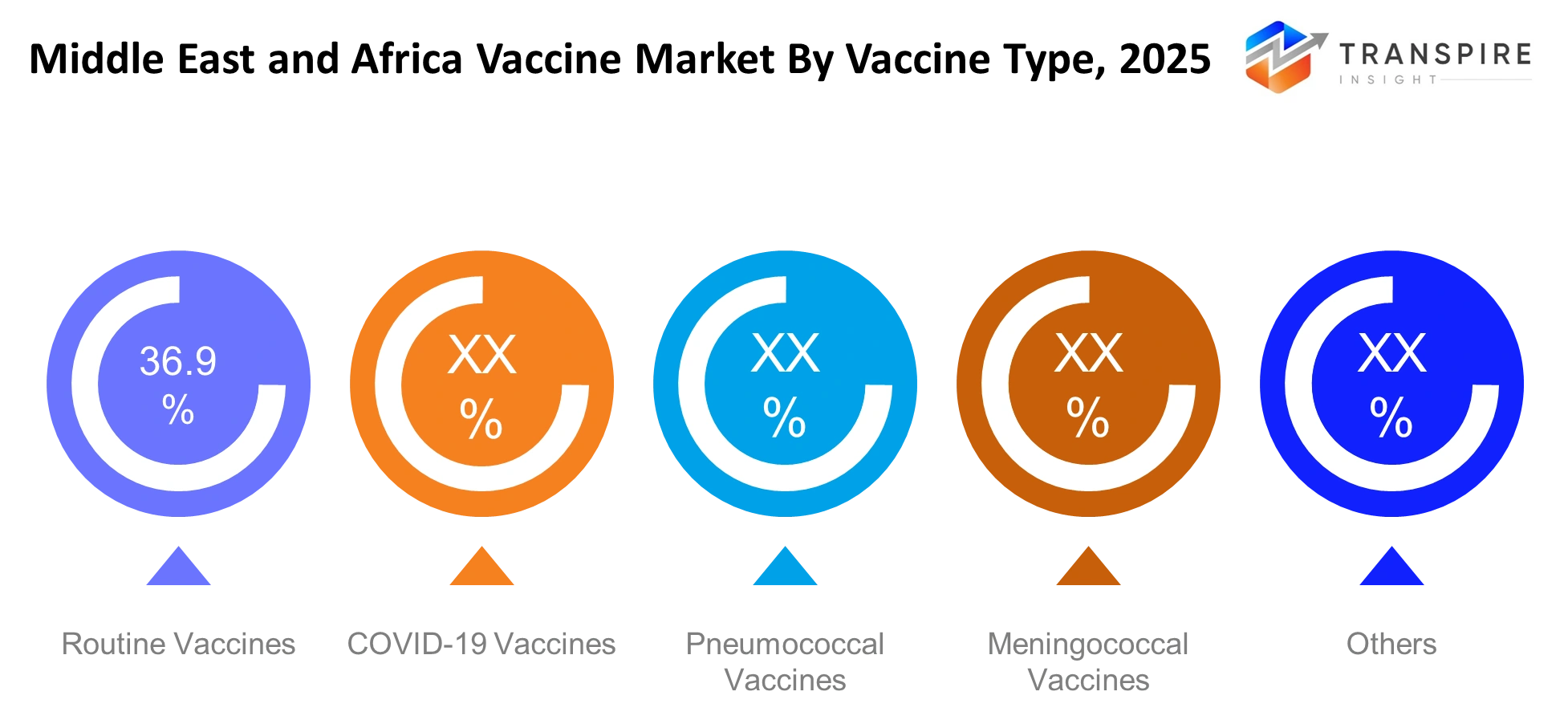
Routine vaccines kind of keep being the base layer of immunization programs throughout the region. The products aimed at measles, polio, diphtheria, tetanus and hepatitis still show solid procurement volumes, since national vaccination schedules basically insist on steady administration from infancy into childhood. Meanwhile stable government purchasing schemes help keep the long term demand and supply planning on track.
COVID-19 vaccines stay important for booster campaigns, and for pandemic readiness planning as well, so they do not just fade out. Pneumococcal vaccines support work to lower respiratory infections and the knock-on hospital stays. And meningococcal vaccines, are crucial for prevention of the disease in high-risk areas, where it can flare up more easily. Then there are the others, like influenza vaccines and travel related products, which add a bit more variety to regional immunization portfolios and help meet wider public health goals.
To learn more about this report, Download Free Sample Report
By Technology
Live attenuated vaccines somehow keep getting a lot of uptake, mainly because their real world effectiveness against multiple infectious diseases has already been demonstrated. Inactivated vaccines also still show up everywhere in large immunization programs, not just for effectiveness but mostly for that long safety track record, plus the broad regulatory comfort people have with them.
mRNA technology has caught more attention lately after the pandemic , when deployment worked well and the results were seen publicly, and now there are also ongoing efforts toward combination vaccines. Recombinant vaccines keep stretching forward too, largely driven by gains in production efficiency and a more focused approach to disease prevention. Then there are other methods, less mainstream, that show up for specialized scenarios and help make the whole vaccine development landscape feel more varied, and less like one-size-fits-all.
By End User
Hospitals, sorta represent a big distribution route, because vaccine services are often blended into preventive healthcare and disease management initiatives. Clinics too do a lot here, through local immunization services and those regular patient follow-ups that keep people engaged, even if it’s not always obvious.
Government programs take a pretty sizable slice of vaccine procurement, mainly thanks to national immunization drives and public health promotions. Beyond that, other end users show up too, like non-governmental organizations, private healthcare providers, plus occupational health programs that aim to carry out targeted vaccination among particular population groups.
By Age Group
Pediatric immunization ends up producing the biggest volume of vaccine administration across the region. The national immunization schedules mostly focus on protecting kids from common childhood illnesses, and that keeps a steady demand going for routine as well as combination vaccines, basically year after year.
Meanwhile, adult vaccination programs are still growing too, since many healthcare systems put more attention on preventing influenza, plus travel related health needs and also occupational vaccine requirements. The geriatric segment is getting more attention lately because older populations face higher risks from respiratory issues and other contagious diseases. There are also other age-group lanes, sort of specialized immunization programs, built for people who are vulnerable or considered high-risk.
What are the Key Use Cases Driving the Middle East and Africa Vaccine Market?
Routine childhood immunization still shows up as the biggest use case in the market, more or less. National vaccination programs end up hinging on massive procurement of vaccines for measles, polio, hepatitis, and other diseases that can actually be prevented. Because of that, this particular application sees the biggest volume demand, since governments tend to push early-life protection first, and then they keep looking at long term public health outcomes.
Other use cases are also pretty important, like hospital-based adult vaccination programs and community health drives aimed at respiratory infections. In practice, clinics, along with public health agencies, are administering pneumococcal, influenza, and meningococcal vaccines more and more, to shrink the disease load and lower healthcare expenses .
Then there are the newer emerging applications, pandemic readiness efforts for example, plus vaccination responses during outbreaks. Funding for next-generation vaccines aimed at Ebola, HIV, and other infections is opening room for manufacturers, as well as public health organizations.
|
Report Metrics |
Details |
|
Market size value in 2025 |
USD 6083.9 Million |
|
Market size value in 2026 |
USD 6512.7 Million |
|
Revenue forecast in 2033 |
USD 10524.4 Million |
|
Growth rate |
CAGR of 7.10% from 2026 to 2033 |
|
Base year |
2025 |
|
Historical data |
2021 - 2024 |
|
Forecast period |
2026 - 2033 |
|
Report coverage |
Revenue forecast, competitive landscape, growth factors, and trends |
|
Regional scope |
Middle East and Africa (Saudi Arabia, United Arab Emirates, South Africa, Rest of Middle East and Africa) |
|
Key company profiled |
Pfizer, GSK, Sanofi, Merck & Co., Moderna, AstraZeneca, Serum Institute of India, CSL Seqirus, Bharat Biotech, Sinovac, BioNTech, Novavax, SK Bioscience, Valneva, Emergent BioSolutions |
|
Customization scope |
Free report customization (country, regional & segment scope). Avail customized purchase options to meet your exact research needs. |
|
Report Segmentation |
By Vaccine Type (Routine Vaccines, COVID-19 Vaccines, Pneumococcal Vaccines, Meningococcal Vaccines, Others); By Technology (Live Attenuated, Inactivated, mRNA, Recombinant, Others); By End User (Hospitals, Clinics, Government Programs, Others); By Age Group (Pediatric, Adult, Geriatric, Others) |
Which Regions are Driving the Middle East and Africa Vaccine Market Growth?
The Gulf area still shows up as the top revenue driver, mainly because the healthcare infrastructure is a bit more developed, government healthcare budgets stay strong, and vaccine procurement is handled pretty central. In places like Saudi Arabia and the United Arab Emirates, leaders keep putting real money into preventive healthcare efforts. There are regulatory setups that are pretty well established, plus distribution networks that work efficiently, so vaccination access stays broad, and procurement doesn’t really lose momentum. On top of that , solid public funding tends to push adoption of the more recent vaccine approaches and, yes, new technologies.
South Africa meanwhile is a major contributor but with a somewhat different growth pattern. The market holds up due to manufacturing capabilities, active research work, and a healthcare ecosystem that’s relatively mature. Funding for local production sites, along with public-private collaborations, gives a more steady environment and helps protect regional supply security. Together these elements create a dependable baseline for long-term market involvement.
Sub-Saharan Africa is expected to post the fastest growth over the forecast period. In the last few years, investments in local manufacturing, wider immunization programs, and support from international funding have changed the overall market situation. New vaccine production initiatives, plus improvements in healthcare infrastructure, are opening doors for broader access and stronger regional self-reliance. For investors and manufacturers, this part of the region basically becomes an expansion runway through 2033.
Who are the Key Players in the Middle East and Africa Vaccine Market and How Do They Compete?
Competition kinda blends big global pharmaceutical groups with smaller regional makers, who lean hard on affordability , technology transfer, and dependable supply. Most market players end up competing by pushing innovation, scaling manufacturing, getting regulatory approvals, and building partnerships with governments plus international health orgs. And yeah, the more advanced vaccine platforms, wider product portfolios, and more localized supply approaches, those still end up being the real differentiators in practice.
Pfizer, for instance, leans on huge vaccine research muscle, plus a broad portfolio covering several disease areas. Moderna meanwhile differentiates itself via mRNA technology and it keeps working on combo vaccines and pandemic readiness products. Lately, its progress in influenza and respiratory vaccines supports that tech-forward story, even if the framing changes a bit by quarter.
GSK tends to focus on strategic collaborations and pipeline growth, often via licensing agreements and joint research efforts. Bharat Biotech builds momentum through cost efficient manufacturing, and partnerships meant to widen access in emerging markets. Sanofi keeps using its broad vaccine know how and the established distribution networks it already has in place.
More and more companies now pursue technology transfer agreements, regional manufacturing investments, and cooperative development programs. That combination seems aimed at locking in longer term competitive advantages, like, beyond just a single product cycle.
Company List
- Pfizer
- GSK
- Sanofi
- Merck & Co.
- Moderna
- AstraZeneca
- Serum Institute of India
- CSL Seqirus
- Bharat Biotech
- Sinovac
- BioNTech
- Novavax
- SK Bioscience
- Valneva
- Emergent BioSolutions
Recent Development News
In April 2026, Biovac secured backing from the European Investment Bank Group, European Commission, and IFC for Africa's first end-to-end multi-vaccine manufacturing facility. The investment strengthens regional vaccine self-reliance and expands local production capacity.https://www.eib.org
In June 2026, Moderna expanded a strategic collaboration with CEPI to develop a vaccine against Bundibugyo Ebola virus. The agreement includes up to USD 50 million in funding and supports accelerated clinical development and manufacturing activities.https://www.biospace.com
What Strategic Insights Define the Future of the Middle East and Africa Vaccine Market?
In the next five, to seven years it seems like the market will drift toward more regional self sufficiency. diversified manufacturing capability, and a broader uptake of advanced vaccine technologies. There’s a pretty strong structural push under all of this, mainly the push to reduce reliance on imported items while also improving readiness for whatever future infectious disease threats show up. Local manufacturing spending and tech transfer programs will end up doing a lot of the heavy lifting when it comes to who ends up competing and how.
There’s also a risk that’s a bit less obvious. it has to do with how funding gets clustered and how much immunization programs lean on external donors. If international help gets trimmed, even somewhat, it can ripple through procurement activities and it may slow down vaccine rollout in lower income countries.
At the same time, there’s a growing opening in regional production of mRNA and also for combination vaccines. If early investment lands in manufacturing infrastructure, plus technology partnerships, it could translate into a real edge once these products become more mainstream.
So market players should basically go hard on local partnerships, expand manufacturing, and build digital supply chain capabilities, to improve resilience and to catch the longer term growth upside.
Middle East and Africa Vaccine Market Report Segmentation
-By Vaccine Type
- Routine Vaccines
- COVID-19 Vaccines
- Pneumococcal Vaccines
- Meningococcal Vaccines
- Others
By Technology
- Live Attenuated
- Inactivated
- mRNA
- Recombinant
- Others
By End User
- Hospitals
- Clinics
- Government Programs
- Others
By Age Group
- Pediatric
- Adult
- Geriatric
- Others
Frequently Asked Questions
Find quick answers to common questions.
The expected Middle East and Africa Vaccine Market size for the market will be USD 10524.4 Million in 2033.
Key segments for the Middle East and Africa Vaccine Market are By Vaccine Type (Routine Vaccines, COVID-19 Vaccines, Pneumococcal Vaccines, Meningococcal Vaccines, Others); By Technology (Live Attenuated, Inactivated, mRNA, Recombinant, Others); By End User (Hospitals, Clinics, Government Programs, Others); By Age Group (Pediatric, Adult, Geriatric, Others)
Major Middle East and Africa Vaccine Market players are Pfizer, GSK, Sanofi, Merck & Co., Moderna, AstraZeneca, Serum Institute of India, CSL Seqirus, Bharat Biotech, Sinovac, BioNTech, Novavax, SK Bioscience, Valneva, Emergent BioSolutions
The Middle East and Africa Vaccine Market size is USD 6083.9 Million in 2025.
The Middle East and Africa Vaccine Market CAGR is 7.10% from 2026 to 2033.
- Pfizer
- GSK
- Sanofi
- Merck & Co.
- Moderna
- AstraZeneca
- Serum Institute of India
- CSL Seqirus
- Bharat Biotech
- Sinovac
- BioNTech
- Novavax
- SK Bioscience
- Valneva
- Emergent BioSolutions
About the Authors

Pankaj Ghogare Patil
I am Pankaj Ghogare Patil, a Senior Research Analyst at Transpire Insight, specializing in the Pharmaceutical, Chemicals & Materials, Healthcare IT, and Biotechnology industry. My expertise lies in conducting comprehensive market research, analyzing industry trends, evaluating competitive landscapes, and translating complex data into actionable insights. At Transpire Insight, I closely follow emerging technologies, regulatory developments, and market innovations to create accurate, well-researched, and informative content that helps businesses and professionals make informed decisions. I am committed to producing credible, evidence-based articles that reflect industry best practices while making technical topics accessible and valuable for a broad audience.

Chakradhar Khansole
Chakradhar serves as the Research Director at Transpire Insight, bringing over 8 years of experience in technology, innovation, and strategic market intelligence. He specializes in transforming complex market data into actionable business insights that enable organizations to make informed, growth-oriented decisions. Recognized for his strategic vision and analytical expertise, Chakradhar leads high-impact research initiatives, delivering comprehensive market assessments, competitive intelligence, and forward-looking industry analysis.
Recently Published Reports
-
Jul 2026
Alopecia Treatment Market
Alopecia Treatment Market Size, Share & Analysis Report By Disease Type (Alopecia Areata, Cicatricial Alopecia, Traction Alopecia, Alopecia Totalis, Androgenetic Alopecia, Alopecia Universalis, and Other Disease Types), By Treatment Type (Topical Treatments, Oral Medications, Injectable Therapies, and Hair Transplantation), By Gender (Male, and Female), By Distribution Channel (Hospitals and Clinics, Retail Pharmacies, and Online Retailers), and Geography (North America, Europe, Asia-Pacific, Middle East and Africa, South and Central America), 2021 - 2031
-
Jul 2026
Medical Ultrasound Probe Market
Medical Ultrasound Probe Market Size, Share & Analysis Report By Type (Linear Type, Convex Type, Endocavitary Probe, Phased Array/Cardiac Probe, Transesophageal (TEE) Probe, and Others), By Application (Ophthalmology, Cardiology, Musculoskeletal, Oncology, Obstetrics & Gynecology, General Imaging, and Others), By End User (Hospitals & Clinics, Diagnostic Centers, Ambulatory Surgical Centers, and Others), and Geography (North America, Europe, Asia-Pacific, Middle East and Africa, South and Central America), 2021 – 2031
-
May 2026
Biosimilars Market
Biosimilars Market By Product Type (Monoclonal Antibodies, Recombinant Hormones, Erythropoietin, G-CSF, Others), By Indication (Oncology, Autoimmune Diseases, Blood Disorders, Diabetes, Others), By Manufacturing Type (In-House Manufacturing, Contract Manufacturing), By Distribution Channel (Hospital Pharmacies, Retail Pharmacies, Online Pharmacies), By Industry Analysis, Size, Share, Growth, Trends, and Forecasts 2021-2033
-
Apr 2026
Gastrointestinal Endoscopy Market
Gastrointestinal Endoscopy Market By Type (Rigid Gastrointestinal Endoscope, Flexible Gastrointestinal Endoscopes, Disposable Gastrointestinal Endoscope), By Procedure Type (Colonoscopy, Gastroscopy, Duodenoscopy, Enteroscopy, Flexible Sigmoidoscopy, Others), By Application (Diagnosis, Treatment), By End-Users (Hospitals, Ambulatory Surgical Centers, Specialty Clinics, Laboratories, Others), By Industry Analysis, Size, Share, Growth, Trends, and Forecasts 2021-2033