
Middle East and Africa Time Domain (TDOCT) - Optical Coherence Tomography Market Size & Forecast:
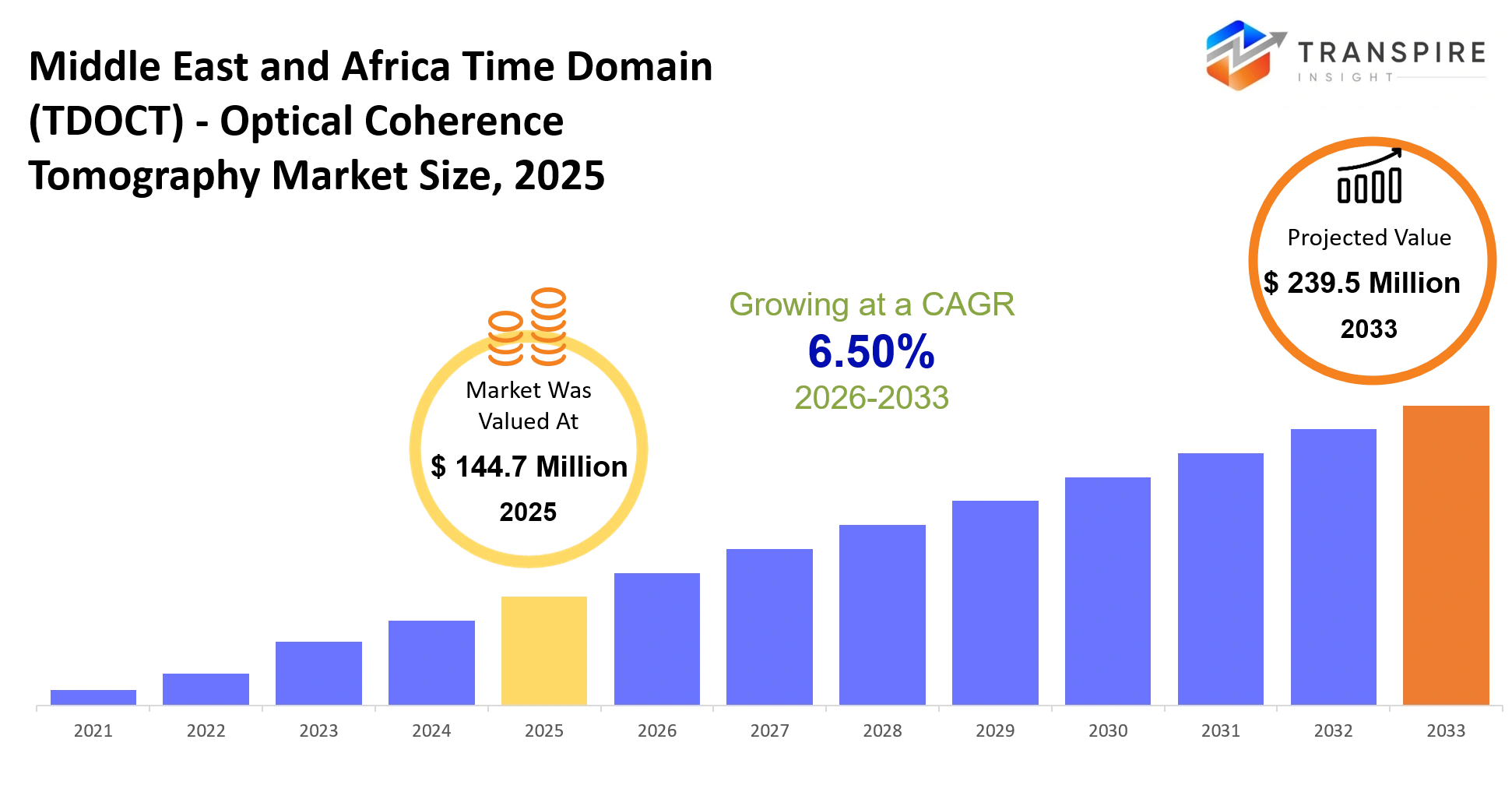
- Middle East and Africa Time Domain (TDOCT) - Optical Coherence Tomography Market Size 2025: USD 144.7 Million
- Middle East and Africa Time Domain (TDOCT) - Optical Coherence Tomography Market Size 2033: USD 239.5 Million
- Middle East and Africa Time Domain (TDOCT) - Optical Coherence Tomography Market CAGR: 6.50%
- Middle East and Africa Time Domain (TDOCT) - Optical Coherence Tomography Market Segments: By Product Type (Standalone OCT, Handheld OCT, Integrated OCT Systems, Others); By Application (Ophthalmology, Cardiology, Dermatology, Others); By End User (Hospitals, Eye Clinics, Research Centers, Others); By Technology (Time Domain OCT, Hybrid OCT, Others)
Middle East and Africa Time Domain (TDOCT) - Optical Coherence Tomography Market Summary
The Middle East and Africa Time Domain (TDOCT) - Optical Coherence Tomography Market was valued at USD 144.7 Millionin 2025. It is forecast to reach USD 239.5 Million by 2033. That is a CAGR of 6.50% over the period.
The Middle East and Africa Time Domain (TDOCT) - Optical Coherence Tomography Market seems to play a big role in helping clinicians to actually see retinal structures, catch eye disorders sooner, and back treatment choices without doing invasive steps. In real healthcare everyday use, TDOCT systems assist ophthalmologists when they’re diagnosing glaucoma, diabetic retinopathy, macular degeneration, and other kinds of vision-threatening problems where catching it early can really change the way patients do later. Over the past five years, the market has sort of shifted in a more structural way toward faster spectral and hybrid OCT platforms, and this is pushing manufacturers to squeeze more clinical value out of existing TDOCT systems. So they do software upgrades, add workflow integration, and generally make the instruments feel more useful. A key driver is the rising diabetes burden across Gulf Cooperation Council countries and South Africa, which has raised the number of retinal screening initiatives in place. And as providers keep expanding diagnostic capacity, plus they invest more in digital ophthalmology infrastructure, OCT adoption is spreading across hospitals, specialty eye clinics, and research centers too. This keeps generating steady revenue potential for device manufacturers, and also for service providers, even when budgets shift around.
Key Market Insights
- Saudi Arabia and the UAE, together kinda made up about 38% of the regional revenue in 2025, thanks to strong healthcare modernization programs, that sort of push everything forward.
- The Gulf countries look like the fastest-growing regional cluster through 2033, supported by specialty eye care investments ,and also diabetes management initiatives.
- Standalone OCT systems, held roughly 42% market share in 2025, mainly because the acquisition costs are lower and deployment is easier, like less friction overall.
- Integrated OCT systems took second place with around 31% share, benefiting from multi modality imaging needs inside tertiary hospitals.
- Hybrid OCT platforms are projected to grow the quickest through 2033 since providers want better imaging accuracy and smoother workflow efficiency.
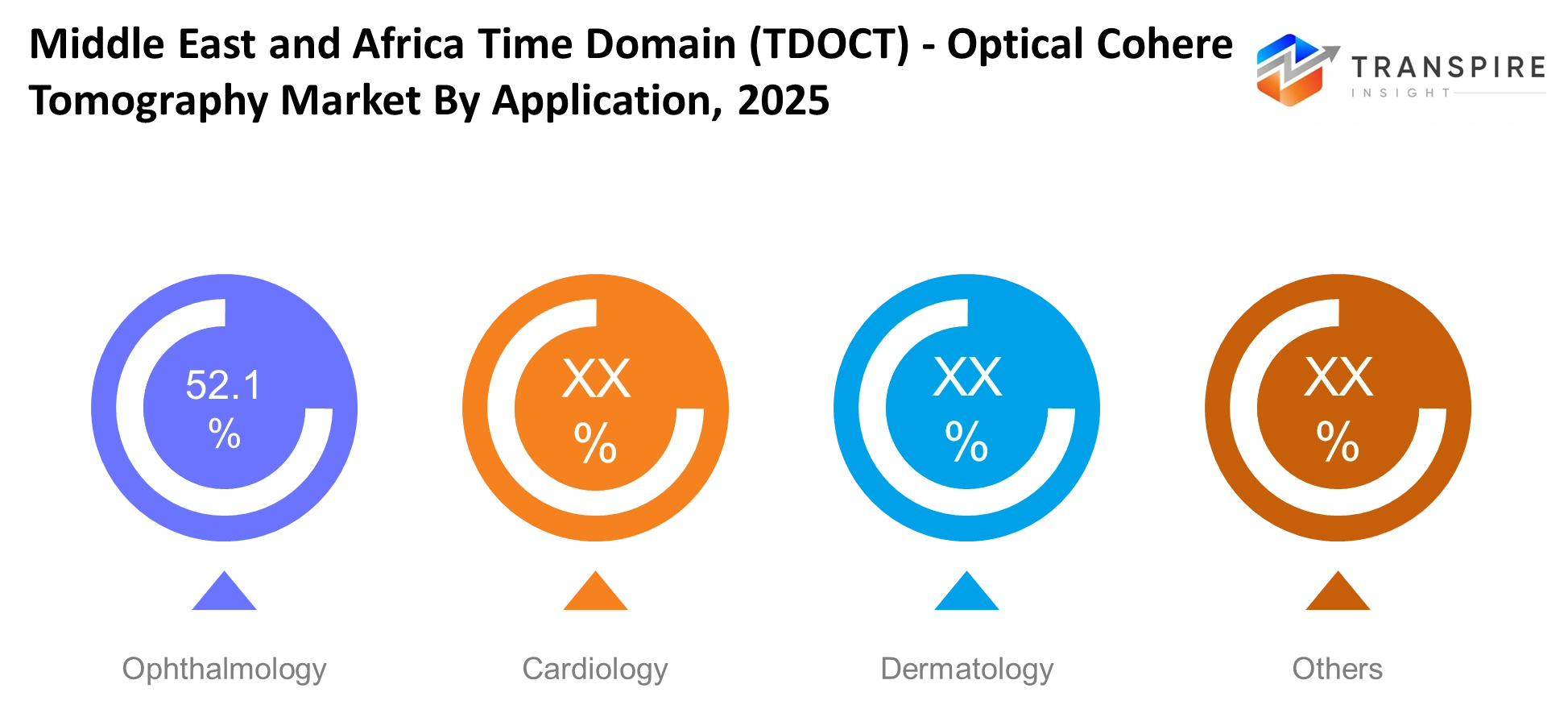
- In terms of applications, ophthalmology dominated with more than 70% share in 2025, driven by glaucoma and diabetic retinopathy diagnostics.
- Dermatology OCT applications are moving up over 7% per year, because non-invasive skin imaging is gaining more clinical acceptance.
- Hospitals represented nearly 48% of total end user revenue in 2025, due to big patient volumes, plus advanced diagnostic capabilities.
- Eye clinics are showing up as the fastest-growing end-user segment, as outpatient ophthalmology services keep spreading across urban centers.
- Major companies such as Carl Zeiss Meditec, Heidelberg Engineering, Topcon, Canon Medical, and Nidek are strengthening their positions by leaning on AI-enabled diagnostics, partnerships, and broader regional expansion programs.
What are the Key Drivers, Restraints, and Opportunities in the Middle East and Africa Time Domain (TDOCT) - Optical Coherence Tomography Market?
The strongest growth driver comes from the rising incidence of diabetes-associated eye disorders across the Middle East and some areas of Africa, and it really keeps stacking up. In Saudi Arabia, the UAE, and South Africa, the national diabetes screening programs have been expanding retinal examinations, so ophthalmology departments end up with more diagnostic work than before. As a consequence, many healthcare providers now lean on OCT imaging to spot retinal irregularities before symptoms get noticeably worse. That change bumps equipment utilization rates up, plus it feeds service contracts, software licensing revenue and even the replacement pull for aging imaging systems.
The biggest obstacle still is the heavy capital cost tied to ophthalmic imaging infrastructure, and also the specialized workforce needs that go with it. A bunch of healthcare facilities in lower-income African countries still have tight budgets, and that kind of thing keeps access from being great to advanced diagnostic tools. It feels kind of structural, because building the healthcare infrastructure, extending reimbursement channels, and training specialists are not quick wins, they all need steady long-term money. As a result, adoption stays mostly inside city hospitals, which slows the wider market reach a fair bit, and then the revenue upside seems… a little more limited than people hope.
One major opportunity is AI-assisted retinal diagnostics, paired with tele-ophthalmology networks, which is becoming a more common direction. Healthcare systems are increasingly interested in options where images can be captured in remote sites, while specialists review scans from central locations. In particular, countries investing in digital health infrastructure—especially Saudi Arabia and the UAE—are setting up good conditions for AI-enabled OCT rollouts. Vendors that bring cloud-based analysis together with automated disease detection, and remote consultation, should be able to reach underserved patient populations and unlock new recurring revenue streams.
What Has the Impact of Artificial Intelligence Been on the Middle East and Africa Time Domain (TDOCT) - Optical Coherence Tomography Market?
Artificial intelligence is kind of reshaping OCT imaging workflows, sort of in a quiet but steady way, because it trims down manual interpretation time, while at the same time it makes diagnostic consistency a lot better. A lot of modern imaging platforms now use AI algorithms that can spot retinal abnormalities, sort of flag the more suspicious scans first, and even assist clinicians while they are doing diagnostic review. With these tools, ophthalmologists are able to juggle more patient volume, and not see staffing needs rise at the same pace, which is usually the whole problem.
Machine learning models are also getting better at prediction, not just faster sorting. When they analyze older imaging records, the algorithms can pick up patterns linked with glaucoma progression, diabetic retinopathy changes and age-related macular degeneration. That can support earlier intervention and more personalized treatment planning. Several manufacturers have rolled out AI-enhanced image segmentation plus automated disease classification capabilities, and this helps cut reporting time while also improving overall workflow efficiency. In recent updates, ZEISS has highlighted integrated AI-assisted OCT interpretation technologies, showing a wider trend toward real adoption.
On the operations side, healthcare providers tend to gain from rapid image analysis, improved diagnostic steadiness, and more efficient use of specialist resources. Still, AI adoption is not fully smooth, and it is held back by integration expenses, limited access to large regional training datasets and also the issue of validating algorithms across varied patient populations. Because of those hurdles, deployment keeps lagging behind outside major healthcare centers, even if interest is clearly growing.
Key Market Trends
- Since 2021, hospitals have been, kinda accelerating replacement cycles, and the integrated imaging systems have been taking more share away from the older standalone setups, slowly but surely.
- During 2024–2026 AI-assisted image interpretation really expanded too, as makers embedded automated diagnostic help more or less directly into the products.
- In Saudi Arabia , digital health investments went up more than 20% across multiple healthcare modernization programs from 2022 through 2025, not small at all.
- Multi site ophthalmology networks have also been leaning more and more toward centralized image management platforms, which has improved specialist utilization across different regions, in practice.
- Retinal screening volumes jumped after expanded diabetes management programs rolled out across Gulf healthcare systems, like it was expected, but still noticeable.
- ZEISS introduced AI enabled OCT assessment tools in 2025, this kind of signals the wider industry movement toward automated diagnostics support, generally.
- Topcon strengthened AI imaging abilities via strategic acquisition activity, and that helps support connected eye care ecosystems.
- Eye clinics increasingly prefer compact imaging systems because they reduce examination times, and they improve patient throughput, without making the workflow messy.
- Between 2023 and 2026, manufacturers also expanded cloud connectivity features, kind of to power tele ophthalmology initiatives in a smoother way.
- Overall, competitive differentiation now depends less on imaging hardware alone, and more on software functionality, analytics capabilities, and workflow integration, rather than just optics.
Middle East and Africa Time Domain (TDOCT) - Optical Coherence Tomography Market Segmentation
By Product Type
Standalone OCT systems kinda keep getting adopted ,since the install stuff stays relatively straight forward and the purchase price is usually lower than the integrated alternatives, so it makes sense for many clinics. Independent eye clinics and medium-sized healthcare places often choose these systems for retinal diagnostics and glaucoma assessment, because they can get up and running faster, well with less fuss. Imaging performance stays dependable, which helps keep routine clinical workflows moving across a wide range of patients. Even today demand is fairly steady for facilities that want dedicated imaging solutions without needing extensive infrastructure upgrades, or at least not too many.
Handheld OCT devices fit nicely into pediatric care, bedside diagnostics, and outreach screening programs, and the portability aspect really brings clinical value. Integrated OCT systems, on the other hand, bundle multiple diagnostic functions into one platform, which boosts workflow efficiency and shortens the exam time in larger hospitals. There are also other product types such as specialized imaging platforms made for research applications and niche clinical needs. More and more emphasis on workflow optimization keeps pushing investment toward integrated solutions, rather than staying split across separate systems.
By Application
Ophthalmology is basically the biggest use case, since retinal imaging still stays essential for diagnosing diabetic retinopathy, glaucoma ,and macular disorders. With OCT tech you get detailed visualization of retinal layers and it also helps with treatment planning and diagnostic accuracy stays high. As diabetic populations grow across the region, examination volumes keep moving up and in turn more people get screened. Healthcare providers also tend to slot OCT into routine eye care pathways, more and more often.
On the Cardiology side, OCT imaging helps assess vascular structures and supports interventional steps. Dermatology adoption also keeps widening, because many clinicians prefer non-invasive imaging methods for skin lesion evaluation and follow-up monitoring during treatment. Beyond that, there are research activities and specialized medical investigations that need high-resolution tissue imaging. All these segments, kind of quietly, bring more growth possibilities that go beyond the usual ophthalmology focus.
By End User
Hospitals account for quite a lot of industry revenue, mainly because advanced ophthalmology units need full diagnostic support, and not only quick exams. Huge healthcare facilities handle complicated patient pathways and keep multidisciplinary treatment programs running, kind of all at once. Also strong purchasing power helps them put money into integrated imaging tools and upgrades. On top of that, government healthcare funding keeps adding momentum to hospital demand over time.
Eye Clinics, Research Centers, Others: Eye clinics keep pushing for expanded diagnostic services especially as outpatient ophthalmology volumes rise across many of the largest city areas. Research centers are using OCT systems for clinical investigations, imaging novelty, and tracking disease progression in a more consistent way. Other end users include specialty healthcare facilities and academic institutions that run advanced diagnostic initiatives. This mixed end user uptake, helps the market develop more broadly.
By Technology
Time Domain OCT is still relevant for facilities that already have solid diagnostic infrastructure, and also have to deal with cost-sensitive purchasing, honestly it just fits there. The systems that are already installed keep on giving clinically useful retinal imaging. A lot of healthcare providers also stretch the lifespan of the equipment with software upgrades and maintenance programs, it tends to work out. Even with more competition coming in from newer imaging methods, this approach kind of stays around.
Hybrid OCT platforms mix imaging tools in a way that gives you better resolution and quicker capture, plus more diagnostic nuance in one single setup. The whole thing looks very appealing to hospitals , because they’re after stronger clinical performance, as well as a sort of future-proof diagnostic backbone. In practice, it feels like they’re getting upgraded insight without having to go all in on a totally different configuration, and that makes the decision seem even smoother. Meanwhile, other technologies handle specialized clinical and research needs with customized imaging strategies. Ongoing innovation then supports a slow, steady move toward higher-performance imaging platforms, step by step.
What are the Key Use Cases Driving the Middle East and Africa Time Domain (TDOCT) - Optical Coherence Tomography Market?
The biggest use case is still about retinal disease diagnosis,mostly in ophthalmology. Healthcare providers depend on OCT imaging to spot diabetic retinopathy, glaucoma, and macular degeneration early, so it gets easier to shape the treatment plan. Since diabetes prevalence keeps growing across Gulf countries, the diagnostic case volume keeps climbing in a pretty noticeable way.
More uses are popping up in cardiology and dermatology. In cardiology, specialists do intravascular imaging when procedures are complex , and that helps guide decisions in the moment. In dermatology centers, OCT technology is used to look at skin structures, without invasive biopsy work, which is kind of a big deal for patients. Research institutions also use these imaging platforms for clinical work and follow up monitoring studies.
Then there are the newer directions, like AI-assisted tele-ophthalmology, and remote retinal screening programs. Digital healthcare efforts increasingly help with image acquisition in community environments,while specialists review outcomes from centralized locations. If these models keep scaling, they could boost diagnostic access across less served regions throughout the forecast period.
|
Report Metrics |
Details |
|
Market size value in 2025 |
USD 144.7 Million |
|
Market size value in 2026 |
USD 154.1 Million |
|
Revenue forecast in 2033 |
USD 239.5 Million |
|
Growth rate |
CAGR of 6.50% from 2026 to 2033 |
|
Base year |
2025 |
|
Historical data |
2021 - 2024 |
|
Forecast period |
2026 - 2033 |
|
Report coverage |
Revenue forecast, competitive landscape, growth factors, and trends |
|
Regional scope |
Middle East and Africa (Saudi Arabia, United Arab Emirates, South Africa, Rest of Middle East and Africa) |
|
Key company profiled |
Carl Zeiss Meditec, Heidelberg Engineering, Topcon, Canon Medical, Nidek, Optovue, Leica Microsystems, Agfa, Tomey, Visionix, Optopol, Santec, Michelson Diagnostics, Philips, Abbott |
|
Customization scope |
Free report customization (country, regional & segment scope). Avail customized purchase options to meet your exact research needs. |
|
Report Segmentation |
By Product Type (Standalone OCT, Handheld OCT, Integrated OCT Systems, Others); By Application (Ophthalmology, Cardiology, Dermatology, Others); By End User (Hospitals, Eye Clinics, Research Centers, Others); By Technology (Time Domain OCT, Hybrid OCT, Others) |
Which Regions are Driving the Middle East and Africa Time Domain (TDOCT) - Optical Coherence Tomography Market Growth?
The Gulf Cooperation Council region is basically leading the market because of solid healthcare spending, more advanced hospital infrastructure, and national digital health initiatives that keep moving forward. Saudi Arabia and the UAE go on investing heavily in specialized ophthalmology services, and also diabetic eye disease management programs. Modern healthcare facilities make it easier for people to adopt advanced diagnostic technologies quickly, sometimes even faster than expected. A well-developed private healthcare sector also adds extra momentum to market demand.
South Africa ends up as the second-largest contributor, and it feels different from Gulf markets since it mixes public and private healthcare investment rather than following one single path. There are established ophthalmology networks, plus specialist training infrastructure, so equipment demand stays fairly stable. Instead of relying on huge government modernization efforts , the market grows through steady clinical adoption. That approach builds a dependable revenue base for imaging technology suppliers, year after year.
The remainder of Africa is anticipated to see the fastest growth during the forecast period. Healthcare infrastructure keeps expanding, international healthcare funding supports the momentum, and diagnostic services get broader access than before. Investments in telemedicine and mobile healthcare programs have opened up new deployment options, more than a lot of companies planned. For manufacturers and investors, these markets come with strong long-term expansion potential, especially as diagnostic capacity continues to improve across regions.
Who are the Key Players in the Middle East and Africa Time Domain (TDOCT) - Optical Coherence Tomography Market and How Do They Compete?
Competition still looks moderately concentrated across the global ophthalmic imaging specialists, and most of them carry fairly strong technology portfolios. In practice, success is usually less about price tug-of-war and more about imaging quality, the software’s real-world functionality, AI integration, service support, and how quickly the clinical workflow can move along. Existing manufacturers keep trying to defend market share with innovation, but they also keep pushing into digital capabilities more and more.
Carl Zeiss Meditec seems to stand out with its integrated diagnostic ecosystem, AI-assisted image interpretation, and these connected ophthalmology workflows that feel very “end to end” without too much friction. The latest software improvements and AI-enabled OCT assessment tools, improve diagnostic efficiency, and they also add clinical decision support strength. Heidelberg Engineering is heavily oriented toward high-resolution retinal imaging, plus a very research-friendly, clinically strong track record. That combination makes its platforms appealing to specialist centers and academic institutions, where precision matters and evidence matters even more.
Topcon blends imaging hardware with connected-care approaches and AI-driven analytics. The RetInSight acquisition, for example, helped lock in advanced retinal image analysis capabilities and it also widened their digital health offerings. Canon Medical leans into imaging accuracy and tight integration with wider healthcare technology infrastructure, while Nidek stays competitive by offering systems that are easy to use, along with continuous development aimed specifically at ophthalmology. Taken together, these moves suggest differentiation comes from technology depth, workflow optimization, and clinical specialization, not from pricing alone.
Company List
- Carl Zeiss Meditec
- Heidelberg Engineering
- Topcon
- Canon Medical
- Nidek
- Optovue
- Leica Microsystems
- Agfa
- Tomey
- Visionix
- Optopol
- Santec
- Michelson Diagnostics
- Philips
- Abbott
Recent Development News
In August 2025, Carl Zeiss Meditec launched the CE-marked CIRRUS PathFinder AI clinical support tool. The solution integrates artificial intelligence directly into OCT workflows to automate abnormal scan identification and improve diagnostic efficiency.https://www.zeiss.com
In May 2025, Topcon Healthcare announced acquisition of RetInSight GmbH. The acquisition strengthened AI-powered retinal imaging analytics and expanded capabilities for OCT-based disease detection and monitoring.https://www.ophthalmologymanagement.com
What Strategic Insights Define the Future of the Middle East and Africa Time Domain (TDOCT) - Optical Coherence Tomography Market?
The market is sort of structurally moving toward connected diagnostic ecosystems where imaging hardware, artificial intelligence, cloud analytics, and remote consultation capabilities kind of work like one unified platform. This trend is pushed by the rising retinal disease burdens, specialist shortages , and by healthcare system initiatives aimed at improving diagnostic efficiency without really increasing workforce costs in the same proportion.
There’s also a less visible risk that people miss, it’s technology substitution. As spectral-domain and advanced hybrid imaging systems become more affordable, some providers might skip the usual TDOCT upgrades and instead move straight into higher-performance alternatives. In turn, that could speed up replacement pressure on older, legacy platforms.
On the other hand, there is a genuinely promising opportunity in AI-enabled tele-ophthalmology networks across underserved African markets. As digital health infrastructure expands and mobile screening programs keep growing, conditions are getting favorable for remote retinal diagnostics. Market players should focus on software development, interoperability, and cloud-based analytics partnerships instead of leaning only on hardware sales . The organizations that manage to build scalable digital diagnostic ecosystems should be better placed to capture long-term value as healthcare delivery models continue to evolve, more and more.
Middle East and Africa Time Domain (TDOCT) - Optical Coherence Tomography Market Report Segmentation
By Product Type
- Standalone OCT
- Handheld OCT
- Integrated OCT Systems
- Others
By Application
- Ophthalmology
- Cardiology
- Dermatology
- Others
By End User
- Hospitals
- Eye Clinics
- Research Centers
- Others
By Technology
- Time Domain OCT
- Hybrid OCT
- Others
Frequently Asked Questions
Find quick answers to common questions.
The expected Middle East and Africa Time Domain (TDOCT) - Optical Coherence Tomography Market size for the market will be USD 239.5 Million in 2033.
Key segments for the Middle East and Africa Time Domain (TDOCT) - Optical Coherence Tomography Market are By Product Type (Standalone OCT, Handheld OCT, Integrated OCT Systems, Others); By Application (Ophthalmology, Cardiology, Dermatology, Others); By End User (Hospitals, Eye Clinics, Research Centers, Others); By Technology (Time Domain OCT, Hybrid OCT, Others).
Major Middle East and Africa Time Domain (TDOCT) - Optical Coherence Tomography Market players are Carl Zeiss Meditec, Heidelberg Engineering, Topcon, Canon Medical, Nidek, Optovue, Leica Microsystems, Agfa, Tomey, Visionix, Optopol, Santec, Michelson Diagnostics, Philips, Abbott.
The Middle East and Africa Time Domain (TDOCT) - Optical Coherence Tomography Market size is USD 144.7 Million in 2025.
The Middle East and Africa Time Domain (TDOCT) - Optical Coherence Tomography Market CAGR is 6.50% from 2026 to 2033.
- Carl Zeiss Meditec
- Heidelberg Engineering
- Topcon
- Canon Medical
- Nidek
- Optovue
- Leica Microsystems
- Agfa
- Tomey
- Visionix
- Optopol
- Santec
- Michelson Diagnostics
- Philips
- Abbott
About the Authors

Pankaj Ghogare Patil
I am Pankaj Ghogare Patil, a Senior Research Analyst at Transpire Insight, specializing in the Pharmaceutical, Chemicals & Materials, Healthcare IT, and Biotechnology industry. My expertise lies in conducting comprehensive market research, analyzing industry trends, evaluating competitive landscapes, and translating complex data into actionable insights. At Transpire Insight, I closely follow emerging technologies, regulatory developments, and market innovations to create accurate, well-researched, and informative content that helps businesses and professionals make informed decisions. I am committed to producing credible, evidence-based articles that reflect industry best practices while making technical topics accessible and valuable for a broad audience.

Chakradhar Khansole
Chakradhar serves as the Research Director at Transpire Insight, bringing over 8 years of experience in technology, innovation, and strategic market intelligence. He specializes in transforming complex market data into actionable business insights that enable organizations to make informed, growth-oriented decisions. Recognized for his strategic vision and analytical expertise, Chakradhar leads high-impact research initiatives, delivering comprehensive market assessments, competitive intelligence, and forward-looking industry analysis.
Recently Published Reports
-
Apr 2026
AI in Diabetic Retinopathy Market
AI in Diabetic Retinopathy Market Size, Share & Analysis Report By Type (Screening AI Systems, Diagnostic AI Systems, and Predictive AI Models), By Application Segment (Hospitals, Ophthalmology Clinics, Diagnostic Centers, and Research and Development), and Geography (North America, Europe, Asia-Pacific, Middle East and Africa, South and Central America), 2021 - 2031
-
Apr 2026
Psychometric Tests Market
Psychometric Tests Market Size, Share & Analysis Report By Type (Personality Tests, Ability/Aptitude Tests, Skill/Knowledge Tests, and Others), By Application (Talent Acquisition and Talent Management), and Geography (North America, Europe, Asia-Pacific, Middle East and Africa, South and Central America), 2021 – 2031
-
Apr 2026
Rare Biological Sample Collection Market
Rare Biological Sample Collection Market Size, Share & Analysis Report By Type (Isolation Kits & Reagent, Blood Collection Tubes, and Others), By Application (Oncology, Transcriptomics, Pharmacogenomics, and Others), and Geography (North America, Europe, Asia-Pacific, Middle East and Africa, South and Central America), 2021 – 2031
-
Jul 2026
Diabetic Retinopathy Market
Diabetic Retinopathy Market Size, Share & Analysis Report By Type (Proliferative Diabetic Retinopathy, and Diabetic Macular Edema (DME)), By Treatment Type (Anti VEGF Drug, Steroid Implants, Laser Surgeries, and Vitrectomy), and Geography (North America, Europe, Asia-Pacific, Middle East and Africa, South and Central America), 2021 – 2031
Our Clients







