

Asia Pacific In Vitro Diagnostics Market Size & Forecast:
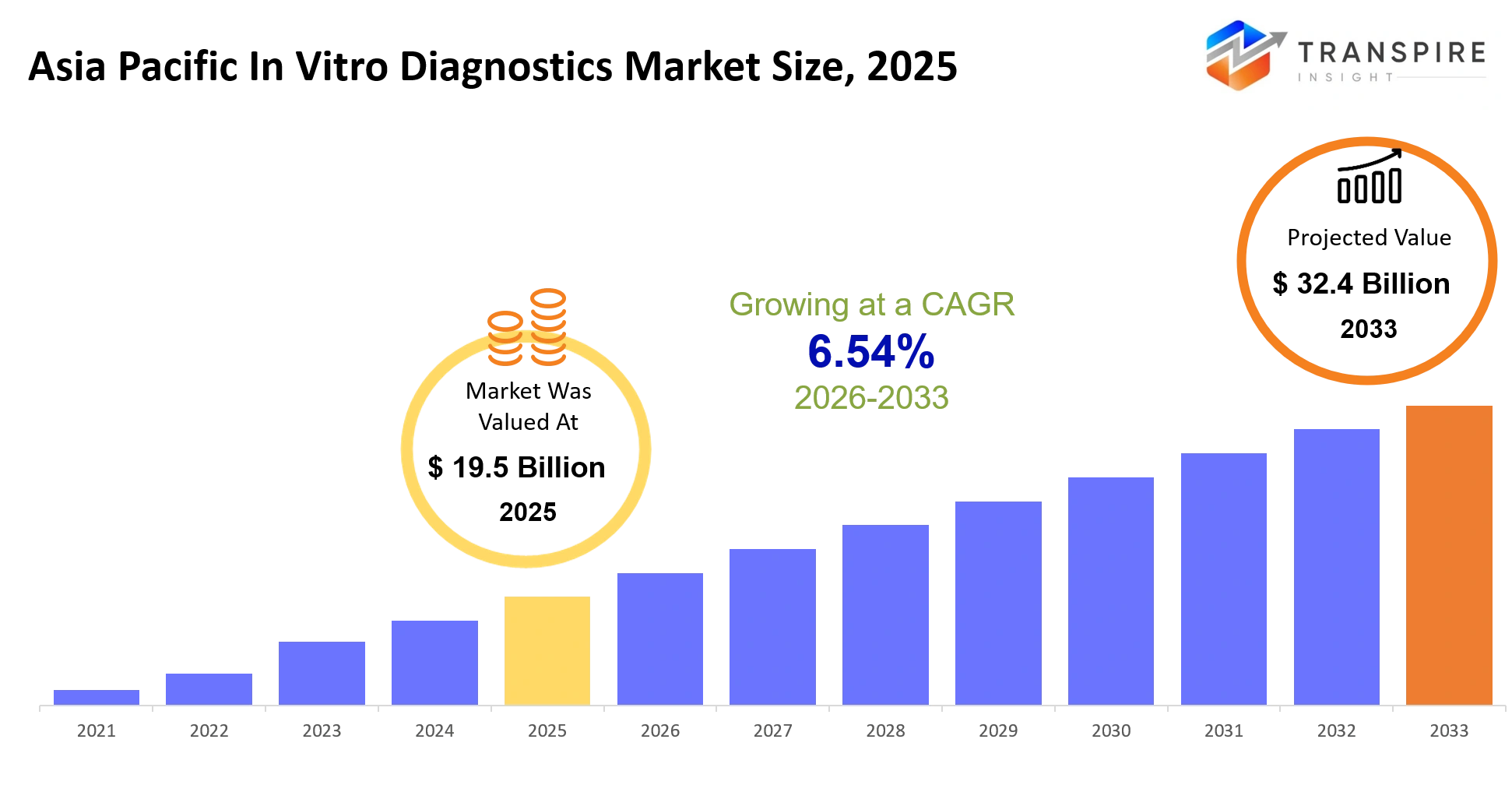
- Asia Pacific In Vitro Diagnostics Market Size 2025: USD 19.5 Billion
- Asia Pacific In Vitro Diagnostics Market Size 2033: USD 32.4 Billion
- Asia Pacific In Vitro Diagnostics Market CAGR: 6.54%
- Asia Pacific In Vitro Diagnostics Market Segments: By Product Type (Reagents, Instruments, Software, Kits, Others); By Technology (Immunoassay, Molecular Diagnostics, Clinical Chemistry, Hematology, Microbiology, Others); By Application (Infectious Diseases, Oncology, Cardiology, Diabetes, Others); By End User (Hospitals, Labs, Clinics, Others).
To learn more about this report,  Download Free Sample Report
Asia Pacific In Vitro Diagnostics Market Summary
The Asia Pacific In Vitro Diagnostics Market was valued at USD 19.5 Billion in 2025. It is forecast to reach USD 32.4 Billion by 2033. That is a CAGR of 6.54% over the period.
In the Asia Pacific In Vitro Diagnostics market, hospitals and also diagnostic networks tend to rely on lab work, plus point-of-care testing, on blood, urine, and tissue specimens, so they can convert patient data into treatment decisions rather quickly. This matters a lot especially when early detection makes the difference, for infectious diseases, but also for long-term chronic conditions. Over the last five years, the region seems to have moved away from purely centralized laboratory testing toward more decentralized, and fairly automated, molecular diagnostics. In practical terms, more testing is now happening closer to the patient, through clinics and bedside platforms, rather than always sending samples away.
Then COVID-19, acted like a big catalyst, because it showed how tight the supply chain can be for reagents. It also pushed demand upward for rapid testing setups and for higher throughput capacity. After that, governments and private players have been expanding investment in local manufacturing, and in digital lab workflows too, which in turn reduces turnaround times, and makes operations more resilient. So now the adoption keeps going, since diagnostics that come back faster improves hospital throughput, and it also tends to lower downstream treatment costs.
Key Market Insights
- The Asia Pacific In Vitro Diagnostics market is kind of dominated by China and Japan, and together they represent over 35% of the combined regional diagnostic test demand in 2025.
- India looks like the fastest-growing place during 2025–2030, mainly because hospital networks are expanding and infectious disease screening programs are spreading, more or less.
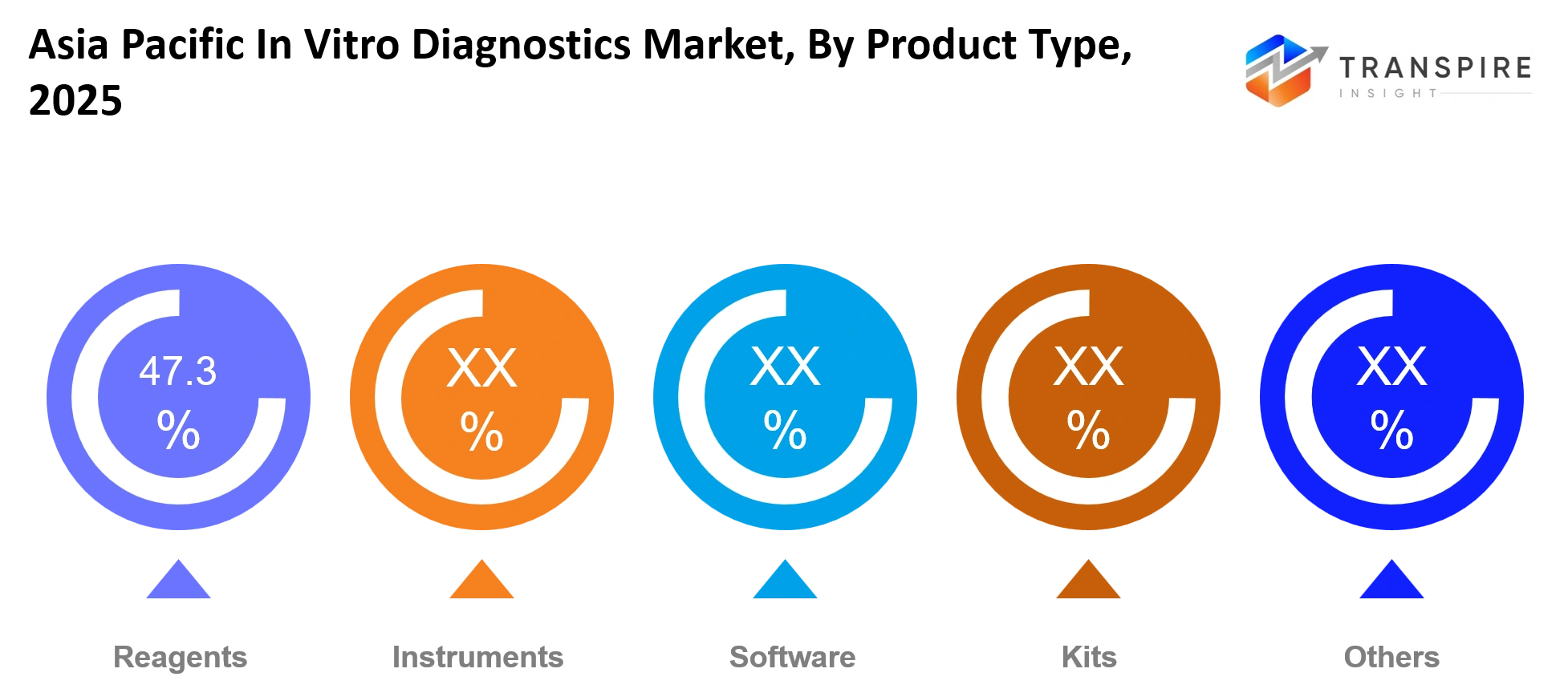
- In the product split, reagents and consumables come in first, with over 45% share, largely due to a repeat purchase dependency inside lab workflows.
- On top of that, molecular diagnostics is the fastest-growing segment. This is backed by higher adoption levels in oncology as well as infectious disease detection.
- Clinical chemistry still sits as the second-largest segment, and it’s broadly used across routine hospital diagnostic testing.
- You know, hospital laboratories they kind of dominate the end-user share at almost 50%, while diagnostic chains keep showing that quickest expansion trend, though it depends.
- On the application side infectious disease testing takes the biggest slice, but oncology diagnostics is the one growing faster, pretty clearly.
- Roche, Abbott, Siemens Healthineers, Danaher, bioMérieux, and Thermo Fisher are pushing competition forward through automation, and also through rapid test innovation—like it’s the main vibe.
- Many players are trying to strengthen their Asia Pacific In Vitro Diagnostics Market footing via local manufacturing, AI-enabled platforms, and those strategic hospital partnerships.
- And the competitive edge is shifting more toward high-throughput systems, integrated lab automation, and faster turnaround diagnostic solutions, overall.
What are the Key Drivers, Restraints, and Opportunities in the Asia Pacific In Vitro Diagnostics Market?
The main driver in the Asia Pacific In Vitro Diagnostics Market is this kind of fast movement toward earlier disease detection, backed up by government supported screening initiatives and hospital modernization, you know. More and more infectious and chronic illnesses are showing up so healthcare providers are pushing toward quicker molecular and immunoassay technologies. That directly ups the test volumes, plus it keeps the consumables revenue coming in again and again. Overall this shift from reactive medicine to preventive diagnostics helps patient outcomes, but it also improves lab throughput efficiency in a pretty tangible way.
One major restraint, though, is the price tag and the built in complexity of advanced diagnostic platforms. Especially molecular systems, which often need trained technicians, plus stable lab infrastructure, like consistent conditions all the time. A lot of secondary and rural healthcare facilities across Asia Pacific have limited funding, and their lab networks are fragmented so the adoption just gets delayed. This structural mismatch makes market penetration less uniform, and it also reduces how much revenue can actually be captured in lower tier settings, where budgets are tighter.
Still, there’s an emerging chance in decentralized testing, particularly point of care expansion. This is showing up strongly in India, Southeast Asia, and rural China. Portable diagnostic devices that connect with digital reporting tools are helping clinicians make faster decisions outside of centralized labs. And when local manufacturing hubs are funded, plus government programs for healthcare digitization keep rolling forward, the market gets clearer scalable adoption routes, which helps the Asia Pacific In Vitro Diagnostics Market stay on track for long term growth.
What Has the Impact of Artificial Intelligence Been on the Asia Pacific In Vitro Diagnostics Market?
Artificial intelligence is kind of reshaping the Asia Pacific In Vitro Diagnostics Market, mostly by pushing diagnostic accuracy, workflow automation and overall lab efficiency across those high-volume testing areas. AI enabled image analysis tools are now pretty common in pathology and hematology, helping with slide interpretation and basically cutting down on the manual review time. This also improves result consistency across big hospital networks, in a way that feels more uniform than before. On top of that, machine learning models optimize laboratory workflows too, for example by suggesting sample prioritization and cutting back bottlenecks in high-throughput diagnostic centers.
Also, predictive analytics is getting used more often to forecast disease patterns and help optimize reagent usage. That approach can lower wastage, and keep testing capacity steady, even when demand spikes. In larger diagnostic chains, AI based quality control systems keep an eye on instrument performance in real time, which tends to minimize downtime. In advanced facilities the operational uptime can improve by roughly 20–30%, depending on how well everything is integrated and maintained.
Still, adoption has a main limitation, and it’s not small. Uneven data standardization, plus integration headaches across fragmented healthcare systems in Asia Pacific can slow things down. A lot of diagnostic centers still rely on legacy laboratory information systems that are not really compatible with AI platforms, so implementation costs rise, and scalability ends up being slower than expected. There’s also the issue of limited availability of high quality labeled medical datasets. Without enough representative training material, model performance can suffer, especially in diverse patient populations.
Key Market Trends
- Hospital networks in China and Japan jumped into automation after 2023 kinda quickly, cutting manual testing reliance by around 25% across big laboratories.
- India then rolled out national infectious disease screening programs starting in 2024, so diagnostic spend shifted hard toward high volume rapid test kits and mobile labs, really noticeable.
- Molecular diagnostics took off post 2022 COVID restructuring, where slower immunoassays were replaced for oncology and respiratory testing workflows across many Asia Pacific sites.
- Roche and Abbott also expanded localized manufacturing hubs during 2023–2025, and that reduced reagent import delays, while also making the regional supply chain feel more resilient, overall.
- Diagnostic groups like Dr. Lal PathLabs and Sonic Healthcare pushed further into digital reporting systems, boosting turnaround efficiency by more than 30% since 2023.
- After 2024, governments introduced tighter laboratory quality compliance rules, which basically forced mid tier labs to upgrade equipment, or simply outsource advanced testing services to others.
- In Southeast Asia, point of care testing use rose after 2023, mainly because rural healthcare access gaps stayed stubborn, and people wanted faster bedside diagnostics.
- AI in pathology workflows accelerated after 2024, helping diagnostic accuracy, plus reducing those human interpretation slip ups in large hospital networks.
- Strategywise, competition moved toward platform based diagnostics, with Siemens Healthineers and Danaher bundling automation, analytics and reagent ecosystems for recurring revenue, you know.
- And after 2023 geopolitical disruptions, cross border supply chain diversification increased too, with companies moving production closer to Asia Pacific demand centers for more stability.
Asia Pacific In Vitro Diagnostics Market Segmentation
By Product Type:
Reagents hold the biggest share of use,more or less, because labs rely on repeated supply to keep daily testing work running. Instruments are seeing a steadier demand climb too, since hospitals keep upgrading their systems so they can push outputs faster, and it shows in buying patterns. Kits and software also add value, they back workflow monitoring and testing consistency, which lets laboratories cut down on lags and speed up reporting across big patient volumes, especially inside Asia Pacific healthcare networks.
Reagents usage keeps trending up, in part because the testing cadence keeps getting higher, not just for infectious disease checks but also for chronic disease surveillance. Instruments are moving away from manual setups toward automated platforms in large hospitals, most noticeably in cities and other urban regions. Meanwhile, software adoption helps with data stewardship and result management, so reporting mistakes go down, and coordination improves between diagnostic departments and clinical teams, kind of in a smoother, continuous way.
To learn more about this report, Download Free Sample Report
By Technology:
Immunoassay still stays widely used, mainly because it is cost effective and fits well with routine disease screening. Molecular diagnostics is seeing the quickest change in adoption because the demand rose for more exact genetic and pathogen detection, honestly it feels like everything is pushing that direction. Clinical chemistry and hematology keep fairly stable usage across hospitals and diagnostic centers for routine health evaluations.
In practice, technology adoption shifted quite a bit after the COVID period, with molecular testing moving from kind of niche use to something closer to standard application in many facilities. Immunoassay systems can still handle large test volumes, yet in the highest precision areas they’re being slowly replaced. Microbiology methods remain important for infection tracking, while automated platforms are improving turnaround time and cutting down on the manual steps that used to slow laboratories down.
By Application:
Infectious disease testing drives demand over and over because of those recurring outbreaks and also because strong screening programs are happening across Asia Pacific countries. For oncology, usage is expanding too, since early cancer detection programs are getting more traction, and people are paying attention sooner. Cardiology and diabetes testing are still staying pretty solid in use, mainly due to the lifestyle related health conditions that are increasing among people in big urban areas.
Overall, application patterns seem to have shifted more toward preventive diagnosis instead of doing testing only at late stage treatment moments. Infectious disease monitoring is still kind of the core in public health systems, while oncology testing keeps climbing, helped by better awareness and easier screening access. Diabetes and cardiac testing volumes grow steadily, since long-term disease management is turning into a major slice of what hospital workloads are built around.
By End User:
Hospitals stay, generally the top end user because patient inflow stays high and they still need in-house diagnostic work. Diagnostic laboratories are showing solid expansion too, as outsourcing testing keeps rising. Clinics and smaller medical centers add to the overall pull, especially where rapid testing solutions and basic diagnostic services are required.
The end user makeup is changing a bit, since diagnostic labs are taking more of the centralized testing role. Hospitals keep putting money into automated systems to handle those large sample loads, with less manual bottleneck. Clinics are leaning on point-of-care devices, so they don’t rely as much on the big laboratories, which helps speed up decisions and gives patients more direct access to everyday diagnostic services in many regions.
What are the Key Use Cases Driving the Asia Pacific In Vitro Diagnostics Market?
In the Asia Pacific In Vitro Diagnostics Market , infectious disease testing still feels like the main thing, because hospitals and public health systems depend on quick detection for outbreak control , and even patient triage. With lots of patients coming through, plus seasonal infections that keep coming back, there’s an ongoing need for faster and more precise diagnostic output, particularly in busy urban healthcare locations.
Cancer screening and chronic disease monitoring are also getting more attention, mostly through hospital networks and dedicated diagnostic laboratories. Oncology testing is picking up steam, largely due to more early detection programs, while diabetes and cardiac tracking are more and more being managed by outpatient clinics and preventive health centers , where the emphasis stays on long term patient care.
Point-of-care testing in rural clinics , and home based diagnostic kits, are starting to look like important new use cases with real future upside. They help with quicker choices when lab access is limited, and digital connected testing devices can speed up reporting , plus make patient follow-up smoother across more distributed healthcare environments.
|
Report Metrics |
Details |
|
Market size value in 2025 |
USD 19.5 Billion |
|
Market size value in 2026 |
USD 20.8 Billion |
|
Revenue forecast in 2033 |
USD 32.4 Billion |
|
Growth rate |
CAGR of 6.54% from 2026 to 2033 |
|
Base year |
2025 |
|
Historical data |
2021 - 2024 |
|
Forecast period |
2026 - 2033 |
|
Report coverage |
Revenue forecast, competitive landscape, growth factors, and trends |
|
Regional scope |
Asia Pacific (India, China, Japan, Australia, South Korea, Rest of Asia Pacific) |
|
Key company profiled |
Roche, Abbott, Siemens Healthineers, Danaher, Thermo Fisher, Bio-Rad, Sysmex, Qiagen, BioMerieux, Agilent, Mindray, Beckman Coulter, BD, PerkinElmer, Fujirebio. |
|
Customization scope |
Free report customization (country, regional & segment scope). Avail customized purchase options to meet your exact research needs. |
|
Report Segmentation |
By Product Type (Reagents, Instruments, Software, Kits, Others); By Technology (Immunoassay, Molecular Diagnostics, Clinical Chemistry, Hematology, Microbiology, Others); By Application (Infectious Diseases, Oncology, Cardiology, Diabetes, Others); By End User (Hospitals, Labs, Clinics, Others). |
Which Regions are Driving the Asia Pacific In Vitro Diagnostics Market Growth?
China and Japan kinda lead the Asia Pacific In Vitro Diagnostics Market mostly because their hospital foundation is solid, plus the diagnostic quality rules are pretty strict. There are huge public health initiatives , and they also have advanced lab networks that keep testing numbers high in big cities and tier-one locations. With integrated hospital groups and decent government support for early disease detection, their edge stays pretty noticeable. And ongoing spending on automated diagnostic platforms also helps keep them on top, across both infectious disease testing , and chronic condition work too.
South Korea and Australia, meanwhile , act as solid secondary contributors. They benefit from steady healthcare spending and regulatory systems that are clearly organized. Compared with the leading markets, growth here is driven more by gradual technology upgrades than by fast volume expansion. Both places still push for strong diagnostic accuracy , and they try to keep laboratory practices standardized in public , as well as private hospitals. Over time, investment in preventive healthcare and insurance-supported testing keeps demand from dropping, and it keeps advanced diagnostic services in steady motion.
India and Southeast Asia are the fastest-moving regions, largely due to quick hospital expansion and better access to diagnostic services. Since 2024, new investments in rural healthcare facilities and government screening efforts have boosted diagnostic reach in a real way. Private diagnostic chains are also expanding fairly aggressively into tier-two and tier-three cities. This overall momentum creates real opening points for global manufacturers that want to sell into cost-sensitive but high-volume diagnostic markets across 2026–2033.
Who are the Key Players in the Asia Pacific In Vitro Diagnostics Market and How Do They Compete?
Competition in the Asia Pacific In Vitro Diagnostics market is kinda moderately consolidated, with big global players holding a solid grip, and then regional names quietly pushing forward using cost effective options. Most incumbents try to keep their share by doing technology upgrades, but some new entrants go straight after price sensitive areas, plus decentralized testing formats… which sounds simple but it really changes how they sell. Overall, the competition is mostly powered by innovation in molecular diagnostics, better automation integration, and solutions that can deliver a faster turnaround time across both hospital and lab networks, you know the typical setup.
Roche goes in with high end molecular diagnostic platforms, where automation is integrated with precision testing, and that combo helps them stay strong especially in oncology and infectious disease segments. Abbott leans into scalable point of care testing devices, supporting quick deployment in clinics and emergency care environments, so they benefit in more decentralized healthcare environments. Siemens Healthineers strengthens its position through integrated laboratory automation systems, and these roll imaging, diagnostics, and data management into one unified workflow, mainly across big hospitals.
Danaher uses a multi brand approach across its diagnostics portfolio, so it can cover both high throughput lab systems and specialized testing equipment. That helps them reach different healthcare tiers without feeling too narrow. bioMérieux stays focused on microbiology and infection diagnostics, giving them a niche advantage in hospital acquired infection monitoring. Thermo Fisher Scientific tends to expand via acquisitions and regional partnerships, which reinforces its supply chain footprint and also improves access to reagent manufacturing hubs across the Asia Pacific region.
Company List
- Roche
- Abbott
- Siemens Healthineers
- Danaher
- Thermo Fisher
- Bio-Rad
- Sysmex
- Qiagen
- BioMerieux
- Agilent
- Mindray
- Beckman Coulter
- BD
- PerkinElmer
- Fujirebio
Recent Development News
In May 2026, Roche announced expansion of its molecular diagnostics manufacturing capacity in Asia to strengthen regional supply resilience. The company stated that localized production of high-throughput testing kits will reduce dependency on cross-border imports and improve turnaround times for hospital laboratories across China and Southeast Asia.
Source: https://www.biospace.com/
In May 2026, Roche announced acquisition of PathAI for up to $1.05 billion. The deal strengthens AI-enabled digital pathology capabilities and expands precision diagnostics across oncology workflows in global and Asia-linked hospital networks.
Source https://www.reuters.com/
What Strategic Insights Define the Future of the Asia Pacific In Vitro Diagnostics Market?
The Asia Pacific In Vitro Diagnostics Market is kinda moving, toward very automated, decentralized, and digitally linked testing setups, pushed by the long term shift from hospital-centric diagnostics to more distributed care networks. This shift is being molded by chronic disease staying high, plus sustained investment in early detection systems that ease hospital loads and boost turnaround speed, in a practical way.
There’s also a risk that’s not as obvious—greater dependency on connected digital platforms and imported high-end reagents, which becomes a weak spot if cross border supply chains tighten or if data compliance rules diverge country by country. Another constraint is that smaller labs may not be able to match the pace of rapid technology upgrades , so you end up with uneven uptake and a patchwork of diagnostic quality standards across the region.
On the opportunity side, there’s momentum around AI-assisted point of care diagnostics paired with more localized manufacturing in Southeast Asia and India, where healthcare expansion is really speeding up. Players should lean into hybrid models that mix low-cost rapid testing devices with cloud analytics, so adoption can scale while margins stay steadier, even across different healthcare environments.
Asia Pacific In Vitro Diagnostics Market Report Segmentation
By Product Type
- Reagents
- Instruments
- Software
- Kits
By Technology
- Immunoassay
- Molecular Diagnostics
- Clinical Chemistry
- Hematology
- Microbiology
By Application
- Infectious Diseases
- Oncology
- Cardiology
- Diabetes
By End User
- Hospitals
- Labs
- Clinics
Frequently Asked Questions
Find quick answers to common questions.
The expected Asia Pacific In Vitro Diagnostics Market size is USD 32.4 Billion in 2033.
Key segments for the Asia Pacific In Vitro Diagnostics Market are By Product Type (Reagents, Instruments, Software, Kits, Others); By Technology (Immunoassay, Molecular Diagnostics, Clinical Chemistry, Hematology, Microbiology, Others); By Application (Infectious Diseases, Oncology, Cardiology, Diabetes, Others); By End User (Hospitals, Labs, Clinics, Others).
Major Asia Pacific In Vitro Diagnostics Market players are Roche, Abbott, Siemens Healthineers, Danaher, Thermo Fisher, Bio-Rad, Sysmex, Qiagen, BioMerieux, Agilent, Mindray, Beckman Coulter, BD, PerkinElmer, Fujirebio.
The Asia Pacific In Vitro Diagnostics Market size is USD 19.5 Billion in 2025.
The Asia Pacific In Vitro Diagnostics Market CAGR is 6.54% from 2026 to 2033.
- Roche
- Abbott
- Siemens Healthineers
- Danaher
- Thermo Fisher
- Bio-Rad
- Sysmex
- Qiagen
- BioMerieux
- Agilent
- Mindray
- Beckman Coulter
- BD
- PerkinElmer
- Fujirebio
About the Authors

Pankaj Ghogare Patil
I am Pankaj Ghogare Patil, a Senior Research Analyst at Transpire Insight, specializing in the Pharmaceutical, Chemicals & Materials, Healthcare IT, and Biotechnology industry. My expertise lies in conducting comprehensive market research, analyzing industry trends, evaluating competitive landscapes, and translating complex data into actionable insights. At Transpire Insight, I closely follow emerging technologies, regulatory developments, and market innovations to create accurate, well-researched, and informative content that helps businesses and professionals make informed decisions. I am committed to producing credible, evidence-based articles that reflect industry best practices while making technical topics accessible and valuable for a broad audience.

Chakradhar Khansole
Chakradhar serves as the Research Director at Transpire Insight, bringing over 8 years of experience in technology, innovation, and strategic market intelligence. He specializes in transforming complex market data into actionable business insights that enable organizations to make informed, growth-oriented decisions. Recognized for his strategic vision and analytical expertise, Chakradhar leads high-impact research initiatives, delivering comprehensive market assessments, competitive intelligence, and forward-looking industry analysis.
Recently Published Reports
-
Apr 2026
AI in Diabetic Retinopathy Market
AI in Diabetic Retinopathy Market Size, Share & Analysis Report By Type (Screening AI Systems, Diagnostic AI Systems, and Predictive AI Models), By Application Segment (Hospitals, Ophthalmology Clinics, Diagnostic Centers, and Research and Development), and Geography (North America, Europe, Asia-Pacific, Middle East and Africa, South and Central America), 2021 - 2031
-
Apr 2026
Psychometric Tests Market
Psychometric Tests Market Size, Share & Analysis Report By Type (Personality Tests, Ability/Aptitude Tests, Skill/Knowledge Tests, and Others), By Application (Talent Acquisition and Talent Management), and Geography (North America, Europe, Asia-Pacific, Middle East and Africa, South and Central America), 2021 – 2031
-
Apr 2026
Rare Biological Sample Collection Market
Rare Biological Sample Collection Market Size, Share & Analysis Report By Type (Isolation Kits & Reagent, Blood Collection Tubes, and Others), By Application (Oncology, Transcriptomics, Pharmacogenomics, and Others), and Geography (North America, Europe, Asia-Pacific, Middle East and Africa, South and Central America), 2021 – 2031
-
Jul 2026
Diabetic Retinopathy Market
Diabetic Retinopathy Market Size, Share & Analysis Report By Type (Proliferative Diabetic Retinopathy, and Diabetic Macular Edema (DME)), By Treatment Type (Anti VEGF Drug, Steroid Implants, Laser Surgeries, and Vitrectomy), and Geography (North America, Europe, Asia-Pacific, Middle East and Africa, South and Central America), 2021 – 2031
Our Clients







