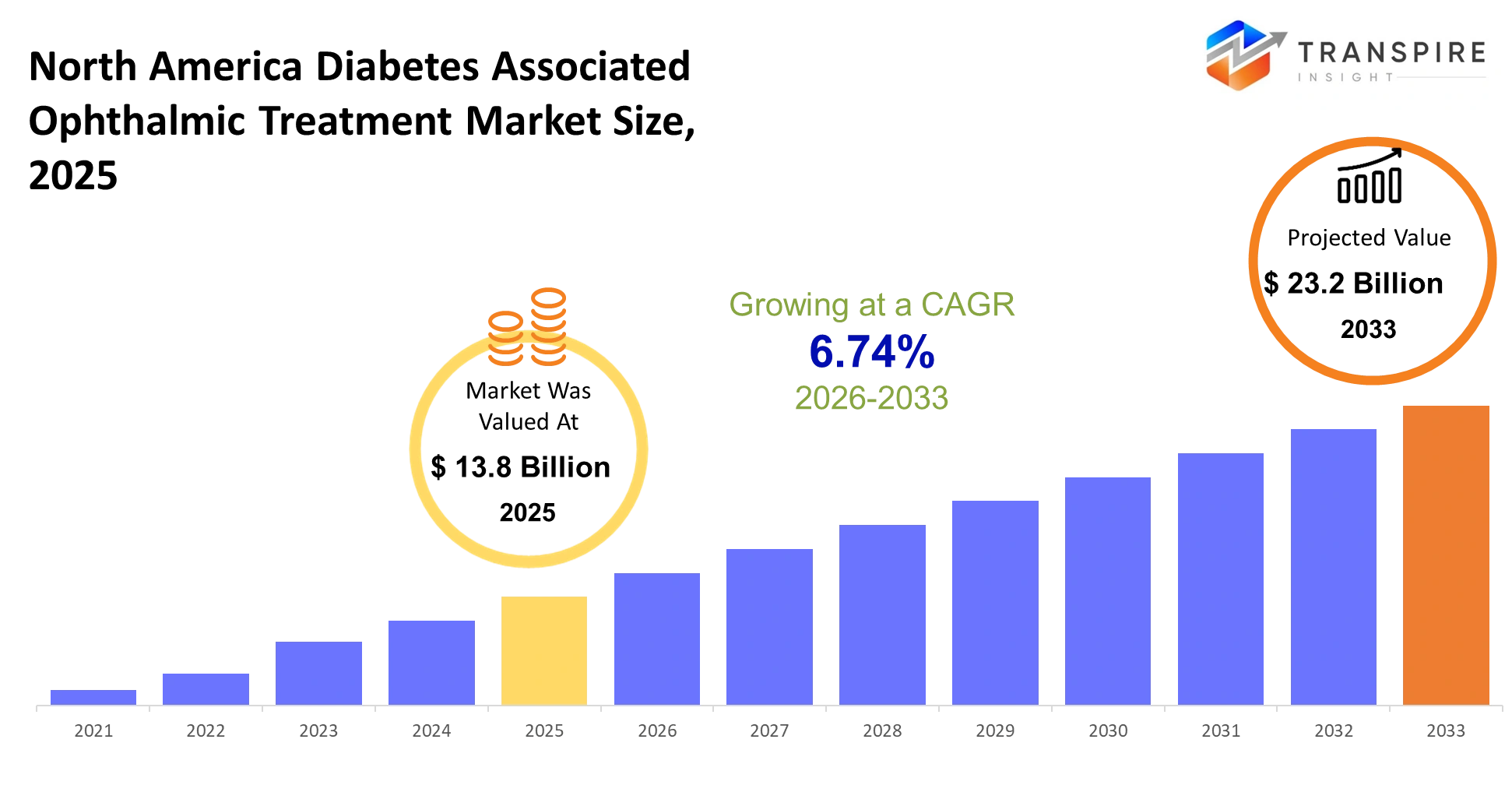
North America Diabetes Associated Ophthalmic Treatment Market Size & Forecast:
- North America Diabetes Associated Ophthalmic Treatment Market Size 2025: USD 13.8 Billion
- North America Diabetes Associated Ophthalmic Treatment Market Size 2033: USD 23.2 Billion
- North America Diabetes Associated Ophthalmic Treatment Market CAGR: 6.74%
- North America Diabetes Associated Ophthalmic Treatment Market Segments: By Treatment Type (Anti-VEGF Therapy, Laser Therapy, Corticosteroid Therapy, Vitrectomy Surgery, Others); By Disease Type (Diabetic Retinopathy, Diabetic Macular Edema, Glaucoma, Cataracts, Others); By End User (Hospitals, Ophthalmology Clinics, Ambulatory Surgical Centers, Others); By Drug Type (Ranibizumab, Aflibercept, Bevacizumab, Dexamethasone Implants, Others)
To learn more about this report,  Download Free Sample Report
North America Diabetes Associated Ophthalmic Treatment Market Summary
The North America Diabetes Associated Ophthalmic Treatment Market was valued at USD 13.8 Billion in 2025. It is forecast to reach USD 23.2 Billion by 2033. That is a CAGR of 6.74% over the period.
The North America Diabetes Associated Ophthalmic Treatment Market is basically about keepin vision for diabetic patients when elevated glucose complications start harming the retina and the nearby eye structures. In everyday settings, these treatments let hospitals ophthalmology clinics, and ambulatory surgery centers better handle diabetic retinopathy and diabetic macular edema, before someone reaches that point where sight loss becomes irreversible, and it then hits things like day to day mobility, job stability, and the long run health care expenses.
Over the last five years, the market vibe moved from late, reactive laser based correction toward earlier biologic options plus AI supported retinal screening that gets folded into diabetes management programs. This change really picked up after COVID-19, where routine eye checkups got disrupted and a backlog formed for people with undiagnosed retinal problems. So providers leaned into remote screening, and faster care pathways. Meanwhile, wider insurance coverage for anti-VEGF treatments and sustained-release ophthalmic drugs has improved patient reach , and also helped with adherence. And since diabetes keeps spreading among aging groups and obese populations, clinicians are pushing earlier detection and then repeating treatment cycles more often. That pattern is driving higher procedure counts, more drug consumption, and ongoing revenue chances across the whole regional eye care ecosystem.
Key Market Insights
The United States kinda dominated the North America Diabetes Associated Ophthalmic Treatment Market with something like 82% market share in 2025, mostly because it’s really advanced the ophthalmic infrastructure and that makes the whole ecosystem move faster.
Canada meanwhile seems like the fastest-growing regional market through 2030, driven by broader diabetic screening programs, plus public reimbursement schemes for retinal therapies, so adoption keeps rolling along.
At the same time, urban specialty eye clinics all across North America keep taking a bigger portion of ophthalmic treatment demand, since retinal imaging technologies have gotten more accessible,and that portion is still climbing year after year.
There’s also cross-border clinical collaboration that’s speeding up ophthalmic drug approvals and generally strengthening regional market growth pathways, which is kinda a big deal if you think about timelines and uptake.
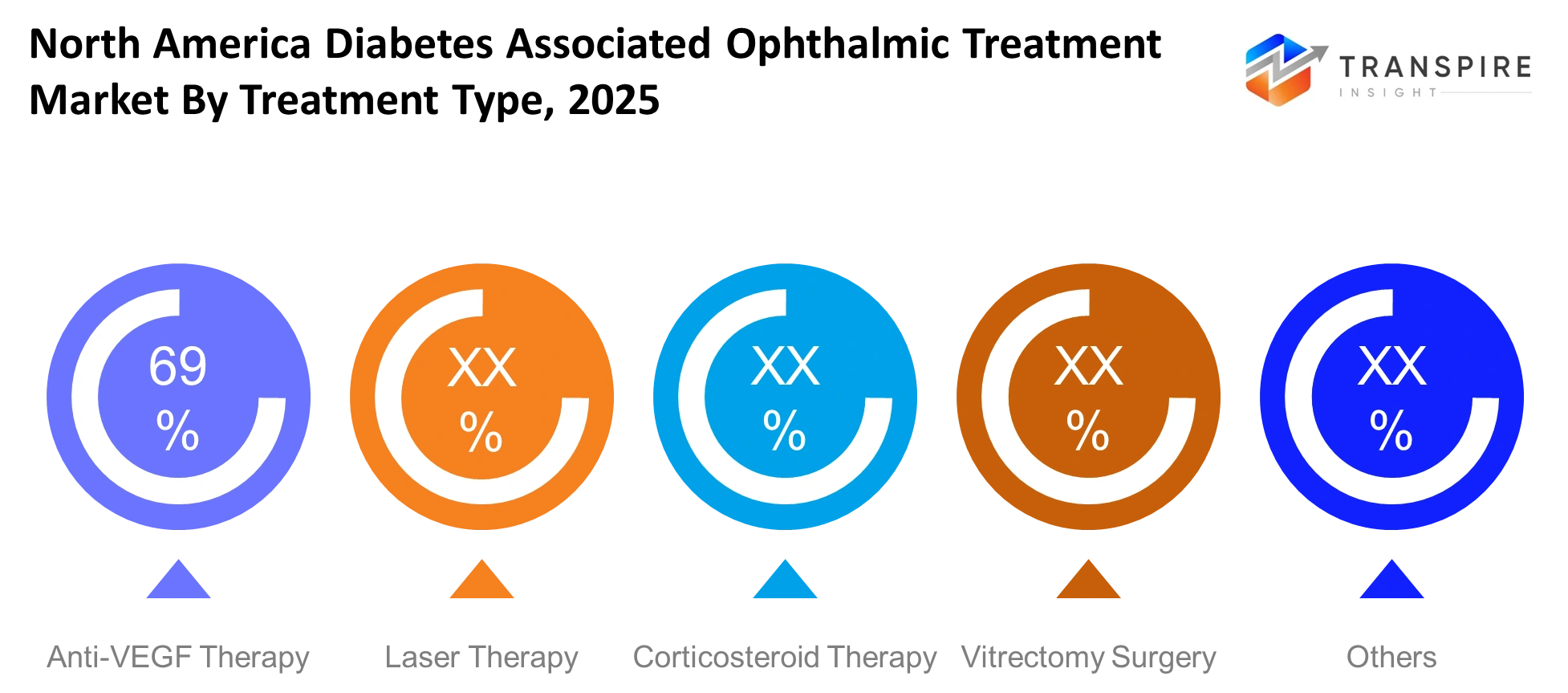
Anti-VEGF drugs sort of took the lead in the North America Diabetes Associated Ophthalmic Treatment Market, and they landed at more than 48% revenue share in 2025.
Corticosteroid implants remained the second-largest segment, mostly because they do a decent job for long term diabetic macular edema management , which is a chronic issue so it makes sense.
Sustained release ophthalmic therapies are projected to be the fastest growing segment between 2026 and 2030, largely because the injection schedule is less frequent. Also, it tends to lessen the overall burden on patients , day to day.
As for condition categories, diabetic retinopathy treatment accounted for roughly 57% of the total industry size in 2025, mainly tied to the continuing increase in long term diabetes complications.
On applications, diabetic macular edema showed up as the fastest growing slice, since biologic therapy adoption keeps climbing across outpatient ophthalmology networks.
Hospitals and specialty ophthalmology clinics held close to 61% market share in 2025, and that’s because they manage high procedure volumes, they also have stronger retinal care capabilities. So yeah, it’s a pretty straightforward match with the demand.
What are the Key Drivers, Restraints, and Opportunities in the North America Diabetes Associated Ophthalmic Treatment Market?
Driver: The strongest force pushing the North America Diabetes Associated Ophthalmic Treatment Market forward seems to be the quick adoption of anti-VEGF biologics into normal diabetic retinopathy and diabetic macular edema care routes. This change really picked up speed once bigger clinical studies showed that early biologic action can safeguard sight better than older laser approaches. And at the same time, wider reimbursement help from Medicare, plus private insurers, has made the patient’s out-of-pocket expenses lower. That lets ophthalmology groups expand their injection oriented programs. What follows is higher patient staying power, recurring therapy cycles and overall stronger revenue streams for specialty eye clinics and pharmaceutical makers.
Restraint: The biggest structural snag still sits in the high ongoing price burden linked to repeated intravitreal injections, and also the more advanced retinal imaging. A lot of diabetic patients need continuous watchfulness and several injections each year. So even with insurance there are affordability hurdles, that do not just “go away”. This situation can’t be corrected overnight, because it’s tied to how reimbursement is set up, specialist availability shortages, and uneven reach to retinal care facilities especially in rural areas. So delayed detection and uneven follow-through on treatment keep dragging down procedure totals and they also restrain full market penetration.
Opportunity: AI enabled retinal screening platforms feel like the most credible growth chance for the next phase of expansion. Health systems across the United States and Canada are steadily putting money into cloud driven retinal imaging tools, which can detect diabetic eye disease during regular primary care checkups.Companies working on automated diagnostic algorithms are helping clinicians spot retinal issues earlier, and this could really make a difference in patient referrals going into ophthalmic care networks over the next ten years. It’s kind of like they’re narrowing the window for late detection, plus providers can be more in tune, so referrals may grow.
What Has the Impact of Artificial Intelligence Been on the North America Diabetes Associated Ophthalmic Treatment Market?
Artificial intelligence , and other advanced digital technologies, are kind of reworking the North America Diabetes Associated Ophthalmic Treatment Market by changing how diabetic eye disease gets spotted, tracked, and handled across big healthcare networks. AI built retinal imaging platforms are now automating diabetic retinopathy screening too, by interpreting fundus images right inside primary care clinics, endocrinology centers, and even retail eye care sites. In a practical sense this automation eases specialist workload and trims referral timelines for ophthalmologists dealing with diabetic macular edema and various retinal problems. A number of U.S. hospital systems have also brought in cloud-based diagnostic software that can flag retinal abnormalities within minutes, so providers can scale screening capacity without a matching rise in staffing expenses.
Then there is machine learning, which also supports predictive disease progression analysis. These tools use retinal scans, glucose history, and patterns of treatment response to sort out patients who appear at higher risk of vision decline. Ophthalmology clinics are leaning on predictive analytics to fine-tune follow up timing and to boost adherence during anti-VEGF injection cycles. That, in turn, helps limit preventable vision loss and keeps treatment continuity more stable. Clinics often mention better diagnostic efficiency and fewer missed screenings once AI assisted imaging workflows are in place.
Still though, not everything is smooth. The integration cost can be steep, and it keeps acting like a real bottleneck. A lot of smaller ophthalmology practices don’t yet have interoperable electronic health record setups or standardized retinal imaging infrastructure, so large scale deployment of AI-driven ophthalmic care platforms across the region moves slower than expected.
Key Market Trends
- Since 2021, anti-VEGF biologics kind of replaced laser photocoagulation in lots of retinal centers, and this has gone on to boost recurring treatment income for ophthalmology networks, not just once but on a repeating basis.
- AI-enabled retinal screening platforms grew really fast after COVID-19 messed up normal diabetic eye checks, and also uncovered big, previously undiagnosed patient backlogs.
- Between 2022 and 2025, Medicare reimbursement updates, made it easier for outpatient clinics to adopt long-acting ophthalmic injection therapies across various specialty settings.
- Companies like Regeneron Pharmaceuticals and Roche then increased spending on sustained-release retinal drugs, aiming to lower injection frequency and make patient adherence feel more steady, and less hassle.
- Meanwhile retail health providers, plus pharmacy-based vision centers expanded their diabetic retinal screening collaborations, which improved access for under-served suburban and rural communities.
- Cloud-based ophthalmic imaging systems started gaining traction after 2023 as providers pushed for quicker referral workflows, and more centralized retinal data handling.
- Hospitals also moved a greater share of diabetic macular edema procedures toward ambulatory surgical centers, mostly to cut down operating costs, and to make patient throughput efficiency a lot smoother.
- In Canada, provincial healthcare systems expanded reimbursement coverage for retinal biologics between 2022 and 2025, so regional treatment accessibility got stronger, and more reliable.
- At the same time, ophthalmology groups increasingly leaned on predictive analytics tools, to spot high-risk diabetic patients before irreversible retinal damage had time to appear.
- Competitive pressure got sharper after biosimilar retinal therapies entered the market, and that forced manufacturers to prioritize pricing flexibility , plus distinct drug delivery systems that are a bit more differentiated.
North America Diabetes Associated Ophthalmic Treatment Market Segmentation
By Treatment Type
Anti-VEGF therapy is still basically leading the way in diabetic ophthalmic care adoption, mostly because retinal specialists are increasingly choosing biologic drugs that help keep sight measurable long term results, and yes that matters in practice. In the United States and Canada, solid reimbursement coverage has kept procedural volumes higher in hospitals as well as in ophthalmology clinics, so uptake just keeps going. Laser therapy remains relevant too, especially for people with more advanced retinal injury or those who have trouble getting access to biologic injections. Corticosteroid therapy and vitrectomy surgery take smaller portions, not because they are unimportant but because both of these approaches tend to aim at very severe, or hard-to-control complications, rather than routine retinal management.
During the forecast period sustained release drug delivery systems are expected to change how this segment works. Pharmaceutical companies are putting more money into treatments designed to lower the injection frequency and support adherence among older diabetic populations. Demand for vitrectomy surgery may stay fairly steady since major diabetic retinal complications still often need surgical care, even while biologic therapy keeps improving. Product developers that concentrate on long lasting effect and outpatient compatibility should build better competitive traction over the coming decade.
To learn more about this report, Download Free Sample Report
By Disease Type
Diabetic retinopathy holds the biggest share within disease segmentation, mainly because diabetes is so common and it keeps fueling retinal screening plus ongoing treatment volumes across North America. Healthcare systems are also using AI supported retinal imaging more and more, which boosts early-stage diagnosis. That means retinal damage can be spotted sooner, before irreversible vision problems really take hold, and this shift is becoming pretty noticeable.Cataracts and glaucoma, linked to diabetic complications, keep showing pretty steady procedural demand across ophthalmic surgery networks, you know.
Diabetic macular edema is expected to grow the quickest during the forecast period, mostly because more biologic therapy is being used and reimbursement backing is getting broader. Ophthalmology providers are rolling out more integrated retinal care programs, where imaging diagnostics, injection therapy, and long‑term monitoring services all end up in the same workflow. Cataract-related procedures could rise too, since aging diabetic groups often need surgical correction sooner than non-diabetic patients do. Investors keep leaning into retinal disease technologies that help enable preventive detection and a recurring treatment path.
By End User
Hospitals currently lead end-user adoption, mainly because big healthcare systems have advanced retinal imaging gear, surgical infrastructure and, multidisciplinary diabetes management capabilities. Ophthalmology clinics also take a solid slice of demand, thanks to patients increasingly wanting specialized retinal treatment and shorter waiting periods. Ambulatory surgical centers are steadily increasing procedural volumes, since payers and providers are chasing lower-cost outpatient care models. Other end users, like retail screening centers and community healthcare facilities, are still smaller players, but they are continuing to expand preventive diabetic eye services.
Healthcare delivery models are gradually moving toward more decentralized outpatient ophthalmic care. Specialty clinics and ambulatory centers are investing a lot in AI-assisted retinal diagnostics, and high-volume injection workflows, to boost operational efficiency.Future expansion is likely to push the market toward providers that can merge diabetic screening, retinal imaging, and biologic administration into one kinda unified treatment ecosystem. Buyers are also starting to lean more and more toward scalable ophthalmic infrastructure that can handle repeat patient management, and also speed up referral coordination, without all the extra friction.
By Drug Type
Aflibercept still seems to hold a solid market stance, since ophthalmologists broadly prescribe it for diabetic macular edema and various retinal vascular issues. Ranibizumab continues to keep notable share too, largely due to its long time clinical acceptance and generally strong visual acuity outcomes across big patient groups. Bevacizumab keeps climbing in cost sensitive healthcare settings because the lower pricing improves access to care for people who are uninsured or underinsured. Dexamethasone implants still feel like a mainstay for chronic inflammatory retinal problems, particularly for people who want corticosteroid delivery that keeps going, rather than those shorter, kinda temporary bursts.
Competitive strategies are also starting to slide, especially since biosimilar products and longer acting retinal drugs are starting to enter commercial pipelines. Pharmaceutical companies seem to be zeroing in on formulations that reduce the whole treatment burden but still hold on to therapeutic effectiveness across longer stretches of time. Because of that, the uptake of the dexamethasone implant could end up climbing again, as ophthalmology clinics widen outpatient programs for ongoing, chronic disease care. During the forecast period, factors such as drug affordability, reimbursement alignment, and dosing durability will likely guide how clinicians choose, and those choices will then shape the market competition.
What are the Key Use Cases Driving the North America Diabetes Associated Ophthalmic Treatment Market?
Anti-VEGF therapy for diabetic retinopathy and diabetic macular edema remains the primary use case driving treatment adoption across North America. Hospitals and ophthalmology clinics generate the highest procedure volumes because early biologic intervention helps preserve vision and reduces long-term blindness-related healthcare costs among diabetic patients.
Secondary applications are expanding across ambulatory surgical centers and outpatient retinal care networks. Corticosteroid implants and laser therapies are gaining traction for chronic retinal inflammation management and advanced diabetic eye complications, particularly among aging populations requiring long-term follow-up treatment and lower-cost outpatient procedures.
Emerging use cases include AI-assisted retinal screening within primary care networks and teleophthalmology programs serving rural diabetic populations. Healthcare providers are also testing predictive analytics platforms that identify high-risk retinal disease progression earlier, allowing faster referrals into specialized ophthalmic treatment pathways over the forecast period.
|
Report Metrics |
Details |
|
Market size value in 2025 |
USD 13.8 Billion |
|
Market size value in 2026 |
USD 14.7 Billion |
|
Revenue forecast in 2033 |
USD 23.2 Billion |
|
Growth rate |
CAGR of 6.74% from 2026 to 2033 |
|
Base year |
2025 |
|
Historical data |
2021 - 2024 |
|
Forecast period |
2026 - 2033 |
|
Report coverage |
Revenue forecast, competitive landscape, growth factors, and trends |
|
Regional scope |
North America (Canada, The United States, and Mexico) |
|
Key company profiled |
Roche, Regeneron Pharmaceuticals, Novartis, Bayer, Alimera Sciences, AbbVie, Bausch + Lomb, Pfizer, Alcon, Santen Pharmaceutical, EyePoint Pharmaceuticals, Ocular Therapeutix, Kodiak Sciences, Oxurion, Genentech |
|
Customization scope |
Free report customization (country, regional & segment scope). Avail customized purchase options to meet your exact research needs. |
|
Report Segmentation |
By Treatment Type (Anti-VEGF Therapy, Laser Therapy, Corticosteroid Therapy, Vitrectomy Surgery, Others); By Disease Type (Diabetic Retinopathy, Diabetic Macular Edema, Glaucoma, Cataracts, Others); By End User (Hospitals, Ophthalmology Clinics, Ambulatory Surgical Centers, Others); By Drug Type (Ranibizumab, Aflibercept, Bevacizumab, Dexamethasone Implants, Others) |
Which Regions are Driving the North America Diabetes Associated Ophthalmic Treatment Market Growth?
The United States is still kind of the main region in the North America Diabetes Associated Ophthalmic Treatment Market, mainly because the strong reimbursement systems, plus an already advanced retinal care setup, and also those high rates for biologic therapy take-up. Big hospital networks and dedicated ophthalmology clinics keep putting money into AI-assisted retinal imaging, and into outpatient injection programs as well , so they can keep up with large treatment volumes. On top of that, federal health programs like Medicare have widened access to anti-VEGF options and diabetic retinal screening services , which helps the whole long term way of managing patients. There is also a mature pharmaceutical ecosystem, strong clinical research activity, and an early shift toward sustained-release ophthalmic drugs, all of which continue to advance the regional lead.
Canada remains the second-largest in size, but honestly, the market behaviour feels different. The provincial healthcare systems focus on a more steady reimbursement growth and preventive diabetic eye screening, instead of leaning hard on high volume private ophthalmology networks. Because publicly funded retinal care programs have been improving, patient treatment continuity for diabetic macular oedema and retinopathy is better across both urban and suburban care settings. With consistent healthcare spending, more teleophthalmology initiatives rolling out, and coordinated chronic condition management programs, Canada keeps showing up as a steady contributor to regional ophthalmic treatment revenue.
Mexico looks like it’s moving fastest lately , driven by rising diabetes prevalence, better ophthalmic infrastructure, and wider access to private specialty care services, so the regional numbers are climbing quicker than the rest.Recent investments in urban retinal treatment centers and digital diagnostic technologies have accelerated diabetic eye disease detection rates across major metropolitan areas. Private healthcare providers are increasingly partnering with international pharmaceutical companies to improve access to biologic retinal therapies and outpatient ophthalmic procedures. This growth trajectory is creating strong opportunities for device manufacturers, retinal imaging providers, and pharmaceutical companies seeking expansion between 2026 and 2033.
Who are the Key Players in the North America Diabetes Associated Ophthalmic Treatment Market and How Do They Compete?
The competitive landscape of the North American Diabetes-Associated Ophthalmic Treatment Market still feels moderately consolidated, with a small set of pharmaceutical players capturing a large share of retinal biologic therapy revenue. Lately, the whole fight seems to be less about plain pricing and more about treatment durability, how often patients actually get dosed, whether reimbursement lines up cleanly and how well solutions integrate with outpatient ophthalmology networks, not just margins. On top of that, the established drug manufacturers are protecting their positions using next-generation sustained-release options, while biosimilar developers and even digital retinal imaging companies are adding pressure in the cheaper treatment plus diagnostic areas. In practice, technology progress and the ability to manage patients over the long term are becoming the main differentiators in the regional ophthalmic treatment ecosystem.
Regeneron Pharmaceuticals keeps pushing its market footing via extended-duration anti-VEGF therapies meant to cut injection frequency and support patient adherence, which sounds simple but it actually matters a lot. They also lean on strong relationships with retinal specialists and big ophthalmology clinic networks, giving them an edge in high-volume outpatient settings where consistency is everything. Roche, meanwhile, differentiates with a dual-focus approach—biologic ophthalmic drugs alongside AI-enabled diagnostic technologies—so that earlier retinal disease detection can happen. Their strategic tie-ups with digital health partners and retinal imaging firms are also expanding integrated diabetic eye care solutions across North America, bit by bit.
Novartis concentrates heavily on sustained-release retinal drug development along with longer-horizon ophthalmic research partnerships, aiming to keep treatment continuity steady for diabetic macular edema management.AbbVie leverages corticosteroid implant technologies that target chronic inflammatory retinal complications often underserved by standard biologic therapy. Bausch + Lomb is expanding through broader ophthalmic care integration, combining surgical devices, retinal treatment products, and vision care services within outpatient ophthalmology networks. These strategies are helping manufacturers secure stronger positioning across both preventive retinal diagnostics and recurring therapeutic treatment pathways.
Company List
- Roche
- Regeneron Pharmaceuticals
- Novartis
- Bayer
- Alimera Sciences
- AbbVie
- Bausch + Lomb
- Pfizer
- Alcon
- Santen Pharmaceutical
- EyePoint Pharmaceuticals
- Ocular Therapeutix
- Kodiak Sciences
- Oxurion
- Genentech
Recent Development News
In April 2026, Regeneron Pharmaceuticals announced FDA approval for extended dosing intervals of EYLEA HD (aflibercept) up to every 20 weeks for diabetic macular edema treatment. The approval strengthened Regeneron’s position in long-duration retinal biologics by reducing injection frequency and improving outpatient treatment efficiency. https://investor.regeneron.com
In April 2026, Roche announced expanded ophthalmology research presentations at ARVO 2026 featuring Vabysmo and Susvimo retinal therapies for diabetic eye diseases. The company highlighted real-world retinal drying data and continuous drug delivery technologies that could reduce treatment burden across ophthalmology networks. https://www.roche.com
What Strategic Insights Define the Future of the North America Diabetes Associated Ophthalmic Treatment Market?
North America Diabetes Associated Ophthalmic Treatment Market seems to be drifting, not in a straight line exactly, toward more integrated, data-driven retinal care, and it’s being organized around earlier detection, longer-lasting biologic therapies, and also more decentralized outpatient treatment delivery. At the same time, the rising diabetic population—plus payer pressure to cut down the healthcare costs tied to blindness—are pushing fresh investment into AI-assisted retinal screening, plus sustained-release ophthalmic drugs, so that the overall treatment frequency can drop. In the next five to seven years, I’d say competitive edge will depend more and more on whether firms can blend diagnostics, predictive analytics, and ongoing therapeutic care inside basically one ophthalmology platform, even if they brand it differently.
There is also a less obvious risk that isn’t discussed as often. The market is gradually concentrating around just a handful of anti-VEGF biologic manufacturers. If providers and payers end up relying too heavily on a small set of premium retinal therapies, it can create exposure to pricing pressure, reimbursement disputes, or even supply disruptions, especially if biosimilar uptake progresses at an uneven speed across regions. But, there’s an opportunity that feels pretty tangible too: retinal screening programs are starting to spill into primary care and retail health settings, using cloud-connected AI imaging systems. Organizations that form partnerships with diabetes care networks and invest early in interoperable diagnostic ecosystems could end up with stronger long-term patient stickiness and better treatment volume growth, even when the competitive noise gets louder.
North America Diabetes Associated Ophthalmic Treatment Market Report Segmentation
By Treatment Type
- Anti-VEGF Therapy
- Laser Therapy
- Corticosteroid Therapy
- Vitrectomy Surgery
- Others
By Disease Type
- Diabetic Retinopathy
- Diabetic Macular Edema
- Glaucoma
- Cataracts
- Others
By End User
- Hospitals
- Ophthalmology Clinics
- Ambulatory Surgical Centers
- Others
By Drug Type
- Ranibizumab
- Aflibercept
- Bevacizumab
- Dexamethasone Implants
- Others
Frequently Asked Questions
Find quick answers to common questions.
The expected North America Diabetes Associated Ophthalmic Treatment Market size is USD 23.2 Billion in 2033.
Key segments for the North America Diabetes Associated Ophthalmic Treatment Market are By Treatment Type (Anti-VEGF Therapy, Laser Therapy, Corticosteroid Therapy, Vitrectomy Surgery, Others); By Disease Type (Diabetic Retinopathy, Diabetic Macular Edema, Glaucoma, Cataracts, Others); By End User (Hospitals, Ophthalmology Clinics, Ambulatory Surgical Centers, Others); By Drug Type (Ranibizumab, Aflibercept, Bevacizumab, Dexamethasone Implants, Others).
Major North America Diabetes Associated Ophthalmic Treatment Market players are Roche, Regeneron Pharmaceuticals, Novartis, Bayer, Alimera Sciences, AbbVie, Bausch + Lomb, Pfizer, Alcon, Santen Pharmaceutical, EyePoint Pharmaceuticals, Ocular Therapeutix, Kodiak Sciences, Oxurion, Genentech
The North America Diabetes Associated Ophthalmic Treatment Market size is USD 13.8 Billion in 2025.
The North America Diabetes Associated Ophthalmic Treatment Market CAGR is 6.74% from 2026 to 2033.
- Roche
- Regeneron Pharmaceuticals
- Novartis
- Bayer
- Alimera Sciences
- AbbVie
- Bausch + Lomb
- Pfizer
- Alcon
- Santen Pharmaceutical
- EyePoint Pharmaceuticals
- Ocular Therapeutix
- Kodiak Sciences
- Oxurion
- Genentech
Recently Published Reports
-
Apr 2026
AI in Diabetic Retinopathy Market
AI in Diabetic Retinopathy Market Size, Share & Analysis Report By Type (Screening AI Systems, Diagnostic AI Systems, and Predictive AI Models), By Application Segment (Hospitals, Ophthalmology Clinics, Diagnostic Centers, and Research and Development), and Geography (North America, Europe, Asia-Pacific, Middle East and Africa, South and Central America), 2021 - 2031
-
Apr 2026
Psychometric Tests Market
Psychometric Tests Market Size, Share & Analysis Report By Type (Personality Tests, Ability/Aptitude Tests, Skill/Knowledge Tests, and Others), By Application (Talent Acquisition and Talent Management), and Geography (North America, Europe, Asia-Pacific, Middle East and Africa, South and Central America), 2021 – 2031
-
Apr 2026
Rare Biological Sample Collection Market
Rare Biological Sample Collection Market Size, Share & Analysis Report By Type (Isolation Kits & Reagent, Blood Collection Tubes, and Others), By Application (Oncology, Transcriptomics, Pharmacogenomics, and Others), and Geography (North America, Europe, Asia-Pacific, Middle East and Africa, South and Central America), 2021 – 2031
-
May 2026
Patient Lift Pendant Market
Patient Lift Pendant Market By Product Type (Wired Pendants, Wireless, Programmable), By Operation Type(Manual, Electric), By End-Users (Healthcare Professionals, Patients), By Application (Hospitals, Homecare, Rehabilitation Centers, Others), By Industry Analysis, Size, Share, Growth, Trends, and Forecasts 2021-2033
Our Clients
.jpg)