
Middle East and Africa Structured Cabling Market Size & Forecast:
- Middle East and Africa Structured Cabling Market Size 2025: USD 1.83 Billion
- Middle East and Africa Structured Cabling Market Size 2033: USD 3.39 Billion
- Middle East and Africa Structured Cabling Market CAGR: 8.06%
- Middle East and Africa Structured Cabling Market Segments: By Product Type (Copper Cables, Fiber Optics, Patch Panels, Connectors, Racks, Cable Management, Network Outlets, Others); By Application (Data Centers, LAN, Telecom, Industrial Networks, Smart Buildings, Security Systems, Healthcare Facilities, Others); By End User (IT & Telecom, BFSI, Healthcare, Government, Manufacturing, Education, Retail, Others); By Cable Category (Cat5e, Cat6, Cat6A, Cat7, Cat8, Fiber Optics, Coaxial, Others).

Middle East and Africa Structured Cabling Market Summary
The Middle East and Africa Structured Cabling Market was valued at USD 1.83 Billion in 2025. It is forecast to reach USD 3.39 Billion by 2033. That is a CAGR of 8.06% over the period.
Structured cabling is kind of the physical backbone that ties together data centers, enterprise networks, telecom setups , industrial plants, hospitals, and even smart buildings, you know the whole usual cast. It supports the moving of voice, data, video, and cloud based applications in a steady kind of manner, which then cuts downtime and makes later upgrades less stressful and more organized. Also, across the Middle East and Africa, more organizations are leaning on structured cabling systems , because they’re trying to drive digital transformation, roll out large connectivity projects, and keep data hungry operations running without drama.
In the last five years though, the market has sort of shifted, from the classic copper heavy installations toward hybrid and fiber rich architectures. These newer setups are built for cloud computing, artificial intelligence work, edge computing, and those high density data centers where everything is tightly packed. One of the big triggers for this change is the fast growth of hyperscale data centers and broader digital infrastructure spending in the Gulf region, especially in Saudi Arabia and the UAE. When enterprises start running bandwidth heavy applications, and when governments push smart city programs, network operators end up needing cabling that can scale smoothly, with faster speeds and better low latency. So, overall, this movement is pushing up the value of installations, increasing fiber usage, and opening more revenue possibilities across enterprise, industrial, and telecom environments.
Key Market Insights
- The Gulf region seems to lead the Middle East and Africa Structured Cabling Market, with an estimated 42%+ share by 2025, largely backed by big digital backbone spending and that kind of large scale push.
- Sub-Saharan Africa shows up as the fastest-growing regional market through 2033, mainly due to broadband rollout, telecom modernization, and cloud adoption, though the pace feels uneven in places.
- Fiber optic solutions are still in front, taking nearly 35% market share, because higher bandwidth needs keep rising and long-distance transmission is just more efficient.
- Copper cabling stays as the second biggest slice, around 28% of industry revenue in 2025, and it shows up a lot in enterprise LAN setups.
- Fiber optic installations are forecasted to post the highest growth rate, above 10% every year during the period, as firms migrate toward high-speed networks.
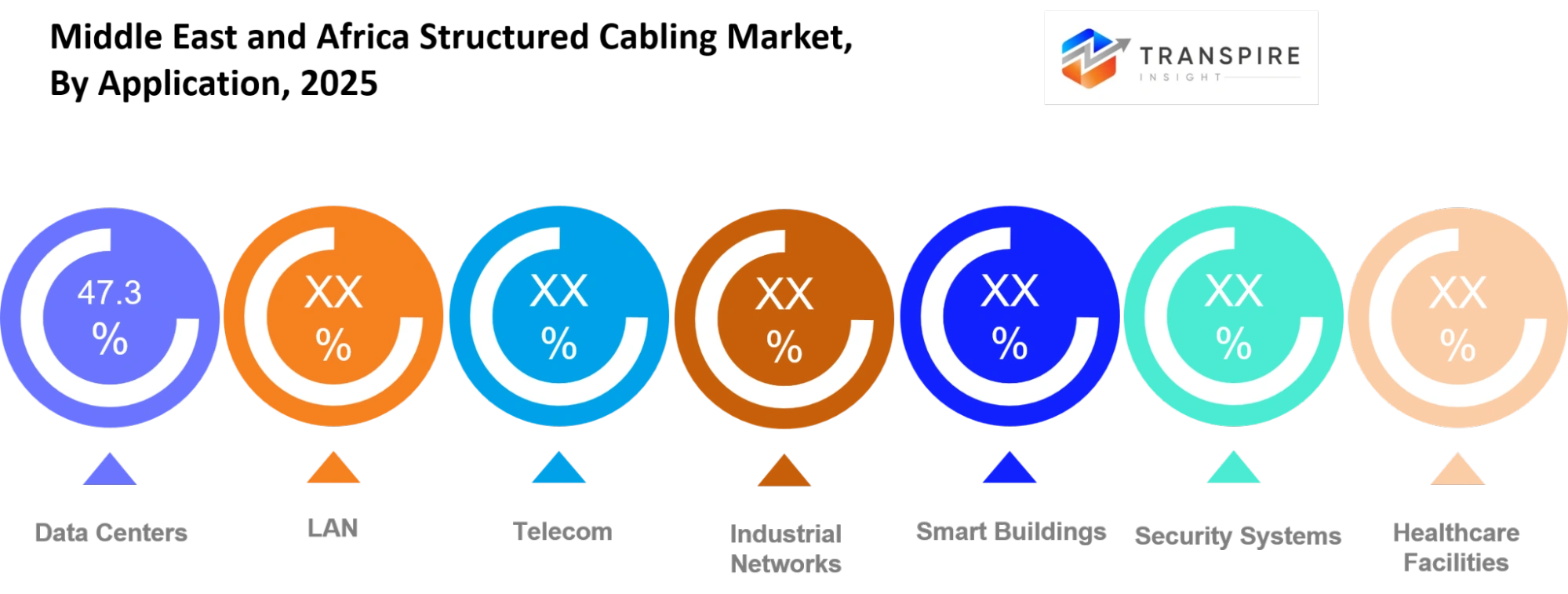
- For applications, data centers look like the main segment, with an estimated 30% market share, supported by hyperscale plus colocation buildouts.
- Smart building deployments are becoming the quickest moving application area as governments expand connected infrastructure and intelligent facility management, and they are not slowing down.
- IT & Telecom remains the primary end-user group, contributing more than 32% of overall demand, helped by 5G and cloud infrastructure investments.
- Healthcare and government are also expanding structured network deployments for digital records, surveillance systems, and secure communications, even when procurement cycles are slow.
- Key players such as CommScope, Corning Incorporated, Legrand, Panduit, Belden, and Nexans are growing their offerings via fiber innovation, AI-ready infrastructure, and regional collaborations.
What are the Key Drivers, Restraints, and Opportunities in the Middle East and Africa Structured Cabling Market?
The most powerful growth trigger is basically the rapid spread of hyperscale data centers , cloud computing facilities, and government digital pushes across the Gulf region. In Saudi Arabia , the Vision 2030 push, the UAE smart-city efforts , and the steady uptake of enterprise cloud have made it so there is strong demand for top-tier network infrastructure to handle AI workloads, real-time insights, and massive data transfer needs. Usual cabling setups often don’t have the needed throughput or expansion options for all that. So as organizations modernize their IT environment, the budget moves toward fiber-heavy and upgraded cabling options, which then boosts both installation volumes and overall job values.
The biggest structural snag is still the tough up-front spend tied to new fiber runs and wider network modernization. A lot of African markets still struggle with budget pressure, some missing know-how , and uneven build-out patterns. This isn’t just like a quick supply gap either , it’s more about wider economic and institutional constraints that usually take years of steady backing to fix. So you see modernization programs getting pushed back, smaller and mid-sized companies adopting slower, and less network upgrade momentum across the developing regions.
A real chance shows up with AI-ready data center setups and edge computing rollouts. Local governments and private backers are putting billions of dollars into digital infrastructure, especially across Saudi Arabia , the UAE , South Africa, and Egypt. These high-density AI computing areas depend on faster fiber links , smart cable organization, and low-latency network designs.
What Has the Impact of Artificial Intelligence Been on the Middle East and Africa Structured Cabling Market?
Artificial intelligence is kinda changing how people plan, roll out, and keep up with network infrastructure in structured cabling setups, overall. A lot of data center operators now lean on AI-powered monitoring systems to look at traffic trends, spot slowdowns, and then automate capacity planning. In practice, these platforms let operators stretch cable use better, boost asset visibility, and also cut down on the amount of hands-on, manual network busywork they have to do.
On top of that, machine learning is backing predictive maintenance efforts. When the systems track temperature swings, signal degradation, port utilization, and equipment performance readings, they can point toward likely failures before those failures turn into service interruptions. That translates into better network uptime , fewer maintenance expenses, and a longer run for the infrastructure life cycle. In bigger sites, predictive analytics can lower the chance of surprise outages, while also improving day to day operational flow and overall service continuity.
Then there are the more advanced digital approaches, like automated documentation, digital twin modeling, and smart network mapping. These help teams make expansion projects feel less chaotic, and they can speed up deployment timelines for data centers, telecom locations, and even smart buildings. AI-guided infrastructure planning is especially useful in hyperscale environments where you’re dealing with thousands of connections and you really need constant monitoring, plus ongoing tuning.
Still, adoption doesn’t always move fast, because integration costs can be heavy, data quality gets messy sometimes, and there’s still a shortage of specialized networking know-how. Lots of orgs keep using legacy infrastructure that doesn’t include the sensors and monitoring functions needed for smooth AI deployment. So even with the obvious operational upside, these constraints tend to slow things down.
Key Market Trends
- Between 2021 and 2025, fiber optic deployments went up pretty a lot, mostly because cloud computing and AI workloads needed more capacity, like immediately.
- Gulf countries also pushed forward hyperscale data center spend, growing it by over 30% since 2022, and that basically meant bigger structured cabling project pipelines showing up everywhere.
- At the enterprise level, people gradually swapped legacy Cat5e networks for Cat6A or even Cat7 systems, so they can run faster applications without all the slowdowns.
- Around the same time, smart building projects started moving more quickly across Saudi Arabia and the UAE, and they tied cabling in with security, automation, energy management, all in one go, kind of.
- During 2025, AI-focused facilities began using 400G and 800G network architectures, and that choice then influenced what cabling specs everyone had to follow.
- Network operators shifted too, moving away from isolated infrastructure deployments toward integrated connectivity ecosystems, where fiber, power, and edge computing all live together in the plan.
- And yeah, supply chain disruptions from 2022 through 2025 drove procurement diversification and more regional sourcing strategies, instead of relying on one route.
- Manufacturers, meanwhile, started rolling out high-density fiber solutions that reduce installation complexity and also make it easier for future scaling.
- Strategic partnerships expanded as well, since vendors teamed up on AI-ready data center infrastructure projects. Finally, sustainability targets pushed adoption of modular cabling systems, because upgrades become simpler, and material waste can shrink.
Middle East and Africa Structured Cabling Market Segmentation
By Product Type
Copper cables keep showing up in enterprise networking , local area networks, and commercial building installations, mainly because they’re affordable, and the compatibility is broad. At the same time, fiber optics tend to outperform with more bandwidth, reduced latency, and signal reach that goes way farther, so fiber becomes the go to option for data centers and telecom infrastructure.
Patch panels together with connectors help you keep the whole network tidy, they also make troubleshooting and maintenance a bit easier, which boosts the overall dependability of the system. Racks add structured equipment housing, and they also help manage airflow inside network spaces, so things stay cooler and more stable. Cable management options improve installation quality , they cut down the messy maintenance workload, and they’re useful when you plan future network expansions.
Network outlets act like the real access points across commercial sites. Then there are the other bits too, specialized accessories, which basically add more network flexibility and support stronger operational performance over time.
By Application
Data centers are a huge deployment area, because high density computing spaces really need dependable, and scalable, connectivity infrastructure, it’s not optional. LAN environments still lean on structured cabling for enterprise communication , file sharing and also digital teamwork platforms. Telecom applications back broadband delivery, mobile backhaul networks, and big communications systems too.
In industry, network setups are leaning more and more on structured connectivity so automation, monitoring, and operational technology systems can work smoothly. Smart buildings tie the networking groundwork with lighting, security, and energy management platforms, kind of all in one. Healthcare facilities, meanwhile, use advanced cabling for medical records, connected devices and diagnostic systems, plus there are other uses like transportation, education, and public infrastructure projects as well.
By End User
IT & Telecom organizations account for a pretty substantial share of installations, largely because cloud expansion is pushing things forward, plus digital transformation programs and telecom network upgrades just keep rolling. BFSI institutions, meanwhile, spend on secure yet resilient connectivity setups, the kind that back up digital banking, cybersecurity, and real-time transactions, without the usual drama. In healthcare facilities, dependable infrastructure matters a lot for connected medical systems and for handling patient data management.
Government agencies keep going with network modernization initiatives , to support smart governance and public service delivery, at least that’s the idea. Manufacturing facilities lean on structured networks for automation, and for industrial control systems too. Education institutions and retail organizations are also increasingly moving toward high-performance connectivity, in order to support digital learning, omnichannel operations, and customer engagement platforms. Other sectors then add their own specialized deployment requirements, sometimes with very specific constraints and timing, depending on the project.
By Cable Category
Cat5e is still around in legacy setups, but there’s a growing push to swap it out for higher performance options. Cat6, and also Cat6A, fit enterprise networking better since they bring improved bandwidth and future scalability. Cat7 is often picked for demanding workloads where protection against electromagnetic interference really matters.
Cat8 use is getting bigger in advanced data centers, specifically where ultra-high-speed links are basically a must. Fiber optics keep rising in preference mainly due to bandwidth strengths, longer span transmissions, and support for newer digital workloads. Coaxial cables are still used in certain communication and broadcasting situations, while some other cable types handle specialized networking needs.
What are the Key Use Cases Driving the Middle East and Africa Structured Cabling Market?
Data centers are still kind of the main reason people adopt this market in the first place. Hyperscale locations, colocation providers, and cloud service operators all need network infrastructure that stays very dependable, especially for AI workloads, big storage environments, and rapid data transfers. And honestly these kinds of initiatives create a lot of demand because every single server, switch, and storage platform relies on structured connectivity in one form or another.
Beyond that, other uses are popping up across telecom networks, smart buildings , and industrial settings. Telecom operators are rolling out more advanced cabling systems so they can push broadband forward and build out 5G support. At the same time, manufacturing sites are weaving structured networking into automation routines and monitoring platforms, so everything stays coordinated.
Also, a bunch of new opportunities seem to be forming around edge computing facilities and infrastructure that is tuned for AI. Smart healthcare campuses, intelligent transport systems, and digitally connected government sites are all moving toward newer network architectures that call for cabling solutions that are scalable, and sort of ready for whatever comes next.
|
Report Metrics |
Details |
|
Market size value in 2025 |
USD 1.83 Billion |
|
Market size value in 2026 |
USD 1.97 Billion |
|
Revenue forecast in 2033 |
USD 3.39 Billion |
|
Growth rate |
CAGR of 8.06% from 2026 to 2033 |
|
Base year |
2025 |
|
Historical data |
2021 - 2024 |
|
Forecast period |
2026 - 2033 |
|
Report coverage |
Revenue forecast, competitive landscape, growth factors, and trends |
|
Regional scope |
United States; Canada; Mexico; United Kingdom; Germany; France; Italy; Spain; Denmark; Sweden; Norway; China; Japan; India; Australia; South Korea; Thailand; Brazil; Argentina; South Africa; Saudi Arabia; United Arab Emirates |
|
Key company profiled |
CommScope, Corning, Legrand, Panduit, Belden, Nexans, Schneider Electric, Siemon, Furukawa Electric, Molex, ABB, TE Connectivity, R&M, D-Link, Hubbell. |
|
Customization scope |
Free report customization (country, regional & segment scope). Avail customized purchase options to meet your exact research needs. |
|
Report Segmentation |
By Product Type (Copper Cables, Fiber Optics, Patch Panels, Connectors, Racks, Cable Management, Network Outlets, Others); By Application (Data Centers, LAN, Telecom, Industrial Networks, Smart Buildings, Security Systems, Healthcare Facilities, Others); By End User (IT & Telecom, BFSI, Healthcare, Government, Manufacturing, Education, Retail, Others); By Cable Category (Cat5e, Cat6, Cat6A, Cat7, Cat8, Fiber Optics, Coaxial, Others). |
Which Regions are Driving the Middle East and Africa Structured Cabling Market Growth?
The Gulf Cooperation Council region kind of leads the market, mostly because there are big investments in digital infrastructure, smart cities, cloud services, and hyperscale data centers. Saudi Arabia and the UAE keep funding large technology projects that really need advanced connectivity networks. There is strong government support, plus pretty favorable investment policies which helps infrastructure roll out faster. Also you have this more mature mix of technology vendors, telecom operators, and data center developers, and together they sustain the regional leadership.
South Africa is another major player, but it shows a different growth profile. The market activity here benefits from already established enterprise IT infrastructure, a solid financial services sector, and expanding colocation data center capacity. Private-sector investment keeps flowing in fairly consistently, and it supports ongoing modernization work across the network. Because enterprise demand stays steady, suppliers get more predictable revenue opportunities.
Meanwhile the quickest growth momentum is starting to show up across North and East Africa, especially in Egypt and Kenya. Broadband expansion programs, digital economy initiatives, and investments in international connectivity have pushed infrastructure development forward. Regulatory rules are improving, and cloud adoption is rising, so new project opportunities keep appearing. Overall this momentum is expected to pull in international vendors, and infrastructure investors too during the 2026–2033 period.
Who are the Key Players in the Middle East and Africa Structured Cabling Market and How Do They Compete?
Competition is still pretty consolidated, but the big global infrastructure specialists keep going after each other on tech performance, fiber innovation, data center know-how, and what they can actually do in the region, service wise. Lately though, it’s not only about who has the better price. Winning depends more on how well they can back AI-ready infrastructure, hyperscale deployments, and the more stitched together connectivity setups.
CommScope stands out with end-to-end enterprise connectivity platforms, plus scalable network architectures that are meant for big commercial installs. They’re also still growing modular infrastructure solutions that blend power delivery with data, and they’re doing it in a way that leaves room for future technology upgrades , too.
Corning Incorporated is more about advanced optical connectivity, high-density fiber solutions, and AI oriented network infrastructure. The newer push is mostly about higher fiber density, faster deployment efficiency, and the kind of scalability you need for next generation data centers.
Siemon leans into high-performance connectivity for AI, cloud, and data center environments. Its strategic partnerships and 800G-ready cabling portfolios help keep it strong for high-bandwidth applications, especially those that grow fast.
Panduit, Belden, and Nexans continue to build out intelligent infrastructure offerings, using industrial networking expertise, improved cable technologies, and regional distribution networks that fit different enterprise and industrial customers, depending on what they need.
Company List
- CommScope
- Corning
- Legrand
- Panduit
- Belden
- Nexans
- Schneider Electric
- Siemon
- Furukawa Electric
- Molex
- ABB
- TE Connectivity
- R&M
- D-Link
- Hubbell
Recent Development News
In March 2026, Corning announced the launch of new AI-focused fiber, cable, and connectivity innovations at OFC 2026. The portfolio introduced multicore fiber, micro-cable solutions, and next-generation connectors that increase network density and accelerate AI data center deployments.
Source: https://www.corning.com/
In March 2026, Corning expanded its AI data center connectivity portfolio through a licensing collaboration with US Connect for PRIZM® TMT optical ferrule technology. The move strengthens high-density optical connectivity capabilities for large-scale AI infrastructure projects.
Source: https://www.corning.com
In October 2025, Siemon entered a strategic partnership with Krambu to develop infrastructure for next-generation AI factory deployments. The collaboration supports advanced cabling architectures designed for high-bandwidth and high-density computing environments.
Source: https://www.siemon.com
What Strategic Insights Define the Future of the Middle East and Africa Structured Cabling Market?
The market seems to be moving, toward fiber dominant AI-ready and really high scalability network architectures , you know. One of the most obvious structural forces behind this shift is the rapid expansion of data hungry applications, like artificial intelligence, cloud computing, edge processing, and smart infrastructure . Instead of relying on the usual enterprise connectivity needs, future revenue growth will lean more and more on whether a provider can handle ultra high bandwidth requirements.
There’s also a risk that’s a bit less visible, basically, possible constraints across fiber and copper supply chains. Since AI driven infrastructure projects are ramping up all over the globe, shortages of certain critical materials could nudge costs higher and, yeah, slow down timelines longer than people expect. At the same time there’s an opportunity quietly forming around edge data centers in secondary cities across Africa and the Middle East, where investment in digital infrastructure is still underpenetrated .
So market players should focus on integrated solutions that blend fiber connectivity with intelligent monitoring and a network design that scales smoothly. Firms that tune their product mix to match AI infrastructure demands plus regional digital transformation initiatives, will likely end up in the strongest position for long term value creation .
Middle East and Africa Structured Cabling Market Report Segmentation
By Product Type
- Copper Cables
- Fiber Optics
- Patch Panels
- Connectors
- Racks
- Cable Management
- Network Outlets
- Others
By Application
- Data Centers
- LAN
- Telecom
- Industrial Networks
- Smart Buildings
- Security Systems
- Healthcare Facilities
- Others
By End User
- IT & Telecom
- BFSI
- Healthcare
- Government
- Manufacturing
- Education
- Retail
- Others
By Cable Category
- Cat5e
- Cat6
- Cat6A
- Cat7
- Cat8
- Fiber Optics
- Coaxial
- Others
Frequently Asked Questions
Find quick answers to common questions.
The expected Middle East and Africa Structured Cabling Market size for the market will be USD 3.39 Billion in 2033.
Key segments for the Middle East and Africa Structured Cabling Market are By Product Type (Copper Cables, Fiber Optics, Patch Panels, Connectors, Racks, Cable Management, Network Outlets, Others); By Application (Data Centers, LAN, Telecom, Industrial Networks, Smart Buildings, Security Systems, Healthcare Facilities, Others); By End User (IT & Telecom, BFSI, Healthcare, Government, Manufacturing, Education, Retail, Others); By Cable Category (Cat5e, Cat6, Cat6A, Cat7, Cat8, Fiber Optics, Coaxial, Others).
Major Middle East and Africa Structured Cabling Market players are CommScope, Corning, Legrand, Panduit, Belden, Nexans, Schneider Electric, Siemon, Furukawa Electric, Molex, ABB, TE Connectivity, R&M, D-Link, Hubbell.
The Middle East and Africa Structured Cabling Market size is USD 1.83 Billion in 2025.
The Middle East and Africa Structured Cabling Market CAGR is 8.06% from 2026 to 2033.
- CommScope
- Corning
- Legrand
- Panduit
- Belden
- Nexans
- Schneider Electric
- Siemon
- Furukawa Electric
- Molex
- ABB
- TE Connectivity
- R&M
- D-Link
- Hubbell
About the Authors

Avinash Kumar
I’m Avinash Kumar, a Senior Research Analyst at Transpire Insight, with expertise in the Electronics and Semiconductor and Energy & Power industry. My work focuses on analyzing emerging technologies, market trends, industry developments, and innovation across these sectors. I specialize in transforming complex technical and market insights into clear, research-backed content that helps professionals, businesses, and decision-makers stay informed. Through continuous industry research and data-driven analysis, I strive to deliver accurate, reliable, and practical perspectives on the latest advancements shaping the semiconductor and energy landscape.

Chakradhar Khansole
Chakradhar serves as the Research Director at Transpire Insight, bringing over 8 years of experience in technology, innovation, and strategic market intelligence. He specializes in transforming complex market data into actionable business insights that enable organizations to make informed, growth-oriented decisions. Recognized for his strategic vision and analytical expertise, Chakradhar leads high-impact research initiatives, delivering comprehensive market assessments, competitive intelligence, and forward-looking industry analysis.
Recently Published Reports
-
Apr 2026
Fiber Optic Faceplates Market
Fiber Optic Faceplates Market Size, Share & Analysis Report By Type (< 300 mm2, 300-350 mm2, and > 350 mm2, By Application (Night Vision, Holographic Imaging, Medical, and Others), and Geography (North America, Europe, Asia-Pacific, Middle East and Africa, South and Central America), 2021 - 2031
-
Apr 2026
High Temperature Superconductors Market
High Temperature Superconductors Market Size, Share & Analysis Report By Type (1G HTS, and 2G HTS), By Application (Power Cable, Fault Current Limiter, and Transformer), and Geography (North America, Europe, Asia-Pacific, Middle East and Africa, South and Central America), 2021 - 2031
-
Apr 2026
Industrial Plugs and Socket Market
Industrial Plugs and Socket Market Size, Share & Analysis Report By Type (Industrial Plugs, Industrial Sockets), By Current (Up to 32 A, 32 to 125 A, Above 125 A), By Protection (Dustproof and Splash Proof, Waterproof, Explosion Proof), By End User (Heavy Industries, Oil and Gas, Chemicals and Pharmaceuticals, Power Generation, Others), and Geography (North America, Europe, Asia-Pacific, Middle East and Africa, South and Central America), 2021 - 2031
-
Apr 2026
InGaAs Avalanche Photodiodes Market
InGaAs Avalanche Photodiodes Market Size, Share & Analysis Report By Type (1100 - 1700 nm, and 1000 - 1600 nm), By Application (Missile Warning System, Muzzle Flash Detection, Wafer Defect Inspection, Laser Rangefinders, and Others), and Geography (North America, Europe, Asia-Pacific, Middle East and Africa, South and Central America), 2021 - 2031