Middle East and Africa Smart Airports Market Summary
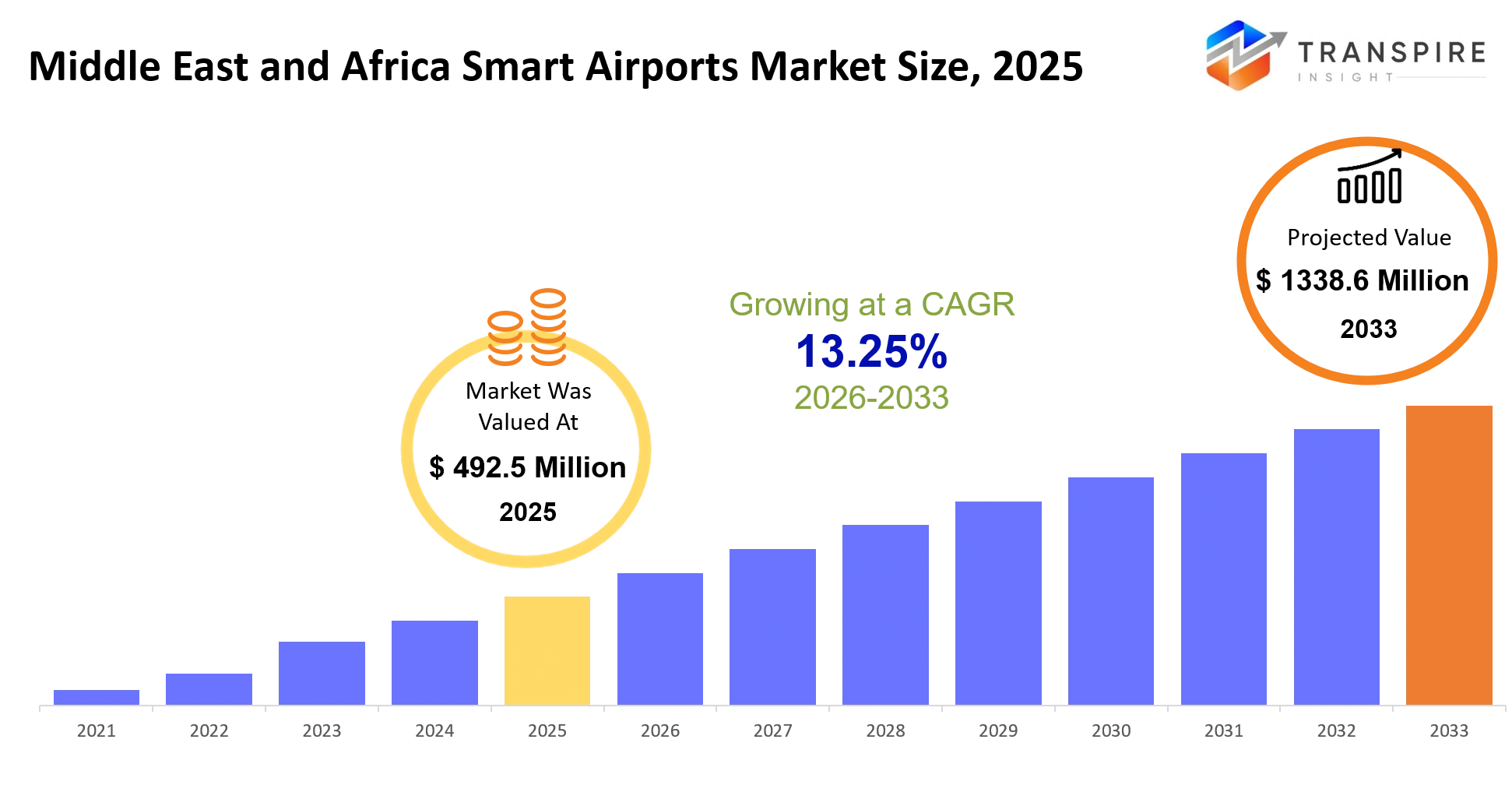
As per Transpire Insight Analysis the Middle East and Africa Smart Airports Market size is estimated at USD 492.5 Million in 2025 and is anticipated to reach USD 1338.6 Million by 2033, growing at a CAGR of 13.25% from 2026 to 2033.
operations , and how resources get used via linked systems and automation. it sort of deals with the typical operational snags like those long passenger queues , clumsy ground handling , flight delays, and also infrastructure costs that keep going up in the big aviation hubs. In the last 3–5 years, the market moved away from standalone airport automation , sort of like it was a separate thing, toward more joined digital ecosystems. those ecosystems lean on artificial intelligence, iot, cloud platforms, plus biometric technologies. big aviation modernization efforts in Saudi Arabia, the UAE, Qatar , and South Africa helped adoption pick up speed, and after the pandemic travel bounce back, airports felt even more pressure to sharpen both efficiency and service quality. investments in smart infrastructure , digital passenger services , and predictive maintenance are helping airports trim operational costs, manage capacity better, and keep supporting long-term aviation expansion throughout the region.
Middle East and Africa Smart Airports Market Size & Forecast:
- Middle East and Africa Smart Airports Market Size 2025: USD 492.5 Million
- Expected Market Value 2033: USD 1338.6 Million
- Forecast CAGR: 13.25%
- Leading region in 2025: Middle East
- Fastest Growing region:Africa
- Key Profile: Siemens, Honeywell, Thales, Collins Aerospace, SITA, Amadeus IT Group, Cisco, IBM, Huawei, NEC Corporation, Bosch, Indra Sistemas, Vanderlande, Daifuku, Leidos.
Key Market Insights
- The Middle East dominated the Middle East and Africa Smart Airports Market in 2025, mainly because a pretty heavy wave of aviation investments in the UAE, Saudi Arabia, and Qatar.
- In the same stretch, Saudi Arabia’s Vision 2030 aviation expansion programs are speeding up smart airport infrastructure rollouts via automation, AI systems and those digital passenger services.
- Meanwhile Africa is showing up as the fastest-moving regional market, since airports are modernizing day to day operations using biometric processing , cloud platforms, and linked security systems.
- In 2025, hardware solutions were a major chunk of the market, mostly from spending on sensors, surveillance setups , kiosks, and automated baggage equipment that keeps getting installed.
- AI powered airport management is also getting more attention now, as operators begin using predictive analytics for maintenance scheduling and better resource use. Passenger processing systems are becoming a key focus too, because airports are rolling out biometric identification along with contactless travel technologies.
- Cloud based deployment models have been expanding after 2020, since airports want scalable infrastructure with reduced maintenance effort and quicker integration.
- Companies like Siemens, Thales, Honeywell, and SITA are also pushing harder by building airport automation platforms and forming digital technology alliances.
- On top of that, IoT enabled monitoring systems are changing the way airports run, improving equipment visibility, energy management, and real time decision making. And yes, there are more strategic collaborations between technology providers and airport authorities too, which are helping support smart terminal development across emerging aviation hubs.
What are the Key Drivers, Restraints, and Opportunities in the Middle East and Africa Smart Airports Market?
The main push behind the Middle East and Africa Smart Airports Market is basically the rapid modernization of aviation infrastructure, tied to government-style airport expansion plans and also digital shift programs. You see countries like Saudi Arabia , the UAE, and Qatar putting money into more intelligent terminals, automated passenger handling, and smarter security setups, so they can deal with larger passenger loads and still keep operations running more efficiently. At the same time the movement toward AI, IoT, and cloud based airport management platforms is opening up revenue chances for technology suppliers, since they can cut down on manual routines, make better use of assets, and enable real time decisions, not just slower reports.
On the restraint side, the big issue is the very high upfront capital spending needed to plug smart airport technologies into older airport infrastructure. A lot of airports across Africa still rely on legacy systems, and those usually demand wide upgrades before they can really adopt advanced automation, cybersecurity frameworks, and data led platforms. So this “structural” problem tends to stretch deployment schedules, inflate the actual costs, and it can even slow adoption, especially for smaller airport operators who only have tight budgets and few options.
There’s also a strong opportunity in AI driven autonomous airport operations, and in the digital twin concept as well. New or emerging aviation hubs in Africa, plus the continued expansion of airports in the Middle East, are setting up good conditions for predictive analytics, automated resource scheduling, and connected infrastructure. If technology companies build strategic partnerships with airport authorities, they can speed up smart airport rollouts, because they can deliver scalable solutions that improve efficiency while still supporting long term aviation growth.
What Has the Impact of Artificial Intelligence Been on the Middle East and Africa Smart Airports Market?
Artificial intelligence is kind of reshaping airport operations, making more or less automated choices possible, along with predictive maintenance and a better way to handle passengers in big aviation hubs. AI systems—powered by all these analytics—look at passenger movement, security info, baggage routines, and equipment status so they can tune what happens each day. In practice, airports are leaning on machine learning models for foreseeing breakdowns in baggage-handling systems, escalators, screening machines, and even aircraft support infrastructure. That helps the teams plan maintenance ahead of time, before any disruption turns into a real problem.
On top of that, advanced analytics platforms back demand forecasting, resource distribution, and congestion control. There’s also AI-based monitoring of passenger flow, which can reduce those waiting times, support terminal capacity planning, and generally raise service quality. Predictive models further help airport authorities squeeze down energy consumption, set staffing needs more accurately, and keep operational reliability on track.
Still, AI adoption runs into limitations. The integration costs can be high, the older systems are often fragmented, and region-specific operational data may be scarce for training models that actually work well. A lot of airports end up needing major infrastructure updates, plus skilled professionals, before they can get the full AI-driven automation they expect. Even with all that, artificial intelligence keeps showing up as a key technology for smart airport development, mainly because it improves efficiency, increases automation, and enables data-based decision-making.
Key Market Trends
- Airports across the Middle East went for biometric passenger processing after 2020, mostly to make travel quicker, and basically touch less when possible.
- Then Saudi Arabia and UAE kind of pushed their smart airport spending harder after 2021, via national aviation strategies, and also with big infrastructure modernization pushes.
- From there, artificial intelligence stopped being just pilot stuff and moved into real operations, as airports used predictive analytics for things like maintenance and passenger management.
- Around 2022, IoT-enabled monitoring systems showed up more widely, so airport operators can watch assets , energy usage and day to day operational performance in real time, not just later reports.
- Cloud-based airport platforms started getting stronger adoption too, as operators replaced those isolated systems, with more scalable digital structure and more centralized data management.
- After 2023, cybersecurity budgets went up noticeably, because connected airport networks meant higher expectations for safeguarding operational details and passenger data.
- Digital twin technology also emerged, kind of as a planning tool, especially for major hubs aiming for better simulation, capacity control, and infrastructure optimization.
- At the same time automated baggage handling solutions advanced, with international airports concentrating on reducing delays, and tightening luggage tracking accuracy .
- Finally partnerships between technology providers and airport authorities increased, where companies like Siemens, Thales, and SITA expanded regional smart airport solutions, more or less everywhere.
- Outside the Middle East, African airports started adopting smart technologies more actively after 2022, to improve operational efficiency and modernize aviation infrastructure in a more direct way.
Middle East and Africa Smart Airports Market Segmentation
By Component
Hardware solutions make up a big chunk of smart airport investments, I mean as airports roll out sensors, surveillance systems, automated kiosks, baggage handling gear, and comms infrastructure. You can say these setups help with real time monitoring, getting passengers processed, and keeping day to day operational control going across terminals. On top of that, software platforms are becoming more and more important, with things like airport management, data analytics, flight operations, and resource planning tools. There are also services that back implementation, upkeep, and system integration tasks, while IoT platforms make it possible to handle connected infrastructure in a more controlled way.
Then there’s AI solutions, they boost decision making using predictive analytics, automation, and passenger flow analysis, which sounds almost obvious but it actually changes the outcome. Security systems are focused on surveillance, access control, and threat detection. And passenger processing systems keep stretching further, usually through biometric identification, self service kiosks, and digital check-in technologies too.
By Technology
Artificial Intelligence is turning into this key technology space, as airports adopt machine learning for predictive maintenance, operational optimization, and the whole passenger management kind of thing. The IoT side helps build connected airport ecosystems , because it enables real-time tracking of equipment, vehicles and infrastructure performance , like all at once. Biometrics will see more adoption via automated identity verification and contactless passenger journeys, which sounds straightforward but it is also kinda complex in practice. Cloud computing lets airports handle huge volumes of operational data using flexible infrastructure without too much fuss. Then, big data analytics helps spot traffic patterns, tune resources, and make better choices faster. Digital twin technology backs up airport planning and simulation, while robotics assists with baggage handling, cleaning operations, and customer support services, pretty much end-to-end.
By Application
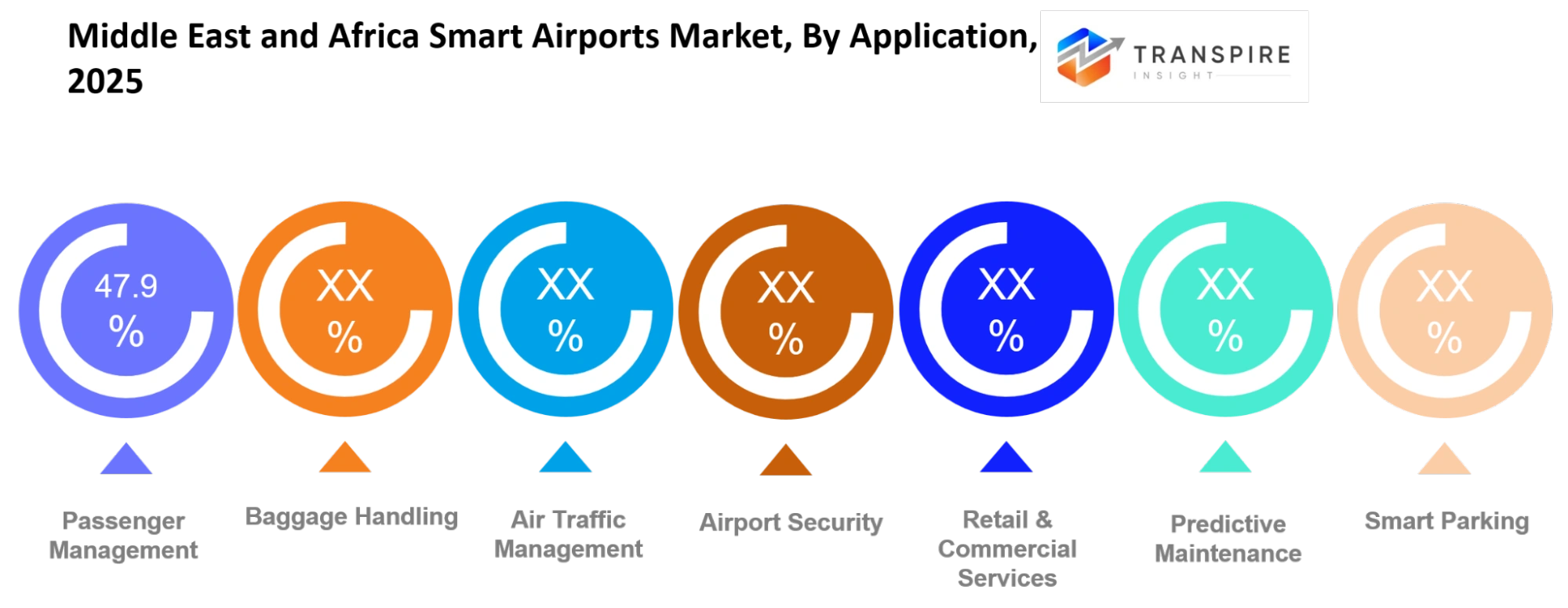
Passenger management is basically one of the top application areas, because airports are trying to make the whole travel process quicker, more smooth through automated check in, biometric boarding, and digital identity services. Baggage handling systems are also moving toward automation along with tracking methods to cut down those annoying delays and to keep operational accuracy much higher. For air traffic management, teams are relying on advanced analytics and linked systems to help with better flight coordination and also airport capacity use. On the security side, AI driven surveillance and automated screening tools are getting more common, sort of expanding fast. Meanwhile retail and commercial services are leaning on digital platforms, to boost customer involvement and more tailored experiences. There are also predictive maintenance applications, which help keep equipment stable by spotting likely failures before they turn into real operational disruptions. Even smart parking is getting smarter, with better vehicle management across airport grounds.
By End User
International airports stand out as the biggest end-user slice, mostly because of intense passenger traffic, rather involved operations, and they usually can spare more budget for newer technologies. Domestic airports , over time, are starting to lean into smart solutions in a more steady way, to boost efficiency , trim operating expenses, and strengthen the whole passenger experience. Airport authorities are also putting money into digital platforms that help coordinate infrastructure, security, and overall operational output. Airlines in the meantime are moving toward connected systems so the timing and coordination with airport operations and passenger services feels smoother, and more reliable. Ground handling firms apply automation tech for baggage movement , aircraft servicing, and faster turnaround optimization, which sounds small but adds up a lot. Government aviation agencies back smart airport development via modernization initiatives, regulatory frameworks, and extra infrastructure funding . Some other participants, like aviation service providers and technology partners, are involved too, they supply things and support day to day airport operations.
By Deployment
Cloud based deployment is getting a lot of traction now, since airports are looking for flexible , scalable and yes, more cost-effective technology infrastructure. With cloud platforms , airport operators can link applications, handle data, and pull insights using analytics, without having to pour money into heavy physical infrastructure. That said, on-premise solutions still matter for airports that need direct control over sensitive operational and security related data. Lately hybrid deployments are also becoming more common because airports try to get that cloud adaptability but still keep local system management in place, like a firmer grip.
Some organizations also lean toward private cloud setups, mainly when they want extra security and a data environment that can be tuned. Public cloud platforms can be especially helpful for smaller airports, because they can tap into more advanced digital capabilities while keeping the starting investment lower than it would otherwise be. Alongside all that, edge computing is starting to look like a key deployment path for real time processing, especially for security data, IoT signals, and day to day operational information. And of course, other deployment models will continue to show up , to match the particular technical needs found across different airport contexts.
What are the Key Use Cases Driving the Middle East and Africa Smart Airports Market?
Passenger processing is kind of the main thing driving adoption for smart airport solutions, and it seems to be supported by international airports that want quicker passenger movement, better security, and an overall smoother experience. Biometric identification, automated check in , and digital boarding systems create solid demand because they directly cut congestion and make terminal operations work more efficiently.
Airport authorities along with airlines are also widening the rollout, using predictive maintenance approaches, and doing baggage optimization more actively, too. Ground handling firms are joining the trend toward connected platforms so they can improve turnaround times, keep a closer eye on equipment tracking, and coordinate tasks in a more synced way.
Newer angles are showing up as well, like digital twins, autonomous airport operations and AI driven resource planning. These tools are getting more attention from major airport operators that are building future-ready infrastructure, roughly between 2026 to 2033.
|
Report Metrics |
Details |
|
Market size value in 2025 |
USD 492.5 Million |
|
Market size value in 2026 |
USD 560.2 Million |
|
Revenue forecast in 2033 |
USD 1338.6 Million |
|
Growth rate |
CAGR of 13.25% from 2026 to 2033 |
|
Base year |
2025 |
|
Historical data |
2021 - 2024 |
|
Forecast period |
2026 - 2033 |
|
Report coverage |
Revenue forecast, competitive landscape, growth factors, and trends |
|
Regional scope |
Middle East and Africa (Saudi Arabia, United Arab Emirates, South Africa, Rest of Middle East and Africa) |
|
Key company profiled |
Siemens, Honeywell, Thales, Collins Aerospace, SITA, Amadeus IT Group, Cisco, IBM, Huawei, NEC Corporation, Bosch, Indra Sistemas, Vanderlande, Daifuku, Leidos. |
|
Customization scope |
Free report customization (country, regional & segment scope). Avail customized purchase options to meet your exact research needs. |
|
Report Segmentation |
By Component (Hardware, Software, Services, IoT Platforms, AI Solutions, Security Systems, Passenger Processing Systems, Others); By Technology (Artificial Intelligence, IoT, Biometrics, Cloud Computing, Big Data Analytics, Digital Twin, Robotics, Others); By Application (Passenger Management, Baggage Handling, Air Traffic Management, Airport Security, Retail & Commercial Services, Predictive Maintenance, Smart Parking, Others); By End User (International Airports, Domestic Airports, Airport Authorities, Airlines, Ground Handling Companies, Government Aviation Agencies, Others); By Deployment (Cloud-Based, On-Premise, Hybrid, Private Cloud, Public Cloud, Edge Computing, Others). |
Which Regions are Driving the Middle East and Africa Smart Airports Market Growth?
The Middle East kind a dominates the regional market because there are large scale aviation investments, pretty solid airport infrastructure, and those government backed modernization programs that keep moving. In practice, places like the UAE, Saudi Arabia, and Qatar are building smarter terminals via national aviation strategies, tourism expansion plans, plus several digital transformation initiatives. There is also this supportive ecosystem, driven by well established airline networks, high levels of international passenger traffic, and partnerships with global technology providers. All of that makes it easier for airports to keep adopting AI, IoT, and automated airport systems without too much friction.
Africa shows a bit of another growth pattern. Here, the momentum seems tied to infrastructure upgrades, broader air connectivity, and improving conditions for aviation investment. Countries such as South Africa, Egypt, Kenya, and Morocco are leaning into modernizing airport operations using cloud platforms, security technologies, and automated passenger services. Compared with the Middle East, though, the pace depends more on gradual infrastructure improvements, international funding support, and continuous attempts to raise operational efficiency at airports that already exist, rather than replacing everything at once.
Looking ahead, Africa is expected to get the fastest growth momentum. This happens as governments and airport authorities push harder on digital transformation programs, while also upgrading aging facilities. Lately, airport expansion projects, smart security systems, and passenger management technologies are opening up new opportunities for technology suppliers. That regional growth should let new market entrants offer scalable solutions for airports that want modernization options that stay cost effective from 2026 to 2033, even when budgets are tight.
Who are the Key Players in the Middle East and Africa Smart Airports Market and How Do They Compete?
Competition in the Middle East and Africa Smart Airports Market is, kind of moderately consolidated, with global technology providers going head to head by leaning on advanced automation platforms, digital infrastructure skills, and longterm partnerships with airport authorities. Most of them try to stand apart via AI solutions, cybersecurity knowhow, passenger processing technologies, and tight integration abilities, not just because of price. Big-name technology firms keep a solid grip, while more specialized vendors still slip in through narrower offerings that emphasize automation and analytics, you know, the focused stuff.
Siemens shows up with intelligent infrastructure, automation systems, plus digital twin technologies that back airport operations and energy management. Honeywell leans into integrated airport control systems, building automation and operational efficiency solutions, so airports can push for better reliability, and less hassle. Thales differentiates using biometric passenger processing, cybersecurity, and aviation security technologies, which basically supports airports that need advanced identity management without delay.
SITA strengthens its role through passenger processing platforms, airport communication systems, and digital travel solutions that global aviation operators actually rely on day to day. Collins Aerospace, on the other hand, expands via aviation technology integration including airport systems designed to enhance operational coordination and passenger services. Overall these players are extending their regional presence through collaborations with airport operators, technology alliances, and customized solutions aimed at major aviation hubs, so it kind of broadens fast.
Company List
- Siemens
- Honeywell
- Thales
- Collins Aerospace
- SITA
- Amadeus IT Group
- Cisco
- IBM
- Huawei
- NEC Corporation
- Bosch
- Indra Sistemas
- Vanderlande
- Daifuku
- Leidos
Recent Development News
In February 2025, SITA launched SITA Airport Management technology solutions to enhance airport operational efficiency through improved data integration, automation, and real-time decision support for airport operators.
Source: https://www.sita.aero/ (SITA)
In March 2025, Thales entered a partnership with Riyadh Air to support advanced digital aviation solutions, including technology systems designed to improve operational efficiency and passenger experiences in Saudi Arabia’s expanding aviation sector.
Source: https://www.thalesgroup.com/ (Thales)
In April 2025, Siemens expanded its airport digitalization solutions portfolio through enhanced automation and smart infrastructure technologies designed to support sustainable and efficient airport operations globally.
Source: https://www.siemens.com/ (Siemens)
What Strategic Insights Define the Future of the Middle East and Africa Smart Airports Market?
The Middle East and Africa Smart Airports Market is moving, kind of rapidly, toward integrated digital airport ecosystems where AI, automation, and connected infrastructure get treated like the core operating layers, not just standalone add-ons or “separate toys”. The big push behind this shift is pretty straightforward: airports want to increase capacity, but without a matching rise in operational complexity and without ballooning the workforce needs too.
There’s also a quieter downside people may not spot early , and it’s technology fragmentation. When an airport picks solutions from several vendors at the same time, there can be annoying integration hurdles, more cybersecurity exposure than expected ,and higher lifecycle costs that show up later.
On the opportunity side, an emerging angle is AI-driven digital twins. These can model terminal operations, help with resource allocation in a more predictive way, and even support infrastructure planning before any physical changes are actually made. Market players should really lean into interoperable platforms, regional partnerships, and cloud-based solutions that can scale as requirements change across different airports. In general, companies that blend tech innovation with solid local implementation capability—so it works in real conditions, not only in demos—will likely be in a stronger spot to grab longer-term growth across the aviation landscape in Middle Eastern and African markets.
Middle East and Africa Smart Airports Market Report Segmentation
By Component
- Hardware
- Software
- Services
- IoT Platforms
- AI Solutions
- Security Systems
- Passenger Processing Systems
- Others
By Technology
- Artificial Intelligence
- IoT
- Biometrics
- Cloud Computing
- Big Data Analytics
- Digital Twin
- Robotics
- Others
By Application
- Passenger Management
- Baggage Handling
- Air Traffic Management
- Airport Security
- Retail & Commercial Services
- Predictive Maintenance
- Smart Parking
- Others
By End User
- International Airports
- Domestic Airports
- Airport Authorities
- Airlines
- Ground Handling Companies
- Government Aviation Agencies
- Others
By Deployment
- Cloud-Based
- On-Premise
- Hybrid
- Private Cloud
- Public Cloud
- Edge Computing
- Others
Frequently Asked Questions
Find quick answers to common questions.
The expected Middle East and Africa Smart Airports Market size for the market will be USD 1338.6 Million in 2033.
Key segments for the Middle East and Africa Smart Airports Market are By Component (Hardware, Software, Services, IoT Platforms, AI Solutions, Security Systems, Passenger Processing Systems, Others); By Technology (Artificial Intelligence, IoT, Biometrics, Cloud Computing, Big Data Analytics, Digital Twin, Robotics, Others); By Application (Passenger Management, Baggage Handling, Air Traffic Management, Airport Security, Retail & Commercial Services, Predictive Maintenance, Smart Parking, Others); By End User (International Airports, Domestic Airports, Airport Authorities, Airlines, Ground Handling Companies, Government Aviation Agencies, Others); By Deployment (Cloud-Based, On-Premise, Hybrid, Private Cloud, Public Cloud, Edge Computing, Others).
Major Middle East and Africa Smart Airports Market players are Siemens, Honeywell, Thales, Collins Aerospace, SITA, Amadeus IT Group, Cisco, IBM, Huawei, NEC Corporation, Bosch, Indra Sistemas, Vanderlande, Daifuku, Leidos.
The Middle East and Africa Smart Airports Market size is USD 492.5 Million in 2025.
The Middle East and Africa Smart Airports Market CAGR is 13.25% from 2026 to 2033.
- Siemens
- Honeywell
- Thales
- Collins Aerospace
- SITA
- Amadeus IT Group
- Cisco
- IBM
- Huawei
- NEC Corporation
- Bosch
- Indra Sistemas
- Vanderlande
- Daifuku
- Leidos
About the Authors

Tejashri Dhatrak
I am Tejashri Dhatrak, a Senior Research Analyst at Transpire Insight, specializing in the Aerospace and Defence sector. My work focuses on analyzing industry trends, defence technologies, market developments, and emerging innovations that shape the global aerospace and security landscape. At Transpire Insight, I research complex topics, evaluate credible sources, and transform technical insights into accurate, well-structured, and easy-to-understand content for industry professionals and decision-makers. My goal is to provide reliable, research-backed information that helps readers stay informed about defence capabilities, aerospace advancements, strategic developments, and the evolving dynamics of the global defence ecosystem.

Chakradhar Khansole
Chakradhar serves as the Research Director at Transpire Insight, bringing over 8 years of experience in technology, innovation, and strategic market intelligence. He specializes in transforming complex market data into actionable business insights that enable organizations to make informed, growth-oriented decisions. Recognized for his strategic vision and analytical expertise, Chakradhar leads high-impact research initiatives, delivering comprehensive market assessments, competitive intelligence, and forward-looking industry analysis.
Recently Published Reports
-
Apr 2026
Aerospace Fluoropolymers Market
Aerospace Fluoropolymers Market Size, Share & Analysis Report By Type (PTFE, FEP, PFA, ETFE, and Others), By Application (Electrical Insulation, Seals & Gaskets, Coatings, and Others), By End User (Commercial Aviation, Military Aviation, General Aviation, and Others), and Geography (North America, Europe, Asia-Pacific, Middle East and Africa, South and Central America), 2021 - 2031
-
Apr 2026
Airborne SATCOM System Market
Airborne SATCOM System Market Size, Share & Analysis Report By Type (SATCOM Terminals, Transceivers, Airborne Radio, Modems and Routers, SATCOM Radomes, and Other), By Application (Government and Defense and Commercial), and Geography (North America, Europe, Asia-Pacific, Middle East and Africa, South and Central America), 2021 – 2031
-
Apr 2026
Ship Leasing Market
Ship Leasing Market Size, Share & Analysis Report By Vessel Type (Container Ships, Bulk Carriers, Tankers, and Specialized Vessels), By Lease Duration (Short-Term Lease (Less than 1 year), Medium-Term Lease (1-5 years), and Long-Term Lease (More than 5 years)), By Lease Type (Bareboat Charter, Time Charter, Financial Lease, and Others), By End-User Industry (Oil and Gas, Manufacturing and Industrial, Automotive, Agriculture and Food, Retail and Consumer Goods, and Others), and Geography (North America, Europe, Asia-Pacific, Middle East and Africa, South and Central America), 2021 – 2031
-
Apr 2026
Thread Rolling Dies Market
Thread Rolling Dies Market Size, Share & Analysis Report By Type (Flat Thread Rolling Dies, Circular (Cylindrical) Dies, Tangential Thread Rolling Dies, Planetary Thread Rolling Dies, and Other Types), By Material Type (High-Speed Steel (HSS), Carbide, Tool Steel, Alloy Steel, and Other Specialized Alloys), By Distribution Channel (Direct Sales, Distributors and Dealers, and Online Platforms), By Application (Automotive Industry, Aerospace and Defense, Construction and Infrastructure, Industrial Machinery, Electronics and Electrical Components, Medical Devices, and Fastener Production), and Geography (North America, Europe, Asia-Pacific, Middle East and Africa, South and Central America), 2021 – 2031
Our Clients