

Middle East and Africa Satellite Servicing Market Size & Forecast:
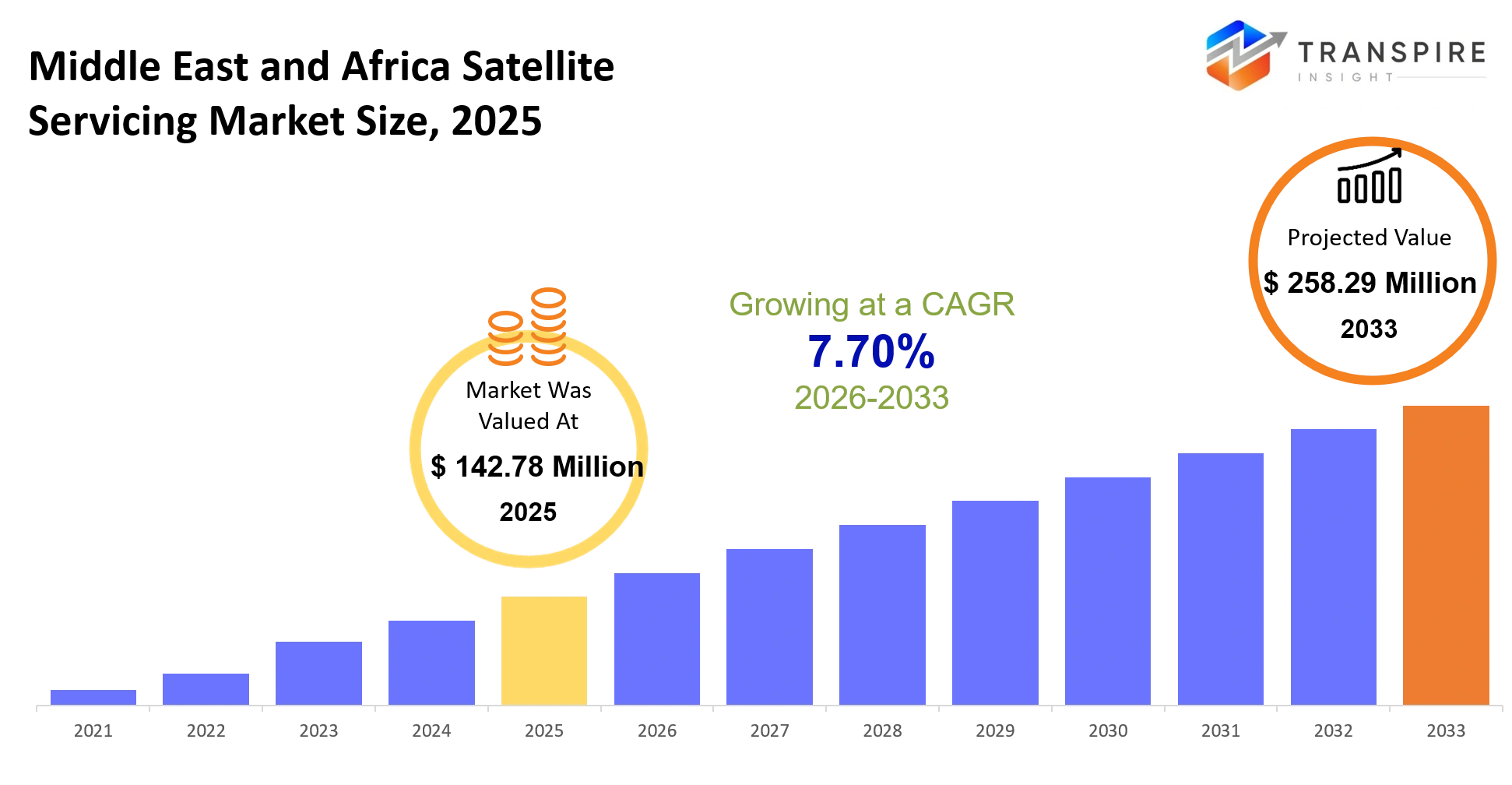
- Middle East and Africa Satellite Servicing Market Size 2025: USD 142.78 Million
- Middle East and Africa Satellite Servicing Market Size 2033: USD 258.29 Million
- Middle East and Africa Satellite Servicing Market CAGR: 7.70%
- Middle East and Africa Satellite Servicing Market Segments: By Service Type (Refueling, Repair & Maintenance, Inspection, Debris Removal, Life Extension Services, Others); By Orbit (LEO, MEO, GEO, Others); By Satellite Type (Communication, Earth Observation, Navigation, Others); By End User (Commercial Operators, Government, Defense, Others)
To learn more about this report,  Download Free Sample Report
Middle East and Africa Satellite Servicing Market Summary
The Middle East and Africa Satellite Servicing Market was valued at USD 142.78 Million in 2025. It is forecast to reach USD 258.29 Million by 2033. That is a CAGR of 7.70% over the period.
Satellite servicing helps operators keep spacecraft going longer, by refueling satellites, repairing the key systems, doing in orbit inspections on assets… and even removing debris that can mess with space infrastructure. In practice, these kinds of services cut replacement costs down, help asset utilization, and keep support for communications , navigation, defense, plus Earth observation running without interruption across the Middle East and Africa.
Over the past five years the whole industry has sort of moved on from experimental demonstrations toward things that are actually commercially viable, like real in orbit servicing missions. One big push was the successful wrap up of life extension missions by satellite servicing providers. That effort basically proved that older satellites can keep working for years beyond their initial design life , which is a huge shift. Because of that, investment priorities across the space sector changed, and operators started to treat servicing as a piece of fleet management, not just a nice idea “later”.
Right now, more satellite launches, increasing orbital congestion, and higher replacement costs, are steadily making the business case stronger for servicing solutions. And as operators try to squeeze more value out of what they already own, spending is drifting toward maintenance, checkups, and life extension services, and that in turn creates new revenue streams across the regional space ecosystem.
Key Market Insights
- In the Middle East and Africa Satellite Servicing Market, there is this clear tilt toward extending asset life, and servicing missions can pile up to, like, five more years of operational life.
- And yes, GEO satellite servicing is still the main driver of current revenue, roughly 45%+ market share, largely because those high value communications assets tend to need on orbit care for a long time.
- After 2022, LEO servicing demand really picked up, largely tied to commercial constellation deployments that grew by more than 30% across the globe.
- Within the mix, inspection services are holding a pretty big chunk, since operators lean on anomaly detection and satellite health monitoring before anything turns into a real failure.
- Then there’s refueling, which is starting to look more like a strategic lane, backed by orbital logistics firms working on commercial fuel delivery systems.
- On the demand side, government and defense operators make up over 35%, mostly from national security concerns and space resilience expectations.
- Regionally, the Gulf area is leading revenue, supported by sovereign space programs and ongoing satellite investments.
- Africa is projected to grow fastest through 2033, as national satellite programs keep expanding.
- Some of the companies making real moves include Northrop Grumman, Astroscale, Airbus, Maxar Technologies, and Orbit Fab, all pushing hard into robotic servicing capabilities.
- Looking ahead, strategic partnerships, autonomous navigation technologies , and debris removal platforms are becoming the differentiators that matter most across the satellite servicing industry.
What are the Key Drivers, Restraints, and Opportunities in the Middle East and Africa Satellite Servicing Market?
The strongest growth driver is the economic value of stretching satellite lifespans, kind of, really. Communications, navigation and defense satellites often need investments that can reach hundreds of millions of dollars, easy. Recent commercial servicing missions showed that operators can tack on several years of useful service without just launching a fresh replacement spacecraft. That technical milestone shifted where the industry puts its money. Rather than retiring aging assets, operators can buy servicing missions that preserve revenue producing capacity, and keep things going. The outcome is better take up of inspection, maintenance, and refueling services, so service providers see recurring revenue chances, more consistently.
The biggest constraint is technical complexity. Especially servicing satellites that were not originally built for in orbit maintenance. Many existing spacecraft don’t include standardized docking interfaces, servicing ports, or robotic access points. To make this workable, the industry has to redesign upcoming satellite architectures and set industry-wide standards. Those kind of structural changes take years to roll out across satellite fleets, which is a bit slow. The consequence becomes slower commercial adoption, plus delayed revenue realization for servicing providers.
A major future opportunity is orbital sustainability and debris removal services. Satellite constellations in low Earth orbit keep expanding quickly, which raises collision risks and adds regulatory scrutiny. Governments and commercial operators are starting to earmark funding toward active debris removal and end of life disposal approaches. The companies building robotic capture, inspection, and removal techniques are positioned to benefit once sustainability requirements get embedded inside satellite licensing frameworks.
What Has the Impact of Artificial Intelligence Been on the Middle East and Africa Satellite Servicing Market?
Artificial intelligence is slowly turning into a key day to day operational tool across satellite servicing. In practice, advanced machine learning algorithms chew through telemetry, orbital information, and spacecraft health signals, and then they kinda automate inspection routing plus the servicing decisions. AI driven navigation systems further let the servicing vehicles handle proximity operations with more precision, also with less hands on work from operators. That whole set of abilities matters a lot during inspection missions, because correct positioning and spotting anomalies really swing mission outcomes.
Predictive maintenance is probably the most practical use case. Here, machine-learning models look at temperature swings, propulsion behavior, battery wear patterns, and communication system tendencies, then try to forecast likely failures before they actually happen. Operators can end up scheduling servicing steps in a more proactive manner, instead of only reacting after outages. In the end, this tends to boost satellite availability, cut down on annoying operational interruptions, and make maintenance budgets feel more controlled.
AI also backs orbital traffic coordination and collision-risk review. Automated systems keep checking debris movement, and satellite trajectories, which supports safer servicing actions in orbital regions that are becoming more crowded. Still, rollout is held back by expensive integration work and by the fact that historical servicing data is somewhat scarce. Because commercial in-orbit servicing is still a relatively young industry, the training datasets are smaller than what mature industrial areas can offer, and that can reduce accuracy when real world orbital conditions get complicated, and unpredictable.
Key Market Trends
- Since 2021 , operators have been leaning more and more toward life-extension missions after those successful commercial demos somehow added up to around five years of extra service life, which is kind of the point.
- During 2025 , robotic servicing platforms moved forward fast, because next-generation servicing vehicles reached the last stages of integration and testing, and you could feel the momentum.
- By 2025 , more than 100 satellite docking plates were ordered, and that really shows the industry getting ready for future compatibility with servicing systems.
- In 2025 , defense agencies also put more money into space sustainability and servicing technologies, so government involvement became even more noticeable, even if the details were a bit slow.
- Satellite operators are increasingly choosing inspection services now, as orbital congestion and collision risks are becoming more prominent, like, more in-your-face.
- Refueling and logistics concepts gained traction in 2025 because operators want an alternative to expensive satellite replacement programs, rather than just repeating the same cycle.
- After 2024 , partnerships between servicing companies and satellite manufacturers increased, aimed at making spacecraft designs more service-ready, almost like it was baked in from the start.
- Commercial debris-removal technologies progressed from feasibility studies toward operational mission planning between 2024 and 2026, and not just on paper either.
- Multi-orbit inspection missions showed up as a new service category, giving fleets wider assessment abilities across different orbital regions.
- And overall, space sustainability objectives are increasingly shaping procurement choices, pushing buyers to fund servicing, inspection, and debris-mitigation technologies.
Middle East and Africa Satellite Servicing Market Segmentation
By Service Type
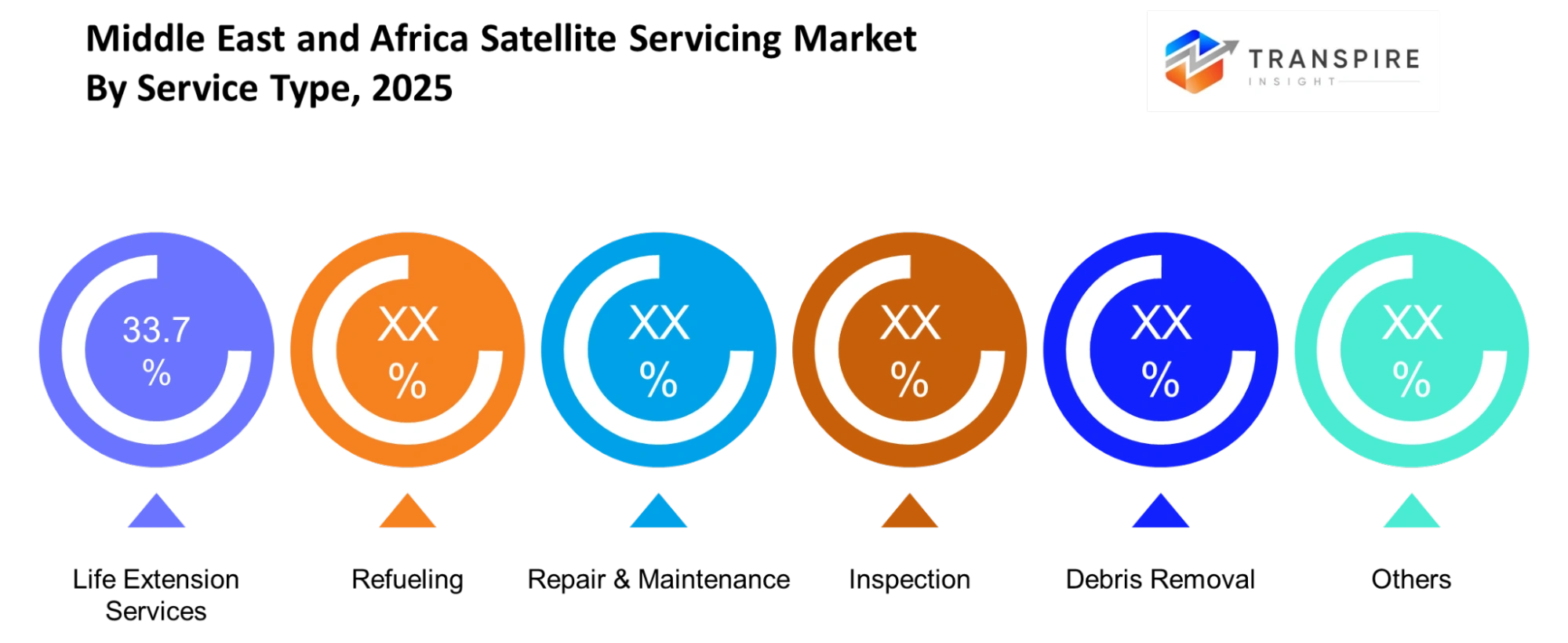
Refueling services help when satellites are getting close to fuel depletion, and they kind of extend the operational life, so there’s no real need for replacement launches. Repair and maintenance activities take on hardware problems, propulsion system performance issues, and they also make sure onboard components still function as they should. Inspection services then give detailed spacecraft assessments, which helps operators catch anomalies, and evaluate asset conditions, before something fails, goes bad, or stops.
Debris removal solutions are centered on lowering collision risk and keeping the orbital environment safer over time. Life extension services let operators stretch the value of existing satellite investments, typically through propulsion assistance and station keeping support. Other services cover things like relocation support, mission upgrades, and specialized operational aid that boosts satellite efficiency and overall sustainability.
To learn more about this report, Download Free Sample Report
By Orbit
Low Earth Orbit, kind of supports a growing number of commercial constellations, and because of that inspection and maintenance and debris removal activities are getting more and more important, right. Medium Earth Orbit applications often rely on navigation systems that need operational continuity, the kind that stays dependable even when conditions shift a bit. Geostationary Orbit still stays a major focus too, mainly because the communication satellites that have high value operate in that region.
There are other orbital categories as well, like highly elliptical and specialized mission orbits, they typically need customized servicing solutions. The growth we see across these orbital categories shows a wider deployment of communications, navigation, and Earth observation infrastructure. Service providers keep developing technologies that can support multiple orbital environments, without too much hassle.
By Satellite Type
Communication satellites kinda drive a lot of servicing work because staying connected without interruptions is still commercially crucial, pretty much every day. Earth observation satellites also really benefit from maintenance, plus on orbit inspection tasks, so the data collection keeps working and the whole mission performance doesn’t drift away. For navigation satellites, reliable functioning and long term availability matter a lot, so the market keeps pulling toward life extension efforts as well as maintenance solutions.
Then there are the other groups, scientific and research satellites, and even specialized government missions that need attention. With satellite deployments expanding across different industries, servicing providers get more opening to support a wider range of spacecraft types. And overall, better servicing knows how to keep pushing operational efficiency forward across the board, even when the missions are very different.
By End User
Commercial operators use servicing solutions, to kind of extend asset life, lower replacement expenses, and push better investment returns overall. Government organizations tend to keep strategic infrastructure alive while also safeguarding long term mission continuity. Defense agencies are now looking more closely at servicing capability, as one part of wider space resilience , and operational readiness strategies too, not just as an afterthought.
There are also other end users, like research institutions, international organizations, and newer space agencies that are still coming up. Interest in orbital sustainability and satellite longevity keeps growing across basically all these user groups. Because the operational needs can vary so much, people are developing flexible servicing platforms, so they can support multiple mission profiles without much fuss, or delay.
What are the Key Use Cases Driving the Middle East and Africa Satellite Servicing Market?
The most important use case is basically about extending the operational lifetime of communication satellites. Satellite operators need continuous service availability to pull in revenue, so life extension missions and even refueling services become pretty attractive versus doing a full replacement launch which is usually way more expensive. There is strong demand here too, because a lot of communication assets can still be technically functional even after the fuel reserves have dropped , not always but often.
Inspection and maintenance services are also picking up steam, especially with government agencies, Earth observation operators, and defense organizations involved. With detailed spacecraft inspections, teams can spot structural concerns earlier, evaluate mission readiness, and back up anomaly investigations. In practice, this kind of work reduces operational uncertainty and it helps improve fleet management decisions that would otherwise stay vague.
There are also newer applications showing up, like active debris removal, plus robotic satellite upgrades. Looking ahead, servicing missions may install fresh hardware , modernize onboard systems, or reposition satellites when mission needs shift over time. If that happens at scale it could really reshape satellite management during the forecast period.
|
Report Metrics |
Details |
|
Market size value in 2025 |
USD 142.78 Million |
|
Market size value in 2026 |
USD 153.63 Million |
|
Revenue forecast in 2033 |
USD 258.29 Million |
|
Growth rate |
CAGR of 7.70% from 2026 to 2033 |
|
Base year |
2025 |
|
Historical data |
2021 - 2024 |
|
Forecast period |
2026 - 2033 |
|
Report coverage |
Revenue forecast, competitive landscape, growth factors, and trends |
|
Regional scope |
Middle East and Africa (Saudi Arabia, United Arab Emirates, South Africa, Rest of Middle East and Africa) |
|
Key company profiled |
Northrop Grumman, Astroscale, Maxar Technologies, Airbus, Thales Alenia Space, Orbit Fab, ClearSpace, Lockheed Martin, Boeing, L3Harris, Sierra Space, OHB SE, Redwire, Intelsat, ESA |
|
Customization scope |
Free report customization (country, regional & segment scope). Avail customized purchase options to meet your exact research needs. |
|
Report Segmentation |
By Service Type (Refueling, Repair & Maintenance, Inspection, Debris Removal, Life Extension Services, Others); By Orbit (LEO, MEO, GEO, Others); By Satellite Type (Communication, Earth Observation, Navigation, Others); By End User (Commercial Operators, Government, Defense, Others) |
Which Regions are Driving the Middle East and Africa Satellite Servicing Market Growth?
The Gulf region kinda leads market development because of ongoing investment in national space programs, satellite comms infrastructure and those sovereign tech initiatives. There is really strong government backing, that helps a lot with satellite procurement and the longer-term operational planning. Space agencies in the region, plus the commercial operators, keep pushing ahead—expanding their communications , Earth observation and those strategic space assets. All of this ends up making pretty favorable conditions for future servicing adoption.
South Africa is another big piece of the puzzle, mostly due to established aerospace know-how, research strengths and satellite development programs. The pace here looks a bit different from the Gulf, since it’s driven more by institutional continuity and long-term technological improvement rather than huge sovereign spending. With consistent investment in satellite infrastructure, the demand for maintenance and inspection services stays more steady.
For the broader African market, growth is expected to build the strongest momentum all the way through 2033. New satellite missions, digital connectivity efforts, and expanding Earth observation programs are steadily growing the regional satellite base. As more nations put orbital assets in place, servicing solutions should start showing up more clearly in the demand curves. So this shift really opens the door for technology providers, investors and service operators who want earlier market entry, before it gets crowded.
Who are the Key Players in the Middle East and Africa Satellite Servicing Market and How Do They Compete?
Competition still feels technology-driven, because for servicing missions to actually work you need advanced robotics, autonomous navigation, good docking systems, and also serious know-how in orbital operations, kind of like you can’t just wing it. The market is still pretty concentrated, with only a limited set of companies that already show demonstrated in-orbit servicing capability in practice. In general, competitive edge gets shaped mainly by mission heritage, technical reliability, and the overall sophistication of the servicing platform, not by flashy marketing alone.
Northrop Grumman stands out by running proven life extension missions, using Mission Extension Vehicles that have already serviced commercial satellites in geostationary orbit. They are also scaling up with robotic servicing platforms aimed at repair, relocation, and upgrade work, so it isn’t only one type of task.
Astroscale leans hard into orbital sustainability, inspection services, and debris removal technologies. The firm keeps pushing partnerships and demonstration missions, which, in turn, help enable future commercial servicing ecosystems.
Orbit Fab is more about orbital refueling infrastructure, while Airbus brings service-ready technologies into satellite architectures. Maxar Technologies and Thales Alenia Space, meanwhile, lean on spacecraft engineering depth to help future servicing compatibility and keep long-term assets sustainable.
Company List
- Northrop Grumman
- Astroscale
- Maxar Technologies
- Airbus
- Thales Alenia Space
- Orbit Fab
- ClearSpace
- Lockheed Martin
- Boeing
- L3Harris
- Sierra Space
- OHB SE
- Redwire
- Intelsat
- ESA
Recent Development News
"In June 2025, Northrop Grumman integrated the robotic servicing payload onto its Mission Robotic Vehicle spacecraft. The milestone advances commercial robotic repair and upgrade capabilities for satellites in geostationary orbit.https://www.nrl.navy.mil
"In June 2025, Astroscale secured a £5.15 million UK defense contract for the Orpheus mission. The project strengthens space situational awareness capabilities and supports future servicing and sustainability applications.https://www.astroscale.com
"In April 2025, Intelsat and Northrop Grumman completed the five-year IS-901 life-extension mission. The achievement validated commercial satellite servicing and demonstrated measurable economic benefits from in-orbit maintenance.https://www.satellitetoday.com
What Strategic Insights Define the Future of the Middle East and Africa Satellite Servicing Market?
The market is drifting toward a service based orbital economy where satellites are cared for, maintained, upgraded , refueled and shifted around rather than simply swapped out in a routine way. This kind of shift is largely powered by spacecraft values going up, launch costs climbing, and the growing need to handle orbital congestion more effectively. Over the next five to seven years, servicing compatibility is probably going to turn into a design expectation for a lot of the newly launched satellites.
There is also a less visible risk that doesn’t get as much attention, the lack of globally harmonized servicing standards. If docking interfaces vary, and the operational procedures differ, plus the regulatory frameworks don’t line up cleanly, then commercial scaling could end up slower even if the growth outlook looks good on paper. Meanwhile autonomous robotic servicing in low Earth orbit is showing up as an opportunity, it’s emerging now but it has substantial long term potential as constellation rollouts increase.
Market actors should lean into partnerships with satellite manufacturers so future spacecraft are actually built with servicing compatibility in mind. If they move early into this ecosystem, they’ll likely lock in stronger competitive edges as orbital maintenance shifts from a niche skill into a standard piece of satellite lifecycle management .
Middle East and Africa Satellite Servicing Market Report Segmentation
By Service Type
- Refueling
- Repair & Maintenance
- Inspection
- Debris Removal
- Life Extension Services
- Others
By Orbit
- LEO
- MEO
- GEO
- Others
By Satellite Type
- Communication
- Earth Observation
- Navigation
- Others
By End User
- Commercial Operators
- Government
- Defense
- Others
Frequently Asked Questions
Find quick answers to common questions.
The expected Middle East and Africa Satellite Servicing Market size for the market will be USD 258.29 Million in 2033.
Key segments for the Middle East and Africa Satellite Servicing Market are By Service Type (Refueling, Repair & Maintenance, Inspection, Debris Removal, Life Extension Services, Others); By Orbit (LEO, MEO, GEO, Others); By Satellite Type (Communication, Earth Observation, Navigation, Others); By End User (Commercial Operators, Government, Defense, Others).
Major Middle East and Africa Satellite Servicing Market players are Northrop Grumman, Astroscale, Maxar Technologies, Airbus, Thales Alenia Space, Orbit Fab, ClearSpace, Lockheed Martin, Boeing, L3Harris, Sierra Space, OHB SE, Redwire, Intelsat, ESA.
The Middle East and Africa Satellite Servicing Market size is USD 142.78 Million in 2025.
The Middle East and Africa Satellite Servicing Market CAGR is 7.70% from 2026 to 2033.
- Northrop Grumman
- Astroscale
- Maxar Technologies
- Airbus
- Thales Alenia Space
- Orbit Fab
- ClearSpace
- Lockheed Martin
- Boeing
- L3Harris
- Sierra Space
- OHB SE
- Redwire
- Intelsat
- ESA
About the Authors

Mayur Shinde
I am Mayur Shinde, a Senior Research Analyst at Transpire Insight, specializing in the Automotive & Transportation and Information & Communication Technology (ICT) Industry. My work focuses on analyzing emerging market trends, technological advancements, competitive landscapes, and industry developments to deliver accurate, data-driven insights. I am passionate about transforming complex market information into clear, actionable content that helps businesses, professionals, and decision-makers stay informed and make confident strategic decisions.

Chakradhar Khansole
Chakradhar serves as the Research Director at Transpire Insight, bringing over 8 years of experience in technology, innovation, and strategic market intelligence. He specializes in transforming complex market data into actionable business insights that enable organizations to make informed, growth-oriented decisions. Recognized for his strategic vision and analytical expertise, Chakradhar leads high-impact research initiatives, delivering comprehensive market assessments, competitive intelligence, and forward-looking industry analysis.
Recently Published Reports
-
Apr 2026
3D Optical Profiler Market
3D Optical Profiler Market Size, Share & Analysis Report By Type (Desktop 3D Optical Profiler, and Portable 3D Optical Profiler), By Technology (Confocal Technology, and White Light Interference), By End-Use Industry (Manufacturing, Research Institutions, Automotive, Aerospace and Defense, Medical Devices, and Other), and Geography (North America, Europe, Asia-Pacific, Middle East and Africa, South and Central America), 2021 - 2031
-
Apr 2026
Depth Sensor Market
Depth Sensor Market Size, Share & Analysis Report By Type (Infrared Depth Sensors, Time-of-Flight (ToF) Sensors, Stereo Vision Sensors, Structured Light Sensors, Ultrasonic Depth Sensors), By Application (Automotive, Robotics, Gaming, Consumer Electronics, Industrial Automation, Healthcare, Security & Surveillance, Others), By End Users (Automotive Manufacturers, Consumer Electronics Companies, Healthcare Providers, Industrial Companies, Security Agencies, Gaming Companies, Robotics Companies, Others), and Geography (North America, Europe, Asia-Pacific, Middle East and Africa, South and Central America), 2021 – 2031
-
Apr 2026
Digital Manufacturing Market
Digital Manufacturing Market Size, Share & Analysis Report By Component (Hardware, Software, and Services), By Technology (Robotics, 3D Printing, Internet of Things (IoT), and Others), By Application (Automotive and Transportation, Aerospace and Defense, Consumer Electronics, Industrial Machinery, and Others), By Process Type (Computer-Based Designing, Computer-Based Simulation, Computer 3D Visualization, Analytics, and Others), and Geography (North America, Europe, Asia-Pacific, Middle East and Africa, South and Central America), 2021 – 2031
-
Apr 2026
Digital Visa Services Market
Digital Visa Services Market Size, Share & Analysis Report By Type (Individual Travelers, Group Travelers), By Application (Tourism, Business Travel, Others), and Geography (North America, Europe, Asia-Pacific, Middle East and Africa, South and Central America), 2021 – 2031