
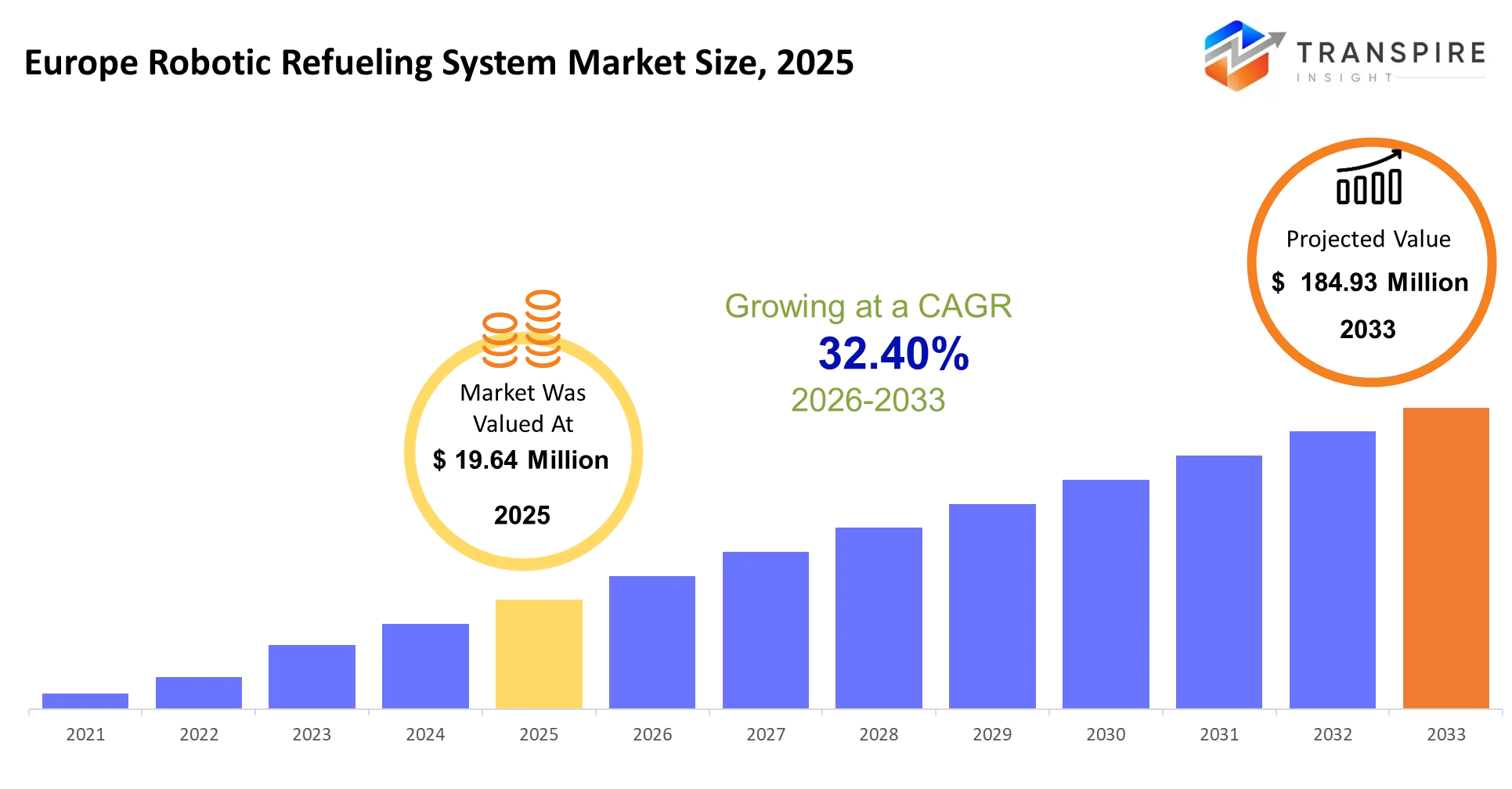
Europe Robotic Refueling System Market Size & Forecast:
- Europe Robotic Refueling System Market Size 2025: USD 19.64 Million
- Europe Robotic Refueling System Market Size 2033: USD 184.93 Million
- Europe Robotic Refueling System Market CAGR: 32.40%
- Europe Robotic Refueling System Market Segments: By Type (Fully Automated Systems, Semi-automated Systems, Robotic Arms, AI-enabled Systems, Others), By Application (Automotive Fueling, Aviation Fueling, Industrial Fueling, Fleet Operations, Logistics, Others), By End-User (Fuel Stations, Airports, Industrial Facilities, Logistics Companies, Defense Sector, Others), By Component (Robotic Arms, Sensors, Software, Controllers, Others).
To learn more about this report,  Download Free Sample Report
Europe Robotic Refueling System Market Summary:
The Europe Robotic Refueling System Market size is estimated at USD 19.64 Million in 2025 and is anticipated to reach USD 184.93 Million by 2033, growing at a CAGR of 32.40% from 2026 to 2033. Robotic refueling systems automate fuel transfer operations in naval vessels and offshore platforms and hazardous industrial areas because these systems require precise and safe operations and continuous equipment functionality. The system performs automatic refueling operations under extreme weather conditions and in remote locations because it eliminates the need for human workers to move between dangerous areas.
The market has progressed from testing pilot programs during the last three to five years to implementing autonomous systems across entire operational environments. Refueling robots now connect with digital control systems and maintenance prediction systems, which enables operators to use these robots as part of their complete system infrastructure instead of treating them as independent devices. European environmental and safety regulations, which became stricter through emissions control and spill prevention measures, have created higher expenses for businesses because manual errors now require additional costs to resolve.
The system drives adoption because automation decreases compliance risks and employee hazards while it maintains continuous business operations. Buyers now use two methods to demonstrate their investment value which includes both current efficiency improvements and future costs from downtime and regulatory fines.
Key Market Insights
- Western Europe controls more than 45% of the European Robotic Refueling System Market in 2025 because of its modern maritime facilities and its enforcement of strict regulations.
- Through 2030 Northern Europe will experience the highest growth rate because of its offshore energy development and its use of autonomous marine systems.
- The market share of fully automated robotic refueling systems reaches 50% in 2025 because these systems need fewer human operators while they increase safety during operations.
- The second largest market segment consists of semi-automated systems which operate in existing facilities that need to implement partial automation solutions.
- AI-integrated robotic systems represent the fastest-growing segment, gaining traction between 2025–2030 with predictive maintenance and real-time monitoring capabilities.
- The maritime sector controls 60% of the market in 2025 because navies modernize their fleets and offshore vessels need automated operations.
- The fastest-growing application area for industrial refueling operations depends on hazardous environment automation which companies use to meet safety requirements.
- The defense and naval industries operating in Europe control 40% of the robotic refueling system market because they need automated systems for their essential missions which need fewer operators.
- The energy and offshore operators market segment, which represents the fastest-growing end-user group, has been rapidly expanding its use of these technologies until the year 2030.
What are the Key Drivers, Restraints, and Opportunities in the Europe Robotic Refueling System Market?
The Europe Robotic Refueling System Market experiences its main growth force because the European Union enforces stricter safety and emissions standards which apply specifically to maritime and offshore activities. The European Maritime Safety Agency guidelines together with the strengthened spill prevention rules which now require manual refueling operations have created increased compliance expenses. The new technology enables operators to implement robotic systems which achieve exact fueling results while protecting workers from dangerous areas. Procurement processes now include three financial factors which process companies use to assess procurement costs for their contracts while public transportation and energy companies acquire their fleets.
The primary structural obstacle consists of two factors which require substantial initial funding together with difficulties linked to implementing new systems. European ports and industrial sites use different safety procedures which require robotic refueling systems to connect with existing refueling systems and different ship designs. The absence of standardized processes leads to extended deployment periods while driving up engineering expenses. The smaller companies in the industry face major obstacles which result from their need for extended operation periods before they can start earning money.
The primary market potential exists through the development of robotic refueling systems which work together with autonomous vessel systems. The North Sea energy corridors project development requires unmanned and remotely operated ships which drive up the need for complete automated support systems. The combination of robotic refueling systems and AI-based fleet management systems enables nonstop operations without crew members which creates possibilities for valuable new applications.
What Has the Impact of Artificial Intelligence Been on the Europe Robotic Refueling System Market?
The field of robotics has transformed through artificial intelligence which creates better fuel systems and marine emission control systems that combine instant decision-making with their operational processes. Operators now use AI technology to control their onboard systems which enables them to manage fuel transfers and track scrubber operations while keeping European emission limits.
The systems use sensor data to control their operations by continuously modifying flow rates and pressure levels and valve timing functions which leads to decreased manual control needs and reduced possibility of operational mistakes during essential processes. The analysis of historical equipment data together with environmental conditions enables machine learning models to predict when maintenance will be needed while they also help optimize equipment performance.
Predictive maintenance algorithms enable operators to identify equipment problems through advanced analysis which helps them decrease unplanned outages between 15 and 25 percent of their normal operations. AI-driven analytics also support emissions forecasting, allowing fleet managers to plan refueling schedules and routes that improve fuel efficiency and compliance outcomes.
The limited ability to connect to networks at sea together with the poor quality of data restricts organizations from implementing their programs. The unreliability of real-time data transmission, which affects many vessels, leads to decreased model precision and causes delays in deploying AI-driven optimization systems at their complete operational capacity.
Key Market Trends
- The European Union established spill prevention and emission control regulations in 2021. These regulations lead buyers to choose robotic refueling systems because these systems decrease human error and protection liabilities.
- Between 2022 and 2025, leading operators moved from their existing individual systems to new integrated systems which merged robotics with IoT sensors and centralized fleet control software.
- Kongsberg Gruppen and ABB Ltd. expanded their digital automation solutions by creating links between refueling processes and predictive maintenance and remote monitoring capabilities.
- European defense procurement strategies since 2020 have established crew reduction as their main focus which has led to increased use of autonomous refueling systems in naval modernization projects.
- North Sea offshore energy operators adopted robotic fueling systems after 2022 because these systems enabled them to continue operations despite more demanding safety assessments and reduced operational staff.
- The AI-enabled diagnostics system cut unplanned refueling system downtime by 15 to 20 percent according to the 2024 report. This reduction in downtime led operators to base their investment decisions on lifecycle cost savings rather than immediate operational efficiency advantages.
- The time needed for system integration has increased since 2021 because infrastructure restrictions required businesses to create their own engineering solutions. This development has made it harder for mid-sized ports and industrial facilities to implement solution
- Between 2023 and 2025, automation companies and shipbuilders formed more partnerships which enabled them to integrate robotic refueling systems into their new ship designs instead of installing these systems on existing fleets.
- Eastern European countries started using robotic refueling systems after 2023. This development happened because EU funding programs and infrastructure modernization projects aimed to solve existing compliance issues.
Europe Robotic Refueling System Market Segmentation
By Type
The top category of automated systems exists because it can operate without human input in dangerous fueling zones while meeting European safety regulations. The second option for transitional systems exists as semi-automated systems which require high upgrade expenses to achieve complete automation in functions that depend on existing systems. The main component of robotic systems continues to be robotic arms while operators use AI-based systems to achieve flexible system management and forecast system performance.
This segment experiences expansion because organizations must comply with regulations while needing precise fueling solutions that work under different operational scenarios. The future trajectory of development will support the creation of modular systems which integrate AI technology and can operate throughout various boat types and industrial facilities, thus leading manufacturers to concentrate on achieving system compatibility and developing unique software-based solutions.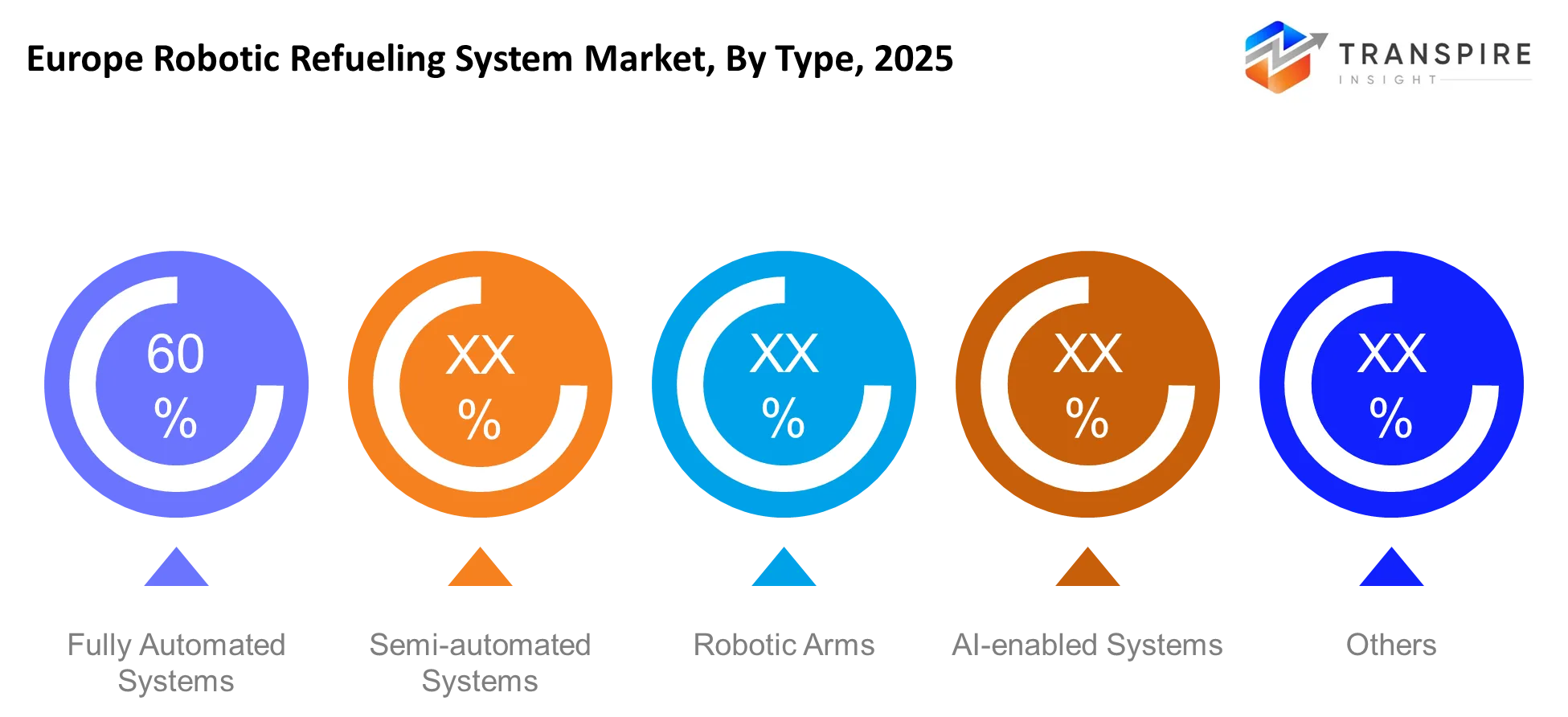
To learn more about this report, Download Free Sample Report
By Application
The offshore and heavy industrial sectors experience their highest operational risk and regulatory scrutiny which results in maritime and industrial fueling systems being their primary fuel solution. Although aviation fueling operates as a minor market segment, it maintains consistent demand because of its strict certification standards and slow-paced development of new airport facilities. Fleet operations and logistics become major growth sectors because operators want automated refueling systems that enable their continuous operations while decreasing their need for manual work.
Demand patterns differ between maritime users who need safety compliance and logistics operators who want to achieve maximum efficiency through faster operations at lower costs. The upcoming expansion will take place in industrial automation centers which will use integrated fueling systems as components of their complete digital systems, thereby driving vendors to develop solutions based on specific usage requirements.
By End-User
The defense sector achieves its leading position among end-user sectors because it adopted autonomous technologies early and invested heavily in systems that minimize crew exposure during essential operations. Industrial facilities follow because they need to handle hazardous materials while meeting strict workplace safety standards. Fuel stations and airports face slow implementation because their existing systems limit new changes and their operational expenses make them cautious, but pilot deployments are becoming more frequent.
The logistics sector is developing into a rapidly expanding market sector because supply chains choose to implement automation systems which enhance their operational reliability and decrease equipment failures. The future growth of vendors will depend on their capability to provide economical and expandable solutions which meet different operational needs of mid-sized commercial clients.
By Component
Robotic arms and sensors serve as the main physical components which enable accurate fuel management and continuous operational observation. The systems are moving towards intelligent automation and centralized control which makes software and controllers essential for system development. Sensors drive adoption by improving accuracy and safety, while advanced software platforms enable predictive maintenance and compliance tracking.
The growth logic centers on the transition from hardware-focused systems to integrated digital solutions. Manufacturing companies plan to invest more in software development and data analytics capabilities while they build platforms which combine reliable hardware with advanced operational intelligence.
What are the Key Use Cases Driving the Europe Robotic Refueling System Market?
Naval fleets and energy support vessels utilize maritime and offshore operations as their primary operational function. The robotic refueling systems operate to transfer fuel during dangerous sea conditions because manual operations create more substantial safety and spill threats. The European Maritime Safety Agency enforces strict compliance frameworks which require automation to maintain continuous regulation-compliant fueling operations that fulfill the highest demand requirements.
Automation technology now enables industrial facilities and logistics fleets to achieve operational continuity through its widespread implementation. Chemical plants and heavy manufacturing sites use robotic systems to manage hazardous fuel handling while logistics operators use them to optimize operations during peak demand in their fleet activities.
Remote offshore platforms and autonomous vessels represent emerging use cases that develop in North Sea regions. The environments require complete automated fueling systems which enable unmanned operations to establish fresh market expansion possibilities.
|
Report Metrics |
Details |
|
Market size value in 2025 |
USD 19.64 Million |
|
Market size value in 2026 |
USD 25.924 Million |
|
Revenue forecast in 2033 |
USD 184.93 Million |
|
Growth rate |
CAGR of 32.40% from 2026 to 2033 |
|
Base year |
2025 |
|
Historical data |
2021 - 2024 |
|
Forecast period |
2026 - 2033 |
|
Report coverage |
Revenue forecast, competitive landscape, growth factors, and trends |
|
Regional scope |
Europe (Germany, United Kingdom, France, Italy, Spain and Rest of Europe) |
|
Key company profiled |
KUKA, ABB, FANUC, Yaskawa, Universal Robots, Bosch, Siemens, Honeywell, Mitsubishi Electric, Kawasaki Robotics, Comau, Denso, Omron, Epson, Staubli |
|
Customization scope |
Free report customization (country, regional & segment scope). Avail customized purchase options to meet your exact research needs. |
|
Report Segmentation |
By Type (Fully Automated Systems, Semi-automated Systems, Robotic Arms, AI-enabled Systems, Others), By Application (Automotive Fueling, Aviation Fueling, Industrial Fueling, Fleet Operations, Logistics, Others), By End-User (Fuel Stations, Airports, Industrial Facilities, Logistics Companies, Defense Sector, Others), By Component (Robotic Arms, Sensors, Software, Controllers, Others) |
Which Regions are Driving the Europe Robotic Refueling System Market Growth?
The market base for Western Europe exists because Germany Norway and the Netherlands function as its main support countries. The operators must implement automated refueling systems because the maritime safety regulations and emissions regulations require strict enforcement. The advanced port facilities together with their busy commercial shipping activities generate ongoing requirements for precise fueling equipment. The established ecosystem which includes automation companies shipbuilding businesses and digital technology providers enables the organization to maintain its market position while driving ongoing progress.
The maritime modernization efforts in Sweden and Denmark demonstrate that these countries which make up Northern Europe function as a stable technology-focused region. This area prioritizes speedy implementation of autonomous ships together with complete digital technology solutions while Western Europe depends on its larger operational capacity. The strong partnership between public and private entities guarantees ongoing financial support for smart port development and offshore renewable energy initiatives. The region generates dependable revenue through its regular operations which continue to function despite not having its most extensive fleet operations.
Eastern Europe is emerging as the fastest-growing region which Poland and Romania currently lead. The European Union has supported recent port modernization projects through funding which has resulted in increased infrastructure development activities since 2023. The operators move toward robotic refueling systems because they need to expand their fleets and meet European Union safety requirements. The market for technology solutions will experience strong growth between 2026 and 2033 because businesses and investors will target cost-effective markets that are implementing modernization efforts.
Who are the Key Players in the Europe Robotic Refueling System Market and How Do They Compete?
The industry displays its competitive landscape through moderate consolidation which established automation and maritime technology companies control while niche software companies are entering the market. The existing companies maintain their market share through their ability to integrate systems and their contract agreements with naval and offshore operators. The companies engage in market competition through their different technological offerings which include precise control systems and AI-powered diagnostic tools and system compatibility with vessel platforms. Buyers focus on product reliability and compliance and lifecycle performance to make purchasing decisions while they consider cost as a minor factor in their decision-making process.
Through its advanced maritime automation system Kongsberg Gruppen provides complete autonomous vessel system integration which enables naval and offshore fleets to operate their systems without interruptions. ABB Ltd. creates unique value through its digital control platforms which enable refueling operations to connect with wider electrification and energy management systems. Siemens AG develops industrial-grade software solutions together with controller ecosystems which enable standardized installation across both ports and industrial sites.
Bosch Rexroth AG uses its knowledge of motion control systems and hydraulic technologies to produce robotic arms that operate with extreme accuracy in dangerous fueling situations. Saab AB develops defense systems which can function through remote and autonomous operation modes during mission-critical conditions. The companies develop their businesses through partnerships with shipbuilders and their integration into new vessel classes and their participation in offshore energy projects which help them build a competitive advantage for the future.
Company List
- KUKA
- ABB
- FANUC
- Yaskawa
- Universal Robots
- Bosch
- Siemens
- Honeywell
- Mitsubishi Electric
- Kawasaki Robotics
- Comau
- Denso
- Omron
- Epson
- Staubli
Recent Development News
In November 2025, Europe’s first in-orbit robotic refueling experiment moves toward validation phase: The ASTRAL mission—backed by European partners—progresses toward validating robotic docking and propellant transfer systems in orbit, testing standardized refueling interfaces for satellites. The mission is a key step in proving operational robotic refueling for future European spacecraft servicing networks.
Source: https://www.militaryaerospace.com
In March 2026, Airbus collaborates on robotic satellite refueling interface testing: Airbus is working with Orbit Fab under an ESA-supported program to evaluate RAFI refueling valve integration for future geostationary satellites. The initiative focuses on enabling standardized robotic refueling interfaces to extend satellite lifetimes and support dynamic orbital operations.
Source: https://www.orbitfab.com
What Strategic Insights Define the Future of the Europe Robotic Refueling System Market?
The Europe Robotic Refueling System Market is moving towards a new market trend which establishes automated fueling systems as essential components of digitalized vessel and industrial operational systems. The need for this transition occurs because organizations must now follow more stringent regulations while they require better methods to protect their workers from dangerous work situations. Over the next 5 to 7 years standalone hardware products will lose market share to integrated platforms which combine robotics and AI diagnostics and fleet control systems to generate income through extended service contracts.
The less visible danger exists because technology substitution occurs when alternative energy systems like electrification and hydrogen fueling infrastructure decrease their dependence on traditional liquid fuel systems in specific areas. An emerging opportunity is developing around the creation of automated offshore logistics hubs which organizations are constructing in North Sea regions to handle their uncrewed operational requirements for complete refueling operations. Market participants should invest early in software-centric, interoperable architectures which enable fuel type flexibility and support the development of autonomous ecosystems.
Europe Robotic Refueling System Market Report Segmentation
By Type
- Fully Automated Systems
- Semi-automated Systems
- Robotic Arms
- AI-enabled Systems
- Others
By Application
- Automotive Fueling
- Aviation Fueling
- Industrial Fueling
- Fleet Operations
- Logistics
- Others
By End-User
- Fuel Stations
- Airports
- Industrial Facilities
- Logistics Companies
- Defense Sector
- Others
By Component
- Robotic Arms
- Sensors
- Software
- Controllers
- Others
Frequently Asked Questions
Find quick answers to common questions.
The Approximate Europe Robotic Refueling System Market size for the Market will be USD 184.93 Million in 2033.
The key Segments of the Europe Robotic Refueling System Market are By Type (Fully Automated Systems, Semi-automated Systems, Robotic Arms, AI-enabled Systems, Others), By Application (Automotive Fueling, Aviation Fueling, Industrial Fueling, Fleet Operations, Logistics, Others), By End-User (Fuel Stations, Airports, Industrial Facilities, Logistics Companies, Defense Sector, Others), By Component (Robotic Arms, Sensors, Software, Controllers, Others).
Major Players in the Europe Robotic Refueling System Market are KUKA, ABB, FANUC, Yaskawa, Universal Robots, Bosch, Siemens, Honeywell, Mitsubishi Electric, Kawasaki Robotics, Comau, Denso, Omron, Epson, Staubli.
The Current Market size of the Europe Robotic Refueling System Market is USD 19.64 Million in 2025.
The Europe Robotic Refueling System Market CAGR is 32.40%
- KUKA
- ABB
- FANUC
- Yaskawa
- Universal Robots
- Bosch
- Siemens
- Honeywell
- Mitsubishi Electric
- Kawasaki Robotics
- Comau
- Denso
- Omron
- Epson
- Staubli
Recently Published Reports
-
Apr 2026
Handling and Lifting Equipment Market
Handling and Lifting Equipment Market Size, Share & Analysis Report By Product (Cranes and Hoists, Forklifts, Conveyor Systems, Aerial Work Platforms, Others), By Application (E-Commerce, Automotive and Railway, Food and Beverages, Aviation, Others), and Geography (North America, Europe, Asia-Pacific, Middle East and Africa, South and Central America), 2021 - 2031
-
Apr 2026
HVAC Equipment Market
HVAC Equipment Market Size, Share & Analysis Report By Heating Equipment Type (Boilers and Furnaces, Heat Pumps, and Unitary Heaters), By Ventilation Equipment (Air Handling Units, Humidifiers and Dehumidifiers, Air Filters, and Fan Coiling Units), By Air Conditioning Equipment (Unitary Air Conditioners, Room Air Conditioners, Packaged Terminal Air Conditioners, and Chillers), By End User (Commercial, Residential, Industrial, and others), and Geography (North America, Europe, Asia-Pacific, Middle East and Africa, South and Central America), 2021 – 2031
-
Apr 2026
Refrigeration Valves Market
Refrigeration Valves Market Size, Share & Analysis Report By Type (Solenoid Valves, Expansion Valves, Check Valves, Service Valves, Others), By Application (Commercial Refrigeration, Industrial Refrigeration, Transport Refrigeration, Residential Refrigeration, Air Conditioning Systems), By End User (Food and Beverage Industry, Pharmaceutical Industry, HVAC Industry, Chemical Industry, Others), and Geography (North America, Europe, Asia-Pacific, Middle East and Africa, South and Central America), 2021 – 2031
-
Apr 2026
E-Commerce Packaging Materials Market
E-Commerce Packaging Materials Market By Material Type (Corrugated Boxes, Paper & Paperboard, Foam & Cushioning Materials, Plastic Packaging, Flexible Packaging, Protective Packaging, Others), By Product(Primary Packaging, Secondary Packaging, Tertiary Packaging), By Packaging Function (Protective Packaging, Branding & Presentation Packaging, Transit & Logistic Packaging, Sustainable Packaging, Tamper Evidence Packaging), By End-User (Retail & Consumer Goods, Electronic Appliances, Food & Beverages, Healthcare & Pharmaceutical, Fashion & Apparel, Home & Furnishing, Others); By Industry Analysis, Size, Share, Growth, Trends, and Forecasts 2021-2033