

United States Fixed Satellite Services Market Size & Forecast:
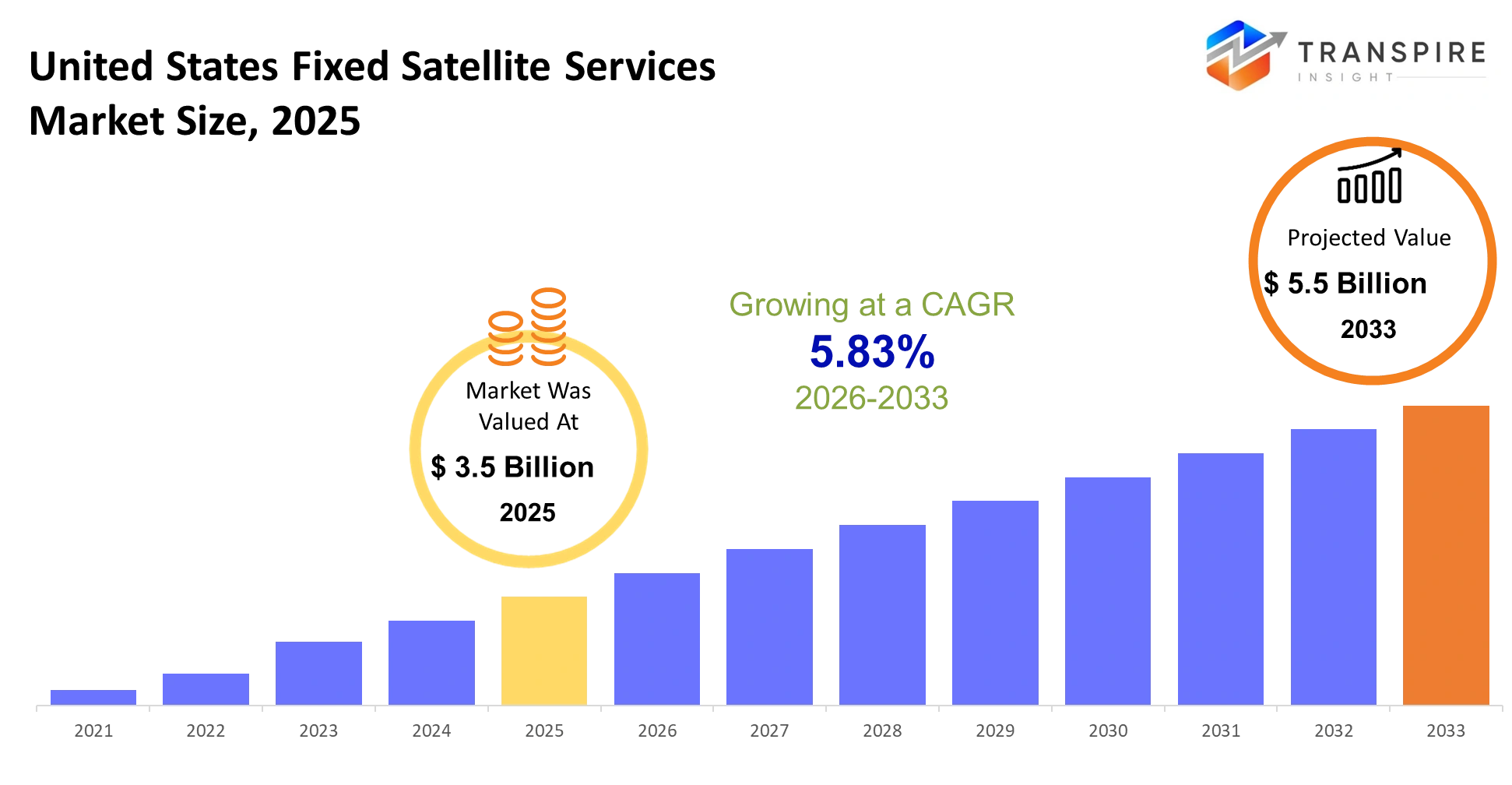
- United States Fixed Satellite Services Market Size 2025: USD 3.5 Billion
- United States Fixed Satellite Services Market Size 2033: USD 5.5 Billion
- United States Fixed Satellite Services Market CAGR: 5.83%
- United States Fixed Satellite Services Market Segments: By Service Type (Video Services, Data Services, Voice Services, Broadband Services, Managed Network Services, Others), By Frequency Band (C-band, Ku-band, Ka-band, X-band, Others), By Application (Telecommunications, Broadcasting, Government Communications, Maritime Communications, Aviation Communications, Others), By End User (Telecom Operators, Media Companies, Government Agencies, Enterprises, Defense Sector, Others).
To learn more about this report,  Download Free Sample Report
United States Fixed Satellite Services Market Summary:
The United States Fixed Satellite Services Market size is estimated at USD 3.5 Billion in 2025 and is anticipated to reach USD 5.5 Billion by 2033, growing at a CAGR of 5.83% from 2026 to 2033.The United States Fixed Satellite Services market kind of anchors communications whenever terrestrial networks can’t quite keep up, from offshore drilling platforms and cargo fleets to military outposts, remote utilities, and disaster recovery situations. In actual practice, it supports constant voice, video, broadband, plus data transmission across places that are hard to reach where operational downtime means either money is lost or safety gets compromised. Over the last five years, the whole market has been moving away from the older geostationary bandwidth leasing, and toward these hybrid setups that mix high-throughput satellites, software-defined networking, and low Earth orbit integration. As a result, latency has gotten better and bandwidth is more adjustable which makes satellite connectivity more realistic for real-time industrial observation and cloud-connected workflows.
A big part of the momentum happened around the COVID-19 period, when remote work, supply chain turbulence, and defense communication requirements made it clear that ground-based infrastructure has real limits. Enterprises then reworked their resilience playbooks , and satellite operators started landing steadier long term contracts across maritime logistics, energy, aviation, and government communication channels. That shift has increased recurring service revenue, beyond the older legacy broadcasting style of doing things.
Key Market Insights
- The Southern United States ended up really dominating the United States Fixed Satellite Services Market , with almost 38% market share in 2025, mostly because defense along with the energy sector were kind of concentrated there.
- The Western United States is showing up as the fastest-growing regional market through 2032, and that’s backed by aerospace innovation hubs and lots of commercial space investments, all together pushing demand.
- Gulf Coast maritime plus offshore operations still keep generating a lot of satellite bandwidth demand for things like fleet connectivity and remote monitoring applications.
- Federal infrastructure modernization programs have sped up satellite communication deployments across rural Alaska, mountain regions , and also those underserved industrial corridors , a lot quicker than before.
- Managed satellite communication services were the big leader in the United States Fixed Satellite Services Market, taking roughly 44% revenue share in 2025.
- Satellite bandwidth leasing came in as the second-largest segment, telecom operators were expanding backhaul capacity in order to support rural broadband coverage, pretty directly.
- High-throughput satellite services are the fastest-growing segment between 2026 and 2032, mainly due to reduced latency and better data efficiency.
- Hybrid GEO-LEO network integration picked up strong momentum as enterprises wanted uninterrupted connectivity across maritime and industrial operations.
- Defense and government communications held more than 32% market share in 2025, driven by secure data transmission needs, and mission-critical connectivity, always.
- For applications, maritime connectivity showed the quickest growth, shipping operators ramped up investments in real-time fleet management systems, basically turning it into a priority.
- Oil and gas operators kept accelerating the take-up of fixed satellite communication networks for offshore asset monitoring and predictive maintenance capabilities.
What are the Key Drivers, Restraints, and Opportunities in the United States Fixed Satellite Services Market?
The United States Fixed Satellite Services market kind of anchors communications whenever terrestrial networks can’t quite keep up, from offshore drilling platforms and cargo fleets to military outposts, remote utilities, and disaster recovery situations. In actual practice, it supports constant voice, video, broadband, plus data transmission across places that are hard to reach where operational downtime means either money is lost or safety gets compromised. Over the last five years, the whole market has been moving away from the older geostationary bandwidth leasing, and toward these hybrid setups that mix high-throughput satellites, software-defined networking, and low Earth orbit integration.
As a result, latency has gotten better and bandwidth is more adjustable which makes satellite connectivity more realistic for real-time industrial observation and cloud-connected workflows.A big part of the momentum happened around the COVID-19 period, when remote work, supply chain turbulence, and defense communication requirements made it clear that ground-based infrastructure has real limits.
Enterprises then reworked their resilience playbooks , and satellite operators started landing steadier long term contracts across maritime logistics, energy, aviation, and government communication channels. That shift has increased recurring service revenue, beyond the older legacy broadcasting style of doing things.
What Has the Impact of Artificial Intelligence Been on the United States Fixed Satellite Services Market?
Artificial intelligence and more advanced digital technologies are slowly changing the United States Fixed Satellite Services Market. Mostly it happens by making network automation better, handling bandwidth in smarter ways and also improving asset reliability across maritime, aviation, defense and even remote industrial work. Satellite operators these days are more and more using AI driven network orchestration platforms, those systems can assign bandwidth on their own based on where a vessel is, how weather interrupts things and how much traffic demand is showing up in practice. In maritime connectivity, these tools support fleets to keep steadier communication links, while also trimming unnecessary bandwidth use and lowering their day to day operational costs.
Machine learning models are reshaping predictive maintenance too, both for satellite ground infrastructure and for onboard communication terminals. Operators start examining telemetry data, antenna performance, patterns of signal degradation, plus environmental conditions, then they predict failures before outages actually happen. This method has helped increase network uptime and it also reduced the number of unplanned maintenance events for offshore energy operators and for commercial shipping fleets. There are also AI powered traffic optimization tools, which add an extra layer of fuel efficiency by enabling real time route adjustments tied to weather analytics and communication dependability.
On top of that, advanced analytics platforms help with regulatory compliance. They do it by automating communication logs, cybersecurity monitoring, and operational reporting, especially for government and defense users. Still, AI adoption runs into a big limitation, because many remote maritime areas experience inconsistent connectivity and scattered operational data. High integration costs and limited access to standardized training datasets continue to weaken model accuracy, and they tend to slow down wider deployment across older satellite infrastructure.
Key Market Trends
- Since 2021, maritime operators have sorta shifted away from simple voice connectivity toward cloud-linked fleet management and real time vessel performance analytics platforms, you know the whole thing.
- Defense agencies then ramped up buying resilient satellite communications systems after geopolitical tensions kinda showed the weak spots in terrestrial infrastructure ,and also in cybersecurity frameworks
- High-throughput satellite adoption grew pretty sharply after bandwidth costs fell almost 30% from 2019 to 2024 across commercial enterprise applications, not just one sector
- Companies like Viasat and SES started speeding up hybrid GEO-LEO integration strategies so they could cut latency for industrial customers, even where conditions are rough
- Aviation operators moved past passenger Wi-Fi services and took on satellite enabled predictive maintenance plus aircraft telemetry monitoring systems after 2022 rolled in
- AI based bandwidth orchestration platforms really appeared across offshore energy operations, assisting providers to reduce network congestion and boost uptime during severe weather disruptions
- Federal broadband expansion initiatives also pushed satellite backhaul deployments across remote US regions where fiber infrastructure was still financially impractical after 2020, basically the economics didn’t cooperate
- Satellite providers increasingly ditched long term fixed capacity contracts in favor of flexible consumption based pricing models, to pull in enterprise and maritime customers
- Supply chain disruptions in 2021 and 2022 slowed down satellite manufacturing schedules, so operators had to diversify launch providers and adjust component sourcing strategies, fast
- Cybersecurity investments then grew a lot after ransomware attacks hit critical infrastructure networks, which drove demand for encrypted satellite communication platforms across government and industrial areas
United States Fixed Satellite Services Market Segmentation
By Service Type
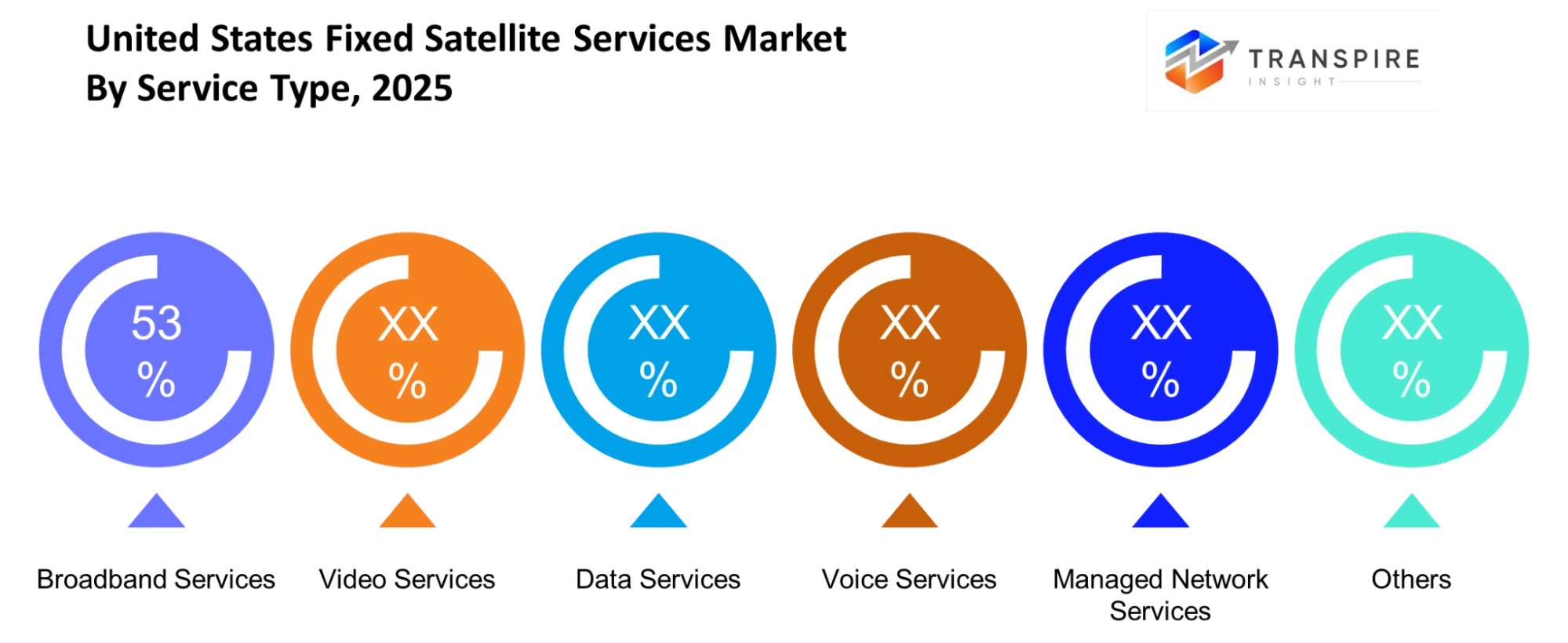
Data services along with managed network services are sitting in what feels like the strongest spot in the service type area right now because enterprise digitalization, defense modernization, and remote industrial operations really hinge on steady, high-capacity connectivity. Broadband services have also picked up serious momentum after offshore operators, airlines, and logistics companies started pouring more money into cloud based communication platforms during 2020 to 2025. Video services keep pulling in steady revenue from broadcasting applications, but the shift toward streaming and the fiber expansion—those two things lowered the long term reliance on classic satellite TV distribution.
Voice services stay useful for maritime safety and emergency communication setups, especially where terrestrial infrastructure just can’t be relied on. Demand trends are moving toward integrated service bundles that bring in cybersecurity, bandwidth optimization and real time monitoring, all together, not as separate add ons. Service providers compete more and more with flexible subscription models, plus software defined network management rather than leaning only on fixed capacity contracts. The direction the market seems to be heading is a kind of hybrid communication ecosystem, where satellite operators offer scalable managed connectivity for industrial automation, far off operations, and mission critical enterprise infrastructure.
To learn more about this report, Download Free Sample Report
By Frequency Band
Ku-band services, uh, are still basically leading the way in frequency band adoption because maritime fleets, aviation operators and commercial broadcasters lean on dependable coverage and on balanced bandwidth economics too. C-band keeps playing a key role for government communications and weather-sensitive uses, mostly because it has strong resistance to rain fade as well as less vulnerability to signal interference. Ka-band is the fastest-growing piece of the puzzle since high-throughput satellite deployments keep ramping up, pushing data speeds higher and, at the same time lowering bandwidth costs for enterprise clients. X-band also has real staying power in military and defense communication networks where secure transmission and operational resilience are the main priorities, no question.
Demand patterns shifted a lot once high-throughput satellite architecture reduced latency constraints ,and basically made more kinds of real-time industrial applications feel practical commercially. Satellite operators are also puttin’ more money into multi-band payload capabilities so they can deliver service flexibility across various, kind of mixed operating environments. Looking ahead, future investments will probably tilt toward adaptive frequency management and software controlled spectrum allocation systems, which will let providers dial up network efficiency while still supporting high-bandwidth uses like autonomous systems, AI analytics and remote infrastructure monitoring.
By Application
Telecommunications applications keep leading in overall market usage, mostly because satellite networks help push rural broadband further along with cellular backhaul , and emergency communication infrastructure across parts that are still under served. In a similar way, Government communications stay pretty solid in the market, since federal agencies are prioritizing encrypted data transmission, surveillance coordination, and disaster recovery features. Broadcasting applications are still quite relevant too, especially for live media distribution , but digital streaming platforms have been slowly reshaping the old revenue curves, even if the impact was not instant.
Maritime communications, meanwhile, has turned into one of the quicker expanding pockets, after shipping companies started rolling out real-time fleet management, crew welfare services and also predictive maintenance systems. Aviation communications picked up momentum as well, with airlines adopting connected aircraft technologies, plus in-flight broadband services, so operations get smoother and passengers feel the difference. Application demand now seems to mirror a very specific need for constant connectivity in remote and also mobile environments. Looking ahead, growth will likely focus on low latency communication systems for autonomous operations , industrial IoT deployments, and AI-driven analytics across transportation, defense, and energy infrastructure networks.
By End User
Telecom operators, right now, count as the biggest end-user group in think because nationwide broadband pushes and mobile data growth keep piling on new satellite backhaul needs. Government agencies and defense organizations, too, still hold a sizable slice via long-term deals, mainly for secure communication, intelligence coordination, and network resilience like infrastructure that can actually take a hit. Media firms keep satellite usage pretty steady for live broadcasting and content delivery, especially around huge sports nights and breaking news, when coverage cannot really wait. Enterprise take-up moved fast through mining, oil and gas, utilities and logistics, where remote equipment observation and uninterrupted operations became “must haves” after the recent supply chain disruptions, honestly.
Commercial aviation plus maritime operators have also been spending more on connectivity, to back digital operations and the passenger, or crew, service expectations that people now assume are included. Buying habits are also shifting toward scalable managed connectivity platforms instead of just grabbing standalone bandwidth, and doing it that way feels safer. Looking ahead, market momentum seems to point to more collaboration between satellite operators, cloud providers and industrial enterprises, because organizations want combined communication environments that can handle automation, cybersecurity, and near real-time operational intelligence.
What are the Key Use Cases Driving the United States Fixed Satellite Services Market?
Remote broadband connectivity still feels like the main reason, satellite services get adopted across the United States , even if people phrase it differently. Telecom operators, defense agencies, and offshore energy companies basically lean on fixed satellite networks when terrestrial infrastructure can’t quite do its job reliably, or at least not for long. And the “always on” part, meaning continuous connectivity for command systems, data transfer, and day to day operational monitoring, creates the strongest repeat service demand.
Maritime and aviation comms have been picking up momentum, pretty steadily over the last five years. Commercial shipping fleets now lean into satellite connectivity for near-real time navigation, engine diagnostics, and crew welfare service, while airlines are more and more rolling out in flight broadband, along with aircraft telemetry systems. On top of that , government disaster recovery programs have expanded satellite deployments for emergency response coordination, especially during hurricanes and wildfires.
Looking ahead, emerging applications show up like autonomous industrial operations and AI enabled remote asset management. Mining operators in Alaska, and offshore energy platforms in the Gulf of Mexico are already testing low latency hybrid satellite systems, to support predictive maintenance, drone surveillance, and automated infrastructure inspections over the forecast period.
|
Report Metrics |
Details |
|
Market size value in 2025 |
USD 3.5 Billion |
|
Market size value in 2026 |
USD 3.7 Billion |
|
Revenue forecast in 2033 |
USD 5.5 Billion |
|
Growth rate |
CAGR of 5.83% from 2026 to 2033 |
|
Base year |
2025 |
|
Historical data |
2021 - 2024 |
|
Forecast period |
2026 - 2033 |
|
Report coverage |
Revenue forecast, competitive landscape, growth factors, and trends |
|
Geographic scope |
United States of America |
|
Key company profiled |
Intelsat, SES S.A., Eutelsat, Viasat, Hughes Network Systems, Telesat, Inmarsat, EchoStar, Gilat Satellite Networks, Iridium Communications, Boeing, Lockheed Martin, Airbus Defence and Space, Speedcast, OneWeb |
|
Customization scope |
Free report customization (country, regional & segment scope). Avail customized purchase options to meet your exact research needs. |
|
Report Segmentation |
By Service Type (Video Services, Data Services, Voice Services, Broadband Services, Managed Network Services, Others), By Frequency Band (C-band, Ku-band, Ka-band, X-band, Others), By Application (Telecommunications, Broadcasting, Government Communications, Maritime Communications, Aviation Communications, Others), By End User (Telecom Operators, Media Companies, Government Agencies, Enterprises, Defense Sector, Others) |
Which Regions are Driving the United States Fixed Satellite Services Market Growth?
The Southern United States basically leads the market, because the region combines strong defense spending, offshore energy infrastructure and a lot of maritime trade activity right along the Gulf Coast. In practice states like Texas, Louisiana and Florida host major satellite ground stations, naval facilities and offshore drilling operations, all of which need uninterrupted communication coverage. A bunch of federal contracts tied to military modernization as well as emergency response systems, keep extending long-term service agreements for the satellite operators. There is also this mature ecosystem of aerospace manufacturers, launch providers telecom integrators and port infrastructure, which helps make deployment stable and operational scalability feel pretty straightforward across the region.
Meanwhile the Western United States stays a strong revenue contributor mostly through technology innovation and commercial aerospace investment, rather than heavy maritime dependence. California, Colorado, and Arizona do well with concentrated satellite manufacturing, private space ventures, and advanced research partnerships involving government agencies and technology firms. Compared to the Southern region, the West’s market activity leans more on enterprise digital infrastructure, cloud connectivity and aviation communication systems. Steady investment from commercial airlines, remote mining operators and technology enterprises creates a calmer demand backdrop, so long-term network expansion and predictable service revenue can keep moving forward without too much drama.
The fastest growth momentum is showing up in Alaska and remote northern territories where infrastructure gaps and industrial digitization kind of sped up satellite adoption after 2021. With more federal broadband funding, plus Arctic surveillance programs and mining modernization projects there’s now a new kind of demand for resilient communications systems in those isolated operating conditions. At the same time, maritime activity along northern shipping routes , and the push for more environmental monitoring, also helped strengthen deployment opportunities for hybrid satellite networks. All of this regional expansion, really creates attractive entry points for satellite providers, managed service firms and infrastructure investors who are looking for underserved high-value markets between 2026 and 2033..
Who are the Key Players in the United States Fixed Satellite Services Market and How Do They Compete?
In the United States, the Fixed Satellite Services Market kinda sits in a moderately consolidated kind of setup, where a small group of large satellite operators controls most of the high-capacity orbital assets and the big enterprise contracts. So instead of competing only on bandwidth pricing, the competition now swings more toward actual network performance, multi-orbit integration, cyber-security competence, and managed service flexibility. Older operators keep trying to defend market share, mostly through long-term government and aviation arrangements, but newer low Earth orbit players are pushing the incumbents to cut latency and improve service responsiveness. Meanwhile, buyers seem to be putting a lot more weight on hybrid connectivity options, basically mixing satellite, cloud, and terrestrial infrastructure into one unified communications platform for maritime, defense, and industrial use, kind of as a whole package.
Viasat competes by leaning on high-capacity broadband infrastructure plus a vertically integrated way of delivering services across aviation, maritime, and defense. It differentiates itself with an advanced Ka-band satellite design, and it also folds in integrated cybersecurity capabilities, which is meant to back mission-critical communications. Their recent growth push has been about integrating acquired global satellite assets, and also strengthening in-flight connectivity partnerships with commercial airlines. Intelsat uses a network diversification approach, centered around hybrid GEO-LEO connectivity and flexible managed services aimed at enterprise and government clients. They also maintain strong ties with media broadcasters and mobility operators, which helps create steady recurring revenue while they expand into software defined networking style solutions.
SES kind of differentiates itself with multi-orbit communication systems, that blend geostationary reach and medium Earth orbit coverage for low-latency enterprise uses. In practice, Strategic partnerships with cloud providers and defense agencies somehow boosted demand for secure remote connectivity services across industrial as well as government networks, and that kind of momentum kept building. Hughes Network Systems focuses on broadband access and rural connectivity programs, running managed network platforms to support underserved markets both commercial and residential. EchoStar keeps expanding via spectrum optimization and integrated satellite terrestrial communication approaches, targeting enterprise mobility and remote infrastructure monitoring applications.
Company List
- Intelsat
- SES S.A.
- Eutelsat
- Viasat
- Hughes Network Systems
- Telesat
- Inmarsat
- EchoStar
- Gilat Satellite Networks
- Iridium Communications
- Boeing
- Lockheed Martin
- Airbus Defence and Space
- Speedcast
- OneWeb
Recent Development News
In May 2026, FCC Approves EchoStar Spectrum Sale to SpaceX and AT&T: The U.S. Federal Communications Commission approved a major $40 billion spectrum transaction involving EchoStar, SpaceX, and AT&T. The agreement strengthens satellite-based direct-to-device connectivity and expands rural communication coverage across the United States, significantly impacting the Fixed Satellite Services ecosystem.
Source: https://www.reuters.com
In May 2026, U.S. Wireless Carriers Launch Satellite Connectivity Joint Venture: Verizon, AT&T, and T-Mobile announced a joint venture focused on eliminating wireless dead zones using satellite-based technologies. The initiative relies heavily on direct-to-device satellite infrastructure and reflects rising investment in hybrid terrestrial-satellite communication services within the U.S. FSS market.
Source: https://www.reuters.com
What Strategic Insights Define the Future of the United States Fixed Satellite Services Market?
The United States Fixed Satellite Services market is kind of moving away from pure, raw bandwidth supply toward software-defined, multi-orbit communication ecosystems, where value kind of shifts into managed connectivity and real time network choreography. This change seems to be pulled along by the growing reliance on durable links across defense, offshore energy aviation, and autonomous industrial systems that really cannot afford a terrestrial network breakdown. Over the next 5–7 years, satellite operators will likely start monetizing end-to-end service intelligence instead of only selling capacity, and that will nudge revenue structures toward subscription style offerings and usage-optimized platforms.
There’s also a less obvious risk building in the background, which is supply chain concentration for advanced semiconductor components used in payload processing plus ground terminal systems. If there’s any geopolitical disruption or export limitations on those components, constellation upgrade timelines could get pushed out, and service scalability might end up being constrained even while demand stays strong. At the same time, there’s a newer opportunity brewing too, centered around Arctic maritime corridors, where climate related route expansion and thin terrestrial infrastructure are increasing demand for hybrid GEO-LEO coverage, tailored for navigation and surveillance use cases.
Because of all that, market participants should push for modular satellite architectures and tighter software-defined network integration, so upgrade cycles can be reduced, and flexibility is preserved across those shifting orbital environments.
United States Fixed Satellite Services Market Report Segmentation
By Service Type
- Video Services
- Data Services
- Voice Services
- Broadband Services
- Managed Network Services
- Others
By Frequency Band
- C-band
- Ku-band
- Ka-band
- X-band
- Others
By Application
- Telecommunications
- Broadcasting
- Government Communications
- Maritime Communications
- Aviation Communications
- Others
By End User
- Telecom Operators
- Media Companies
- Government Agencies
- Enterprises
- Defense Sector
- Others
Frequently Asked Questions
Find quick answers to common questions.
The approximate United States Fixed Satellite Services Market size for the market will be USD 5.5 Billion in 2033.
The key segments of the United States Fixed Satellite Services Market are By Service Type (Video Services, Data Services, Voice Services, Broadband Services, Managed Network Services, Others), By Frequency Band (C-band, Ku-band, Ka-band, X-band, Others), By Application (Telecommunications, Broadcasting, Government Communications, Maritime Communications, Aviation Communications, Others), By End User (Telecom Operators, Media Companies, Government Agencies, Enterprises, Defense Sector, Others).
Major players in the United States Fixed Satellite Services Market are Intelsat, SES S.A., Eutelsat, Viasat, Hughes Network Systems, Telesat, Inmarsat, EchoStar, Gilat Satellite Networks, Iridium Communications, Boeing, Lockheed Martin, Airbus Defence and Space, Speedcast, OneWeb.
The current market size of the United States Fixed Satellite Services Market is USD 3.5 Billion in 2025.
The United States Fixed Satellite Services Market CAGR is 5.83%.
- Intelsat
- SES S.A.
- Eutelsat
- Viasat
- Hughes Network Systems
- Telesat
- Inmarsat
- EchoStar
- Gilat Satellite Networks
- Iridium Communications
- Boeing
- Lockheed Martin
- Airbus Defence and Space
- Speedcast
- OneWeb
Recently Published Reports
-
Apr 2026
3D Optical Profiler Market
3D Optical Profiler Market Size, Share & Analysis Report By Type (Desktop 3D Optical Profiler, and Portable 3D Optical Profiler), By Technology (Confocal Technology, and White Light Interference), By End-Use Industry (Manufacturing, Research Institutions, Automotive, Aerospace and Defense, Medical Devices, and Other), and Geography (North America, Europe, Asia-Pacific, Middle East and Africa, South and Central America), 2021 - 2031
-
Apr 2026
Depth Sensor Market
Depth Sensor Market Size, Share & Analysis Report By Type (Infrared Depth Sensors, Time-of-Flight (ToF) Sensors, Stereo Vision Sensors, Structured Light Sensors, Ultrasonic Depth Sensors), By Application (Automotive, Robotics, Gaming, Consumer Electronics, Industrial Automation, Healthcare, Security & Surveillance, Others), By End Users (Automotive Manufacturers, Consumer Electronics Companies, Healthcare Providers, Industrial Companies, Security Agencies, Gaming Companies, Robotics Companies, Others), and Geography (North America, Europe, Asia-Pacific, Middle East and Africa, South and Central America), 2021 – 2031
-
Apr 2026
Digital Manufacturing Market
Digital Manufacturing Market Size, Share & Analysis Report By Component (Hardware, Software, and Services), By Technology (Robotics, 3D Printing, Internet of Things (IoT), and Others), By Application (Automotive and Transportation, Aerospace and Defense, Consumer Electronics, Industrial Machinery, and Others), By Process Type (Computer-Based Designing, Computer-Based Simulation, Computer 3D Visualization, Analytics, and Others), and Geography (North America, Europe, Asia-Pacific, Middle East and Africa, South and Central America), 2021 – 2031
-
Apr 2026
Digital Visa Services Market
Digital Visa Services Market Size, Share & Analysis Report By Type (Individual Travelers, Group Travelers), By Application (Tourism, Business Travel, Others), and Geography (North America, Europe, Asia-Pacific, Middle East and Africa, South and Central America), 2021 – 2031