
Middle East and Africa Reusable Insulin Injector Pens Market Size & Forecast:
- Middle East and Africa Reusable Insulin Injector Pens Market Size 2025: USD 167.4 Million
- Middle East and Africa Reusable Insulin Injector Pens Market Size 2033: USD 291.98 Million
- Middle East and Africa Reusable Insulin Injector Pens Market CAGR: 7.20%
- Middle East and Africa Reusable Insulin Injector Pens Market Segments: By Product Type (Manual Reusable Pens, Smart Reusable Pens, Bluetooth-enabled Pens, Durable Pens, Others); By Application (Type 1 Diabetes, Type 2 Diabetes, Gestational Diabetes, Others); By Distribution Channel (Hospitals, Retail Pharmacies, Online Pharmacies, Others); By End User (Adults, Pediatrics, Elderly, Others)
Middle East and Africa Reusable Insulin Injector Pens Market Summary
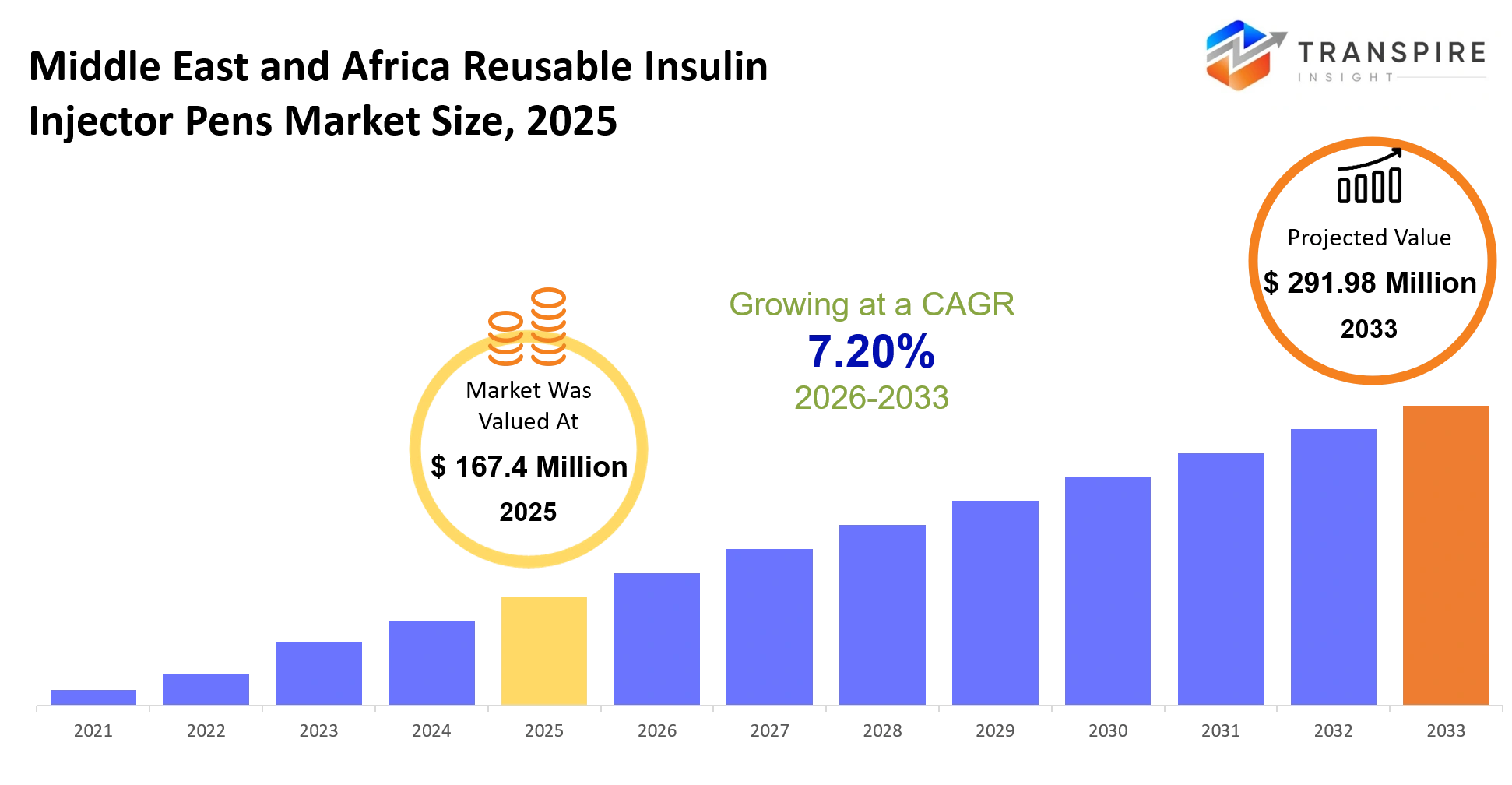
The Middle East and Africa Reusable Insulin Injector Pens Market was valued at USD 167.4 Million in 2025. It is forecast to reach USD 291.98 Million by 2033. That is a CAGR of 7.20%over the period.
The Middle East and Africa Reusable Insulin Injector Pens Market matters a lot in diabetes care because it allows accurate, repeatable insulin delivery while also helping cut down on the long-term cost and waste that usually comes with disposable injection systems. Many healthcare providers and patients, they’re leaning toward reusable pens more and more because they boost dosing consistency, help with treatment adherence, and make everyday insulin use feel simpler, almost like a smoother routine.
In the last five years the market has moved away from simple mechanical devices, and toward connected ,smart pen platforms that can track dosage history and also fit into digital diabetes management. One major reason for this shift is the fast growth of diabetes care initiatives in Gulf countries and in several areas of Africa, plus more access to digital health tools after the COVID-19 period. Since health systems are trying to reduce complications tied to weak glycemic control, the need for precision delivery devices keeps getting stronger. All of this is encouraging manufacturers to launch advanced reusable pen technologies, broaden regional distribution channels , and put more effort into patient-focused product design, which should keep supporting steady revenue potential across the whole region.
Key Market Insights
- The Middle East and Africa Reusable Insulin Injector Pens Market is expected to grow from USD 167.4 million in 2025, and then reach about USD 291.98 million by 2033.
- In 2025, the Gulf Cooperation Council countries brought in roughly 40%+ of regional revenue, mostly because diabetes care infrastructure is already quite advanced there.
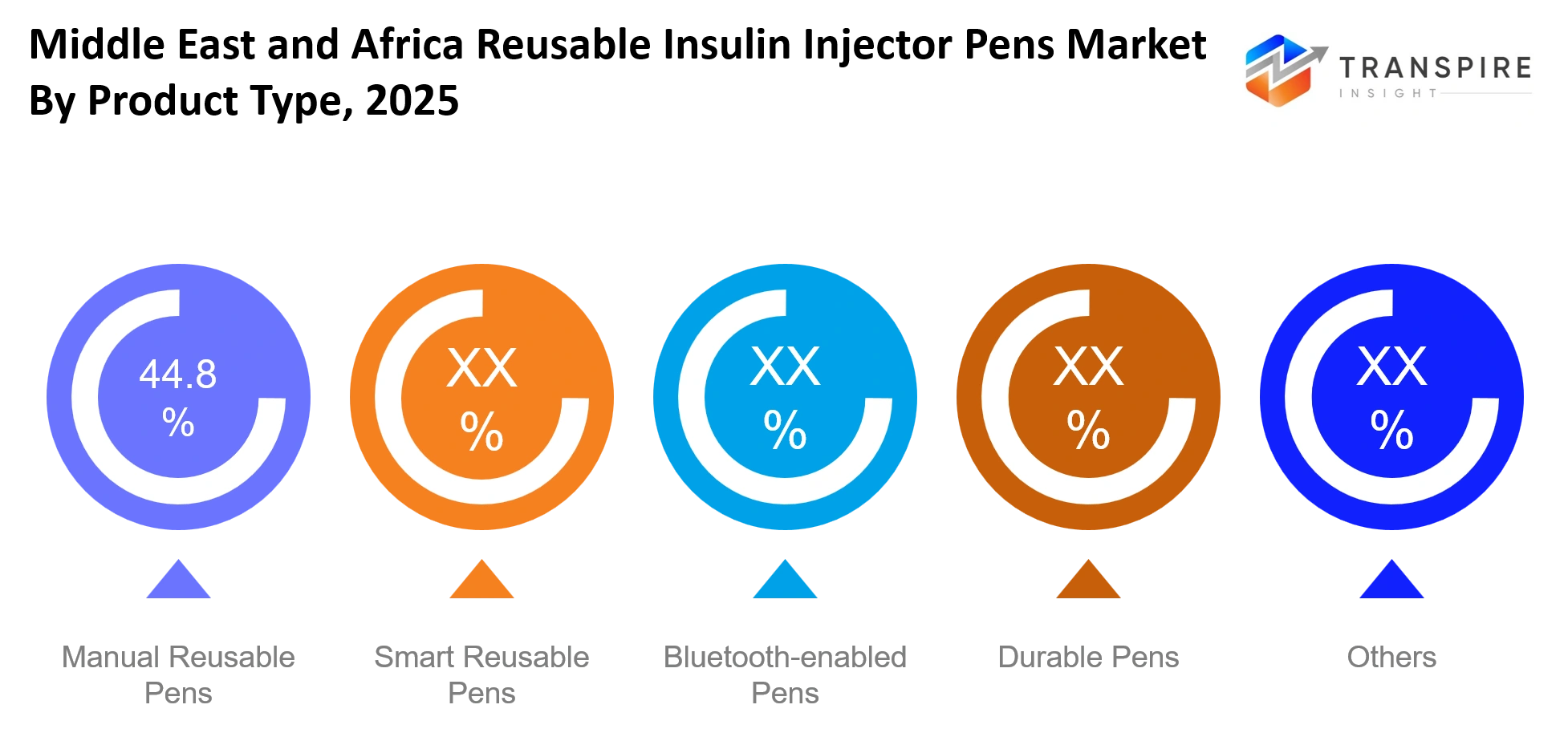
- Manual reusable pens still held the biggest portion of the market, around 45% in 2025, largely due to affordability and wide clinical comfort in practice.
- Smart, and Bluetooth enabled pens are forecasted to show the fastest rise all the way through 2033, backed by connected care ecosystems and related services.
- As for use cases , type 2 diabetes applications accounted for more than 60% of market revenue in 2025, which makes sense given how large the diabetic population is across the region.
- Adult patients created over 70% of demand in 2025, so adults basically remain the leading end user category.
- Online pharmacy channels picked up speed quickly after 2020, with digital prescription fulfillment getting more attention across many urban healthcare systems.
- Product innovation is still a main competitive lever, since manufacturers are weaving in dose memory functions, connectivity capabilities, and adherence monitoring tools.
- And there’s also strategic expansion by firms like Novo Nordisk, Eli Lilly, Sanofi, Ypsomed, and Medtronic, which is helping them push deeper into the regional market.
- Finally, partnerships between insulin manufacturers and digital health providers are building more integrated diabetes management platforms, with the goal of improving adherence, and overall patient outcomes.
What are the Key Drivers, Restraints, and Opportunities in the Middle East and Africa Reusable Insulin Injector Pens Market?
The strongest growth driver is this quick uptick in diabetes prevalence across the Middle East and some parts of Africa, mixed together with healthcare initiatives that try to make chronic disease management work better. At the moment, Governments and healthcare providers are kind of shifting their focus toward long-term treatment efficiency, not so much short-term device costs. Reusable insulin pens lower the total lifetime treatment expenses compared with the habit of continuously buying disposable alternatives. That cost–performance sweet spot makes it easier for hospitals, clinics, and insurers to back wider adoption, and it directly pushes stronger sales volumes plus recurring revenue tied to insulin therapy programs.
The biggest restraint still seems to be uneven healthcare infrastructure, along with uneven reimbursement coverage, across several African countries. This issue feels structural, because it depends on healthcare funding levels, insurance penetration, specialist workforce availability, and even the distribution networks. Fixes won’t happen fast since they need years of investment and policy development. When reimbursement is limited, patients often end up prioritizing upfront affordability over more advanced delivery systems. So adoption of premium reusable and connected devices gets delayed. In the end, manufacturers see slower market penetration, and lower revenue realization in those underserved regions.
A major opportunity is there though, and it’s about integrating reusable insulin pens together with digital health platforms and remote patient monitoring systems. Smart pens that can log dosing history and transmit treatment data are becoming more relevant, as healthcare providers chase better diabetes outcome management. Gulf countries, especially Saudi Arabia and the UAE, are putting money into digital healthcare infrastructure quite heavily.
What Has the Impact of Artificial Intelligence Been on the Middle East and Africa Reusable Insulin Injector Pens Market?
Artificial intelligence is, kind of slowly, transforming diabetes management across the reusable insulin injector pen ecosystem. AI-powered software platforms that connect with smart insulin pens can look into dosing behavior, glucose trends, and those treatment adherence patterns people don’t always talk about. In practice, these platforms help healthcare providers spot missed doses, nudge insulin schedules, and refine individualized treatment plans… like more tailored, less generic.
Machine learning algorithms are getting used more and more to anticipate blood glucose swings from historical patient data. And when you combine details coming from connected insulin pens with glucose monitoring devices, plus digital health applications, healthcare providers can craft better treatment recommendations, with fewer guesses. Predictive analytics also supports early intervention when adherence slips, or when glucose control starts to deteriorate a bit.
On the operational side, digital diabetes management platforms reduce manual record keeping and, generally speaking, make treatment visibility better. Healthcare providers tend to get quicker patient assessments, while patients get more personalized therapy guidance. A few connected insulin solutions have already shown improved adherence rates and more consistent treatment, which may translate into better clinical outcomes and lower healthcare costs.
Still, adoption hits a key limitation. Many healthcare systems across the region don’t yet have integrated digital infrastructure, and connected insulin devices can also mean higher implementation costs. Data interoperability is another stumbling point, plus limited access to high-quality patient datasets, both of which restrict accuracy, and scalability for AI-driven diabetes management solutions.
Key Market Trends
- Smart insulin pen adoption went up a lot from 2021 into 2025 , mostly because healthcare providers kept pushing data-driven diabetes management, sort of like the “look at the numbers first” approach.
- Bluetooth enabled devices also moved from kinda niche products into mainstream diabetes programs, across a bunch of major Gulf healthcare systems , not just a few pilots.
- After 2022 , digital health partnerships seemed to speed up, by tying insulin delivery devices with mobile monitoring applications, so they feel less separate.
- Since 2021 Saudi Arabia and the UAE have increased healthcare technology spending by over 20% across several diabetes management efforts .
- Reusable devices started getting picked more often than disposable alternatives, healthcare organizations basically wanted long term cost optimization, which makes sense even if the upfront work looks annoying.
- Between 2023 and 2025 , manufacturers broadened regional distribution partnerships, aiming to make products easier to find in underserved markets, not only in big cities.
- Patient adherence tracking changed too , it moved from manual recording methods toward automated cloud based monitoring platforms.
- And for more than 60% of the new premium pen introductions since 2022, the designs added connectivity , or digital dose recording functions, sometimes both.
- Competition then shifted away from “device only” offers, toward integrated treatment ecosystems that combine hardware , software, and clinical support services.
- More and more regional healthcare providers now judge insulin delivery solutions based on treatment outcomes, rather than just device acquisition costs , it’s a different kind of decision logic.
Middle East and Africa Reusable Insulin Injector Pens Market Segmentation
By Product Type
Manual Reusable Pens still hold a big chunk of insulin delivery, mostly because they are affordable , easy to run, and they keep working in a pretty consistent way. A lot of healthcare facilities end up choosing these devices for routine diabetes management programs, day to day. Smart Reusable Pens bring in extra digital features like dose tracking and treatment monitoring, which helps healthcare providers think about patient adherence in a more organized way. Then there are Bluetooth-enabled Pens , which go a step further by enabling mobile connectivity, so data moves smoothly and fits with newer diabetes management systems.
Durable Pens keep pulling steady demand because strong construction means longer use, and fewer replacements. Even so, consistent performance along with user comfort are still key factors when facilities are buying. Some programs also look at other options, including specialized reusable devices built for a specific insulin formulation, or for distinct patient needs. Ongoing product development will keep expanding what’s possible in treatment choices, and it should help manufacturers meet different clinical requirements across regional healthcare markets.
By Application
Type 1 Diabetes still stays as an important application area, because insulin administration is basically essential for the whole treatment period. Getting the dose delivered accurately and the long-term therapy requirements, these things help keep consistent use of reusable injection devices. Type 2 Diabetes takes the largest application share, mostly due to the big patient population that still needs insulin based treatment. Also, cost efficiency plus day to day convenience really help adoption across different healthcare systems and diabetes care programs.
Gestational Diabetes creates a strong need for dependable insulin delivery during pregnancy, since glucose control needs careful management all the time. In this category, healthcare providers often focus on safety, ease-of-use, and dosing precision, even when schedules get complicated. “Others” includes secondary diabetes conditions, along with specialized treatment situations where insulin administration remains required. So the different clinical needs keep supporting the demand for reusable injection technologies across various patient groups, even when the use case is not exactly the same.
By Distribution Channel
Hospitals still sort of stay as a big distribution channel for diabetes stuff, since diagnosis, starting treatment, and then specialist care often happen right inside hospital environments. When procurement decisions get made, companies usually lean on product dependability, clinical results, and treatment outcomes… not just one thing. Retail Pharmacies are useful too, they give easy access to insulin delivery devices and help keep a wide range of products available in both city and semi-urban areas. Pharmacy networks keep expanding, so diabetes care products can reach more people across the region.
Online Pharmacies are getting more and more important, mainly because digital health adoption keeps rising , and e-commerce activity keeps widening. People like the ordering flow, and the fact that there is home delivery too, which boosts use of online channels. Other routes show up as specialty diabetes clinics, healthcare centers, and dedicated treatment facilities aimed at specific patient groups. Overall, spreading distribution across multiple routes should make products more reachable and help widen market reach across the forecast period.
By End User
Adults really show up as the biggest end user segment, mainly because insulin treated diabetes is more common in working-age and middle aged people. Because the condition is basically ongoing, people usually need to keep using reusable injection devices, pretty continuously, you know. For Pediatrics the demand is a bit different, like there is a strong need for products that keep dosing precise yet still feel easy to manage, and they have to support effective diabetes management in younger age groups. A lot of Product design thinking goes toward safety, comfort, and also ease of operation, even when the device is handled often.
The elderly also matter a lot as a user category, since diabetes prevalence tends to climb as people get older. Healthcare providers often end up preferring devices that are easy to read, have reliable performance, and still feel comfortable in the hand. Then there are Others too, like specialized patient groups, with distinct treatment needs, or with clinical conditions that require insulin administration in the first place. Going forward, Continued product innovation will help enable more personalized treatment approaches, and it should expand usage across different healthcare settings, not just one.
What are the Key Use Cases Driving the Middle East and Africa Reusable Insulin Injector Pens Market?
The main use case seems to be long term insulin administration for people who live with Type 2 diabetes. Honestly this kind of setup creates the top demand, because the treatment might go on for many years , so reusable devices end up being a more cost efficient and useful option for both healthcare providers and patients. When dosing stays consistently accurate , and device waste goes down, it naturally makes adoption feel easier for everyone.
Beyond that, there are extra use cases showing up in specialized diabetes management programs, especially for Type 1 diabetes and pediatric care. Endocrinology clinics are increasingly leaning on more advanced reusable devices, those that can help with precise insulin delivery and also support treatment monitoring in a more controlled way. Hospitals and specialty diabetes centers too are starting to weave connected insulin pen technologies into chronic disease management pathways, step by step.
And there are also emerging opportunities around connecting these tools with digital health platforms and remote patient monitoring programs. Smart reusable pens that sync with mobile applications help healthcare professionals observe adherence patterns and refine therapy decisions. As the digital healthcare infrastructure keeps maturing across Gulf countries, and certain parts of Africa too, these applications are expected to build stronger commercial momentum over time.
|
Report Metrics |
Details |
|
Market size value in 2025 |
USD 167.4 Million |
|
Market size value in 2026 |
USD 179.45 Million |
|
Revenue forecast in 2033 |
USD 291.98 Million |
|
Growth rate |
CAGR of 7.20% from 2026 to 2033 |
|
Base year |
2025 |
|
Historical data |
2021 - 2024 |
|
Forecast period |
2026 - 2033 |
|
Report coverage |
Revenue forecast, competitive landscape, growth factors, and trends |
|
Regional scope |
United States; Canada; Mexico; United Kingdom; Germany; France; Italy; Spain; Denmark; Sweden; Norway; China; Japan; India; Australia; South Korea; Thailand; Brazil; Argentina; South Africa; Saudi Arabia; United Arab Emirates |
|
Key company profiled |
Novo Nordisk, Eli Lilly, Sanofi, Owen Mumford, Ypsomed, Haselmeier, Companion Medical, Emperra, Biocon, Wockhardt, Roche, Medtronic, Terumo, Becton Dickinson, Julphar |
|
Customization scope |
Free report customization (country, regional & segment scope). Avail customized purchase options to meet your exact research needs. |
|
Report Segmentation |
By Product Type (Manual Reusable Pens, Smart Reusable Pens, Bluetooth-enabled Pens, Durable Pens, Others); By Application (Type 1 Diabetes, Type 2 Diabetes, Gestational Diabetes, Others); By Distribution Channel (Hospitals, Retail Pharmacies, Online Pharmacies, Others); By End User (Adults, Pediatrics, Elderly, Others) |
Which Regions are Driving the Middle East and Africa Reusable Insulin Injector Pens Market Growth?
In the Gulf Cooperation Council region there is kind of a clear lead in market revenue generation , with Saudi Arabia and the United Arab Emirates showing up as the biggest contributors, overall. Strong spending on healthcare , plus advanced diabetes management programs and some supportive healthcare modernization efforts, really helps create the right conditions for adoption. Then there is also easier access to specialist care, and premium medical devices are broadly available which keeps regional leadership even stronger. On top of that, continuous investment into digital healthcare infrastructure keeps the long term growth momentum alive and moving.
South Africa is positioned as the second-largest contributor, but you can see that within the wider regional landscape it behaves a bit differently. Growth is supported by a relatively mature healthcare system , established pharmaceutical distribution networks, and fairly consistent diabetes treatment programs. Market performance doesn’t match the Gulf countries exactly , because expansion leans more on improving healthcare accessibility , instead of relying as much on premium technology adoption. Still, demand stays stable from both public and private healthcare sectors, which helps revenue generation stay predictable.
The remaining part of Africa is expected to post the strongest growth through 2033. Healthcare infrastructure investment, rising diabetes diagnosis rates, and better access to insulin therapies are reshaping the whole market dynamic. Government initiatives and international healthcare funding programs have improved treatment availability across several countries as well. So this growth path ends up creating pretty attractive options for manufacturers , especially those looking for new customer groups and long- term market expansion opportunities.
Who are the Key Players in the Middle East and Africa Reusable Insulin Injector Pens Market and How Do They Compete?
Competition is still sort of moderately concentrated, and multinational pharmaceutical plus medical device firms seem to grab a meaningful portion of overall revenue. Instead of competing mostly on price, firms are leaning more on tech integration, dosing accuracy, digital connectivity, and distribution strength, maybe even more so than before. At the same time, companies are putting serious money into product innovation, to help patient adherence stay on track and treatment outcomes look better.
Novo Nordisk kind of separates itself with deep insulin therapy know-how and continuous investment into reusable injection technologies. They keep building next generation reusable pen platforms, with sustainability goals in mind, but also with the whole patient convenience angle. Sanofi uses its wide diabetes portfolio and relies on long established regional distribution channels to keep its market position steady. Those integrated treatment solutions also help lock in customer loyalty across healthcare systems, fairly consistently.
Ypsomed is more focused on connected drug delivery technologies, and it pairs that with digital health integration. Their innovation plan really emphasizes device connectivity and patient data management, so the whole system can “talk.” Eli Lilly keeps expanding insulin delivery solutions along with wider diabetes treatment offerings. Meanwhile Becton Dickinson leans on injection technology expertise plus healthcare provider relationships. Strategic partnerships , digital ecosystem development, and regional expansion still show up as core competitive priorities for most of them.
Company List
- Novo Nordisk
- Eli Lilly
- Sanofi
- Owen Mumford
- Ypsomed
- Haselmeier
- Companion Medical
- Emperra
- Biocon
- Wockhardt
- Roche
- Medtronic
- Terumo
- Becton Dickinson
- Julphar
Recent Development News
In April 2025, Ypsomed announced the sale of Ypsomed Diabetes Care AG to TecMed AG. The transaction, valued at up to CHF 420 million, allows Ypsomed to focus on self-injection technologies and advanced drug-delivery systems, strengthening innovation in reusable injector pen platforms.https://www.walderwyss.com
In September 2025, Ypsomed received FDA clearance for SmartPilot. The digital connectivity add-on converts the YpsoMate autoinjector into a connected injection system that automatically captures and transmits injection data, supporting adherence monitoring and expanding opportunities for smart reusable injection technologies.https://www.ypsomed.com
In March 2026, Novo Nordisk received FDA approval for Awiqli® (insulin icodec-abae), the first once-weekly basal insulin treatment for adults with Type 2 diabetes. The approval introduces a major innovation in insulin delivery by reducing injection frequency from seven injections per week to one, supporting future adoption of advanced insulin administration solutions across global diabetes care markets.https://www.globenewswire.com/
What Strategic Insights Define the Future of the Middle East and Africa Reusable Insulin Injector Pens Market?
The market is kinda moving toward connected insulin delivery ecosystems, where reusable hardware , digital monitoring platforms, and data led treatment management kinda work together as one integrated solution. The real push behind all this is the increasing need to improve diabetes outcomes while also keeping long term healthcare costs under control. Providers are now more and more judging products based on treatment effectiveness and adherence results instead of just focusing on the device price, alone.
There’s a less obvious risk too , one that doesn’t get talked about as much market concentration around a relatively small number of multinational suppliers. If there’s a supply disruption, or manufacturing gets reallocated, or companies shift their portfolios toward newer diabetes therapies, then product availability could get impacted across multiple countries at once. And since a lot of medical technology is imported, there’s also exposure to currency fluctuations plus potential regulatory slow downs.
On the other side, there’s also an emerging opportunity in AI enabled diabetes management platforms that connect with reusable insulin pens. In the Gulf region, governments are building conditions that make adoption easier, largely because of healthcare digitalization investments. Market participants should really focus on partnerships with digital health providers, and also invest in connected device ecosystems that combine insulin delivery , treatment monitoring, and predictive analytics. Doing this should give stronger differentiation and help maintain a solid competitive position for the long run.
Middle East and Africa Reusable Insulin Injector Pens Market Report Segmentation
By Product Type
- Manual Reusable Pens
- Smart Reusable Pens
- Bluetooth-enabled Pens
- Durable Pens
- Others
By Application
- Type 1 Diabetes
- Type 2 Diabetes
- Gestational Diabetes
- Others
By Distribution Channel
- Hospitals
- Retail Pharmacies
- Online Pharmacies
- Others
By End User
- Adults
- Pediatrics
- Elderly
- Others
Frequently Asked Questions
Find quick answers to common questions.
The expected Middle East and Africa Reusable Insulin Injector Pens Market size for the market will be USD 291.98 Million in 2033.
Key segments for the Middle East and Africa Reusable Insulin Injector Pens Market are By Product Type (Manual Reusable Pens, Smart Reusable Pens, Bluetooth-enabled Pens, Durable Pens, Others); By Application (Type 1 Diabetes, Type 2 Diabetes, Gestational Diabetes, Others); By Distribution Channel (Hospitals, Retail Pharmacies, Online Pharmacies, Others); By End User (Adults, Pediatrics, Elderly, Others)
Major Middle East and Africa Reusable Insulin Injector Pens Market players are Novo Nordisk, Eli Lilly, Sanofi, Owen Mumford, Ypsomed, Haselmeier, Companion Medical, Emperra, Biocon, Wockhardt, Roche, Medtronic, Terumo, Becton Dickinson, Julphar
The Middle East and Africa Reusable Insulin Injector Pens Market size is USD 167.4 Million in 2025.
The Middle East and Africa Reusable Insulin Injector Pens Market CAGR is 7.20% from 2026 to 2033.
- Novo Nordisk
- Eli Lilly
- Sanofi
- Owen Mumford
- Ypsomed
- Haselmeier
- Companion Medical
- Emperra
- Biocon
- Wockhardt
- Roche
- Medtronic
- Terumo
- Becton Dickinson
- Julphar
About the Authors

Pankaj Ghogare Patil
I am Pankaj Ghogare Patil, a Senior Research Analyst at Transpire Insight, specializing in the Pharmaceutical, Chemicals & Materials, Healthcare IT, and Biotechnology industry. My expertise lies in conducting comprehensive market research, analyzing industry trends, evaluating competitive landscapes, and translating complex data into actionable insights. At Transpire Insight, I closely follow emerging technologies, regulatory developments, and market innovations to create accurate, well-researched, and informative content that helps businesses and professionals make informed decisions. I am committed to producing credible, evidence-based articles that reflect industry best practices while making technical topics accessible and valuable for a broad audience.

Chakradhar Khansole
Chakradhar serves as the Research Director at Transpire Insight, bringing over 8 years of experience in technology, innovation, and strategic market intelligence. He specializes in transforming complex market data into actionable business insights that enable organizations to make informed, growth-oriented decisions. Recognized for his strategic vision and analytical expertise, Chakradhar leads high-impact research initiatives, delivering comprehensive market assessments, competitive intelligence, and forward-looking industry analysis.
Recently Published Reports
-
Apr 2026
AI in Diabetic Retinopathy Market
AI in Diabetic Retinopathy Market Size, Share & Analysis Report By Type (Screening AI Systems, Diagnostic AI Systems, and Predictive AI Models), By Application Segment (Hospitals, Ophthalmology Clinics, Diagnostic Centers, and Research and Development), and Geography (North America, Europe, Asia-Pacific, Middle East and Africa, South and Central America), 2021 - 2031
-
Apr 2026
Psychometric Tests Market
Psychometric Tests Market Size, Share & Analysis Report By Type (Personality Tests, Ability/Aptitude Tests, Skill/Knowledge Tests, and Others), By Application (Talent Acquisition and Talent Management), and Geography (North America, Europe, Asia-Pacific, Middle East and Africa, South and Central America), 2021 – 2031
-
Apr 2026
Rare Biological Sample Collection Market
Rare Biological Sample Collection Market Size, Share & Analysis Report By Type (Isolation Kits & Reagent, Blood Collection Tubes, and Others), By Application (Oncology, Transcriptomics, Pharmacogenomics, and Others), and Geography (North America, Europe, Asia-Pacific, Middle East and Africa, South and Central America), 2021 – 2031
-
Jul 2026
Diabetic Retinopathy Market
Diabetic Retinopathy Market Size, Share & Analysis Report By Type (Proliferative Diabetic Retinopathy, and Diabetic Macular Edema (DME)), By Treatment Type (Anti VEGF Drug, Steroid Implants, Laser Surgeries, and Vitrectomy), and Geography (North America, Europe, Asia-Pacific, Middle East and Africa, South and Central America), 2021 – 2031
Our Clients







