
Middle East and Africa Plastic Pallets Crates And Boxes Market Size & Forecast:
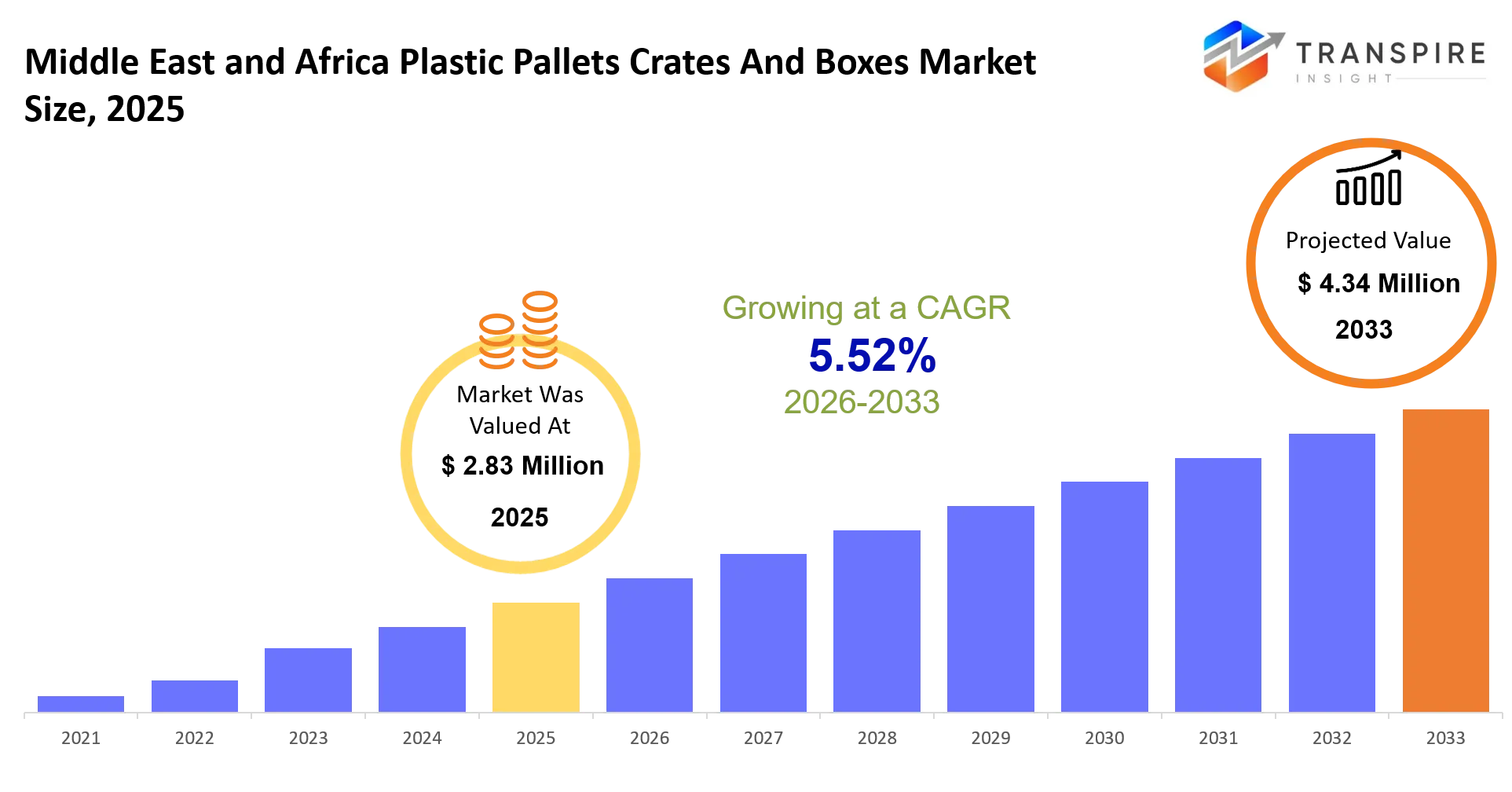
- Middle East and Africa Plastic Pallets Crates And Boxes Market Size 2025: USD 2.83 Billion
- Middle East and Africa Plastic Pallets Crates And Boxes Market Size 2033: USD 4.34 Billion
- Middle East and Africa Plastic Pallets Crates And Boxes Market CAGR: 5.52%
- Middle East and Africa Plastic Pallets Crates And Boxes Market Segments: By Product Type (Plastic Pallets, Plastic Crates, Plastic Boxes, Foldable Containers, Others); By Material (HDPE, PP, Recycled Plastic, Others); By End User (Food & Beverage, Logistics, Agriculture, Pharmaceuticals, Others); By Application (Storage, Transportation, Warehousing, Others)
To learn more about this report,  Download Free Sample Report
Middle East and Africa Plastic Pallets Crates And Boxes Market Summary
The Middle East and Africa Plastic Pallets Crates And Boxes Market was valued at USD 2.83 Billion in 2025. It is forecast to reach USD 4.34 Billion by 2033. That is a CAGR of 5.52% over the period.
Plastic pallets, crates, and boxes kinda do a huge job when it comes to moving goods without too much trouble across supply chains, warehouses, food processing facilities, farms , distribution centers, and also pharmaceutical networks. They help keep products from getting banged up, lift hygiene standards a bit, and make material handling feel more smooth—while at the same time cutting down long term replacement expenses compared with plain wooden options. Over the last five years, the market has sort of turned ,with a pretty clear pull toward reusable, and recyclable transport packaging as regional logistics operators looked for more durability and traceability.
One big reason was the supply chain disruption that happened during and right after the pandemic, which basically showed where global freight networks were weak, and made many businesses decide to put money into sturdier packaging assets. Today the growth feels tied to organized retail expanding, cold-chain infrastructure growing, pharmaceutical distribution scaling, and even automated warehousing setups becoming more common. As companies keep modernizing their logistics operations, reusable plastic transport packaging turns into a strategic tool, it drives repeat replacement demand too, and helps support stronger market revenues across the region..
Key Market Insights
- Saudi Arabia, the UAE , and South Africa together bring in over 45% of the regional market revenue, mostly because their logistics setups are pretty advanced.
- Right now, the Middle East sort of dominates the Middle East and Africa Plastic Pallets Crates And Boxes Market, holding an estimated 58% share by 2025.
- East Africa is expected to become the fastest-growing regional cluster through 2033, supported by investments in ports and trade corridors, you know that whole pipeline idea.
- In terms of product demand, plastic pallets lead with about 38% of the market, mainly for durability and good compatibility with automated handling systems.
- Plastic crates land as the second-largest segment, and theyre used heavily across agriculture, food processing, and retail distribution networks.
- Foldable containers are projected to post the quickest growth through 2033 as businesses double down on return logistics efficiency.
- Transportation uses account for nearly 35% of total demand because of cross-border trade and distribution activities.
- For end users, food and beverage stays in front with roughly a 30% market share, pushed by hygiene compliance needs, with no real surprise there.
- Pharmaceutical logistics is also among the fastest-growing groups, thanks to cold-chain expansion and stricter handling standards.
- Companies such as Schoeller Allibert, Craemer , ORBIS, Brambles, Cabka, and Nilkamal are investing in recycled materials, smart tracking, and region-leaning expansion strategies.
What are the Key Drivers, Restraints, and Opportunities in the Middle East and Africa Plastic Pallets Crates And Boxes Market?
The strongest growth driver is modernization of regional logistics and distribution networks, if you ask me. Big investments in fulfillment centers, cold-storage facilities , and food processing infrastructure have increased the need for durable transport packaging that can handle high-volume operations day after day. Retail chains , pharmaceutical distributors, and third-party logistics providers increasingly prefer plastic pallets and crates because they tend to give a longer service life, consistent dimensions, and reduced contamination risks. That shift kind of improves operational efficiency straight away and it also supports recurring procurement demand across several industries, not just one.
The biggest stumbling block still is the higher upfront cost of plastic alternatives compared with wooden packaging. This is structural, because it’s tied to resin prices, manufacturing technology , and limited local recycling infrastructure in some African markets. Small and medium-sized businesses often go for short-term spending over lifecycle savings, so they delay conversion projects. Because of that, adoption rates stay uneven across cost-sensitive sectors, and that in turn caps revenue expansion potential a bit.
A major opportunity sits in closed-loop logistics systems built around recycled plastics and returnable packaging assets. Regional investments in circular economy programs and recycling capacity are creating favorable conditions for reusable packaging models. Companies that introduce recycled-content pallets, RFID-enabled tracking systems, and pooling services can catch new demand from food, pharmaceutical, and retail supply chains, especially where traceability matters.
What Has the Impact of Artificial Intelligence Been on the Middle East and Africa Plastic Pallets Crates And Boxes Market?
Artificial intelligence is now influencing transport packaging tasks more and more, mostly via smarter asset management, better inventory visibility, and warehouse optimization that feels kind of “always on” even when people are not looking. Logistics operators use AI-driven software to keep track of pallet circulation , figure out utilization patterns, and make automated inventory allocation choices across distribution networks . In many cases, advanced analytics platforms are taking data coming from RFID tags , plus sensor streams, and also warehouse management systems, so they can reduce asset loss and, on top of that, improve return rates.
Machine learning models are also helping with predictive maintenance programs for automated material handling equipment that interacts with pallets and containers, not just “machines” in general. By spotting wear patterns and operational bottlenecks before any failures show up, companies can cut downtime ,and boost throughput efficiency . Then there’s AI-assisted route optimization, which further strengthens transportation performance by lowering empty return trips and improving asset utilization across regional logistics networks.
The operational upsides tend to show up as lower replacement costs, improved inventory accuracy, stronger traceability, and higher warehouse productivity. A few logistics providers even mention double digit improvements in asset visibility, and measurable reductions in packaging losses after rolling out digital tracking systems.
Still, AI adoption is not a smooth ride. Integration costs can be high, digital infrastructure stays fragmented ,and data quality can be inconsistent across developing logistics networks , which limits large-scale deployment. On top of that, many regional operators don’t have enough historical data to train predictive models effectively in the first place.
Key Market Trends
- Recycled content pallet production went up pretty sharply after 2022, and it seems manufacturers kinda scrambled to meet those corporate sustainability targets—ya know, the ones that keep coming up.
- More than 40% of big logistics facilities across Gulf markets now use automated handling systems, so naturally they need standardized packaging formats… which makes sense, but it also adds pressure.
- RFID pallet tracking adoption also kept climbing across retail plus pharmaceutical supply chains between 2023 and 2026, like it was a steady ramp not just a spike.
- Food-grade plastic containers gained share since hygiene rules got tighter across processing and distribution facilities, and everyone adjusted the way they operate, a little faster than before.
- Foldable container deployment rose close to 20% in certain logistics networks, mostly tied to transportation cost optimization initiatives, which sounds simple but it really isn't.
- Manufacturers shifted more investment toward high-density polyethylene products because of durability and longer service life, rather than only focusing on price.
- Circular packaging partnerships became more frequent after 2024, connecting recyclers with packaging manufacturers, and it all sort of snowballed from there.
- Regional warehousing capacity expanded a lot in Saudi Arabia and the UAE, and that helped support the growing need for reusable logistics assets—especially when demand got heavier.
- Companies like Brambles, Cabka, and Schoeller Allibert pushed ahead with investment in recycled-material product portfolios, like they decided early and didn't look back.
- Cross-border trade growth then encouraged broader use of standardized transport packaging systems along major logistics corridors, even when routes are complex.
Middle East and Africa Plastic Pallets Crates And Boxes Market Segmentation
By Product Type
Plastic pallets still remain the go to choice for big logistics and warehousing work, mainly due to their strong load-bearing capability, consistent dimensions, and that long run service life. Plastic crates keep a solid position especially in agriculture, food processing, and the retail distribution chain, because they’re rather easy to manage and they protect the goods properly. Plastic boxes are often used for dependable storage and transport of industrial and commercial items, especially when protection from moisture or contamination really matters.
Foldable containers keep getting more accepted since the space they take up drops during the return transport cycle, like, it really helps with stacking and backhauls. Some other product groups fit specialized industrial uses, where customized dimensions or certain handling traits are the key point. Product innovation more and more aims at lightweight designs, higher recycled content, and better compatibility with automated logistics systems, and in practice it’s becoming a normal expectation.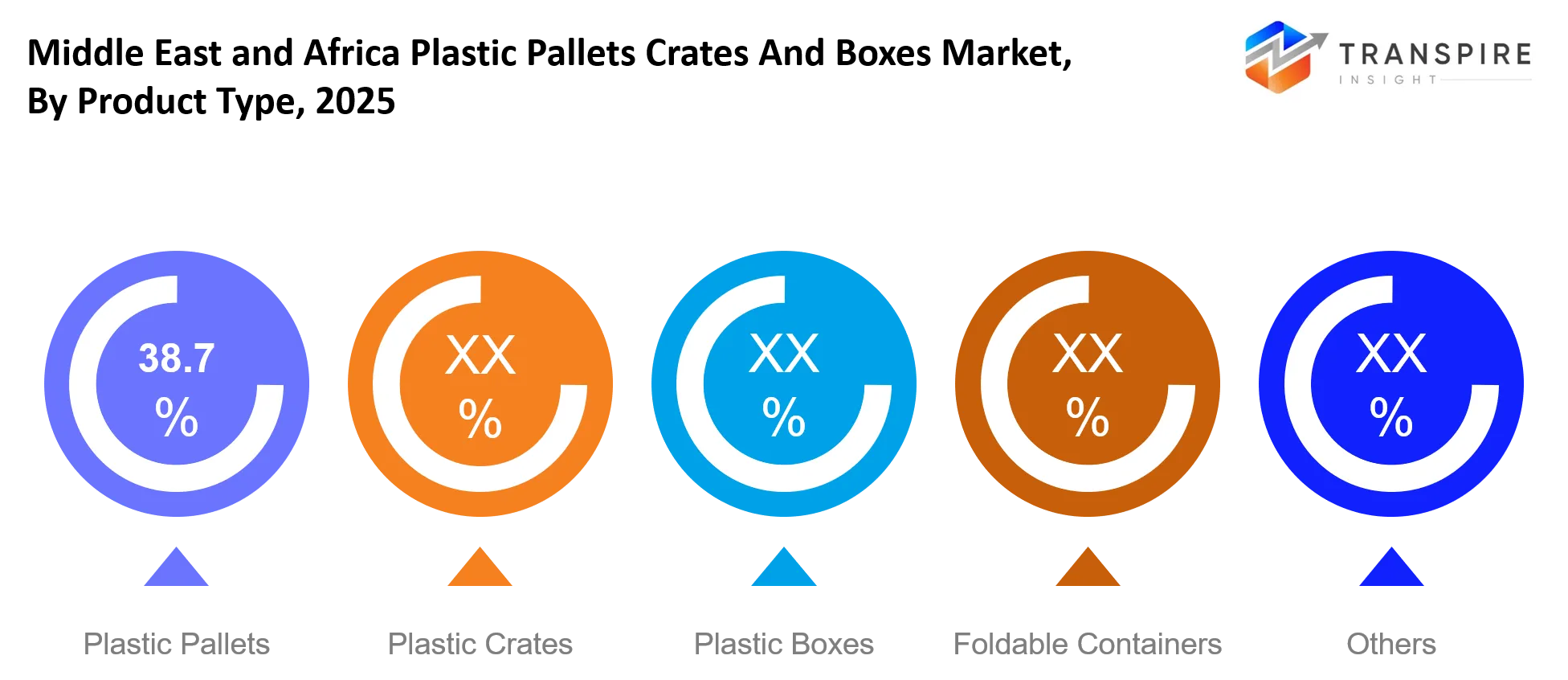
To learn more about this report, Download Free Sample Report
By Material
HDPE plays a pretty big role because it has great impact resistance , solid chemical stability, and it works well when things have to be used again and again in tough conditions . Lots of pallets and crates in food processing and logistics depend on HDPE for durability and a long operational life , you know the kind. Meanwhile , PP is still widely used when people care most about lightweight construction and cost efficiency .
Recycled plastic materials are starting to get more attention too, especially as circular economy efforts ramp up across regional supply chains. Manufacturers keep expanding recycled-content offerings so they can hit corporate sustainability goals. And then there are other material types too that support specialized performance needs , like better strength, higher temperature resistance, or specific compliance standards for certain industries .
By End User
Food and beverage organizations account for substantial usage because hygiene requirements kinda push reusable plastic packaging over traditional options. Logistics providers lean on pallets , crates and containers a lot to back up warehouse operations and freight movement, it sort of all ties together. In agriculture , applications keep expanding since producers are looking for durable solutions for harvesting storage and distribution, you know.
Pharmaceutical companies are also using plastic transport packaging more and more to help keep product integrity and regulatory compliance stable across the whole supply chain. Other end user segments include manufacturing, retail , chemicals and industrial distribution, and they all want similar things. Overall growth across these fields supports steady replacement needs and extra expansion demand too.
By Application
Storage applications make up a big chunk of market demand, mostly because plastic packaging has that durability feel, it’s stackable too, and it resists environmental conditions rather well. Transportation is still a key use case, since goods keep traveling through domestic channels and also international distribution networks. When packaging formats are standardized it becomes easier to manage, and that helps cut down on product damage during transit.
Meanwhile, warehousing applications are still growing, tied to investments in newer distribution centers and even automated storage systems. Beyond that, you’ll see other uses such as material handling, inventory oversight, and some specialized industrial operations. With logistics modernization continuing, adoption can spread across all those application categories, sort of steadily over time.
What are the Key Use Cases Driving the Middle East and Africa Plastic Pallets Crates And Boxes Market?
Transportation and distribution activities represent the primary use case, and honestly it kinda makes sense. Large logistics operators, food processors, and retail distribution centers depend on reusable pallets and containers to move products efficiently while also reducing handling damage risks and contamination risks which is not a small thing.
Then you have the secondary applications that are getting more attention, like agricultural supply chains and pharmaceutical distribution networks. Fresh produce exporters use plastic crates for better product protection during long-distance transport, and at the same time pharmaceutical companies lean on specialized containers to support cold-chain operations, plus keep regulatory compliance in check.
After that, some emerging opportunities are starting to show up in e-commerce fulfillment centers and automated warehouse environments. Smart packaging systems, with RFID technology and asset tracking capabilities, are starting to help with inventory visibility and return logistics management and even operational analytics across these advanced supply chains.
|
Report Metrics |
Details |
|
Market size value in 2025 |
USD 2.83 Billion |
|
Market size value in 2026 |
USD 2.98 Billion |
|
Revenue forecast in 2033 |
USD 4.34 Billion |
|
Growth rate |
CAGR of 5.52% from 2026 to 2033 |
|
Base year |
2025 |
|
Historical data |
2021 - 2024 |
|
Forecast period |
2026 - 2033 |
|
Report coverage |
Revenue forecast, competitive landscape, growth factors, and trends |
|
Regional scope |
United States; Canada; Mexico; United Kingdom; Germany; France; Italy; Spain; Denmark; Sweden; Norway; China; Japan; India; Australia; South Korea; Thailand; Brazil; Argentina; South Africa; Saudi Arabia; United Arab Emirates |
|
Key company profiled |
Schoeller Allibert, Craemer, ORBIS, Brambles, Cabka, IPL Plastics, Rehrig Pacific, Supreme Industries, Nilkamal, Myers Industries, Greif, Buckhorn, DS Smith, TranPak, Monoflo |
|
Customization scope |
Free report customization (country, regional & segment scope). Avail customized purchase options to meet your exact research needs. |
|
Report Segmentation |
By Product Type (Plastic Pallets, Plastic Crates, Plastic Boxes, Foldable Containers, Others); By Material (HDPE, PP, Recycled Plastic, Others); By End User (Food & Beverage, Logistics, Agriculture, Pharmaceuticals, Others); By Application (Storage, Transportation, Warehousing, Others) |
Which Regions are Driving the Middle East and Africa Plastic Pallets Crates And Boxes Market Growth?
The Middle East kind of leads in regional revenue generation, helped by advanced logistics infrastructure, broad warehousing capacity, and solid government investment in trade connectivity programs. Countries like Saudi Arabia and the UAE are still pushing forward with industrial zones, plus distribution networks, and it shows. More and more supply chains now need standardized reusable transport packaging, because handling, transport, and repeat usage really matter. Strong uptake across retail, food processing, and logistics channels is what keeps the region in front.
South Africa keeps being a key contributor within Africa, mainly due to its well rooted manufacturing base, and a relatively mature logistics ecosystem. The way the market develops looks a bit different from the Gulf, because the growth depends more on industrial production and domestic distribution work, rather than big infrastructure expansion on a wide scale. Demand stays fairly stable from agriculture, food processing, and retail sectors, so revenue generation stays consistent. Over time, investments aimed at supply chain efficiency will continue to support adoption.
East Africa is emerging as the fastest-growing area during the forecast period, at least that’s what the momentum suggests. Large investments in ports, transportation corridors, and regional trade integration have improved freight movement across several countries. Logistics modernization efforts, together with industrial development initiatives, are opening fresh doors for reusable packaging suppliers. New entrants and investors should gain from rising trade volumes and infrastructure building through 2033, even if timelines can shift a little here and there.
Who are the Key Players in the Middle East and Africa Plastic Pallets Crates And Boxes Market and How Do They Compete?
The competition is still kinda moderately fragmented, with big global manufacturers showing up next to regional suppliers and all of that. In practice, the key points that separate one outfit from another are product durability, recycled-content know how, pooling services , customization options, and logistics support too. Meanwhile the large multinational brands keep trying to hold their market share by putting money into tech and building very broad distribution networks, pretty steadily.
Schoeller Allibert seems to focus on reusable transport packaging systems, more or less, aiming for long term lifecycle performance. They stand out via customized logistics solutions and a solid level of know how in returnable packaging applications. Craemer goes more toward heavy-duty pallet technology, plus advanced manufacturing capabilities for harsh industrial settings. ORBIS leans into product engineering and supply chain optimization solutions that are matched to automated logistics operations, not generic ones.
Brambles , through its CHEP network, gets an advantage from a pallet pooling model. This helps customers lower ownership costs, while also improving how efficiently assets circulate. Cabka differentiates by making extensive use of recycled plastics and circular manufacturing processes. Nilkamal leans on regional manufacturing capacity along with cost competitiveness, to cover demand across developing markets. Going forward, continued investment in recycled materials, smart tracking technologies , and regional expansion initiatives is expected to steer competitive positioning in a more noticeable way.
Company List
- Schoeller Allibert
- Craemer
- ORBIS
- Brambles
- Cabka
- IPL Plastics
- Rehrig Pacific
- Supreme Industries
- Nilkamal
- Myers Industries
- Greif
- Buckhorn
- DS Smith
- TranPak
- Monoflo
Recent Development News
In September 2025, Cabka entered a partnership with Renewi and launched the Eco CP3 pallet. The product uses 100% recycled polyethylene and supports circular transport packaging through a closed-loop recycling model, strengthening adoption of recycled-content logistics assets.https://www.globenewswire.com
In September 2025, Brambles launched its 2030 Sustainability Programme. The initiative expands circular logistics practices, targets 80% circular materials in new plastic products, and increases sustainability collaboration across global supply networks.https://www.chep.com
In August 2025, Cabka announced its H1 2025 results and continued investment in automation, reusable transport packaging, and operational efficiency through its Shift transformation program. The company highlighted expansion and automation investments aimed at improving future profitability and strengthening its packaging portfolio.https://live.euronext.com
What Strategic Insights Define the Future of the Middle East and Africa Plastic Pallets Crates And Boxes Market?
The market seems to be moving toward a more circular and tech-enabled transport packaging ecosystem, kind of like everything is getting a bit smarter, and more “connected” day by day. In the long run, growth is likely to come from warehouse automation, supply chain digitalization, and the steady adoption of reusable packaging models that, in general, cut lifecycle costs while also boosting day to day operational efficiency . As logistics networks get more sophisticated, standardized plastic packaging assets start looking less like simple handling tools, and more like real infrastructure components, sort of like quiet foundation stuff.
There’s also a less obvious risk, involving swings in recycled resin availability and pricing. Some areas of the region still have limited recycling infrastructure, so that could lead to supply constraints which then impact production economics and profitability. But at the same time, there is an opportunity quietly forming around smart reusable packaging, the kind that comes with RFID and IoT tracking capabilities. This is especially relevant within pharmaceutical logistics , and in high-value retail logistics where visibility actually matters.
Market participants should probably put focus on investments in recycled-material capabilities , digital asset tracking, and building regional manufacturing partnerships. The organizations that blend circular economy solutions with supply chain visibility technologies will, most likely, be the ones best placed to capture future value creation across the Middle East and Africa.
Middle East and Africa Plastic Pallets Crates And Boxes Market Report Segmentation
-
By Product Type
Plastic Pallets
Plastic Crates
Plastic Boxes
Foldable Containers
Others -
By Material
HDPE
PP
Recycled Plastic
Others -
By End User
Food & Beverage
Logistics
Agriculture
Pharmaceuticals
Others -
By Application
Storage
Transportation
Warehousing
Others
Frequently Asked Questions
Find quick answers to common questions.
The Expected Middle East and Africa Plastic Pallets Crates And Boxes Market size for the market will be USD 4.34 Billion in 2033.
Key Segments for the Middle East and Africa Plastic Pallets Crates And Boxes Market are By Product Type (Plastic Pallets, Plastic Crates, Plastic Boxes, Foldable Containers, Others); By Material (HDPE, PP, Recycled Plastic, Others); By End User (Food & Beverage, Logistics, Agriculture, Pharmaceuticals, Others); By Application (Storage, Transportation, Warehousing, Others)
Major Middle East and Africa Plastic Pallets Crates And Boxes Market players are Schoeller Allibert, Craemer, ORBIS, Brambles, Cabka, IPL Plastics, Rehrig Pacific, Supreme Industries, Nilkamal, Myers Industries, Greif, Buckhorn, DS Smith, TranPak, Monoflo.
The Current Middle East and Africa Plastic Pallets Crates And Boxes Market size is USD 2.83 Billion in 2025.
The Middle East and Africa Plastic Pallets Crates And Boxes Market CAGR is 5.52% from 2026 to 2033.
- Schoeller Allibert
- Craemer
- ORBIS
- Brambles
- Cabka
- IPL Plastics
- Rehrig Pacific
- Supreme Industries
- Nilkamal
- Myers Industries
- Greif
- Buckhorn
- DS Smith
- TranPak
- Monoflo
About the Authors

Pankaj Ghogare Patil
I am Pankaj Ghogare Patil, a Senior Research Analyst at Transpire Insight, specializing in the Pharmaceutical, Chemicals & Materials, Healthcare IT, and Biotechnology industry. My expertise lies in conducting comprehensive market research, analyzing industry trends, evaluating competitive landscapes, and translating complex data into actionable insights. At Transpire Insight, I closely follow emerging technologies, regulatory developments, and market innovations to create accurate, well-researched, and informative content that helps businesses and professionals make informed decisions. I am committed to producing credible, evidence-based articles that reflect industry best practices while making technical topics accessible and valuable for a broad audience.

Chakradhar Khansole
Chakradhar serves as the Research Director at Transpire Insight, bringing over 8 years of experience in technology, innovation, and strategic market intelligence. He specializes in transforming complex market data into actionable business insights that enable organizations to make informed, growth-oriented decisions. Recognized for his strategic vision and analytical expertise, Chakradhar leads high-impact research initiatives, delivering comprehensive market assessments, competitive intelligence, and forward-looking industry analysis.
Recently Published Reports
-
May 2026
Healthcare Polymer Packaging Market
Healthcare Polymer Packaging Market Size, Share & Analysis Report By Packaging Type (Syringes, IV Bottles and Pouches, Clamshells, Blisters, Bottles & Jars, Containers, Tubes, IV Parental Packaging, Others), By Type (Regulated, Non-regulated), By Polymer Type (LDPE (Low-Density Polyethylene), HDPE (High-Density Polyethylene), Homo-polymer (Homo), Random Copolymer (Random), Block Copolymer (Block), PET, Polystyrene, Polyvinyl Chloride, Polyamide/EVOH, Others), and Geography (North America, Europe, Asia-Pacific, Middle East and Africa, South and Central America), 2021 - 2031
-
Apr 2026
Hydrophilic Tape (Waterstop) Market
Hydrophilic Tape (Waterstop) Market Size, Share & Analysis Report By Type (Bentonite-Based Hydrophilic Tape, Rubber-Based Hydrophilic Tape), By Application (Residential Buildings, Commercial Buildings, Infrastructure Projects), and Geography (North America, Europe, Asia-Pacific, Middle East and Africa, South and Central America), 2021 - 2031
-
Apr 2026
Metalens Market
Metalens Market Size, Share & Analysis Report By Type (Visible Light Metalens, and Infrared Metalens), By Application (Consumer Electronics, Automotive Electronics, Industrial, Medical, and Others), and Geography (North America, Europe, Asia-Pacific, Middle East and Africa, South and Central America), 2021 - 2031
-
Apr 2026
PBT Resin Market
PBT Resin Market Size, Share & Analysis Report By Type (Reinforced PBT Resin, Unreinforced PBT Resin), By Processing Method (Injection Molding, Extrusion, Blow Molding, Others), By End-User (Automotive, Electrical & Electronics, Consumer Appliances, Industrial Machinery, Medical Devices, Packaging, Others), and Geography (North America, Europe, Asia-Pacific, Middle East and Africa, South and Central America), 2021 - 2031