
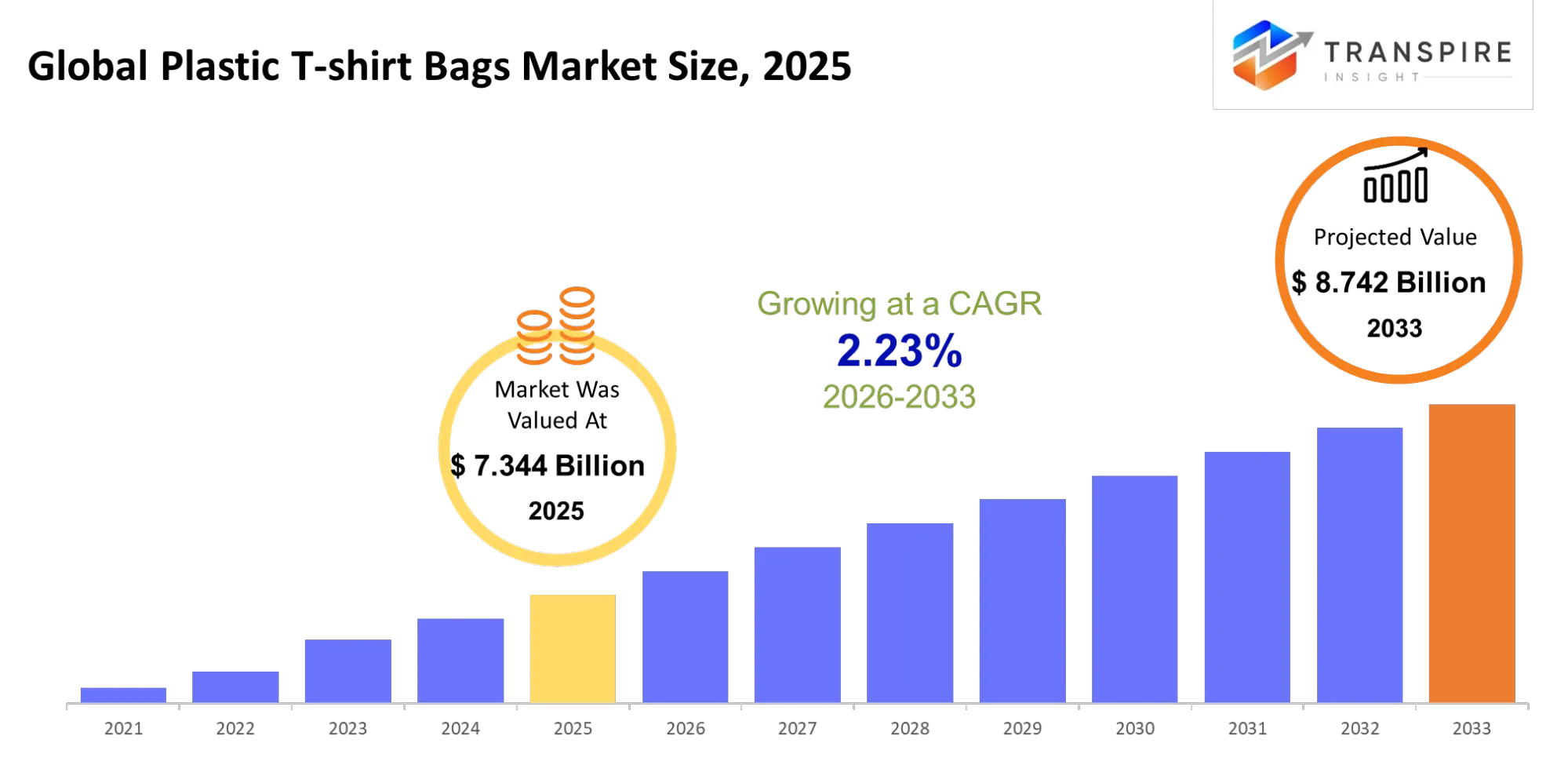
Global Plastic T-shirt Bags Market Size & Forecast:
- Global Plastic T-shirt Bags Market Size 2025: USD 7.344 Billion
- Global Plastic T-shirt Bags Market Size 2033: USD 8.742 Billion
- Global Plastic T-shirt Bags Market CAGR: 2.23%
- Global Plastic T-shirt Bags Market Segments: By Type (HDPE T-shirt Bags, LDPE T-shirt Bags, Biodegradable Plastic Bags, Compostable T-shirt Bags, Recycled Plastic Bags, Printed Plastic Bags, Others); By Application (Retail Shopping, Grocery Stores, Food Packaging, Industrial Packaging, Promotional Packaging, Others); By End-User (Retailers, Supermarkets, Food Service Providers, Packaging Companies, Others); By Thickness (Thin Gauge Bags, Medium Gauge Bags, Heavy-duty Bags, Ultra-thick Bags, Others)
To learn more about this report,  Download Free Sample Report
Global Plastic T-shirt Bags Market Summary
The Global Plastic T-shirt Bags Market size is estimated at USD 7.344 Billion in 2025 and is anticipated to reach USD 8.742 Billion by 2033, growing at a CAGR of 2.23% from 2026 to 2033. This market supplies the ultra-lightweight, moisture-resistant carrier bags essential for moving goods quickly across daily retail, grocery, and food delivery supply chains. Over the last few years, the traditional business model ran straight into a wall. Tightening government crackdowns on single-use plastics completely upended how manufacturers operate. The real shift happened on the ground when major grocery chains and supermarkets were legally forced to strip old-school film bags from their checkout lanes. This sudden pressure instantly forced suppliers to scramble and pivot their entire production lines over to green, alternative materials. Despite these severe bans, overall market volume is still expanding. The core cause is the relentless rise of organized retail in emerging economies, which absolutely require low-cost, durable carriers. Because of this, businesses are rapidly substituting traditional stock with premium biodegradable variants, successfully keeping the industry moving forward.
Key Market Insights:
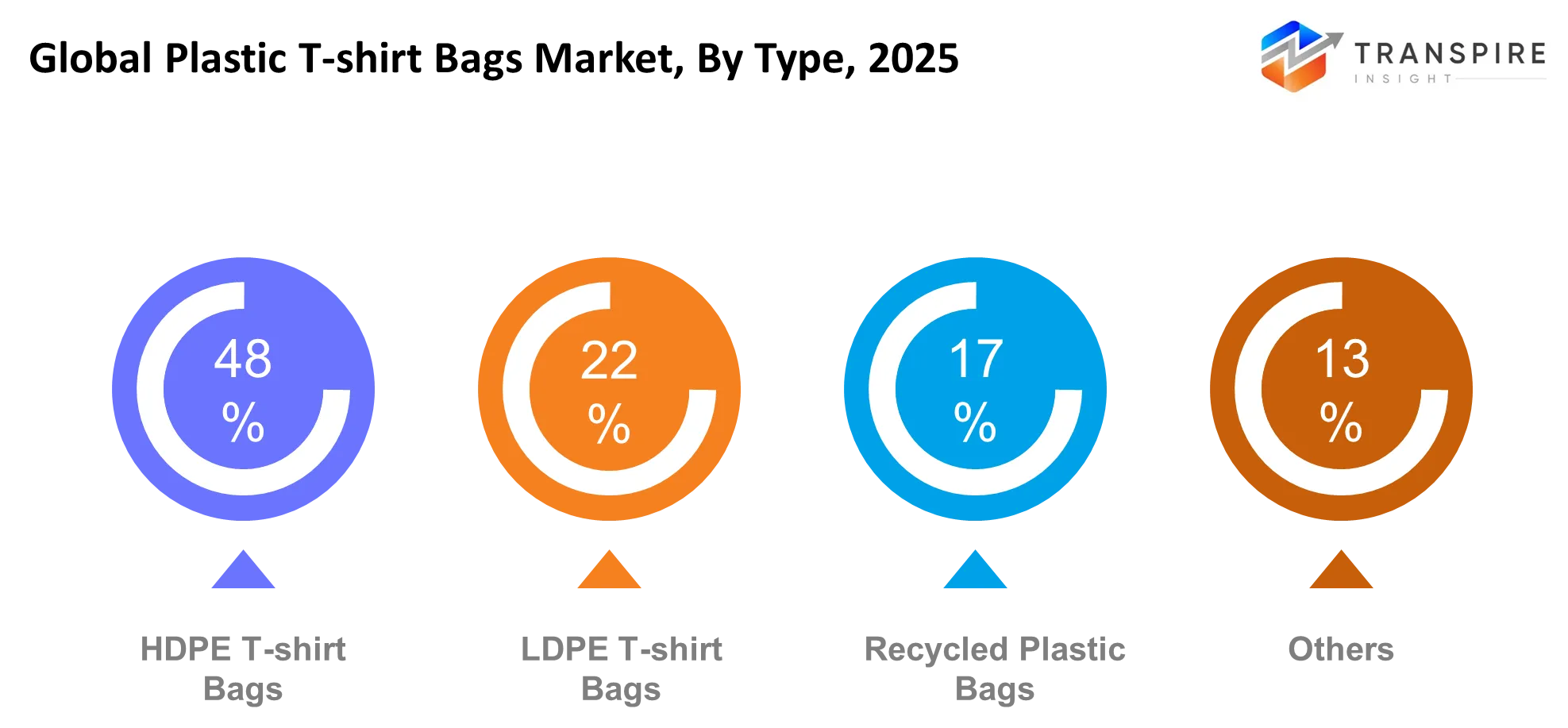
- HDPE T-shirt Bags dominate with a 48% share, driven by players like Novolex scaling their closed-loop recycling systems to turn scrap film directly back into retail-ready carrier bags.
- Biodegradable Plastic Bags lead growth with a 14.2% CAGR, driven by players like Novolex launching over 1,000 certified compostable options to meet strict single-use checkout bans.
- Retail Shopping dominates applications with a 56% share, driven by players like Berry Global committing to a 30% circular plastics baseline to help supermarkets abandon virgin polymers.
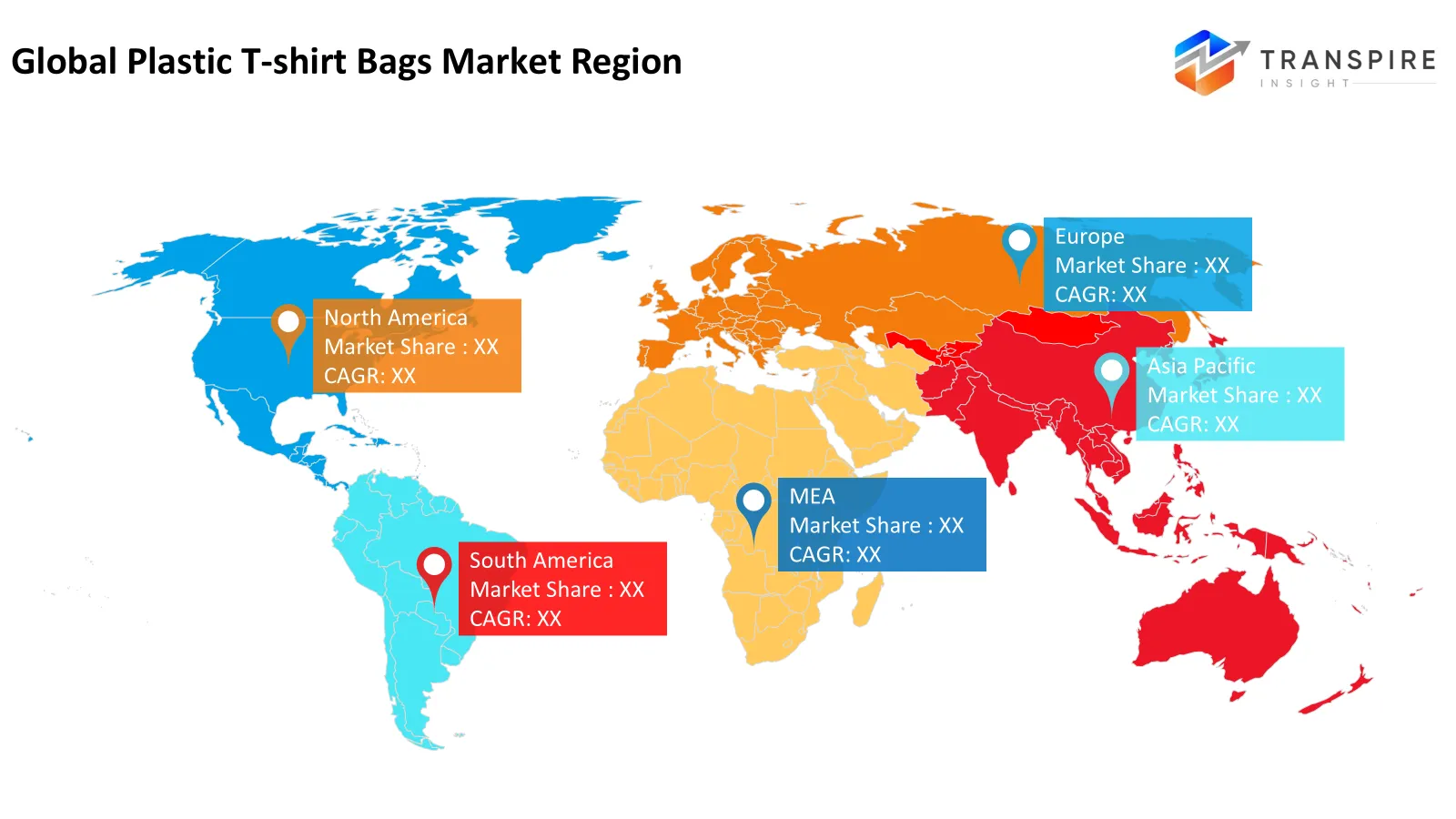
- Asia Pacific dominates regional volume with a 42% share, driven by players like Amcor rolling out ultra-lightweight carrier films that balance cost-efficiency with emerging circular rules.
- Europe leads regional growth with a 13.1% CAGR, driven by players like Berry Global introducing reusable and high-compliance packaging models to bypass aggressive single-use plastic rollbacks.
- Recycled Plastic Bags hold a 17% share, driven by players like Berry Global expanding their "B Circular Range" with up to 100% post-consumer recycled content to meet urgent brand demands.
- North America accounts for a 25% share, driven by players like Novolex introducing "Eco Blend" lines engineered to guarantee compliance with a messy patchwork of state-level PCR laws.
What are the Key Drivers, Restraints, and Opportunities in the Global Plastic T-shirt Bags Market?
Driver
Retailers are under massive pressure to adopt recycled polyethylene bags, acting as a major growth engine. The real catalyst is a wave of Extended Producer Responsibility (EPR) mandates and strict post-consumer recycled (PCR) minimums. Because supermarkets must comply to avoid fines, they are buying premium, high-PCR carriers in bulk. This fundamentally changes the economics for compliant manufacturers, driving up average order values and locking in reliable revenue.
- In April 2026, Amcor invested in its European industrial film capacity to help retail clients scale recycle-ready packaging and meet new EPR laws.
https://www.amcor.com/media/news/amcor-boosts-industrial-film-capability-in-europe
Restraint
Growth is severely bottlenecked by fragmented, aggressive single-use plastic bans. This structural issue persists because local governments view thin-gauge virgin films as permanent environmental hazards that clog municipal sorting machinery and pollute urban waterways. Because this is a deeply entrenched, heavily legislated barrier, traditional film manufacturers are finding themselves permanently locked out of major retail checkout lanes across Europe and parts of North America. Retooling an entire production plant to meet these varying local laws requires massive capital, leaving smaller suppliers unable to compete.
Opportunity
The smartest path forward is in BPI-certified compostable T-shirt bags. As municipal governments increasingly force residents to sort organic food waste, grocery chains need a clever workaround: checkout bags that can double as home compost bin liners. Suppliers who can efficiently scale up 100% plant-based resins will unlock massive expansion, fast. It’s a wide-open, high-margin opportunity across Europe and North America, where supermarkets are ready to pay a premium for packaging that aligns with zero-waste municipal goals—not just on paper, but in practice.
What Has the Impact of Artificial Intelligence Been on the Global Plastic T-shirt Bags Market?
AI is quietly changing the factory floor for plastic bag producers, moving operations away from basic manual checks toward automated control.
Instead of relying purely on an operator's eyes, manufacturers are plugging smart controllers directly into blown-film extrusion lines. These tools monitor variables like melt temperatures and die pressures in real time. The moment a resin blend goes slightly off-spec, the software micro-adjusts the machinery instantly. This keeps the film thickness perfectly consistent and cuts down heavily on raw material scrap.
Quality assurance has also seen a massive upgrade through computer vision. Fast camera arrays scan the bags as they speed down the line, catching tiny pinholes or weak bottom seals that a human worker would easily miss. On top of that, tracking heat and vibrations via predictive sensors means maintenance teams can swap out worn components right before a breakdown occurs, saving hours of costly downtime.
The real roadblock here comes down to upfront cash. Trying to overhaul a legacy factory with things like edge computing, smart camera setups, and complex data pipelines costs a fortune. Because the initial buy-in is so painfully expensive, smaller regional suppliers end up completely priced out of the tech loop. The AIRE initiative rolled out deep learning models on active plastic bag production lines, using intelligent cameras to catch structural defects and automatically adjust machine temperatures on the fly.
Key Market Trends:
- The plastic T-shirt bag is no longer a cheap, afterthought commodity—it’s transforming into a highly engineered, heavily regulated piece of packaging. Retailers are forcing this evolution because they are backed into a corner by single-use bans and desperately need materials that won't trigger massive compliance fines.
- Supermarkets are walking away from old-school virgin polyethylene, increasingly calling for PHA and corn-starch biopolymers so their checkout bags can double as municipal food-waste liners.
- Grocers have largely traded basic, single-layer films for advanced multi-layer co-extrusion setups, forcing suppliers to aggressively thin out the plastic without losing the bag's structural backbone.
- Brands are completely ditching the old linear take-and-toss supply model, choosing tight closed-loop recycling networks to lock down a steady, legal supply of high-PCR material.
- The explosion of online grocery deliveries has totally changed the game for bag design, sparking a massive need for thicker, tamper-evident carriers built to survive rough last-mile handling.
- Retailers are dropping traditional solvent-based inks entirely, switching over to water-based dyes to ensure their branded logos don't cause a bag to fail strict chemical compostability tests.
- Packaging firms have stopped messing around with fragile, first-generation bioplastics, opting instead to infuse their resins with nano-cellulose additives to finally match the heavy load-bearing strength of old-school plastics.
- Major retail hubs are flat-out retiring thin, single-use designs, pivoting instead to heavy-gauge, multi-trip plastic totes that force shoppers into a permanent habit of reusing their bags.
Global Plastic T-shirt Bags Market Segmentation
By Type
The product landscape is undergoing a massive shift as legacy virgin HDPE—which historically held the volume heavyweight position—rapidly loses its footing to premium, eco-ready materials like recycled and certified compostable resins. The unique growth logic here has completely flipped from a race for the lowest production cost to a strict race for regulatory compliance. Traditional thin-gauge types are shrinking due to single-use penalties, while premium PCR (post-consumer recycled) lines and plant-based biopolymers like PHA are booming because they offer retailers a legal checkout alternative. Looking ahead, basic virgin plastic will be almost entirely pushed out of major commercial regions, splitting the future market into two clear winners: ultra-thick, multi-trip recycled bags and zero-waste compostable carriers.
To learn more about this report, Download Free Sample Report
By Application
Grocery stores and high-volume retail shopping command the absolute lion's share of application volume, comfortably accounting for over half of all global demand. Growth in this segment depends entirely on adapting to the checkout counter, where public opinion and municipal waste crackdowns dictate design. Instead of purchasing flimsy, single-use films, the current movement demands highly durable, structural carriers that can seamlessly handle last-mile e-commerce logistics or double as secondary household trash liners. Moving forward, application design will no longer be treated as a sunk cost, but rather as a rolling compliance asset, utilizing specialized water-based inks that allow heavily branded grocery bags to easily pass municipal recycling and composting audits.
By End-User
Supermarkets and massive retail chains act as the primary market gatekeepers, utilizing their massive purchasing power to dictate exact manufacturing requirements to packaging companies. These end-users are completely moving away from treating bags as a cheap commodity because corporate ESG targets and Extended Producer Responsibility (EPR) laws now hold major brands directly liable for plastic waste. To avoid steep tax penalties and public backlash, their buying behavior focuses entirely on securing high-PCR content. Consequently, the vendor-buyer relationship will transform into long-term, closed-loop supply agreements where packaging firms act as waste-management partners, taking back used retail scrap to reprocess it straight back into store-compliant inventory.
By Thickness
Flimsy, ultra-thin gauge bags are rapidly losing ground on the factory floor, while medium-gauge, heavy-duty, and ultra-thick formats are seeing an unprecedented surge in demand. This transition is structural and legally enforced because many regional single-use bans explicitly define an illegal "plastic bag" based on its thickness in microns. By manufacturing heavy-duty or ultra-thick bags, companies can legally bypass "single-use" definitions, transforming a disposable item into a legal, multi-trip tote. The future implication is clear: the era of the featherweight, microscopic-thin plastic bag is essentially over, and manufacturing lines will pivot to focus almost exclusively on co-extrusion technologies built to spin out robust, structural carriers engineered for repeated use.
What are the Key Use Cases Driving the Global Plastic T-shirt Bags Market?
High-volume grocery checkout remains the absolute core driver for this market. Supermarkets rely heavily on durable, high-capacity T-shirt bags to pack heavy, sharp-edged food items quickly at checkout counters while keeping operational overhead low.
Meanwhile, the explosive rise of online grocery apps is rapidly expanding application demands. Last-mile delivery networks are adopting thicker, heavy-duty formats as sturdy, tamper-evident carriers to transport bulk items safely from local dark stores directly to residential doorsteps.
On the flip side, a massive new use case is popping up in municipal organic waste programs. Cities are actively encouraging shoppers to take certified compostable checkout bags home and reuse them as green bin liners. This gives the packaging a valuable second life, proving it can work as a circular tool in practice, rather than just a disposable item on paper.
|
Report Metrics |
Details |
|
Market size value in 2025 |
USD 7.344 Billion |
|
Market size value in 2026 |
USD 7.491 Billion |
|
Revenue forecast in 2033 |
USD 8.742 Billion |
|
Growth rate |
CAGR of 2.23% from 2026 to 2033 |
|
Base year |
2025 |
|
Historical data |
2021 - 2024 |
|
Forecast period |
2026 - 2033 |
|
Report coverage |
Revenue forecast, competitive landscape, growth factors, and trends |
|
Regional scope |
United States; Canada; Mexico; United Kingdom; Germany; France; Italy; Spain; Denmark; Sweden; Norway; China; Japan; India; Australia; South Korea; Thailand; Brazil; Argentina; South Africa; Saudi Arabia; United Arab Emirates |
|
Key companies profiled |
Novolex, Berry Global, Inteplast Group, Poly-America, Amcor, International Plastics, Rutan Poly Industries, Four Star Plastics, Hilex Poly, Coveris, Plastipak, Sigma Plastics, Alpha Poly, Shabra Plastics, Reynolds Consumer Products |
|
Customization scope |
Free report customization (country, regional & segment scope). Avail customized purchase options to meet your exact research needs. |
|
Report Segmentation |
By Type (HDPE T-shirt Bags, LDPE T-shirt Bags, Biodegradable Plastic Bags, Compostable T-shirt Bags, Recycled Plastic Bags, Printed Plastic Bags, Others); By Application (Retail Shopping, Grocery Stores, Food Packaging, Industrial Packaging, Promotional Packaging, Others); By End-User (Retailers, Supermarkets, Food Service Providers, Packaging Companies, Others); By Thickness (Thin Gauge Bags, Medium Gauge Bags, Heavy-duty Bags, Ultra-thick Bags, Others) |
Which Regions are Driving the Global Plastic T-shirt Bags Market Growth?
Asia Pacific holds a massive 42% of the global Global Plastic T-shirt Bags Market, mostly because of skyrocketing urbanization and a booming retail sector. The whole industrial setup here revolves around ultra-cheap, high-volume polyethylene production, which easily keeps up with the non-stop daily demands of grocery chains and food delivery apps. On top of that, local governments in developing countries are heavily backing domestic manufacturing plants to make sure supply can match rising consumer spending. Since these local supply chains care way more about pure affordability and massive scale than rushed green transitions, factories here push out unparalleled volumes compared to anywhere else.
North America comfortably locks in the number-two spot with a 25% chunk of the market, playing a much more stable, predictable game than the wild volume spikes over in Asia Pacific. Buyers here aren't looking to flood the checkout counter with ultra-cheap, flimsy film; instead, the business is anchored by massive corporate grocery chains and online delivery networks that demand tough, uniform carriers. Order numbers stay incredibly steady because factories have heavily invested in quick-change digital printing tech, letting brands swap out custom graphics mid-run without stopping the assembly line. On top of that, while a growing list of states keep hammering away with strict single-use bans, the massive move toward selling thick, multi-use plastic totes has completely cushioned local packaging firms from taking a serious financial hit.
Europe is pacing ahead of everyone else right now with a striking 13.1% CAGR, but this explosive growth isn't coming from natural market pull—it's being forced by aggressive government crackdowns. Tough new Extended Producer Responsibility (EPR) laws and citywide bans have effectively upended traditional supply chains, leaving retail giants with zero choice but to ditch virgin plastics altogether. This relentless regulatory pressure has created an absolute scramble for next-gen biomaterials, forcing grocery chains to quickly swap out traditional checkout sacks for certified compostable options. As lawmakers systematically squeeze old-school plastics entirely out of retail lanes, packaging suppliers that can actually mass-produce reliable bio-resins are looking at a highly lucrative, captive audience.In 2025, the Packaging and Packaging Waste Regulation (PPWR) officially entered into force across the EU, mandating that certain packaging formats, including very lightweight plastic carrier bags, must transition into certified compostable alternatives before the general application date in August 2026.
To learn more about this report, Download Free Sample Report
Who are the Key Players in the Global Plastic T-shirt Bags Market and how do they Compete?
The global market for plastic T-shirt bags is wide open and incredibly cutthroat, forcing manufacturers to abandon basic volume-based games and take regional environmental regulations seriously. Just turning out Billions of bags a day doesn't guarantee a steady profit anymore, especially since strict single-use penalties keep changing how major retailers buy packaging. This shift has created a massive divide between factories sticking to dirt-cheap legacy films and those pivoting to high-end, eco-friendly engineering.
Novolex relies heavily on an aggressive cost-leadership strategy combined with regional network acquisition. By building massive domestic infrastructure and integrating post-consumer recycled material directly into their mainstream product lines, they deliver high-recycled-content carrier bags at a massive commercial scale that easily undercut localized competitors.
On the other side of the spectrum, Berry Global relies on an innovation-driven differentiation strategy backed by extensive material science R&D. Instead of engaging in raw price wars on basic commodities, they focus on advanced co-extrusion down-gauging technology to create ultra-thin, high-strength bags that minimize raw plastic use while maintaining heavy load capacities. Their global footprint expands through strategic long-term corporate supply contracts with multi-national retail chains looking to hit strict ESG metrics.
Global Plastic T-shirt Bags Market Companies
- Novolex
- Berry Global
- Inteplast Group
- Poly-America
- Amcor
- International Plastics
- Rutan Poly Industries
- Four Star Plastics
- Hilex Poly
- Coveris
- Plastipak
- Sigma Plastics
- Alpha Poly
- Shabra Plastics
- Reynolds Consumer Products
Recent Development News
In April 2025, Novolex sealed the deal on a $6.7 billion acquisition of Pactiv Evergreen. The buyout rewired the competitive landscape by throwing a massive assortment of packaging styles into a single portfolio. Instead of just adding a few factories to the map, it gave Novolex the instant manufacturing muscle to crank out next-gen, green checkout carriers at full speed. https://www.cppinvestments.com
In February 2026, Amcor officially wrapped up its major all-stock merger with Berry Global. By joining forces, Amcor basically became the undisputed heavyweight for flexible films and retail packaging across North America. The combination handed the company a highly resilient supply chain and the sheer production muscle needed to easily keep up with surging retail demands for heavy-duty checkout bags. [https://www.amcor.com
In February 2026, Inteplast Group acquired STA, LLC, wasting no time folding the business into its AmTopp Division as STA Coated Technologies. This smart move put Inteplast right on the map for custom coating, handed them immediate access to high-tech, water-based adhesives, and injected a ton of extra depth into their already massive selection of flexible retail packaging films. https://www.inteplast.com
What Strategic Insights Define the Future of the Global Plastic T-shirt Bags Market?
The market is speeding toward a forced circular model where survival means mastering extreme down-gauging and packing products with high-percentage recycled polymers.
A serious, hidden trap for manufacturers is the sudden crack down on additive-based "greenwashing." Regulators are aggressively targeting misleading oxo-degradable claims, leaving unprepared factories wide open to crushing compliance fines and canceled retail contracts overnight.
On the flip side, an incredible window is opening up in the development of tough, food-contact-approved recycled resins, allowing smart suppliers to charge a premium to massive grocery chains scrambling to hit tough corporate ESG goals.
The smartest move right now is to completely ditch basic commodity production and channel capital into multi-layer co-extrusion machinery. Upgrading lines to smoothly process post-consumer recycled (PCR) blends keeps you legally compliant while fully protecting your margins from volatile virgin plastic prices.
Global Plastic T-shirt Bags Market Segmentation
By Type
- HDPE T-shirt Bags
- LDPE T-shirt Bags
- Biodegradable Plastic Bags
- Compostable T-shirt Bags
- Recycled Plastic Bags
- Printed Plastic Bags
- Others
By Application
- Retail Shopping
- Grocery Stores
- Food Packaging
- Industrial Packaging
- Promotional Packaging
- Others
By End-User
- Retailers
- Supermarkets
- Food Service Providers
- Packaging Companies
- Others
By Thickness
- Thin Gauge Bags
- Medium Gauge Bags
- Heavy-duty Bags
- Ultra-thick Bags
- Others
Regional Outlook
North America
- United States
- Canada
- Mexico
Europe
- Germany
- United Kingdom
- France
- Spain
- Italy
- Rest of Europe
Asia Pacific
- Japan
- China
- Australia & New Zealand
- South Korea
- India
- Rest of Asia Pacific
South America
- Brazil
- Argentina
- Rest of South America
Middle East & Africa
- Saudi Arabia
- United Arab Emirates
- South Africa
- Rest of the Middle East & Africa
Frequently Asked Questions
Find quick answers to common questions.
The global Plastic T-shirt Bags Market size was valued at USD 7.344 Billion in 2025 and is poised to reach USD 8.742 Billion by 2033, expanding at a 2.23% CAGR.
Key segments for the market are Type (HDPE T-shirt Bags, LDPE T-shirt Bags, Biodegradable Plastic Bags, Compostable T-shirt Bags, Recycled Plastic Bags, Printed Plastic Bags, Others), Application (Retail Shopping, Grocery Stores, Food Packaging, Industrial Packaging, Promotional Packaging, Others), End-User (Retailers, Supermarkets, Food Service Providers, Packaging Companies, Others), and Thickness (Thin Gauge Bags, Medium Gauge Bags, Heavy-duty Bags, Ultra-thick Bags, Others).
Growth is primarily driven by the non-stop demand from high-volume grocery checkouts where cheap, durable sacks are essential. The explosive expansion of online grocery apps and last-mile delivery networks needing heavy-duty, tamper-evident carriers also pushes demand, alongside cities encouraging the reuse of compostable checkout bags as food scrap bin liners.
The global market is led by major manufacturers including Novolex, Berry Global, Inteplast Group, Poly-America, Amcor, International Plastics, Rutan Poly Industries, Four Star Plastics, Hilex Poly, Coveris, Plastipak, Sigma Plastics, Alpha Poly, Shabra Plastics, and Reynolds Consumer Products.
Asia Pacific commands a dominant 42% share of the global market, strongly influencing industry trends through its massive consumer base and booming retail sector. The region's vast, low-cost polyethylene manufacturing setup handles unparalleled production volumes, ensuring a steady, affordable supply that easily fulfills the daily packaging needs of massive grocery chains and food delivery networks.
High-margin opportunities are emerging in the development of heavy-duty, food-contact-approved recycled resins that help major supermarkets meet their strict environmental targets. Suppliers can also capitalize on the massive regulatory shift by mass-producing high-performance, certified compostable bags to replace traditional plastics banned by local governments.
- Novolex
- Berry Global
- Inteplast Group
- Poly-America
- Amcor
- International Plastics
- Rutan Poly Industries
- Four Star Plastics
- Hilex Poly
- Coveris
- Plastipak
- Sigma Plastics
- Alpha Poly
- Shabra Plastics
- Reynolds Consumer Products
About the Authors

Chetan Dhatrak
I’m Chetan Dhatrak, a Senior Research Analyst at Transpire Insight, specializing in the Consumer Goods, Foods and Beverages industry. I focus on analyzing market trends, consumer behavior, competitive landscapes, and industry developments to deliver accurate, data-driven insights. My research at Transpire Insight is built on credible sources and in-depth analysis, helping businesses and readers better understand market dynamics, emerging opportunities, and evolving consumer preferences. I’m committed to creating reliable, well-researched content that supports informed decision-making and reflects the latest developments in the consumer goods and food & beverage sectors.

Chakradhar Khansole
Chakradhar serves as the Research Director at Transpire Insight, bringing over 8 years of experience in technology, innovation, and strategic market intelligence. He specializes in transforming complex market data into actionable business insights that enable organizations to make informed, growth-oriented decisions. Recognized for his strategic vision and analytical expertise, Chakradhar leads high-impact research initiatives, delivering comprehensive market assessments, competitive intelligence, and forward-looking industry analysis.
Recently Published Reports
-
Apr 2026
Bottled Water Market
Bottled Water Market Size, Share & Analysis Report By Product Type (Still Bottled Water, Carbonated Bottled Water, Functional Bottled Water, and Others), By Packaging (PET, Cans, and Others), By Sales Channel (Supermarkets/Hypermarkets, Convenience Stores/Drug Stores, Grocery Stores/Club Stores, Foodservice, and Others) and Geography (North America, Europe, Asia-Pacific, Middle East and Africa, South and Central America), 2021 - 2032
-
Apr 2026
Color Cosmetic Packaging Market
Color Cosmetic Packaging Market Size, Share & Analysis Report By Application (Mascara Packaging, Liquid Packaging, and Liquid Face), By Type (Tubes & Bottles, Pens & Markers, Compacts & Containers, and Droppers & Pumps), and Geography (North America, Europe, Asia-Pacific, Middle East and Africa, South and Central America), 2021 - 2031
-
Apr 2026
External Microphone For Camera Market
External Microphone For Camera Market Size, Share & Analysis Report By Type (Shotgun Microphone, Lavalier Microphone, and Others), By Application (Digital Camera, Professional Video Camera, and Others), and Geography (North America, Europe, Asia-Pacific, Middle East and Africa, South and Central America), 2021 - 2031
-
Apr 2026
Foot Orthotic Insoles Market
Foot Orthotic Insoles Market Size, Share & Analysis Report By Type (Pre-fabricated, and Custom-made), By Material (Thermoplastic, Composite Carbon Fiber, and Others), By Distribution Channel (Drug Stores, Hospitals & Clinics, and Others), and Geography (North America, Europe, Asia-Pacific, Middle East and Africa, South and Central America), 2021 - 2031