
Middle East and Africa Personal Protective Equipment In Construction Market Size & Forecast:
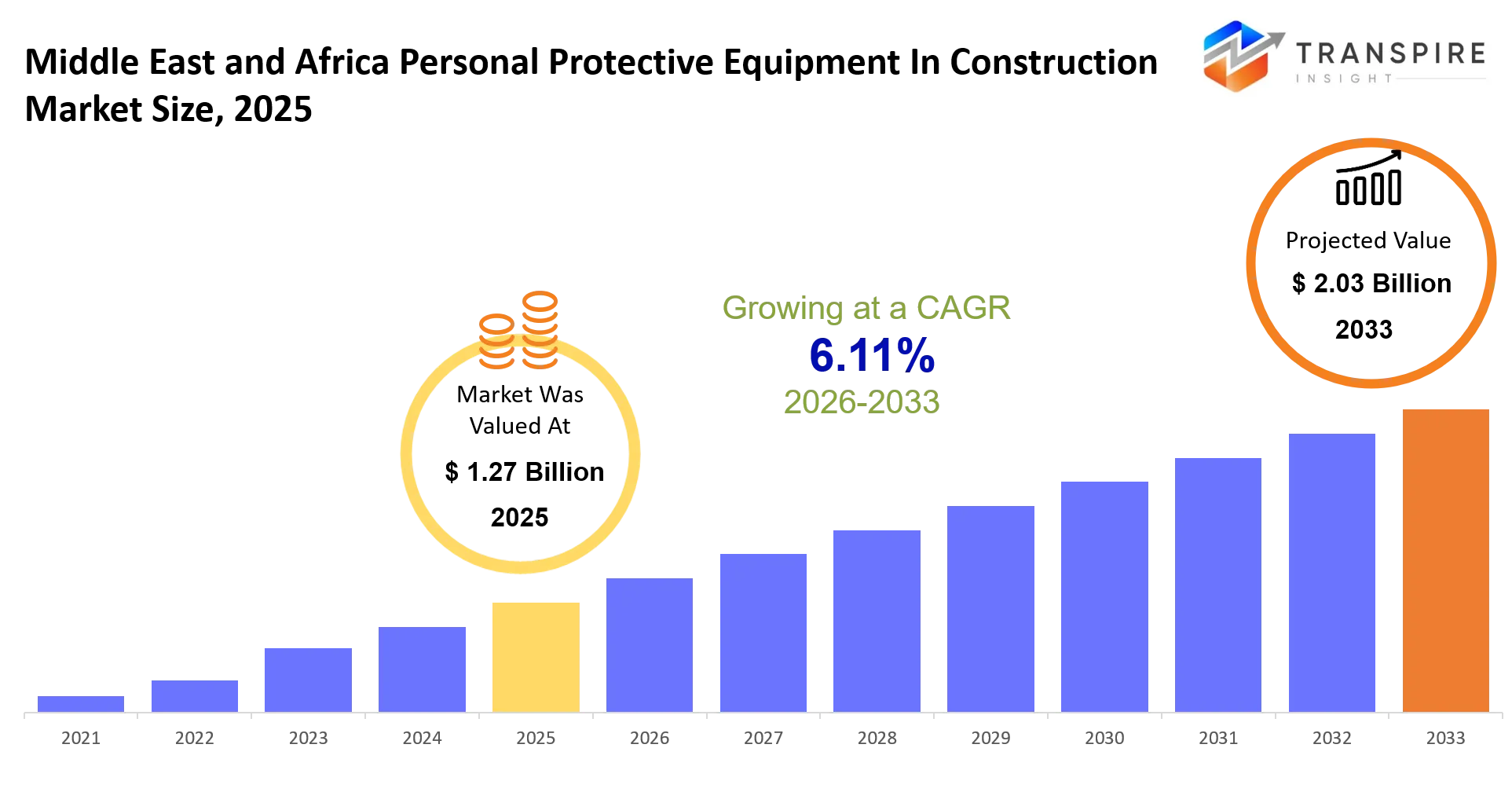
- Middle East and Africa Personal Protective Equipment In Construction Market Size 2025: USD 1.27 Billion
- Middle East and Africa Personal Protective Equipment In Construction Market Size 2033: USD 2.03 Billion
- Middle East and Africa Personal Protective Equipment In Construction Market CAGR: 6.11%
- Middle East and Africa Personal Protective Equipment In Construction Market Segments: By Product Type (Head Protection, Eye Protection, Hand Protection, Foot Protection, Fall Protection, Others); By Application (Residential Construction, Commercial Construction, Infrastructure Projects, Others); By End User (Construction Companies, Contractors, Government Projects, Others); By Distribution Channel (Direct Sales, Distributors, Online, Others)
To learn more about this report,  Download Free Sample Report
Middle East and Africa Personal Protective Equipment In Construction Market Summary
The Middle East and Africa Personal Protective Equipment In Construction Market was valued at USD 1.27 Billion in 2025. It is forecast to reach USD 2.03 Billion by 2033. That is a CAGR of 6.11% over the period.
The Middle East and Africa Personal Protective Equipment in Construction Market plays a critical role in safeguarding workers from hazards that show up on construction sites, like falls, head impacts, eye damage, hand injuries and also the nasty exposure to dust and debris. Basically, personal protective gear helps contractors, developers and project owners keep workplace safety in check , cut down on accident related expenses, and stay aligned with occupational safety rules across residential, commercial and infrastructure builds.
Over the last five years the market has been kind of moving away from purely basic compliance driven buying toward higher performance, certified safety equipment. In particular, governments across Gulf nations and in several African economies have tightened workplace safety enforcement which makes contractors lean into more advanced protection solutions. A big push showed up with large scale infrastructure investments and megaprojects, especially in Saudi Arabia and the UAE, where tougher contractor vetting and qualification standards increased the real demand for PPE. That change has then driven higher spending on premium safety products , stretched and also changed replacement cycles, and encouraged manufacturers to develop specialized equipment tuned for difficult jobsite conditions. And as projects get more complicated and safety inspections become more strict , PPE use is also shifting from “just a regulation thing” into an operational need that supports workforce productivity and keeps project timelines running.
Key Market Insights
- In 2025, Saudi Arabia kind of dominated regional demand , holding an estimated 32% market share because of big infrastructure and construction spends.
- Meanwhile, the Gulf Cooperation Council countries are viewed as the fastest-growing regional group through 2033, driven by megaproject momentum and stricter enforcement around worker safety, actually.
- For the products, head protection stayed on top as the leading segment with about 25% share in 2025, mainly since helmet requirements are mandatory on most jobs.
- Hand protection came in as the second-largest category, supported by broad usage across residential, commercial, and industrial construction work.
- Fall protection is projected to see the quickest growth through 2033 , as more high-rise development rolls out across urban centers.
- Looking at applications, infrastructure projects generated nearly 40% of market revenue in 2025, so they’re clearly the dominant application segment.
- Commercial construction is also starting to stand out as a higher-growth area, due to expanding logistics hubs, industrial parks, and mixed-use developments.
- On the end-user side, construction companies made up over 45% of total demand in 2025, largely because of heavy workforce needs and persistent compliance requirements.
- Key players such as 3M, Honeywell, MSA Safety, DuPont, and Portwest are pushing out regional distribution networks, plus they are rolling out improved PPE solutions.
- Smart safety equipment that blends sensors, impact monitoring, and connected worker technologies is picking up steam, especially with large contractors who want both productivity boosts and compliance advantages.
What are the Key Drivers, Restraints, and Opportunities in the Middle East and Africa Personal Protective Equipment In Construction Market?
The strongest growth driver seems to be the growing tightening of occupational safety rules across big construction markets in the Middle East and Africa, and it is kind of noticeable how this shows up everywhere. Governments have ramped up site inspections, pushed contractor accountability steps, and added safety certification requirements especially when we talk about larger public infrastructure undertakings. Because of this, PPE procurement is no longer treated like a “maybe later” or a discretionary buy, it becomes a mandatory operational expense. And as contractors try to win government plus private-sector projects, meeting safety standards directly affects whether they even get selected, so equipment adoption rates rise and PPE suppliers see more consistent revenue.
Still, price sensitivity is the biggest, structural roadblock I guess. A lot of small and medium sized contractors keep working with pretty tight project budgets, and they often choose lower-cost equipment instead of more premium, fully certified products. It’s hard to fix because procurement habits in construction usually reward immediate cost savings more than long-term safety performance , even when the economics could be better later on. So the penetration of advanced PPE tends to move more slowly and manufacturers that sell higher-value solutions end up with fewer revenue opportunities.
One big opportunity is smart, connected protective equipment. Wearable sensors built into helmets, safety vests, and fall protection systems can track worker location, fatigue, and safety incidents in real time. Major construction projects in Saudi Arabia, the UAE, and South Africa are increasingly leaning into digital site management platforms, which basically sets up better conditions for intelligent PPE deployment.
What Has the Impact of Artificial Intelligence Been on the Middle East and Africa Personal Protective Equipment In Construction Market?
Artificial intelligence is gradually changing construction safety management across the Middle East and Africa, kind of bit by bit, by improving the way protective gear is monitored, maintained, and used. Bigger contractors more and more rely on AI based video analytics setups to spot workers who are not wearing the needed safety equipment, like helmets, gloves, safety glasses , or harnesses. With automated monitoring the need for so much manual checking goes down, and safety managers can react faster when compliance issues pop up.
Machine learning is also backing predictive safety efforts. These models look through incident records, look at environmental conditions, track worker movement patterns, and review equipment usage data, to flag higher risk situations before incidents turn into accidents. Connected helmets and wearable devices can pass operational information back, which helps project managers fine tune workforce placement, and also makes it easier to improve day to day site safety results.
On the operational side, the gains often include fewer accident events, quicker compliance reporting, reduced insurance exposure, and better project continuity. AI assisted safety platforms can further help contractors keep up with regulatory requirements while cutting down on the administrative burden that usually eats up time.
Still, there are limits that slow things down. Adoption is held back by expensive implementation, and by the fact that many construction sites don’t have strong digital infrastructure. Smaller contractors often don’t have the budget or technical team to integrate connected PPE systems, and when data is spotty or inconsistent, predictive accuracy can drop. Because of this, those constraints keep delaying the broad rollout of advanced AI enabled safety technologies across many parts of the region.
Key Market Trends
- Since 2021, certified PPE adoption has kinda expanded , as governments started strengthening workplace inspection programs across major construction markets.
- Smart helmets and connected safety wearables moved from pilot programs to actual commercial deployment among large contractors by 2025, which is like a noticeable shift.
- Demand for fall protection went up too, especially with the high-rise developments, and several Gulf markets reported double-digit annual growth, year after year.
- Premium PPE products gained more market share, particularly when it came to infrastructure projects that are valued above USD 500 million.
- Between 2023 and 2025, regional manufacturers boosted local production capacity, in an effort to reduce import dependency and limit supply disruptions.
- Online procurement channels also gained traction and in selected construction markets by 2025, they represented nearly 15% of PPE purchases—so e-commerce style ordering is becoming more normal.
- On top of that, sustainability initiatives nudged manufacturers to introduce recyclable materials, and environmentally responsible packaging solutions.
- Strategic partnerships between global PPE brands and regional distributors also helped speed up market penetration across Africa and the Gulf region.
- Worker monitoring technologies expanded adoption among major contractors, mainly because they want measurable improvements in safety performance, not just promises.
- Finally, large infrastructure programs kept standardizing PPE specifications, which basically created stronger demand for globally certified equipment.
Middle East and Africa Personal Protective Equipment In Construction Market Segmentation
By Product Type
Head protection keeps being essential across construction activities, mostly because helmets give protection from falling objects, collisions, and a mix of on site hazards. Demand stays strong across housing, offices, and infrastructure projects where safety rules insist on certified head protection. Eye Protection is also a key part, because it shields workers from dust, fragments, sparks, and the construction materials you bump into during regular work.
Hand Protection helps support safe handling of tools, machinery, and building materials while lowering the chance of injury. Foot Protection keeps climbing in importance, since workers face heavy equipment, sharp objects, and uneven surfaces all day. Fall Protection is seeing faster uptake as high rise and public works projects broaden through cities. The “others” category tends to include hearing protection, respiratory protection, and protective clothing made for specialized job settings.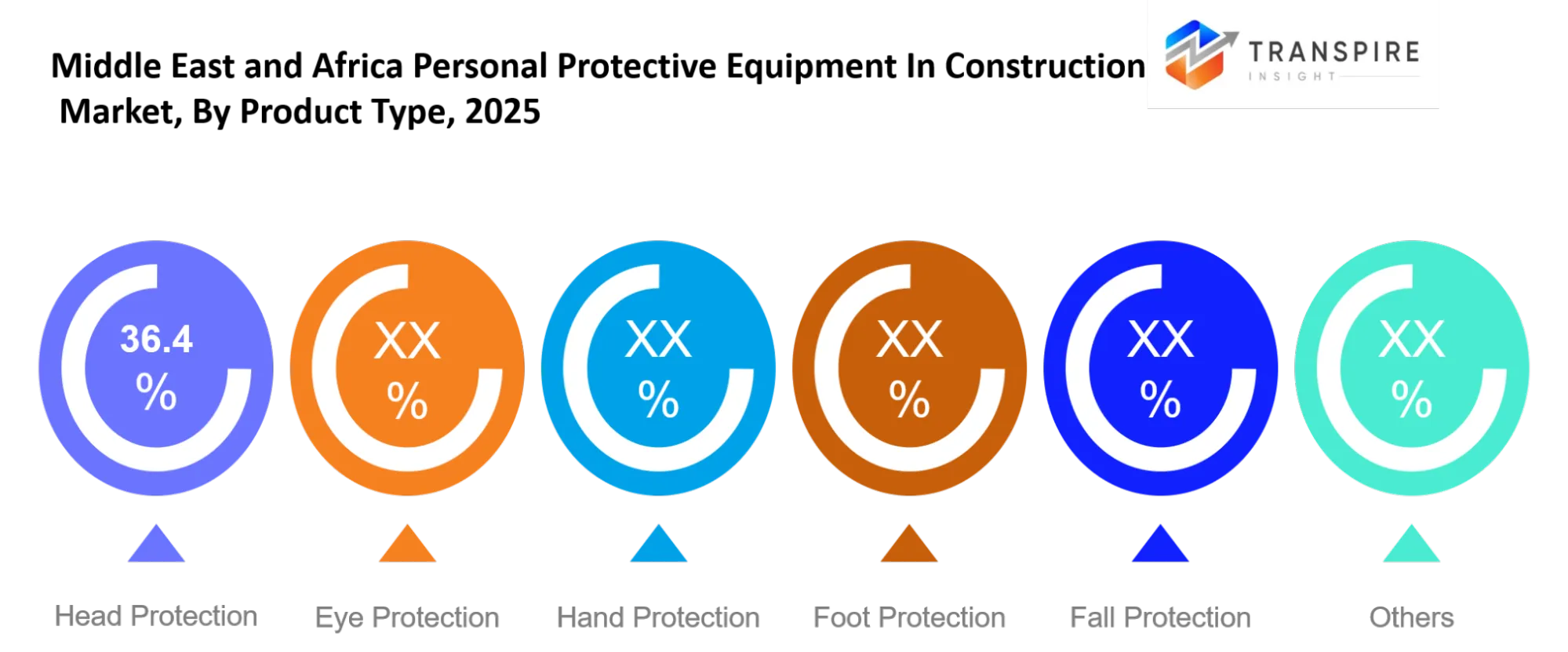
To learn more about this report, Download Free Sample Report
By Application
Residential Construction keeps bringing a steady PPE demand, mostly from housing developments, renovation work and that kind of urban expansion that keeps going on. Even so Worker safety requirements still feed the buying of helmets, gloves, footwear and eye protection equipment, across many residential construction sites.
Commercial Construction, however , seems to push a heavier protective equipment need because the projects are larger and the timelines stretch longer. Infrastructure Projects then add a lot to PPE consumption, think highways, rail systems, airports, ports and utility developments. Then there are the Others category , which covers industrial facilities, energy projects and specialized construction activities where worker protection stays a real priority during the whole execution phase.
By End User
Construction Companies kinda show up as the most major end-user group, mostly because large organizations handle huge workforces and keep pretty strict safety compliance standards in place. In many procurement programs they tend to push certified products, the ones that better align with what the project needs, and also the regulatory obligations.
Contractors are another key segment too, since subcontracting is still expanding across regional construction markets, and that’s not going away. Government Projects create substantial demand as public infrastructure investments move forward, plus there are mandatory safety specifications written into the process. Then there are the Others category, which can include engineering firms, project management organizations, and maintenance service providers, involved in construction related operations, kinda day-to-day.
By Distribution Channel
Direct sales still matter a lot for bigger construction firms that want customized buying terms, and steady product flow. In many cases, manufacturers lean into direct engagement, to keep support close during major projects, and for those longer term contracts too.
Meanwhile, distributors really sit in the middle, helping with wide product availability, plus regional market reach. At the same time, online channels keep growing, since buyers prefer convenience, faster product comparisons, and smoother procurement efficiency. There are also other routes, like retailers focused on specialty safety equipment, and local procurement networks that target particular construction markets, more or less directly.
What are the Key Use Cases Driving the Middle East and Africa Personal Protective Equipment In Construction Market?
The main thing , for this use case , is worker safety protection across big infrastructure and commercial builds. You end up doing structural assembly, excavation , concrete work, plus equipment operation, and that means the need to keep using helmets, gloves, protective footwear, and eye gear almost all the time. These projects typically end up with the biggest PPE consumption , mainly because workforce numbers are higher and the compliance rules for safety are more strict and nitpicky.
Other use cases are showing up too, especially in industrial facility construction, logistics hubs, renewable energy projects, and larger residential developments. The contractors in those spaces are starting to lean more into specialized protective equipment, sort of to handle project-specific safety hazards, while also satisfying the safety duties that are written into contracts.
On top of that, newer applications are leaning into smart PPE deployments, where location tracking, worker monitoring, and incident reporting all get folded together. More advanced wearable safety technologies are also catching attention from organizations that want digital construction management support, and stronger protection for workers over the forecast period.
|
Report Metrics |
Details |
|
Market size value in 2025 |
USD 1.27 Billion |
|
Market size value in 2026 |
USD 1.34 Billion |
|
Revenue forecast in 2033 |
USD 2.03 Billion |
|
Growth rate |
CAGR of 6.11% from 2026 to 2033 |
|
Base year |
2025 |
|
Historical data |
2021 - 2024 |
|
Forecast period |
2026 - 2033 |
|
Report coverage |
Revenue forecast, competitive landscape, growth factors, and trends |
|
Regional scope |
Middle East and Africa (Saudi Arabia, United Arab Emirates, South Africa, Rest of Middle East and Africa) |
|
Key company profiled |
3M, Honeywell, MSA Safety, Ansell, Delta Plus, Uvex, Lakeland, Kimberly-Clark, JSP, Drager, Karam, Mallcom, DuPont, Bullard, Portwest |
|
Customization scope |
Free report customization (country, regional & segment scope). Avail customized purchase options to meet your exact research needs. |
|
Report Segmentation |
By Product Type (Head Protection, Eye Protection, Hand Protection, Foot Protection, Fall Protection, Others); By Application (Residential Construction, Commercial Construction, Infrastructure Projects, Others); By End User (Construction Companies, Contractors, Government Projects, Others); By Distribution Channel (Direct Sales, Distributors, Online, Others) |
Which Regions are Driving the Middle East and Africa Personal Protective Equipment In Construction Market Growth?
In the Gulf region the market stays in front, mostly because there is an ongoing construction push, heavy investment in infrastructure, plus a kind of strict enforcement around workplace safety. Saudi Arabia and the UAE also add real momentum, driven by big program developments and those urban modernization plans, which is why demand stays high. At the same time, regulatory oversight is still stronger than in many nearby markets. There is also a mature supplier setup and pretty solid distribution channels which helps keep leadership steady.
South Africa meanwhile looks like a key contributor but with a different growth tempo. Here the expansion is more tied to mining-adjacent building work, along with commercial spaces and industrial projects, not so much the huge megaproject style programs. Regulatory follow-through is fairly consistent and occupational safety practices are already well established, so the demand trends feel more stable. Strong industrial activity then supports regular PPE renewal cycles, that kind of routine replacement demand.
The quickest growth is expected across several emerging African economies including Kenya, Egypt, and Nigeria. More funding for infrastructure, wider transport investments and industrial expansion initiatives have basically intensified construction work over the past few years. Governments are also slowly tightening workplace safety frameworks while they work on wider economic development goals. So overall, manufacturers, distributors and investors should find appealing chances for longer term regional growth between 2026 and 2033, even if it’s not all the same everywhere.
Who are the Key Players in the Middle East and Africa Personal Protective Equipment In Construction Market and How Do They Compete?
Competition is still pretty moderately fragmented , you know global manufacturers sit next to regional suppliers and then there are these specialized providers focused on safety gear. In practice, product quality, certification norms , distribution reach, and pricing approach are the main things companies fight over. International brands usually keep an edge via technology development and compliance credentials, meanwhile regional players tend to lean hard on localized service and easier market access .
3M stands out with advanced material technologies, respiratory protection know-how, and just really wide product range . Honeywell leans more toward integrated workplace safety solutions, plus it benefits from solid industrial customer ties across the region. MSA Safety highlights engineered protection systems, especially in head protection and fall protection use cases , where actual product performance still becomes the make-or-break part.
DuPont competes by using specialized protective materials and high-performance safety apparel meant for tough environments. Portwest keeps pushing out regional distribution capacity, while also rolling in fresh product designs aimed at construction and industrial customers. Delta Plus improves its market visibility through more affordable pricing tactics and broad product availability, which helps it penetrate more deeply into developing construction markets . Overall, strategic partnerships , distribution expansion programs , and product innovation are the usual methods used to sharpen competitive positioning and capture market share, even when everything stays a bit fragmented .
Company List
- 3M
- Honeywell
- MSA Safety
- Ansell
- Delta Plus
- Uvex
- Lakeland
- Kimberly-Clark
- JSP
- Dräger
- Karam
- Mallcom
- DuPont
- Bullard
- Portwest
Recent Development News
In March 2026,Honeywell launched new connected industrial safety solutions integrating wearable technologies and real-time worker monitoring capabilities. The development strengthened digital safety management adoption across construction and industrial environments.https://www.honeywell.com
What Strategic Insights Define the Future of the Middle East and Africa Personal Protective Equipment In Construction Market?
The market is kinda moving toward higher value, tech enabled protective equipment, backed by more strict regulatory enforcement, more infrastructure spend ing, and digital construction management habits. Over the next five to seven years, safety performance data will matter more and more for procurement decisions, and competition will start to shift away from just product price, toward provable workforce protection outcomes.
There’s also a less obvious risk too, and it’s tied to raw material supply volatility and how much advanced protective equipment depends on imported components. If supply gets disrupted, or costs start inflating, that can shake pricing stability, and it may slow down adoption among contractors who are very budget sensitive. At the same time though, connected PPE systems, when they’re integrated with workforce analytics platforms, look like a meaningful emerging opportunity. Adoption is still not that widespread today but it could speed up as big projects roll out more digital monitoring.
For market participants, the smart play is to push partnerships that blend protective gear with digital safety solutions. The firms that start early on smart PPE development, build out regional distribution networks, and grow localized manufacturing capability will likely end up in a better spot to capture the next wave of growth. In the end, this also helps them build competitive resilience across the Middle East and Africa construction safety ecosystem.
Middle East and Africa Personal Protective Equipment In Construction Market Report Segmentation
-
By Product Type
Head Protection
Eye Protection
Hand Protection
Foot Protection
Fall Protection
Others -
By Application
Residential Construction
Commercial Construction
Infrastructure Projects
Others -
By End User
Construction Companies
Contractors
Government Projects
Others -
By Distribution Channel
Direct Sales
Distributors
Online
Others
Frequently Asked Questions
Find quick answers to common questions.
The expected Middle East and Africa Personal Protective Equipment In Construction Market size for the market will be USD 2.03 Billion in 2033.
Key Segments for the Middle East and Africa Personal Protective Equipment In Construction Market are By Product Type (Head Protection, Eye Protection, Hand Protection, Foot Protection, Fall Protection, Others); By Application (Residential Construction, Commercial Construction, Infrastructure Projects, Others); By End User (Construction Companies, Contractors, Government Projects, Others); By Distribution Channel (Direct Sales, Distributors, Online, Others).
Major Middle East and Africa Personal Protective Equipment In Construction Market players are 3M, Honeywell, MSA Safety, Ansell, Delta Plus, Uvex, Lakeland, Kimberly-Clark, JSP, Drager, Karam, Mallcom, DuPont, Bullard, Portwest.
The Current Middle East and Africa Personal Protective Equipment In Construction Market size is USD 38489.2 Million in 2025.
The Middle East and Africa Personal Protective Equipment In Construction Market CAGR is 6.11% from 2026 to 2033.
- 3M
- Honeywell
- MSA Safety
- Ansell
- Delta Plus
- Uvex
- Lakeland
- Kimberly-Clark
- JSP
- Dräger
- Karam
- Mallcom
- DuPont
- Bullard
- Portwest
About the Authors

Chetan Dhatrak
I’m Chetan Dhatrak, a Senior Research Analyst at Transpire Insight, specializing in the Consumer Goods, Foods and Beverages industry. I focus on analyzing market trends, consumer behavior, competitive landscapes, and industry developments to deliver accurate, data-driven insights. My research at Transpire Insight is built on credible sources and in-depth analysis, helping businesses and readers better understand market dynamics, emerging opportunities, and evolving consumer preferences. I’m committed to creating reliable, well-researched content that supports informed decision-making and reflects the latest developments in the consumer goods and food & beverage sectors.

Chakradhar Khansole
Chakradhar serves as the Research Director at Transpire Insight, bringing over 8 years of experience in technology, innovation, and strategic market intelligence. He specializes in transforming complex market data into actionable business insights that enable organizations to make informed, growth-oriented decisions. Recognized for his strategic vision and analytical expertise, Chakradhar leads high-impact research initiatives, delivering comprehensive market assessments, competitive intelligence, and forward-looking industry analysis.
Recently Published Reports
-
Apr 2026
Bottled Water Market
Bottled Water Market Size, Share & Analysis Report By Product Type (Still Bottled Water, Carbonated Bottled Water, Functional Bottled Water, and Others), By Packaging (PET, Cans, and Others), By Sales Channel (Supermarkets/Hypermarkets, Convenience Stores/Drug Stores, Grocery Stores/Club Stores, Foodservice, and Others) and Geography (North America, Europe, Asia-Pacific, Middle East and Africa, South and Central America), 2021 - 2032
-
Apr 2026
Color Cosmetic Packaging Market
Color Cosmetic Packaging Market Size, Share & Analysis Report By Application (Mascara Packaging, Liquid Packaging, and Liquid Face), By Type (Tubes & Bottles, Pens & Markers, Compacts & Containers, and Droppers & Pumps), and Geography (North America, Europe, Asia-Pacific, Middle East and Africa, South and Central America), 2021 - 2031
-
Apr 2026
External Microphone For Camera Market
External Microphone For Camera Market Size, Share & Analysis Report By Type (Shotgun Microphone, Lavalier Microphone, and Others), By Application (Digital Camera, Professional Video Camera, and Others), and Geography (North America, Europe, Asia-Pacific, Middle East and Africa, South and Central America), 2021 - 2031
-
Apr 2026
Foot Orthotic Insoles Market
Foot Orthotic Insoles Market Size, Share & Analysis Report By Type (Pre-fabricated, and Custom-made), By Material (Thermoplastic, Composite Carbon Fiber, and Others), By Distribution Channel (Drug Stores, Hospitals & Clinics, and Others), and Geography (North America, Europe, Asia-Pacific, Middle East and Africa, South and Central America), 2021 - 2031