France Personal Protective Equipment Market Size & Forecast
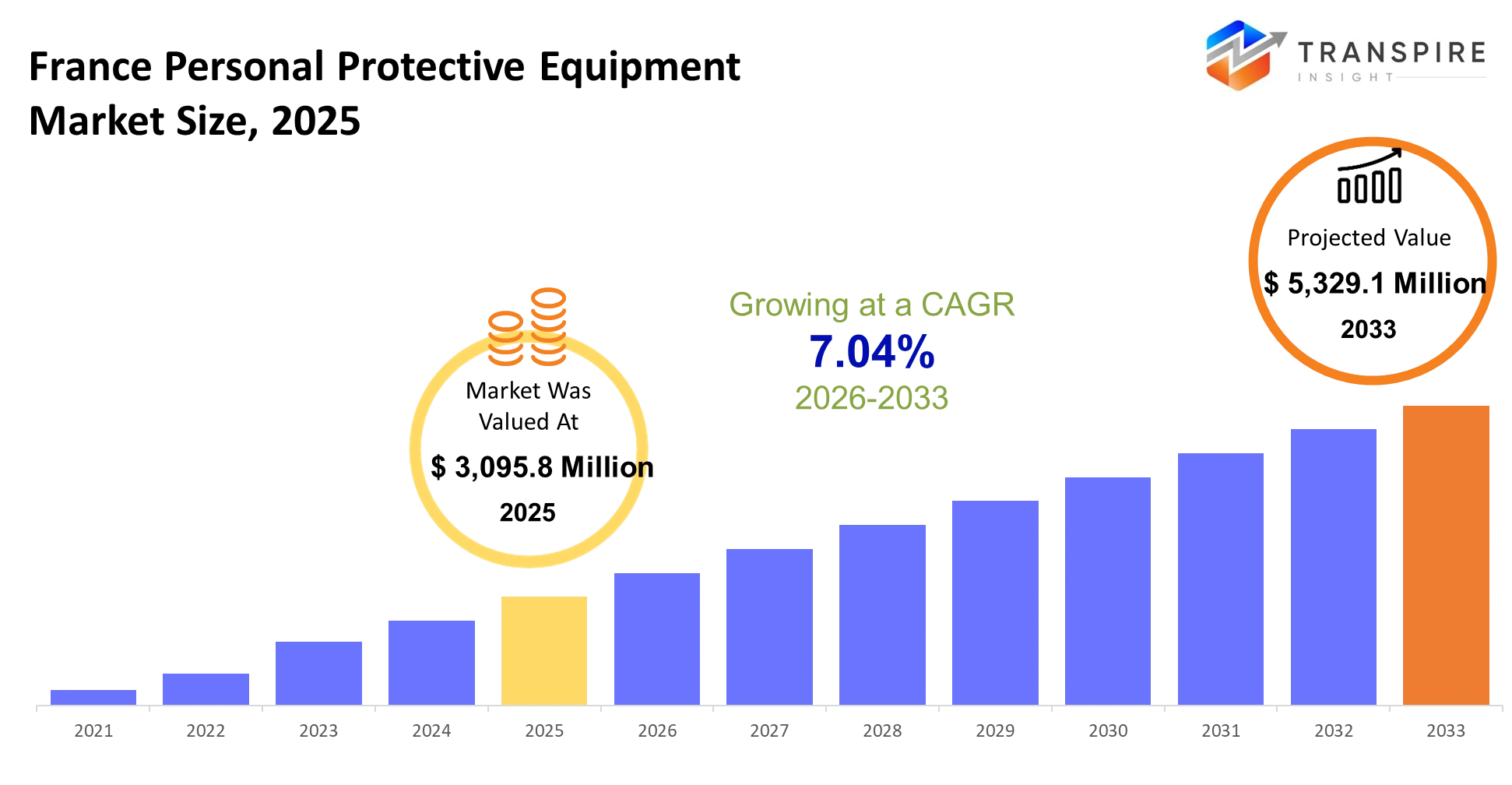
- France Personal Protective Equipment Market Size 2025: USD 3,095.8 Million
- France Personal Protective Equipment Market Size 2033: USD 5,329.1 Million
- France Personal Protective Equipment Market CAGR: 7.04%
- France Personal Protective Equipment Market Segments: By Type (Hand Protection, Eye Protection, Respiratory Protection, Protective Clothing, Others); By Application (Industrial Safety, Healthcare, Construction, Oil & Gas, Others); By End-User (Healthcare Workers, Industrial Workers, Construction Workers, Firefighters, Others); By Distribution (Online, Retail, Direct Sales, Others)
To learn more about this report,  Download Free Sample Report
France Personal Protective Equipment Market Summary
The France PPE market reached USD 3,095.8 Million in 2025 and is projected to expand to USD 5,329.1 Million by 2033, growing at a 7.04% CAGR. Personal protective equipment (PPE) really prevents workplace injuries and occupational diseases by setting up actual barriers between workers and extremely hazardous materials, very harmful machines, and biological agents itself. A health worker wearing nitrile gloves, an N95 mask, and a very protective gown before entering an isolated patient room shows PPE's role in occupational safety.
The structural catalyst increasing French market growth is much stricter occupational safety regulations and a higher level of workforce health consciousness after the COVID-19 pandemic. French labor laws under the Code du Travail (French Labor Code) actually require employers to take responsibility for worker safety, with much harsher penalties for non-compliance - they've really increased quite a bit since 2020. Employers face serious legal liability for occupational injuries and illnesses that could be prevented by providing adequate PPE. This regulatory environment really creates a solid foundation of market demand regardless of economic cycles.
The real-world trigger keeping the market growing is just normalizing PPE as a common operational expense across all industries. During the pandemic, PPE consumption went way up as companies put health protocols in place. After the pandemic, while we consume less than at the peak levels, our baseline PPE usage really remains higher compared to pre-2020 levels. Companies keep stockpiles ready for emergencies, continue giving PPE out as part of an employee's standard benefits, and invest in reusable protective equipment that replaces single-use items. This structural change really creates a much bigger ongoing demand base than existed before 2020 itself.
Key France Personal Protective Equipment Market Insights
- Healthcare workers account for 70% of France PPE market revenue in 2025, driven by ongoing infection prevention protocols, chronic care expansion, and aging population requiring more medical services.
- Protective clothing segment commands 38% of PPE market revenue, making it the largest product category as full-body protection requirements drive higher per-unit spending than individual hand or eye protection.
- Industrial workers represent the second-largest end-user segment at 22% of market revenue, spanning manufacturing, chemical processing, and heavy equipment operations where comprehensive PPE protocols remain mandatory.
- Online distribution channels grew 24% year-over-year in 2024, capturing 31% of market volume as businesses prioritize procurement convenience and supply chain efficiency through direct-to-distributor e-commerce platforms.
- 3M and Honeywell collectively control 42% of the France PPE market through brand recognition, product breadth, and established distribution networks across healthcare and industrial sectors.
- Respiratory protection equipment expanded 12% in 2024 following introduction of stricter air quality regulations in healthcare facilities and industrial workplaces under EU air quality directives.
- DuPont maintains strong position in protective apparel through specialized materials offering superior hazard protection compared to competitor products, supporting premium pricing.
- Construction segment is growing at 9.2% CAGR through 2033, driven by infrastructure investment programs and tighter enforcement of construction site safety regulations.
- Oil and gas application segment faces modest growth at 5.1% CAGR due to France's energy transition away from fossil fuels and reduced petroleum extraction activities.
- Direct sales through manufacturer representatives account for 38% of market volume, particularly for customized solutions and high-volume industrial contracts where pricing negotiation is standard practice.
What are the Key Drivers, Restraints, and Opportunities in the France Personal Protective Equipment Market?
The primary expansion force is regulatory compliance and workplace safety requirements that generate non-discretionary demand for PPE. The French Labor Code and INRS guidelines set out minimum PPE needs in specific hazardous situations - making employers' provision of this equipment a legal requirement rather than a discretionary benefit. This produces baseline demand that's largely unaffected by economic conditions. Healthcare organizations face very strict infection control requirements - especially after being exposed to infectious diseases during the pandemic. Moreover, EU workplace safety directives set out harmonized standards across all member states - which aligns with French regulations, thus creating predictable, continuous demand that doesn't change much with business cycles.
The biggest hurdle is cost sensitivity and purchasing consolidation among really large healthcare systems and industrial corporations. France's public healthcare system (Assurance Maladie) negotiates PPE prices on centralized contracts - creating price pressure that limits suppliers' profit margins. Big industrial corporations with huge PPE needs use their purchasing power to negotiate bigger volume discounts - thus squeezing retail prices. This consolidation among key buyers reduces suppliers' pricing power - which in turn restricts market revenue growth despite continued growth in the number of units sold.
The highest-growth opportunity lies in sustainable and reusable PPE solutions - addressing environmental concerns and lowering the total cost of ownership for large organizations. Single-use PPE produces enormous waste streams: France generates around 180,000 tonnes of medical waste every year - with PPE being quite a big part of it. Regulations under the EU Circular Economy Action Plan are tightening restrictions on single-use plastics - and encouraging reusable alternatives instead. PPE manufacturers who develop durable, washable protective wear, respirators with reusable filters, and integrated safety systems that greatly reduce per-unit consumption will take market share away from commodity single-use providers. Organizations that're willing to invest in reusable solutions could cut their PPE expenses by 40-50% over the product life cycle - while also reducing their environmental impact.
What Has the Impact of Artificial Intelligence Been on the France Personal Protective Equipment Market?
Artificial intelligence is changing PPE procurement, inventory management, and hazard monitoring more so than the actual protective equipment itself. Machine learning algorithms examine worker injury claims, near-miss reports, and safety incident databases to identify patterns of occupational hazards and suggest specific PPE requirements for certain job functions. This makes it possible for companies to optimize their PPE purchases towards their workers' most at-risk exposures instead of buying a standardized set for every worker. Predictive analytics models incorporating real-time workplace environmental monitoring with worker activity data can recommend when particular PPE should be used, decreasing unnecessary consumption of disposable items all while maintaining safety protections.
Computer vision systems linked to workplace monitoring are starting to identify workers who aren't wearing necessary PPE - then automatically notify their supervisors, creating new accountability tools that support regulatory compliance. This monitoring ability is very valuable in construction and manufacturing settings where workers often ignore PPE due to discomfort or a perceived low level of risk. The biggest constraint holding back wider AI impact is worries over privacy: France's CNIL (Commission Nationale de l'Informatique et des Libertés) has voiced concerns about video surveillance and worker monitoring systems - requiring explicit permission protocols that really complicate deployment.
Key Market Trends
- Healthcare workers account for 70% of market revenue, with growth driven by chronic care expansion and infection prevention protocols that remain elevated relative to pre-pandemic baseline.
- Protective clothing generates 38% of product segment revenue and is the fastest-growing category at 8.4% CAGR, driven by comprehensive hazard protection requirements in healthcare and industrial applications.
- Hand protection accounts for 24% of market revenue with 6.1% CAGR growth, including specialized gloves for chemical handling, cut resistance, and thermal protection across diverse end-user segments.
- Eye protection represents 18% of market revenue with 6.8% CAGR expansion, supported by ergonomic design improvements that increase adoption rates in construction and manufacturing.
- Respiratory protection grew 12% in 2024 following stricter air quality enforcement and increased awareness of occupational respiratory disease risks among healthcare and construction workers.
- Industrial safety applications account for 18% of market revenue with 6.9% CAGR growth as manufacturing sectors maintain steady safety investment despite economic volatility.
- Construction segment grew 9.2% year-over-year in 2024, capturing 12% of market revenue as government infrastructure initiatives drive construction activity and safety enforcement.
- Online distribution channels expanded 24% year-over-year and now represent 31% of market volume, reflecting organizational preference for digital procurement and supply chain transparency.
- Retail distribution maintains 42% of market volume, particularly for individual worker purchases of personal protective equipment and small organization replenishment buying.
- Sustainable PPE solutions grew 28% in 2024 as large healthcare systems and industrial organizations evaluate total cost of ownership including environmental compliance costs of single-use alternatives.
France Personal Protective Equipment Market Segmentation
By Type
Hand protection is comprised of gloves and arm coverings that really help prevent injuries from sharp things, chemical contact, and even thermal hazards itself. This segment really holds 24% of the market's revenue - and keeps growing at a 6. 1% CAGR rate all the time. Nitrile gloves definitely rule in healthcare applications because of common latex allergies and excellent barrier properties themselves. Really specialized gloves for construction, oil and gas, and chemical handling ask for a premium price - with prices ranging from USD 0. 15 per glove for simple latex to USD 2. 50 for resistant chemical options.
Eye protection is made up of safety glasses, face shields, and goggles that stop eye injuries from little flying pieces of debris, radiation, and even chemical splashes. This segment represents 18% of the market's revenue - and really expands at a 6. 8% CAGR rate. Improvements in technology like anti-fog coatings, blue light filtering, and even lighter materials have really increased the adoption rate all the time as worker comfort gets better itself.
Respiratory protection covers respirators, masks, and breathing equipment that filter out very dangerous airborne particles and gases itself. The segment really holds 12% of the market's revenue - and even expanded by 12% in 2024 because of stricter regulations and much greater awareness of occupational respiratory diseases themselves. Premium respirators with reusable parts demand 60-65% margins compared to 35-40% margins on disposable masks itself.
Protective clothing including full-body suits, lab coats, and highly specialized apparel helps prevent contamination and protects against chemical and biological hazards all the time. This segment generates 38% of the market's revenue - and grows at an 8. 4% CAGR rate, really making it the fastest-growing product category itself. Specialized materials offering even better protection ask for premium pricing - and support higher margins over commodity protective clothing itself.
By Application
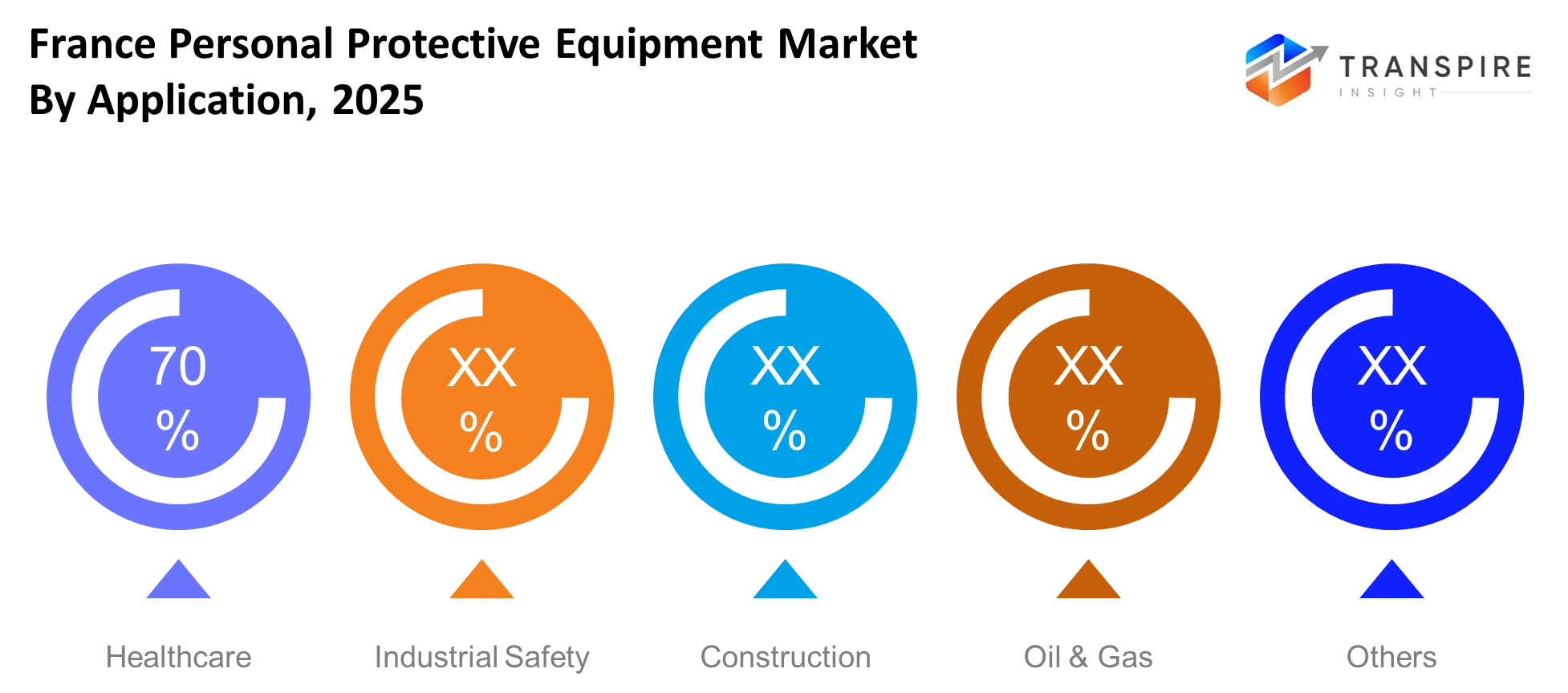
Industrial safety applications comprise 18% of the market's revenue - stretching across manufacturing, chemical processing, and heavy equipment operations where personal protective equipment is mandatory due to hazardous substance exposure. At a 6. 9% compound annual growth rate, growth is sustained by further investment in French manufacturing industries and constant safety law enforcement. This particular sector really shows itself to be very sensitive to price and also has significant volume purchases from many large industrial companies negotiating big contracts with suppliers centrally.
Healthcare applications produce 70% of the market's revenue - and they're actually the fastest-growing segment at a 7. 8% compound annual growth rate. Expansion in chronic care services, a growing population, and still-very-high infection prevention protocols compared to the pre-pandemic baseline really drive ongoing demand for healthcare PPE products. Public hospitals account for about 52% of healthcare PPE expenses all through a centralised procurement process, while private facilities and long-term care centres make up the rest of it.
Construction applications represent 12% of the market's revenue - and they expand at a 9. 2% compound annual growth rate, mostly thanks to government programmes investing in infrastructure construction. Construction safety laws are becoming much stricter, with CNAMTS (the National Social Insurance Fund for Employees) enforcing site safety compliance - thus creating more mandated PPE requirements.
To learn more about this report, Download Free Sample Report
By End-User
Healthcare workers represent 70% of market revenue across hospital employees, clinic staff, and long-term care facility workers. This end-user segment shows the most predictable demand patterns and lowest price sensitivity due to employer-provided PPE budgets and infection prevention protocols that prioritize worker safety over cost minimization.
Industrial workers account for 22% of market revenue in manufacturing, chemical processing, and energy sectors. Price sensitivity is high in this segment due to purchasing consolidation among large corporations that negotiate volume discounts and centralized supplier contracts.
Construction workers represent 6% of market revenue and the fastest-growing end-user segment at 9.5% CAGR. This highly fragmented market includes individual workers purchasing personal equipment and large construction firms with standardized safety programs.
By Distribution
Online distribution channels represent 31% of market volume and expanded 24% year-over-year in 2024. B2B e-commerce platforms enable organizational buyers to access product catalogs, manage accounts, and arrange rapid delivery of standard PPE items. Online channels compress margins by eliminating retail distribution layers but expand addressable market by enabling rural and underserved organizations to access suppliers previously unavailable through local retail channels.
Retail distribution accounts for 42% of market volume through pharmacy chains, specialized safety equipment retailers, and general merchandise retailers. Retail margins are higher than online channels and support a diverse mix of small suppliers. Individual worker purchases at retail locations remain substantial despite growth in organizational online procurement.
Direct sales from manufacturers to large organizational buyers account for 27% of market volume. Customized PPE solutions, high-volume contracts, and negotiations around pricing and delivery terms favor direct sales models. Large healthcare systems and industrial corporations employ dedicated procurement professionals who conduct competitive bidding processes across multiple suppliers.
|
Report Metrics |
Details |
|
Market size value in 2025 |
USD 3,095.8 Million |
|
Market size value in 2026 |
USD 3,309.5 Million |
|
Revenue forecast in 2033 |
USD 5,329.1 Million |
|
Growth rate |
CAGR of 7.04% from 2026 to 2033 |
|
Base year |
2025 |
|
Historical data |
2021 - 2024 |
|
Forecast period |
2026 - 2033 |
|
Report coverage |
Revenue forecast, competitive landscape, growth factors, and trends |
|
Geographic scope |
France |
|
Key companies profiled |
3M, Honeywell, DuPont, Kimberly-Clark, Ansell, Lakeland, MSA Safety, Delta Plus, Uvex, Drager, Alpha Pro Tech, Moldex, Bullard, JSP Safety, Portwest |
|
Customization scope |
Free report customization (regional & segment scope). Avail customized purchase options to meet your exact research needs. |
|
Report Segmentation |
By Type (Hand Protection, Eye Protection, Respiratory Protection, Protective Clothing, Others); By Application (Industrial Safety, Healthcare, Construction, Oil & Gas, Others); By End-User (Healthcare Workers, Industrial Workers, Construction Workers, Firefighters, Others); By Distribution (Online, Retail, Direct Sales, Others) |
Regional Analysis
France represents approximately 28% of the broader Western Europe personal protective equipment market - and is the fastest-growing major European market at 7. 04% CAGR. French healthcare system centralization really enables coordinated PPE procurement and standardized safety protocols that drive adoption even more. The Île-de-France (Paris region) and Rhone-Alpes regions account for 52% of French PPE market revenue due to a concentration of healthcare facilities and manufacturing infrastructure. Regional variations in industrial activity and construction investment create quite different growth rates across France - with industrial regions like Grand Est and Hauts-de-France showing much faster growth than rural areas themselves.
Compared to peer European nations, France's healthcare-dominated PPE market structure really differs from Germany and UK markets where industrial applications represent quite a larger revenue share. This healthcare concentration helps support higher baseline margins and more predictable demand patterns than industrial-focused European PPE markets altogether. The ageing French population will drive sustained healthcare PPE growth - as people over the age of 65 consume three times more healthcare services than younger populations indeed.
Who are the Key Players in the France Personal Protective Equipment Market and How Do They Compete?
The France PPE market divides between multinational manufacturers with global supply chains and specialized European suppliers with regional brand recognition. 3M and Honeywell lead through brand recognition, product breadth, and established distribution relationships with large healthcare systems and industrial corporations. These global suppliers compete on innovation, offering advanced materials and technological features that command premium pricing. DuPont specializes in protective apparel and maintains strong positions through superior material properties that support premium pricing. Kimberly-Clark competes primarily in healthcare PPE where brand recognition and product quality drive purchasing decisions.
Mid-tier suppliers including Ansell, MSA Safety, and Uvex maintain strong positions in specific product categories or end-user segments. Ansell dominates hand protection through specialized glove manufacturing. MSA Safety leads respiratory protection through technical expertise and safety certifications. European specialists including Lakeland, Delta Plus, and Portwest compete on regional distribution networks and customized solutions for specific occupational hazards. The strategic competitive dynamic centers on healthcare consolidation: as French hospitals centralize procurement, supplier selection increasingly follows nationwide competitive bidding processes that favor globally-recognized brands with proven quality and compliance track records.
France Personal Protective Equipment Market Companies
- 3M
- Honeywell
- DuPont
- Kimberly-Clark
- Ansell
- Lakeland
- MSA Safety
- Delta Plus
- Uvex
- Drager
- Alpha Pro Tech
- Moldex
- Bullard
- JSP Safety
- Portwest
Recent Developments
In March 2026, 3M announced expansion of its reusable respiratory protection product line in France with introduction of next-generation filtering cartridges offering extended service life and reduced total cost of ownership. The product launch targets large healthcare systems and industrial corporations evaluating sustainable PPE alternatives. https://www.3m.com/news (3M Newsroom).
In February 2026, Honeywell completed acquisition of a French-based PPE distribution company, expanding its direct-to-customer sales capabilities and establishing dedicated French logistics infrastructure for faster order fulfillment. The acquisition strengthens Honeywell's competitive position in direct sales channel targeting large healthcare systems. https://www.honeywell.com/news (Honeywell Investor Relations).
In January 2026, the French government announced updated occupational safety guidelines requiring expanded respiratory protection in healthcare settings, effective immediately for all public hospitals and private facilities. The regulation expansion is expected to increase respiratory protection demand by approximately 22% annually through 2028. https://www.inrs.fr (French Occupational Safety Institute).
What Strategic Insights Define the Future of the France Personal Protective Equipment Market?
Over the next five to seven years, the France PPE market will consolidate around sustainable, reusable products as environmental regulations tighten and total cost of ownership considerations favor durable alternatives. Single-use PPE will face increasing regulatory restrictions under EU Circular Economy Action Plan implementations, creating cost pressures that accelerate adoption of reusable solutions. Organizations investing in reusable PPE infrastructure now will position themselves for regulatory compliance and cost advantage as single-use alternatives become economically disadvantageous.
The hidden risk is healthcare cost containment pressure that could suppress PPE spending growth despite regulatory mandates. French healthcare system budget constraints have intensified since 2020, with hospitals operating under extended austerity conditions. If budget pressures worsen, hospital procurement departments may reduce PPE consumption below safety-recommended levels, creating health and safety risks but also near-term revenue headwinds for suppliers. Suppliers that demonstrate quantifiable return on investment through reduced infection rates or occupational illness prevention will maintain pricing power even in cost-constrained environments.
The clearest opportunity is specialized PPE for emerging occupational hazards including exposure to novel infectious agents, chemical and biological threats, and thermal hazards from climate change-driven extreme weather. Healthcare organizations are establishing emergency response protocols requiring broader, more comprehensive PPE inventories than historical standards. Suppliers that develop modular PPE systems customizable for specific organizational needs and occupational scenarios will capture premium pricing and differentiate from commodity product competitors. The strategic recommendation is to invest in modular PPE design and healthcare organization partnerships to understand emerging hazard management requirements before they become widespread through regulatory mandates.
By Type
- Hand Protection
- Eye Protection
- Respiratory Protection
- Protective Clothing
- Others
By Application
- Industrial Safety
- Healthcare
- Construction
- Oil & Gas
- Others
By End-User
- Healthcare Workers
- Industrial Workers
- Construction Workers
- Firefighters
- Others
By Distribution
- Online
- Retail
- Direct Sales
- Others
Frequently Asked Questions
Find quick answers to common questions.
The France Personal Protective Equipment Market size is expected to reach USD 5,329.1 Million by 2033.
The key segments are By Type (Hand Protection, Eye Protection, Respiratory Protection, Protective Clothing, Others); By Application (Industrial Safety, Healthcare, Construction, Oil & Gas, Others); By End-User (Healthcare Workers, Industrial Workers, Construction Workers, Firefighters, Others); By Distribution (Online, Retail, Direct Sales, Others).
Major players include 3M, Honeywell, DuPont, Kimberly-Clark, Ansell, Lakeland, MSA Safety, Delta Plus, Uvex, Drager, Alpha Pro Tech, Moldex, Bullard, JSP Safety, and Portwest.
The France Personal Protective Equipment Market size is USD 3,095.8 Million in 2025.
The France Personal Protective Equipment Market CAGR is 7.04% from 2026 to 2033.
- 3M
- Honeywell
- DuPont
- Kimberly-Clark
- Ansell
- Lakeland
- MSA Safety
- Delta Plus
- Uvex
- Drager
- Alpha Pro Tech
- Moldex
- Bullard
- JSP Safety
- Portwest
Recently Published Reports
-
Apr 2026
AI in Diabetic Retinopathy Market
AI in Diabetic Retinopathy Market Size, Share & Analysis Report By Type (Screening AI Systems, Diagnostic AI Systems, and Predictive AI Models), By Application Segment (Hospitals, Ophthalmology Clinics, Diagnostic Centers, and Research and Development), and Geography (North America, Europe, Asia-Pacific, Middle East and Africa, South and Central America), 2021 - 2031
-
Apr 2026
Psychometric Tests Market
Psychometric Tests Market Size, Share & Analysis Report By Type (Personality Tests, Ability/Aptitude Tests, Skill/Knowledge Tests, and Others), By Application (Talent Acquisition and Talent Management), and Geography (North America, Europe, Asia-Pacific, Middle East and Africa, South and Central America), 2021 – 2031
-
Apr 2026
Rare Biological Sample Collection Market
Rare Biological Sample Collection Market Size, Share & Analysis Report By Type (Isolation Kits & Reagent, Blood Collection Tubes, and Others), By Application (Oncology, Transcriptomics, Pharmacogenomics, and Others), and Geography (North America, Europe, Asia-Pacific, Middle East and Africa, South and Central America), 2021 – 2031
-
Apr 2026
Patient Lift Pendant Market
Patient Lift Pendant Market By Product Type (Wired Pendants, Wireless, Programmable), By Operation Type(Manual, Electric), By End-Users (Healthcare Professionals, Patients), By Application (Hospitals, Homecare, Rehabilitation Centers, Others), By Industry Analysis, Size, Share, Growth, Trends, and Forecasts 2021-2033
Our Clients
.jpg)