
Middle East and Africa Long Term Evolution Market Size & Forecast:
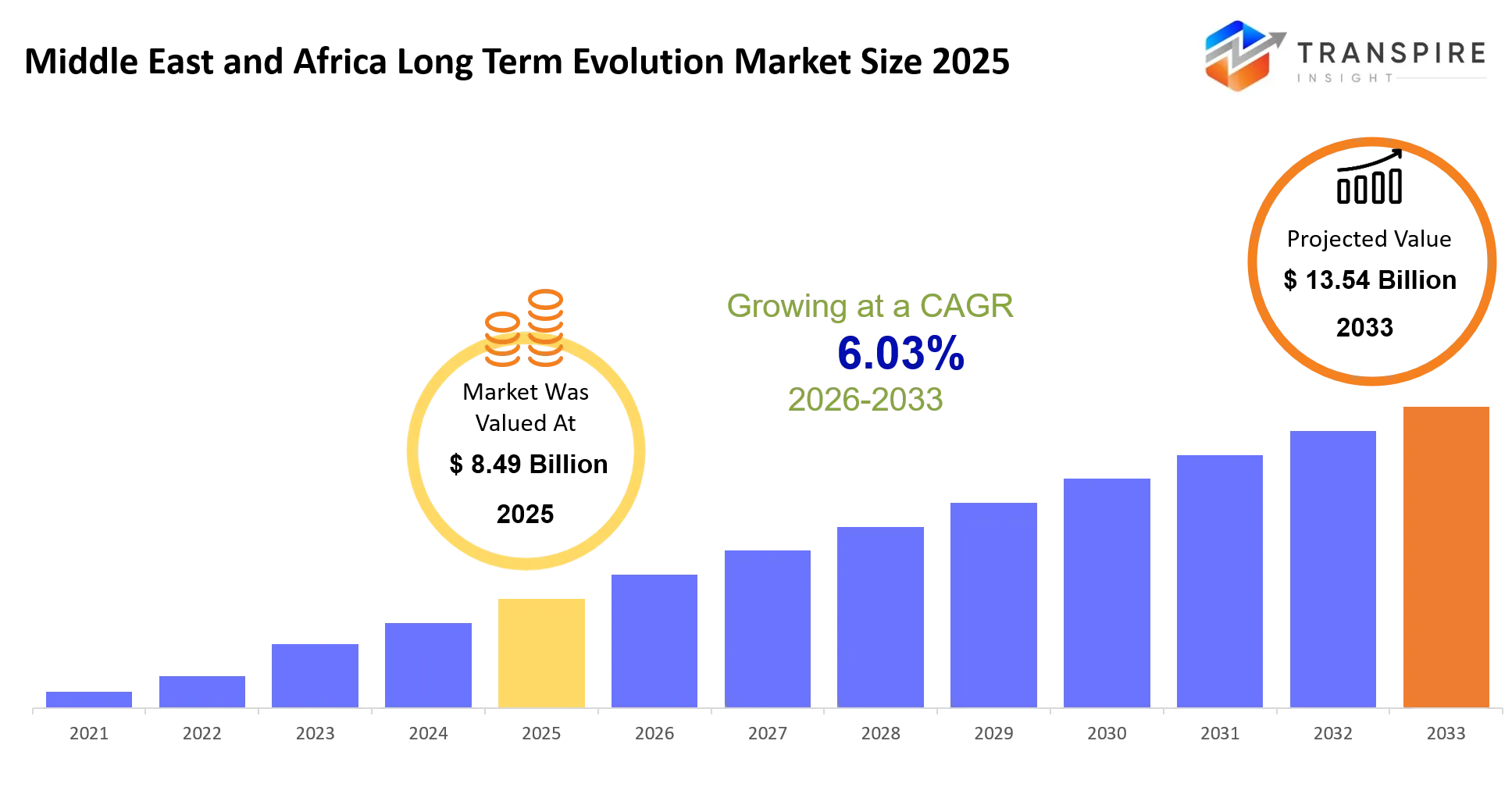
- Middle East and Africa Long Term Evolution Market Size 2025: USD 8.49 Billion
- Middle East and Africa Long Term Evolution Market Size 2033: USD 13.54 Billion
- Middle East and Africa Long Term Evolution Market CAGR: 6.03%
- Middle East and Africa Long Term Evolution Market Segments: By Technology (FDD-LTE, TDD-LTE, LTE-Advanced, LTE-A Pro, VoLTE, LTE-M, NB-IoT, Others); By Application (Mobile Broadband, IoT Connectivity, Smart Cities, Industrial Automation, Public Safety, Others); By End User (Telecom Operators, Enterprises, Government, Consumers, Utilities, Others); By Deployment (Urban, Rural, Private LTE, Public LTE, Others)
Middle East and Africa Long Term Evolution Market Summary
The Middle East and Africa Long Term Evolution Market was valued at USD 8.49 Billion in 2025. It is forecast to reach USD 13.54 Billion by 2033. That is a CAGR of 6.03% over the period.
The Long Term Evolution (LTE) market across the Middle East and Africa works like the “base layer” for fast wireless connectivity through mobile networks, industrial settings, smart municipalities, utility systems, and public-sector communication. With LTE, dependable broadband is available, connected equipment is supported, and companies can run data-heavy services with reduced delay plus more consistent network stability. In the past five years the whole market kind of moved, it shifted away from mostly consumer mobile broadband rollouts, toward enterprise ,and also industry tailored LTE networks that back digital transformation programs.
One real push behind this change was the quick scaling of remote work modes, cloud oriented services, and digital infrastructure spending after pandemic era connectivity requirements and then, later, new smart city efforts. As administrations and enterprises upgrade their day to day operations, LTE networks are increasingly becoming important for factory automation, public safety links, and IoT connectivity. This kind of movement spreads network usage beyond only traditional mobile subscribers, which opens fresh monetization paths for operators while also making adoption easier across commercial operations, industrial sites ,and government initiatives.
Key Market Insights
- In 2025, Gulf Cooperation Council countries showed about 42% market share, kind of backed by advanced telecom infrastructure and a slew of digital economy initiatives, which is why it feels more stable than some other areas.
- Meanwhile, Sub-Saharan Africa is expected to be the fastest-moving regional market through 2033, mainly driven by broadband rollouts and rural connectivity projects that keep expanding, little by little.
- FDD-LTE came in first, grabbing nearly 34% in 2025, because it was deployed widely across established mobile operator networks.
- LTE-Advanced sat as the second-largest technology segment , supported by stronger needs for higher data throughput and overall network capacity upgrades.
- NB-IoT is projected to grow the quickest through 2033, with support from utility metering, smart agriculture, and asset tracking use cases.
- For applications, Mobile Broadband held more than 38% share in 2025, and it stays the biggest category across urban, and semi-urban markets as well.
- Also, industrial automation use is expanding fast, as manufacturing, mining, and logistics providers are rolling out dedicated LTE networks.
- On the end-user side, telecom operators represented the leading group, with roughly 40% of market revenue in 2025, which seems to stay consistent across regions.
- Strategic investments from Huawei Technologies, Ericsson, Nokia, ZTE Corporation, and Cisco Systems are also helping accelerate LTE modernization projects.
- And right now, network virtualization, edge computing integration, plus private LTE deployments are turning into real competitive differentiators throughout the whole industry.
What are the Key Drivers, Restraints, and Opportunities in the Middle East and Africa Long Term Evolution Market?
The most powerful thing that is pushing market growth is that fast digital transformation push being taken up by governments and organizations all over the region, you know. National broadband programs , smart city schemes ,and industrial digitization undertakings have basically created a clear requirement for dependable, high capacity wireless networks. Big investments in areas like energy logistics, manufacturing, and public services increasingly bank on LTE infrastructure to keep assets, workers, and operational systems connected. This shift, in practice, expands the chances for network rollout and it also brings in repeatable service income for operators and for the people providing infrastructure.
The biggest hitch still is uneven telecommunications infrastructure across many African markets. You get rural coverage gaps, fiber backhaul that’s scarce, and high costs for new network build outs… so there are structural problems that can’t really be fixed overnight. In multiple countries, mobile operators keep running into spectrum assignment limits, plus heavy capital expenditure needs. All of that slows down network rollouts, lowers service quality in places that are not well served and it even holds back how quickly enterprises can start using more advanced LTE enabled applications. So, it kind of suppresses the revenue potential.
Private LTE networks are a notable forward-looking growth chance. Mining firms, oil and gas operators, ports, utilities and industrial sites are leaning more and more toward secure, dedicated communications systems that public networks can’t always deliver. Nations like Saudi Arabia, the UAE, and South Africa are backing industrial digitalization programs that support the deployment of private wireless infrastructure. As mission critical use cases keep expanding inside industrial settings, demand for customi…
What Has the Impact of Artificial Intelligence Been on the Middle East and Africa Long Term Evolution Market?
Artificial intelligence is, like, reshaping how LTE network operations are run by making it easier to handle more and more complex communication conditions. Telecom operators are now rolling out AI-driven network optimization platforms that automatically look at traffic patterns, assign bandwidth where it matters, and cut down congestion throughout their LTE infrastructure. In practice these tools do help raise service quality, while also trimming operational expenses a bit.
At the same time, machine learning models are backing predictive maintenance efforts. By examining equipment performance metrics from base stations, antennas and the broader transmission setup operators can spot likely failures ahead of time before they turn into real service interruptions. This helps keep the network up longer, lowers maintenance budgets, and reduces those annoying customer service disruptions. On top of that, AI-powered analytics also supports traffic forecasting and capacity planning, so operators can fine-tune where investments go and improve utilization rates.
And then there are advanced digital technologies that are pushing enterprise LTE deployments forward in utilities, logistics and manufacturing. Connected sensors plus AI-enabled monitoring platforms let operators watch network performance in real time, and react fast when operational issues pop up. Still, uptake is held back by pretty high integration costs, limited access to skilled AI people, and sometimes messy or inconsistent data quality in certain regional markets. Because of this, deployment schedules keep stretching out, even though the operational upside AI can bring is clearly there.
Key Market Trends
- Private LTE deployments went up quite a bit after 2023, and mining, utilities, and logistics operators were looking for more secure wireless communications, you know.
- NB-IoT connections expanded at over 20% each year across several regional markets between 2023 and 2025, not just one area.
- Meanwhile smart city initiatives in Saudi Arabia and the UAE, pushed faster adoption of LTE based surveillance and connected infrastructure platforms, kinda big.
- Telecom operators also moved their capital spending more toward LTE-Advanced and LTE-A Pro upgrades so they could boost spectrum efficiency and get better performance.
- Ericsson, Nokia, and Huawei grew their regional partnerships around enterprise wireless solutions and industrial connectivity, more collaboration in general.
- Public safety agencies extended LTE style emergency communication systems after national digital resilience initiatives, this helped them respond quicker.
- Rural broadband programs across Africa, accelerated LTE rollouts into places that were previously underserved after 2024, and that change stood out.
- Utilities increasingly leaned on LTE-enabled smart metering networks, which improved operational visibility and reduced the need for so many manual inspections.
- Edge computing integration became a priority technology trend supporting low latency industrial applications, especially where response time matters.
- And the competitive focus shifted away from pure coverage expansion, toward service quality, enterprise offerings and network intelligence capabilities.
Middle East and Africa Long Term Evolution Market Segmentation
By Technology
FDD-LTE keeps getting strong adoption because operators deploy it widely and it uses the spectrum in an efficient way, across the well established mobile broadband networks. TDD-LTE fits really well for high-capacity urban areas where data demand keeps on climbing, without too much trouble. LTE-Advanced boosts overall network performance, by relying on carrier aggregation and generally higher throughput. LTE-A Pro then pushes efficiency even further, by enabling more advanced functions that somehow bridge LTE with next generation network architectures.
VoLTE improves voice communication clarity while also cutting down on how much network resources it consumes. LTE-M works for low power machine connections, used in logistics, asset monitoring, and utility type operations. NB-IoT keeps gaining traction via smart metering, environmental observation, and big scale sensor rollouts. Other technologies handle more specialized communication needs and those niche industrial use cases across different sectors too.
By Application
Mobile Broadband still ends up being the largest application area, because consumer s and companies really need dependable, fast internet access. Network operators are basically still rolling out more coverage and extra capacity as data usage keeps growing in those everyday patterns people expect. IoT Connectivity covers connected devices that are used across transport, farming, healthcare, and also utilities, so you can see it showing up in a lot of places. Smart Cities lean on LTE infrastructure for so called intelligent traffic handling, video surveillance systems , and public service delivery.
For Industrial Automation, the idea is to link machinery, production setups and operational assets in a way that improves output, reliability, and overall productivity. Public Safety networks then provide consistent communications for emergency response teams and government organizations. Then there are other use cases like education, transportation management, and even more specialized enterprise communication setups. With continued digital transformation initiatives, deployments keep widening across a range of sectors.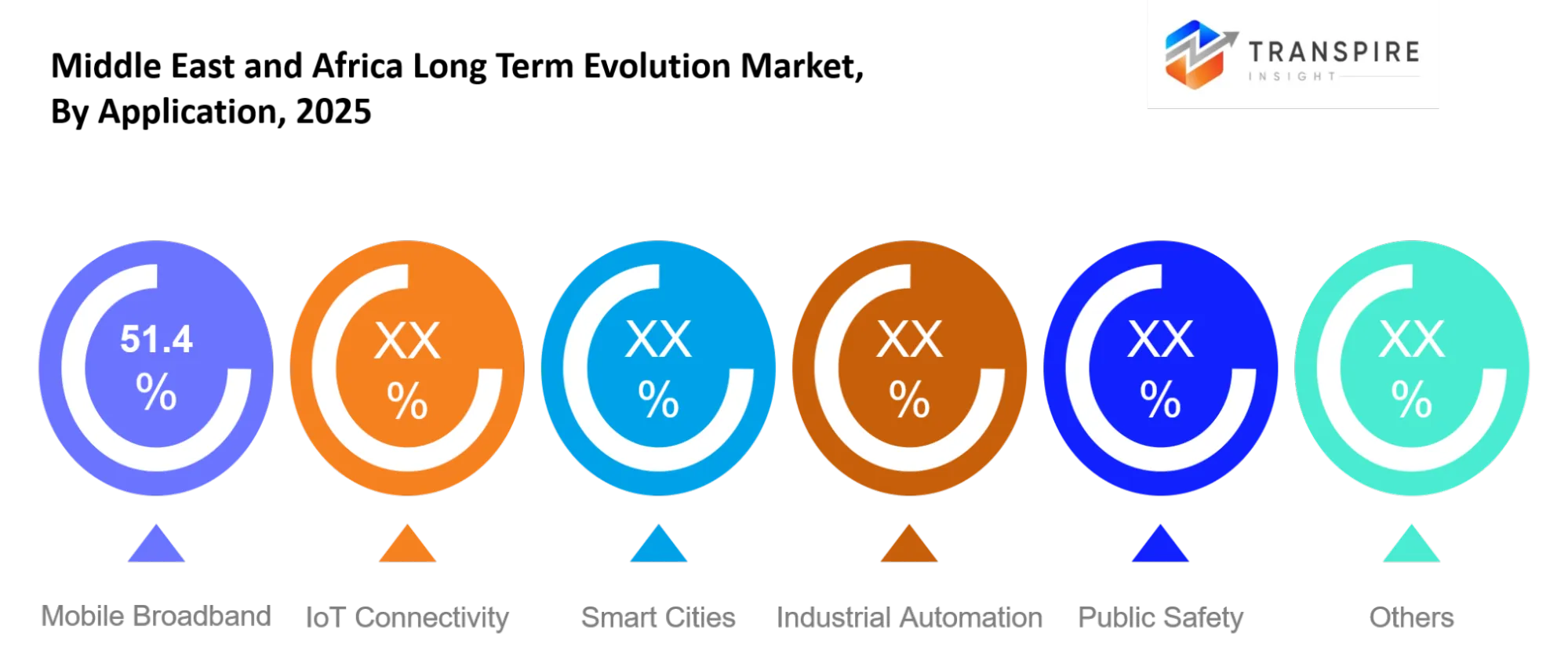
By End User
Telecom Operators kinda count as the biggest user group, because network deployment and the actual service delivery stay the core of the industry. Ongoing spend on coverage expansion, as well as network modernization, keeps this segment’s demand alive. A lot of Enterprises now deploy LTE solutions to support digital operations, workforce mobility, and industrial connectivity needs. Government organizations use LTE infrastructure for public administration, security operations, and smart infrastructure endeavors.
Consumers push huge traffic volumes too, mainly via mobile broadband services, video streaming, and digital applications. Utilities often roll out LTE networks for grid monitoring, smart metering, and day to day operational communications. Other end users also show up, like healthcare providers, educational institutions, transportation operators, and commercial organizations looking for dependable wireless connectivity options.
By Deployment
Urban deployments make up a pretty large slice since densely populated cities need advanced network capacity, and also strong performance. There’s also the continuous growth of digital services, commercial activity, and smart city initiatives which keeps fueling more investment, you know, year after year. For rural deployments the emphasis shifts toward extending broadband access, plus improving communications infrastructure across areas that are underserved. Government connectivity programs fit in here too, and they matter because they help keep the expansion going.
Private LTE deployments are also increasing across industrial sites, ports, mines, and utility operations where secure and dedicated communications are required. Meanwhile, public LTE networks still support widespread consumer and business connectivity across regional markets. Other deployment models are being used for specialized operational needs, and customized connectivity solutions that don’t quite match the usual template. Overall, greater network flexibility keeps enabling more variety in how companies roll out LTE across different sectors.
What are the Key Use Cases Driving the Middle East and Africa Long Term Evolution Market?
Mobile broadband still ends up being the main thing, driving adoption across the region. Telecom operators depend on LTE infrastructure to provide fast internet access, video streaming, digital banking services, and cloud apps for both residential and business users. It’s this particular application, generating the biggest traffic volumes and also the heaviest network investment needs… basically the most pressure on budgets.
Then you have industrial connectivity and IoT driven operations which are getting more and more relevant across utilities , mining, logistics, and manufacturing. Connected sensors, remote monitoring platforms, and asset management systems help organizations make operations more efficient, while also lowering maintenance expenses. On top of that, government agencies use LTE networks for emergency response and public safety communications, so it’s not only commercial.
Looking ahead , emerging use cases are starting to show up, like autonomous industrial equipment, intelligent transportation systems, and advanced smart city applications. Edge enabled industrial operations and mission critical private wireless networks have pretty solid long term potential as digital transformation programs keep expanding across the Middle East and Africa.
|
Report Metrics |
Details |
|
Market size value in 2025 |
USD 8.49 Billion |
|
Market size value in 2026 |
USD 8.99 Billion |
|
Revenue forecast in 2033 |
USD 13.54 Billion |
|
Growth rate |
CAGR of 6.03% from 2026 to 2033 |
|
Base year |
2025 |
|
Historical data |
2021 - 2024 |
|
Forecast period |
2026 - 2033 |
|
Report coverage |
Revenue forecast, competitive landscape, growth factors, and trends |
|
Regional scope |
United States; Canada; Mexico; United Kingdom; Germany; France; Italy; Spain; Denmark; Sweden; Norway; China; Japan; India; Australia; South Korea; Thailand; Brazil; Argentina; South Africa; Saudi Arabia; United Arab Emirates |
|
Key company profiled |
Ericsson, Nokia, Huawei, ZTE, Samsung, Cisco, Qualcomm, Intel, NEC, Fujitsu, CommScope, Mavenir, Juniper Networks, VMware, Ribbon Communications |
|
Customization scope |
Free report customization (country, regional & segment scope). Avail customized purchase options to meet your exact research needs. |
|
Report Segmentation |
By Technology (FDD-LTE, TDD-LTE, LTE-Advanced, LTE-A Pro, VoLTE, LTE-M, NB-IoT, Others); By Application (Mobile Broadband, IoT Connectivity, Smart Cities, Industrial Automation, Public Safety, Others); By End User (Telecom Operators, Enterprises, Government, Consumers, Utilities, Others); By Deployment (Urban, Rural, Private LTE, Public LTE, Others) |
Which Regions are Driving the Middle East and Africa Long Term Evolution Market Growth?
In the Gulf region, the market kind of leads on revenue generation because of advanced telecom infrastructure, supportive government policies and pretty hefty digital transformation investments. Saudi Arabia and the United Arab Emirates are still backing smart city initiatives and next generation connectivity programs. Also, strong enterprise take up across energy, logistics and public sector organizations helps keep that leadership steady. On top of that, you have a more mature ecosystem of telecom operators, technology vendors, and digital service providers which sort of locks in long term growth.
South Africa shows up as another meaningful contributor though the growth drivers there are not exactly the same as the Gulf markets. They rely more on established mobile networks, relatively stable regulatory frameworks, and consistent enterprise spending on technology. Meanwhile, mining , financial services, and industrial sectors continue to pour money into enhanced connectivity solutions. All of this supports a dependable revenue base and keeps the infrastructure modernization process moving.
For the wider Sub Saharan African region , growth momentum is expected to be the strongest through 2033. Lately there have been investments in broadband expansion, rural connectivity programs, and digital inclusion initiatives, and those changes improve market conditions. With more smartphone adoption and wider network coverage, new opportunities keep opening for underserved populations. This overall trajectory makes the market look appealing for equipment suppliers, infrastructure developers and telecommunications service providers.
Who are the Key Players in the Middle East and Africa Long Term Evolution Market and How Do They Compete?
Competition still stays fairly concentrated among the biggest network infrastructure players, but over time the regional service providers and those specialized technology vendors keep widening their footprint, sort of, everywhere. Meanwhile the key ways companies fight it out are pretty much always technology innovation and real network performance, plus deployment capabilities and those broader enterprise solution portfolios. Lately vendors seem to prefer competing with integrated connectivity platforms, not just selling standalone infrastructure, which is a bit of a shift.
Huawei Technologies tends to focus on large-scale network deployments and those integrated digital infrastructure solutions. Its strong regional relationships plus an extensive product portfolio help it deliver solutions across both public networks and enterprise environments, even when the needs vary a lot. Ericsson , on the other hand, differentiates with advanced radio technologies, network automation platforms and energy-efficient infrastructure solutions. It also leans on strategic collaborations with telecom operators , that kind of support helps network modernization programs move forward across the region.
Nokia highlights private wireless networking and industrial connectivity use cases, and that creates openings in manufacturing, mining, and utility sectors. ZTE Corporation competes with cost-efficient deployment models and by expanding infrastructure partnerships with local players. Cisco Systems leans hard on enterprise networking know-how, cloud integration capabilities, and secure connectivity platforms to reinforce enterprise oriented LTE deployments. Overall, these more separated strategies let vendors align themselves with particular customer needs while still growing regional market presence, slowly but steadily.
Company List
- Ericsson
- Nokia
- Huawei
- ZTE
- Samsung
- Cisco
- Qualcomm
- Intel
- NEC
- Fujitsu
- CommScope
- Mavenir
- Juniper Networks
- VMware
- Ribbon Communications
Recent Development News
In April 2026, Nokia announced the acquisition agreement under which Inseego would acquire Nokia’s Fixed Wireless Access (FWA) business. The transaction strengthens wireless broadband capabilities, expands LTE and fixed wireless connectivity portfolios, and supports future network infrastructure investments across global and emerging markets.http://www.nokia.com
In March 2026, Ericsson entered a multi-year partnership with Safaricom to expand and modernize network transport infrastructure in Kenya. The agreement enhances LTE and 5G network capacity while introducing AI-enabled analytics and automation that improve network performance and support broader digital connectivity across East Africa.http://www.ericsson.com
In September 2025, ZTE and MTN commercially deployed the world's first 5-band Remote Radio Unit (RRU) in South Africa. The launch improved spectrum utilization, increased network energy efficiency, and strengthened LTE network capacity, supporting continued mobile broadband expansion across the African telecommunications sector.http://www.zte.com.cn
What Strategic Insights Define the Future of the Middle East and Africa Long Term Evolution Market?
Over the next five to seven years, the market is going to slowly but surely shift away from the usual mobile broadband backbone and toward enterprise oriented connectivity ecosystems. Industrial digitization, private wireless networking, and IoT driven operational patterns will start to act as the main push behind where money goes. Revenue growth will depend more and more on specialized enterprise services, not just on adding more subscribers, like it used to be.
There’s also a risk that feels a bit less obvious, something like technology replacement pressure, as more advanced 5G rollouts keep widening across key regional economies. On top of that, if infrastructure spending keeps clustering among a handful of very large operators, it can generate both competitive and procurement issues for smaller players.
An emerging opportunity though, is pretty interesting: private LTE deployments for mining operations, energy infrastructure, ports, and big industrial sites across Africa and the Gulf region. The kinds of organizations that need secure, reliable, and mission critical communications are making demand show up in ways that go beyond standard telecom offerings. Market participants should lean into enterprise first solution catalogs, work closely with industrial partners, and build AI enhanced network management capabilities. That way they can aim for longer term value as connectivity needs become more and more specific.
Middle East and Africa Long Term Evolution Market Report Segmentation
-
By Technology
FDD-LTE
TDD-LTE
LTE-Advanced
LTE-A Pro
VoLTE
LTE-M
NB-IoT
Others -
By Application
Mobile Broadband
IoT Connectivity
Smart Cities
Industrial Automation
Public Safety
Others -
By End User
Telecom Operators
Enterprises
Government
Consumers
Utilities
Others -
By Deployment
Urban
Rural
Private LTE
Public LTE
Others
Frequently Asked Questions
Find quick answers to common questions.
The Expected Middle East and Africa Long Term Evolution Market size for the Market will be USD 13.54 Billion in 2033.
Key Segments for the Middle East and Africa Long Term Evolution Market are By Technology (FDD-LTE, TDD-LTE, LTE-Advanced, LTE-A Pro, VoLTE, LTE-M, NB-IoT, Others); By Application (Mobile Broadband, IoT Connectivity, Smart Cities, Industrial Automation, Public Safety, Others); By End User (Telecom Operators, Enterprises, Government, Consumers, Utilities, Others); By Deployment (Urban, Rural, Private LTE, Public LTE, Others).
Major Middle East and Africa Long Term Evolution Market Players are Ericsson, Nokia, Huawei, ZTE, Samsung, Cisco, Qualcomm, Intel, NEC, Fujitsu, CommScope, Mavenir, Juniper Networks, VMware, Ribbon Communications.
The Current Middle East and Africa Long Term Evolution Market size is USD 8.49 Billion in 2025.
The Middle East and Africa Long Term Evolution Market CAGR is 6.03% from 2026 to 2033.
- Ericsson
- Nokia
- Huawei
- ZTE
- Samsung
- Cisco
- Qualcomm
- Intel
- NEC
- Fujitsu
- CommScope
- Mavenir
- Juniper Networks
- VMware
- Ribbon Communications
About the Authors

Mayur Shinde
I am Mayur Shinde, a Senior Research Analyst at Transpire Insight, specializing in the Automotive & Transportation and Information & Communication Technology (ICT) Industry. My work focuses on analyzing emerging market trends, technological advancements, competitive landscapes, and industry developments to deliver accurate, data-driven insights. I am passionate about transforming complex market information into clear, actionable content that helps businesses, professionals, and decision-makers stay informed and make confident strategic decisions.

Chakradhar Khansole
Chakradhar serves as the Research Director at Transpire Insight, bringing over 8 years of experience in technology, innovation, and strategic market intelligence. He specializes in transforming complex market data into actionable business insights that enable organizations to make informed, growth-oriented decisions. Recognized for his strategic vision and analytical expertise, Chakradhar leads high-impact research initiatives, delivering comprehensive market assessments, competitive intelligence, and forward-looking industry analysis.
Recently Published Reports
-
Apr 2026
3D Optical Profiler Market
3D Optical Profiler Market Size, Share & Analysis Report By Type (Desktop 3D Optical Profiler, and Portable 3D Optical Profiler), By Technology (Confocal Technology, and White Light Interference), By End-Use Industry (Manufacturing, Research Institutions, Automotive, Aerospace and Defense, Medical Devices, and Other), and Geography (North America, Europe, Asia-Pacific, Middle East and Africa, South and Central America), 2021 - 2031
-
Apr 2026
Depth Sensor Market
Depth Sensor Market Size, Share & Analysis Report By Type (Infrared Depth Sensors, Time-of-Flight (ToF) Sensors, Stereo Vision Sensors, Structured Light Sensors, Ultrasonic Depth Sensors), By Application (Automotive, Robotics, Gaming, Consumer Electronics, Industrial Automation, Healthcare, Security & Surveillance, Others), By End Users (Automotive Manufacturers, Consumer Electronics Companies, Healthcare Providers, Industrial Companies, Security Agencies, Gaming Companies, Robotics Companies, Others), and Geography (North America, Europe, Asia-Pacific, Middle East and Africa, South and Central America), 2021 – 2031
-
Apr 2026
Digital Manufacturing Market
Digital Manufacturing Market Size, Share & Analysis Report By Component (Hardware, Software, and Services), By Technology (Robotics, 3D Printing, Internet of Things (IoT), and Others), By Application (Automotive and Transportation, Aerospace and Defense, Consumer Electronics, Industrial Machinery, and Others), By Process Type (Computer-Based Designing, Computer-Based Simulation, Computer 3D Visualization, Analytics, and Others), and Geography (North America, Europe, Asia-Pacific, Middle East and Africa, South and Central America), 2021 – 2031
-
Apr 2026
Digital Visa Services Market
Digital Visa Services Market Size, Share & Analysis Report By Type (Individual Travelers, Group Travelers), By Application (Tourism, Business Travel, Others), and Geography (North America, Europe, Asia-Pacific, Middle East and Africa, South and Central America), 2021 – 2031