
Middle East and Africa Live Commerce Platforms Market Size & Forecast:
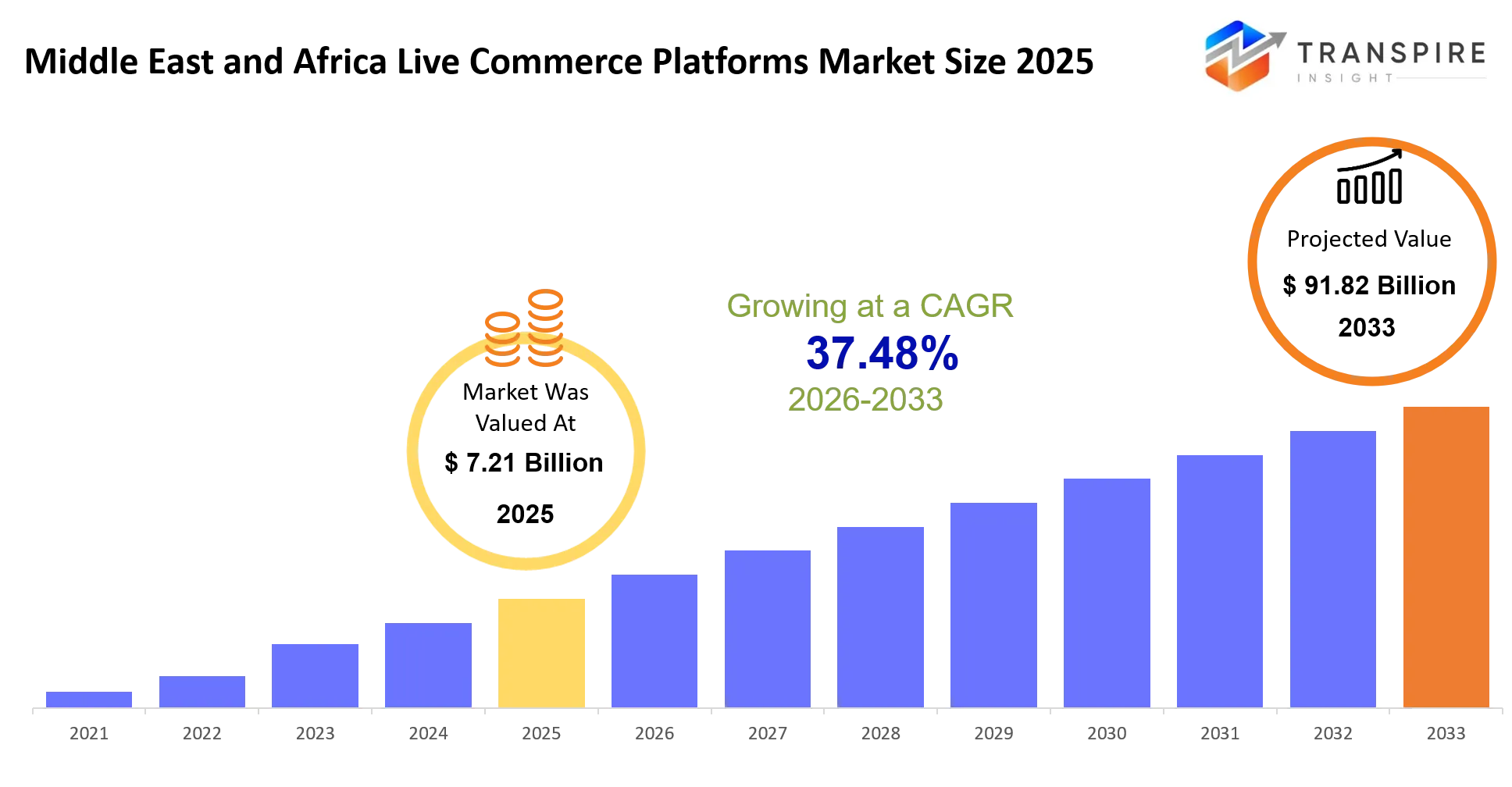
- Middle East and Africa Live Commerce Platforms Market Size 2025: USD 7.21 Billion
- Middle East and Africa Live Commerce Platforms Market Size 2033: USD 91.82 Billion
- Middle East and Africa Live Commerce Platforms Market CAGR: 37.48%
- Middle East and Africa Live Commerce Platforms Market Segments: By Platform Type (Social Commerce, Video Commerce, Influencer Commerce, Brand-Owned Platforms, Marketplace Live Commerce, Others, Others, Others); By Device (Mobile, Desktop, Tablet, Smart TV, Others, Others, Others, Others); By Application (Fashion, Beauty, Electronics, Home Goods, Food & Beverage, Others, Others, Others); By End User (Retailers, Brands, SMEs, Influencers, Others, Others, Others, Others)
Middle East and Africa Live Commerce Platforms Market Summary
The Middle East and Africa Live Commerce Platforms Market was valued at USD 7.21 Billion in 2025. It is forecast to reach USD 91.82 Billion by 2033. That is a CAGR of 37.48% over the period.
Live commerce platforms kind of turn product discovery into real-time purchasing by stitching together livestream video, creator interaction, quick product demonstrations and checkout that’s already built in. For brands, retailers, and influencers this style of platform solves that important bottleneck, the gap between someone becoming curious and then actually buying. Consumers can ask questions, see the products in actual use, and make the purchase within the same digital session , which makes people hesitate a bit less and it can boost conversion rates.
Over the last five years the market sort of moved away from classic e-commerce toward content-driven commerce. In this model discovery happens more often via short videos and livestreams, not so much through pure keyword searching. The quick growth of social commerce ecosystems, especially on services like TikTok Shop, YouTube Shopping, and Meta commerce tools, has pushed the change forward. There have also been regulatory updates that support digital payments, along with more smartphone reach. On top of that, investments in logistics infrastructure across Gulf Cooperation Council countries helped adoption. Now, as these platforms blend creator ecosystems, AI-based personalization, and payment systems inside the flow, revenue growth is starting to depend less on “just traffic” and more on stronger engagement, better conversion results, and expanded monetization chances for merchants, creators, and platform operators.
Key Market Insights
- In 2025, the Gulf countries were responsible for around 42% of regional revenue, mostly backed by quick digital payment uptake and pretty strong social media engagement , though the details kind of blur together in practice.
- Through 2033, Sub-Saharan Africa is projected to become the fastest-growing regional market , and this momentum comes from the expansion of mobile commerce alongside more fintech integration, in a steady way.
- Social Commerce kinda led the platform categories, taking close to 35% market share in 2025, and it leaned on direct integration with social networks.
- Video Commerce followed in second place, supported by higher engagement rates and better product demonstration abilities , which sounds simple but works well.
- Marketplace Live Commerce is expected to show the quickest growth through 2033, as marketplaces roll out livestream selling features, step by step.
- Fashion applications grabbed about 30% of market revenue in 2025, pointing to effective visual merchandising plus influencer marketing that actually performs.
- Beauty and personal care came out as the most rapidly expanding category, fueled by livestream tutorials and creator-led product showcases.
- Retailers represented nearly 38% of platform spending in 2025, and they used live shopping to lift conversion rates and keep customers longer , rather than just for a moment.
- SMEs are moving toward live commerce tools faster, since platform costs are easing, and creator partnerships are becoming more reachable.
- Major players, like TikTok, Alibaba, Meta, Shopify, YouTube, and Bambuser , are putting money into AI-based recommendations, monetization mechanisms for creators, and regional commerce collaborations.
What are the Key Drivers, Restraints, and Opportunities in the Middle East and Africa Live Commerce Platforms Market?
The most force that seems to push market expansion is kind of a convergence, where social media consumption meets digital commerce. People are more and more discovering products through creator stuff, not really by doing those old style online searches. And the platforms, they have responded by weaving checkout functionality right into livestreams and short-form videos, so the distance between “seeing” and “buying” gets shorter, less friction. In practice, this has made conversion efficiency better for brands and it also opened new revenue lanes for creators. On top of that, the expansion of digital wallets and the real-time payment setup across Gulf markets has boosted how often transactions actually finish, and also increased platform monetization chances.
Still, the biggest block is uneven digital infrastructure and the maturity of the payment ecosystem across multiple African economies. Reliable broadband connectivity, smooth video streaming quality, and payment processing that feels seamless, these things are not consistent once you step away from major urban areas. This is more structural than casual, it’s because it relies on long-term telecommunications investment, financial inclusion efforts, and broader logistics network development. So you end up with slower merchant onboarding, livestreams that don’t perform as well, and lower transaction volumes in emerging markets.
A big future opening is AI powered personalized commerce experiences. Platforms are rolling out more recommendation engines, automated product pairing, virtual shopping assistants, and creator performance analytics. Places like Saudi Arabia and the UAE are basically becoming test grounds for advanced social commerce models, mainly because digital infrastructure is stronger there, and consumers are highly engaged.
What Has the Impact of Artificial Intelligence Been on the Middle East and Africa Live Commerce Platforms Market?
Artificial intelligence has become a kind of central technology layer across live commerce ecosystems in the Middle East and Africa. More and more platforms start using AI based recommendation engines, to look at viewing behavior, purchase history , engagement style, and demographic signals too. In practice these systems sort of quietly lift up the products with the best odds of conversion, which in turn boosts customer participation and transaction outcomes.
Then there are machine learning models that help with predictive demand planning and inventory tuning. Retailers can try to foresee what people will buy during livestream moments, so they avoid stock gaps, while also preventing too much leftover inventory later. AI chatbots also step in during live sessions, handling customer questions fast, and that allows merchants to manage many simultaneous viewers, without staffing growing in the same direct way.
On top of that, advanced analytics tools help creators and brands figure out more suitable broadcast times, content styles, and even which product pairings feel right. This raises campaign efficiency, while also pushing down customer acquisition costs. Some platform providers also rolled out AI generated content aids, which help merchants create promotional assets, polish product descriptions, and deliver tailored suggestions.
Still, there are implementation issues that do not just disappear. Integration costs can be high, customer data sits in fragmented places, and access to strong training datasets is limited, so AI does not always perform as well in every market. Smaller merchants often do not have the technical bandwidth needed to run more advanced AI systems, and that creates a gap in capability between big retailers and newer sellers. As infrastructure keeps improving and AI tools become more attainable, adoption should spread across a wider set of participants in the market.
Key Market Trends
- Since 2022 , creator-led shopping campaigns have been delivering conversion rates that are frequently above what older display ads could do, so yeah it kind of stands out.
- Between 2025 and 2026 , TikTok Shop rolled out more commercial tools across several international markets, and that really sped up the platform competition, fast.
- Globally, over 35% of people now first find products via social video, before they even think about marketplace searches.
- During 2025–2026, AI-driven recommendation engines moved from “nice to have” into core platform infrastructure, like it became the base.
- Brands are also steering bigger slices of their marketing budgets toward creator partnerships rather than the usual digital advertising campaigns, more and more.
- Livestream shopping sessions changed from one-off promotional moments into kind of recurring sales pathways for major retailers.
- Video commerce picked up speed because short-form content can lower customer acquisition costs , and it also boosts engagement quality in a more measurable way.
- Marketplace operators are increasingly weaving live shopping features right into their existing commerce ecosystems , not treating it like a separate add-on.
- Cross-border commerce capabilities expanded too, through localized fulfillment and regional warehousing investments , which helps reduce friction.
- And finally, strategic partnerships between commerce platforms and content ecosystems grew stronger, so competition across the whole sector intensified, again and again.
Middle East and Africa Live Commerce Platforms Market Segmentation
By Platform Type
Social commerce is still the biggest platform category, mostly because the buying activity kinda starts from inside social media spaces now, not from those separate online stores alone. Product discovery happens right there, plus creator engagement and community interaction get woven in, and the checkout functions are integrated too so brands can turn attention into sales. Also the social channels help with recommendations, customer feedback, and viral content sharing all within one single ecosystem, so it feels smoother.
Then there’s video commerce and influencer commerce, which boost engagement via demonstrations, reviews, tutorials, and live conversations. For brand owned platforms you get more command over customer data and how the brand looks, while marketplace live commerce basically widens the audience because it rides on established online shopping ecosystems. Other options include smaller community commerce setups, industry specific platforms, and newer interactive shopping technologies that back more specialized selling models.
By Device
Mobile devices are responsible for the most platform traffic, mainly because smartphones allow livestream viewing, social media engagement, and immediate buying throughout the day. Good mobile internet penetration across Gulf countries, plus growing smartphone uptake in African markets, keeps fueling transactions via mobile applications, more and more.
Desktop devices still matter, especially for deeper product research , corporate purchasing, and managing professional content in a focused way. Tablets often enable a sort of blended viewing and shopping setup, while smart TVs open up chances for big screen interactive commerce experiences. Other devices also play a role, like connected displays, wearable style interfaces, and upcoming commerce-enabled technologies that may broaden digital shopping access.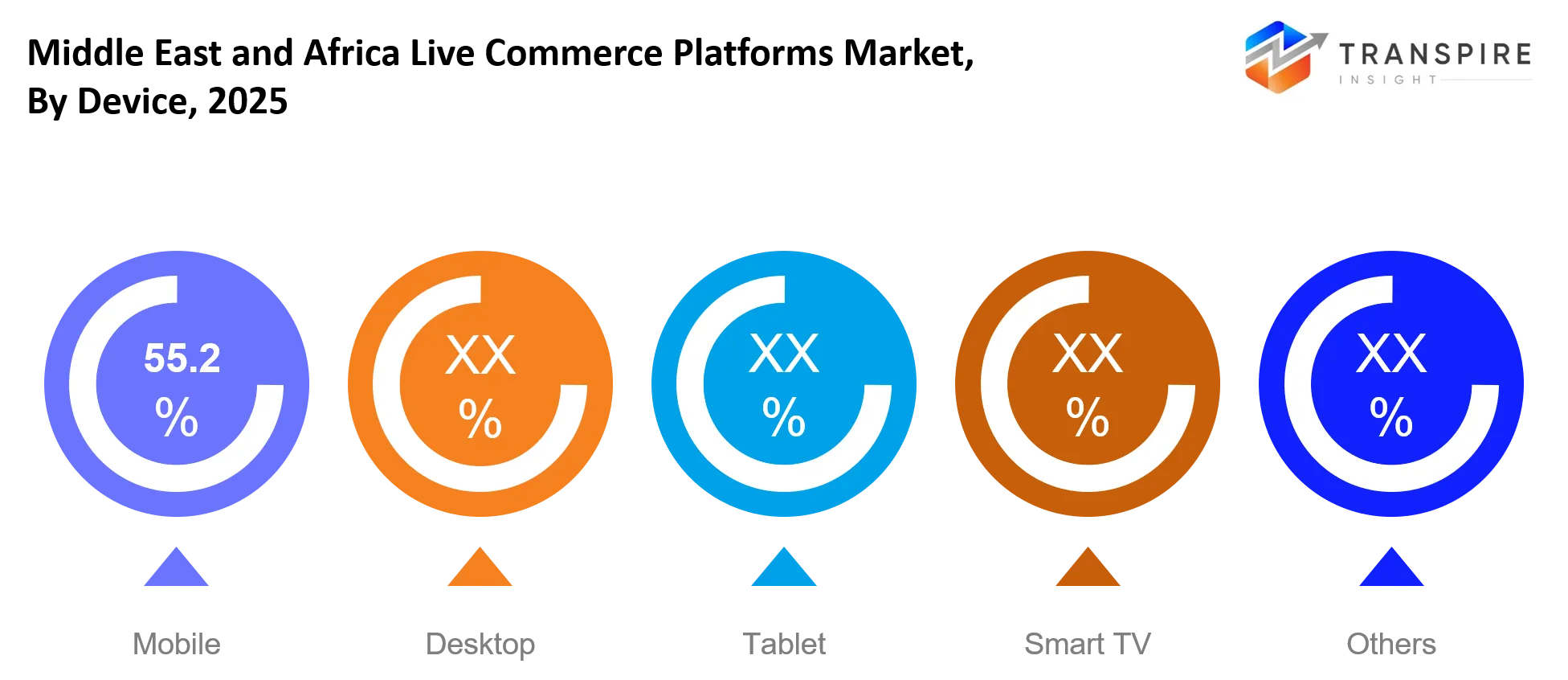
By Application
Fashion tends to drive application demand because the visual way products are shown fits sort of naturally with livestreaming, where people demo outfits, share styling guidance, and get pushed by influencer promotions at the same time. Shoppers often end up buying apparel, footwear, and accessories after seeing how things look and work in real-life usage, and that kind of context makes them feel more certain. It also cuts down on purchase uncertainty, so there’s less hesitance, overall.
Beauty works well too, mainly because tutorials, hands-on product testing and skincare demonstrations can make results feel more tangible. Electronics categories lean on live sessions to spell out features, and performance capabilities in a way that feels immediate. Home goods then can use demonstrations to emphasize both functionality, and the design details.
Food and beverage applications are catching on fast, too, using creator recommendations plus interactive promotions that feel less like ads and more like guidance. Beyond that there are health products, personal services, and specialty consumer categories, all of which benefit from the same general idea, showing rather than just telling.
By End User
Retailers make up the biggest share in platform adoption, because live commerce gives a sort of direct line for customer acquisition, engagement, and conversion. When interaction happens in real time, shoppers feel more sure about what they buy, and retailers can show product advantages in a more effective way than those static online listings, you know, the usual catalog style.
Brands are also leaning into dedicated commerce communities, often via livestream events and creator partnerships. SMEs tend to use live commerce to tap into bigger audiences even if their advertising budget is… limited, and influencers then monetize that attention through affiliate purchases, sponsored posts , and straight product showcasing. Beyond that, you’ll find distributors, wholesalers, service providers, and newer digital commerce players jumping in with interactive selling approaches, which is basically the same idea but with different actors.
What are the Key Use Cases Driving the Middle East and Africa Live Commerce Platforms Market?
Fashion and beauty retail is basically the main use case across the whole market. Live demonstrations, influencer-led product showcases, styling sessions, and real-time customer back-and-forth kind of let people figure out if something really works for them before buying, it’s like evaluation on the spot. In practice this approach trims uncertainty and tends to lift conversion rates, so it works especially well for items that are visually driven.
Elsewhere, extra use cases are showing up in consumer electronics and also home goods. Electronics companies run livestreams to show real performance, plus they answer technical questions on the fly. At the same time, home furnishing brands use these sessions to present design ideas , and installation concepts too. Retailers are increasingly mixing live events with promotional campaigns, so the buying decision happens faster, more or less.
After that, more chances are taking shape around health products, educational commerce, and business-to-business selling settings. Things like AI-powered virtual shopping assistants, more tailored livestream experiences, and hands-on product consultations may unlock extra revenue over the forecast period , especially as platform capabilities keep maturing and getting more solid.
|
Report Metrics |
Details |
|
Market size value in 2025 |
USD 7.21 Billion |
|
Market size value in 2026 |
USD 9.89 Billion |
|
Revenue forecast in 2033 |
USD 91.82 Billion |
|
Growth rate |
CAGR of 37.48% from 2026 to 2033 |
|
Base year |
2025 |
|
Historical data |
2021 - 2024 |
|
Forecast period |
2026 - 2033 |
|
Report coverage |
Revenue forecast, competitive landscape, growth factors, and trends |
|
Regional scope |
United States; Canada; Mexico; United Kingdom; Germany; France; Italy; Spain; Denmark; Sweden; Norway; China; Japan; India; Australia; South Korea; Thailand; Brazil; Argentina; South Africa; Saudi Arabia; United Arab Emirates |
|
Key company profiled |
TikTok Shop, Alibaba, Amazon Live, YouTube Shopping, Meta, Shopee Live, LazLive, NTWRK, TalkShopLive, Bambuser, Livescale, Firework, Buywith, Channelize, Shopify |
|
Customization scope |
Free report customization (country, regional & segment scope). Avail customized purchase options to meet your exact research needs. |
|
Report Segmentation |
By Platform Type (Social Commerce, Video Commerce, Influencer Commerce, Brand-Owned Platforms, Marketplace Live Commerce, Others, Others, Others); By Device (Mobile, Desktop, Tablet, Smart TV, Others, Others, Others, Others); By Application (Fashion, Beauty, Electronics, Home Goods, Food & Beverage, Others, Others, Others); By End User (Retailers, Brands, SMEs, Influencers, Others, Others, Others, Others) |
Which Regions are Driving the Middle East and Africa Live Commerce Platforms Market Growth?
The Gulf Cooperation Council region leads market revenue generation because of more advanced digital infrastructure, lots of smartphone ownership, and pretty high digital payment adoption. Saudi Arabia and the UAE do particularly well with strong social media engagement and digital economy strategies that are supportive. Also extensive logistics networks and, efficient fulfillment systems help merchants turn online attention into actual completed transactions. And honestly a mature creator economy, kind of keeps reinforcing the regional market leadership too.
South Africa stands as the second largest contributor and it feels different from Gulf markets, since its retail ecosystem is more diversified. Growth is pushed forward by established e-commerce infrastructure, online payment adoption that keeps expanding and steady investment from major retailers. People are already familiar with digital shopping which gives a certain stability, even when the economy gets wobbly. That kind of consistency makes the country a reliable source of recurring platform revenue.
Sub-Saharan Africa is expected to deliver the strongest growth momentum through 2033. Mobile broadband coverage keeps widening, fintech innovation keeps moving, and digital entrepreneurship is growing in real terms—so market accessibility has changed a lot. More recent investments in payment infrastructure, plus mobile commerce ecosystems, have lowered the barriers for merchants and consumers. In general this setup creates meaningful opportunities for platform providers, investors, and regional commerce partners who want long-term expansion.
Who are the Key Players in the Middle East and Africa Live Commerce Platforms Market and How Do They Compete?
Competition stays kinda moderately fragmented, with global technology giants, specialized live commerce providers , and regional platform operators all trying to win merchant adoption , and then keep consumer engagement. In practice the differentiators aren’t random, its mostly tech capability depth, creator ecosystems, payment integration, and those content discovery algorithms. If you look at it from the other side, the established platforms usually get an edge from sheer scale , but newer entrants often push through more niche features and industry specific solutions .
TikTok Shop is leaning into discovery driven commerce, like it mixes shopping right inside short form videos and livestream moments. Its recommendation engines plus creator monetization tools , seem to drive solid engagement and conversion results . YouTube Shopping kinda plays both long form and short form video ecosystems, while also expanding merchant integrations and affiliate programming. Meta connects commerce across Instagram and Facebook, using social interaction patterns and its advertising infrastructure to help merchants grow.
Shopify differentiates by going merchant first, with commerce infrastructure that feels purpose built, plus AI powered store management tools , and multi channel sales integration. Bambuser is more enterprise oriented live shopping technology, aimed at retailers who want tailored implementations. Firework, meanwhile, is centered on video commerce solutions that let brands keep customer relationships to themselves, while still launching interactive shopping experiences across their owned digital properties.
Company List
- TikTok Shop
- Alibaba
- Amazon Live
- YouTube Shopping
- Meta
- Shopee Live
- LazLive
- NTWRK
- TalkShopLive
- Bambuser
- Livescale
- Firework
- Buywith
- Channelize
- Shopify
Recent Development News
In May 2026, TikTok Shop launched a dedicated Skincare OEM recruitment channel covering Saudi Arabia and the UAE. The initiative expands localized cross-border commerce infrastructure and strengthens direct-to-consumer opportunities for beauty manufacturers entering Gulf markets.http://www.hairongalloy.com/news/beauty-care/skincare/TikTok-Shop-Launches-Skincare-OEM-Channel-in-Middle-East.html (Hairong Alloy).
In September 2025, YouTube expanded its Shopping program with new creator monetization capabilities, including automated product tagging and enhanced brand integration tools. The update improves shopping conversion opportunities and strengthens platform competitiveness in video commerce.https://techcrunch.com/2025/09/16/youtube-unveils-new-ways-for-creators-to-earn-with-brand-deals-youtube-shopping-program/ (TechCrunch).
In May 2025, Shopify launched an AI-powered store builder and expanded AI commerce tools for merchants. The development improves storefront creation efficiency and supports stronger integration between commerce operations and content-driven sales channels.https://techcrunch.com/2025/05/21/shopify-launches-an-ai-powered-store-builder-as-part-of-its-latest-update/ (TechCrunch).
What Strategic Insights Define the Future of the Middle East and Africa Live Commerce Platforms Market?
The market seems to be drifting toward a content-first commerce model where entertainment, community engagement, and transaction execution basically run inside one unified digital environment, kinda like it’s all the same place. The engine behind this shift is that creator-led discovery is getting more effective than the usual search-based online shopping flow. In the next five to seven years, platform operators will likely compete less on how big their audience looks, and more on conversion efficiency, smarter personalization, and merchant enablement tooling.
There is also a quieter kind of risk, maybe harder to notice at first. Market power can concentrate around a small number of dominant platforms. When merchants lean heavily on platform algorithms, creator ecosystems, and policy choices then sudden changes in visibility, costs , or monetization chances can hit very fast, like without much warning. Still, at the same time AI-powered personalized shopping experiences are an important emerging opportunity, especially in Gulf markets where the digital setup is more advanced.
So, market participants should put money into multi-platform commerce strategies, build proprietary customer data assets, and strengthen AI-enabled analytics. Those organizations that lower their dependence on just one platform while also deepening direct customer relationships will probably be in a better spot to earn and keep long-term value as the competition keeps reshaping itself.
Middle East and Africa Live Commerce Platforms Market Report Segmentation
By Platform Type
- Social Commerce
- Video Commerce
- Influencer Commerce
- Brand-Owned Platforms
- Marketplace Live Commerce
- Others
By Device
- Mobile
- Desktop
- Tablet
- Smart TV
- Others
By Application
- Fashion
- Beauty
- Electronics
- Home Goods
- Food & Beverage
- Others
By End User
- Retailers
- Brands
- SMEs
- Influencers
- Others
Frequently Asked Questions
Find quick answers to common questions.
The Expected Middle East and Africa Live Commerce Platforms Market size for the Market will be USD 91.82 Billion in 2033.
Key Segments for the Middle East and Africa Live Commerce Platforms Market are By Platform Type (Social Commerce, Video Commerce, Influencer Commerce, Brand-Owned Platforms, Marketplace Live Commerce, Others, Others, Others); By Device (Mobile, Desktop, Tablet, Smart TV, Others, Others, Others, Others); By Application (Fashion, Beauty, Electronics, Home Goods, Food & Beverage, Others, Others, Others); By End User (Retailers, Brands, SMEs, Influencers, Others, Others, Others, Others).
Major Middle East and Africa Live Commerce Platforms Market Players are TikTok Shop, Alibaba, Amazon Live, YouTube Shopping, Meta, Shopee Live, LazLive, NTWRK, TalkShopLive, Bambuser, Livescale, Firework, Buywith, Channelize, Shopify.
The Current Middle East and Africa Live Commerce Platforms Market size is USD 7.21 Billion in 2025.
The Middle East and Africa Live Commerce Platforms Market CAGR is 37.48% from 2026 to 2033.
- TikTok Shop
- Alibaba
- Amazon Live
- YouTube Shopping
- Meta
- Shopee Live
- LazLive
- NTWRK
- TalkShopLive
- Bambuser
- Livescale
- Firework
- Buywith
- Channelize
- Shopify
About the Authors

Mayur Shinde
I am Mayur Shinde, a Senior Research Analyst at Transpire Insight, specializing in the Automotive & Transportation and Information & Communication Technology (ICT) Industry. My work focuses on analyzing emerging market trends, technological advancements, competitive landscapes, and industry developments to deliver accurate, data-driven insights. I am passionate about transforming complex market information into clear, actionable content that helps businesses, professionals, and decision-makers stay informed and make confident strategic decisions.

Chakradhar Khansole
Chakradhar serves as the Research Director at Transpire Insight, bringing over 8 years of experience in technology, innovation, and strategic market intelligence. He specializes in transforming complex market data into actionable business insights that enable organizations to make informed, growth-oriented decisions. Recognized for his strategic vision and analytical expertise, Chakradhar leads high-impact research initiatives, delivering comprehensive market assessments, competitive intelligence, and forward-looking industry analysis.
Recently Published Reports
-
Apr 2026
3D Optical Profiler Market
3D Optical Profiler Market Size, Share & Analysis Report By Type (Desktop 3D Optical Profiler, and Portable 3D Optical Profiler), By Technology (Confocal Technology, and White Light Interference), By End-Use Industry (Manufacturing, Research Institutions, Automotive, Aerospace and Defense, Medical Devices, and Other), and Geography (North America, Europe, Asia-Pacific, Middle East and Africa, South and Central America), 2021 - 2031
-
Apr 2026
Depth Sensor Market
Depth Sensor Market Size, Share & Analysis Report By Type (Infrared Depth Sensors, Time-of-Flight (ToF) Sensors, Stereo Vision Sensors, Structured Light Sensors, Ultrasonic Depth Sensors), By Application (Automotive, Robotics, Gaming, Consumer Electronics, Industrial Automation, Healthcare, Security & Surveillance, Others), By End Users (Automotive Manufacturers, Consumer Electronics Companies, Healthcare Providers, Industrial Companies, Security Agencies, Gaming Companies, Robotics Companies, Others), and Geography (North America, Europe, Asia-Pacific, Middle East and Africa, South and Central America), 2021 – 2031
-
Apr 2026
Digital Manufacturing Market
Digital Manufacturing Market Size, Share & Analysis Report By Component (Hardware, Software, and Services), By Technology (Robotics, 3D Printing, Internet of Things (IoT), and Others), By Application (Automotive and Transportation, Aerospace and Defense, Consumer Electronics, Industrial Machinery, and Others), By Process Type (Computer-Based Designing, Computer-Based Simulation, Computer 3D Visualization, Analytics, and Others), and Geography (North America, Europe, Asia-Pacific, Middle East and Africa, South and Central America), 2021 – 2031
-
Apr 2026
Digital Visa Services Market
Digital Visa Services Market Size, Share & Analysis Report By Type (Individual Travelers, Group Travelers), By Application (Tourism, Business Travel, Others), and Geography (North America, Europe, Asia-Pacific, Middle East and Africa, South and Central America), 2021 – 2031