
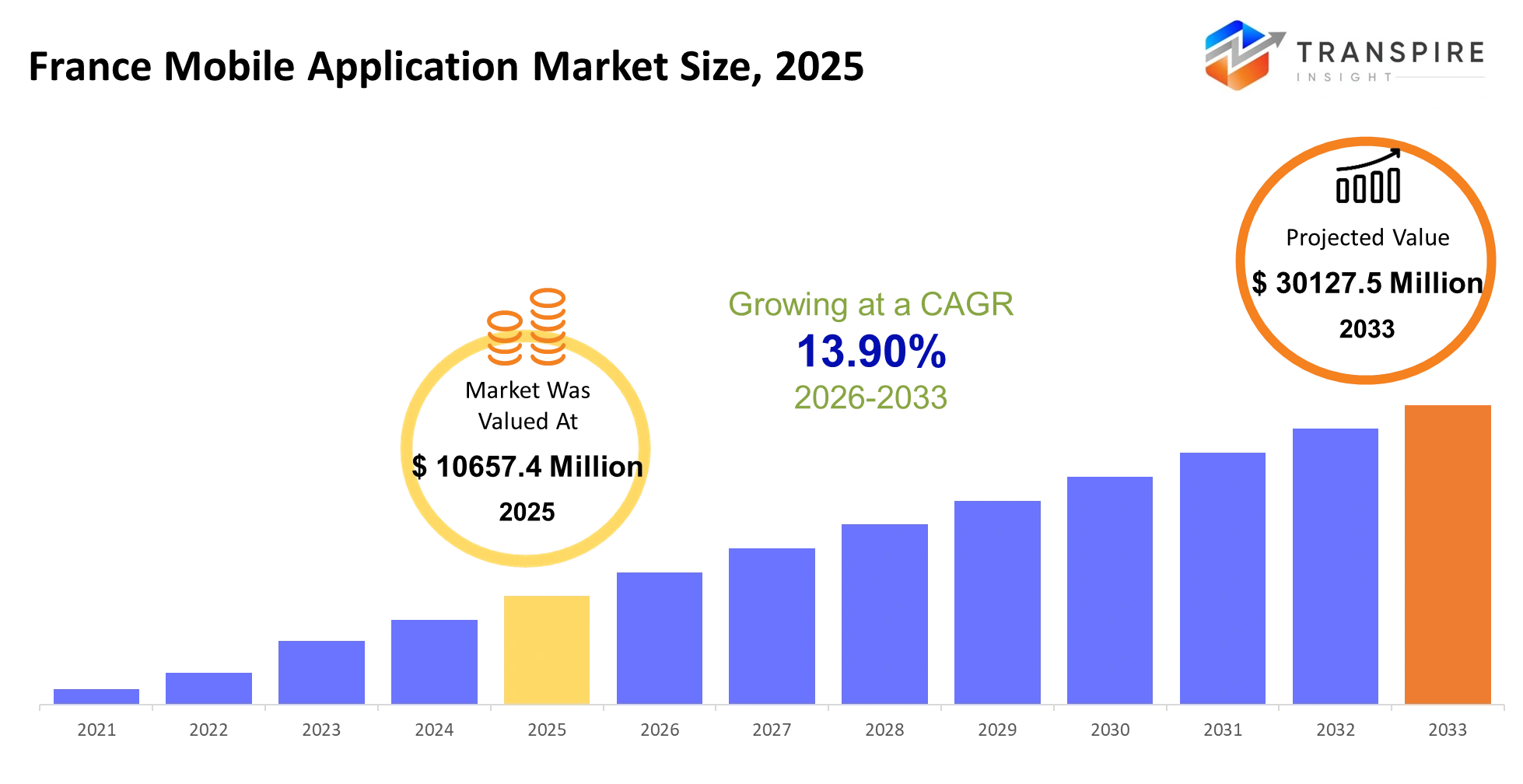
France Mobile Application Market Size & Forecast:
- France Mobile Application Market Size 2025: USD 10657.4 Million
- France Mobile Application Market Size 2033: USD 30127.5 Million
- France Mobile Application Market CAGR: 13.90%
- France Mobile Application Market Segments: By Type (Native, Hybrid, Web, Others); By Application (Gaming, Social Media, E-commerce, Health, Education, Others); By End-User (Consumers, Enterprises, SMEs, Developers, Others); By Platform (iOS, Android, Others).
To learn more about this report,  Download Free Sample Report
France Mobile Application Market Summary
The France Packaged Burgers Market was valued at USD 10657.4 Million in 2025. It is forecast to reach USD 30127.5 Millionby 2033. That is a CAGR of 13.90% over the period.
Mobile applications in France serve as the main digital bridge which connects consumers to businesses. This bridge enables customers to use digital payment systems and shop online and book transportation and access healthcare services and experience automated business procedures. The market operates as a service delivery environment which functions in real time because businesses use applications to decrease customer contact obstacles and enhance their operational efficiency across three sectors which include retail finance and mobility.
Over the last 3–5 years, a major structural shift has been the transition from standalone apps to integrated super-app ecosystems and API-driven platforms, allowing seamless data exchange between services. The combination of post-pandemic digital growth and European Union data privacy regulations produced new challenges which required companies to establish new data management systems and customer personalization techniques. The combination of rising smartphone usage and increasing user demand for instant access to services has led to increased revenue from subscription and in-app purchase models which creates ongoing funding for mobile application development in the French market.
Key Market Insights
- The main revenue sources for the French mobile application market come from subscription-based monetization and in-app purchases.
- Enterprise digitization is increasing demand for workflow automation solutions and logistics systems and cloud-integrated mobile platforms.
- AI-powered personalization helps mobile apps to improve user engagement and retention and conversion rates.
- The Île-de-France region controls the market because it has established strong startup ecosystems and corporate headquarters.
- The tourism industry and retail digitization and mobile-first services make Southern France the fastest-growing region.
- The market for consumer mobile applications has its largest share because most people use smartphones to access entertainment content.
- The demand for enterprise mobility solutions is growing quickly because businesses are adopting digital transformation and software as a service solutions.
- The demand for scalable solutions and analytical capabilities has made cloud-native applications which include artificial intelligence the fastest-growing application segment.
- E-commerce and fintech applications dominate usage because digital payments and online shopping continue to expand.
- The individual consumer group drives adoption while enterprises represent the most rapidly expanding end-user segment.
What are the Key Drivers, Restraints, and Opportunities in the France Mobile Application Market?
The primary driver of the France Mobile Application Market is the rapid shift toward digital-first service delivery across retail, finance, mobility, and healthcare sectors. Businesses increasingly depend on mobile applications to reduce operational friction and improve customer engagement speed. The growth of secure digital payment systems together with widespread smartphone usage has resulted in increased mobile transactions which generate more revenue through subscriptions and commissions and in-app advertisements.
The rising complexity of European data privacy requirements creates a key restraint which forces organizations to spend more money on building secure data systems and consent management technologies. This structural barrier prevents timely product launches while making development work more expensive for both small businesses and startup companies. The application of strict regulations in fintech and healthtech markets results in decreased innovation speed which prevents companies from generating revenue.
The expansion of AI-based hyper-personalized mobile systems presents a significant opportunity for development. Developers who use machine learning to create real-time targeting systems show better results in user retention. Fintech and retail applications now use AI recommendation systems to enhance their customer conversion rates and customer lifetime value. The use of edge computing together with 5G technology will enable France to reach its next development stage through improved performance of AR retail and smart mobility applications.
What Has the Impact of Artificial Intelligence Been on the France Mobile Application Market?
Artificial intelligence transforms the France Mobile Application Market through its ability to automate processes while providing predictive intelligence and customized user experiences for both consumer and business applications. AI-driven automation now enables mobile platforms to optimize their backend functions, which include customer support chatbots and transaction verification and dynamic content personalization, by decreasing the need for human workers while boosting their operational efficiency.
Machine learning enables predictive capabilities that users employ to forecast their own behavior and predict customer churn while sensing market demands. E-commerce and fintech applications use these models to determine their optimal pricing methods and identify fraudulent activities and enhance their recommendation systems. The study found that both user engagement rates and conversion efficiency increased, while the company experienced lower business risks.
The integration of AI technology into operations has enabled better application performance through its ability to optimize server loads in real time and deliver customized content and execute A/B testing processes through automated systems. The main challenge for developers who work in smaller or medium-sized companies involves handling the expensive costs that advanced AI systems require during their implementation. The real-time learning systems face limitations because of two factors: inconsistent training data quality and EU regulations which restrict data usage for privacy reasons, which results in slow AI technology deployment across all application types.
Key Market Trends
- France experienced a significant rise in subscription-based app monetization between 2023 and 2026 which decreased the need for customers to buy apps through one-time payment systems
- The rapid growth of fintech applications started after 2024 because retail businesses began using instant digital payment systems throughout their networks
- All major applications in 2025 adopted AI-powered personalization which enabled businesses to keep users engaged with their products
- Development teams started using cross-platform development frameworks because these tools helped them build applications for multiple devices at a faster pace
- The adoption of enterprise mobility applications increased after 2023 because remote and hybrid work models became common in workplaces
- Developers implemented app store optimization strategies to compete with each other in markets that already had established consumer bases
- Data privacy regulations under EU frameworks reshaped app architecture because companies needed to invest in systems that prioritized compliance throughout their design process
- The demand for scalable backend infrastructure together with real-time data processing needs drove strong growth in cloud-native mobile applications
- Fintech and mobility integrations through global technology providers created super-app ecosystems in France which started to develop during this period
- The 5G rollout between 2023 and 2026 improved mobile application performance through better latency which supports advanced AR and real-time interactive features.
France Mobile Application Market Segmentation
By Type
Native applications maintain their leading status because they deliver optimal performance for activities that require fast processing and seamless device connections. Enterprises and high-end consumer services choose native development because it provides better protection and creates smoother experiences and enhanced compatibility with iOS and Android platforms. App developers prefer native frameworks for their applications which require access to device hardware components such as cameras and biometric systems and GPS technology.
Hybrid applications hold a strong secondary market position because their development expenses remain lower and their deployment process occurs faster across various operating systems. Service-based startups and SMEs now choose hybrid frameworks because their unified codebase system leads to decreased upkeep costs and faster product delivery. Web applications continue to be useful for lightweight service applications which need browser access to function without requiring users to install software. Businesses now use various application types such as progressive web apps and low-code mobile solutions to create flexible deployment methods. Native applications will maintain their lead in high-end and resource-demanding markets throughout the forecast period while hybrid and web-based applications will attract budget-conscious developers and fast-growing digital companies.
By Application
The continued success of native applications results from their ability to deliver peak performance during tasks that need quick processing and direct connections to multiple devices. Native development remains the preferred choice for enterprises and premium consumer services because it offers superior security and delivers uninterrupted user experiences across both iOS and Android platforms. App developers prefer native frameworks for their applications which require access to device hardware components such as cameras and biometric systems and GPS technology.
Hybrid applications maintain a strong secondary market position because their development costs remain lower than other options while their deployment process enables deployment across different operating systems at a rapid pace. Hybrid frameworks emerge as the preferred choice for service-based startups and SMEs because their unified codebase systems enable reduced maintenance costs while accelerating product development. Web applications remain valuable for lightweight service applications that require browser access to operate without user software installation. Businesses now use various application types such as progressive web apps and low-code mobile solutions to create flexible deployment methods. The native applications will preserve their market dominance during the forecast period because hybrid applications and web-based applications will attract budget-sensitive software developers and emerging digital businesses.
To learn more about this report, Download Free Sample Report
By End-User
The primary user group that dominates the market consists of consumers who use mobile devices for their daily activities that include entertainment, payments, shopping, and communication. People now depend on smartphones more than ever, which leads them to use applications throughout their various daily activities. People interact with consumer applications because social trends and user behaviors continue to change.
Enterprises use cloud integration and operational automation together with workforce mobility to maintain their market share. The adoption of mobile applications by SMEs has increased because these tools help businesses connect with customers and handle digital payments and improve their internal processes without needing major system upgrades. The developer community drives market growth through their creation of independent application ecosystems together with their development of new platform features. Educational institutions and healthcare providers are starting to invest more in dedicated mobile solutions for their operations. The forecast period will show an increase in enterprise and SME adoption because mobile platforms have become essential for businesses to achieve their digital transformation goals and engage with customers.
By Platform
Android enables users to access its operating system because it exists on a wide range of devices which support different pricing options and it successfully reaches most average consumers. Application developers choose to develop their applications for Android because it provides them with the best chance to reach new users who live in both urban and rural areas. Startups and small-to-medium enterprises (SMEs) use open ecosystem flexibility to conduct their experiments while they create connections with various partners.
iOS maintains a strong secondary position because it attracts more premium users who spend money on its applications through purchases and subscription fees. The gaming industry along with the fintech sector and enterprise application providers all prefer to optimize their products for iOS because Apple users show better retention rates and higher transaction values. The other platforms function with restricted capabilities yet they continue to provide support for specialized business needs and cross-platform deployment solutions. Android will continue to lead in volume across the forecast period while iOS will develop its presence in premium applications and enterprise mobility solutions along with high-value digital subscription services.
What are the Key Use Cases Driving the France Mobile Application Market?
The France Mobile Application Market has its primary application through e-commerce and fintech services, which use mobile applications to provide users with easy digital payment and online shopping and safe financial transaction capabilities. The demand exists because most people in the market use smartphones while businesses want customers to have quick and easy access through all their retail and banking services on mobile devices.
The company uses mobile applications to provide enterprise mobility and healthcare services, which enable organizations to automate their workflows and support remote work and conduct telemedicine sessions. The use cases show great strength for businesses and healthcare organizations that use cloud-based systems because these systems help them work more efficiently and deliver services more quickly.
The market for AI-driven predictive applications and smart mobility platforms has developed into an emerging use case, which enables users to receive personalized recommendations and organizations to forecast demand and optimize transportation through real-time systems. The logistics and urban mobility sectors have started adopting these solutions because organizations are using data-driven systems to enhance their decision-making processes and create better user experiences throughout the upcoming forecast period.
|
Report Metrics |
Details |
|
Market size value in 2025 |
USD 10657.4 Million |
|
Market size value in 2026 |
USD 12117.3 Million |
|
Revenue forecast in 2033 |
USD 30127.5 Million |
|
Growth rate |
CAGR of 13.90% from 2026 to 2033 |
|
Base year |
2025 |
|
Historical data |
2021 - 2024 |
|
Forecast period |
2026 - 2033 |
|
Report coverage |
Revenue forecast, competitive landscape, growth factors, and trends |
|
Regional scope |
France |
|
Key company profiled |
Google, Apple, Microsoft, Meta, Amazon, Tencent, ByteDance, SAP, Oracle, IBM, Salesforce, Adobe, Zoho, Infosys, Accenture. |
|
Customization scope |
Free report customization (country, regional & segment scope). Avail customized purchase options to meet your exact research needs. |
|
Report Segmentation |
By Type (Native, Hybrid, Web, Others); By Application (Gaming, Social Media, E-commerce, Health, Education, Others); By End-User (Consumers, Enterprises, SMEs, Developers, Others); By Platform (iOS, Android, Others). |
Which Regions are Driving the France Mobile Application Market Growth?
The France Mobile Application Market in Île-de-France operates as its leading region because Paris contains multiple technology companies and startup businesses and corporate offices. The area benefits from its established digital infrastructure which enables quick application development and expansion and its plentiful venture capital resources. The local digital policy institutions together with regulatory authorities enhance the process of new application compliance requirements. The established ecosystem of fintech companies and software as a service providers and mobility service operators delivers ongoing product development and high product deployment rates.
The industrial sector of Auvergne-Rhône-Alpes generates steady economic growth through its industrial activities and business use of mobile technologies. The region differs from Île-de-France because it has fewer startups and more businesses that use mobile applications for their production processes and logistics operations and supply chain management. Large enterprises prioritize operational efficiency and long-term digital transformation over rapid consumer-facing innovation. The region generates stable revenue because its economic activities operate at consistent levels instead of experiencing high growth fluctuations.
Southern France experiences its fastest growth because its economies depend on tourism and people increasingly use mobile-first services. The hospitality industry together with retail businesses and transport companies starts to use applications for handling their booking operations and payment processing and customer interaction. The combination of digital infrastructure advancements and 5G network expansion has enhanced application performance throughout coastal urban areas. The growth provides app developers with strong potential to develop applications which will help small and medium enterprises digitize their operations and create digital ecosystems that depend on tourism until 2033.
Who are the Key Players in the France Mobile Application Market and How Do They Compete?
The France Mobile Application Market displays moderate platform-level consolidation but exhibits intense competition in its application and services segment. Large technology ecosystems dominate distribution and operating systems, while smaller developers compete aggressively on niche functionality and user experience. The main factors creating competition between companies include technology innovation and ecosystem control together with cross-platform integration capabilities which exceed price competition. The factors which determine success in the market are data ownership and AI capabilities together with the strength of developer ecosystems.
Apple uses its fully integrated iOS platform to create competitive advantages because its app store control system maintains high quality standards which help developers achieve better revenue results. Google uses the open ecosystem of Android to expand its presence across different devices while emphasizing its advertising solutions and AI-powered recommendation systems. Microsoft uses its enterprise mobility solution to connect mobile applications with its Azure and Microsoft 365 platforms. Amazon enhances its market position by combining retail and cloud operations which enables mobile applications to function within their retail and logistics systems along with AWS-based backend infrastructure. Meta and similar companies use AI-powered content delivery to create social engagement platforms which help them achieve their advertising goals through user retention on mobile devices.
Company List
- Google
• Apple
• Microsoft
• Meta
• Amazon
• Tencent
• ByteDance
• SAP
• Oracle
• IBM
• Salesforce
• Adobe
• Zoho
• Infosys
• Accenture
Recent Development News
In January 2026, Orange, Bouygues Telecom, and Iliad entered renewed negotiations to acquire significant parts of SFR’s mobile and broadband assets. The proposed consolidation could reshape app distribution channels by reducing telecom fragmentation in France.
Source: https://www.reuters.com
In April 2026, European regulators continued reviewing the proposed multi-billion-euro telecom consolidation involving Orange, Bouygues Telecom, and Iliad. The outcome is expected to influence mobile ecosystem control, app delivery networks, and digital service competition in France.
Source: https://www.reuters.com
What Strategic Insights Define the Future of the France Mobile Application Market?
The mobile application market in France is undergoing a structural transformation that leads to an artificial intelligence native application ecosystem which enables programs to operate as interconnected service components. The growth of the market will occur through enhanced mobile application connections with cloud services and financial technology systems and systems that provide real-time data access. The danger exists because companies increasingly depend on a few major global platform providers who will use their market power to enforce pricing changes and restrict developers through their policy and fee alterations.
The emerging opportunity exists in hyper-localized AI-powered service applications which will serve tourism healthcare and small and medium enterprise automation needs throughout France's regional areas. The market participants need to implement modular system designs and cross-platform deployment methods because these approaches will help them diminish their reliance on specific ecosystems while they need to accelerate their development process for regulated digital services.
France Mobile Application Market Report Segmentation
By Type
- Native
- Hybrid
- Web
- Other
By Application
- Gaming
- Social Media
- E-commerce
- Health & Fitness
- Education
- Other
By End-User
- Consumers
- Enterprises
- SMEs
- Developers
- Other
By Platform
- iOS
- Android
- Other
Frequently Asked Questions
Find quick answers to common questions.
The estimated 2033 market size figure in USD 30127.5 Million.
Key segments for the France Mobile Application Market are By Type (Native, Hybrid, Web, Others); By Application (Gaming, SocialMedia, E-commerce, Health, Education, Others); By End-User (Consumers, Enterprises, SMEs, Developers, Others); By Platform (iOS, Android, Others).
Major France Mobile Application Market players are Google, Apple, Microsoft, Meta, Amazon, Tencent, ByteDance, SAP, Oracle, IBM, Salesforce, Adobe, Zoho, Infosys, Accenture.
The France Mobile Application Market size is USD 10657.4 Million in 2025.
The France Mobile Application Market CAGR is 13.90% from 2026 to 2033.
- Google
• Apple
• Microsoft
• Meta
• Amazon
• Tencent
• ByteDance
• SAP
• Oracle
• IBM
• Salesforce
• Adobe
• Zoho
• Infosys
• Accenture
Recently Published Reports
-
Apr 2026
3D Optical Profiler Market
3D Optical Profiler Market Size, Share & Analysis Report By Type (Desktop 3D Optical Profiler, and Portable 3D Optical Profiler), By Technology (Confocal Technology, and White Light Interference), By End-Use Industry (Manufacturing, Research Institutions, Automotive, Aerospace and Defense, Medical Devices, and Other), and Geography (North America, Europe, Asia-Pacific, Middle East and Africa, South and Central America), 2021 - 2031
-
Apr 2026
Depth Sensor Market
Depth Sensor Market Size, Share & Analysis Report By Type (Infrared Depth Sensors, Time-of-Flight (ToF) Sensors, Stereo Vision Sensors, Structured Light Sensors, Ultrasonic Depth Sensors), By Application (Automotive, Robotics, Gaming, Consumer Electronics, Industrial Automation, Healthcare, Security & Surveillance, Others), By End Users (Automotive Manufacturers, Consumer Electronics Companies, Healthcare Providers, Industrial Companies, Security Agencies, Gaming Companies, Robotics Companies, Others), and Geography (North America, Europe, Asia-Pacific, Middle East and Africa, South and Central America), 2021 – 2031
-
Apr 2026
Digital Manufacturing Market
Digital Manufacturing Market Size, Share & Analysis Report By Component (Hardware, Software, and Services), By Technology (Robotics, 3D Printing, Internet of Things (IoT), and Others), By Application (Automotive and Transportation, Aerospace and Defense, Consumer Electronics, Industrial Machinery, and Others), By Process Type (Computer-Based Designing, Computer-Based Simulation, Computer 3D Visualization, Analytics, and Others), and Geography (North America, Europe, Asia-Pacific, Middle East and Africa, South and Central America), 2021 – 2031
-
Apr 2026
Digital Visa Services Market
Digital Visa Services Market Size, Share & Analysis Report By Type (Individual Travelers, Group Travelers), By Application (Tourism, Business Travel, Others), and Geography (North America, Europe, Asia-Pacific, Middle East and Africa, South and Central America), 2021 – 2031