

France Internet Protocol Television Market Size & Forecast:
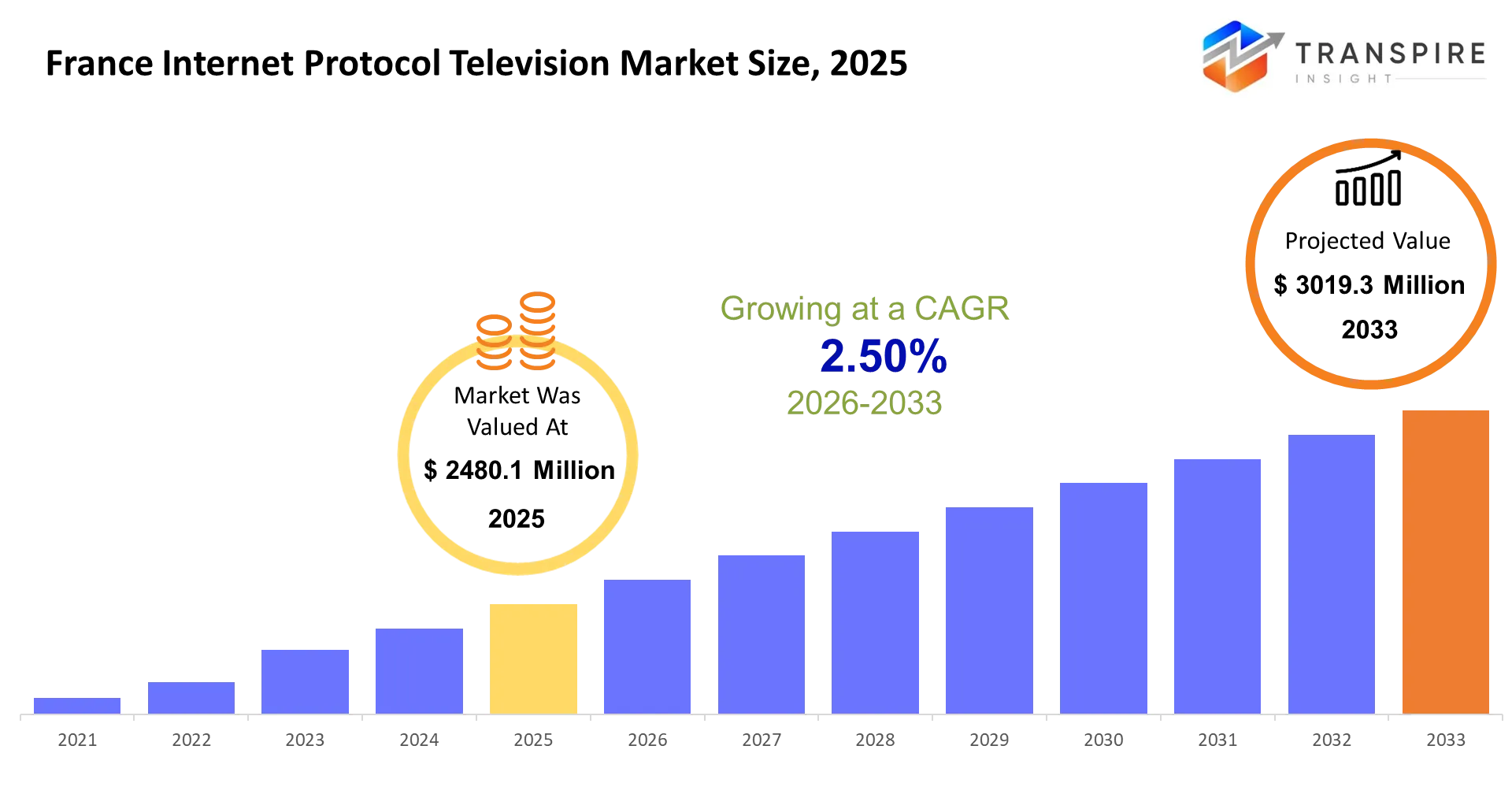
- France Internet Protocol Television Market Size 2025: USD 2480.1 Million
- France Internet Protocol Television Market Size 2033: USD 3019.3 Million
- France Internet Protocol Television Market CAGR: 2.50%
- France Internet Protocol Television Market Segments: By Type (Subscription IPTV, Free IPTV, Hybrid IPTV, Others); By Application (VOD, Live Streaming, Time-shifted Media, Interactive TV, Others); By End-User (Residential, Commercial, Enterprises, Others); By Device (Smart TVs, Set-top Boxes, Mobile, Others)
To learn more about this report,  Download Free Sample Report
France Internet Protocol Television Market Summary
The France Internet Protocol Television Market was valued at USD 2480.1 Million in 2025. It is forecast to reach USD 3019.3 Million by 2033. That is a CAGR of 2.50% over the period.
The France Internet Protocol Television market lets homes and companies get television content over broadband connections, basically swapping the old cable and satellite ways with internet-based streaming infrastructure. So in real terms, it helps with flexible, on-demand viewing across different devices, while also letting telecom operators tie in video services together with their internet and mobile plans. Over the last few years, the whole market kind of leaned more and more toward fiber-first distribution, because France’s nationwide fiber rollout improved streaming reliability a lot, and it lowered latency problems that used to limit IPTV take-up in semi-urban and country zones.
One major trigger for this change was the spike in home entertainment consumption during pandemic lockdowns, which kinda locked in new viewing habits, more toward on-demand platforms and mixed, “hybrid” TV bundles. Because of that, operators started pouring money into cloud-based content delivery networks, and also into tailored recommendation systems. In the end, revenue growth is less about adding more standard channels, and more about subscription bundling deals and premium content partnerships.
Key Market Insights
- The France Internet Protocol Television market is kind of pushed forward by the fiber rollout , expansion, and better streaming performance with less buffering across both urban and semi urban areas.
- IPTV uptake in the France Internet Protocol Television market is increasingly leaning on bundled telecom packages from big operators plus multiple service providers , not really standalone offerings as much.
- Île-de-France is still the main region, mostly because the broadband web is very dense and urban households consume a lot of digital entertainment , day to day.
- Southern France together with more rural zones is where the quickest growth shows up. This happens as fiber-to-the-home deployment keeps speeding up, and it helps expand internet based access through 2026 .
- Subscription based IPTV services take the lead , since viewers move away from satellite TV toward more flexible viewing models that are driven by the internet .
- Hybrid IPTV with OTT integration is the segment that’s growing the fastest, like it combines live television with a whole on-demand streaming environment.
- Residential users are the biggest source of demand, while business hospitality IPTV adoption is also rising quickly in hotels and shared living spaces , which is kind of noticeable.
- Competitive strategy is mostly about exclusive content entitlements, cloud streaming infrastructure, and AI powered personalization, just to keep viewers around for longer.
What are the Key Drivers, Restraints, and Opportunities in the France Internet Protocol Television Market?
The primary driver of the France Internet Protocol Television market is kind of the fast expansion of fiber broadband infrastructure, backed by national digital modernization programs. As these fiber connections slowly replace copper-based networks, operators can push higher-resolution streaming and low-latency live television, and this directly boosts subscriber conversion, plus it helps premium package adoption. Telecom bundling strategies also add a bit of extra revenue steadiness, by pairing IPTV with mobile and internet subscriptions, so customer retention improves and lifetime value goes up too.
A main restraint though is the pretty heavy dependence on how good the network infrastructure is. This becomes especially noticeable in rural or low-density regions where the fiber rollout is still incomplete, so the service quality ends up uneven, and full-scale IPTV replacement of satellite television gets delayed. On top of that, content licensing is fragmented across broadcasters. That fragmentation raises operational costs, and it also slows down how quickly providers can scale a unified content library, which then pulls down short-term profitability in competitive urban markets.
The main opportunity sits in AI-powered content personalization and cloud-native IPTV platforms. Providers are spending more on recommendation engines and adaptive bitrate streaming to strengthen viewer engagement. For instance, telecom operators expanding edge computing nodes in regional data centers can reduce latency a lot, while also making real-time content optimization possible. This tends to create a route toward more distinct user experiences and opens up new monetization models, like targeted advertising and interactive television services, where viewers can do more than just watch.
What Has the Impact of Artificial Intelligence Been on the France Internet Protocol Television Market?
Artificial intelligence is kinda reshaping the France Internet Protocol Television market, mostly by improving how content delivery works, adding personalization, and tuning network performance across big subscriber populations. Telecom operators take machine learning algorithms and basically look at viewing patterns, then automate content suggestions, which leads to higher user engagement and a longer average viewing session. With AI-driven video compression and adaptive bitrate streaming, bandwidth usage gets optimized, so playback stays more stable even when the network is busy during peak traffic windows.
On the operational side, predictive analytics models let service providers estimate network congestion ahead of time, and then reroute traffic through content delivery networks pretty automatically. This helps cut down on buffering incidents ,and it boosts overall service uptime, especially when it’s live sports or another high-demand broadcast happening. Also, AI supports churn prediction systems, meaning operators can spot subscribers who might cancel and then offer proactive retention incentives that are aimed at them.
Still, there is a main snag: the integration cost of AI within legacy IPTV infrastructure can be quite high. A lot of operators continue using older middleware platforms that aren’t fully compatible with real-time data processing, so deployment at full scale ends up slowing down and feeling delayed. On top of that, uneven user connectivity in some rural regions leads to less consistent behavioral data, which then lowers the accuracy of the models and limits predictive strength in those areas.
Key Market Trends
- From 2020 to 2026, in France, the IPTV market kind of moved away from satellite dominance, toward fiber driven streaming across big urban zones, it was noticeable.
- Between that same span, especially after 2022, telecom bundling strategies grew a lot more, and they started combining mobile, home internet, and IPTV into one subscription style ecosystem.
- Live TV viewing went down slowly, starting around 2021, because many French households adopted on-demand streaming more often, and it just kept increasing.
- In 2024, hybrid IPTV-OTT platforms became a real thing, since providers were adding global streaming applications directly into their telecom set-top boxes, which feels more convenient.
- Also, the fiber rollout picked up speed between 2023 and 2026. That improved service quality in rural areas, and it helped shrink the digital gap between cities and countryside, not instantly but steadily.
- Canal+ , in particular, tightened up its exclusive sports plus entertainment licensing, to keep the premium IPTV subscribers from drifting elsewhere.
- After 2023, AI based recommendation engines turned into a standard feature across major operators, and they boosted engagement, and those retention numbers too.
- Cloud based IPTV infrastructure also became more common, because operators were reducing their dependence on physical broadcasting hardware.
- Finally, advertising models started leaning toward targeted digital ads inside IPTV interfaces, so the old-style broadcast advertising formats were gradually replaced.
France Internet Protocol Television Market Segmentation
By Type
Subscription IPTV kinda holds the dominant position in the France Internet Protocol Television Market, mostly because it plugs in with bundled telecom services from the big fiber operators. The strong penetration is driven by predictable monthly income models and also by consumer preference for an all in one setup that mixes broadband, mobile, and television, in one go. Telecom operators tend to push subscription based delivery, because it helps with steady churn control and keeps customers longer, especially across urban and suburban households. Plus, content licensing arrangements with major broadcasters do help too , especially for premium entertainment delivery.
Free IPTV stays a limited but still meaningful segment, it is mainly backed by advertising funded platforms and simpler channel access models. Real adoption is more common among price sensitive viewers, and on secondary household screens, where subscription fatigue makes people less willing to pay for premium bundles. Hybrid IPTV has the fastest structural momentum though, since operators are combining linear television with OTT libraries, so consumption can be more flexible across devices. This hybrid approach benefits from the growing appetite for personalized content and for streaming ecosystems that feel unified. Other categories, like niche enterprise IPTV deployments, remain small but they still support specialized communication needs. During the forecast period, hybrid systems are expected to reshape service architecture quite a bit, and that is pushing developers toward modular, API driven content delivery platforms.
By Application
Video on Demand, or VOD, kind of takes the lead in the France Internet Protocol Television Market, because more viewers are moving toward flexible, on demand watching. With broadband penetration already high, and fiber links getting better, people can open big content catalogues pretty smoothly, so the usual buffering annoyances get reduced a lot. Telecom operators are really pushing VOD too, since it tends to lift average viewing duration, and it also helps subscription stickiness via tailored content suggestions. Add smart interface integration into the mix, and user engagement feels stronger across different devices, like phones, tablets, or set-top boxes.
Live streaming still matters a lot as a second tier option, especially for sports broadcasts and national happenings that need real time delivery across large audiences. Meanwhile, time shifted media is getting more visible with working households that like watching later, after the scheduled program has aired. This makes the overall service feel more adjustable, less rigid, more workable. Interactive TV is also growing, propelled by advertising based monetization, where viewers can engage during playback and receive focused offers. Other offerings, such as learning content and infotainment services, stay relatively niche, but they’re becoming more noticeable in business environments and in public sector messaging. Looking ahead, interactive and time shifted formats should rise faster than the classic VOD approach, as platforms lean more into engagement focused revenue models, even if the shift isn’t overnight.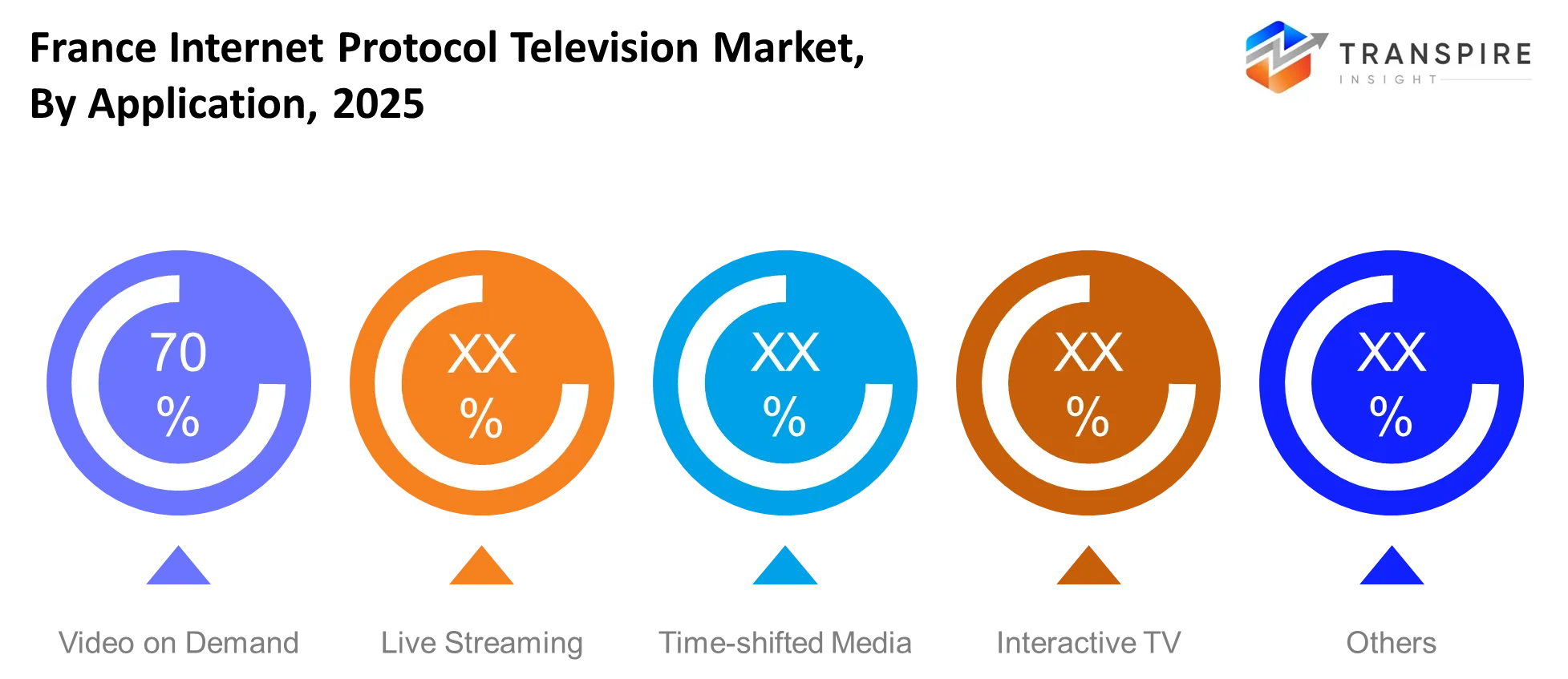
To learn more about this report, Download Free Sample Report
By End-User
Residential users basically have the top position in the France Internet Protocol Television Market , mostly because fiber-based broadband is now everywhere plus telecom bundles people sign up for. In general households like IPTV more than older satellite methods , not only because it feels flexible but also because it works on multiple devices and it plays nicely with streaming platforms that kind of replace traditional satellite TV. The appetite for IPTV keeps getting stronger, especially in bigger cities where digital lifestyles are common, and because people consume more on-demand entertainment these days. Telecom operators give a lot of attention to this part of the market , since it brings steady recurring money and it helps with long-term customer staying power .
Meanwhile commercial uptake is moving ahead, mainly in hospitality—hotels, serviced apartments, and similar setups where they need a centralized content distribution system. Companies are also adopting IPTV for internal messaging, training modules , and corporate broadcasting across different sites. This area tends to win on practical grounds because content can be delivered more cost-efficiently than many older ways of handling internal communication. There are also other users , like educational organizations and public institutions , who are slowly folding IPTV into their routines for things like information sharing and digital signage. Through the forecast period , the enterprise and commercial groups are expected to expand faster than residential adoption, largely driven by digital transformation programs plus the push to modernize workplace communication .
By Device
Smart TVs kind of represent the leading device segment in the France Internet Protocol Television Market, largely because built-in applications do most of the work so you don’t really need extra external hardware. Consumers seem to lean toward those integrated viewing experiences, and that supports strong adoption, especially for households that are moving into connected home ecosystems. A lot of manufacturers now preload IPTV applications, so people can tap into telecom based streaming services right away, with no additional setup costs, or not much of it at least. This straightforward access, basically reinforces Smart TV dominance across urban households.
Meanwhile, set-top boxes are still a stable option, mainly among legacy subscribers who are gradually switching away from traditional broadcast systems. These boxes keep playing a necessary part in telecom managed IPTV environments where things like service control, and content security really matter. Mobile devices are growing the quickest segment too, since many viewers now prefer to watch on smartphones and tablets, especially during travel and when they are multitasking. Other screens, like gaming consoles or laptops, add supplementary demand in secondary viewing spaces. Over time, mobile-first consumption may well reshape how content is delivered, and it will push developers to improve adaptive streaming, plus cross device synchronization features and so on.
What are the Key Use Cases Driving the France Internet Protocol Television Market?
The main use case in the France Internet Protocol Television market is kind of residential entertainment delivery , through broadband-connected set-top boxes, where households tend to watch live TV , use replay services and also pick on-demand content from one interface. The demand feels strongest, because telecom operators bundle IPTV with fiber internet plans, so it turns into a smooth , low-latency viewing experience that basically replaces the old satellite reliance.
A second , growing use case is hospitality and multi-dwelling unit distribution, mainly in hotels and student housing where centralized IPTV systems help reduce infrastructure costs and also allow more tailored channel lineups for different guest profiles. In corporate places, IPTV is used for internal updates and digital signage across the office network, not just for watching stuff.
An emerging angle is interactive and addressable television for retail and sports broadcasts, where real time personalization , targeted advertisements, and integrated electronic commerce features are being trialed across connected TV ecosystems.
|
Report Metrics |
Details |
|
Market size value in 2025 |
USD 2480.1 Million |
|
Market size value in 2026 |
USD 2539.8 Million |
|
Revenue forecast in 2033 |
USD 3019.3 Million |
|
Growth rate |
CAGR of 2.50% from 2026 to 2033 |
|
Base year |
2025 |
|
Historical data |
2021 - 2024 |
|
Forecast period |
2026 - 2033 |
|
Report coverage |
Revenue forecast, competitive landscape, growth factors, and trends |
|
Regional scope |
France |
|
Key company profiled |
Orange, SFR, Bouygues, AT&T, Verizon, Huawei, Ericsson, Nokia, Cisco, ZTE, Amino, Broadcom, Roku, Apple, Comcast |
|
Customization scope |
Free report customization (country, regional & segment scope). Avail customized purchase options to meet your exact research needs. |
|
Report Segmentation |
By Type (Subscription IPTV, Free IPTV, Hybrid IPTV, Others); By Application (VOD, Live Streaming, Time-shifted Media, Interactive TV, Others); By End-User (Residential, Commercial, Enterprises, Others); By Device (Smart TVs, Set-top Boxes, Mobile, Others) |
Which Regions are Driving the France Internet Protocol Television Market Growth?
Île-de-France still feels like the front runner in the France Internet Protocol Television market, mostly because it has that dense fiber broadband backbone, and also a lot of digital-first households. In practice the region gets along quite well with national FTTH expansion rules, so high-speed access is close to everywhere. Also, Paris makes a difference, since it has big telecom headquarters and content distribution hubs, which kind of locks in ecosystem alignment. People there have higher disposable income, they adopt technology earlier, so IPTV adoption becomes more natural. Plus, ongoing smart city investments help streaming become smoother, and cloud based content delivery keeps getting supported.
Provence-Alpes-Côte d’Azur looks more like a steady second-tier player, it’s driven by tourism pull and a sizable share of seasonal residences. Compared with the capital area, its momentum is a bit less tied to corporate infrastructure, and more to hospitality led IPTV deployment, in hotels and also in rental units. The region benefits from ongoing fiber build outs, and operator spending stays consistent, with major providers like Orange and SFR showing up reliably. Even when population patterns shift, demand remains fairly even, because you get a mixed urban-coastal crowd that usually keeps subscriptions active across the year. So it ends up as a predictable revenue contributor, even if it’s not as dense as Île-de-France.
Auvergne-Rhône-Alpes is growing the quickest, mainly because industrial digitization is speeding up, and fiber rollout at scale is reaching mid-sized places like Lyon and Grenoble. More recently, public private infrastructure programs have pushed high-speed connectivity into suburban lanes that were maybe underserved before. On top of that, enterprises and tech parks are adopting IPTV not just for “watching”, but for internal broadcasting and training, you could say.
Who are the Key Players in the France Internet Protocol Television Market and How Do They Compete?
The France Internet Protocol Television market is pretty moderately consolidated, sort of, with telecom incumbents holding most distribution paths, while global tech providers push in backend infrastructure and streaming enablement, kinda in parallel. The rivalry is mostly influenced by network quality, the strength of content bundling, and how well platforms integrate, not only by price , but also by execution. The more established operators keep defending their market share via bundled telecom offerings, whereas technology firms tend to lean into middleware, cloud delivery, and video optimization systems. In the last while, the whole market feels more driven by ecosystem partnerships where telecom infrastructure gets paired with big global content platforms.
Orange competes by using deep fiber integration and very tightly bundled IPTV-internet-mobile packages, leaning on its nationwide infrastructure footprint so service stays consistent, even when demand spikes. SFR leans harder on aggressive content bundling and sports broadcasting partnerships, to stand out for its IPTV subscriptions particularly in city environments. Bouygues Telecom goes for cost-efficient packages plus stable network performance, targeting more price-sensitive suburban users, while keeping broadband speeds competitive enough to not lose them.
On the technology front, players like Huawei, Ericsson, and Nokia supply key network infrastructure that helps enable low-latency IPTV streaming and fiber optimization. At the same time, Cisco supports cloud-based video delivery architectures, and platforms such as Roku and Apple shape user experience through interface design, and streaming ecosystem linkage too. Overall, this layered competition builds a kind of dual market structure where telecom operators manage access and technology providers manage performance, in a way that feels almost separate, but it’s all connected.
Company List
Recent Development News
In April 2026, Bouygues Telecom, Free (Iliad Group), and Orange entered negotiations with Altice France to acquire SFR assets. The consortium move aims to consolidate telecom infrastructure and directly reshape IPTV distribution by merging broadband and TV subscriber bases across France’s largest operators.https://www.reuters.com
In April 2026, Bouygues Telecom, Free, and Orange formally advanced a €20.35 billion acquisition proposal for SFR. The deal is expected to centralize IPTV and broadband services under fewer operators, strengthening bundled TV and streaming ecosystems across France.https://www.agefi.fr
What Strategic Insights Define the Future of the France Internet Protocol Television Market?
The France Internet Protocol Television market is shifting structurally toward fully converged digital entertainment ecosystems, where IPTV, OTT platforms, and telecom services sort of merge into unified subscription environments. This transition is driven by fiber saturation in urban regions, and also by an increasing appetite for individualized, on-demand viewing experiences. Over the next 5–7 years, the value creation piece will depend more and more on content intelligence layers, not just basic signal delivery.
But there’s a hidden risk, platform dependency concentration, where telecom operators lean heavily on a small group of global content and technology providers. That setup makes everyone more exposed to pricing fluctuations and licensing pressure, in a rather direct way. At the same time, there’s an emerging opening too, edge-enabled interactive television especially in regional France. There, localized advertising and low-latency sports streaming, can unlock new kinds of revenue, in a more immediate sense.
So market participants should push for modular cloud IPTV architectures, because they can reduce reliance on legacy hardware. And they also help with faster integration of AI-driven personalization and advertising systems, rather than doing it the slow, traditional route.
France Internet Protocol Television Market Report Segmentation
By Type
- Subscription IPTV
- Free IPTV
- Hybrid IPTV
- Others
By Application
- Video on Demand (VOD)
- Live Streaming
- Time-shifted Media
- Interactive TV
- Others
By End-User
- Residential
- Commercial (Hotels, Hospitality, Retail Spaces)
- Enterprises (Corporate Communication, Internal Broadcasting)
- Others
By Device
- Smart TVs
- Set-top Boxes
- Mobile Devices (Smartphones & Tablets)
- Others
Frequently Asked Questions
Find quick answers to common questions.
The Approximate France Internet Protocol Television Market size for the Market will be USD 3019.3 Million in 2033.
Key Segments for the France Internet Protocol Television Market are By Type (Subscription IPTV, Free IPTV, Hybrid IPTV, Others); By Application (VOD, Live Streaming, Time-shifted Media, Interactive TV, Others); By End-User (Residential, Commercial, Enterprises, Others); By Device (Smart TVs, Set-top Boxes, Mobile, Others).
Major France Internet Protocol Television Market Players are Orange, SFR, Bouygues, AT&T, Verizon, Huawei, Ericsson, Nokia, Cisco, ZTE, Amino, Broadcom, Roku, Apple, Comcast.
The Current France Internet Protocol Television Market size is USD 2480.1 Million in 2025.
The France Internet Protocol Television Market CAGR is 2.50% from 2026 to 2033.
- Orange
- SFR
- Bouygues
- AT&T
- Verizon
- Huawei
- Ericsson
- Nokia
- Cisco
- ZTE
- Amino
- Broadcom
- Roku
- Apple
- Comcast
Recently Published Reports
-
Apr 2026
3D Optical Profiler Market
3D Optical Profiler Market Size, Share & Analysis Report By Type (Desktop 3D Optical Profiler, and Portable 3D Optical Profiler), By Technology (Confocal Technology, and White Light Interference), By End-Use Industry (Manufacturing, Research Institutions, Automotive, Aerospace and Defense, Medical Devices, and Other), and Geography (North America, Europe, Asia-Pacific, Middle East and Africa, South and Central America), 2021 - 2031
-
Apr 2026
Depth Sensor Market
Depth Sensor Market Size, Share & Analysis Report By Type (Infrared Depth Sensors, Time-of-Flight (ToF) Sensors, Stereo Vision Sensors, Structured Light Sensors, Ultrasonic Depth Sensors), By Application (Automotive, Robotics, Gaming, Consumer Electronics, Industrial Automation, Healthcare, Security & Surveillance, Others), By End Users (Automotive Manufacturers, Consumer Electronics Companies, Healthcare Providers, Industrial Companies, Security Agencies, Gaming Companies, Robotics Companies, Others), and Geography (North America, Europe, Asia-Pacific, Middle East and Africa, South and Central America), 2021 – 2031
-
Apr 2026
Digital Manufacturing Market
Digital Manufacturing Market Size, Share & Analysis Report By Component (Hardware, Software, and Services), By Technology (Robotics, 3D Printing, Internet of Things (IoT), and Others), By Application (Automotive and Transportation, Aerospace and Defense, Consumer Electronics, Industrial Machinery, and Others), By Process Type (Computer-Based Designing, Computer-Based Simulation, Computer 3D Visualization, Analytics, and Others), and Geography (North America, Europe, Asia-Pacific, Middle East and Africa, South and Central America), 2021 – 2031
-
Apr 2026
Digital Visa Services Market
Digital Visa Services Market Size, Share & Analysis Report By Type (Individual Travelers, Group Travelers), By Application (Tourism, Business Travel, Others), and Geography (North America, Europe, Asia-Pacific, Middle East and Africa, South and Central America), 2021 – 2031