
Middle East and Africa LGC And VLGC LPG Shipyard Carrier Market Size & Forecast:
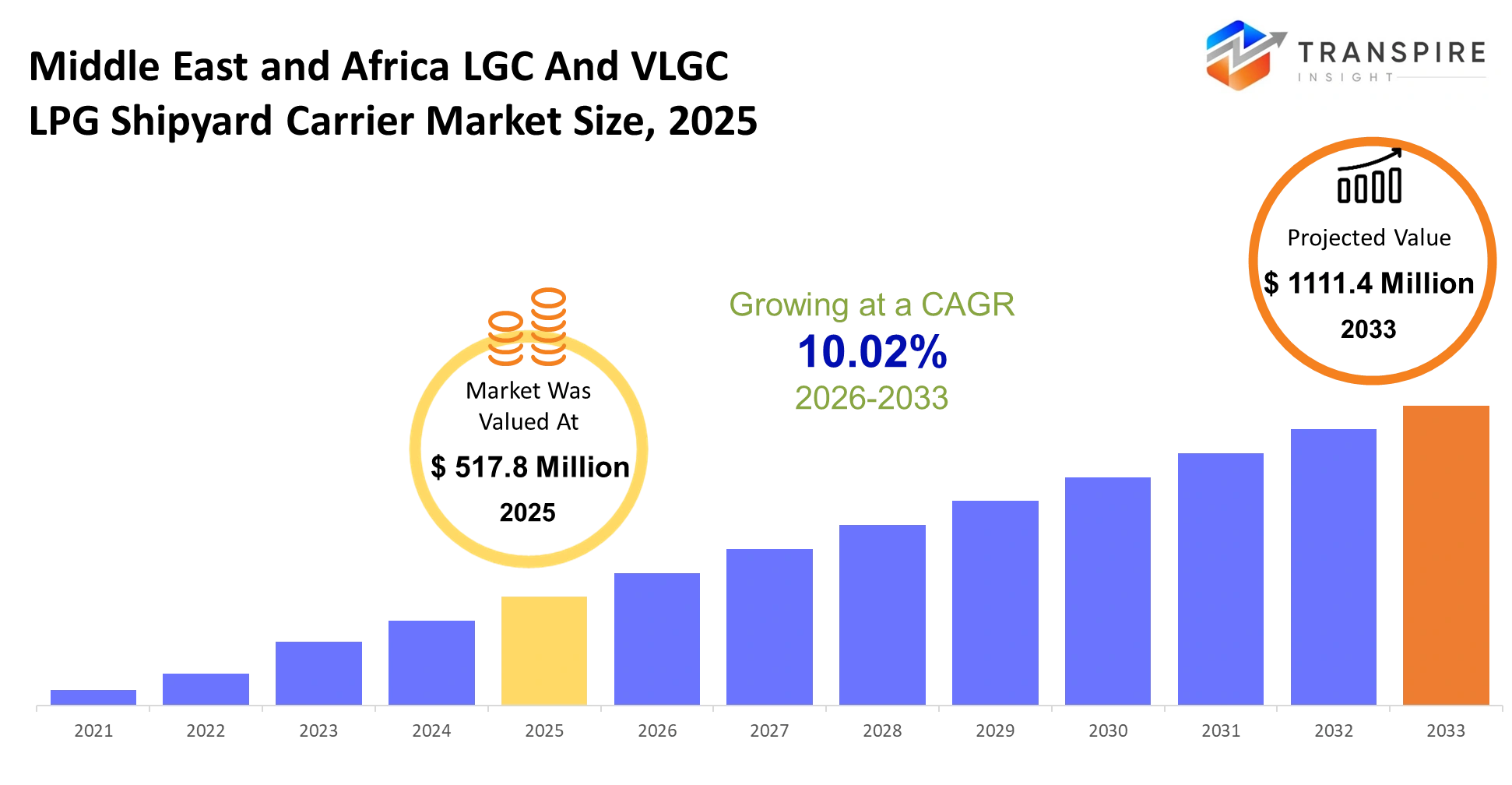
- Middle East and Africa LGC And VLGC LPG Shipyard Carrier Market Size 2025: USD 517.8 Million
- Middle East and Africa LGC And VLGC LPG Shipyard Carrier Market Size 2033: USD 1111.4 Million
- Middle East and Africa LGC And VLGC LPG Shipyard Carrier Market CAGR: 10.02%
- Middle East and Africa LGC And VLGC LPG Shipyard Carrier Market Segments: By Vessel Type (LGC, VLGC, VLEC, Others); By Propulsion (Dual Fuel, Conventional Fuel, LNG Powered, Others); By Application (LPG Transport, Petrochemical Transport, Ammonia Transport, Others); By End User (Shipping Companies, Energy Companies, Others)
To learn more about this report,  Download Free Sample Report
Middle East and Africa LGC And VLGC LPG Shipyard Carrier Market Summary
The Middle East and Africa LGC And VLGC LPG Shipyard Carrier Market was valued at USD 517.8 Million in 2025. It is forecast to reach USD 1111.4 Millionby 2033. That is a CAGR of 10.02%over the period.
The Middle East and Africa LGC and VLGC LPG Shipyard Carrier market plays a major role in moving liquefied petroleum gas from production places to import dependent economies, so energy stays reliable for households, factories and petrochemicals. Large Gas Carriers, also known as LGCs, and Very Large Gas Carriers or VLGCs help with cost efficient transport of bulk LPG cargo across long distance trade lanes, which backs regional energy steadiness and keeps international commodity movements flowing. In the last five years, things have moved a bit, toward bigger vessel types and dual fuel propulsion systems, because operators want cheaper running costs, and they also need to meet tougher emission rules.
Geopolitical disruptions, especially those tied to key shipping corridors around the Middle East and the Strait of Hormuz, have basically remixed how fleets are deployed and they also lifted the need for fleet modernization. Meanwhile LPG exports from Gulf producers are expanding, and import needs grow across Asia and Africa, so shipowners are putting money into higher capacity ships, which then builds stronger orderbooks and pushes shipyard earnings higher, through longer term vessel building programs.
Key Market Insights
- In 2025 the Middle East takes up roughly 62% of the regional market revenue, seems driven by pretty strong LPG export infrastructure and also big carrier deployments, so overall volumes are steadier than many places.
- Africa on the other hand, is showing the quickest climb all the way through 2033 , largely backed by port upgrades and more LPG import terminals coming online.
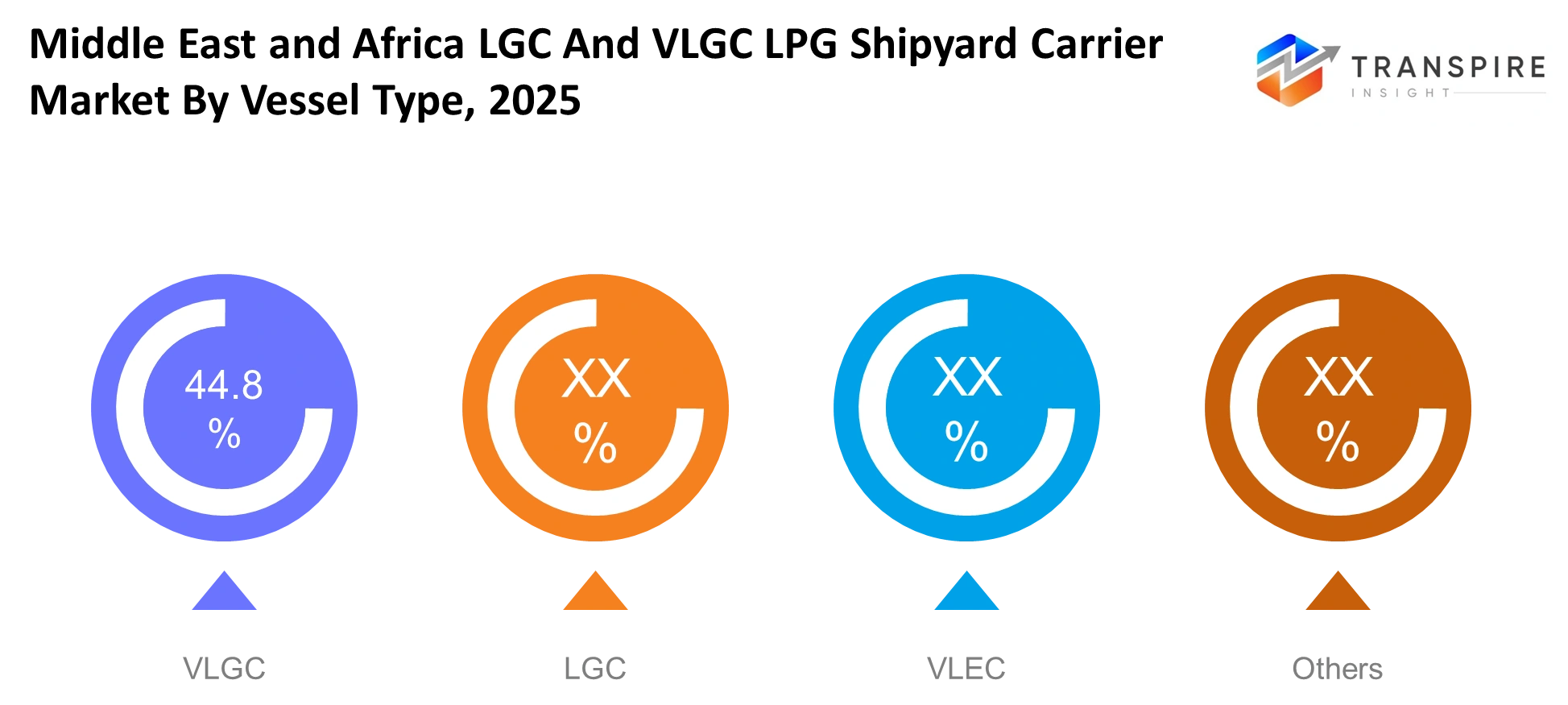
- When it comes to vessel type , VLGC ships are leading, they hold close to 58% of the market share , because larger cargo capacities really help reduce transportation costs per tonne, which is kind of the key point for operators trying to stay competitive.
- LGC vessels still sit in the second position, supporting medium-volume trade lanes and regional distribution needs, not just niche routes.
- Dual-fuel propulsion vessels are forecast to grow the fastest through 2033, operators are chasing fuel flexibility and aiming for emission compliance, so this is not only a technical preference.
- For applications, LPG transport covers more than 70% of the demand, and it’s supported by long-haul export routes starting with Gulf producers, mostly.
- Ammonia transport is emerging as the fastest-growing application too, tied to clean fuel narratives and hydrogen economy investments, people are investing ahead of demand curves.
- On the demand side, shipping companies hold about 64% of the end-user demand, helped by fleet renewal and charter market openings, while others follow more slowly.
- Energy companies are also pushing for longer term vessel contracts to lock in LPG export capacity as trade flows keep changing, and that matters for planning.
- Major participants, such as Hyundai Heavy Industries, Hanwha Ocean, Samsung Heavy Industries, BW LPG, Dorian LPG, and Nakilat, tend to focus on dual-fuel technology, broader fleet expansion, plus long-term charter agreements, all together in one strategy.
What are the Key Drivers, Restraints, and Opportunities in the Middle East and Africa LGC And VLGC LPG Shipyard Carrier Market?
The strongest growth driver comes from expanding LPG export capacity across Gulf energy producing nations, and this shift toward long-haul LPG trade routes kind of follows. New gas processing facilities plus export terminals in Saudi Arabia, Qatar and the UAE have boosted seaborne cargo volumes. That’s then creating demand for more LGC and VLGC capacity. Vessel owners are responding too, by ordering bigger carriers that can move more cargo per voyage, so the freight economics look better. It also supports higher shipyard revenues, in a way that feels pretty direct. On top of that, the growing preference for dual fuel vessels nudges fleet renewal programs along, generating fresh construction contracts.
The biggest challenge is the capital intensive nature of vessel construction and fleet modernization, period. Building modern VLGCs takes real money, longer construction cycles, and specialized shipyard capabilities. There are limited global shipyard slots, and the delivery timelines are extended, so it becomes a structural supply constraint. And honestly it can’t be fixed quickly. Those limitations end up delaying fleet expansion plans and they limit how fast operators can bring in advanced vessel technologies.
A major future opportunity sits with ammonia transportation. Energy companies are investing heavily in low carbon fuels, and also hydrogen supply chains, which then creates demand for vessels that can handle ammonia cargoes. Several Middle Eastern producers are pushing large scale ammonia export projects, while African markets keep building their import infrastructure. As these projects mature, specialized gas carriers able to handle ammonia and LPG cargoes will open new revenue streams for shipyards and vessel operators.
What Has the Impact of Artificial Intelligence Been on the Middle East and Africa LGC And VLGC LPG Shipyard Carrier Market?
Artificial intelligence is, sort of, increasingly reshaping vessel construction , fleet management, and the overall operational effectiveness throughout the gas carrier industry. Shipyards are now leaning on AI based design optimization toolsets, to squeeze more hull efficiency out of every project, cut down material waste, and compress engineering cycles. At the same time, fleet operators run machine learning approaches that keep watch on propulsion systems, cargo containment equipment, and engine performance in near-real time. In practice, these setups flag early signals of mechanical wear, then help arrange predictive maintenance, so failures don’t turn into expensive surprises later.
AI enabled performance platforms also dig into weather circumstances, fuel consumption behavior, and route choices, in order to boost sailing economy. A lot of operators say they actually see meaningful drops in fuel use and upkeep expenses, while vessel availability improves and downtime shrinks. Even compliance tasks feel easier, because automated tools can follow emission performance, manage regulatory paperwork, and coordinate vessel certification duties across various jurisdictions, without as much manual wrangling.
On the analytics side, advanced evaluation methods assist with cargo forecasting and fleet deployment thinking by weighing trade streams , freight rate movements, and port congestion trends. Still, adoption is held back by a few stubborn things: high implementation costs, patchy satellite coverage in some maritime zones, and uneven operational data standards. When those constraints show up, model accuracy may suffer, and the digital shift can slow down, especially for smaller operators who have tight tech budgets and very limited room to experiment.
Key Market Trends
- Since 2021, dual fuel VLGC orders have gone up pretty fast, operators are chasing lower fuel costs and also stronger emission compliance so yeah.
- In 2024 to 2026, Panama Canal congestion kind of pushed alternative routings, which then lifted ton mile demand and made vessel utilization climb a bit more.
- By 2026, global VLGC orderbooks passed 100 vessels, it signals real confidence in long term LPG trade growth, at least that’s how it looks.
- Between 2023 and 2026, Gulf exporters expanded their LPG production capacity, helping them fund larger carrier deployment programs, not just smaller incremental builds.
- Digital fleet management platforms started getting used more broadly, and that improved predictive maintenance plus voyage optimization, which is useful in practice.
- After 2024, ammonia-ready vessel designs showed up more often, shipowners were basically preparing for future clean energy cargo opportunities.
- Charter agreements longer than three years became more common as freight market volatility got worse, so counterparties seemed to lock in arrangements earlier.
- In 2025, India and Southeast Asia recorded LPG import growth above 10%, this strengthened the long haul trade routes, overall.
- From 2024 to 2026, major shipbuilders increasingly favored high value gas carriers instead of conventional vessel categories, like they were shifting the emphasis.
- Fleet renewal also sped up, because vessels older than 25 years faced rising operational headaches and compliance pressures that were harder to ignore.
Middle East and Africa LGC And VLGC LPG Shipyard Carrier Market Segmentation
By Vessel Type
LGC kinda covers medium capacity gas transportation, across regional and international trade routes. Its balanced cargo capacity mixed with operational flexibility helps it work across various export and import corridors. Utilization that stays steady still supports investment calls by operators who want efficient transportation solutions.
VLGC basically holds a pretty major share, mainly because it has a larger cargo-carrying capability and a lower transportation cost per unit of cargo. Also, the long distance LPG trade is growing, which keeps pushing adoption of this vessel type. Then VLEC is used for transporting ethane and specialized gas cargoes that need more advanced containment systems. Other options include smaller and specialized carrier categories , which handle niche transportation requirements and regional distribution activities, better.
To learn more about this report, Download Free Sample Report
By Propulsion
Dual Fuel propulsion grabs a lot of attention, mainly because it offers fuel flexibility, can reduce emissions, and tends to improve day to day operational efficiency. Meeting international environmental standards, sure has pushed more stakeholders toward adoption, even within new construction programs. Investment activity is also shifting more and more toward propulsion systems that help with long-term cost optimization, not just short-term performance
Conventional Fuel propulsion still holds a solid place in existing fleets, mostly since the infrastructure is already there and the operating practices are familiar. LNG powered systems also come up often, for their lower emission profiles and because they fit the maritime sustainability objectives pretty well. Beyond that there are other approaches—alternative propulsion technologies, hybrid configurations, and emerging fuel solutions, all aimed at supporting decarbonization goals, plus those practical operational improvements that people actually notice over time.
By Application
LPG Transport kinda comes across as the biggest application segment, mostly because liquefied petroleum gas gets used a lot across residential, commercial ,and industrial areas. At the same time, international energy trade keeps backing transportation volumes between major export and import destinations. On top of that, long term supply agreements also help keep cargo movement steady, like almost consistently.
Then there’s Petrochemical Transport, which basically supports the movement of gas based feedstocks that go into chemical manufacturing and industrial processing work. Ammonia Transport is also getting more attention lately, partly due to investments connected to hydrogen production and low-carbon energy initiatives. And there are others too, like specialized gas transportation activities that serve industrial operations, energy projects, and some more niche cargo needs across different markets.
By End User
Shipping Companies really take up a notable portion of demand since fleet ownership, vessel management, and chartering work are still at the core of gas transport operations. Their fleet modernization programs, plus efficiency oriented investment strategies, keep the purchasing momentum going . Also those long-term transportation contracts help keep their role strong inside this segment.
Energy Companies, on the other hand, lean on carrier capacity for export operations , supply chain coordination, and broader international energy distribution. The way production assets connect with transportation infrastructure keeps shaping those investment calls. Beyond that there are commodity traders, logistics providers, and industrial organizations that need specialized transportation services, in order to keep commercial activities moving and to handle cargo distribution requirements properly.
What are the Key Use Cases Driving the Middle East and Africa LGC And VLGC LPG Shipyard Carrier Market?
The Middle East is still kinda the main regional player, because there is a lot of LPG production capacity, plus world-scale export terminals and then the government backing for energy infrastructure. You can see it in how the big hydrocarbon reserves keep producing cargo, while the better port facilities let vessels operate more efficiently. The major producers keep on expanding their export capabilities to boost their footprint in the global market. And honestly, a fairly mature shipping ecosystem around there just keeps reinforcing that regional lead.
Africa, on the other hand, sits as the second-largest contributor, but it takes a bit of a different route. Here market performance is pushed by slower yet steady LPG adoption, more import infrastructure coming online, and also the growth of energy access initiatives. Investments are more about receiving terminals and storage units, not so much the huge scale export setups. Stable economic development along with energy diversification programs helps keep vessel demand fairly steady.
Africa is also expected to build the fastest growth momentum up through 2033. In recent years, investments into coastal infrastructure , energy security efforts, and LPG distribution networks have made conditions better. Fleet modernization efforts , plus port upgrades , are opening up new chances for shipping operators and investors. If the infrastructure development continues, it should lock in a stronger role for the region in international LPG trade across the forecast period.
|
Report Metrics |
Details |
|
Market size value in 2025 |
USD 517.8 Million |
|
Market size value in 2026 |
USD 569.7 Million |
|
Revenue forecast in 2033 |
USD 1111.4 Million |
|
Growth rate |
CAGR of10.02%from 2026 to 2033 |
|
Base year |
2025 |
|
Historical data |
2021 - 2024 |
|
Forecast period |
2026 - 2033 |
|
Report coverage |
Revenue forecast, competitive landscape, growth factors, and trends |
|
Regional scope |
Middle East and Africa (Saudi Arabia, United Arab Emirates, South Africa, Rest of Middle East and Africa) |
|
Key company profiled |
Hyundai Heavy Industries, Hanwha Ocean, Samsung Heavy Industries, Mitsubishi Heavy Industries, Kawasaki Heavy Industries, CSSC, Namura Shipbuilding, Imabari Shipbuilding, COSCO Shipping, MOL, NYK Line, BW LPG, Dorian LPG, Exmar, Nakilat |
|
Customization scope |
Free report customization (country, regional & segment scope). Avail customized purchase options to meet your exact research needs. |
|
Report Segmentation |
By Vessel Type (LGC, VLGC, VLEC, Others); By Propulsion (Dual Fuel, Conventional Fuel, LNG Powered, Others); By Application (LPG Transport, Petrochemical Transport, Ammonia Transport, Others); By End User (Shipping Companies, Energy Companies, Others) |
Which Regions are Driving the Middle East and Africa LGC And VLGC LPG Shipyard Carrier Market Growth?
The Middle East stays like the big dominant regional market , mainly because of the huge LPG production capacity , world-scale export terminals , and the kind of solid government push for energy infrastructure . Large hydrocarbon reserves keep feeding steady cargo generation, and the more advanced port facilities mean vessels can operate pretty efficiently . The major producers keep enlarging their export capabilities , to better hold a stronger global market stance . On top of that, a mature shipping ecosystem sort of keeps reinforcing why the region leads.
Africa comes next and is the second-largest contributor , but it doesn’t really follow the exact same rhythm . Market performance is supported by a slower, gradual LPG adoption pattern, more and more import infrastructure , plus energy access efforts that are steadily expanding . Here, the investment is more about receiving terminals and storage facilities , rather than huge-scale export expansions . With stable economic development and energy diversification programs in the mix , vessel demand stays fairly consistent.
Africa is also expected to show the fastest growth momentum through 2033 . A bunch of recent investment in coastal infrastructure , energy security programs , and LPG distribution networks has made conditions better . Fleet modernization initiatives and port upgrades are creating additional openings for shipping operators , as well as for investors . If infrastructure development continues without pause, it will further lock in Africa’s role in international LPG trade across the forecast period .
Who are the Key Players in the Middle East and Africa LGC And VLGC LPG Shipyard Carrier Market and How Do They Compete?
Competition is still kind of moderately concentrated among the big shipbuilders, and also the specialized gas carrier operators. Basically, success is about vessel design skills , construction speed , fuel technology know how , and then those longer-term customer ties. Most established firms keep trying to hold their place in the market by pouring money into technology and offering more advanced vessel types. Meanwhile, newer entrants push harder on cost, and also on delivery timing, even if the overall approach feels a bit different.
Hyundai Heavy Industries tends to focus on high efficiency gas carrier designs, along with advanced engineering capabilities that can really back up large scale vessel construction programs. Hanwha Ocean leans into high value vessel segments and uses its specialized yard strengths to land more premium contracts. Samsung Heavy Industries differentiates with digital ship technologies, and fuel efficient vessel platforms as a kind of steady theme.
Looking at operators, BW LPG expands through long term charter agreements, dual fuel vessel deployment, and fleet renewal programs that keep things moving. Dorian LPG concentrates on operational efficiency and has been building around modern VLGC assets. Nakilat, on the other hand, benefits from solid links to Gulf energy export projects. Taken together, these strategies end up creating competitive advantages via scale, technology adoption, and long term customer relationships that are hard to replicate, at least not quickly.
Company List
- Hyundai Heavy Industries
- Hanwha Ocean
- Samsung Heavy Industries
- Mitsubishi Heavy Industries
- Kawasaki Heavy Industries
- CSSC
- Namura Shipbuilding
- Imabari Shipbuilding
- COSCO Shipping
- MOL
- NYK Line
- BW LPG
- Dorian LPG
- Exmar
- Nakilat
Recent Development News
In June 2026, BW LPG secured a newbuilding contract for eight 90,000 cbm Panamax VLGCs valued at approximately USD 940 million. The investment expands long-term transport capacity and strengthens future fleet competitiveness in the global LPG trade.https://www.businesswire.com
In February 2026, BW LPG entered three-year time charter-out contracts for the VLGCs BW Tucana and BW Yushi. The agreement increased fixed-rate fleet coverage and improved earnings visibility amid evolving LPG shipping market conditions.https://www.businesswire.com
In April 2026, Hanwha Ocean secured a USD 283 million order for two very large crude carriers while continuing its strategy of prioritizing high-value large-vessel construction. The contract reinforced shipyard utilization and demonstrated sustained demand for advanced large-vessel manufacturing capabilities.https://en.sedaily.com
What Strategic Insights Define the Future of the Middle East and Africa LGC And VLGC LPG Shipyard Carrier Market?
The market is shifting, structurally, toward larger gas carriers that are more fuel-efficient and can move multiple cargoes at once, as global LPG and ammonia routes are becoming more connected than before. On the Gulf side, the expansion of export capacity, plus the fact that a lot of runs are long-haul, should keep backing investment in newer vessel types and in specialized shipyard know-how. There’s also a more quiet kind of risk that doesn’t get talked about much, and it has to do with how concentrated the vessel orderbook is. If too many new ships start working around the same narrow window, freight rates could take a hit, and then returns on those fresh investments may soften.
One important, emerging angle looks like ammonia-ready vessel construction. A bunch of projects tied to hydrogen exports and low-carbon energy roadmaps are driving a demand for ships that can carry more than one gas cargo. So market participants should push for flexible hull and system designs , dual-fuel propulsion tech, and long-horizon charter relationships. And companies that lock in early spots in ammonia transport infrastructure, as well as in purpose-built carrier development, may be better placed to catch the next stage of industry growth.
Middle East and Africa LGC And VLGC LPG Shipyard Carrier Market Report Segmentation
By Vessel Type
- LGC
- VLGC
- VLEC
- Others
By Propulsion
- Dual Fuel
- Conventional Fuel
- LNG Powered
- Others
By Application
- LPG Transport
- Petrochemical Transport
- Ammonia Transport
- Others
By End User
- Shipping Companies
- Energy Companies
- Others
Frequently Asked Questions
Find quick answers to common questions.
The expected Middle East and Africa LGC And VLGC LPG Shipyard Carrier Market size for the market will be USD 1111.4 Million in 2033.
Key segments for the Middle East and Africa LGC And VLGC LPG Shipyard Carrier Market are By Vessel Type (LGC, VLGC, VLEC, Others); By Propulsion (Dual Fuel, Conventional Fuel, LNG Powered, Others); By Application (LPG Transport, Petrochemical Transport, Ammonia Transport, Others); By End User (Shipping Companies, Energy Companies, Others)
Major Middle East and Africa LGC And VLGC LPG Shipyard Carrier Market players are Hyundai Heavy Industries, Hanwha Ocean, Samsung Heavy Industries, Mitsubishi Heavy Industries, Kawasaki Heavy Industries, CSSC, Namura Shipbuilding, Imabari Shipbuilding, COSCO Shipping, MOL, NYK Line, BW LPG, Dorian LPG, Exmar, Nakilat.
The Middle East and Africa LGC And VLGC LPG Shipyard Carrier Market size is USD 517.8 Million in 2025.
The Middle East and Africa LGC And VLGC LPG Shipyard Carrier Market CAGR is 10.02% from 2026 to 2033.
- Hyundai Heavy Industries
- Hanwha Ocean
- Samsung Heavy Industries
- Mitsubishi Heavy Industries
- Kawasaki Heavy Industries
- CSSC
- Namura Shipbuilding
- Imabari Shipbuilding
- COSCO Shipping
- MOL
- NYK Line
- BW LPG
- Dorian LPG
- Exmar
- Nakilat
About the Authors

Avinash Kumar
I’m Avinash Kumar, a Senior Research Analyst at Transpire Insight, with expertise in the Electronics and Semiconductor and Energy & Power industry. My work focuses on analyzing emerging technologies, market trends, industry developments, and innovation across these sectors. I specialize in transforming complex technical and market insights into clear, research-backed content that helps professionals, businesses, and decision-makers stay informed. Through continuous industry research and data-driven analysis, I strive to deliver accurate, reliable, and practical perspectives on the latest advancements shaping the semiconductor and energy landscape.

Chakradhar Khansole
Chakradhar serves as the Research Director at Transpire Insight, bringing over 8 years of experience in technology, innovation, and strategic market intelligence. He specializes in transforming complex market data into actionable business insights that enable organizations to make informed, growth-oriented decisions. Recognized for his strategic vision and analytical expertise, Chakradhar leads high-impact research initiatives, delivering comprehensive market assessments, competitive intelligence, and forward-looking industry analysis.
Recently Published Reports
-
Apr 2026
Active Power Filter Market
Active Power Filter Market Size, Share & Analysis Report By Type (Shunt Active Power Filters, Series Active Power Filter, Hybrid Active Power Filter), By Application (Harmonics Mitigation, Reactive Power Compensation, Voltage Regulation, Power Factor Correction), By Phase (Single Phase, Three Phase), By End-User Industry (Manufacturing, Healthcare, Commercial, Automotive, Oil and Gas, Others), and Geography (North America, Europe, Asia-Pacific, Middle East and Africa, South and Central America), 2021 - 2031
-
Apr 2026
Electrical Transformer Market
Electrical Transformer Market Size, Share & Analysis Report By Core (Closed, Shell, and Berry), By Insulation (Gas, Oil, Solid, Air, and Other), By Phase (Single, and Three), By Rating (100 MVA to 500 MVA, 501 MVA to 800 MVA, and 801 MVA to 1200 MVA), and Geography (North America, Europe, Asia-Pacific, Middle East and Africa, South and Central America), 2021 – 2031
-
Apr 2026
Hydraulic Piston Pumps Market
Hydraulic Piston Pumps Market Size, Share & Analysis Report By Type (Axial Piston Pumps, Radial Piston Pumps), By Operating Pressure (Low Pressure, Medium Pressure, High Pressure), By Application (Construction, Mining, Agriculture, Automotive, Oil & Gas, Industrial Machinery, Others), By End-User (OEMs, Aftermarket), and Geography (North America, Europe, Asia-Pacific, Middle East and Africa, South and Central America), 2021 – 2031
-
Apr 2026
Laboratory Gas Generators Market
Laboratory Gas Generators Market Size, Share & Analysis Report By Product (Nitrogen Gas Generator, Hydrogen Gas Generator, Zero Air Gas Generator, Purge Gas Generator, TOC Gas Generators, Others), By Application (Gas Chromatography, Liquid Chromatography-mass Spectrometry (LC-MS), Gas Analyzers, Others), By End-user (Life Science, Chemical & Petrochemical, Food & Beverage, Others), and Geography (North America, Europe, Asia-Pacific, Middle East and Africa, South and Central America), 2021 – 2031