

Middle East and Africa International Express Delivery Market Size & Forecast:
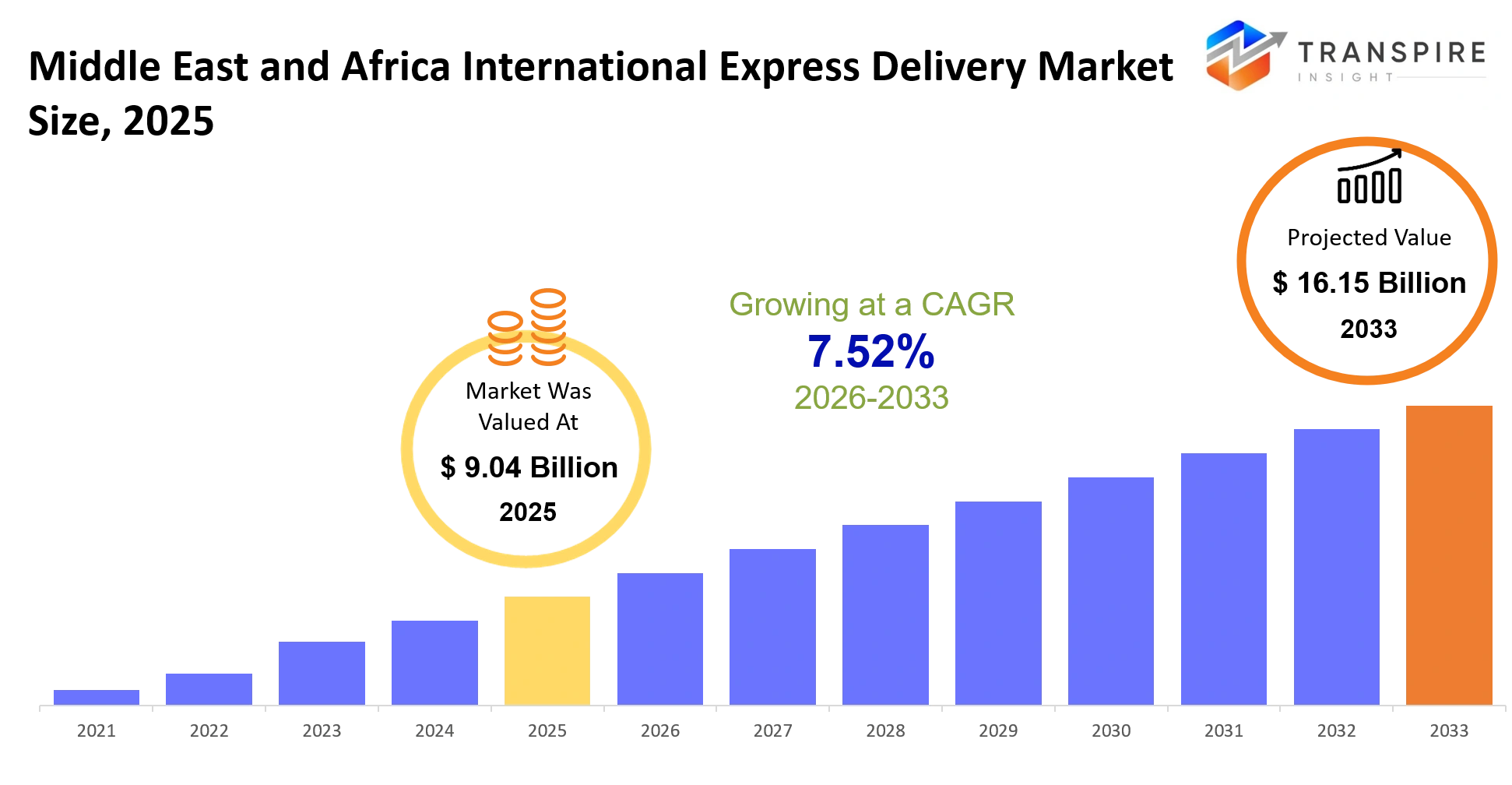
- Middle East and Africa International Express Delivery Market Size 2025: USD 9.04 Billion
- Middle East and Africa International Express Delivery Market Size 2033: USD 16.15 Billion
- Middle East and Africa International Express Delivery Market CAGR: 7.52%
- Middle East and Africa International Express Delivery Market Segments: By Service (Same Day, Next Day, Deferred, Freight Express, Parcel Delivery, Others, Others, Others); By Mode (Air, Road, Rail, Sea, Multimodal, Others, Others, Others); By Shipment Type (Documents, Parcels, Freight, E-commerce Packages, Others, Others, Others, Others); By End User (E-commerce, BFSI, Healthcare, Manufacturing, Retail, Others, Others, Others).
Middle East and Africa International Express Delivery Market Summary
The Middle East and Africa International Express Delivery Market was valued at USD 9.04 Billion in 2025. It is forecast to reach USD 16.15 Billion by 2033. That is a CAGR of 7.52% over the period.
International express delivery services, kind of solve a really critical business issue by moving time-sensitive documents, parcels, medical supplies, industrial components, and e-commerce orders across borders, with predictable transit times, which sounds simple but it really isn’t. In the Middle East and across Africa, these services help keep trade corridors alive, and they also back up digital commerce networks and end to end supply chains that care more about speed and dependability, not the old style freight pace.
In the last five years, the whole market has shifted away from conventional parcel transportation toward more technology driven logistics ecosystems. They’re built around real time tracking, automated sorting, and customs processing that’s integrated in the flow. One big reason for this was the supply chain disruption during ,and right after the COVID-19 period , it basically shone a light on weak spots in traditional logistics networks and made companies invest faster in resilient delivery infrastructure, even if that meant shifting their plans. At the same time cross border e-commerce kept expanding, so more businesses leaned into just in time inventory models , which in turn moved the appetite toward premium delivery services. This pivot then boosted shipment volumes, improved network utilization, and encouraged logistics providers to extend regional hubs, which was kinda the obvious next move. In the end, it opened up stronger revenue opportunities across the broader market.
Key Market Insights
- The Middle East and Africa International Express Delivery Market is growing, kind of quietly yet really fast, as cross-border online retail sales go up more than 15% every year across the main Gulf economies, you know.
- Gulf Cooperation Council nations were close to 42% of the regional revenue in 2025, backed by better logistics hubs and the airport infrastructure.
- The Middle East holds the largest market slice, and meanwhile Africa logistics corridors look like the speediest chance for growth all the way through 2033.
- Parcel delivery was around 38% of the market share in 2025, pushed forward by international e-commerce parcels and direct to consumer fulfillment.
- Freight express stayed the second biggest service block, it helps manufacturing, automotive, and industrial supply networks move smoother.
- Same Day delivery services are expected to grow the quickest through 2033, since companies want rapid replenishment cycles, basically quicker restocks.
- Air transport made up over 55% of international express shipments in 2025, showing how premium time-sensitive delivery can be.
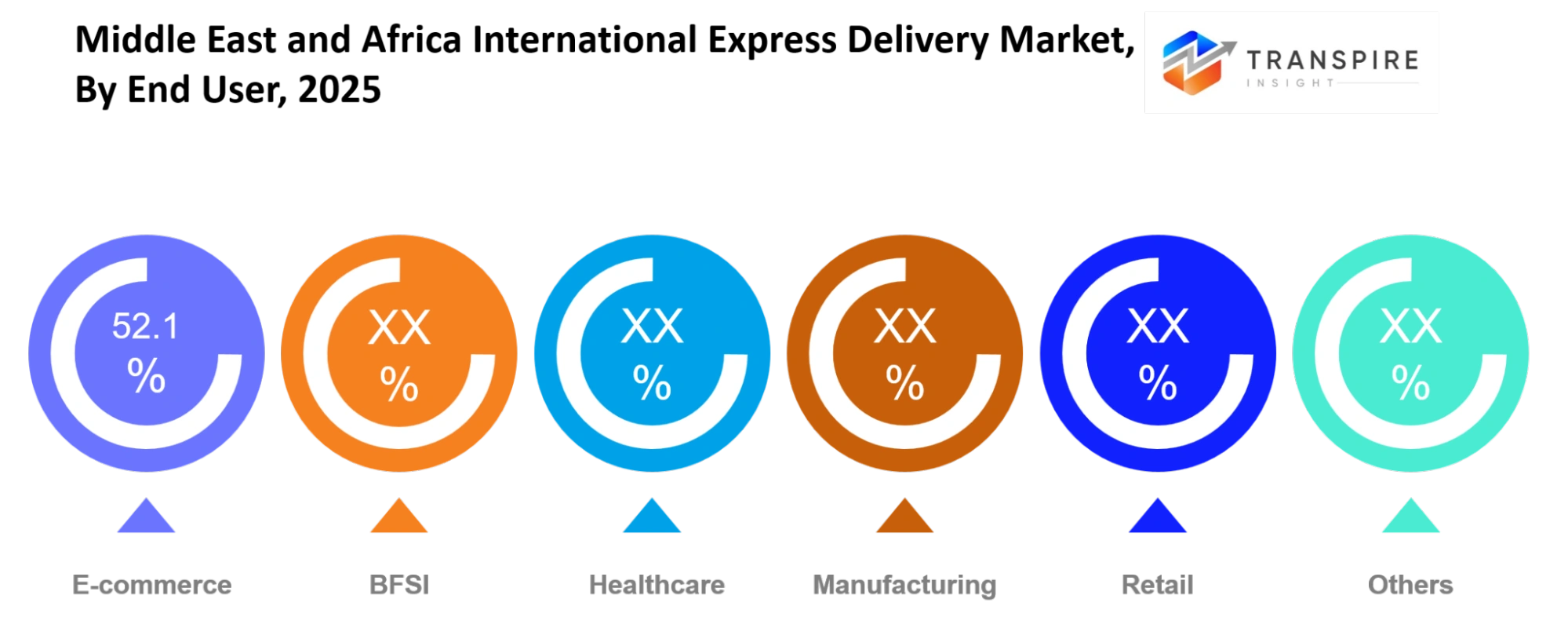
- E-commerce counted for nearly 35% of end-user demand, so it basically dominates the customer side in these regional markets.
- Firms such as DHL, FedEx, UPS, Aramex, DSV, and Kuehne+Nagel keep pushing their plans forward via automation, digital customs processing, and regional fulfillment centers.
- AI enabled route optimization, automated sorting setups, and predictive shipment tracking tools are starting to feel like the real competitive edge inside the express logistics space, for sure.
What are the Key Drivers, Restraints, and Opportunities in the Middle East and Africa International Express Delivery Market?
The strongest growth driver, like honestly is the rapid expansion of cross-border e-commerce and digital trade ecosystems , even if it sounds a bit big. Marketplace adoption, the reach of mobile commerce, and better digital payment infrastructure have lowered barriers for buying internationally across Gulf countries and major African economies. Because of that change, customers want premium parcel delivery services, with dependable transit times and real shipment visibility. Logistics providers then see benefit from more shipment frequency, bigger delivery volumes, and stronger revenue generation, especially from value-added add-ons like customs clearance services and tracking solutions.
Still, the biggest structural barrier shows up as infrastructure disparities across different parts of Africa, which is hard to fix fast. Limited air cargo capacity, road networks that are not fully developed, customs procedures that feel fragmented, and logistics standards that are inconsistent create operational inefficiencies that simply cannot be fixed quickly. These issues raise transportation costs and stretch delivery times, so the service becomes less competitive. The consequence, more or less delayed adoption of premium express delivery services, and weaker market penetration in several emerging economies.
Looking ahead, one major future opportunity is the building of regional logistics corridors along with smart trade hubs. Governments across Saudi Arabia, the UAE, South Africa, Kenya, and Egypt keep investing in airport modernization, free trade zones, and digital customs platforms. If you combine that with AI-based logistics management, plus warehouse automation, delivery efficiency can improve a lot. And when infrastructure quality keeps rising, trade routes that were previously underserved may turn into viable markets for premium international express services, which then opens new revenue paths for logistics providers.
What Has the Impact of Artificial Intelligence Been on the Middle East and Africa International Express Delivery Market?
Artificial intelligence has sort of become a critical operational tool across international express delivery networks throughout the Middle East and Africa ,though it’s not like everyone uses it the same way. Logistics providers now more and more deploy AI-driven route optimization systems, they look at traffic situations, weather shifts, customs processing durations, and shipment priorities, all that to push better delivery results. At the same time automated sorting centers use computer vision plus machine learning routines to sort packages by categories, so less manual handling is needed and throughput feels more stable.
On top of that, predictive analytics platforms help with maintenance planning, especially for delivery fleets and cargo handling equipment. Machine learning models sift through operational signals to spot likely equipment failures ahead of time, so breakdowns don’t surprise anyone as much. That improves asset availability, and can also reduce these annoying service interruptions. Several logistics operators say they’ve actually measured lower fuel use and fewer route inefficiencies because of AI-assisted fleet governance systems. And for customers, real-time shipment visibility platforms help a lot by giving more precise delivery expectations and handling exceptions when something goes off course.
Still, adoption is not fully smooth, because integration costs are big and the data quality stuff can be tricky. In many emerging markets the logistics networks are still pretty fractured ,with digital infrastructure that doesn’t quite match up from place to place. If the access to clean operational data is limited then prediction accuracy drops, and advanced analytics tend to get delayed. But as digital connectivity keeps improving across regional logistics ecosystems ,wider AI deployment is expected to boost efficiency, regulatory compliance, and overall profitability
Key Market Trends
- From 2021 to 2025, cross-border online commerce shipments grew pretty dramatically, and that put more pressure on premium parcel delivery services, you know.
- Air cargo kept taking more of the pie too, and by 2025, it looks like over 55% of time-critical international shipments are moving via air networks.
- DHL and FedEx also pushed out additional automated sorting capacity across different regional hubs, aiming for better processing efficiency, and, yes, shorter transit times.
- After 2022 the take up of AI-driven route optimization jumped quickly, which helped carriers cut fuel costs by estimated double digit percentages.
- Meanwhile digital customs clearance tools have been shaving down documentation processing durations along several Gulf trade corridors, starting around 2023.
- At the same time, same day and next day international delivery choices started appearing in major metropolitan areas, and that has, in turn, shifted how customers expect service to work.
- On top of that, investments into regional airport infrastructure ran into the billions of dollars between 2022 and 2025, strengthening express logistics capabilities across the board.
- E-commerce fulfillment facilities expanded fast in the UAE, Saudi Arabia, South Africa, and Kenya, supporting quicker cross-border distribution.
- Strategic partnerships between airlines and logistics providers increased route reach and improved cargo capacity utilization.
- And sustainability programs nudged fleet procurement decisions toward more fuel-efficient vehicles, plus transportation networks that are better optimized overall.
Middle East and Africa International Express Delivery Market Segmentation
By Service
Same-day services sort of focus on those urgent international shipments that need arrival within a few hours after dispatch, not later. Healthcare products, critical industrial components and high-value commercial documents pretty often lean on this type of service. There are strong tracking options and premium transportation networks that support day-to-day operational performance. Providers keep expanding their coverage, across the major trade hubs, step by step.
Business users usually choose same-day solutions because it helps them sidestep production delays and contract disruptions. Express carriers often set aside dedicated transport capacity to keep delivery promises intact. Advanced routing systems boost overall efficiency and also improve shipment visibility. Revenue input keeps growing too, as time-sensitive logistics needs keep increasing.
By Mode
Air transportation is still the main way for urgent cross-border deliveries, mostly because it’s fast, and it stays reliable , which matters a lot. Road networks give that key first-mile and last-mile access, kind of the “get it going then bring it home” part. Rail fits particular freight corridors where the infrastructure is actually there, and where it makes sense in practice. Sea transport handles shipments that really care about cost, especially when the journey is longer, yet international. So overall each mode brings its own operational benefits, and they work together inside regional logistics nets .
Multimodal transportation, on the other hand, stitches together multiple modes to tune cost, transit time, and service flexibility . Logistics providers now more often bundle air, sea, road, and rail capabilities into one delivery package, rather than treating them separately. Also, more advanced tracking platforms help with end-to-end visibility, across every movement stage. There are other transport modes too, but they’re usually for special operational needs, and for niche cargo types.
By Shipment Type
Even today, document shipments stay pretty central for legal , finance , and corporate messages that have to arrive securely across borders. Parcel transportation is also involved, you know, for consumer products and business goods that move through cross border trade lanes. Then there are freight shipments, which really back industrial operations and the manufacturing supply chain. Each group, in a slightly different way, impacts how the network gets used and how service revenues come in.
E-commerce packages count as one of the more lively shipment types, largely because online retail keeps growing, and it’s not just hype. Fulfillment networks tend to lean more toward streamlined package processing and reliable tracking, basically to keep everything flowing. Beyond that, you still have other shipment types, including specialized cargo that needs uncommon handling procedures, and sometimes extra paperwork. When providers diversify their shipment portfolio, it helps them steady revenue sources while also reducing operational risk, even if the demand shifts around.
By End User
E-commerce comes with big shipment volumes, from international consumer buying behavior, and it kinda keeps going. BFSI organizations depend on safe transport of financial papers, as well as delicate materials. In healthcare, institutions demand speedy transfer of medical products and diagnostic items. Manufacturing groups count on on-time movement of parts and production inputs, otherwise the whole thing slows down.
Retail firms use international express networks to keep stock on hand and to back omnichannel sales, which is kinda the whole point. Other end users show up too, like public agencies, schools, and niche commercial segments. Since customers have different needs, that pushes service innovation and network expansion. Industry participants keep working on logistics abilities that fit each sector, and they keep refining it.
What are the Key Use Cases Driving the Middle East and Africa International Express Delivery Market?
Cross-border e-commerce is the biggest use case in the whole market, and it’s not subtle about it. International retailers, as well as online marketplaces, lean on express delivery services to move consumer goods quickly across national borders. With fast transit times , plus shipment visibility, and customs handling that’s reliably managed, merchants and buyers end up seeing real value.
Healthcare logistics, and also manufacturing supply chains, are getting more and more attention as major application areas. Pharmaceutical distributors often choose expedited transportation for medical products. At the same time, manufacturers rely on urgent delivery of production components so they can prevent operational disruptions, and avoid inventory shortages too.
There are also newer, emerging applications that look like specialized logistics support for technology products, high-value electronics, and digital trade ecosystems. These often operate through regional free zones, and that setup seems to be gaining traction. Growth in cross-border small business exports, together with direct-to-consumer international sales, is expected to open up more opportunities during the forecast period.
|
Report Metrics |
Details |
|
Market size value in 2025 |
USD 9.04 Billion |
|
Market size value in 2026 |
USD 9.72 Billion |
|
Revenue forecast in 2033 |
USD 16.15 Billion |
|
Growth rate |
CAGR of 7.52% from 2026 to 2033 |
|
Base year |
2025 |
|
Historical data |
2021 - 2024 |
|
Forecast period |
2026 - 2033 |
|
Report coverage |
Revenue forecast, competitive landscape, growth factors, and trends |
|
Regional scope |
Middle East and Africa (Saudi Arabia, United Arab Emirates, South Africa, Rest of Middle East and Africa) |
|
Key company profiled |
DHL, FedEx, UPS, Aramex, TNT, SF Express, Blue Dart, DSV, DB Schenker, CEVA, Kuehne+Nagel, Nippon Express, Emirates Logistics, J&T Express, DTDC. |
|
Customization scope |
Free report customization (country, regional & segment scope). Avail customized purchase options to meet your exact research needs. |
|
Report Segmentation |
By Service (Same Day, Next Day, Deferred, Freight Express, Parcel Delivery, Others, Others, Others); By Mode (Air, Road, Rail, Sea, Multimodal, Others, Others, Others); By Shipment Type (Documents, Parcels, Freight, E-commerce Packages, Others, Others, Others, Others); By End User (E-commerce, BFSI, Healthcare, Manufacturing, Retail, Others, Others, Others). |
Which Regions are Driving the Middle East and Africa International Express Delivery Market Growth?
The Middle East kinda stands out as the dominant regional market. There’s advanced airport infrastructure, plenty of free trade zones and also strong government investment in logistics modernization, which helps keep market leadership pretty solid. Nations like Saudi Arabia and the UAE function as major international trade gateways, linking Asia, Europe, and Africa in a direct way. Plus , efficient customs processes along with wide cargo handling capacity, really reinforces regional competitiveness overall, I mean it works together.
Africa comes next, ranking as the second-largest contributor but it does not follow the same growth style. Here, market performance is more tied to deepening regional trade integration, and also to upgrading transportation connectivity. South Africa, Kenya, and Egypt offer relatively stable logistics ecosystems, backed by continuous infrastructure development. Ongoing investment in freight corridors and digital trade platforms then supports consistent revenue, more or less.
Sub-Saharan Africa is currently the fastest-growing regional opportunity. In recent times , investments in airports, logistics parks, and customs modernization initiatives have improved access to the market. As digital commerce activity keeps expanding, and regional economic integration continues, new shipment flows keep showing up. Altogether, these changes create worthwhile prospects for logistics providers aiming for long-term expansion during 2026 to 2033.
Who are the Key Players in the Middle East and Africa International Express Delivery Market and How Do They Compete?
Competition is still moderately consolidated, like you know, global logistics firms trade places with regional specialists, sort of side by side. The real yardstick, however, is service dependability, how wide the network spreads, customs know how, then delivery speed and yes, the technology abilities. Big multinational operators keep pushing their positions forward, mostly via automation and also through integrated logistics platforms. Meanwhile regional providers try to win by using local market insight, and customer responsiveness too.
DHL, for instance, stands out with broad international network coverage, automated sorting operations, and customs brokerage strength that is genuinely hard to beat. FedEx leans hard into air express connectivity, and digital shipment visibility tools, which in turn help maintain that premium delivery performance. UPS uses its integrated transport and supply chain services, essentially offering end-to-end logistics management for multinational customers, without too much friction.
Aramex keeps a solid foothold across Middle Eastern markets through localized delivery networks and e-commerce fulfillment services. Kuehne+Nagel expands by combining freight with express logistics offerings, and DSV improves market presence through well-timed acquisitions plus multimodal transportation capabilities. All these players continue to invest in automation, warehouse technology, and regional hub expansion, so they can improve operational efficiency, and secure that competitive edge, even when the environment shifts.
Company List
- DHL
- FedEx
- UPS
- Aramex
- TNT
- SF Express
- Blue Dart
- DSV
- DB Schenker
- CEVA Logistics
- Kuehne+Nagel
- Nippon Express
- Emirates Logistics
- J&T Express
- DTDC
Recent Development News
In May 2026, DHL Express signed a long-term sustainable aviation fuel (SAF) offtake agreement with SAF One in Bahrain. The agreement secures 25,000 metric tons of SAF annually and strengthens DHL's regional aviation sustainability strategy while supporting future air express capacity growth in the Middle East.
Source: https://group.dhl.com
In February 2026, Aramex launched an AI-first global data foundation built on Google Cloud. The platform creates a unified data architecture across Aramex's network, enabling real-time logistics intelligence, operational visibility, and advanced AI applications across international delivery operations.
Source: https://mid-east.info
In March 2026, DHL Express confirmed plans to continue investing more than €500 million across Middle Eastern markets through 2030 despite regional geopolitical disruptions. The investment focuses on aviation capacity, logistics infrastructure, and regional network expansion supporting international express delivery growth.
Source: https://www.reuters.com
What Strategic Insights Define the Future of the Middle East and Africa International Express Delivery Market?
Competition is still moderately consolidated, like you know, global logistics firms trade places with regional specialists, sort of side by side. The real yardstick, however, is service dependability, how wide the network spreads, customs know how, then delivery speed and yes, the technology abilities. Big multinational operators keep pushing their positions forward, mostly via automation and also through integrated logistics platforms. Meanwhile regional providers try to win by using local market insight, and customer responsiveness too.
DHL, for instance, stands out with broad international network coverage, automated sorting operations, and customs brokerage strength that is genuinely hard to beat. FedEx leans hard into air express connectivity, and digital shipment visibility tools, which in turn help maintain that premium delivery performance. UPS uses its integrated transport and supply chain services, essentially offering end-to-end logistics management for multinational customers, without too much friction.
Aramex keeps a solid foothold across Middle Eastern markets through localized delivery networks and e-commerce fulfillment services. Kuehne+Nagel expands by combining freight with express logistics offerings, and DSV improves market presence through well-timed acquisitions plus multimodal transportation capabilities. All these players continue to invest in automation, warehouse technology, and regional hub expansion, so they can improve operational efficiency, and secure that competitive edge, even when the environment shifts.
Middle East and Africa International Express Delivery Market Report Segmentation
By Service
- Same Day
- Next Day
- Deferred
- Freight Express
- Parcel Delivery
- Others
By Mode
- Air
- Road
- Rail
- Sea
- Multimodal
- Others
By Shipment Type
- Documents
- Parcels
- Freight
- E-commerce Packages
- Others
By End User
- E-commerce
- BFSI
- Healthcare
- Manufacturing
- Retail
- Others
Frequently Asked Questions
Find quick answers to common questions.
The expected Middle East and Africa International Express Delivery Market size for the market will be USD 16.15 Billion in 2033.
Key segments for the Middle East and Africa International Express Delivery Market are By Service (Same Day, Next Day, Deferred, Freight Express, Parcel Delivery, Others, Others, Others); By Mode (Air, Road, Rail, Sea, Multimodal, Others, Others, Others); By Shipment Type (Documents, Parcels, Freight, E-commerce Packages, Others, Others, Others, Others); By End User (E-commerce, BFSI, Healthcare, Manufacturing, Retail, Others, Others, Others).
Major Middle East and Africa International Express Delivery Market players are DHL, FedEx, UPS, Aramex, TNT, SF Express, Blue Dart, DSV, DB Schenker, CEVA, Kuehne+Nagel, Nippon Express, Emirates Logistics, J&T Express, DTDC.
The Middle East and Africa International Express Delivery Market size is USD 9.04 Billion in 2025.
The Middle East and Africa International Express Delivery Market CAGR is 7.52% from 2026 to 2033.
- DHL
- FedEx
- UPS
- Aramex
- TNT
- SF Express
- Blue Dart
- DSV
- DB Schenker
- CEVA Logistics
- Kuehne+Nagel
- Nippon Express
- Emirates Logistics
- J&T Express
- DTDC
About the Authors

Mayur Shinde
I am Mayur Shinde, a Senior Research Analyst at Transpire Insight, specializing in the Automotive & Transportation and Information & Communication Technology (ICT) Industry. My work focuses on analyzing emerging market trends, technological advancements, competitive landscapes, and industry developments to deliver accurate, data-driven insights. I am passionate about transforming complex market information into clear, actionable content that helps businesses, professionals, and decision-makers stay informed and make confident strategic decisions.

Chakradhar Khansole
Chakradhar serves as the Research Director at Transpire Insight, bringing over 8 years of experience in technology, innovation, and strategic market intelligence. He specializes in transforming complex market data into actionable business insights that enable organizations to make informed, growth-oriented decisions. Recognized for his strategic vision and analytical expertise, Chakradhar leads high-impact research initiatives, delivering comprehensive market assessments, competitive intelligence, and forward-looking industry analysis.
Recently Published Reports
-
Apr 2026
ATV & UTV Market
ATV & UTV Market Size, Share & Analysis Report By Type (ATV, and UTV), By Variants (Less Than 400 CC, 400 CC To 800 CC, and More Than 800 CC), and Geography (North America, Europe, Asia-Pacific, Middle East and Africa, South and Central America), 2021 - 2031
-
Apr 2026
Automotive Central Gateway Module Market
Automotive Central Gateway Module Market Size, Share & Analysis Report By Type (Ethernet Central Gateway Module, CAN Central Gateway Module, LIN Central Gateway Module, and FlexRay), By Application (Powertrain Control, Body Control, Infotainment System, Advanced Driver Assistance Systems (ADAS), and Others), By End User (Passenger Vehicles, and Commercial Vehicles), and Geography (North America, Europe, Asia-Pacific, Middle East and Africa, South and Central America), 2021 - 2031
-
Apr 2026
Automotive Engine Oil Filter Market
Automotive Engine Oil Filter Market Size, Share & Analysis Report By Filter Type (Fuel Filter, Engine Oil Filter, Hydraulic Oil Filter, and Others), By Filter Media (Cellulose, Synthetic, and Micro), By Sales Channel (OEMs, and Aftermarket), By Vehicle Type (Passenger Cars, Light Commercial Vehicles, Heavy Duty Trucks, Buses and Coaches, and Off-road Vehicles), and Geography (North America, Europe, Asia-Pacific, Middle East and Africa, South and Central America), 2021 - 2031
-
Apr 2026
Automotive Parts Aluminium Die Casting Market
Automotive Parts Aluminium Die Casting Market Size, Share & Analysis Report By Production Process (Pressure Die Casting, Vacuum Die Casting, Squeeze Die Casting, Gravity Die Casting), By Application (Body Parts, Engine Parts, Transmission Parts, Battery And Related Components, Other Application Types), and Geography (North America, Europe, Asia-Pacific, Middle East and Africa, South and Central America), 2021 - 2031
Our Clients



