
Middle East and Africa In Vitro Toxicology Testing Market Summary
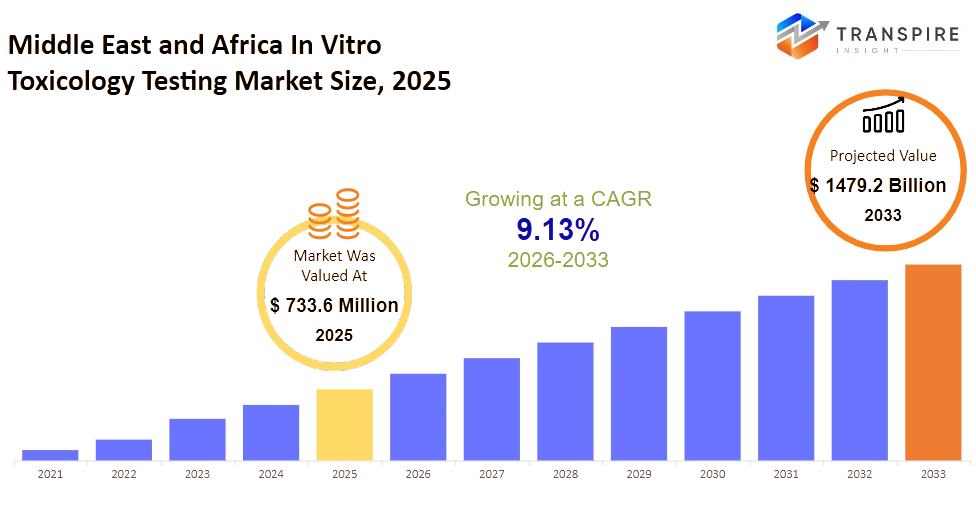
As per Transpire Insight Analysis the Middle East and Africa In Vitro Toxicology Testing Market size is estimated at USD 733.6 Million in 2025 and is anticipated to reach USD 1479.2 Billion by 2033, growing at a CAGR of 9.13% from 2026 to 2033.
The Middle East and Africa In Vitro Toxicology Testing Market kinda supports pharmaceutical developers , chemical manufacturers and research organizations by offering lab-based safety evaluations that cut down on animal testing and help speed up product approval time lines. Over the last few years the market has shifted a lot, not just slowly, mostly because biotechnology adoption ramped up , regulatory pressure got stronger, and advanced cell-based testing methods changed how safety assessment is done. One big structural change is moving away from traditional toxicity screening to automated high-throughput setups, using 3D cell models , organ-on-chip systems and AI aided analysis too, which is… honestly a different workflow than before. The COVID-19 pandemic also pushed investment in local research capabilities, and demand for quicker drug development processes across the region went up. Growth is being backed by pharmaceutical expansion, government funding in life sciences, and partnerships with global testing providers , which are improving access to more advanced toxicology solutions and boosting regional uptake.
Middle East and Africa In Vitro Toxicology Testing Market Size & Forecast:
- Middle East and Africa In Vitro Toxicology Testing Market Size 2025: USD 733.6 Million
- Expected Market Value 2033: USD 1479.2 Billion
- Forecast CAGR: 9.13%
- Leading region in 2025: Middle East
- Fastest Growing region:North Africa
- Key Profile: Thermo Fisher Scientific, Charles River Laboratories, Eurofins Scientific, Agilent Technologies, Bio-Rad Laboratories, Danaher, Merck KGaA, PerkinElmer, Promega, Sartorius, BioIVT, Labcorp, InSphero, Lonza, Creative Bioarray
Key Market Insights
- The Middle East and Africa In Vitro Toxicology Testing market growth kind of gets shaped by more biotechnology investments, and lately the advanced screening platforms are being taken up more after 2020 or so, depending on how you look at it.
- Pharmaceutical firms seem to be moving toward cell based assays since regulatory agencies are pushing for alternatives, not just the usual animal toxicity studies, it’s sort of encouraged.
- Saudi Arabia and the UAE still dominate regional adoption, mostly because healthcare modernization programs keep moving ahead, and because there is solid biotechnology infrastructure funding in place.
- South Africa keeps a notable market share through established research institutions, CRO networks, and its broader pharmaceutical testing capabilities.
- Also 3D cell culture approaches, and organ-on-chip technologies too are showing the fastest growth, because laboratories are trying to get more human relevant toxicity models rather than relying only on older methods.
- At the same time, high throughput screening platforms are gaining traction among pharmaceutical developers, mainly to cut down testing timelines and to improve how compounds get evaluated.
- After 2024, AI powered toxicology analytics appear to be expanding, which helps teams predict toxicity faster and improves overall research efficiency. Meanwhile CRO expansion across Middle Eastern countries is creating fresh testing capacity via partnerships with global technology providers.
- Thermo Fisher Scientific, Charles River Laboratories, and Eurofins Scientific continue to strengthen their regional standing through broader technology portfolios, plus service expansion.
- And on the policy side, government backed life science initiatives are increasing funding for advanced research labs, and for regulatory testing facilities, which in turn keeps the ecosystem moving.
What are the Key Drivers, Restraints, and Opportunities in the Middle East and Africa In Vitro Toxicology Testing Market?
The main driver behind the Middle East and Africa In Vitro Toxicology Testing Market seems to be the ongoing expansion of pharmaceutical , and biotechnology research infrastructure in places like Saudi Arabia, the UAE, and South Africa. A lot of it is pushed by government supported healthcare programs, plus local drug manufacturing initiatives. On top of that, there’s regulatory pressure to upgrade safety evaluation methods so labs can more or less adopt newer in vitro platforms. In practice these approaches can shorten testing time, they can boost predictive accuracy, and they also let companies keep a tighter grip on research costs while they’re developing drugs.
Still, there’s a big restraint that keeps coming up, namely the limited access to specialized laboratory infrastructure and the shortage of trained professionals across parts of Africa and several developing markets in the Middle East. Building advanced testing facilities needs heavy capital , plus real technical know-how and ongoing equipment upkeep. Because of this, adoption tends to move slower outside the biggest biotechnology hubs.
At the same time, there are meaningful opportunities too, especially around AI integrated toxicology platforms and organ on chip technologies. Pharmaceutical firms are putting more money into predictive models that can parse biological reactions faster, and they back up efforts in personalized medicine research. Also, the biotechnology hubs in the UAE and Saudi Arabia create a smoother setting for collaborations , between international technology providers and local research organizations. This is likely to open room for an expansion of advanced testing services.
What Has the Impact of Artificial Intelligence Been on the Middle East and Africa In Vitro Toxicology Testing Market?
Artificial intelligence is kind of reshaping the Middle East and Africa In Vitro Toxicology Testing Market because it helps a lot with toxicity prediction, lab automation, and research choices in practice, even if it sounds a little theoretical. AI powered platforms can chew through enormous biological datasets, coming from cell assays , genomic studies and chemical screening programs, and then they sort of flag likely toxic effects early, like before things move too far into development. In response, pharmaceutical firms as well as research labs are leaning on machine learning models to sift and rank safer compounds, which in turn reduces the odds of setbacks during later testing phases.
Meanwhile, digital technologies are improving day to day lab operations in a kind of quiet way too, using automated image analysis, robotic screening systems, plus more comprehensive data management platforms.AI-based systems can process microscopy images from cell cultures, pick up toxicity patterns, and basically back up quicker evaluation of drug candidates. With these changes, labs can raise testing capacity while also shrinking the need for so much manual analysis work.
Still, there are some limits to adoption, mostly because the implementation cost is high, the availability of high-quality toxicology datasets is not consistent across the region, and there are shortages of specialists who can manage advanced computational setups. So, the pace of AI integration across regional toxicology laboratories will likely depend on continued investment in digital infrastructure and workforce training, not just pilots.
Key Market Trends
- After 2020, a lot of pharmaceutical companies kind of shifted toward cell based toxicity models, aiming to improve drug safety evaluation , and also speed up development timelines.
- Since 2022 GCC countries started pushing more money into biotechnology, which led to new lab capacity for advanced toxicology testing services.
- Then after 2023, organ on chip platforms got more attention, because researchers wanted more human relevant toxicity prediction , instead of the older ways.
- Around 2024 AI based toxicology analysis started showing up more, it made interpretation faster for those complex biological screening datasets.
- In the meantime CRO networks grew across Middle Eastern markets, while pharma companies outsourced specialized safety testing activities, more often than before.
- Regulatory laboratories also began adopting automated screening tools at higher rates, to boost testing accuracy, and to keep compliance moving efficiently.
- Also 3D cell culture models gained traction, as alternatives to traditional two dimensional toxicity assessment methods, even when people already had established workflows.
- Global suppliers like Thermo Fisher Scientific and Eurofins Scientific , strengthened regional partnerships to widen laboratory access and reduce bottlenecks.
- Biotechnology startups increased investment in predictive toxicology platforms, supporting personalized medicine efforts and drug discovery programs.
- Government funded life science initiatives in Saudi Arabia and UAE, helped accelerate demand for advanced research technologies , and that momentum stayed noticeable.
Middle East and Africa In Vitro Toxicology Testing Market Segmentation
By Product Type
Cell culture assays kind of represent a huge product category as pharmaceutical companies, biotechnology firms, and research labs rely on these solutions to see how cells respond to drug candidates, chemicals and other compounds. In practice they give faster safety clues during early discovery phases and they also back up more efficient toxicity screening workflows. On top of that, toxicology reagents and assay kits have their own role, because they bring standardized materials that help make results more trustworthy, cut down on the prep time, and keep lab processes pretty steady across CROs and academic institutions, even when teams are different.
Then there are cell lines, instruments, software, consumables, and other supporting items that add up to a more complete testing environment and make day to day work smoother, along with better research accuracy. Cell lines help build reliable toxicity models, while advanced equipment plus software approaches can assist automation, imaging based readouts and data interpretation. Consumables keep showing up for routine testing tasks, and future adoption should keep rising as regional labs upgrade their facilities with modern toxicology infrastructure.
By Technology
Cell-based assays still seem to get real traction with many pharmaceutical companies, biotechnology organizations, and research institutes, mostly because they give direct views into how biology reacts. In practice, these methods help with drug discovery , chemical safety checks, and regulatory testing too, since they can spot possible toxicity behaviors early on when development is still young. Also, high-throughput screening is getting a bit more attention lately, because labs want quicker readouts for bigger compound collections and they are pushing research output in general.
Meanwhile, Omics approaches, 3D cell culture, organ-on-chip setups, stem cell technology, molecular imaging, and a few other advanced platforms are shifting how toxicity evaluation is done. They tend to offer more dependable, human-relevant signals, since they try to mirror complicated biological settings and that improves the prediction strength. Research organizations, over time, will likely lean into these options as budgets for advanced lab systems grow , and as personalized medicine work keeps expanding across the region.
By Application
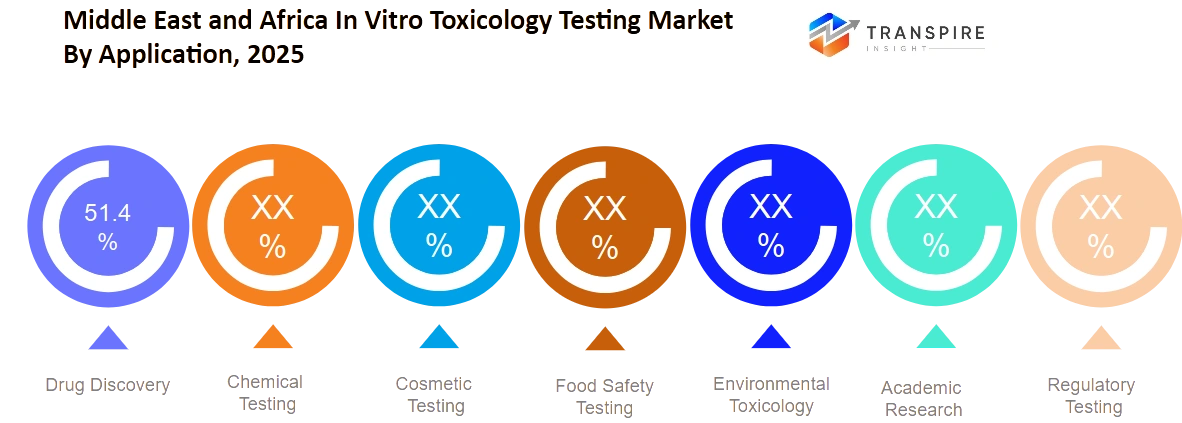
Drug discovery is arguably the biggest application area, largely because pharmaceutical companies rely on in vitro toxicology testing to check compound safety before they even reach clinical trials. These approaches tend to surface dangerous effects earlier, which in turn helps lower development setbacks and makes the whole research program decision process less messy, or at least more informed. Chemical testing is moving forward too, and cosmetic testing is getting more attention as well, since producers increasingly need consistent safety evaluation techniques, mainly to satisfy regulatory expectations and speed up product approval workflows.
Meanwhile, food safety testing, environmental toxicology, work in academic labs, regulatory testing, and a bunch of other uses are also pushing the market outward. Broader adoption of toxicity assessment methods is a big driver here. Food laboratories use these solutions to screen for possible contaminants, whereas environmental organizations study chemical impacts on living systems, kind of like checking how things ripple. Government facilities and universities are adopting modern testing platforms to support their research efforts, regulatory responsibilities, and public safety initiatives, all at once, not just in one phase.
By End User
Pharmaceutical companies show up as one of the leading end-user categories, I mean, drug manufacturers clearly need precise toxicity screening solutions across the whole development timeline. At the same time regional growth in pharmaceutical production, rising research spending, and tightening regulatory demands are all nudging organizations to move toward more advanced in vitro testing platforms. In practice, these tools support faster safety evaluation, and they also lower the chance of late-stage development slip ups, like failures that only appear near the end.
Then there is the whole broader ecosystem too. Biotechnology companies, CROs, academic research institutes, government laboratories, cosmetic manufacturers, food testing labs, and a few other kinds of organizations are steadily increasing the use of toxicology testing solutions. For example, biotechnology firms lean on advanced platforms for inventive research, whereas CROs basically offer specialized testing services directly for pharmaceutical customers. Meanwhile, government and academic labs back up scientific investigations and regulatory assessments, while cosmetic and food testing companies apply these approaches to strengthen their product safety verification.
By Workflow
Cytotoxicity testing and genotoxicity testing still feel like core workflows , because they give meaningful clues about how cells get hurt and what kind of genetic risks chemicals or drug candidates might bring. In practice, many pharmaceutical companies along with research organizations use these kind of assessments during the early development phase , mostly to spot safety problems faster and then make better choices about which compound to push forward. They also keep showing up later, since regulators still expect evidence from these evaluations, and it helps in overall product appraisal too.
At the same time, ADME studies , hepatotoxicity testing, neurotoxicity testing, cardiotoxicity testing , and a bunch of related workflows are getting more attention. Researchers are moving toward a finer safety picture , so ADME studies try to clarify how a compound behaves inside living systems, while hepatotoxicity , neurotoxicity, and cardiotoxicity look at key hazards that can decide whether a program succeeds or stalls. More advanced cell models plus predictive technologies will likely sharpen the results a bit, and they should also help expand adoption across research teams and testing facilities, not just in a few specialized labs.
What are the Key Use Cases Driving the Middle East and Africa In Vitro Toxicology Testing Market?
Drug discovery is still the big driver, you know, the main use case, and it’s what keeps pushing adoption, because pharmaceutical companies and CROs are using in vitro toxicology platforms to check compound safety, basically before clinical trials. In general, these approaches help cut down research delays , since they can surface harmful effects during those early development phases.
Meanwhile chemical testing, alongside regulatory safety evaluation, is getting more traction with chemical manufacturers, government laboratories, and environmental research organizations. On top of that, cosmetic manufacturers are also leaning into alternative toxicity methods to comply with international testing needs , and to speed up product approval efficiency, which everyone likes.
More recent directions are showing up too, like AI-supported predictive toxicology, organ-on-chip testing, and personalized medicine work. Biotechnology organizations, plus academic groups across the UAE, Saudi Arabia, and South Africa are exploring these tools to boost human-leaning toxicity prediction and accelerate overall innovation.
|
Report Metrics |
Details |
|
Market size value in 2025 |
USD 733.6 Million |
|
Market size value in 2026 |
USD 802.4 Million |
|
Revenue forecast in 2033 |
USD 1479.2 Billion |
|
Growth rate |
CAGR of 9.13% from 2026 to 2033 |
|
Base year |
2025 |
|
Historical data |
2021 - 2024 |
|
Forecast period |
2026 - 2033 |
|
Report coverage |
Revenue forecast, competitive landscape, growth factors, and trends |
|
Regional scope |
Middle East and Africa (Saudi Arabia, United Arab Emirates, South Africa, Rest of Middle East and Africa) |
|
Key company profiled |
Thermo Fisher Scientific, Charles River Laboratories, Eurofins Scientific, Agilent Technologies, Bio-Rad Laboratories, Danaher, Merck KGaA, PerkinElmer, Promega, Sartorius, BioIVT, Labcorp, InSphero, Lonza, Creative Bioarray |
|
Customization scope |
Free report customization (country, regional & segment scope). Avail customized purchase options to meet your exact research needs. |
|
Report Segmentation |
By Product Type (Cell Culture Assays, Toxicology Reagents, Assay Kits, Cell Lines, Instruments, Software, Consumables, Others); By Technology (Cell-Based Assays, High-Throughput Screening, Omics Technologies, 3D Cell Culture, Organ-on-Chip, Stem Cell Technology, Molecular Imaging, Others); By Application (Drug Discovery, Chemical Testing, Cosmetic Testing, Food Safety Testing, Environmental Toxicology, Academic Research, Regulatory Testing, Others); By End User (Pharmaceutical Companies, Biotechnology Companies, CROs, Academic Research Institutes, Government Laboratories, Cosmetic Manufacturers, Food Testing Laboratories, Others); By Workflow (Cytotoxicity Testing, Genotoxicity Testing, ADME Studies, Hepatotoxicity Testing, Neurotoxicity Testing, Cardiotoxicity Testing, Others) |
Which Regions are Driving the Middle East and Africa In Vitro Toxicology Testing Market Growth?
The Gulf Cooperation Council (GCC) region shows up as the dominant market area , mainly because of big health sector investments, biotechnology development programs and, of course pharmaceutical manufacturing expansion that keeps growing. Saudi Arabia and the UAE have also pushed their research infrastructure forward via national healthcare transformation initiatives, plus spending on advanced laboratory facilities. Because there are modern hospitals, research centers, and even collaborations with international life science firms, adoption of advanced toxicology testing solutions feels pretty natural. On top of that, regulatory upgrades and government funding for biotechnology projects still build a friendly setup for market growth.
South Africa remains pretty important too, as a meaningful contributor to the regional market, largely due to its established pharmaceutical research ecosystem, academic institutions, and clinical research strengths. When you compare it with GCC countries , South Africa’s expansion is helped by a mature scientific community, experienced researchers, and a solid web of universities and testing laboratories. Steady spending from pharmaceutical companies and research organizations helps keep demand stable for in vitro toxicology solutions. And the existing healthcare infrastructure in the country adds extra comfort for long-term involvement in the market.
North Africa, meanwhile, is projected to see the quickest growth throughout the forecast period, especially as countries like Egypt and Morocco ramp up pharmaceutical manufacturing and research capabilities. With new investments going into healthcare infrastructure, local drug production , and biotechnology initiatives, there are openings for advanced testing technologies. Regulatory frameworks are improving, and partnerships with international laboratory providers are also helping companies move in more easily.
Who are the Key Players in the Middle East and Africa In Vitro Toxicology Testing Market and How Do They Compete?
The Middle East and Africa In Vitro Toxicology Testing Market has a pretty competitive structure where big global life science players hold a large chunk , mostly because of advanced technologies, wide product menus and those more specialized testing services too. What people compete on is not just price, but also innovation , more lab automation and how accurate the analytical work is. They also try to stand out by being able to offer integrated research solutions, kind of end to end. At the same time, the older, well known firms keep pushing harder in the region through partnerships with pharmaceutical companies, research institutes , and government laboratories. Meanwhile, more niche tech providers are also getting chances , for example via organ-on-chip platforms, and AI based toxicology analysis, which sounds fancy but it is still just a way to enter through specific needs.
Thermo Fisher Scientific shows up with a broad portfolio of laboratory instruments , reagents, and research solutions that collectively support full toxicology workflows. They keep their edge by offering scalable platforms for pharmaceutical discovery work, and by expanding access to more advanced laboratory technologies across sites. Charles River Laboratories is a bit different since it leans on integrated discovery and safety assessment services, so pharmaceutical firms can handle the complicated testing expectations from early stages right through to regulatory preparation.
Eurofins Scientific builds competitive advantage using its global laboratory footprint, plus specialized analytical strengths that cover pharmaceutical, chemical, and environmental testing, all under the same umbrella. Agilent Technologies, on the other hand , leans hard into technology innovation, by developing advanced analytical instruments and software solutions aimed at improving laboratory efficiency, faster results, fewer bottlenecks. Danaher also keeps a strong market presence because it has a portfolio of life science businesses, automation technologies, and research tools that help with more advanced toxicity evaluation, even when protocols get demanding.
Company List
•Thermo Fisher Scientific
• Charles River Laboratories
• Eurofins Scientific
• Agilent Technologies
• Bio-Rad Laboratories
• Danaher
• Merck KGaA
• PerkinElmer
• Promega
• Sartorius
• BioIVT
• Labcorp
• InSphero
• Lonza
• Creative Bioarray
Recent Development News
In February 2026, Thermo Fisher Scientific launched advanced laboratory workflow solutions for life science research applications. The development strengthened automated research capabilities by improving laboratory efficiency and supporting faster biological analysis workflows.https://www.thermofisher.com/ (Thermo Fisher Scientific)
In January 2026, Charles River Laboratories expanded technology capabilities through continued investment in digital research and safety assessment platforms. The initiative supported pharmaceutical companies by improving preclinical testing efficiency and strengthening integrated toxicology services.https://www.criver.com/ (Charles River Laboratories)
In March 2025, Eurofins Scientific expanded laboratory service capabilities through strategic investments in analytical testing infrastructure. The expansion improved access to specialized testing services for pharmaceutical, environmental, and chemical research customers.https://www.eurofins.com/ (Eurofins Scientific)
What Strategic Insights Define the Future of the Middle East and Africa In Vitro Toxicology Testing Market?
The Middle East and Africa In Vitro Toxicology Testing Market is kinda moving toward digitally enabled and predictive plus human-relevant testing models, and honestly pharmaceutical companies as well as research institutions are really pushing for faster safety evaluation. The most noticeable structural shift seems to come when artificial intelligence, organ-on-chip platforms, and automated lab systems get tied together, because that combo is meant to boost accuracy , and also cut down development timelines. But there’s a quieter risk that shows up, market concentration around big global technology suppliers, and then smaller labs might struggle a lot with access since equipment costs are high, plus they depend on imported solutions which can be slow.
At the same time there’s an opportunity that is getting clearer, localized toxicology research centers popping up across Saudi Arabia, the UAE, and North Africa. With biotechnology investments increasing there , demand grows for more advanced testing capabilities. For companies trying to enter, it may make more sense to lean into regional partnerships, training programs, and flexible service models, rather than treating it like just equipment sales. If providers build local expertise, and also help support integrated digital workflows, they can better secure long term growth, especially as the regulatory frameworks and pharmaceutical ecosystems continue to mature.
Middle East and Africa In Vitro Toxicology Testing Market Report Segmentation
By Product Type
• Cell Culture Assays
• Toxicology Reagents
• Assay Kits
• Cell Lines
• Instruments
• Software
• Consumables
• Others
By Technology
• Cell-Based Assays
• High-Throughput Screening
• Omics Technologies
• 3D Cell Culture
• Organ-on-Chip
• Stem Cell Technology
• Molecular Imaging
• Others
By Application
• Drug Discovery
• Chemical Testing
• Cosmetic Testing
• Food Safety Testing
• Environmental Toxicology
• Academic Research
• Regulatory Testing
• Others
By End User
• Pharmaceutical Companies
• Biotechnology Companies
• CROs
• Academic Research Institutes
• Government Laboratories
• Cosmetic Manufacturers
• Food Testing Laboratories
• Others
By Workflow
• Cytotoxicity Testing
• Genotoxicity Testing
• ADME Studies
• Hepatotoxicity Testing
• Neurotoxicity Testing
• Cardiotoxicity Testing
• Others
Frequently Asked Questions
Find quick answers to common questions.
The expected Middle East and Africa In Vitro Toxicology Testing Market size for the market will be USD 1479.2 Billion in 2033.
Key segments for the Middle East and Africa In Vitro Toxicology Testing Market are By Product Type (Cell Culture Assays, Toxicology Reagents, Assay Kits, Cell Lines, Instruments, Software, Consumables, Others); By Technology (Cell-Based Assays, High-Throughput Screening, Omics Technologies, 3D Cell Culture, Organ-on-Chip, Stem Cell Technology, Molecular Imaging, Others); By Application (Drug Discovery, Chemical Testing, Cosmetic Testing, Food Safety Testing, Environmental Toxicology, Academic Research, Regulatory Testing, Others); By End User (Pharmaceutical Companies, Biotechnology Companies, CROs, Academic Research Institutes, Government Laboratories, Cosmetic Manufacturers, Food Testing Laboratories, Others); By Workflow (Cytotoxicity Testing, Genotoxicity Testing, ADME Studies, Hepatotoxicity Testing, Neurotoxicity Testing, Cardiotoxicity Testing, Others).
Major Middle East and Africa In Vitro Toxicology Testing Market players are Thermo Fisher Scientific, Charles River Laboratories, Eurofins Scientific, Agilent Technologies, Bio-Rad Laboratories, Danaher, Merck KGaA, PerkinElmer, Promega, Sartorius, BioIVT, Labcorp, InSphero, Lonza, Creative Bioarray.
The Middle East and Africa In Vitro Toxicology Testing Market size is USD 733.6 Million in 2025.
The Middle East and Africa In Vitro Toxicology Testing Market CAGR is 9.13% from 2026 to 2033.
• Thermo Fisher Scientific
• Charles River Laboratories
• Eurofins Scientific
• Agilent Technologies
• Bio-Rad Laboratories
• Danaher
• Merck KGaA
• PerkinElmer
• Promega
• Sartorius
• BioIVT
• Labcorp
• InSphero
• Lonza
• Creative Bioarray
About the Authors

Pankaj Ghogare Patil
I am Pankaj Ghogare Patil, a Senior Research Analyst at Transpire Insight, specializing in the Pharmaceutical, Chemicals & Materials, Healthcare IT, and Biotechnology industry. My expertise lies in conducting comprehensive market research, analyzing industry trends, evaluating competitive landscapes, and translating complex data into actionable insights. At Transpire Insight, I closely follow emerging technologies, regulatory developments, and market innovations to create accurate, well-researched, and informative content that helps businesses and professionals make informed decisions. I am committed to producing credible, evidence-based articles that reflect industry best practices while making technical topics accessible and valuable for a broad audience.

Chakradhar Khansole
Chakradhar serves as the Research Director at Transpire Insight, bringing over 8 years of experience in technology, innovation, and strategic market intelligence. He specializes in transforming complex market data into actionable business insights that enable organizations to make informed, growth-oriented decisions. Recognized for his strategic vision and analytical expertise, Chakradhar leads high-impact research initiatives, delivering comprehensive market assessments, competitive intelligence, and forward-looking industry analysis.
Recently Published Reports
-
Apr 2026
AI in Diabetic Retinopathy Market
AI in Diabetic Retinopathy Market Size, Share & Analysis Report By Type (Screening AI Systems, Diagnostic AI Systems, and Predictive AI Models), By Application Segment (Hospitals, Ophthalmology Clinics, Diagnostic Centers, and Research and Development), and Geography (North America, Europe, Asia-Pacific, Middle East and Africa, South and Central America), 2021 - 2031
-
Apr 2026
Psychometric Tests Market
Psychometric Tests Market Size, Share & Analysis Report By Type (Personality Tests, Ability/Aptitude Tests, Skill/Knowledge Tests, and Others), By Application (Talent Acquisition and Talent Management), and Geography (North America, Europe, Asia-Pacific, Middle East and Africa, South and Central America), 2021 – 2031
-
Apr 2026
Rare Biological Sample Collection Market
Rare Biological Sample Collection Market Size, Share & Analysis Report By Type (Isolation Kits & Reagent, Blood Collection Tubes, and Others), By Application (Oncology, Transcriptomics, Pharmacogenomics, and Others), and Geography (North America, Europe, Asia-Pacific, Middle East and Africa, South and Central America), 2021 – 2031
-
Jul 2026
Diabetic Retinopathy Market
Diabetic Retinopathy Market Size, Share & Analysis Report By Type (Proliferative Diabetic Retinopathy, and Diabetic Macular Edema (DME)), By Treatment Type (Anti VEGF Drug, Steroid Implants, Laser Surgeries, and Vitrectomy), and Geography (North America, Europe, Asia-Pacific, Middle East and Africa, South and Central America), 2021 – 2031
Our Clients







