
Middle East and Africa Immersive Technology Market Size & Forecast:
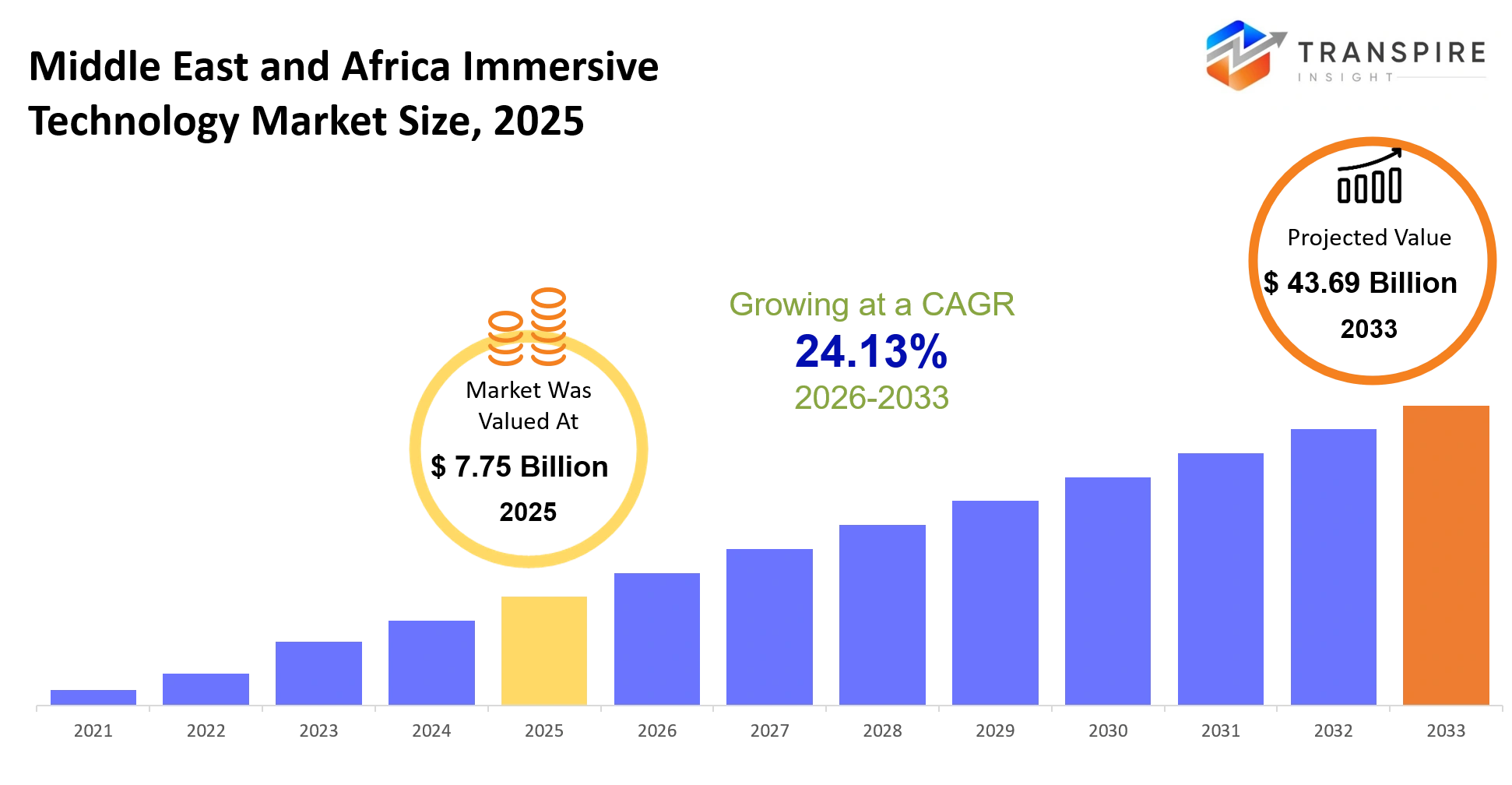
- Middle East and Africa Immersive Technology Market Size 2025: USD 7.75 Billion
- Middle East and Africa Immersive Technology Market Size 2033: USD 43.69 Billion
- Middle East and Africa Immersive Technology Market CAGR: 24.13%
- Middle East and Africa Immersive Technology Market Segments: By Technology Type (VR, AR, MR, XR, Haptics, Spatial Computing, 3D Visualization, Others); By Application (Gaming, Healthcare, Education, Manufacturing, Retail, Real Estate, Defense, Others); By Component (Hardware, Software, Services, Platforms, Sensors, Displays, Controllers, Others); By End User (Consumers, Enterprises, Education, Healthcare, Government, Industrial Users, Others)
Middle East and Africa Immersive Technology Market Summary
The Middle East and Africa Immersive Technology Market was valued at USD 7.75 Billion in 2025. It is forecast to reach USD 43.69 Billion by 2033. That is a CAGR of 24.13%over the period.
Immersive tech is kinda flipping how organizations across the Middle East and Africa train staff, work out product design, deliver care, run industrial work, and connect with customers. Virtual reality, augmented reality, mixed reality, plus spatial computing tools help lower training expenses, sharpen decision-making, speed up product development cycles, and build more engaging digital experiences. In fields like manufacturing, energy, healthcare, and education, immersive platforms let users “act out” real-life situations without the usual operational risks or the physical limits people run into.
Over the last five years , the whole market has moved from experimental pilot efforts toward enterprise-scale deployment. One big structural shift is basically the overlap of AI, cloud computing, and immersive technologies, which makes it possible to build more lifelike and more scalable virtual environments. The COVID-19 pandemic basically pushed remote teamwork, virtual training, and digital learning adoption, so many organizations started spending on immersive platforms. And as hardware costs keep easing down , while enterprise software ecosystems get more mature, the typical rollout friction keeps dropping. This shift is boosting commercial take-up, raising revenue from software and services, and nudging organizations to fold immersive solutions into longer-term digital transformation plans
Key Market Insights
- In 2025 Gulf countries accounted for around 42% market share, and it was pretty much supported by smart city initiatives , plus big digital infrastructure investments that keep going.
- The Middle East region dominates the Middle East and Africa Immersive Technology Market because of government-backed digital economy programs, you know how that goes.
- Sub Saharan Africa is showing the fastest growth through 2033, mainly through expanding connectivity and digital education spending that keeps ramping up.
- AR solutions held close to 30% share in 2025, largely benefiting retail , industrial maintenance and also field service applications.
- VR stayed the second-largest segment too, driven by enterprise training , simulation , and workforce development programs.
- Spatial computing is expected to see the quickest growth between 2026 and 2033, since enterprises are adopting next generation workplace technologies more and more.
- In 2025 healthcare applications represented about 22% of market revenue, with surgical simulation and medical training platforms playing a major role there.
- Education is emerging as the fastest-growing application segment, as governments roll out immersive learning programs across schools and universities.
- Consumer adoption still matters, but enterprise users actually generated over 40% of industry revenue in 2025 via large-scale deployments.
- Companies like Meta, Microsoft, Apple, NVIDIA, and Qualcomm are pushing their positions forward through AI integration, hardware innovation, strategic partnerships and also regional expansion initiatives.
What Has the Impact of Artificial Intelligence Been on the Middle East and Africa Immersive Technology Market?
The strongest growth catalyst is the acceleration of enterprise digital transformation programs across various industries, like manufacturing healthcare energy retail and education. More and more organizations now ask for advanced visualization , remote cooperation, and simulation capabilities to lift workforce productivity and cut down operational costs. At the same time the coming together of high-performance processors, cloud infrastructure, artificial intelligence, and next-generation headsets has made things easier to use while also reducing deployment complexity. Since immersive solutions show tangible returns, via shorter onboarding , fewer operational mistakes, and better customer engagement, investment thinking has moved from small trials toward enterprise-wide rollout. That shift naturally supports recurring software subscriptions, platform revenues, and steady expansion of professional services.
The biggest problem still feels like the high total cost of ownership tied to enterprise deployments. Hardware sourcing, software tailoring, network upgrades, cybersecurity obligations, and workforce training all stack up into real implementation expenses. This issue is basically structural, because many organizations in developing economies continue running into infrastructure limits and budget pressure. On top of that, the limited pool of specialized developers and immersive content creators also drags execution timelines. So adoption often stretches out, especially for small and medium-sized organizations, which then delays near-term revenue pickup.
A major opening is AI-powered spatial computing ecosystems. Through advanced digital twins, immersive industrial simulations, and AI-assisted training environments new commercial opportunities are starting to appear.
Key Market Trends
- Since 2022, the enterprise VR training stuff has been growing kind of a lot across manufacturing, energy, healthcare, and defense. Not just a small bump but a real expansion, you know
- In retail, AR adoption jumped by roughly 25% from 2023 to 2025, as brands put more money into virtual product visualization, more immersive viewing of course
- AI-powered digital twin rollouts sped up after 2024, which helped organizations with predictive operational planning ,and also real time asset monitoring too
- Meanwhile, spatial computing investments went up by more than 30% during 2025, after new hardware announcements from Apple and Meta, even if people call it “spatial tech” in everyday talk
- Healthcare providers then expanded immersive surgical training programs, so there’s less dependence on traditional simulation approaches , overall
- Education ministries across Gulf countries increased funding for immersive learning initiatives somewhere between 2023 and 2025, supporting more hands on learning experiences
- NVIDIA , Qualcomm, and Microsoft also tightened ecosystem partnerships, mainly around enterprise AI and XR integration, not only demos
- Manufacturers started moving away from standalone VR applications toward integrated mixed reality platforms, connected to operational systems instead of being separate tools
- Cloud based immersive platforms gained market share as organizations wanted scalable deployment models across multiple sites, teams, and regions
- Lately, competitive moves seem to focus more on software ecosystems, AI strengths , and developer platforms rather than hardware specs alone, at least in most announcements
Middle East and Africa Immersive Technology Market Segmentation
By Technology Type
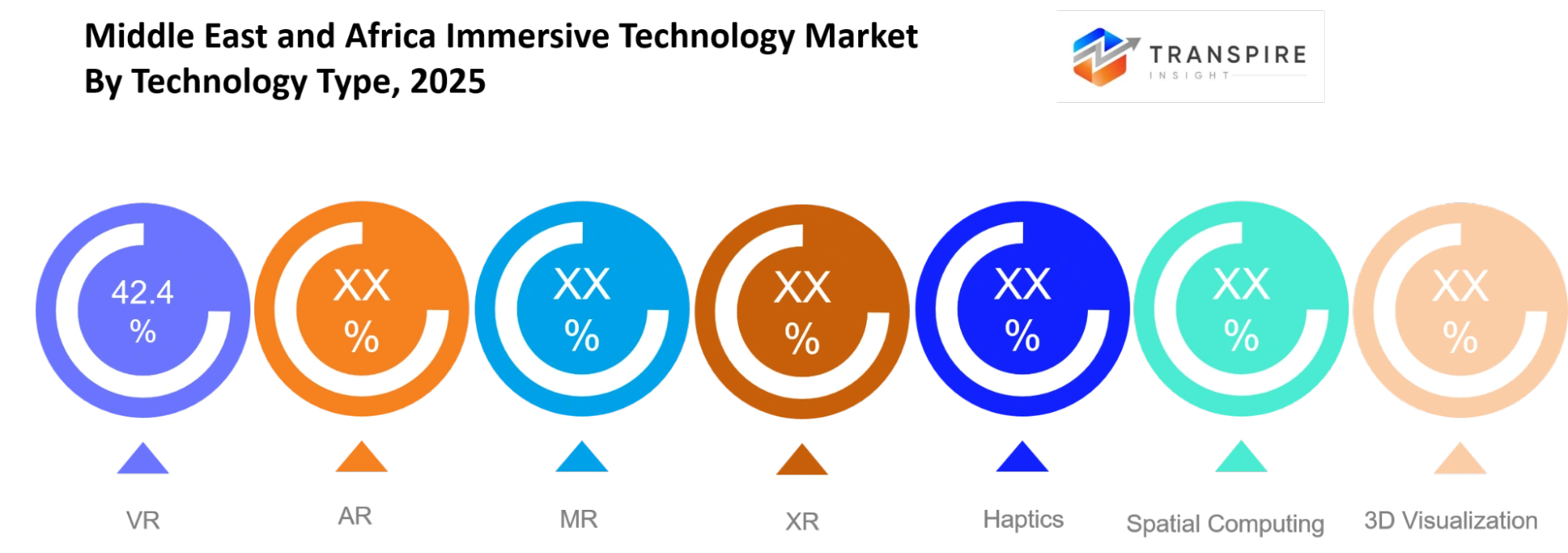
Virtual Reality kind of delivers fully immersed digital spaces, and it is used a lot for workforce training, industrial simulations, gaming moments, and educational use cases. Augmented Reality overlays digital information on top of real-world spaces , so it can help with maintenance work, retail visualization, wayfinding, and healthcare processes. Mixed Reality brings physical things and digital reactions together inside the same shared spaces, which makes more advanced teamwork style experiences for enterprise users. Extended Reality is more like an umbrella term that folds VR, AR, and MR into one combined digital experience.
Haptics tech boosts the immersion, mainly via touch based feedback systems that make training and simulation settings feel more real. Spatial Computing lets you “interact” with digital content through location aware, and context sensitive computing systems. Three Dimensional Visualization supports engineering, architecture, healthcare imaging, product development, and industrial planning, by using realistic visual models. Other technologies include sophisticated tracking systems, wearable devices, immersive audio solutions , and still emerging interface methods that keep widening what these applications can do across many commercial areas.
By Application
Gaming keeps being one of the biggest application areas, mostly because people stay engaged and content keeps getting refreshed. Healthcare organizations, now they also lean on immersive platforms for surgical training, therapy sessions, patient education, plus medical simulation in general. Educational institutions adopt immersive learning tools, to help retention stick better and to strengthen hands on ability.
On the manufacturing side, companies roll out immersive solutions for training the workforce, refining product design, running safety simulations, and pushing operational optimization, even when conditions are messy. Retail businesses, meanwhile, use virtual shopping experiences, product visualization tools, and more tailored customer engagement platforms. Real estate firms often go with immersive property tours and digital visualization systems, so buyers get a clearer feeling before anything physical happens.
Defense organizations deploy advanced simulation environments too, for mission planning, tactical training, and operational readiness. And then there are the other areas like tourism, entertainment, logistics, energy, and public sector services, where immersive experiences tend to lift operational effectiveness overall even if you call it something else.
By Component
Hardware covers things like head mounted displays, smart glasses ,processing devices, cameras and also supporting equipment that basically lets immersive experiences happen. On the other side, software solutions help with content creation, they enable simulation environments, they include analytics tools, and they manage platforms too, in a practical way. Services then step in for implementation ,integration, maintenance, customization and consulting work that you need if deployment is supposed to go smoothly. Platforms act like centralized ecosystems connecting users, applications, content creators, and enterprise systems all together, even when it gets complex.
Sensors matter a lot for motion tracking, environmental mapping, location detection, and watching user interaction. Displays keep moving forward with better resolution ,faster refresh rates, and more visual clarity which in turn improves the whole user experience. Controllers support intuitive navigation and interaction inside virtual and augmented environments. There are also other pieces, connectivity technologies, audio systems, cloud infrastructure tools, plus supporting accessories that round out how the ecosystem functions overall.
By End User
People use immersive tech for gaming, entertainment, hanging out with others, fitness applications and all kinds of digital content feels. Meanwhile enterprises roll out immersive solutions to boost workforce productivity, make training more effective, help with design workflows, and strengthen customer engagement, kind of like a smoother connection overall. Schools and universities put money into immersive learning settings, so practical instruction happens more naturally, and remote collaboration stays less awkward. In healthcare, organizations bring in immersive applications for clinical training, diagnostics, treatment planning, and patient support.
Government bodies also adopt immersive technologies for public services, workforce development, emergency readiness and smart city initiatives. Industrial teams apply immersive systems across manufacturing, logistics, construction, mining, and energy operations, aiming for better efficiency as well as safety results. Other end users include research groups, nonprofit institutions, tourism operators, and professional service providers that plug immersive technologies into very specific operational environments.
What are the Key Use Cases Driving the Middle East and Africa Immersive Technology Market?
Enterprise training plus industrial simulation, is probably the biggest use case pushing everyone to adopt these solutions. In manufacturing sites, energy companies , and defense agencies , they rely on immersive environments to coach staff in a safer way, trim operational mistakes, and boost workforce readiness without constantly interrupting the day-to-day work.
At the same time, healthcare and education keeps growing pretty fast across the region. Hospitals and medical centers are using virtual surgical simulations , along with clinical training systems. Universities and training institutions then roll out immersive learning platforms that tend to raise attention, and help with hands on skill building. Even retail is getting in on it, with augmented reality experiences where customers can preview products before they buy.
New openings are showing up too—like digital twin platforms for smart cities, AI driven spatial computing surroundings, and systems for remote industrial teamwork. Right now these are still early on, but they could become pretty big, especially as infrastructure spending grows , cloud capabilities improve, and enterprise digital transformation programs keep expanding during the forecast window.
|
Report Metrics |
Details |
|
Market size value in 2025 |
USD 7.75 Billion |
|
Market size value in 2026 |
USD 9.62 Billion |
|
Revenue forecast in 2033 |
USD 43.69 Billion |
|
Growth rate |
CAGR of 24.13%from 2026 to 2033 |
|
Base year |
2025 |
|
Historical data |
2021 - 2024 |
|
Forecast period |
2026 - 2033 |
|
Report coverage |
Revenue forecast, competitive landscape, growth factors, and trends |
|
Regional scope |
United States; Canada; Mexico; United Kingdom; Germany; France; Italy; Spain; Denmark; Sweden; Norway; China; Japan; India; Australia; South Korea; Thailand; Brazil; Argentina; South Africa; Saudi Arabia; United Arab Emirates |
|
Key company profiled |
Meta, Microsoft, Apple, Google, Sony, HTC, Unity, Epic Games, Qualcomm, Samsung, Lenovo, NVIDIA, Varjo, Magic Leap, PTC |
|
Customization scope |
Free report customization (country, regional & segment scope). Avail customized purchase options to meet your exact research needs. |
|
Report Segmentation |
By Technology Type (VR, AR, MR, XR, Haptics, Spatial Computing, 3D Visualization, Others); By Application (Gaming, Healthcare, Education, Manufacturing, Retail, Real Estate, Defense, Others); By Component (Hardware, Software, Services, Platforms, Sensors, Displays, Controllers, Others); By End User (Consumers, Enterprises, Education, Healthcare, Government, Industrial Users, Others) |
Which Regions are Driving the Middle East and Africa Immersive Technology Market Growth?
The Gulf region kind of leads market revenue generation, because government support stays strong for digital transformation, smart city growth, and kind of advanced technology take-up. Places like Saudi Arabia and the UAE keep pouring money into innovation ecosystems, cloud infrastructure and next generation connectivity. Big enterprise budgets help push wide roll outs across healthcare, education, manufacturing, and also public sector work. Plus strong technology partnerships, and policy rules that look favorable, keep the region in the lead.
South Africa shows up next, and it feels different from Gulf markets because it blends enterprise demand with real technology services capability, and then adds educational investments as well. The growth is pulled forward by established corporate sectors, who want productivity improvements through digital tools. Ongoing spending on industrial modernization and workforce development initiatives keeps things steady in the market. Meanwhile a growing innovation ecosystem keeps drawing in technology vendors, plus solution providers that want steady demand.
Sub Saharan Africa is starting to look like the fastest growing regional market all the way through 2033. Broadband coverage is widening, digital education programs are spreading, startups are getting more traction, and more technology infrastructure investment is improving the overall situation. Several governments have rolled out digital economy programs, they push innovation and make technology adoption easier. That momentum ends up creating really solid opportunities for technology providers, investors, and platform developers, especially those chasing longer term growth upside.
Who are the Key Players in the Middle East and Africa Immersive Technology Market and How Do They Compete?
Competition stays somewhat moderately concentrated among big global tech firms, mainly ones with solid software ecosystems, solid hardware capability and active developer communities. In general, innovation in technology, not pricing, is still the main way they compete. More and more, vendors are leaning on ecosystem integration as a kind of differentiator, plus AI features, content development tools, cloud connectivity and also enterprise application support. New entrants tend to aim at very specific industry oriented solutions, while the more established players lean hard into scale, and the platform advantages they already have.
Meta is really going after a hardware-software ecosystem fit, using advanced VR headsets and collaborative virtual spaces that feel kinda connected by design. Microsoft differentiates with enterprise mixed reality solutions that sit inside productivity workflows, and they tie those to their cloud platforms too. Apple pushes premium spatial computing experiences, supported by what feels like a tightly integrated hardware and software ecosystem, like everything is meant to click together.
NVIDIA keeps tightening its position via AI, graphics processing, and digital twin technologies that end up powering industrial immersive uses. Qualcomm helps expand the overall ecosystem through specialized XR processors, aiming to enable high performance wearable devices. Unity and Epic Games keep growing their developer networks by offering content creation platforms, which helps teams build immersive applications faster across both enterprise and consumer markets, even when the needs are pretty different.
Company List
- Meta
- Microsoft
- Apple
- Sony
- HTC
- Unity
- Epic Games
- Qualcomm
- Samsung
- Lenovo
- NVIDIA
- Varjo
- Magic Leap
- PTC
Recent Development News
In June 2025, Google advanced its Android XR ecosystem through developer tools, platform enhancements, and ecosystem collaborations that expanded immersive application development opportunities across industries. Source:http://blog.google/products/android/android-xr/
What Strategic Insights Define the Future of the Middle East and Africa Immersive Technology Market?
In the next five to seven years, the market is kind of expected to slide toward AI-powered spatial computing ecosystems that blend immersive moments with enterprise workflows, digital twins, cloud infrastructure, and more advanced analytics. The main push behind this shift is basically the growing need for real-time visualization, remote teamwork, and data led decision making across sectors like healthcare, manufacturing, education, and public services.
There is also a quieter risk, one that doesn’t get as much attention. It’s about ecosystem concentration. A fairly small set of platform providers ends up controlling key things such as hardware, operating systems, developer tools, and the application marketplaces. If an enterprise leans too much on just a few technology ecosystems, that can limit innovation agility, and it can also make switching costs higher than many teams expect.
Still, there’s a pretty strong opportunity taking shape. It’s centered on industrial digital twins connected to AI-driven spatial computing platforms, and this feels especially relevant for Gulf smart city and infrastructure programs. Market players should lean into partnerships that bring together immersive technologies, cloud services, and AI functions. And organizations that craft industry specific solutions instead of generic immersive apps will probably be in a better spot to secure long run value, plus build sustainable competitive differentiation.
Middle East and Africa Immersive Technology Market Report Segmentation
-
By Technology Type
- VR
- AR
- MR
- XR
- Haptics
- Spatial Computing
- 3D Visualization
- Others
-
By Application
- Gaming
- Healthcare
- Education
- Manufacturing
- Retail
- Real Estate
- Defense
- Others
-
By Component
- Hardware
- Software
- Services
- Platforms
- Sensors
- Displays
- Controllers
- Others
-
By End-User
- Consumers
- Enterprises
- Education
- Healthcare
- Government
- Industrial Users
- Others
Frequently Asked Questions
Find quick answers to common questions.
The expected Middle East and Africa Immersive Technology Market size for the market will be USD 43.69 Billion in 2033.
Key segments for the Middle East and Africa Immersive Technology Market are By Technology Type (VR, AR, MR, XR, Haptics, Spatial Computing, 3D Visualization, Others); By Application (Gaming, Healthcare, Education, Manufacturing, Retail, Real Estate, Defense, Others); By Component (Hardware, Software, Services, Platforms, Sensors, Displays, Controllers, Others); By End User (Consumers, Enterprises, Education, Healthcare, Government, Industrial Users, Others).
Major Middle East and Africa Immersive Technology Market players are Meta, Microsoft, Apple, Google, Sony, HTC, Unity, Epic Games, Qualcomm, Samsung, Lenovo, NVIDIA, Varjo, Magic Leap, PTC.
The Middle East and Africa Immersive Technology Market size is USD 7.75 Billion in 2025.
The Middle East and Africa Immersive Technology Market CAGR is 24.13% from 2026 to 2033.
- Meta
- Microsoft
- Apple
- Sony
- HTC
- Unity
- Epic Games
- Qualcomm
- Samsung
- Lenovo
- NVIDIA
- Varjo
- Magic Leap
- PTC
About the Authors

Mayur Shinde
I am Mayur Shinde, a Senior Research Analyst at Transpire Insight, specializing in the Automotive & Transportation and Information & Communication Technology (ICT) Industry. My work focuses on analyzing emerging market trends, technological advancements, competitive landscapes, and industry developments to deliver accurate, data-driven insights. I am passionate about transforming complex market information into clear, actionable content that helps businesses, professionals, and decision-makers stay informed and make confident strategic decisions.

Chakradhar Khansole
Chakradhar serves as the Research Director at Transpire Insight, bringing over 8 years of experience in technology, innovation, and strategic market intelligence. He specializes in transforming complex market data into actionable business insights that enable organizations to make informed, growth-oriented decisions. Recognized for his strategic vision and analytical expertise, Chakradhar leads high-impact research initiatives, delivering comprehensive market assessments, competitive intelligence, and forward-looking industry analysis.
Recently Published Reports
-
Apr 2026
3D Optical Profiler Market
3D Optical Profiler Market Size, Share & Analysis Report By Type (Desktop 3D Optical Profiler, and Portable 3D Optical Profiler), By Technology (Confocal Technology, and White Light Interference), By End-Use Industry (Manufacturing, Research Institutions, Automotive, Aerospace and Defense, Medical Devices, and Other), and Geography (North America, Europe, Asia-Pacific, Middle East and Africa, South and Central America), 2021 - 2031
-
Apr 2026
Depth Sensor Market
Depth Sensor Market Size, Share & Analysis Report By Type (Infrared Depth Sensors, Time-of-Flight (ToF) Sensors, Stereo Vision Sensors, Structured Light Sensors, Ultrasonic Depth Sensors), By Application (Automotive, Robotics, Gaming, Consumer Electronics, Industrial Automation, Healthcare, Security & Surveillance, Others), By End Users (Automotive Manufacturers, Consumer Electronics Companies, Healthcare Providers, Industrial Companies, Security Agencies, Gaming Companies, Robotics Companies, Others), and Geography (North America, Europe, Asia-Pacific, Middle East and Africa, South and Central America), 2021 – 2031
-
Apr 2026
Digital Manufacturing Market
Digital Manufacturing Market Size, Share & Analysis Report By Component (Hardware, Software, and Services), By Technology (Robotics, 3D Printing, Internet of Things (IoT), and Others), By Application (Automotive and Transportation, Aerospace and Defense, Consumer Electronics, Industrial Machinery, and Others), By Process Type (Computer-Based Designing, Computer-Based Simulation, Computer 3D Visualization, Analytics, and Others), and Geography (North America, Europe, Asia-Pacific, Middle East and Africa, South and Central America), 2021 – 2031
-
Apr 2026
Digital Visa Services Market
Digital Visa Services Market Size, Share & Analysis Report By Type (Individual Travelers, Group Travelers), By Application (Tourism, Business Travel, Others), and Geography (North America, Europe, Asia-Pacific, Middle East and Africa, South and Central America), 2021 – 2031