

Global Gaming Industry Market Size & Forecast:
- Global Gaming Industry Market Size 2025: USD 268.74 Billion
- Global Gaming Industry Market Size 2033: USD 600.63 Billion
- Global Gaming Industry Market CAGR: 10.60%
- Global Gaming Industry Market Segments: By Type (PC Gaming, Console Gaming, Mobile Gaming, Cloud Gaming, VR Gaming, Esports Gaming, Others); By Application (Entertainment, Competitive Gaming, Education Gaming, Simulation Training, Social Gaming, Others); By End-User (Casual Gamers, Professional Gamers, Gaming Cafes, Enterprises, Others); By Revenue Model (Subscription-based, In-app Purchases, Advertising-based, Premium Purchases, Others)

To learn more about this report,  Download Free Sample Report
Global Gaming Industry Market Summary:
The Global Gaming Industry Market size is estimated at USD 268.74 billion in 2025 and is anticipated to reach USD 600.63 billion by 2033, growing at a CAGR of 10.60% from 2026 to 2033. The gaming market doesn’t just sell software; it builds live, interactive digital ecosystems. It captures consumer attention through continuous entertainment loops, monetizing via recurring microtransactions and subscriptions rather than one-off retail sales.
In recent years, the industry shifted from a volatile, hit-driven retail model to a highly predictable platform economy. A major structural shift occurred as regulatory anti-steering policies cracked down on the 30% App Store fees. The ultimate real-world trigger was the landmark Epic Games v. Apple antitrust resolution, which legally legitimized alternative web-store billing.
This structural shakeup is directly causing the market to grow. By bypassing traditional platform fees, developers reclaim substantial profit margins. This newly retained capital creates a powerful cause-and-effect loop: increased developer margins lead to heavier investments in continuous content velocity and community engagement, ultimately driving higher player lifetime value and overall industry expansion.
Key Market Insights:
- Asia Pacific leads the global gaming industry market with an estimated market share of 44%, driven by strong mobile gaming adoption, expanding internet penetration, and a large gamer population.
- North America accounts for approximately 27% of the global gaming market, supported by advanced gaming infrastructure, premium console adoption, and high consumer spending on digital entertainment.
- Cloud gaming is emerging as the fastest-growing segment of the global gaming industry due to increasing demand for device-independent gaming experiences and subscription-based access models.
- PC gaming holds around 24% of the market share, maintaining strong popularity among competitive gamers, esports users, and high-performance gaming communities.
- Rising user acquisition costs and stagnant consumer pricing power are significantly compressing profit margins for blockbuster game publishers and large-scale studios.
- Artificial intelligence has evolved from an experimental technology into a critical economic tool that helps gaming companies offset rapidly increasing development budgets.
- Game development studios are increasingly deploying AI-powered tools to accelerate coding, automate workflows, and create digital graphics more efficiently, reducing production costs and development timelines.
What are the Key Drivers, Restraints, and Opportunities in the Global Gaming Industry Market?
Drivers
Market growth is fuelled by cross-platform live-service loops which optimise player lifetime value. This ramp-up was spurred by the fact that high-speed 5G mobile infrastructure has become widely available, effectively eliminating hardware-based barriers to entry. This structural change has turned "passive" engagement into "sticky" and repetitive micro-payments, leading to an increase in average revenue per user (ARPU) and onboarding hundreds of millions of non-interactive digital players around the world.
Restraints
On the other hand, market expansion is severely limited by the exploding budgets of the AAA and extreme platform concentration. This is a genuine deep structural problem, as players love a handful of established, ten-year-old mega-franchises, and push smaller studios into high-stakes content scale cycles that are long games. Expensive acquisition costs combined with little pricing power result in razor-thin developer margins and a huge barrier to discovery for new game titles.
Opportunities
Developer-owned Web stores and direct-to-consumer billing architectures can open the door to growth. This change also enables studios to skirt the storefront tax, which is traditionally 30%, thanks to the regulatory pressure that comes from the European Digital Markets Act (DMA). Mobile publishers that use proprietary billing models immediately regain larger margin control, enabling them to do more with less money, generate localized regional content in the region, or spend more money directly on user retention campaigns.
What Has the Impact of Artificial Intelligence Been on the Global Gaming Industry Market?
AI has revolutionized the gaming industry, impacting production pipelines and live-service operations. Studios use machine learning for automation and optimization, in addition to manual engineering. The tools for Procedural Content Generation (PCG) automatically generate large-scale, photo-realistic digital environments, and the generative AI models can write base code and generate core graphic assets in seconds. This greatly reduces multi-year development time. In the operational sense, publishers use predictive features to analyse large volumes of player data in real-time. These algorithms identify suspicious user behavior and alert fraudsters in real-time, estimate when a player might exit a game, and continuously adapt difficulty settings to ensure optimal player engagement.
These operational improvements have directly benefited the bottom line of the studios. Publishers save significant operational resources, improve visual performance in lower-end hardware running AI upscaling, and increase player lifetime retention by automating repetitive quality assurance (QA) testing. AI tools for game development were increasingly deployed in gaming companies to automate content creation, dialogue generation, and testing, such as Tencent, Sony, and Roblox. According to Reuters, in April 2026, Morgan Stanley reported that advanced AI tools are being increasingly adopted by gaming companies to automate game environment creation, dialogue generation, and software testing.
Key Market Trends:
- Higher-end titles are moving out of the console-only hardware security trend, with cross-play now enabling the easy transfer of profiles between screens at home and on the go.
- The enforcement of regulatory anti-steering has proven to be effective in dismantling the monochannel app store models and enabling alternative direct app stores.
- The linear game development is giving way to simultaneous asset and code production through specialized AI models to compress multi-year creative timelines.
- IP is now flooding out of the traditional interactive media world, with movie versions serving as huge discovery funnels that feed back into the legacy world of catalogs.
- From now on, live-service management is evolving from static content changes to dynamic player monitoring based on deep data algorithms, which forecast exactly when users may leave games.
- Studios have gotten rid of giant, global launch explosions, favoring price tiers and rolling windows across regions to preserve long-tail asset value.
- The average gamer is no longer a young, niche enthusiast who plays for fun, but instead a multi-generational group that sees interactive entertainment as a lifestyle.
- Legacy game preservation is moving towards automated backend tools that will help to clean up old code bases for modern hardware compatibility.
Global Gaming Industry Market Segmentation
By Type
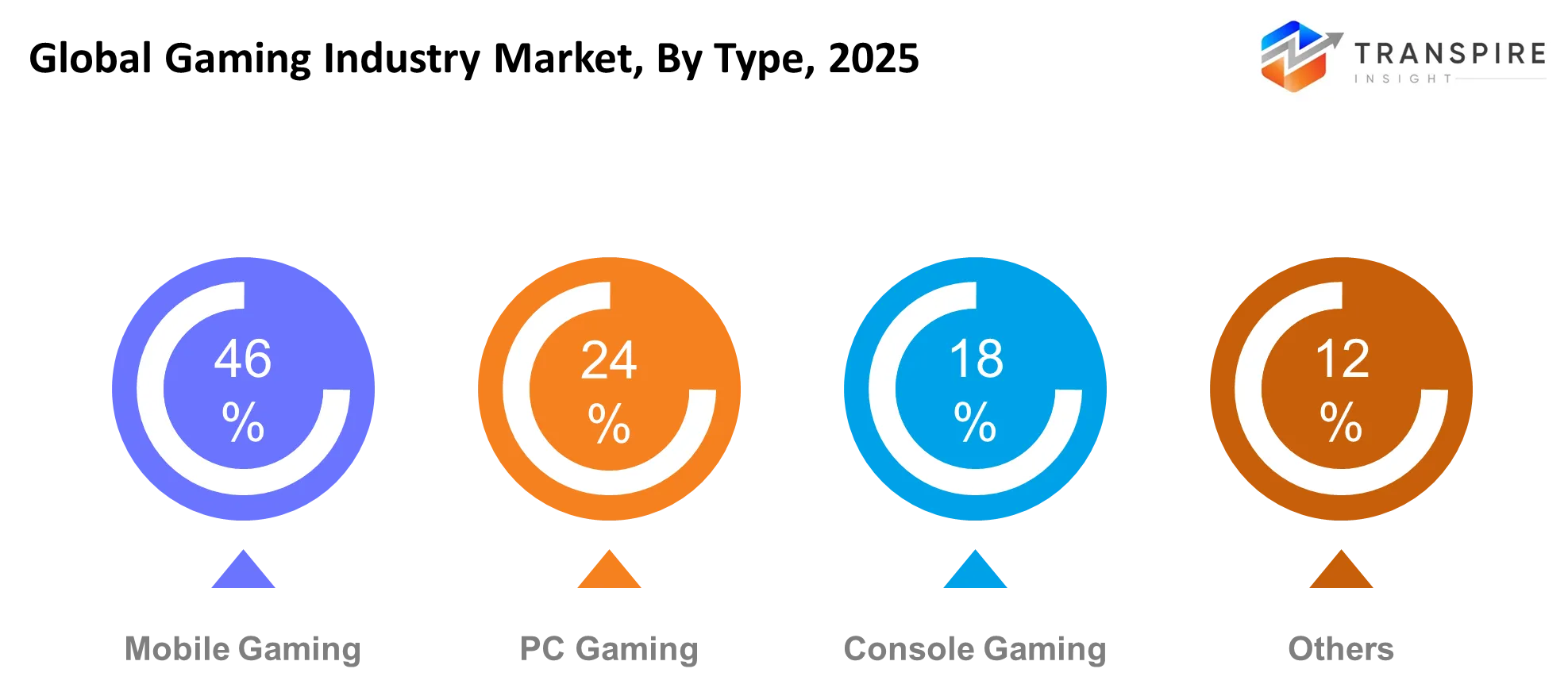
The overall market of the gaming industry is a very strategic and basic market segment of the personal computer market. PC is the 24% market share of the gaming industry. It is the preferred platform for technological innovation, structural game complexity, and graphic processing advances before they are expanded to different gadgets. This segment's growth is largely based on its unique logic, which entails deep customization with users and open-ended ecosystems.
The console market accounts for 18% of the market. This segment is in a premium, locked, high consumer loyalty, and standardized hardware parameter position. It's responsible for massive revenue with exclusive, first-party blockbusters and subscription passes geared toward home television sets.
The sheer number of players and gross transactional revenue (GTR) in the mobile segment is delivering the market share. Through the power of the smartphone, it has been able to make interactive media accessible worldwide. It's an exclusive growth logic, primarily due to low-friction accessibility, hyper-localized payment systems, and the brilliant use of psychological feedback loops that are built into bite-sized, routine playing sessions.
Cloud gaming is the fastest-growing segment of the Global Gaming Industry Market with a CAGR of 14.2%. The segment is an architectural, high-growth vector that aims to make high-quality gaming experiences entirely hardware-independent. It is characterized by the separation of processing power from local consumer equipment and moving the bulk of the processing load to remote server farms. The growth basis is based on removing the typical friction points, which include lengthy download times, limitations on local storage, and high initial computer setup expenses.
The virtual reality portion of the market is a niche and immersive space and is dependent on accessories such as sensory isolation and spatial computing. Although its overall market uptake is limited by headset usability and manufacturing cost, it has some outstanding per-user sales and average session time metrics. The special growth logic is based on the depth of presence and complex physics of space that flat screens can't replicate. The future promise of this segment is that it will eventually become part of lighter mixed-reality glasses, turning these isolated sensory entertainments into ongoing multi-layered digital environments directly overlaid onto “real” environments.
The competitive esports aspect is a strong marketing tool and cultural fixture in the broader entertainment industry. It takes video games from participatory software to a professional spectator sport, and it makes money off of corporate sponsorship, broadcast rights, and physical event ticket sales. The logic of growth is completely media-dependent, celebrity athlete branding, and the naturally acquired retention in the case of normal players emulating the strategies of the professionals. The main concern for this section is the future of such a change in the traditional broadcasting framework of the media, which will come to be deeper and more interactive, in which the audience will be able to choose the parameters of the match and alter them on the spot, thus making a bet.
Other new models include smart home integrated products, handheld micro-consoles, and retro arcade game fitting. Although constituting a small overall share of the revenue, these niche markets occupy a unique position as they are able to resonate with a very strong sense of nostalgia and experimental interest. Their business models are based on touch novelty, place-based physical interaction, and offering non-screen or nostalgic experiences. In the end, these other versions make for very well-integrated interactive experiences in public places and retro collector markets, keeping traditional forms of play alive and challenging new hardware and touch points.
To learn more about this report, Download Free Sample Report
By Application
The entertainment app is a huge commercial segment of the global interactive market where pure play escapism, story immersion, and recreational engagement are paramount. It helps control total consumer playtime, from puzzles and games you can pick up in a few minutes to hundreds of hours of fantasy.
The competitive gaming application is designed as a high-engagement ecosystem, which includes a structured match-making ladder, rewards for skill advancement, and intensive player-versus-player balance. It is built around a player's natural need for online status, social validation, and technical proficiency with the intricate rules and software controls.
The education gaming application is poised to take on a larger and more useful role, combining the best of pedagogical theory and interactive engagement models. It cuts retention time among students by replacing traditional textbook teaching methods with problem-solving.
The simulation training application provides high-fidelity, risk-reduction software for complex professional, industrial, and military procedures. It's market-facing and premium, providing an essential operational intersection between theory and the real-world execution of physical transactions.
The social gaming application emphasizes group interaction, self-expression in the digital world, and the design of virtual communities rather than the traditional win and loss criteria. It is basically an interactive social network, like a modern social network that lets users interact, chat, and collaborate with one another on low-stakes tasks within open digital environments.
Other uses range from therapeutic gaming modules for neurodivergent cognitive therapy to targeted corporate recruitment tools and gamified marketing activations in consumer brands. The alternative use cases gain their market position by using interactive game loops in regular, non-game activities to change human behaviour.
By End-User
The casual gamer end-user segment is the backbone of the industry, comprising billions of everyday consumers who are seeing gaming as a casual and fun way to pass the time without the commitment of a serious game. They like games that are not too time-consuming, don't involve too much mechanical dexterity, and have a mobile platform with low barriers.
The end-user segment of the professional gamer is a small but influential group of competitive gamers and content creators who make a living from their relationship with the games that they play. They lack in quantity but possess great power in the market as they set preferences and bring people to huge engagement levels for certain titles.
The gaming cafe end-user segment is an important physical touch point and provider of access to infrastructure, especially in high-density urban environments and emerging economies. They offer high-quality processing equipment and allow local area networks with zero-latency, even for players who cannot afford expensive equipment and can only access it on an hourly basis.
The enterprise end-user segment includes large corporations, educational institutes, and government bodies that buy and use the interactive software for non-entertainment purposes. The segment has a high value and contract-based market position and demands customized software solutions with a high level of data privacy. The impetus for growth comes from the corporate digital transformation wave, in which organizations need immersive spatial training sessions and interactive visualizations to handle complex datasets.
Other end-users include specific groups such as senior citizen communities playing in the context of cognitive retention games, physically impaired end-users playing using an accessible gaming setup, and academic research institutions researching human-computer interactions. These groups create a separate market niche by deepening the boundaries of the society in which digital media can operate.
Other end-users encompass specialized demographics like senior citizen communities using cognitive retention games, accessible gaming setups for physically impaired individuals, and academic research institutions studying human-computer interactions. These groups maintain a distinct market position by expanding the societal boundaries of who can interact with digital media.
By Revenue Model
It's a subscription-based revenue stream with a very stable platform-centric positioning that's a copy of the business model of the traditional modern streaming giants. It guarantees publishers' highly predictable, recurring monthly income while providing consumers with cost-effective, bulk access to vast libraries of a variety of game titles.
The game-for-free model of revenue generation is the most popular model in the world, where the user comes into the game world for free, but pays for the extra things it offers within the game. It has the ability to corral a ton of money by dividing the players into non-payers and bigger spenders who pay for skins, status items, and structures.
The ad-based revenue model has been the predominant one in the casual mobile space, providing a way to monetize the enormous audience that is unwilling to directly spend money. It turns the attention of the players into the money of the advertisers by offering incentives to watch the videos, clicks on banners, and native product placements.
The premium purchase revenue model was the original business model of the gaming industry, where users pay one time and get a full copy of the game. Although it has lost ground to the live-service models, its share of total revenues has been growing relative to the latter, and it is the gold standard for “narrative-driven” single-player, high-profile blockbusters.
Other revenue structures involve developer crowdfunding, player-to-player secondary transactions, and hardware-software bundle partnerships. These other monetization avenues offer a lifeline of capital to independent creators and specialized hardware innovators outside of the mainstream corporate funding networks.
What are the Key Use Cases Driving the Global Gaming Industry Market?
The major use case of the market is mobile entertainment applications, where the user is able to enjoy the entertainment application on the go in bite-sized sessions. This ongoing cycle of engagement is dependent on a low-friction, casual game design that can be engaging with each day, and which can be sustained with the predictable revenue streams of in-app purchases, the dominant force in the mobile game market.
What's not about gaming infrastructure is that it's getting a lot bigger in the enterprise and education spaces. High-fidelity simulations have been targeted in scenarios across the game development industry, from corporations using cutting-edge game engines for medical procedures to flight operations, to academic institutions using adaptive educational games to allow abstract learning to become interactive, problem-solving applications.
Meanwhile, increased use cases are driving the shift to the social application segment. In today's virtual worlds, software realizes new, modern social utilities, such as persistent digital “places” where global communities meet for live entertainment experiences, corporate remote onboarding, and interactive consumer brand experiences.
Report Metrics
|
Report Metrics |
Details |
|
Market size value in 2025 |
USD 268.74 Billion |
|
Market size value in 2026 |
USD 296.61 Billion |
|
Revenue forecast in 2033 |
USD 600.63 Billion |
|
Growth rate |
CAGR of 10.60% from 2026 to 2033 |
|
Base year |
2025 |
|
Historical data |
2021 - 2024 |
|
Forecast period |
2026 - 2033 |
|
Report coverage |
Revenue forecast, competitive landscape, growth factors, and trends |
|
Regional scope |
United States; Canada; Mexico; United Kingdom; Germany; France; Italy; Spain; Denmark; Sweden; Norway; China; Japan; India; Australia; South Korea; Thailand; Brazil; Argentina; South Africa; Saudi Arabia; United Arab Emirates |
|
Key company profiled |
Sony Interactive Entertainment, Microsoft Xbox, Nintendo, Tencent Games, Activision Blizzard, Electronic Arts, Ubisoft, Epic Games, Valve Corporation, Riot Games, NetEase, Bandai Namco, Roblox Corporation, Sega, Krafton. |
|
Customization scope |
Free report customization (country, regional & segment scope). Avail customized purchase options to meet your exact research needs. |
|
Report Segmentation |
By Type (PC Gaming, Console Gaming, Mobile Gaming, Cloud Gaming, VR Gaming, Esports Gaming, Others); By Application (Entertainment, Competitive Gaming, Education Gaming, Simulation Training, Social Gaming, Others); By End-User (Casual Gamers, Professional Gamers, Gaming Cafes, Enterprises, Others); By Revenue Model (Subscription-based, In-app Purchases, Advertising-based, Premium Purchases, Others) |
Which Regions are Driving the Global Gaming Industry Market Growth?
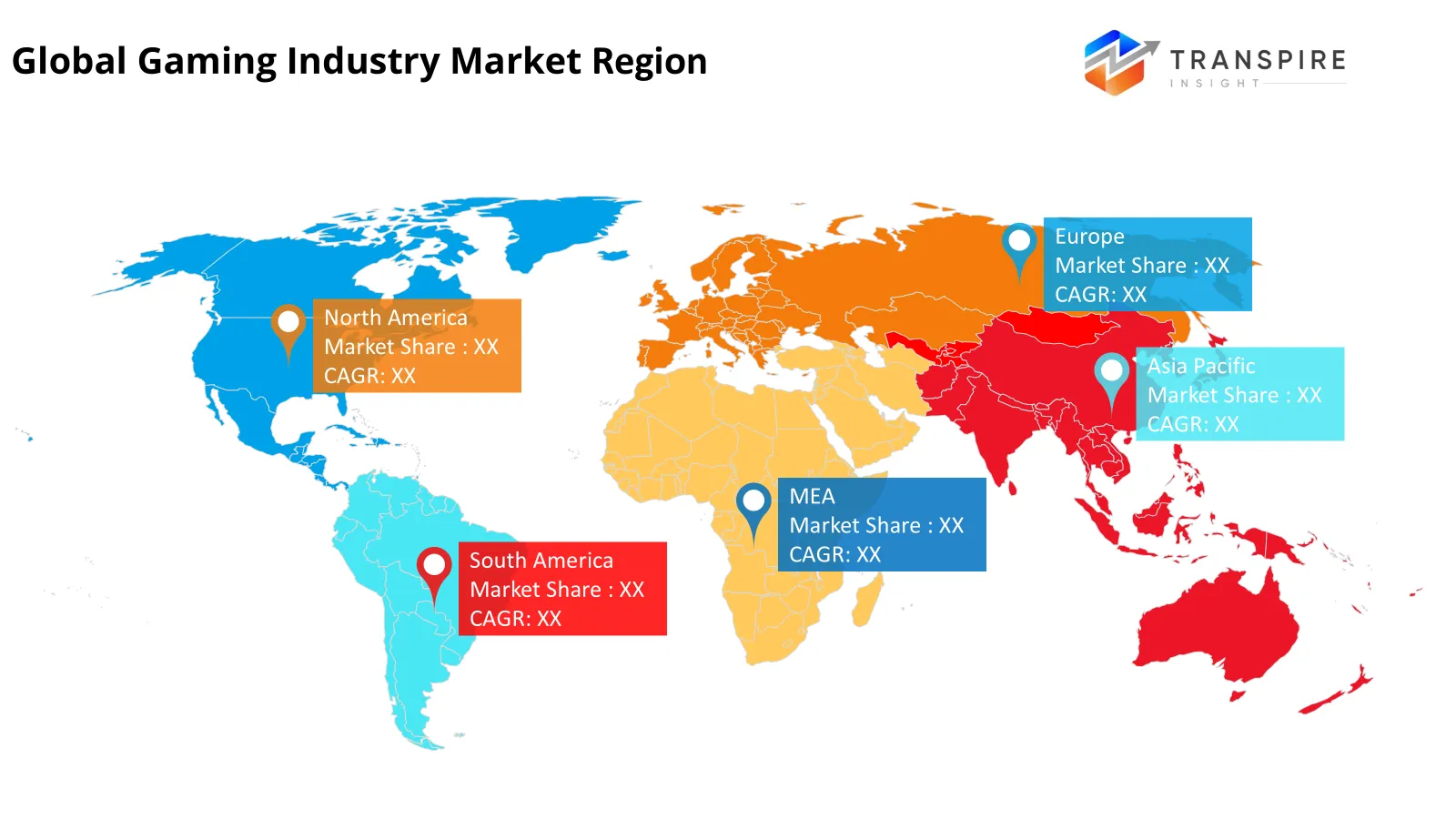
The Asia-Pacific region dominates the global video game industry, capturing a massive 44% share of the total market revenue. It is also surrounded by a rich ecosystem comprising hyper-efficient 5G telecom infrastructure and highly-engrained mobile payment networks that enable instant micro transactions. Local governments actively promote the development of large digital technology parks, allowing for the creation of huge domestic publishers creating localized monopolies that are the foundation of the gaming pipeline. Razer has announced the introduction of its AI Gaming Ecosystem at CES 2026, which includes features such as the development of a new Project AVA (AI Gaming Assistant), a Project Motoko (AI-powered wearable headset), and an AI developer tool for creating games. By enabling the development of AI-powered gaming experiences and contributing to a more engaging player experience in the Asia Pacific gaming market, the launch further solidifies AI's role in the gaming industry. According to Razer, in January 2026, Razer launched new AI gaming tools, including an AI gaming assistant called Project AVA, at CES 2026. Project AVA is like a virtual AI assistant that appears as a 3D animated character on your desk.
Europe's share of the worldwide market is the second largest, with approximately 21% of the industry revenue. While the mobile dominance of the top market is fast-paced, in Europe, the gaming base is much more mature and premium, with console and PC dominating. A steady pattern of spending for a long tail of products on proven software brands and premium hardware upgrades is a major factor in maintaining market stability. Furthermore, the stringent consumer protection laws and structural publisher subsidies in key nations such as Germany, France, and the UK help to immunize the developers against significant monetary fluctuations. Recently, Wargaming introduced World of Tanks: HEAT, a new free-to-play game for PC and consoles. This launch will appeal to players and also help the development of the European gaming industry. In May 2026, Wargaming launched World of Tanks: HEAT, a new free-to-play vehicle combat game for PC and consoles.
North America is the fastest-growing region, growing at an impressive CAGR of 12.7%. Recently, this aggressive growth acceleration has been stimulated by a general macro change from a multi-platform, subscription-based model to a multi-platform, TV-based one, resulting in the success of transmedia television adaptations. The potential for future commercial applications is closely linked to the swift pace of new “advanced cloud-streaming services” and “generative AI production tools” being developed and deployed locally. These ongoing technological advances are now a key factor in opening up huge new opportunities for digital direct-to-consumer monetization across the continent, largely erasing traditional hardware barriers to entry.
To learn more about this report, Download Free Sample Report
Who are the Key Players in the Global Gaming Industry Market and how do they Compete?
The global video game market is a fierce ecosystem battle, with structural scale, IP ownership, and platform ecosystem locks being the drivers of market survival. No longer are companies competing on a one-to-one basis for software sales; they compete for the attention of the user by using different hardware, different subscription models, and different mobile software distribution channels.
Sony has a differentiation strategy based on premium blockbusters from the first party and high-prestige, high-priced hardware innovations. It is gradually expanding its huge user base by migrating its beloved console catalog to the PC market. Meanwhile, Microsoft's takedown-everything approach is aggressive. The company's acquisition of Activision Blizzard into its Xbox Game Pass subscription service will help diversify its business horizontally in the console, PC, and cloud markets.
Tencent and NetEase have adopted a low-friction approach to innovation, expanding with big investments in studios around the world and a mobile-first philosophy. Nintendo has an entirely different strategy. It has an evergreen game that relies on a broad base of family-friendly IP (such as Mario) and is tightly coupled to a dedicated proprietary platform. There are live environments, in which case Epic Games, Valve, and Roblox run platform economies. They differentiate by blending the self-contained multiplayer environments with massive size (Fortnite, Roblox) and developer tool suites such as the Unreal Engine, which promise industry dominance for a long time.
Key Global Gaming Industry Market Companies
- Sony Interactive Entertainment
- Microsoft Xbox
- Nintendo
- Tencent Games
- Activision Blizzard
- Electronic Arts
- Ubisoft
- Epic Games
- Valve Corporation
- Riot Games
- NetEase
- Bandai Namco
- Roblox Corporation
- Sega
- Krafton
Recent Development News
In March 2026, Saudi Arabia-based Savvy Games Group agreed to acquire Moonton, the developer of the popular mobile game Mobile Legends: Bang Bang, from ByteDance. The acquisition helps Savvy Games Group strengthen its position in the global mobile gaming market and expand its gaming portfolio, supporting further growth and investment in the gaming industry.
(Source- https://www.reuters.com)
In April 2026, Jagex announced the expansion of RuneScape: Dragonwilds into the Asia-Pacific region with Chinese, Japanese, and Korean language support. This launch helps the company reach a larger gaming audience across Asia-Pacific and strengthens its presence in one of the world's fastest-growing gaming markets.
(Source- https://www.jagex.com)
What Strategic Insights Define the Future of the Global Gaming Industry Market?
The game industry is moving towards connected, content-rich ecosystems where companies make money on game sales as well as subscriptions, in-game purchases, esports, and live services. The future of the market will be determined by cross-platform gaming, streaming-based delivery in conjunction with deeper player engagement tactics that prolong the life cycle of a game.
Hidden danger: the cost of making games is going up. Due to rising player expectations regarding graphics, content, and online experiences, studios are coming under increased financial strain, making it more challenging for smaller developers to compete and make a profit. This also emerges as the opportunity to expand into untapped markets of Asia-Pacific, Latin America, and the Middle East & Africa, which are currently getting on board with smartphone penetration and Internet access, thereby creating newer participants in this ecosystem of gaming.
On the strategy side, our approach should be scalable when it comes to game development, regional content localization, and long-term player retention models. In the coming years, firms that successfully balance innovation with efficiency and young people who support a community will probably have the leg up.
Global Gaming Industry Market Segmentation
By Type
- PC Gaming
- Console Gaming
- Mobile Gaming
- Cloud Gaming
- VR Gaming
- Esports Gaming
- Othaers
By Application
- Entertainment
- Competitive Gaming
- Education Gaming
- Simulation Training
- Social Gaming
- Others
By End-User
- Casual Gamers
- Professional Gamers
- Gaming Cafes
- Enterprises
- Others
By Revenue Model
- Subscription-based
- In-app Purchases
- Advertising-based
- Premium Purchases
- Others
Regional Outlook
North America
- United States
- Canada
- Mexico
Europe
- Germany
- United Kingdom
- France
- Spain
- Italy
- Rest of Europe
Asia Pacific
- Japan
- China
- Australia & New Zealand
- South Korea
- India
- Rest of Asia Pacific
South America
- Brazil
- Argentina
- Rest of South America
Middle East & Africa
- Saudi Arabia
- United Arab Emirates
- South Africa
- Rest of the Middle East & Africa
Frequently Asked Questions
Find quick answers to common questions.
The expected global gaming industry Market size for the market will be USD 600.63 Billion in 2033.
Key segments for the global gaming industry Market are By Type (PC Gaming, Console Gaming, Mobile Gaming, Cloud Gaming, VR Gaming, Esports Gaming, Othaers); By Application (Entertainment, Competitive Gaming, Education Gaming, Simulation Training, Social Gaming, Others); By End-User (Casual Gamers, Professional Gamers, Gming Cafes, Enterprises, Others); By Revenue Model (Subscription-based, In-app Purchases, Advertising-based, Premium Purchases, Others).
Major global gaming industry Market players are Sony Interactive Entertainment, Microsoft Xbox, Nintendo, Tencent Games, Activision Blizzard, Electronic Arts, Ubisoft, Epic Games, Valve Corporation, Riot Games, NetEase, Bandai Namco, Roblox Corporation, Sega, and Krafton.
The global gaming industry Market size is USD 296.61 billion in 2026.
The global gaming industry Market is expected to grow 10.60% during the forecast period.
- Sony Interactive Entertainment
- Microsoft Xbox
- Nintendo
- Tencent Games
- Activision Blizzard
- Electronic Arts
- Ubisoft
- Epic Games
- Valve Corporation
- Riot Games
- NetEase
- Bandai Namco
- Roblox Corporation
- Sega
- Krafton
About the Authors

Mayur Shinde
I am Mayur Shinde, a Senior Research Analyst at Transpire Insight, specializing in the Automotive & Transportation and Information & Communication Technology (ICT) Industry. My work focuses on analyzing emerging market trends, technological advancements, competitive landscapes, and industry developments to deliver accurate, data-driven insights. I am passionate about transforming complex market information into clear, actionable content that helps businesses, professionals, and decision-makers stay informed and make confident strategic decisions.

Chakradhar Khansole
Chakradhar serves as the Research Director at Transpire Insight, bringing over 8 years of experience in technology, innovation, and strategic market intelligence. He specializes in transforming complex market data into actionable business insights that enable organizations to make informed, growth-oriented decisions. Recognized for his strategic vision and analytical expertise, Chakradhar leads high-impact research initiatives, delivering comprehensive market assessments, competitive intelligence, and forward-looking industry analysis.
Recently Published Reports
-
Apr 2026
3D Optical Profiler Market
3D Optical Profiler Market Size, Share & Analysis Report By Type (Desktop 3D Optical Profiler, and Portable 3D Optical Profiler), By Technology (Confocal Technology, and White Light Interference), By End-Use Industry (Manufacturing, Research Institutions, Automotive, Aerospace and Defense, Medical Devices, and Other), and Geography (North America, Europe, Asia-Pacific, Middle East and Africa, South and Central America), 2021 - 2031
-
Apr 2026
Depth Sensor Market
Depth Sensor Market Size, Share & Analysis Report By Type (Infrared Depth Sensors, Time-of-Flight (ToF) Sensors, Stereo Vision Sensors, Structured Light Sensors, Ultrasonic Depth Sensors), By Application (Automotive, Robotics, Gaming, Consumer Electronics, Industrial Automation, Healthcare, Security & Surveillance, Others), By End Users (Automotive Manufacturers, Consumer Electronics Companies, Healthcare Providers, Industrial Companies, Security Agencies, Gaming Companies, Robotics Companies, Others), and Geography (North America, Europe, Asia-Pacific, Middle East and Africa, South and Central America), 2021 – 2031
-
Apr 2026
Digital Manufacturing Market
Digital Manufacturing Market Size, Share & Analysis Report By Component (Hardware, Software, and Services), By Technology (Robotics, 3D Printing, Internet of Things (IoT), and Others), By Application (Automotive and Transportation, Aerospace and Defense, Consumer Electronics, Industrial Machinery, and Others), By Process Type (Computer-Based Designing, Computer-Based Simulation, Computer 3D Visualization, Analytics, and Others), and Geography (North America, Europe, Asia-Pacific, Middle East and Africa, South and Central America), 2021 – 2031
-
Apr 2026
Digital Visa Services Market
Digital Visa Services Market Size, Share & Analysis Report By Type (Individual Travelers, Group Travelers), By Application (Tourism, Business Travel, Others), and Geography (North America, Europe, Asia-Pacific, Middle East and Africa, South and Central America), 2021 – 2031