
Japan Immersive Virtual Reality Market Size & Forecast:
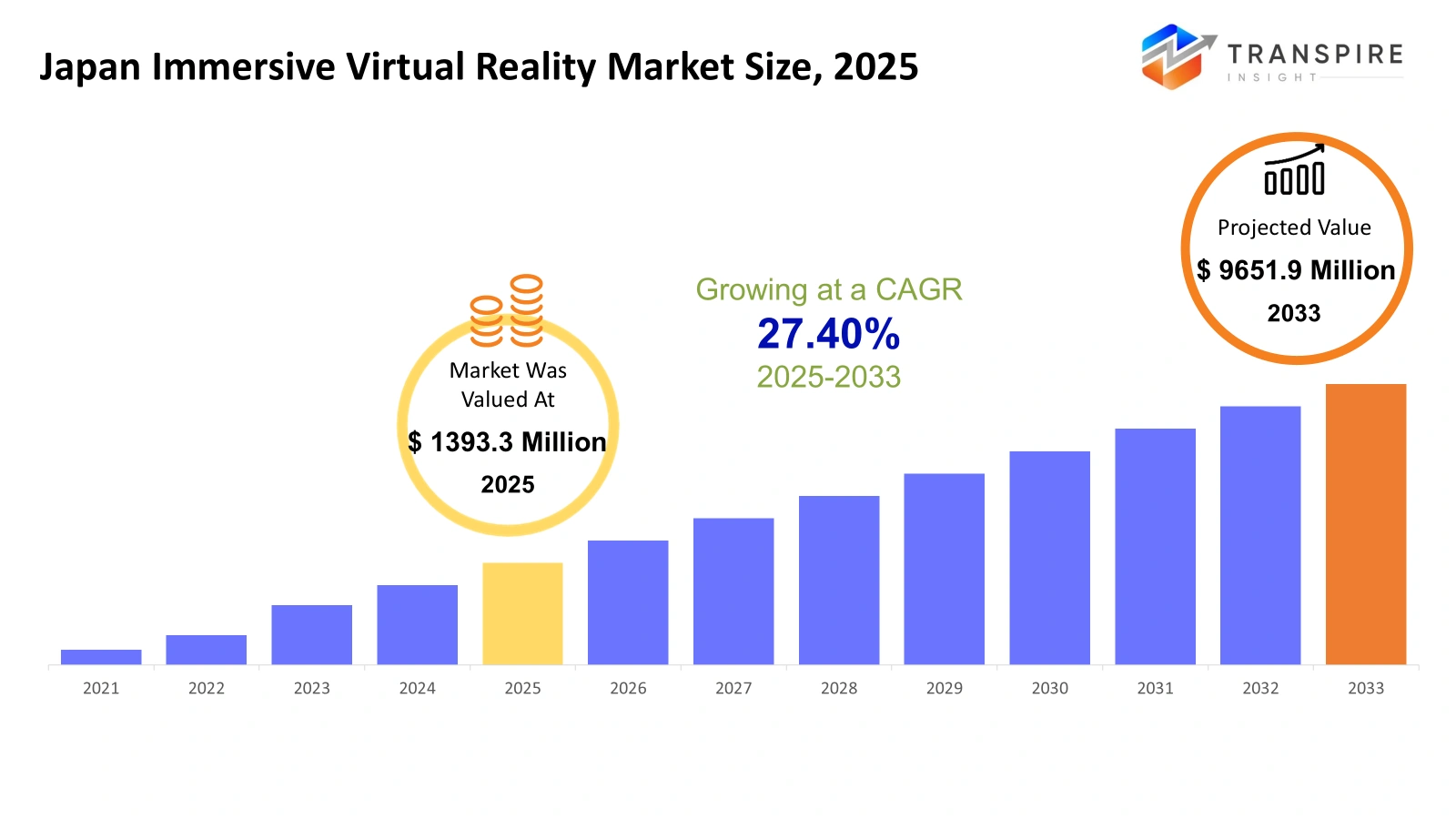
- Japan Immersive Virtual Reality Market Size 2025: USD 1393.3 Million
- Japan Immersive Virtual Reality Market Size 2033: USD 9651.9 Million
- Japan Immersive Virtual Reality Market CAGR: 27.40%
- Japan Immersive Virtual Reality Market Segments:By Component (Hardware, Software, Services), By Device Type (Head-Mounted Displays, Gesture Tracking Devices, Projectors & Display Walls), By Application (Gaming, Healthcare, Education, Retail, Real Estate).
To learn more about this report,  Download Free Sample Report
Japan Immersive Virtual Reality Market Summary:
The Japan Immersive Virtual Reality Market size is estimated at USD 1393.3 Million in 2025 and is anticipated to reach USD 9651.9 Million by 2033, growing at a CAGR of 27.40% from 2026 to 2033. Japan's immersive virtual reality market is experiencing continuous growth as technology accessibility improves across entertainment and gaming, as well as the educational and enterprise training sectors. Companies are investing in advanced virtual reality hardware and realistic simulation platforms to deliver deeper, more engaging digital experiences. The metaverse has become more popular alongside Japan's gaming culture and innovation ecosystem, driving faster market adoption. Businesses use immersive virtual reality technology for three main purposes: product design, remote collaboration, and skill development, while consumers experience more engaging interactive content. The market will continue to expand as innovation advances and new practical uses emerge.
Key Market Trends & Insights:
- The Japanese gaming culture drives people to adopt virtual reality technology, which allows them to experience gaming in an immersive way. The entertainment industry develops interactive virtual reality content which enables users to establish deeper connections with digital environments and animated characters.
- The educational system and corporate training programmes now employ virtual reality technology to create authentic training environments. The use of virtual reality in medical training and technical skill development enables learners to practise their skills within safe virtual environments.
- Japanese technology companies are increasing their investments in virtual reality systems amid rising global interest in the metaverse. Organisations establish virtual environments to facilitate social interactions and conduct digital meetings, and create spaces for working together.
- Japanese electronics manufacturers are producing virtual reality headsets that feature lighter-weight design elements, improved motion detection, and higher display resolution. New technologies allow virtual reality users to experience more authentic content and greater comfort, enabling more people to use the technology.
- Companies in the manufacturing, retail and real estate sectors use virtual reality technology to create and test products, showcase their products and conduct remote team meetings. The system enables organisations to create visual representations of their concepts while reducing costs and improving their decision-making.
- The demand for virtual reality arcades and themed entertainment centres is increasing throughout Japan's metropolitan regions. The venues deliver premium, immersive experiences that most consumers cannot recreate at home, thereby attracting both residents and visitors.
Japan Immersive Virtual Reality Market Segmentation
By Component
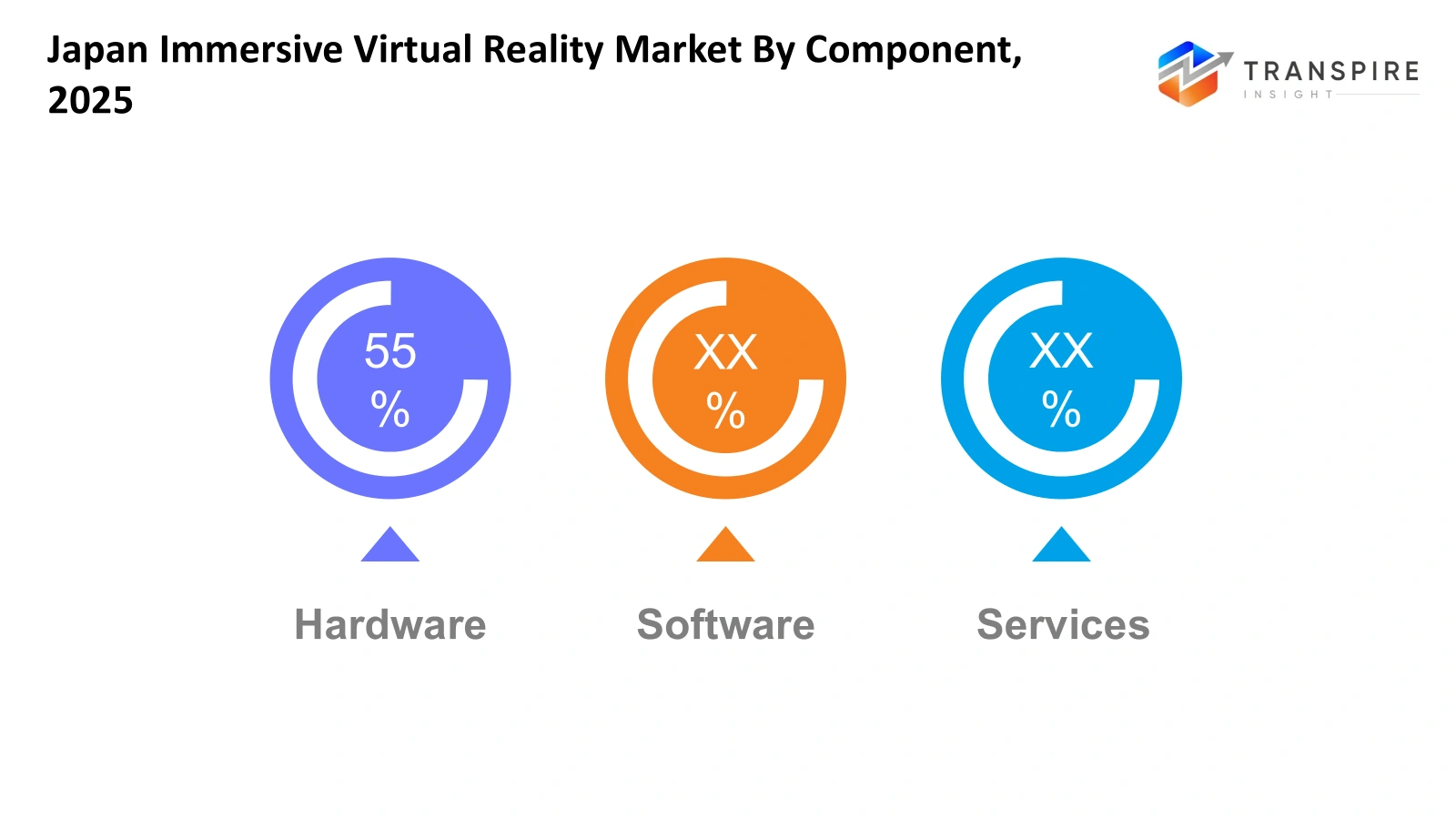
- Hardware: The immersive virtual reality ecosystem in Japan depends on hardware, which serves as its essential support structure through all its components. The system consists of virtual reality headsets, sensors, controllers and processing units which work together to create authentic digital experiences. The country is experiencing growing technology adoption, as display systems, motion detection, and user comfort have improved in quality through ongoing technological development.
- Software: Users interact with virtual environments through virtual reality software to experience immersive content. Japanese developers work on building competitive simulations which include both gaming and business applications. The combination of advanced graphics engines with AI technology and real-time rendering systems enables the creation of virtual environments which present authentic visual experiences.
- Services: The virtual reality ecosystem depends on services that provide essential support through installation, customisation, expert advice, and system maintenance. Japanese companies and solution providers often help businesses integrate immersive virtual reality into training, product design, and marketing strategies, enabling organisations to effectively adopt and scale virtual reality solutions.
To learn more about this report, Download Free Sample Report
By Device Type
- Head-Mounted Displays (HMDs): Head-mounted displays are the most prevalent form of virtual reality equipment in Japan. Users can experience complete digital world immersion with these headsets, which deliver high-definition visual output and 3D sound. The ongoing development of lightweight HMD designs, together with improved comfort features, is driving increased HMD use in gaming and entertainment, as well as in professional training.
- Gesture Tracking Devices: Users can control virtual spaces through their body movements and hand gestures because these devices provide natural interaction methods. The Japanese immersive virtual reality market uses this technology to create realistic experiences that enable users to control their movements with body movements rather than standard controllers, creating a more intuitive experience that benefits training, gaming, and simulation use.
- Projectors & Display Walls: Projectors and large display walls serve as essential components in location-based virtual reality systems, which operate in museums, research facilities and immersive experience centres. The systems create expansive visual spaces that enable multiple users to collaborate on simulations, educational demonstrations, and advanced visualisation projects.
By Application
- Gaming: The use of virtual reality technology in Japan sees its highest growth rate through the gaming industry. Game developers create virtual reality experiences which include interactive storytelling and authentic gameplay elements to match the country's established gaming traditions. The segment attracts both casual and dedicated gamers who want to explore fresh gameplay options.
- Healthcare: The medical field uses immersive virtual reality technology for multiple applications, including medical education, therapeutic treatment and surgery training. Japanese hospitals and research institutions are studying virtual reality technology to enable doctors to practise medical procedures while supporting patient rehabilitation and mental health treatment in controlled medical environments.
- Education: Japanese educational institutions implement immersive virtual reality technology to create interactive learning environments which improve student engagement. Students have the ability to investigate historical locations, scientific principles and technical methods through virtual environments. The method enables students to learn in a visually stimulating environment, enhancing their understanding and memory retention.
- Retail: Japanese retailers use virtual reality technology to create new customer experiences for their stores. The virtual showrooms enable customers to examine products through realistic digital environments which they can use to decide what to buy. The technology enables brands to present their newest collections through innovative methods which provide customers with an interactive and distinctive shopping experience.
- Real Estate: Japanese real estate companies use immersive virtual reality technology to create virtual property walkthroughs. Buyers and investors have the ability to view residential properties and commercial buildings from their remote locations. The technology enables clients to see property layouts and designs in better detail, which makes it easier to choose real estate options and saves time.
Country Insights
The virtual reality market in Japan is currently experiencing rapid growth because the country is adopting new digital technologies and developing modern entertainment systems. Japan has become an essential centre for virtual reality development because it possesses a worldwide recognised gaming sector together with users who prefer interactive media content. Companies that develop technology and create video games are making substantial investments into virtual reality systems which provide users with authentic visual and sensory experiences.
Virtual reality technology now extends beyond its traditional role as a recreational tool because it serves various industries, including healthcare, education, manufacturing and retail. Hospitals and research institutions are exploring virtual reality for medical training and therapy, while educational institutions are using it to create engaging learning environments. Virtual reality technology now enables enterprises to create virtual product demonstrations, which they use to train employees and design products.
Market expansion depends on government backing for digital transformation, combined with protection of business innovation initiatives. The Japanese immersive virtual reality market will continue to grow as device accessibility improves with advancing technology, offering new business opportunities and fresh consumer experiences
Recent Development News
Japanese Schools Experiment with Metaverse and Virtual Reality Classrooms for Digital Learning.
Japanese Virtual Reality Artist Combines Virtual Painting and Traditional Music in Cultural Performance.
|
Report Metrics |
Details |
|
Market size value in 2025 |
USD 1393.3 Million |
|
Market size value in 2026 |
USD 1772.25 Million |
|
Revenue forecast in 2033 |
USD 9651.9 Million |
|
Growth rate |
CAGR of 27.40% from 2026 to 2033 |
|
Base year |
2025 |
|
Historical data |
2021 – 2024 |
|
Forecast period |
2026 – 2033 |
|
Report coverage |
Revenue forecast, competitive landscape, growth factors, and trends |
|
Country scope |
Japan |
|
Key company profiled |
Sony Group Corporation, Meta Platforms Inc., HTC Corporation, Microsoft Corporation, Google LLC, Samsung Electronics, NVIDIA Corporation, Unity Technologies, Qualcomm Technologies, Lenovo Group Ltd., Varjo Technologies, Pico Interactive, Magic Leap Inc., Apple Inc., Fujitsu Limited. |
|
Customization scope |
Free report customization (country, regional & segment scope). AvAIl customized purchase options to meet your exact research needs. |
|
Report Segmentation |
By Component (Hardware, Software, Services), By Device Type (Head-Mounted Displays, Gesture Tracking Devices, Projectors & Display Walls), By Application (Gaming, Healthcare, Education, Retail, Real Estate). |
Key Japan Immersive Virtual Reality Company Insights
The immersive virtual reality market in Japan receives backing from international technology firms and Japanese startups, which drive its growth. The organisations develop virtual reality hardware, software platforms that deliver immersive experiences, and specialised industry solutions for gaming, healthcare, education, and manufacturing. The companies dedicate their resources to research and development initiatives that seek to enhance graphics performance, motion-tracking capabilities, and user interface comfort. Companies use strategic partnerships, product launches, and technology collaborations to increase market share. The companies use their ongoing innovations to drive the adoption of virtual reality technology across Japan.
Company List
- Sony Group Corporation
- Meta Platforms Inc.
- HTC Corporation
- Microsoft Corporation
- Google LLC
- Samsung Electronics
- NVIDIA Corporation
- Unity Technologies
- Qualcomm Technologies
- Lenovo Group Ltd.
- Varjo Technologies
- Pico Interactive
- Magic Leap Inc.
- Apple Inc.
- Fujitsu Limited.
Japan Immersive Virtual Reality Market Report Segmentation
By Component
- Hardware
- Software
- Services
By Device Type
- Head-Mounted Displays
- Gesture Tracking Devices
- Projectors & Display Walls
By Application
- Gaming
- Healthcare
- Education
- Retail
- Real Estate.
Frequently Asked Questions
Find quick answers to common questions.
The approximate Japan Immersive Virtual Reality Market size for the market will be USD 9651.9 Million in 2033.
The key segments of the Japan Immersive Virtual Reality Market are By Component (Hardware, Software, Services), By Device Type (Head-Mounted Displays, Gesture Tracking Devices, Projectors & Display Walls), By Application (Gaming, Healthcare, Education, Retail, Real Estate).
Major players in the Japan Immersive Virtual Reality Market are Sony Group Corporation, Meta Platforms Inc., HTC Corporation, Microsoft Corporation, Google LLC, Samsung Electronics, NVIDIA Corporation, Unity Technologies, Qualcomm Technologies, Lenovo Group Ltd., Varjo Technologies, Pico Interactive, Magic Leap Inc., Apple Inc., Fujitsu Limited.
The current market size of the Japan Immersive Virtual Reality Market is USD 1393.3 Million in 2025.
The Japan Immersive Virtual Reality Market CAGR is 27.40%.
- Sony Group Corporation
- Meta Platforms Inc.
- HTC Corporation
- Microsoft Corporation
- Google LLC
- Samsung Electronics
- NVIDIA Corporation
- Unity Technologies
- Qualcomm Technologies
- Lenovo Group Ltd.
- Varjo Technologies
- Pico Interactive
- Magic Leap Inc.
- Apple Inc.
- Fujitsu Limited.
Recently Published Reports
-
Apr 2026
3D Optical Profiler Market
3D Optical Profiler Market Size, Share & Analysis Report By Type (Desktop 3D Optical Profiler, and Portable 3D Optical Profiler), By Technology (Confocal Technology, and White Light Interference), By End-Use Industry (Manufacturing, Research Institutions, Automotive, Aerospace and Defense, Medical Devices, and Other), and Geography (North America, Europe, Asia-Pacific, Middle East and Africa, South and Central America), 2021 - 2031
-
Apr 2026
Depth Sensor Market
Depth Sensor Market Size, Share & Analysis Report By Type (Infrared Depth Sensors, Time-of-Flight (ToF) Sensors, Stereo Vision Sensors, Structured Light Sensors, Ultrasonic Depth Sensors), By Application (Automotive, Robotics, Gaming, Consumer Electronics, Industrial Automation, Healthcare, Security & Surveillance, Others), By End Users (Automotive Manufacturers, Consumer Electronics Companies, Healthcare Providers, Industrial Companies, Security Agencies, Gaming Companies, Robotics Companies, Others), and Geography (North America, Europe, Asia-Pacific, Middle East and Africa, South and Central America), 2021 – 2031
-
Apr 2026
Digital Manufacturing Market
Digital Manufacturing Market Size, Share & Analysis Report By Component (Hardware, Software, and Services), By Technology (Robotics, 3D Printing, Internet of Things (IoT), and Others), By Application (Automotive and Transportation, Aerospace and Defense, Consumer Electronics, Industrial Machinery, and Others), By Process Type (Computer-Based Designing, Computer-Based Simulation, Computer 3D Visualization, Analytics, and Others), and Geography (North America, Europe, Asia-Pacific, Middle East and Africa, South and Central America), 2021 – 2031
-
Apr 2026
Digital Visa Services Market
Digital Visa Services Market Size, Share & Analysis Report By Type (Individual Travelers, Group Travelers), By Application (Tourism, Business Travel, Others), and Geography (North America, Europe, Asia-Pacific, Middle East and Africa, South and Central America), 2021 – 2031