
Middle East and Africa HVAC Test Instruments Market Size & Forecast:
- Middle East and Africa HVAC Test Instruments Market Size 2025: USD 17.38 Million
- Middle East and Africa HVAC Test Instruments Market Size 2033: USD 23.25 Million
- Middle East and Africa HVAC Test Instruments Market CAGR: 3.71%
- Middle East and Africa HVAC Test Instruments Market Segments: By Product Type (Thermometers, Anemometers, Pressure Meters, Humidity Meters, Airflow Meters, Leak Detectors, Multifunction Testers, Others); By Application (HVAC Installation, HVAC Maintenance, Energy Audits, Building Automation, Industrial HVAC, Others); By End User (HVAC Contractors, Facility Managers, Industrial Users, Utilities, Others); By Technology (Digital Instruments, Analog Instruments, Wireless Instruments, Smart Instruments, Others).
Middle East and Africa HVAC Test Instruments Market Summary
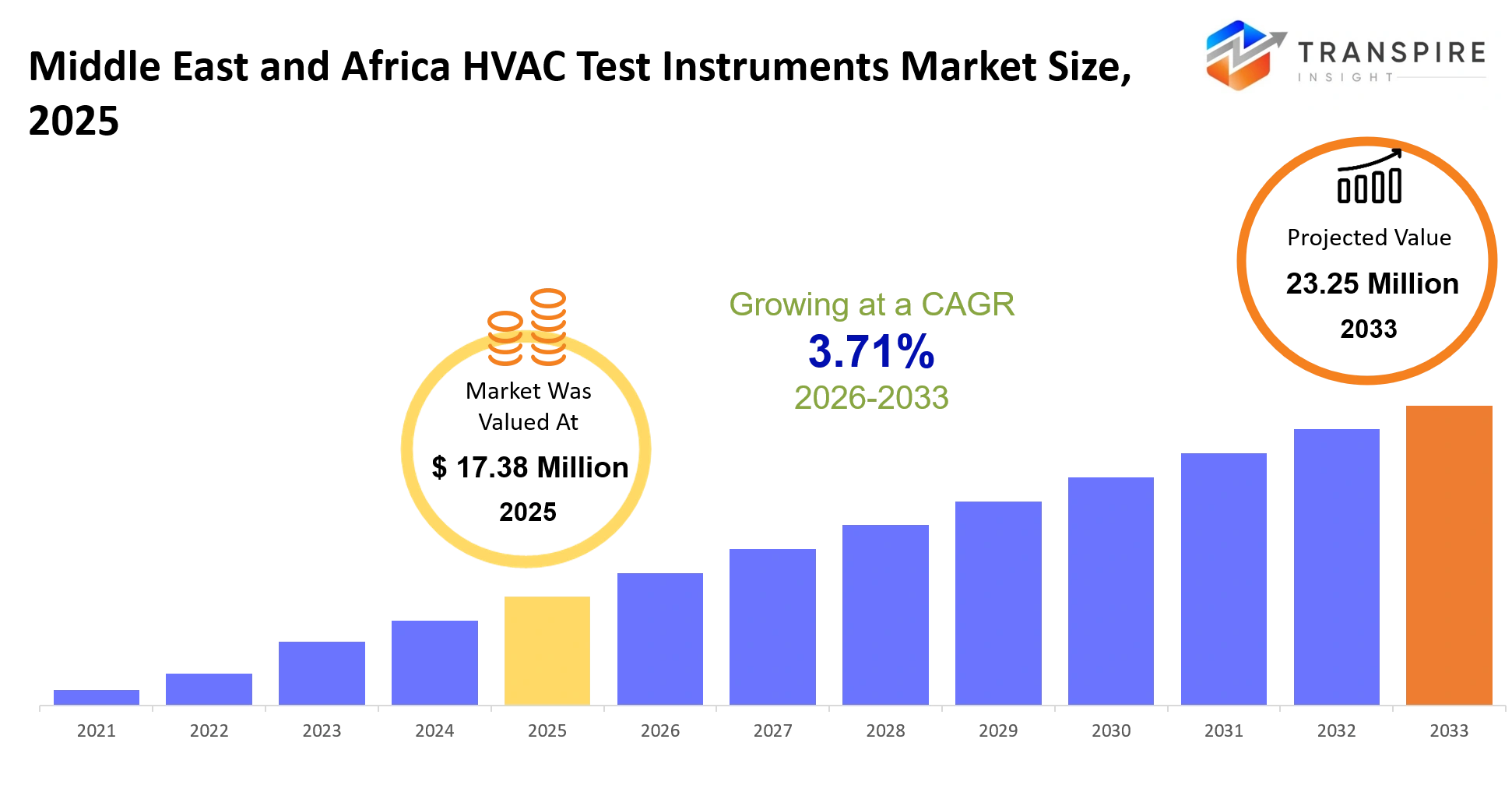
The Middle East and Africa HVAC Test Instruments Market was valued at USD 17.38 Million in 2025. It is forecast to reach USD 23.25 Million by 2033. That is a CAGR of 3.71% over the period.
HVAC test instruments kind of play a critical role in making sure heating, ventilation, and air conditioning systems run safely, efficiently, and stay within their performance spec limits. Contractors , facility managers, and industrial operators rely on these tools for measuring airflow, temperature, pressure humidity, and even refrigerant leakage during installation, commissioning, routine maintenance, and energy optimization work. Over the past five years, the market seems to move away from standalone analog gear and more toward digital wire less and smarter diagnostic instruments that often give quicker readings and better data connectivity, which is kind of the whole point for most crews.
One big reason behind this shift has been the tightening of building efficiency rules and the indoor air quality requirements, across commercial sites as well as industrial ones. Since energy costs are still a major operational expense, companies are pushing for more accurate testing equipment to spot inefficiencies, cut down on system downtime, and confirm system performance. This momentum is also spreading advanced measurement solutions across new build projects and existing building retrofits, which then supports ongoing revenue opportunities for instrument makers and service providers.
Key Market Insights
- The Middle East and Africa HVAC Test Instruments Market kinda hit USD 17.38 million in 2025 and is expected to edge toward USD 23.25 million by 2033, overall.
- Gulf Cooperation Council nations stay at the top, holding roughly a 40%+ slice of regional income, largely because there is a lot of commercial infrastructure being built and upgraded.
- South Africa still shows up as a major player too, mainly tied to industrial upkeep routines and facility modernization programs.
- Portable instruments take the biggest portion of the market, backed by technician needs for real-time, on-site diagnostics and quicker commissioning cycles.
- Digital instruments are currently the leading technology category, since HVAC contractors are swapping older analog units for connected, more capable solutions.
- Smart and wireless instruments are also the fastest rising segment all the way through 2033, with remote monitoring and cloud based diagnostics helping a lot.
- On the application side, HVAC installation remains dominant, driving strong demand from commercial building efforts and broader infrastructure projects.
- HVAC maintenance is the quickest growth lane, because facility operators are leaning into preventive care and energy optimization.
- HVAC contractors account for about 47% of the global end-user demand, so they’re the biggest customer group when it comes to testing gear.
- Firms like Fluke, Testo, Fieldpiece, TSI Incorporated, Honeywell, and ABB are pushing ahead via product innovation, wireless platforms, and regional distribution collaborations.
What are the Key Drivers, Restraints, and Opportunities in the Middle East and Africa HVAC Test Instruments Market?
The strongest growth driver kinda comes from modernizing commercial buildings and industrial facilities that are looking for measurable improvements in HVAC performance. Energy consumption has been turning into a big operational cost for offices, hospitals, airports, data centers, and manufacturing plants across the region. That has pushed contractors and facility operators to start using more advanced airflow meters, pressure gauges, leak detectors and multifunction testers that really help with system diagnostics that are more accurate. Regulatory requirements tied to building efficiency and indoor air quality have also accelerated purchasing decisions, because performance verification is more often than not requiring documented measurements. In the end, suppliers get benefits like higher replacement cycles and wider adoption across maintenance routines.
The main barrier though is still the high upfront cost tied to advanced digital and wireless testing instruments. Lots of smaller contractors and maintenance providers are still leaning on older equipment, because newer devices call for investment in hardware, software, calibration services, and technician training. This obstacle feels structural, since workforce development and capital expenditure constraints can not be solved fast across multiple regional markets. So the technology replacement is slower and the adoption of premium solutions gets delayed, which then limits manufacturers revenue growth potential.
Meanwhile a solid opportunity is appearing from smart building rollout and digital facility management programs across the Gulf region. Fresh commercial developments are increasingly folding in connected HVAC systems, and those systems need continuous performance verification.
What Has the Impact of Artificial Intelligence Been on the Middle East and Africa HVAC Test Instruments Market?
Artificial intelligence is, little by little, changing the way HVAC measurement equipment gets used throughout commercial and industrial spaces. Nowadays, testing platforms more and more often mix sensor arrays , wireless communication links and analytics software together, so diagnostic work can be pushed through automated routines. With AI-enabled setups, airflow , temperature , pressure and humidity readings taken during inspections can be interpreted, and then abnormal operation states can be flagged without much human back and forth. The result is less time spent on manual interpretation, and technicians tend to finish maintenance tasks in a more efficient way.
Then there’s machine learning, which is also helping with predictive maintenance. Old measurement logs can be mined to spot recurring signals tied to things like component wear, refrigerant leakage, airflow imbalance , or general equipment decline. Facility operators take these clues and set up maintenance in advance of failures , which boosts uptime and can cut down emergency repair bills. In bigger commercial buildings, predictive analytics may even help HVAC energy performance, while also supporting compliance with operational efficiency targets.
On top of that, digital reporting tools improve service documentation. They can automatically generate performance records and maintenance suggestions, so the decision-making process becomes smoother and the administrative workload shrinks some. Less paperwork, more clarity, and less time wasted on routine documentation.
Still, AI adoption is not fully smooth, because integration costs and data availability act like brakes. A lot of HVAC systems are installed with only limited sensor coverage, and this makes it difficult to collect the kind of high-quality datasets that reliable machine learning models really need. You notice it most in older facilities and in cost-sensitive markets, where the digital infrastructure is still sparse or incomplete.
Key Market Trends
- From 2021 through 2026, digital diagnostic tools saw a noticeable, kind of rapid adoption in lots of facilities, as they looked for quicker performance checks and better maintenance documentation , at the same time.
- Portable testing instruments stayed dominant, with more than half of the industry leaning on them , because field technicians often want mobility first, and then fast setup second.
- Wireless connectivity showed up across many new product launches, helping teams pull data remotely and funnel it into centralized reporting , which is pretty convenient.
- After 2023, smart building work really pushed demand forward for integrated solutions that measure airflow , pressure, and temperature too.
- Fieldpiece came out with new analog gauge sets in March 2026, which signals that businesses are still investing in technician centered diagnostics.
- Sauermann rolled out a fresh generation of digital manifolds in June 2025, and this helped reinforce connected measurement features.
- Contractors are leaning more toward multifunction instruments, where several testing tasks get bundled into a single device, instead of carrying multiple units.
- Indoor air quality verification became an even stronger purchasing factor after commercial building rules got tighter .
- Cloud based reporting platforms also started gaining traction , since facility managers asked for traceable maintenance records that are easy to reference.
- Between 2024 and 2026, manufacturers expanded regional distributor networks, mainly to improve product availability, and also to boost technical support locally.
Middle East and Africa HVAC Test Instruments Market Segmentation
By Product Type
Thermometers support temperature verification during system commissioning, servicing, and performance testing , so temperature measurement becomes a basic requirement for most commercial and industrial HVAC work. Anemometers help assess air velocity and ventilation effectiveness, and Pressure Meters track system pressure levels which in turn influence operational efficiency, also equipment reliability. Humidity Meters assist in keeping indoor environmental conditions steady, especially in healthcare, hospitality, and office facilities where controlled moisture levels still matter
Airflow Meters provide reliable air distribution measurements and also support balancing efforts in bigger buildings. Leak Detectors help spot refrigerant losses, cutting energy waste, and supporting regulatory compliance needs. Multifunction Testers get attention because one device can perform multiple measurements, which improves technician productivity and reduces the amount of equipment handling
There are also other tools, like specialized instruments used for calibration, environmental monitoring, and more advanced diagnostic applications, across a wide range of HVAC environments.
By Application
HVAC installation is a major area of instrument usage, because new setups need exact testing, balancing , and commissioning before they even start operating. HVAC maintenance keeps instrument demand coming in a steady way, through routine checks, fault finding, performance verification, and preventive servicing tasks that happen a lot. Energy audits use measuring tools to map out energy consumption habits, and also to spot openings for operational improvements inside commercial and industrial spaces.
Building automation applications lean on measurement data so they can do system integration, track how things perform, and push operational optimization along. Industrial HVAC environments need more detailed testing because the operating conditions are demanding and the environmental control requirements are pretty strict. Others cover specialized uses across schools and campuses, healthcare institutions, retail properties, transportation infrastructure, and public sector buildings, where system efficiency stays kind of the main priority.
By End User
HVAC Contractors make up for substantial instrument utilization because installation, commissioning, repairs, and maintenance stuff need constant measurement and some diagnostic support it seems. Facility Managers rely on testing equipment to keep an eye on system performance, boost operational efficiency, and preserve occupant comfort throughout commercial properties. Industrial Users use these tools inside manufacturing plants, processing facilities, warehouses, and various other operational locations where environmental regulation does matter for productivity and equipment output.
Utilities also lean on testing instruments to back up energy management plans, infrastructure maintenance efforts, and operational evaluations tied to large buildings. Then there are Others, like government agencies, educational institutions, healthcare organizations, and service providers who are responsible for maintaining HVAC performance standards. The wide range of end users brings steadier demand across several economic sectors, and it also pushes continued investment in measurement technologies.
By Technology
Digital Instruments sit at a fairly big advantage, since accurate readings, easy to use interfaces ,and faster data processing help a lot with today’s maintenance and diagnostic routines. Meanwhile, Analog Instruments still get picked for certain tasks where straightforward operation durability, and less expensive acquisition costs really matter. Wireless instruments also help spread the use, because remote measurement collection becomes simpler, manual note taking gets reduced, and technicians can move around more freely in large facilities.
Smart Instruments add fancier things like data storage , connectivity, automated reporting, and they can plug into building management platforms. This kind of setup assists with predictive maintenance methods and tries to push operational optimization in commercial and industrial areas. There are also other types, including specialized measurement solutions meant for distinct testing needs, calibration processes, and industry-focused performance assessments.

What are the Key Use Cases Driving the Middle East and Africa HVAC Test Instruments Market?
The main use case centers on HVAC setup and commissioning, across commercial towers, airports, hospitals, hotels, and mixed use developments. Getting the airflow tested, also temperature, pressure, and humidity levels, in a way that is accurate, makes sure the systems actually line up with the design specs before anything starts running. And yes this drives strong demand since project sign off often depends on documented performance verification, which feels like a big gate.
More adoption comes from HVAC maintenance work and energy audit programs inside office complexes, industrial facilities, and public infrastructure projects. Facility managers, and industrial users too, tend to lean on measurement tools to spot efficiency losses, tune operating costs, and keep compliance with building performance standards. On top of that, building automation initiatives also bring in advanced instruments to confirm sensor precision, and system functionality, without surprises later.
Newer use cases are slowly forming around smart buildings, data centers, and high performance sustainable construction projects. Connected diagnostic instruments fit predictive maintenance schedules, and also plug into digital facility management platforms. With growing investment in energy efficient developments across Gulf countries, and certain African urban centers , there should be additional opportunities for advanced testing technologies during the forecast period.
|
Report Metrics |
Details |
|
Market size value in 2025 |
USD 17.38 Million |
|
Market size value in 2026 |
USD 18.02 Million |
|
Revenue forecast in 2033 |
USD 23.25 Million |
|
Growth rate |
CAGR of 3.71% from 2026 to 2033 |
|
Base year |
2025 |
|
Historical data |
2021 - 2024 |
|
Forecast period |
2026 - 2033 |
|
Report coverage |
Revenue forecast, competitive landscape, growth factors, and trends |
|
Regional scope |
United States; Canada; Mexico; United Kingdom; Germany; France; Italy; Spain; Denmark; Sweden; Norway; China; Japan; India; Australia; South Korea; Thailand; Brazil; Argentina; South Africa; Saudi Arabia; United Arab Emirates |
|
Key company profiled |
Fluke, Testo, Fieldpiece, Bacharach, TSI Incorporated, UEi Test Instruments, Extech, Kimo Instruments, Amprobe, Sauermann, Kanomax, Honeywell, Siemens, ABB, Yokogawa. |
|
Customization scope |
Free report customization (country, regional & segment scope). Avail customized purchase options to meet your exact research needs. |
|
Report Segmentation |
By Product Type (Thermometers, Anemometers, Pressure Meters, Humidity Meters, Airflow Meters, Leak Detectors, Multifunction Testers, Others); By Application (HVAC Installation, HVAC Maintenance, Energy Audits, Building Automation, Industrial HVAC, Others); By End User (HVAC Contractors, Facility Managers, Industrial Users, Utilities, Others); By Technology (Digital Instruments, Analog Instruments, Wireless Instruments, Smart Instruments, Others). |
Which Regions are Driving the Middle East and Africa HVAC Test Instruments Market Growth?
The Gulf Cooperation Council region sort of holds the dominant position in the Middle East and Africa HVAC Test Instruments Market. Big commercial construction, airport expansion, healthcare infrastructure development , and smart city investments keep pushing steady demand for HVAC installation and performance verification tools. Energy efficiency regulations in places like Saudi Arabia and the United Arab Emirates mean accurate testing and commissioning of HVAC systems is basically required, so companies lean toward advanced thermometers, airflow meters, and multifunction diagnostic instruments. Then there’s that mature setup of HVAC contractors, engineering consultants, facilities management companies, and technology distributors, which supports ongoing equipment adoption and regular replacement.
South Africa is the second-largest regional contributor, but the growth logic is not identical to the Gulf states. Here, demand is less driven by huge new construction programs and more by ongoing upkeep of industrial facilities, commercial buildings, mining operations and public infrastructure. Steady investment in operational efficiency and building performance creates fairly stable demand for testing instruments across service, maintenance, and related site activities. Also, economic resilience in important industrial sectors plus a gradual rollout of energy management standards helps keep recurring revenue opportunities alive for instrument suppliers.
The Rest of Africa is emerging as the fastest-growing regional market during the forecast period. New investments in industrial parks, logistics facilities, data centers, and commercial real estate have increased the need for HVAC commissioning as well as routine maintenance services.
Who are the Key Players in the Middle East and Africa HVAC Test Instruments Market and How Do They Compete?
Competition in the Middle East and Africa HVAC test instruments market still looks moderately fragmented, in the way that global instrumentation specialists compete with diversified industrial technology companies, at the same time. Honestly the real fight is mostly about technology capability, measurement accuracy , the way software fits together, and how solid after-sales support feels. Most established manufacturers keep trying to hold on to their market share through product upgrades and broader distribution routes, while the specialized instrument suppliers tend to go after more specific HVAC diagnostic needs instead. Lately, the movement toward connected and multifunction testing devices has made digital features, and overall workflow efficiency, a bigger deal than before.
Fluke leans heavily into precision measurement and reliability, positioning its offerings so professional technicians and industrial users can count on dependable diagnostics, especially in demanding environments. Testo differentiates by using integrated digital platforms, where measurement functions get bundled with mobile applications and cloud based reporting. That combination can improve day to day work efficiency for contractors and facility managers. Fieldpiece, on the other hand, concentrates on HVAC-focused product development, and it goes for technician-oriented instruments that are set up for installation, commissioning and refrigerant system servicing. That sort of targeted design helps build customer loyalty with HVAC service professionals, pretty consistently.
TSI Incorporated competes by pushing advanced airflow and indoor environmental quality measurement technologies, which help commercial buildings with optimization tasks and energy performance assessments. Sauermann maintains and grows its presence via connected instrumentation and digital manifold solutions, making data gathering and system diagnostics feel less complicated, more streamlined and faster to manage.
Company List
- Fluke
- Testo
- Fieldpiece
- Bacharach
- TSI Incorporated
- UEi Test Instruments
- Extech
- Kimo Instruments
- Amprobe
- Sauermann
- Kanomax
- Honeywell
- Siemens
- ABB
- Yokogawa
Recent Development News
In June 2025, Sauermann launched its new generation of digital manifolds. The new connected instruments improve HVAC system diagnostics and strengthen the company's smart measurement portfolio.
Source: https://sauermanngroup.com
In June 2026, Fluke Corporation showcased its AI-powered eMaint platform at Maintec 2026. The solution streamlines maintenance workflows and supports predictive maintenance strategies across industrial facilities.
Source: https://pressroom.fluke.com
What Strategic Insights Define the Future of the Middle East and Africa HVAC Test Instruments Market?
The market is drifting toward integrated diagnostic ecosystems, instead of going all in on standalone measurement devices. Underneath it, there’s this push that kind of feels linked to energy management, building automation, and what’s basically predictive maintenance needs. In the next five to seven years, buying decisions will lean more and more toward instruments that pair measurement precision with connectivity, reporting , and analytics features.
There’s also this quieter risk people don’t talk about as much, market concentration around premium digital technologies. If economic conditions start to wobble, or construction activity cools off in important Gulf economies, then the replacement cycles for high value instruments might stretch out and revenue growth could get slowed down or delayed. And because so much electronics is imported, there’s extra exposure to supply chain disruptions and pricing swings, which is not exactly small.
Still, there’s a real opportunity in smart building commissioning and performance verification services. As connected commercial buildings become more common, the demand for cloud enabled testing platforms and continuous monitoring solutions will keep rising. Market players should put effort into software integration, wireless functionality, and strong regional service networks. Firms that blend hardware know how with digital maintenance platforms can likely capture more future value , and they’ll probably keep customers longer too.
Middle East and Africa HVAC Test Instruments Market Report Segmentation
By Product Type
- Thermometers
- Anemometers
- Pressure Meters
- Humidity Meters
- Airflow Meters
- Leak Detectors
- Multifunction Testers
- Others
By Application
- HVAC Installation
- HVAC Maintenance
- Energy Audits
- Building Automation
- Industrial HVAC
- Others
By End User
- HVAC Contractors
- Facility Managers
- Industrial Users
- Utilities
- Others
By Technology
- Digital Instruments
- Analog Instruments
- Wireless Instruments
- Smart Instruments
- Others
Frequently Asked Questions
Find quick answers to common questions.
The expected Middle East and Africa HVAC Test Instruments Market size for the market will be USD 23.25 Million in 2033.
Key segments for the Middle East and Africa HVAC Test Instruments Market are By Product Type (Thermometers, Anemometers, Pressure Meters, Humidity Meters, Airflow Meters, Leak Detectors, Multifunction Testers, Others); By Application (HVAC Installation, HVAC Maintenance, Energy Audits, Building Automation, Industrial HVAC, Others); By End User (HVAC Contractors, Facility Managers, Industrial Users, Utilities, Others); By Technology (Digital Instruments, Analog Instruments, Wireless Instruments, Smart Instruments, Others).
Major Middle East and Africa HVAC Test Instruments Market players are Fluke, Testo, Fieldpiece, Bacharach, TSI Incorporated, UEi Test Instruments, Extech, Kimo Instruments, Amprobe, Sauermann, Kanomax, Honeywell, Siemens, ABB, Yokogawa.
The Middle East and Africa HVAC Test Instruments Market size is USD 17.38 Million in 2025.
The Middle East and Africa HVAC Test Instruments Market CAGR is 3.71% from 2026 to 2033.
- Fluke
- Testo
- Fieldpiece
- Bacharach
- TSI Incorporated
- UEi Test Instruments
- Extech
- Kimo Instruments
- Amprobe
- Sauermann
- Kanomax
- Honeywell
- Siemens
- ABB
- Yokogawa
About the Authors

Avinash Kumar
I’m Avinash Kumar, a Senior Research Analyst at Transpire Insight, with expertise in the Electronics and Semiconductor and Energy & Power industry. My work focuses on analyzing emerging technologies, market trends, industry developments, and innovation across these sectors. I specialize in transforming complex technical and market insights into clear, research-backed content that helps professionals, businesses, and decision-makers stay informed. Through continuous industry research and data-driven analysis, I strive to deliver accurate, reliable, and practical perspectives on the latest advancements shaping the semiconductor and energy landscape.

Chakradhar Khansole
Chakradhar serves as the Research Director at Transpire Insight, bringing over 8 years of experience in technology, innovation, and strategic market intelligence. He specializes in transforming complex market data into actionable business insights that enable organizations to make informed, growth-oriented decisions. Recognized for his strategic vision and analytical expertise, Chakradhar leads high-impact research initiatives, delivering comprehensive market assessments, competitive intelligence, and forward-looking industry analysis.
Recently Published Reports
-
Apr 2026
Fiber Optic Faceplates Market
Fiber Optic Faceplates Market Size, Share & Analysis Report By Type (< 300 mm2, 300-350 mm2, and > 350 mm2, By Application (Night Vision, Holographic Imaging, Medical, and Others), and Geography (North America, Europe, Asia-Pacific, Middle East and Africa, South and Central America), 2021 - 2031
-
Apr 2026
High Temperature Superconductors Market
High Temperature Superconductors Market Size, Share & Analysis Report By Type (1G HTS, and 2G HTS), By Application (Power Cable, Fault Current Limiter, and Transformer), and Geography (North America, Europe, Asia-Pacific, Middle East and Africa, South and Central America), 2021 - 2031
-
Apr 2026
Industrial Plugs and Socket Market
Industrial Plugs and Socket Market Size, Share & Analysis Report By Type (Industrial Plugs, Industrial Sockets), By Current (Up to 32 A, 32 to 125 A, Above 125 A), By Protection (Dustproof and Splash Proof, Waterproof, Explosion Proof), By End User (Heavy Industries, Oil and Gas, Chemicals and Pharmaceuticals, Power Generation, Others), and Geography (North America, Europe, Asia-Pacific, Middle East and Africa, South and Central America), 2021 - 2031
-
Apr 2026
InGaAs Avalanche Photodiodes Market
InGaAs Avalanche Photodiodes Market Size, Share & Analysis Report By Type (1100 - 1700 nm, and 1000 - 1600 nm), By Application (Missile Warning System, Muzzle Flash Detection, Wafer Defect Inspection, Laser Rangefinders, and Others), and Geography (North America, Europe, Asia-Pacific, Middle East and Africa, South and Central America), 2021 - 2031