
Middle East and Africa Healthcare Digital Twins Market Size & Forecast:
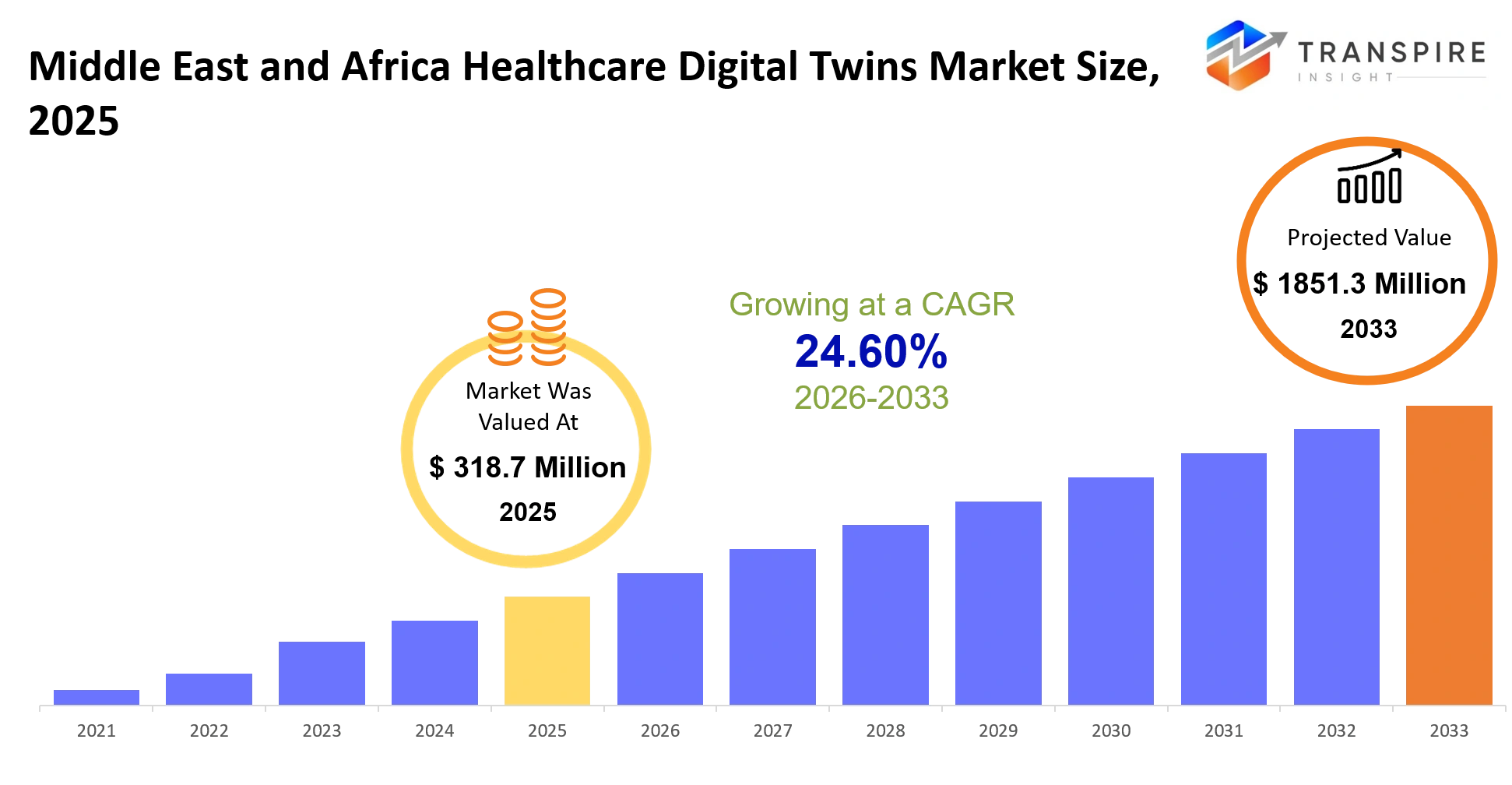
- Middle East and Africa Healthcare Digital Twins Market Size 2025: USD 318.7 Million
- Middle East and Africa Healthcare Digital Twins Market Size 2033: USD 1851.3 Million
- Middle East and Africa Healthcare Digital Twins Market CAGR: 24.60%
- Middle East and Africa Healthcare Digital Twins Market Segments: By Component (Software, Services, Platforms, Others); By Application (Patient Digital Twins, Hospital Operations, Drug Development, Medical Device Simulation, Others); By Deployment (Cloud, On-Premise, Hybrid, Others); By End User (Hospitals, Pharma Companies, Research Institutes, Others).
Middle East and Africa Healthcare Digital Twins Market Summary
The Middle East and Africa Healthcare Digital Twins Market was valued at USD 318.7 Million in 2025. It is forecast to reach USD 1851.3 Million by 2033. That is a CAGR of 24.60%over the period.
Healthcare digital twins, in practice, help hospitals , pharmaceutical companies and research institutions build virtual models of patients, clinical routes, medical devices, and whole healthcare facilities before anything is rolled out in the real world. With these digital representations , clinicians can trial treatment pathways, fine tune hospital capacity, estimate how disease may progress, and improve day-to-day operational planning, all while lowering both clinical and financial exposure.
Over the last five years, the market kind of moved away from just experimental pilot work toward enterprise-scale deployment, and that shift is backed by cloud infrastructure, artificial intelligence , plus connected healthcare systems. One big structural change is the way digital twins have been integrated into smart hospital programs and national digital health initiatives across Gulf countries. And after the COVID-19 pandemic, healthcare digitization accelerated , which made the need for predictive healthcare planning , remote patient monitoring, and capacity management feel even more urgent. Now, as healthcare providers chase better clinical results and stronger operational efficiency, digital twin platforms are turning into sort of decision-support essentials. This transition keeps broadening adoption across hospitals, pharmaceutical research , and precision medicine initiatives, and it also opens up fresh revenue paths for technology vendors, cloud providers, and healthcare analytics specialists.
Key Market Insights
- Saudi Arabia is basically leading the regional revenue pie with about 27% share in healthcare digital twin adoption, with the push coming from national digital health transformation programs that are, you know supported all across the system.
- For the Gulf Cooperation Council countries, the fastest-growth regional cluster is expected through 2033, mostly because of smart hospital investments ,and AI based healthcare modernization projects that are rolling out pretty steadily.
- Software solutions still take the largest market share, since healthcare providers are focusing on predictive modeling, simulation engines and clinical decision-support platforms.
- Services stay as the second-largest segment , not because they are optional but because hospitals need help with integration consulting, cybersecurity and interoperability know-how in order to deploy smoothly.
- Cloud deployment counts for a big portion too, since healthcare organizations are searching for scalable computing resources and centralized analytics capabilities without too much friction.
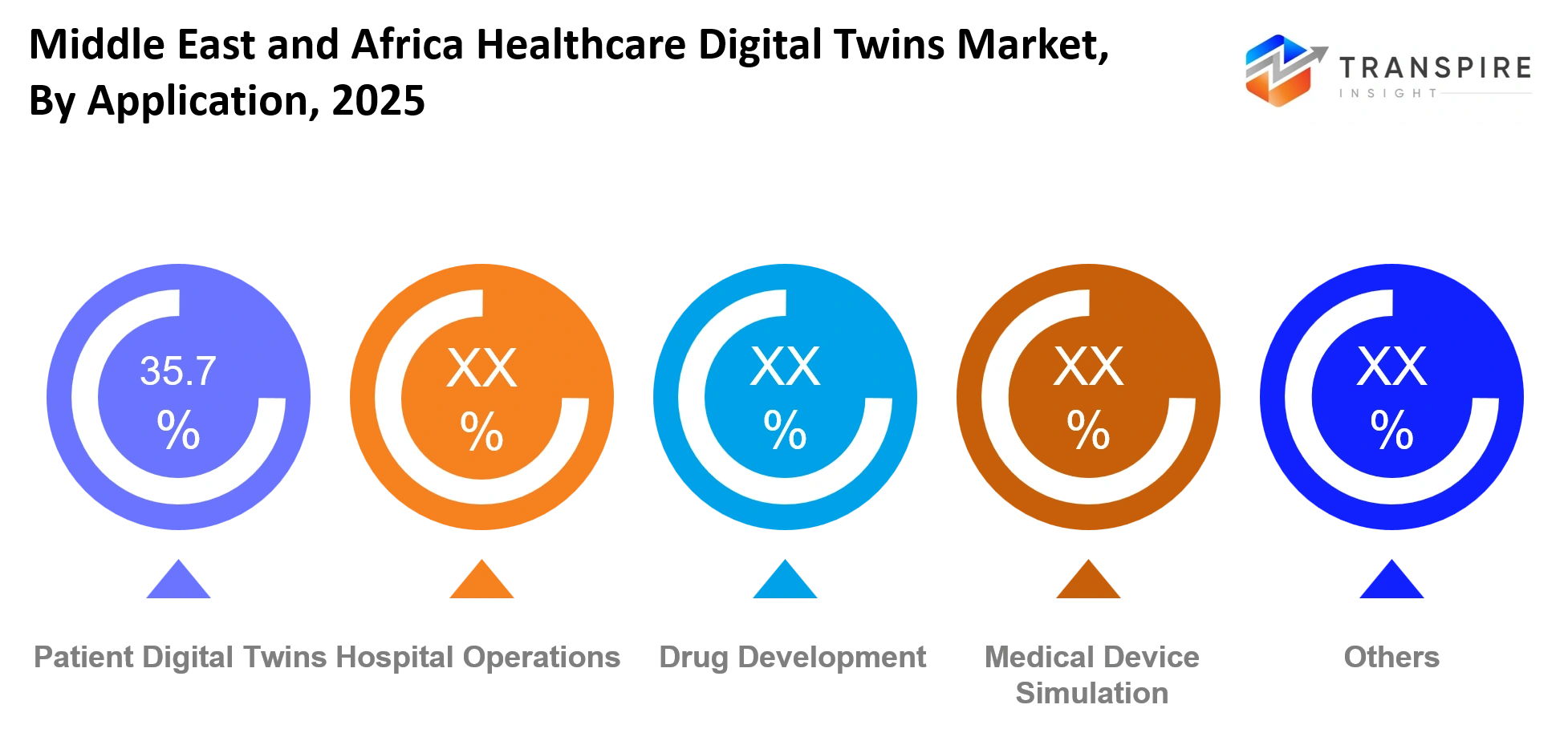
- Patient digital twins dominate the applications side , backed by precision medicine initiatives, and those personalized treatment planning programs that are getting more attention lately.
- Drug development applications are projected to grow the fastest by 2033, since virtual trials tend to cut development costs while also shortening timelines.
- Hospitals bring in more than one-third of total market revenue, which makes sense given the growing use of operational twins for patient flow and resource optimization.
- AI-enabled digital twin platforms are increasingly stitching together imaging, genomic, wearable, and electronic health record data, so predictive care becomes a real operational thing.
- And then there are strategic partnerships among Microsoft, IBM, Siemens Healthineers, GE HealthCare, Oracle, and NVIDIA that are accelerating platform innovation ,and regional expansion at the same time.
What are the Key Drivers, Restraints, and Opportunities in the Middle East and Africa Healthcare Digital Twins Market?
The main driver behind market expansion is, like, the fast digital transformation of healthcare systems throughout the Gulf area. National programs for health modernization, added spending on smart hospitals, wider uptake of electronic health records and AI enabled clinical systems have basically made a space where digital twins can produce, not just theoretical but measurable operational and clinical value. Healthcare providers increasingly lean on virtual patient models and hospital simulations, in order to refine treatment planning, cut down resource waste, and also tune capacity utilization. In practice, these wins directly fuel technology spending and speed up deployment across healthcare networks.
The big restraint though, still it is healthcare data fragmentation and interoperability troubles. Digital twins need near continuous access to strong quality clinical data, imaging records, genomic information, plus operational datasets. A lot of healthcare organizations across Africa and certain parts of the Middle East still run disconnected information systems, with uneven digital infrastructure. This type of structural problem is not something you fix quickly, because it depends on long term investments in data governance, standards, cybersecurity, and healthcare IT modernization. So, implementation timelines get slower and solution providers see delayed revenue realization.
A clear opportunity is sitting in precision medicine and virtual clinical trial uses. Pharmaceutical companies are gradually testing digital twin solutions to mimic treatment outcomes, enhance patient stratification, and lower trial expenses. With more investment in genomics, AI driven diagnostics, and personalized healthcare programs across Saudi Arabia, the UAE and Qatar, the conditions look pretty good for advanced patient digital twins.
What Has the Impact of Artificial Intelligence Been on the Middle East and Africa Healthcare Digital Twins Market?
Artificial intelligence kinda became the real foundation behind modern healthcare digital twin platforms across the Middle East and Africa. AI algorithms keep on scanning patient records, medical imaging, lab outcomes, wearable sensor streams, and even operational metrics to form flexible virtual models that change as things happen, in real time. More and more hospitals use these setups to automate patient movement management, tune scheduling, anticipate resource needs, and basically back clinical choices. With AI-enabled operational twins, administrators can run “what if” alternatives before anything goes live, and that helps reduce bottlenecks while improving overall efficiency, in practice.
Also, machine learning adds extra predictive muscle. The more advanced models can flag disease progression risks, estimate how treatments might respond, anticipate hospital capacity requirements, and support preventive actions. In pharmaceutical research, these digital twins let teams simulate how individual patients may react to therapies, so trial design becomes more efficient, and the whole development uncertainty is reduced. In the end, this improves how resources get used, lowers operating costs, and supports more tailored care delivery.
On top of that, AI integration has improved imaging workflows, diagnostic interpretation, and hospital operations through automated analysis and simulation technologies. Still, there are limitations that show up during adoption. Integration costs can be high, data privacy rules matter a lot, healthcare datasets are often fragmented and shortages of standardized clinical information can lower model accuracy, which then complicates big deployment efforts. Organizations also need to pour in serious investment into cybersecurity and interoperability frameworks before they can actually realize the full value of AI-powered healthcare simulation platforms, and not just the early demos.
Key Market Trends
- Since 2022, Gulf healthcare providers have been putting more money into smart hospital infrastructure, and that kinda supports the rollout of digital twin deployments.
- In 2025, Saudi Arabia showed up for over 27% of the regional adoption activity, mostly from national healthcare modernization initiatives which… kinda stacked up momentum fast.
- Those patient-centric digital twins, have basically moved out of pure research setups and into clinical decision-support programs across top hospitals.
- Cloud-based deployments grew a lot from 2023 to 2025, mainly because scalability is easier, and the implementation stuff is less complicated ,overall.
- Pharmaceutical companies also started relying more on virtual patient simulations, to refine trial design and to lower development risk.
- AI integration turned into a sort of standard platform feature, helping with predictive diagnostics as well as operational optimization capabilities.
- After 2024, partnerships between technology vendors and healthcare providers sped up too, partly to tackle interoperability challenges that were getting in the way.
- Meanwhile, hospital operational twins gained traction for capacity forecasting, scheduling optimization and resource allocation management.
- Big names like Microsoft, Siemens Healthineers, IBM and Oracle have expanded their healthcare simulation abilities, using AI-driven innovation.
- And precision medicine initiatives are increasingly weaving genomic data into digital twin models, so they can back more personalized treatment pathways.
Middle East and Africa Healthcare Digital Twins Market Segmentation
By Component
Software kind a becomes the backbone of digital twin work when it comes to healthcare environments. On top of that, advanced applications let teams build virtual “copies” of patients, medical workflows, and healthcare assets, and yes, they also allow simulation, real-time monitoring and predictive analysis. Adoption keeps growing , generally because the software side improves clinical judgment and the day to day operational flow. When you then blend in artificial intelligence, analytics, and healthcare data systems, the whole functionality feels more solid, and a lot more useful.
On the services side, things cover implementation, customization, routine maintenance, and system integration tasks. In many healthcare organizations , there is a need for consulting and deployment assistance, plus training , and ongoing technical support… so the outcomes stay on track. Platforms usually act as the base for data handling, scenario simulation, and cross-ecosystem collaboration. Other parts also matter: supporting technologies, connectivity tools, visualization apps, and niche solutions that boost overall digital twin performance, and in the end expand the capabilities.
By Application
Patient digital twins seem to be the most widely adopted corner of healthcare because providers want treatment planning that is more accurate, more tailored to the person , and honestly a bit more responsive. Virtual patient models pull from clinical records, imaging info, and various health indicators, then they try to simulate outcomes so clinicians can weigh options. With better care planning, and smoother patient management, many healthcare facilities keep expanding use. Also, the stronger push toward precision medicine kind of feeds into the same trend, and so adoption keeps widening.
On the operations side, Hospital Operations use cases help with scheduling , capacity planning, workflow management, and the steady allocation of resources across units. For Drug Development, the idea is that pharmaceutical teams can run virtual testing and treatment simulations to lower development risk. Medical Device Simulation lets device makers look at performance and safety before anything is deployed, which can help shorten the development timeline. Other use cases include healthcare infrastructure planning, population health studies, training programs, and more advanced research tasks, all of which tap into simulation technologies in a practical way.
By Deployment
Cloud deployment kind of takes a big role, since healthcare orgs want scalable systems and more flexible access to compute resources. In cloud environments, you can run real time data processing, and also enable remote collaboration plus large scale analytics, all without having to pour major money into infrastructure. The easy scale up and simplified upkeep are reasons cloud options are so appealing for healthcare institutions. And as these digital transformation programs keep moving forward, cloud adoption across the region stays strong.
Meanwhile, On-Premise deployment is still important when strict security, privacy, and regulatory expectations show up. There is direct control over infrastructure, and that’s what helps teams keep sensitive healthcare information safer, or at least more managed in a traditional way. Also, Hybrid deployment sort of merges the cloud’s flexibility with on-premise control, so you get a steadier setup for day to day healthcare operations. Other choices include customized hosting models , and specialized deployment environments created for unique operational needs, plus specific technical constraints.
By End User
Hospitals make up a major share of adoption, because healthcare facilities are using digital twins to lift patient care, improve operational efficiency and handle resource management. These virtual models also help with treatment planning, tune workflow better and forecast capacity, across different clinical environments. More spending on smart hospitals and digital healthcare infrastructure keeps nudging more real implementation . Better integration with healthcare information systems is also making the results even more valuable.
Pharma companies use digital twins for drug discovery, clinical research , and assessing treatment outcomes during multiple phases. Research institutes tend to apply simulation technologies for disease investigations, health care innovation and other scientific inquiries that really need advanced modeling capabilities. Other participants include government healthcare agencies, diagnostic centers, healthcare technology providers, and insurance organizations, all of them using digital twins for planning analytics and operational improvement, in practice. More wide ranging involvement across the healthcare ecosystem will keep backing future market growth.
What are the Key Use Cases Driving the Middle East and Africa Healthcare Digital Twins Market?
The most important use case is probably patient specific digital twins , used for personalized treatment planning and sort of predictive healthcare management, like before stuff happens. In practice , healthcare providers lean on virtual patient models to simulate how a disease might progress, weigh different treatment options, and get better at clinical decision making , even prior to any intervention takes place. This part keeps generating real momentum , because it tends to shape patient outcomes directly and also boosts care efficiency , at the same time.
Hospital operations are another area that’s growing quickly. Healthcare networks are deploying digital twins to fine tune bed capacity, emergency department workflows, staffing levels, and the allocation of resources, in general terms. On the pharma side, pharmaceutical organizations are using simulation platforms to improve clinical trial design and to test how effective different therapies might be, before running everything in the real world.
More emerging things also show up , such as virtual clinical trials, genomic based precision medicine, and broad national healthcare system simulations. Over the forecast period, advanced digital twins that can combine genomic signals, wearable measurements, and real time physiological data could turn into a key instruments, especially for preventive healthcare and population health management.
|
Report Metrics |
Details |
|
Market size value in 2025 |
USD 318.7 Million |
|
Market size value in 2026 |
USD 397.1 Million |
|
Revenue forecast in 2033 |
USD 1851.3 Million |
|
Growth rate |
CAGR of 24.60%from 2026 to 2033 |
|
Base year |
2025 |
|
Historical data |
2021 - 2024 |
|
Forecast period |
2026 - 2033 |
|
Report coverage |
Revenue forecast, competitive landscape, growth factors, and trends |
|
Regional scope |
United States; Canada; Mexico; United Kingdom; Germany; France; Italy; Spain; Denmark; Sweden; Norway; China; Japan; India; Australia; South Korea; Thailand; Brazil; Argentina; South Africa; Saudi Arabia; United Arab Emirates |
|
Key company profiled |
Microsoft, IBM, Siemens Healthineers, GE HealthCare, Philips, Oracle, Dassault Systemes, NVIDIA, SAP, Accenture, Medtronic, Twin Health, Unlearn AI, AWS, Cognizant. |
|
Customization scope |
Free report customization (country, regional & segment scope). Avail customized purchase options to meet your exact research needs. |
|
Report Segmentation |
By Component (Software, Services, Platforms, Others); By Application (Patient Digital Twins, Hospital Operations, Drug Development, Medical Device Simulation, Others); By Deployment (Cloud, On-Premise, Hybrid, Others); By End User (Hospitals, Pharma Companies, Research Institutes, Others). |
Which Regions are Driving the Middle East and Africa Healthcare Digital Twins Market Growth?
Saudi Arabia is basically leading the regional growth, because of aggressive healthcare modernization programs, smart hospital investments, and the national digital transformation push. The government has been supporting AI take-up, plus healthcare innovation stuff, which ends up creating solid conditions for digital twin deployment. Big health networks now use simulation technologies more often, both for operational streamlining, and for clinical optimization, it’s kind of becoming standard. And then there is this strong technology ecosystem that keeps on backing market leadership, pretty steadily.
The United Arab Emirates shows up as the second-largest contributor, but it feels different in what it emphasizes, it leans more toward advanced healthcare innovation, and also international collaboration. Healthcare organizations there are actively testing precision medicine, virtual care , and AI-driven healthcare management solutions. Private sector participation is strong , so technology adoption keeps moving without too many delays. Also, stable investment flows continue fueling implementation across hospitals and other healthcare facilities.
Meanwhile, the wider African market is expected to post the fastest long-term growth momentum. As healthcare digitization programs expand, connectivity infrastructure keeps improving, and investment in healthcare technology grows, new opportunities keep appearing. Several countries are strengthening healthcare information systems , and also their digital health capabilities. All of this should open pretty attractive opportunities for technology vendors and investors who are looking for early-stage growth markets between 2026 and 2033.
Who are the Key Players in the Middle East and Africa Healthcare Digital Twins Market and How Do They Compete?
Competition is still pretty moderately concentrated across global tech providers, healthcare software companies, cloud platform vendors, and a handful of specialized digital twin developers. The main thing driving competition is technology innovation, interoperability know how, AI integration, and healthcare domain know-how. More and more, firms are leaning into ecosystem alliances and platform expansion, not just competing on price, which is sort of the norm anyway.
Microsoft taps into cloud infrastructure, AI services, and healthcare data integration to help run scalable digital twin environments. It also rides on deep enterprise relationships and keeps investing in cloud healthcare ecosystems. IBM sets itself apart with advanced analytics, AI powered healthcare insights, and the harder part of data management, which then supports predictive healthcare applications.
Siemens Healthineers leans into imaging expertise, simulation technology, and operational twin solutions for hospitals. Some newer programs around operational simulation, plus AI enabled healthcare services , really tighten the differentiation.
GE HealthCare highlights connected healthcare systems, and it pushes clinical workflow optimization as a key angle. Oracle, meanwhile, is tied to healthcare information management capabilities and enterprise level interoperability solutions. NVIDIA supports the market by offering accelerated computing, alongside advanced simulation environments that make digital twin performance better, faster, in practice.
Company List
- Microsoft
- IBM
- Siemens Healthineers
- GE HealthCare
- Philips
- Oracle
- Dassault Systèmes
- NVIDIA
- SAP
- Accenture
- Medtronic
- Twin Health
- Unlearn AI
- AWS
- Cognizant
Recent Development News
"In February 2026, Siemens Healthineers launched a digital twins and in silico trials platform featuring patient-specific cardiac digital twin capabilities. The launch expanded precision planning and virtual clinical simulation capabilities across healthcare environments.
Source: https://www.biology.digital/news
"In November 2025, Siemens Healthineers launched ActExcell Operational Twin and AI-enabled radiology services. The platform helps healthcare providers simulate operational scenarios and improve hospital performance through predictive modeling.
Source: https://www.siemens-healthineers.com/
What Strategic Insights Define the Future of the Middle East and Africa Healthcare Digital Twins Market?
The market is moving toward more integrated healthcare intelligence platforms, like you have digital twins paired with artificial intelligence, genomics, cloud computing, and also real time patient monitoring. What’s really pushing this change is that the healthcare industry wants to get away from reactive treatment models, and move into predictive plus personalized care delivery. And as hospitals and broader healthcare systems look for real, measurable gains in efficiency and clinical results, digital twins are going to show up more and more in everyday decision making processes, not just in pilots.
There’s also a less visible risk, sort of quietly lurking in the background. Healthcare data fragmentation and interoperability limitations can quietly undermine everything. Even when budgets stay high, if the information systems don’t talk to each other properly then model effectiveness can drop, and large scale adoption tends to slow. If an organization can’t build a solid data ecosystem with good quality signals then it may have trouble reaching the returns people expected.
Still, there’s an emerging opportunity that’s hard to ignore. AI enabled population health digital twins can model entire healthcare networks and public health systems, kind of end to end. Early attention here could translate into real advantages, especially while governments chase national modernization programs for healthcare.
Market players should lean into interoperable platforms, useful healthcare partnerships, and cloud architectures that actually scale. The groups that blend clinical expertise with AI know how, and also secure data integration, will likely be in the best spot to capture durable long term value from healthcare digital twin adoption.
Middle East and Africa Healthcare Digital Twins Market Report Segmentation
By Component
- Software
- Services
- Platforms
- Others
By Application
- Patient Digital Twins
- Hospital Operations
- Drug Development
- Medical Device Simulation
- Others
By Deployment
- Cloud
- On-Premise
- Hybrid
- Others
By End User
- Hospitals
- Pharma Companies
- Research Institutes
- Others
Frequently Asked Questions
Find quick answers to common questions.
The expected Middle East and Africa Healthcare Digital Twins Market size for the market will be USD 1851.3 Million in 2033.
Key segments for the Middle East and Africa Healthcare Digital Twins Market are By Component (Software, Services, Platforms, Others); By Application (Patient Digital Twins, Hospital Operations, Drug Development, Medical Device Simulation, Others); By Deployment (Cloud, On-Premise, Hybrid, Others); By End User (Hospitals, Pharma Companies, Research Institutes, Others).
Major Middle East and Africa Healthcare Digital Twins Market players are Microsoft, IBM, Siemens Healthineers, GE HealthCare, Philips, Oracle, Dassault Systemes, NVIDIA, SAP, Accenture, Medtronic, Twin Health, Unlearn AI, AWS, Cognizant.
The Middle East and Africa Healthcare Digital Twins Market size is USD 318.7 Million in 2025.
The Middle East and Africa Healthcare Digital Twins Market CAGR is 24.60% from 2026 to 2033.
- Microsoft
- IBM
- Siemens Healthineers
- GE HealthCare
- Philips
- Oracle
- Dassault Systèmes
- NVIDIA
- SAP
- Accenture
- Medtronic
- Twin Health
- Unlearn AI
- AWS
- Cognizant
About the Authors

Pankaj Ghogare Patil
I am Pankaj Ghogare Patil, a Senior Research Analyst at Transpire Insight, specializing in the Pharmaceutical, Chemicals & Materials, Healthcare IT, and Biotechnology industry. My expertise lies in conducting comprehensive market research, analyzing industry trends, evaluating competitive landscapes, and translating complex data into actionable insights. At Transpire Insight, I closely follow emerging technologies, regulatory developments, and market innovations to create accurate, well-researched, and informative content that helps businesses and professionals make informed decisions. I am committed to producing credible, evidence-based articles that reflect industry best practices while making technical topics accessible and valuable for a broad audience.

Chakradhar Khansole
Chakradhar serves as the Research Director at Transpire Insight, bringing over 8 years of experience in technology, innovation, and strategic market intelligence. He specializes in transforming complex market data into actionable business insights that enable organizations to make informed, growth-oriented decisions. Recognized for his strategic vision and analytical expertise, Chakradhar leads high-impact research initiatives, delivering comprehensive market assessments, competitive intelligence, and forward-looking industry analysis.
Recently Published Reports
-
Apr 2026
AI in Diabetic Retinopathy Market
AI in Diabetic Retinopathy Market Size, Share & Analysis Report By Type (Screening AI Systems, Diagnostic AI Systems, and Predictive AI Models), By Application Segment (Hospitals, Ophthalmology Clinics, Diagnostic Centers, and Research and Development), and Geography (North America, Europe, Asia-Pacific, Middle East and Africa, South and Central America), 2021 - 2031
-
Apr 2026
Psychometric Tests Market
Psychometric Tests Market Size, Share & Analysis Report By Type (Personality Tests, Ability/Aptitude Tests, Skill/Knowledge Tests, and Others), By Application (Talent Acquisition and Talent Management), and Geography (North America, Europe, Asia-Pacific, Middle East and Africa, South and Central America), 2021 – 2031
-
Apr 2026
Rare Biological Sample Collection Market
Rare Biological Sample Collection Market Size, Share & Analysis Report By Type (Isolation Kits & Reagent, Blood Collection Tubes, and Others), By Application (Oncology, Transcriptomics, Pharmacogenomics, and Others), and Geography (North America, Europe, Asia-Pacific, Middle East and Africa, South and Central America), 2021 – 2031
-
Jul 2026
Diabetic Retinopathy Market
Diabetic Retinopathy Market Size, Share & Analysis Report By Type (Proliferative Diabetic Retinopathy, and Diabetic Macular Edema (DME)), By Treatment Type (Anti VEGF Drug, Steroid Implants, Laser Surgeries, and Vitrectomy), and Geography (North America, Europe, Asia-Pacific, Middle East and Africa, South and Central America), 2021 – 2031
Our Clients







