

Middle East and Africa Glucose Syrup Market Size & Forecast:
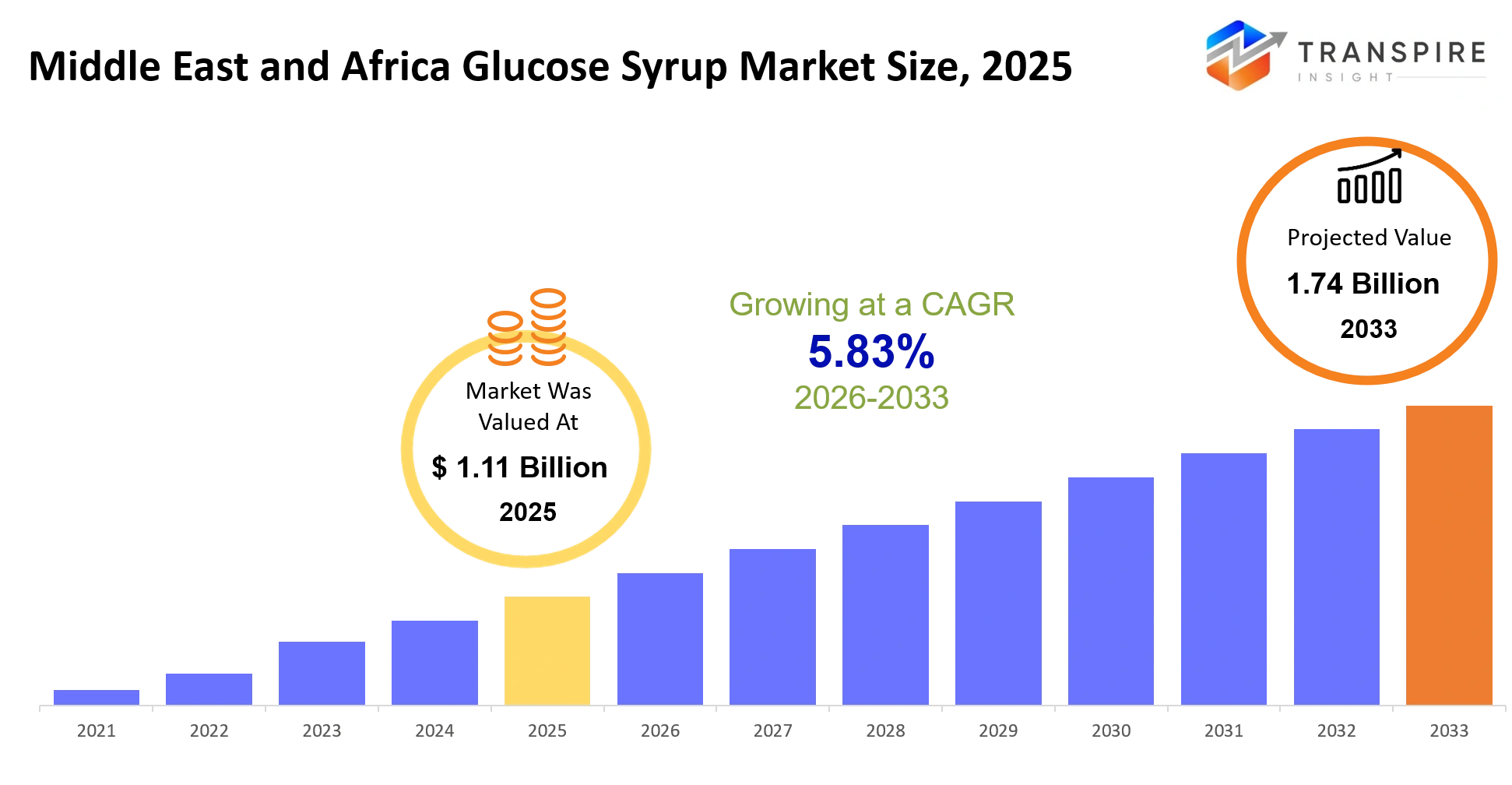
- Middle East and Africa Glucose Syrup Market Size 2025: USD 1.11 Billion
- Middle East and Africa Glucose Syrup Market Size 2033: USD 1.74 Billion
- Middle East and Africa Glucose Syrup Market CAGR: 5.83%
- Middle East and Africa Glucose Syrup Market Segments: By Source (Corn, Wheat, Potato, Cassava, Barley, Rice, Others); By Form (Liquid, Powder, Crystal, Others); By Application (Confectionery, Bakery, Beverages, Dairy, Pharmaceuticals, Others); By End User (Food Industry, Pharma Industry, Retail, Others).
Middle East and Africa Glucose Syrup Market Summary
The Middle East and Africa Glucose Syrup Market was valued at USD 1.11 Billion in 2025. It is forecast to reach USD 1.74 Billion by 2033. That is a CAGR of 5.83% over the period.
Glucose syrup plays a critical role across food, beverage, pharmaceutical, and industrial production because it helps with texture and extends shelf life, it also helps with crystallization control and, yes, it becomes a cost effective sweetening approach. In the Middle East and Africa, manufacturers lean on glucose syrup to keep product consistency steady in confectionery, bakery products, dairy goods and processed foods that are expected to handle long distribution routes, plus fluctuating climatic conditions, without much trouble.
Over the last five years, the market sort of, moved into a more structural shift, toward diversified starch sources and customized syrup blends meant for specific food processing needs. One big trigger behind that change was the disruption to global grain and sweetener supply chains after geopolitical tensions and logistics bottlenecks hit between 2020 and 2023, basically. In that moment it pushed businesses toward regional sourcing and it also drove investment into local processing capacity . Meanwhile, as food manufacturers keep scaling packaged food output, they also look for ingredients that improve production efficiency, and glucose syrup use keeps spreading. You can see it translating into higher processing volumes, stronger supplier partnerships and more revenue opportunities across the food manufacturing ecosystem as a whole .
Key Market Insights
- Saudi Arabia and South Africa together sort of accounted for more than 35% of regional consumption in 2025, kinda backed up by big food processing industries.
- The Gulf Cooperation Council countries are the dominant regional cluster with almost 40% market share, pushed mainly by packaged food manufacturing activities, which makes sense.
- East Africa looks like the fastest-growing regional market through 2033, supported by investments in food processing facilities, and not just small ones.
- Corn-based glucose syrup is leading, holding over 55% share in 2025, mostly because global corn availability stays high and the cost advantages stay real.
- Wheat-derived syrup still ranks second-largest, especially in countries where wheat milling infrastructure is already well established, so adoption comes easier.
- Cassava-based variants are expected to grow the quickest through 2033, as local raw material utilization expands and operators scale up.
- Liquid glucose syrup makes up over 60% of industry volume, reflecting how straightforward it is to handle in industrial food production.
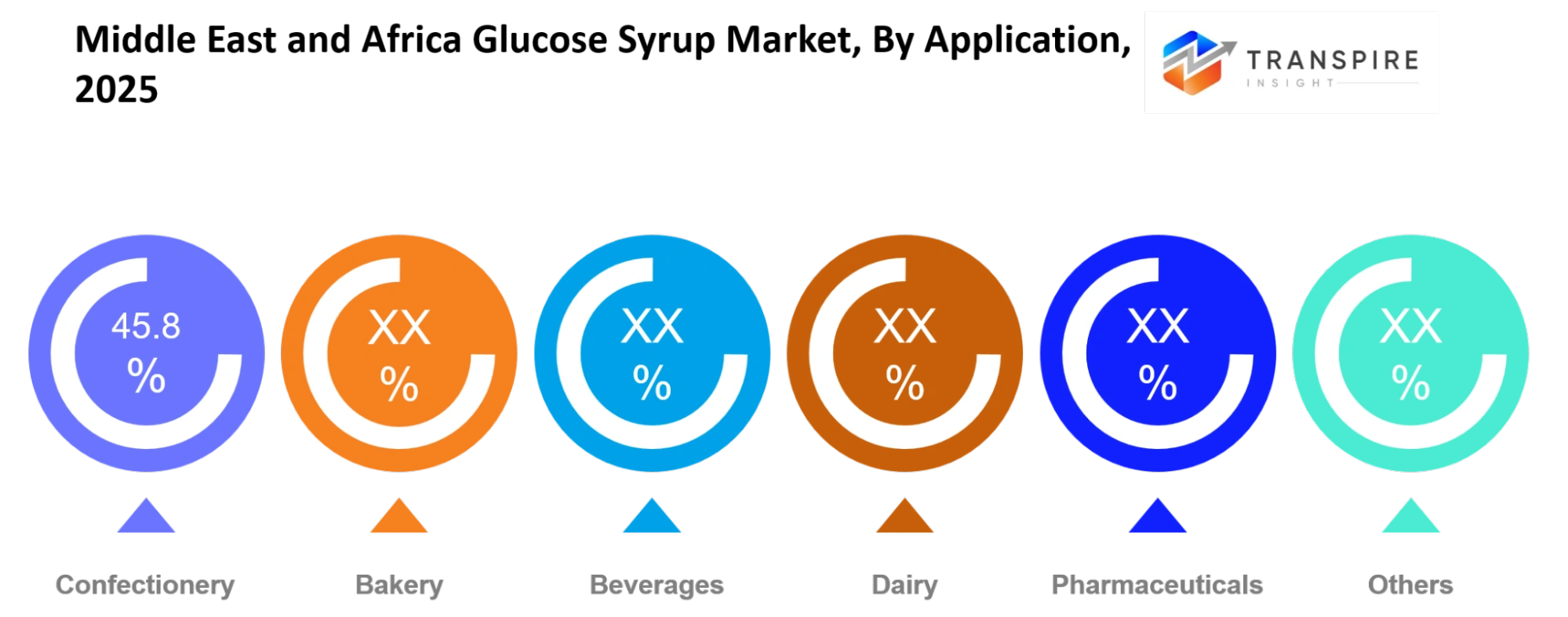
- For applications, confectionery is contributing around 30% of total demand, and that’s why it’s the largest application area, in practice.
- Food industry end users represent more than 70% of regional consumption, supported by expansion of packaged food manufacturing, across multiple markets.
- Companies like Cargill, ADM, Ingredion, Tate & Lyle, and Roquette are going after product innovation, regional expansion and specialty sweetener development, to strengthen their market positions overall.
What are the Key Drivers, Restraints, and Opportunities in the Middle East and Africa Glucose Syrup Market?
The strongest growth driver comes from the quick widening of regional food processing capacity and the modernization of packaged food production, kind of overall. Food producers are leaning more and more toward ingredients that do more than one thing, sweetening , moisture retention , viscosity regulation and shelf life enhancement. Glucose syrup covers all of that needs, while also allowing manufacturers to tune their production expenses in a smarter way. Because large scale confectionery, bakery, and beverage sites are expanding across Saudi Arabia, the United Arab Emirates, Egypt, and South Africa, ingredient purchasing volumes are rising too, and long term supplier relationships are getting more solid.
The biggest restraint really is how much the market depends on agricultural feedstocks , corn, wheat, cassava and potato starch. Feedstock prices stay exposed to weather swings , trade rules, delivery and logistics costs, and the global commodity cycles. The issue feels structural , since processing plants cannot swap feedstocks quickly without technical changes and supply chain readjustments. So when agricultural prices become unstable manufacturers often see margin pressure, and that can slow down new capacity buildouts, and eventually reduce profitability.
One major opportunity sits in creating specialty glucose syrups for pharmaceutical uses, nutritional uses, and functional food applications. Ongoing investment in advanced starch processing technologies is making it possible to produce higher purity , plus more tailored formulations. Countries like Saudi Arabia and the UAE are ramping up local pharmaceutical production, so demand is growing for pharmaceutical-grade sweetening and binding ingredients, in other words.
What Has the Impact of Artificial Intelligence Been on the Middle East and Africa Glucose Syrup Market?
Artificial intelligence and newer digital technologies are getting better, like a lot, at improving day to day operational efficiency across glucose syrup manufacturing sites. In practice, producers roll out AI based process control systems to fine tune starch conversion, keep an eye on enzyme performance, regulate temperatures, and also help keep the product stable across whole production cycles. Along the way, automated monitoring systems continuously scan production parameters and they give operators a heads up, so they can notice inefficiencies before these things mess with output quality.
Then there are machine learning models which are backing predictive maintenance efforts. Those systems look at equipment vibration patterns, pressure readings, and operating temperatures, and they can forecast component failures before unplanned shutdowns happen. The end result is better plant uptime, less money spent on maintenance, and production that feels more dependable overall. Digital twins plus advanced analytics platforms also support manufacturers in tightening energy usage and raw material utilization, and this usually means lower operating costs.
On another front, supply chain management has seen benefits too, because AI applications help here. Forecasting tools help processors anticipate demand changes, control inventory levels and refine procurement approaches for starch based feedstocks. Still, adoption is uneven in the region. High integration costs, not enough digital infrastructure in certain markets, and shortages of specialized technical expertise keep slowing the implementation, especially for smaller and medium sized processors.
Key Market Trends
- Regional food manufacturers boosted local sourcing of ingredients by about 20% in 2021-2025 to cut reliance on imports.
- Formulations based on corn became more dominant as processors were looking for cheaper and easily available sources of starches.
- Specialized glucose syrups for pharmaceuticals and nutritional foods saw growth in Gulf countries starting from 2023.
- The liquid formulations saw an increase in market shares by more than 5 percentage points since 2020 owing to processing ease.
- Use of digital process control systems spread across large manufacturing plants to ensure uniformity and minimize waste in production.
- Food producers began to use specially designed syrup formulas applicable for bakery, confectionery, and beverage sectors.
- Investment in starch processing facilities increased considerably in the area amid disruptions in the supply chain during 2020-2023.
- Major firms like Cargill, Ingredion, and Roquette increased investments into innovations in functional sweeteners.
- Premium confectionery manufacturers showed demand growth because of product differentiation.
- Applications in the pharmaceuticals industry grew fast after 2022 owing to expansion of local drug production.
Middle East and Africa Glucose Syrup Market Segmentation
By Source
Corn stays the biggest source category , mostly because it is broadly available, its global supply chains stay pretty steady, and the starch extraction processes are efficient . Food manufacturers tend to like corn-derived syrup for confectionery, bakery, and beverage use since it shows consistent quality , and the pricing is competitive. Wheat still holds a solid position too, especially where milling industries are already established, plus when grain-processing infrastructure is integrated. Potato-based variants also get used for more specialized food applications, where the exact viscosity and texture traits are needed.
Cassava is starting to get more attention , mainly because regional processors want locally available agricultural feedstocks, and they want to reduce exposure to imported raw materials. Barley-derived syrup works in niche food and beverage applications, where those distinct processing characteristics are actually helpful. Rice-based products support specialized formulations, particularly in premium and sensitive food categories. The remaining options include alternative starch sources that are developed for customized industrial and food processing needs.
By Form
Liquid glucose syrup takes the biggest share mainly because industrial food manufacturers can pretty easily transport, keep, and fold these liquid formulations directly into their production lines. With steady blending behavior and efficient handling, the liquid kind stays especially appealing for confectionery, drinks, and bakery routines. The format also suits high-volume manufacturing places where process efficiency is still kind of the key, every day.
Powder forms keep getting more traction in uses where longer shelf stability matters and where logistics can be kept simpler. Crystal variants show up in more selected specialty applications that need a carefully tuned sweetness, plus pretty exact formulation traits. The other formats handle particular manufacturing needs too, and they back product customization across several industrial sectors.
By Application
Confectionery is still the primary application segment because glucose syrup, uh it helps stop crystallization, gives a smoother texture, and it also stretches the product shelf life. In the bakery area , manufacturers lean on glucose syrup quite a bit too, not just for moisture retention but also for better, more repeatable product consistency. The beverage side keeps expanding as processors look for sweetening options that stay reliable and behave consistently over time. Dairy producers in particular use glucose syrup in flavored items, desserts, and in various processed dairy formulations where stable characteristics matter.
Pharmaceutical use is growing steadily, largely because this ingredient supports medicinal formulations, including syrups, and also nutrition related products. Beyond that, there are other uses like processed foods, industrial formulations, and more specialized manufacturing routines. Overall, new product development happening across several industries keeps the demand diversified, so application growth keeps moving forward through the region.
By End User
Food industry is perhaps the leading end user segment owing to the role of glucose syrup as an important ingredient in confectionary, bakery, dairy, beverages and processed foods. Major food producers normally prefer ingredients which are efficient in terms of cost, reliability and quality. At the same time, ongoing investments in packaged food output keep, pushing demand in this segment, stronger and stronger.
Meanwhile, the Pharma Industry uses glucose syrup within medicinal compositions, oral syrups, and nutrition based products where stable sweetening and binding behaviors are really important. Retail channels then add a bit more reach by giving consumers direct access to special sweetening options and food ingredient assortments. Besides that, other end users cover industrial processors and smaller manufacturing sectors that need tailored, starch-derived alternatives.
What are the Key Use Cases Driving the Middle East and Africa Glucose Syrup Market?
The primary use case is still pretty much confectionery manufacturing, where glucose syrup helps with crystallization control, boosts texture and generally makes the whole product behave more stable. Candy , chewing gum, caramel, and coated confectionery producers lean on these functional advantages to keep their quality consistent, and also extend shelf life a bit more.
Other uses are showing up more and more across bakery, dairy, and beverage industries. In bakery lines, glucose syrup is used for better moisture retention, so freshness lasts longer. Beverage companies use it too, mainly for sweetness control and product stability. On the dairy side , processors blend it into flavored milk products, desserts and even frozen treats.
New opportunities are also growing in pharmaceutical related and nutritional products. Manufacturers are starting to use specialized glucose syrup formulations in medicinal syrups, dietary supplements, and functional nutrition items. Right now these applications are relatively small, but they should become more meaningful as regional healthcare manufacturing capacity expands.
|
Report Metrics |
Details |
|
Market size value in 2025 |
USD 1.11 Billion |
|
Market size value in 2026 |
USD 1.17 Billion |
|
Revenue forecast in 2033 |
USD 1.74 Billion |
|
Growth rate |
CAGR of 5.83% from 2026 to 2033 |
|
Base year |
2025 |
|
Historical data |
2021 - 2024 |
|
Forecast period |
2026 - 2033 |
|
Report coverage |
Revenue forecast, competitive landscape, growth factors, and trends |
|
Regional scope |
Middle East and Africa (Saudi Arabia, United Arab Emirates, South Africa, Rest of Middle East and Africa) |
|
Key company profiled |
Cargill, ADM, Ingredion, Tate & Lyle, Roquette, Tereos, Gulshan Polyols, Grain Processing, Global Sweeteners, AGRANA, COFCO, Avebe, HL Agro, Sayaji, Daesang. |
|
Customization scope |
Free report customization (country, regional & segment scope). Avail customized purchase options to meet your exact research needs. |
|
Report Segmentation |
By Source (Corn, Wheat, Potato, Cassava, Barley, Rice, Others); By Form (Liquid, Powder, Crystal, Others); By Application (Confectionery, Bakery, Beverages, Dairy, Pharmaceuticals, Others); By End User (Food Industry, Pharma Industry, Retail, Others). |
Which Regions are Driving the Middle East and Africa Glucose Syrup Market Growth?
The GCC countries represent the dominant region within the Middle East and Africa glucose syrup market, supported by a well-established food and beverage manufacturing base and a regulatory framework that promotes consistent product quality. Countries such as Saudi Arabia and the United Arab Emirates benefit from advanced processing infrastructure, strong import logistics, and harmonized food standards under Gulf regulatory bodies, which support large-scale glucose syrup consumption across confectionery, bakery, and beverage applications. The region also maintains a dense ecosystem of ingredient suppliers, distributors, and contract manufacturers that enables efficient sourcing and formulation of sweetener products. This combination of regulatory certainty, industrial capacity, and supply chain efficiency allows the GCC to retain its leadership position in regional market revenue.
North Africa ranks as the second most significant regional contributor, but its market strength comes from a different foundation than the GCC. Rather than relying primarily on import-driven processing networks, countries such as Egypt benefit from established domestic manufacturing, expanding bakery and pharmaceutical industries, and steady demand from a large consumer base. Economic diversification efforts and ongoing investment in food processing have created a resilient market environment that supports consistent glucose syrup consumption even during periods of external trade volatility. As a result, North Africa remains a dependable source of revenue growth, driven by industrial stability and long-term production capacity rather than rapid expansion alone.
Sub-Saharan Africa is expected to record the fastest growth through the forecast period as governments and private investors expand agro-processing capabilities and modernize food manufacturing systems. Recent investments in local starch processing, growing interest in cassava-based glucose production, and efforts to strengthen food security have reduced dependence on imported sweeteners while creating new domestic supply opportunities. Rapid urbanization, modern retail expansion, and rising consumption of packaged foods are accelerating demand across major economies such as Nigeria and Kenya. For market entrants and investors, this momentum signals an opportunity to establish production, distribution, and ingredient partnerships early, positioning themselves to benefit from the region's above-average growth trajectory between 2026 and 2033.
Who are the Key Players in the Middle East and Africa Glucose Syrup Market and How Do They Compete?
Competition stays fairly consolidated, at least in a broad sense, with multinational ingredient suppliers still having a lot of say in the market due to scale, technology , and these global sourcing networks. What really separates players is not just one thing, it’s more like product quality, practical application know-how, feedstock access, manufacturing efficiency, and yes the customer support side of things. Bigger suppliers keep putting money into specialty sweetener portfolios, the ones with better margins and a stronger grip on customer retention.
Cargill kind of leans on integrated agricultural supply chains and serious starch-processing knowledge to stay cost competitive. ADM tends to emphasize a wide ingredient range and feedstock sourcing efficiency that works well for large-scale food manufacturers. Ingredion differentiates more through formulation expertise, specialty starch offerings and also through strategic expansion moves. In May 2026, Ingredion said it was starting a joint venture with Sanstar Limited, aimed at growing specialty ingredient production capacity and improving market access in higher-growth areas.
Tate & Lyle continues to push specialty food ingredient innovation, plus expanded customer solutions, after integration work with CP Kelco. At the same time, Roquette puts more emphasis on plant-based ingredient development and portfolio expansion, backed by strategic investments and acquisitions .
Company List
- Cargill
- ADM
- Ingredion
- Tate & Lyle
- Roquette
- Tereos
- Gulshan Polyols
- Grain Processing
- Global Sweeteners
- AGRANA
- COFCO
- Avebe
- HL Agro
- Sayaji
- Daesang
Recent Development News
"In May 2026, Ingredion entered a joint venture with Sanstar Limited and acquired a 9% equity stake in the company. The partnership expands specialty ingredient manufacturing capabilities and strengthens access to food, beverage, and pharmaceutical markets in India.
Source: https://in.investing.com/news/stock-market-news/ingredion-forms-joint-venture-with-indias-sanstar-limited-93CH-5429544 (Investing.com)."
"In June 2026, Ingredion announced the acquisition of Tate & Lyle in a transaction valued at approximately USD 3.6 billion. The deal expands specialty ingredient capabilities and creates a larger global platform focused on sweetening, texture, and nutrition solutions.
Source: https://www.reuters.com/legal/transactional/uks-tate-lyle-agrees-36-billion-ingredion-takeover-2026-06-08/ (Reuters)."
"In April 2026, Roquette successfully priced a €600 million hybrid notes issuance to support strategic growth initiatives and portfolio development. The financing strengthens investment capacity across plant-based and specialty ingredient businesses.
Source: https://www.roquette.com/financial-information (Roquette)."
What Strategic Insights Define the Future of the Middle East and Africa Glucose Syrup Market?
The market is, kind of, moving toward more regional integration, more localized processing capacity, and higher-value specialty formulations , so. Food manufacturers are increasingly looking for ingredients that can do multiple functional benefits at once while also helping with production efficiency and supply chain resilience. This shift will push investment into advanced starch processing technologies and also encourage product development that is basically specific to each application.
There’s also a risk that sits more in the background. Feedstock concentration can be a problem, because heavy dependence on agricultural commodities like corn, and wheat, makes processors vulnerable to weather disruptions, trade restrictions, and commodity price swings. If the volatility keeps going, it could squeeze margins and reduce investment returns even if overall demand is still healthy.
At the same time, there is an emerging opening in pharmaceutical-grade and nutrition-focused glucose syrup formulations. Healthcare manufacturing capacity is expanding across Gulf countries, plus some selected African markets, which is generating new needs for specialized ingredients. Participants should probably prioritize local sourcing partnerships, invest in specialty processing capabilities, and build stronger application-development expertise. Doing so could help capture higher-margin growth over the next decade, and not just chase volume.
Middle East and Africa Glucose Syrup Market Report Segmentation
By Source
- Corn
- Wheat
- Potato
- Cassava
- Barley
- Rice
- Others
By Form
- Liquid
- Powder
- Crystal
- Others
By Application
- Confectionery
- Bakery
- Beverages
- Dairy
- Pharmaceuticals
- Others
By End User
- Food Industry
- Pharma Industry
- Retail
- Others
Frequently Asked Questions
Find quick answers to common questions.
The expected Middle East and Africa Glucose Syrup Market size for the market will be USD 1.74 Billion in 2033.
Key segments for the Middle East and Africa Glucose Syrup Market are By Source (Corn, Wheat, Potato, Cassava, Barley, Rice, Others); By Form (Liquid, Powder, Crystal, Others); By Application (Confectionery, Bakery, Beverages, Dairy, Pharmaceuticals, Others); By End User (Food Industry, Pharma Industry, Retail, Others).
Major Middle East and Africa Glucose Syrup Market players are Cargill, ADM, Ingredion, Tate & Lyle, Roquette, Tereos, Gulshan Polyols, Grain Processing, Global Sweeteners, AGRANA, COFCO, Avebe, HL Agro, Sayaji, Daesang.
The Middle East and Africa Glucose Syrup Market size is USD 1.11 Billion in 2025.
The Middle East and Africa Glucose Syrup Market CAGR is 5.83% from 2026 to 2033.
- Cargill
- ADM
- Ingredion
- Tate & Lyle
- Roquette
- Tereos
- Gulshan Polyols
- Grain Processing
- Global Sweeteners
- AGRANA
- COFCO
- Avebe
- HL Agro
- Sayaji
- Daesang
About the Authors

Chetan Dhatrak
I’m Chetan Dhatrak, a Senior Research Analyst at Transpire Insight, specializing in the Consumer Goods, Foods and Beverages industry. I focus on analyzing market trends, consumer behavior, competitive landscapes, and industry developments to deliver accurate, data-driven insights. My research at Transpire Insight is built on credible sources and in-depth analysis, helping businesses and readers better understand market dynamics, emerging opportunities, and evolving consumer preferences. I’m committed to creating reliable, well-researched content that supports informed decision-making and reflects the latest developments in the consumer goods and food & beverage sectors.

Chakradhar Khansole
Chakradhar serves as the Research Director at Transpire Insight, bringing over 8 years of experience in technology, innovation, and strategic market intelligence. He specializes in transforming complex market data into actionable business insights that enable organizations to make informed, growth-oriented decisions. Recognized for his strategic vision and analytical expertise, Chakradhar leads high-impact research initiatives, delivering comprehensive market assessments, competitive intelligence, and forward-looking industry analysis.
Recently Published Reports
-
Apr 2026
Baby Infant Formula Market
Baby Infant Formula Market Size, Share & Analysis Report By ype (Infant Milk, Follow On Milk, Specialty Baby Milk, Growing-Up Milk), By Ingredient (Carbohydrate, Fat, Protein, Minerals, Vitamins, and Others), By Product Form (Powder, Liquid, and Ready-to-feed), By Distribution Channels (Supermarket/Hypermarket, Specialty Store, Pharmacies, Online Retail, and Others), and Geography (North America, Europe, Asia-Pacific, Middle East and Africa, South and Central America), 2021 - 2031
-
Apr 2026
Edible Insects for Animal Feed Market
Edible Insects for Animal Feed Market Size, Share & Analysis Report By Type (Insect Powder, Insect Meal, Insect Bar, Insect Paste, Insect Oil, and Others), By Insect Type (Beetles, Cricket, Caterpillar, Hymenoptera, Orthoptera, Tree Bugs, and Others), By Application (Livestock, Pet Food, and Aquaculture), By Livestock Type (Poultry, Swine, and Others), and Geography (North America, Europe, Asia-Pacific, Middle East and Africa, South and Central America), 2021 - 2031
-
Apr 2026
Food Industry Disinfection and Bacterial Control Market
Food Industry Disinfection and Bacterial Control Market Size, Share & Analysis Report By Type (Chemical Disinfectants, Physical Disinfectants, and Biocides and Antimicrobials), By Application (Food Processing Equipment Surface Disinfection, Food Preparation Areas Surface Disinfection, Storage Areas Surface Disinfection, Anti-microbial Coatings Food Preservation, and Preservative Solutions Food Preservation), By End User (Meat and Poultry Processing, Dairy Processing, Seafood Processing, Bakery and Confectionery, Restaurants and Commercial Kitchens, and Food Service Providers), By Sales Channel (Online, Offline), and Geography (North America, Europe, Asia-Pacific, Middle East and Africa, South and Central America), 2021 - 2031
-
May 2026
Freeze Dried Food Market
Freeze Dried Food Market Size, Share & Analysis Report By Product Type (Fruits, Vegetables, Freeze-Dried Dairy Products, Freeze-Dried Meat and Seafood, Freeze-Dried Pet Food, and Prepared Meal), By Nature (Organic, and Conventional), By Form (Powdered, Granules, and Diced), By End Use (Breakfast Cereals, Dairy Products, Bakery & Confectionery, Nutritional Bars & Supplements, Powdered Beverages, Snacks, and Retail (Household)), and Geography (North America, Europe, Asia-Pacific, Middle East and Africa, South and Central America), 2021 - 2031