

Japan Glucose Syrup Market Size & Forecast:
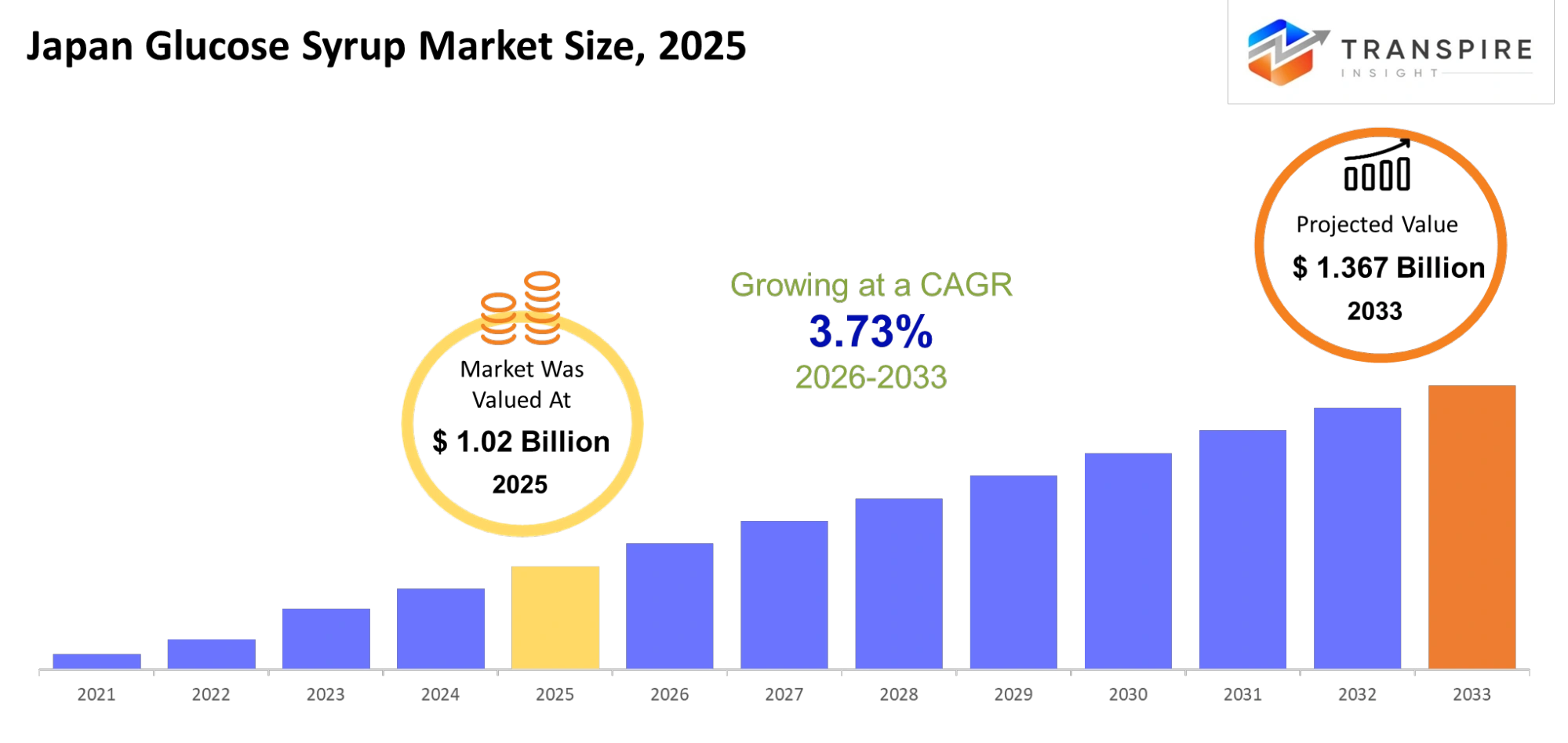
- Japan Glucose Syrup Market Size 2025: USD 1.02 Billion
- Japan Glucose Syrup Market Size 2033: USD 1.367 Billion
- Japan Glucose Syrup Market CAGR: 3.73%
- Japan Glucose Syrup Market Segments: By Type (Corn-based, Wheat-based, Others); By Application (Food & Beverages, Pharmaceuticals, Confectionery, Bakery, Others); By End-User (Food Industry, Pharma Companies, FMCG Companies, Others); By Form (Liquid, Powder, Others)
To learn more about this report,  Download Free Sample Report
Japan Glucose Syrup Market Summary:
The Japan Glucose Syrup Market size is estimated at USD 1.02 Billion in 2025 and is anticipated to reach USD 1.367 Billion by 2033, growing at a CAGR of 3.73% from 2026 to 2033.
The Japanese glucose syrup market within the food ingredients industry will continue to reflect a careful balance between tradition and modern food processing needs. The consumer demand for products will increase because people now pay more attention to the sources of sugar and the levels of sweetness and the transparency of product labels.
Food manufacturers will respond to the market needs by developing new product formulas which will deliver less sweet taste and improved texture for their confectionery and beverage and baked goods products. The market will experience a noticeable transition toward syrups which are made from non-genetically modified corn and alternative starch sources because customers want to verify the origin and quality of their products.
Producers will achieve better processing results through improvements in enzymatic processing methods and filtration systems which enable them to create precise control over product viscosity and flavor neutrality. Japanese regulators will maintain strict oversight of food safety standards and labeling requirements which will result in companies needing to adopt more sustainable production practices. The demand for convenience foods and ready-to-drink beverages will create new usage patterns for glucose syrup which will require suppliers to adapt their operations while still achieving cost effectiveness and product quality.
What Has the Impact of Artificial Intelligence Been on the Japan Glucose Syrup Market?
Japan Glucose Syrup Market operations experience a complete transformation through artificial intelligence which enhances operational activities and strategic business planning while creating more effective decision-making processes and operational outcomes throughout the entire value chain. AI in Japan Glucose Syrup Market operations has significantly improved market research capabilities by enabling companies to process large volumes of consumption data, pricing fluctuations, and raw material trends in real time.
The Japan Glucose Syrup Market uses machine learning and predictive analytics to help businesses identify changing customer preferences and assess market trends while forecasting future demand with increased accuracy. This data-driven approach enables manufacturers to synchronize their production methods with the changing demand patterns from the food processing industry and the confectionery sector and the beverage market.
The manufacturing process of the Japan Glucose Syrup Market has gained momentum through the implementation of artificial intelligence which improves smart automation to achieve better production results while decreasing production expenses. The automated monitoring systems which utilize artificial intelligence technology can discover equipment malfunctions while they enhance starch conversion operations and guarantee product quality.
The implementation of artificial intelligence technology within the Japan Glucose Syrup Market supply chain system enables organizations to optimize their inventory levels while decreasing waste and improving their procurement operations through prediction of disruptions that affect their corn and tapioca-based raw material supply.
The Japan Glucose Syrup Market companies obtain market advantage through these developments which enable them to develop new products at faster rates and develop customized solutions while they better handle customer demands. The Japan Glucose Syrup Market benefits from digital transformation because artificial intelligence technology improves business flexibility and operational precision and sustains market competitiveness for extended periods.
Key Market Trends & Insights:
- The Japanese glucose syrup market is growing because confectionery and bakery and ready-to-drink beverage products need more liquid sweeteners.
- The Kanto region leads the Japanese glucose syrup market because it has multiple food processing centers which generate nearly 38% market share in 2025.
- The Kansai region maintains its position as the second-largest market because confectionery production needs and large-scale syrup production facilities drive demand.
- The Chubu region will become the fastest-growing market because it expects to grow 5.6% annually between 2025 and 2032 through its food manufacturing investment programs.
- Corn-based glucose syrup leads the market with approximately 54% share in 2025 because the industry has developed necessary processing systems.
- The second-largest market share of wheat-based glucose syrup exists because producers can make it at a lower cost.
- The market for organic and specialty glucose syrup will experience its most rapid growth until 2032 because of rising demand for premium food products.
- The confectionery industry controls 41% of the market share because consumers in the United States have high demand for candy and processed sweet products.
- The Japan glucose syrup market has more than 48% market share because food processing manufacturers need large quantities of ingredients.
- The Japan glucose syrup market features Matsutani Chemical Industry Nippon Starch Chemical ADM Ingredion Incorporated Cargill and Tate & Lyle as its main companies.
Japan Glucose Syrup Market Segmentation
By Type :
The Japan Glucose Syrup Market shows strong support for its corn-based segment because raw materials are easily accessible and processed food production needs remain constant. Food manufacturers choose corn-derived syrup because it maintains uniform sweetness and provides a smooth texture that blends easily with their products. The food processing industry uses this type of processing for beverage production and sauce creation and packaged product development because it delivers consistent quality. The segment serves an essential role for manufacturers who want to maintain their daily production rates because demand depends on their ability to produce goods while managing expenses.
Wheat-based glucose syrup serves a different requirement within industrial production. The product serves specific texture and formulation needs that companies require to achieve product differentiation. The bakery and confectionery industry uses this ingredient to maintain product moisture while extending product shelf life. The other segment includes glucose syrup derived from potatoes, rice, and tapioca, which supports niche applications. The food industry now focuses on these alternatives because manufacturers require specialized ingredients that meet consumer preferences and production standards.
By Application :
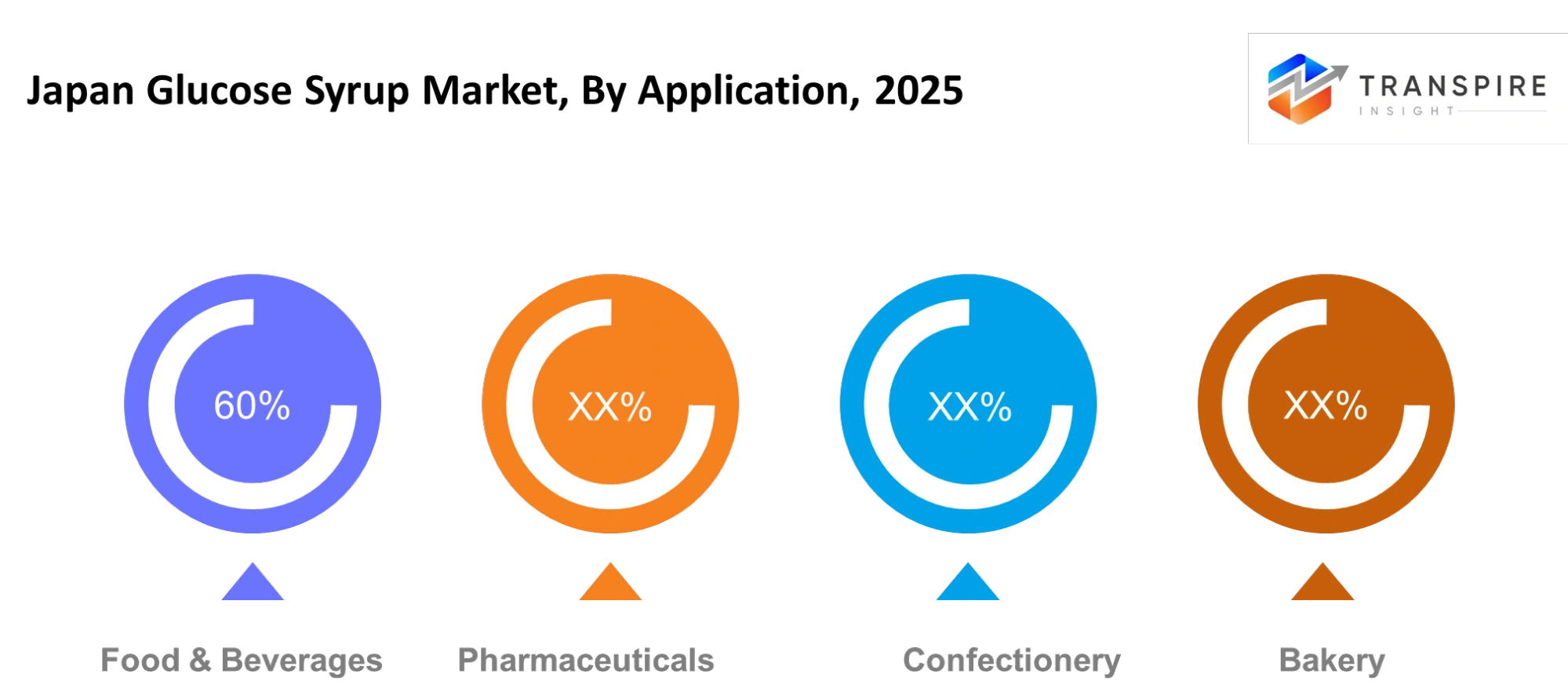
The Japan Glucose Syrup Market shows food and beverages as its primary application area. The food industry uses glucose syrup in soft drinks and dairy products and processed snacks and frozen desserts because it improves texture and increases sweetness while stopping sugar crystallization. Food makers continue to depend on this ingredient for consistency in large-scale production. The growth of packaged products which require no preparation continues to drive this market segment forward.
Pharmaceutical use is growing due to its role as a stabilizing and binding agent in medicinal formulations. In confectionery, glucose syrup is essential for candies, chewing gums, and coated sweets as it controls sugar crystallization and improves smoothness. The bakery sector uses moisture retention technology to extend product freshness which enables baked goods to maintain their softness for extended durations. The other category includes cosmetics and industrial uses where syrup-based formulations support texture control and product stability across different manufacturing processes.
To learn more about this report, Download Free Sample Report
By End-User :
The Japan Glucose Syrup Market shows food processors as their main customer base which operates as the largest user group in this market. Food processors use glucose syrup to create consistent products which help them manage sweetness levels and extend product shelf life. The Japanese packaged food industry maintains its demand for syrup products because it continues to produce packaged items at high volumes. The relationship between ingredient suppliers and food producers creates consistent market activity that extends across various product categories.
Pharma companies use glucose syrup for medicinal syrups and oral formulations which require smooth consistency. FMCG companies also contribute significantly through large-scale manufacturing of confectionery, beverages, and instant products. The group maintains its demand through regular product introduction which matches the evolving preferences of consumers. The other segment includes smaller industrial users that require syrup for technical formulations which creates market opportunities in specialized production areas.
By Form :
The Japan Glucose Syrup Market operates under the dominance of liquid glucose syrup because this product enables simple handling and industrial processing through its immediate usability. The production process requires manufacturers to use liquid form because it enables faster mixing and creates better product consistency and reduces preparation time during manufacturing. Ingredient integration requirements in continuous production systems make this process common in beverage and confectionery and processed food manufacturing.
Powder glucose syrup serves applications where storage convenience and longer shelf life are necessary. The product is frequently selected by manufacturers who require exact measurements and the ability to create dry blends. The powder form of a substance is the preferred choice for handling pharmaceutical formulations and nutritional products and bakery premixes. The liquid form maintains wider usage across different applications, but specialized production environments are increasingly adopting powder form due to its advantages in transportation and storage.
What are the Main Challenges for the Japan Glucose Syrup Market Growth?
The Japan Glucose Syrup Market needs to overcome several technical and operational obstacles which currently decrease its production capacity and expansion potential. The Japan Glucose Syrup Market faces its most significant expansion obstacle because businesses must sustain product quality standards while their corn and starch-based feedstock resources undergo unexpected availability changes.
Supply chain disruptions together with rising transportation costs and dependence on imported agricultural products establish market boundaries which disrupt production scheduling for the entire japan glucose syrup market. Manufacturing processes in the Japan Glucose Syrup Market face their most significant challenges because of their intricate nature.
The production process needs both advanced enzymatic conversion technologies and precise temperature management and compliance with food safety regulations which include GMP and domestic quality standards. The combined effect of increasing energy costs and inflationary pressures on processing operations results in higher production costs which reduce profit margins.
The Japan Glucose Syrup Market faces challenges from two main adoption issues which arise when food manufacturers start using natural sweeteners and create products with less sugar. The smaller processors face two main obstacles which prevent them from developing new products because they cannot access specialized technical expertise and their infrastructure development process moves at a slow pace.
The Japan glucose syrup market faces two main threats from stevia and fructose syrups and clean-label sweeteners which create two pricing challenges and two future market dangers that require manufacturers to spend money on product differentiation and sustainable production methods.
Country Insights
The market in Japan's main manufacturing areas remains influenced by ongoing food processing activities. The manufacturing of beverages and confectionery products and bakery items and packaged food goods creates a steady market need for glucose syrup which functions as both a sweetener and texturizing agent. The manufacturing facilities operate their production processes through three main objectives which include maintaining product quality and reducing expenses and ensuring uniformity of their materials.
The customer demand for food products shows a gradual progression toward convenience-based dining practices which exist in urban areas. The market keeps growing because ready-to-eat meals and packaged desserts and instant food products need their specific ingredients to be produced. Product developers continue adjusting formulations to match changing taste expectations, texture standards, and shelf-life requirements, creating continued opportunities for glucose syrup across multiple consumer-focused food categories.
Japan will achieve better operational efficiency through improvements in starch conversion and refining processes which will provide better control over product customization. The food product manufacturers keep spending money on advanced processing technologies which help them achieve better output and preserve their food-grade product standards. The market trend shows a growing interest in maintaining reliable domestic production networks and managing raw material procurement processes and creating unique syrup varieties for specific industrial requirements.
Recent Development News
In April 2026, Ingredion Incorporated reported earnings growth. The company highlighted continued demand for specialty sweeteners and starch-based ingredients across Asia-Pacific, including Japan, supporting its glucose syrup portfolio expansion.
Source https://www.ingredion.com/
In April 2026, Cargill Incorporated announced product innovation. The firm introduced new clean-label starch and syrup solutions targeting processed food manufacturers in Asia, indirectly strengthening its competitive position in Japan’s glucose syrup supply chain.
Source https://www.cargill.com/
|
Report Metrics |
Details |
|
Market size value in 2025 |
USD 1.02 Billion |
|
Market size value in 2026 |
USD 1.058 Billion |
|
Revenue forecast in 2033 |
USD 1.367 Billion |
|
Growth rate |
CAGR of 3.73% from 2026 to 2033 |
|
Base year |
2025 |
|
Historical data |
2021 - 2024 |
|
Forecast period |
2026 - 2033 |
|
Report coverage |
Revenue forecast, competitive landscape, growth factors, and trends |
|
Country scope |
Japan |
|
Key company profiled |
Cargill, ADM, Tate & Lyle, Ingredion, Roquette, Tereos, Grain Processing Corporation, Gulshan Polyols, Global Sweeteners, COFCO, Daesang, Showa Sangyo, Matsutani Chemical, Nihon Shokuhin Kako, Samyang |
|
Customization scope |
Free report customization (country, regional & segment scope). Avail customized purchase options to meet your exact research needs. |
|
Report Segmentation |
By Type (Corn-based, Wheat-based, Others); By Application (Food & Beverages, Pharmaceuticals, Confectionery, Bakery, Others); By End-User (Food Industry, Pharma Companies, FMCG Companies, Others); By Form (Liquid, Powder, Others) |
How Can New Companies Establish a Strong Foothold in the Japan Glucose Syrup Market?
New entrants who want to build a strong presence in the Japan Glucose Syrup Market need to search for specific market segments which will match their future product needs and client requirements. Companies can create unique market positions through their products which include low-calorie sweeteners and organic glucose syrup and clean-label food ingredients. Emerging companies in the market can develop solutions for food and beverage manufacturers because they create special syrup products which help with reduced-sugar needs and high-quality processed food production.
Technology-driven innovation is another vital market entry method which companies use to develop their business operations in the Japanese glucose syrup market. The company can achieve better operational performance through its investment in advanced enzymatic processing and smart automation and AI-based production monitoring systems which will result in lower operational costs and higher product quality.
Companies can use strategic partnerships with food manufacturers and ingredient distributors and research institutions to speed up product development while building dependable supply chains throughout the Japanese glucose syrup market. The new entrance companies use these innovation strategies to create better market advantage which meets the increasing demand for sustainable yet efficient sweetener solutions.
The R&D efforts of Matsutani's specialty ingredient innovation divisions and food-tech startups that develop starch optimization technologies show how targeted research work can create new commercial possibilities. The Japanese glucose syrup market can be accessed by startups that use precision fermentation and plant-based carbohydrate engineering to develop innovative methods for their market expansion.
Key Japan Glucose Syrup Market Company Insights
The Japan Glucose Syrup Market shows continuous growth because food processing companies maintain their product quality standards while they work to deliver products consistently and control their production costs. The market competition exists because established starch processors work to improve their production processes while regional manufacturers develop new product formulations for confectionery, bakery, and beverage markets.
The practice of clean ingredient sourcing with consistent domestic supply has led manufacturers to improve their operational procedures. The company expands its operations through technology improvements and distribution agreements while producing customized products which enhance its market position among industrial clients who need reliable glucose syrup products in a highly competitive market.
Company List
- Cargill
- ADM
- Tate & Lyle
- Ingredion
- Roquette
- Tereos
- Grain Processing Corporation
- Gulshan Polyols
- Global Sweeteners
- COFCO
- Daesang
- Showa Sangyo
- Matsutani Chemical
- Nihon Shokuhin Kako
- Samyang
What are the Key Use-Cases Driving the Growth of Japan Glucose Syrup Market?
The Japan Glucose Syrup Market experiences its primary growth because the food and beverage industry expands its use of glucose syrup which serves as an essential ingredient for sweetening and thickening and moisture retention. The production of confectionery products relies on glucose syrup to provide texture improvements and prevent crystallization while extending the shelf life of candies and chocolates and chewing gum. The japan glucose syrup market maintains high demand because manufacturers need to achieve product consistency while they work to improve their processing methods.
The Japan Glucose Syrup Market experiences rapid growth because baking and processed food production facilities increasingly adopt this ingredient. Manufacturers use glucose syrup to improve the freshness and mouthfeel and product stability of bread and cakes and frozen desserts and packaged snacks. The convenience food sector in Japan drives market expansion through multiple applications. The Japan glucose syrup market experiences growth because manufacturers develop customized syrup blends that meet reduced-sugar requirements for functional food products.
The Japan Glucose Syrup Market extends its reach beyond food applications into both the pharmaceutical sector and the nutraceutical sector. Glucose syrup functions as a stabilizing agent and energy source in syrups, oral supplements, and medicinal formulations. The emergence of clean-label products and low-calorie product development and smart processing technologies has created new innovation opportunities that will enable the Japan glucose syrup market to achieve growth in various industrial applications.
Japan Glucose Syrup Market Report Segmentation
By Type
- Corn-based
- Wheat-based
By Application
- Food & Beverages
- Pharmaceuticals
- Confectionery
- Bakery
By End-User
- Food Industry
- Pharma Companies
- FMCG Companies
By Form
- Liquid
- Powder
Frequently Asked Questions
Find quick answers to common questions.
The approximate Japan Glucose Syrup Market size for the market will be USD 1.367 Billion in 2033.
Key segments for the Japan Glucose Syrup Market are By Type (Corn-based, Wheat-based, Others); By Application (Food & Beverages, Pharmaceuticals, Confectionery, Bakery, Others); By End-User (Food Industry, Pharma Companies, FMCG Companies, Others); By Form (Liquid, Powder, Others).
Major Japan Glucose Syrup Market players are Cargill, ADM, Tate & Lyle, Ingredion, Roquette, Tereos, Grain Processing Corporation, Gulshan Polyols, Global Sweeteners, COFCO, Daesang, Showa Sangyo, Matsutani Chemical, Nihon Shokuhin Kako, Samyang.
The Japan Glucose Syrup Market size is USD 1.02 Billion in 2025.
The Japan Glucose Syrup Market CAGR is 3.73%.
- Cargill
- ADM
- Tate & Lyle
- Ingredion
- Roquette
- Tereos
- Grain Processing Corporation
- Gulshan Polyols
- Global Sweeteners
- COFCO
- Daesang
- Showa Sangyo
- Matsutani Chemical
- Nihon Shokuhin Kako
- Samyang
Recently Published Reports
-
Apr 2026
Baby Infant Formula Market
Baby Infant Formula Market Size, Share & Analysis Report By ype (Infant Milk, Follow On Milk, Specialty Baby Milk, Growing-Up Milk), By Ingredient (Carbohydrate, Fat, Protein, Minerals, Vitamins, and Others), By Product Form (Powder, Liquid, and Ready-to-feed), By Distribution Channels (Supermarket/Hypermarket, Specialty Store, Pharmacies, Online Retail, and Others), and Geography (North America, Europe, Asia-Pacific, Middle East and Africa, South and Central America), 2021 - 2031
-
Apr 2026
Edible Insects for Animal Feed Market
Edible Insects for Animal Feed Market Size, Share & Analysis Report By Type (Insect Powder, Insect Meal, Insect Bar, Insect Paste, Insect Oil, and Others), By Insect Type (Beetles, Cricket, Caterpillar, Hymenoptera, Orthoptera, Tree Bugs, and Others), By Application (Livestock, Pet Food, and Aquaculture), By Livestock Type (Poultry, Swine, and Others), and Geography (North America, Europe, Asia-Pacific, Middle East and Africa, South and Central America), 2021 - 2031
-
Apr 2026
Food Industry Disinfection and Bacterial Control Market
Food Industry Disinfection and Bacterial Control Market Size, Share & Analysis Report By Type (Chemical Disinfectants, Physical Disinfectants, and Biocides and Antimicrobials), By Application (Food Processing Equipment Surface Disinfection, Food Preparation Areas Surface Disinfection, Storage Areas Surface Disinfection, Anti-microbial Coatings Food Preservation, and Preservative Solutions Food Preservation), By End User (Meat and Poultry Processing, Dairy Processing, Seafood Processing, Bakery and Confectionery, Restaurants and Commercial Kitchens, and Food Service Providers), By Sales Channel (Online, Offline), and Geography (North America, Europe, Asia-Pacific, Middle East and Africa, South and Central America), 2021 - 2031
-
Apr 2026
Freeze Dried Food Market
Freeze Dried Food Market Size, Share & Analysis Report By Product Type (Fruits, Vegetables, Freeze-Dried Dairy Products, Freeze-Dried Meat and Seafood, Freeze-Dried Pet Food, and Prepared Meal), By Nature (Organic, and Conventional), By Form (Powdered, Granules, and Diced), By End Use (Breakfast Cereals, Dairy Products, Bakery & Confectionery, Nutritional Bars & Supplements, Powdered Beverages, Snacks, and Retail (Household)), and Geography (North America, Europe, Asia-Pacific, Middle East and Africa, South and Central America), 2021 - 2031