
Middle East and Africa Global Television - Brand Share Landscape Market Size & Forecast:
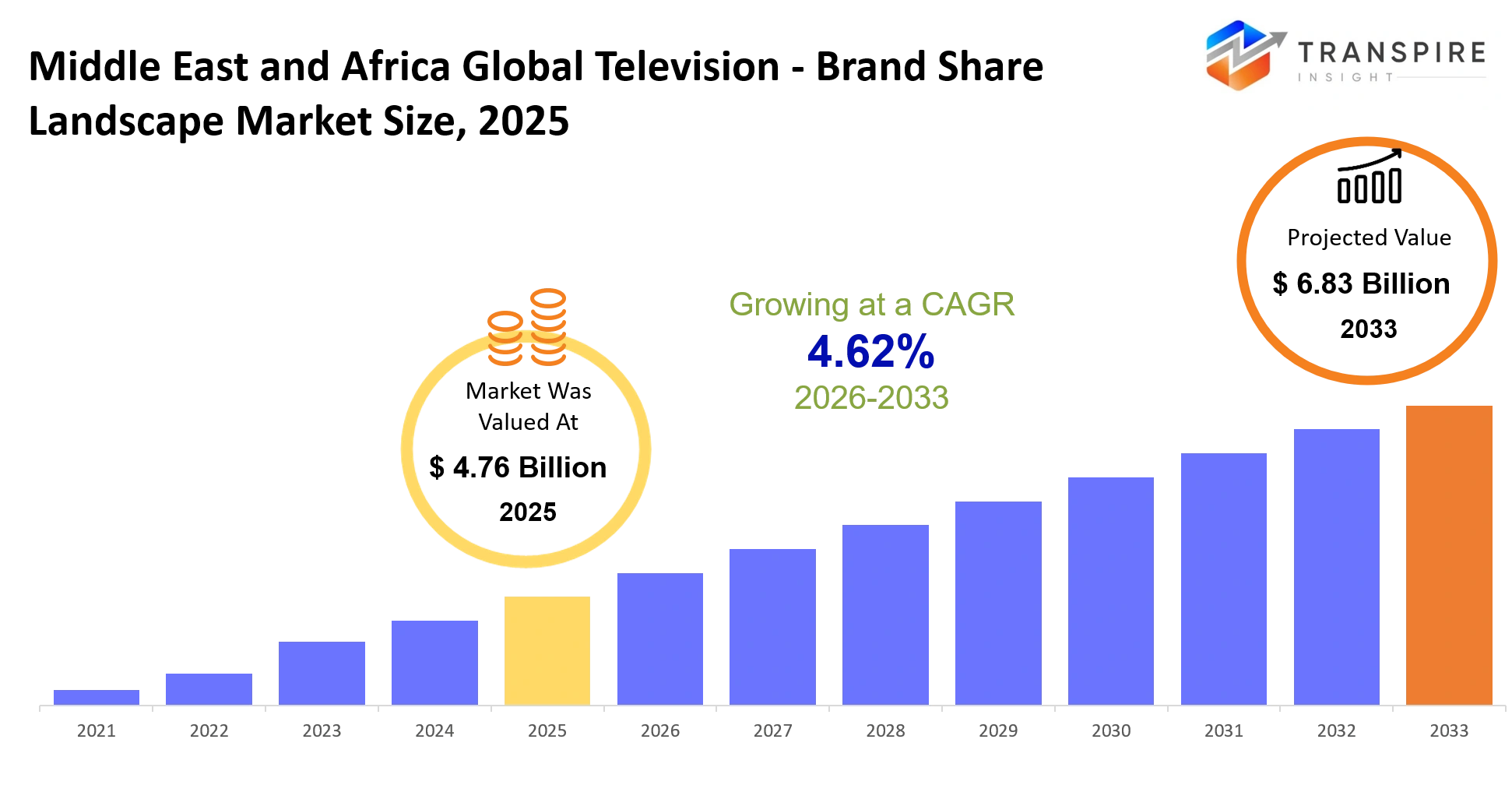
- Middle East and Africa Global Television - Brand Share Landscape Market Size 2025: USD 4.76 Billion
- Middle East and Africa Global Television - Brand Share Landscape Market Size 2033: USD 6.83 Billion
- Middle East and Africa Global Television - Brand Share Landscape Market CAGR: 4.62%
- Middle East and Africa Global Television - Brand Share Landscape Market Segments: By Screen Type (LED TVs, OLED TVs, QLED TVs, Mini-LED TVs, Smart TVs, 4K TVs, 8K TVs, Others); By Distribution Channel (Online Retail, Electronics Stores, Hypermarkets, Supermarkets, Brand Stores, Specialty Stores, Direct Sales, Others); By Screen Size (Below 32 Inch, 32–43 Inch, 44–55 Inch, 56–65 Inch, Above 65 Inch, Ultra Large TVs, Commercial Displays, Others); By End User (Residential, Commercial, Hospitality, Education, Healthcare, Government, Entertainment Venues, Others).
Middle East and Africa Global Television - Brand Share Landscape Market Summary
The Middle East and Africa Global Television - Brand Share Landscape Market was valued at USD 4.76 Billion in 2025. It is forecast to reach USD 6.83 Billionby 2033. That is a CAGR of 4.62% over the period.
Television brands in the Middle East and Africa keep pushing against each other to deliver home entertainment, digital content reach, gaming experiences, and that connected smart-home vibe across households, companies, hotels, and public spaces. This market, kind of acts like a bridge between content providers and the people watching, so it supports streaming, broadcasting, education, advertising, and commercial display use. In the last five years, it feels like the whole space moved away from the older LED-only rivalry, and now it’s more about smart TVs, premium OLED and QLED screens, AI based picture processing, plus streaming ecosystems that are more “all in one”. That shift really sped up during the pandemic, when people stayed home more, home entertainment consumption jumped, and streaming services grew fast across lots of regional markets.
Another thing that really mattered, was the worldwide semiconductor shortages and the supply chain chaos around that time. Manufacturers had to redo their sourcing methods and build regional distribution plans, not just rely on the same suppliers. And as premium display tech became easier to buy , households started upgrading to bigger screens and higher resolution models more often. So, revenue chances have widened, moving past just selling the hardware. Now it’s also about software ecosystems, advertising services, gaming connections, and broader connected device platforms. Brand competition is now more about how well the tech stands out, how strong the AI viewing improvements are, and how smoothly the ecosystem ties together, not only about price, or discounts, whatever.
Key Market Insights
- Samsung is still holding the dominant brand position, with an estimated 25%–30% regional slice across the premium and smart television areas. In GCC countries, you can see more than 35% of premium TV sales, mainly because household spending is higher, like a steady upward trend.
- Smart TVs themselves now make up over 60% of television shipments, and that’s happening as streaming services become the main content source.
- For the segments, LED TVs keep staying the biggest part, crossing 40% market share, largely tied to affordability and pretty wide consumer acceptance.
- Then there are QLED televisions, they land as the second-largest premium group, with support from strong adoption from Samsung and TCL.
- OLED television shipments saw double digit yearly growth from 2023 to 2025, as pricing finally got more reachable for a wider audience.
- When you look at size, screens above 55 inches are moving the fastest size category all the way through 2033, especially in urban homes.
- On the revenue side, residential users contribute more than 70% of the total, so households remain the largest end-user segment by far.
- Hospitality and commercial display installations are also growing quickly, driven by tourism investments throughout Saudi Arabia and the UAE.
- Competitors like Samsung, LG, Sony, TCL, Hisense, and Xiaomi are all pushing hard on AI features, gaming capabilities, and regional expansion, even if their methods differ a bit.
What are the Key Drivers, Restraints, and Opportunities in the Middle East and Africa Global Television - Brand Share Landscape Market?
The strongest growth driver is, honestly, the move toward smart connected entertainment ecosystems. Streaming services , cloud gaming platforms, and AI powered content suggestions keep re-shaping what households want to buy. Because of this, television brands are now embedding more advanced processors, voice assistants, and whole application ecosystems right into their products. It’s kind of a double win, brands can earn stronger revenue from premium devices , and consumers get nudged into quicker replacement cycles when they want the upgraded viewing feel.
Affordability is still the biggest structural blockage. A lot of the Middle East and Africa population segment still deals with income gaps, so premium OLED , Mini-LED, and 8K sets end up out of reach for many homes. On top of that currency swings, import dependence, and logistics expenses push retail prices even higher. Since these issues are tied to wider economic conditions and the supply chain system, it’s unlikely that things get resolved quickly. As a result, penetration of higher value product categories stays limited.
AI enabled televisions are a major future opportunity. Upcoming TV generations are increasingly using AI upscaling, personalized recommendations, energy optimization, plus smart-home integration. There’s also more momentum from investments in smart cities in Saudi Arabia , the UAE, and South Africa, and that helps create a friendlier setup for advanced display adoption. Manufacturers that pair real AI features with reasonable pricing should be placed well to capture the next phase of market expansion.
What Has the Impact of Artificial Intelligence Been on the Middle East and Africa Global Television - Brand Share Landscape Market?
Artificial intelligence has become a big differentiator in the television industry, like a noticeable edge. Manufacturers are more and more rolling out AI processors to automate picture calibration, fine tune sound profiles, and also improve content suggestions based on what people tend to watch. In many models, the newer AI engines look at scene details in real time and then tweak brightness , contrast, color correctness, and the audio output, usually without the user having to touch anything. And yes, some of the recent premium sets from Samsung and LG include AI-assisted upscaling, which is meant to boost lower-resolution material so it still looks good on bigger screens.
Machine learning is not just doing that. It also backs predictive performance tuning, sort of a keep ahead approach. The AI algorithms keep an eye on processor loads, panel conditions, and viewing patterns, so energy use is better, and the viewing quality stays steadier. You can feel it in smoother gaming sessions, more stable streaming, and in general higher customer satisfaction. On top of that, AI recommendation systems help raise engagement across content services and smart television ecosystems.
Still though, there are hurdles. For one thing, advanced AI processors push manufacturing costs up, plus there’s a substantial software development investment needed. There are also data privacy concerns, and in some African markets internet connectivity can be fragmented, which complicates personalization in practice. Limited localized content datasets can also make AI-driven personalization less effective. So, adoption ends up being strongest in premium television categories, rather than entry-level products.
Key Market Trends
- Smart TV penetration seemed to jump from around 45% in 2020, to well over 60% by 2025 across regional shipments, so yeah the trend kept moving.
- During 2025–2026 Samsung pushed harder with AI-centric television portfolios and that actually tightened the competition in premium picture categories.
- OLED took off more quickly too, especially as average selling prices slid by roughly 20% across a three year window, which sounds simple but it matters.
- Television brands are also bundling streaming services, cloud gaming access, and voice assistants into kind of an integrated product ecosystem.
- At the same time consumer preference leaned toward screens above 55 inches, mainly in urban households and in premium residential developments—people want the bigger view.
- In 2026 AI upscaling plus personalized content recommendations became the norm, at least in many flagship releases.
- Meanwhile Mini-LED and RGB backlight technologies started showing up as reasonable alternatives to OLED for high brightness viewing environments.
- Chinese players like TCL, Hisense, Xiaomi, and Skyworth expanded their regional footprint, mostly by leaning on aggressive pricing strategies.
- Even hospitality projects tied to tourism development started adopting larger-format commercial display solutions more often.
- And brands have been investing heavily in gaming optimization features, like 120Hz and 165Hz refresh rates, to appeal to younger consumers who just want smoother performance.
Middle East and Africa Global Television - Brand Share Landscape Market Segmentation
By Screen Type
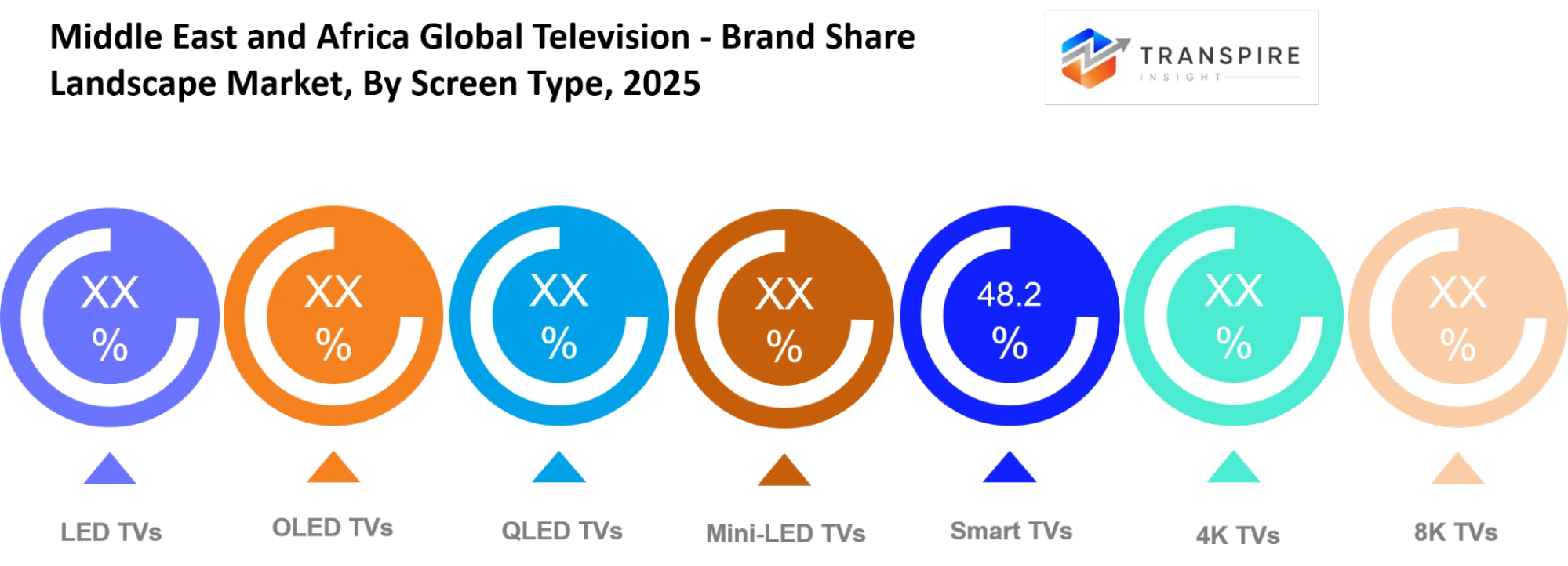
LED televisions still take up the biggest share, kinda because theyre cheaper overall, easy to find, and fit across various income brackets. There is also this strong retail footprint, plus pricing that stays competitive , so buying momentum stays pretty steady for both homes and offices. At the same time, energy use is getting better and the panel visuals look clearer, which makes people feel more comfortable about choosing this kind of TV.
Now OLED TVs, QLED TVs, and Mini-LED TVs kind of sit in the premium corner, focusing more on picture fidelity, brighter outputs , deeper contrast, and that smoother gaming feel. Smart TVs are also trending upward because the built in apps and streaming services make getting content less of a hassle. 4K TVs are still the mainstream choice across mid range and higher end models, while 8K TVs lean toward wealthier consumers chasing a more advanced viewing experience. The “others” category includes specialized, somewhat niche display approaches that cater to particular needs.
By Distribution Channel
Online retail channels grew pretty fast, mostly because of e-commerce adoption, wider product access, and those competitive pricing moves. On digital platforms people can sort of check specs, compare the costs , and read customer reviews before they actually buy. Then promotional campaigns, plus home delivery options, tend to push online sales even more.
Still, Electronics Stores stay relevant , because some shoppers really like to see the product in person, especially before purchasing a premium television. Meanwhile Hypermarkets, Supermarkets, Brand Stores, and Specialty Stores help with upfront visibility and those kind of spontaneous add-on buys. Direct Sales and Others show up too through institutional procurement, hospitality projects, and customized commercial display needs, that sort of thing.
By Screen Size
Smaller televisions still end up helping budget-conscious households, plus those secondary rooms, and also places that have a more educational vibe. The 32–43 Inch bracket stays really popular with urban buyers who want real value, and also everyday functionality. When the pricing feels balanced, and the viewing quality is good enough, the demand kind of stays steady through these sizes.
Then the 44–55 Inch and 56–65 Inch groupings take up a big share of the more premium buys, largely because the entertainment experience feels stronger. Anything above 65 Inch ,including Ultra Large TVs, tends to get boosted by home theater trends, and luxury residential builds. Commercial Displays and Others cover business needs, hospitality spaces, education setups, and advertising efforts, where people usually need bigger viewing formats.
By End User
Residential customers produce most of the overall market revenue because televisions are still kinda central for home entertainment, and for the way people stream their favorite shows. A lot of smart capabilities , plus gaming performance and the look of the display really steer the buying mood. Upgrades also happen fairly often, mainly when viewers want bigger screens, or better functionality, like smoother interfaces or sharper visuals.
On the commercial side, many organizations use televisions in meeting rooms, digital signage placements, and for customer engagement activities. Hospitality, Education, Healthcare, Government, and Entertainment venues are leaning more and more on advanced display systems to handle communication, information sharing , and content delivery without too much hassle. Then there are the other cases too, like specialized institutional or public-sector needs, where they want customized display solutions rather than a generic setup.
What are the Key Use Cases Driving the Middle East and Africa Global Television - Brand Share Landscape Market?
Residential entertainment is still the biggest application area, kind of because households increasingly depend on streaming services, gaming platforms, and those connected content ecosystems. Big screen smart televisions help with high-definition viewing, but also, they make it easier to reach multiple digital services from one single device, not having to juggle a bunch of boxes.
Commercial use keeps growing too , across hospitality properties, retail places, and educational institutions. For example , hotels bring in premium televisions to elevate the guest experience, whereas schools or universities use larger displays for digital learning and more engaging interactive presentations.
Newer applications show up like smart-home control hubs, plus cloud gaming platforms that can be integrated right into the television operating systems. There are also AI-enabled displays being slotted into digital advertising networks and other interactive commercial setups, which ends up opening extra revenue streams beyond the usual home entertainment angle.
|
Report Metrics |
Details |
|
Market size value in 2025 |
USD 4.76 Billion |
|
Market size value in 2026 |
USD 4.98 Billion |
|
Revenue forecast in 2033 |
USD 6.83 Billion |
|
Growth rate |
CAGR of 4.62% from 2026 to 2033 |
|
Base year |
2025 |
|
Historical data |
2021 - 2024 |
|
Forecast period |
2026 - 2033 |
|
Report coverage |
Revenue forecast, competitive landscape, growth factors, and trends |
|
Regional scope |
United States; Canada; Mexico; United Kingdom; Germany; France; Italy; Spain; Denmark; Sweden; Norway; China; Japan; India; Australia; South Korea; Thailand; Brazil; Argentina; South Africa; Saudi Arabia; United Arab Emirates |
|
Key company profiled |
Samsung, LG, Sony, TCL, Hisense, Panasonic, Philips, Sharp, Toshiba, Xiaomi, Skyworth, Haier, Vestel, Changhong, JVC. |
|
Customization scope |
Free report customization (country, regional & segment scope). Avail customized purchase options to meet your exact research needs. |
|
Report Segmentation |
By Screen Type (LED TVs, OLED TVs, QLED TVs, Mini-LED TVs, Smart TVs, 4K TVs, 8K TVs, Others); By Distribution Channel (Online Retail, Electronics Stores, Hypermarkets, Supermarkets, Brand Stores, Specialty Stores, Direct Sales, Others); By Screen Size (Below 32 Inch, 32–43 Inch, 44–55 Inch, 56–65 Inch, Above 65 Inch, Ultra Large TVs, Commercial Displays, Others); By End User (Residential, Commercial, Hospitality, Education, Healthcare, Government, Entertainment Venues, Others). |
Which Regions are Driving the Middle East and Africa Global Television - Brand Share Landscape Market Growth?
The Gulf Cooperation Council area, overall leads the way when it comes to market revenue generation. You can see it in the combination of high disposable incomes, solid broadband reach, and a fast shift toward premium consumer electronics which keeps television sales going strong. Big smart city pushes also keep nudging investment into connected household technologies , and that sort of momentum matters. With a mature retail setup and a noticeable brand footprint, the region basically doubles down on its regional leadership.
South Africa comes in as the second-largest contributor, and it does feel a bit different, more about stable consumer demand than people chasing premium purchases. A fairly well-developed electronics retail backbone helps maintain consistent sales across several television categories, not just one segment. Meanwhile, economic resilience plus rising digital content consumption keeps the market lively. With demand that stays fairly even between residential and commercial sectors, revenue stability holds up better too.
For the fastest growth, emerging African economies are expected to take the lead. More internet access, continued urbanization, and gradual improvements in household purchasing power have really reshaped the market in the last few years. On top of that, investments in telecommunications infrastructure make it easier for streaming to spread, and that supports smarter television penetration. This build-up should open up good opportunities for makers and investors looking at long-term market expansion between 2026 and 2033.
Who are the Key Players in the Middle East and Africa Global Television - Brand Share Landscape Market and How Do They Compete?
Competition is still kind of moderately concentrated around global brands, but Chinese manufacturers are slowly getting more share , mostly by using aggressive pricing and just expanding their distribution networks in a more busy way. For whatever reason, the main competitive levers don't really change much, like technology innovation, display quality, the software ecosystem, and pricing. Even the premium brands keep leaning on differentiation, especially via AI functions, the way the display performs, and how well everything ties into their broader ecosystem.
Samsung kinda leans hard on QLED, OLED, and AI-driven television experiences. Their advanced display tech, plus gaming optimization features, and a big retail footprint, all help them keep a strong brand position. More recently, investments in AI-powered TVs and premium display technologies have been used to reinforce that differentiation.
LG is centered on OLED leadership, AI processors, and premium viewing tech. The newer OLED evo and QNED lines feel like a clear ongoing push toward better picture quality, and also smarter personalization. They are also moving deeper into ultra-large screens, and even RGB display innovations, which sounds like an attempt to broaden the appeal.
Sony, by contrast, differentiates with image processing know-how and premium entertainment integration. TCL and Hisense tend to compete by leaning into value-focused premium technologies, while Xiaomi leans into ecosystem connectivity and competitive pricing. Overall, these companies continue extending their regional distribution networks to win share across both the premium end and the mass market side, which is probably the whole point.
Company List
- Samsung
- LG
- Sony
- TCL
- Hisense
- Panasonic
- Philips
- Sharp
- Toshiba
- Xiaomi
- Skyworth
- Haier
- Vestel
- Changhong
- JVC
Recent Development News
"In March 2026, LG announced pricing and availability for its OLED evo G6 and C6 television lineup. The launch introduced enhanced AI personalization, higher brightness performance, and advanced gaming capabilities, strengthening competition in the premium TV segment.
Source: https://www.lg.com
"In January 2026, Samsung unveiled its new OLED television portfolio at CES 2026, introducing the flagship S99H model. The launch expanded Samsung's premium OLED offering and reinforced competition in the high-end television category.
Source: https://www.gizmochina.com
What Strategic Insights Define the Future of the Middle East and Africa Global Television - Brand Share Landscape Market?
The market is kind of shifting in a structural way toward intelligent entertainment ecosystems, where televisions become central digital hubs, not just standalone display devices. AI powered personalization , cloud gaming hookup, smart-home connectivity, and those premium display technologies will more and more decide who wins competitively. Revenue growth will lean less on old style hardware replacement cycles and more on ecosystem stickiness and software-enabled services.
There is also a less obvious risk that people overlook. It’s the growing concentration inside advanced display supply chains. If everyone depends on only a few panel manufacturers and semiconductor suppliers, then you can see pricing swings and inventory bottlenecks during any future disruptions. Still, at the same time, there is a real opportunity here: AI-enabled televisions that are built for localized content experiences. This feels especially relevant in places like rapidly digitizing African markets.
Market actors should really focus on affordable premium products, with AI features built in, smart connectivity, and larger screen formats. The firms that can balance innovation with accessibility, in a practical way, should be most likely to secure long-term market share and keep profitability steady through 2033.
Middle East and Africa Global Television - Brand Share Landscape Market Report Segmentation
By Screen Type
- LED TVs
- OLED TVs
- QLED TVs
- Mini-LED TVs
- Smart TVs
- 4K TVs
- 8K TVs
- Others
By Distribution Channel
- Online Retail
- Electronics Stores
- Hypermarkets
- Supermarkets
- Brand Stores
- Specialty Stores
- Direct Sales
- Others
By Screen Size
- Below 32 Inch
- 32–43 Inch
- 44–55 Inch
- 56–65 Inch
- Above 65 Inch
- Ultra Large TVs
- Commercial Displays
- Others
By End User
- Residential
- Commercial
- Hospitality
- Education
- Healthcare
- Government
- Entertainment Venues
- Others
Frequently Asked Questions
Find quick answers to common questions.
The expected Middle East and Africa Global Television - Brand Share Landscape Market size for the market will be USD 6.83 Billion in 2033.
Key segments for the Middle East and Africa Global Television - Brand Share Landscape Market are By Screen Type (LED TVs, OLED TVs, QLED TVs, Mini-LED TVs, Smart TVs, 4K TVs, 8K TVs, Others); By Distribution Channel (Online Retail, Electronics Stores, Hypermarkets, Supermarkets, Brand Stores, Specialty Stores, Direct Sales, Others); By Screen Size (Below 32 Inch, 32–43 Inch, 44–55 Inch, 56–65 Inch, Above 65 Inch, Ultra Large TVs, Commercial Displays, Others); By End User (Residential, Commercial, Hospitality, Education, Healthcare, Government, Entertainment Venues, Others).
Major Middle East and Africa Global Television - Brand Share Landscape Market players are Samsung, LG, Sony, TCL, Hisense, Panasonic, Philips, Sharp, Toshiba, Xiaomi, Skyworth, Haier, Vestel, Changhong, JVC.
The Middle East and Africa Global Television - Brand Share Landscape Market size is USD 4.76 Billion in 2025.
The Middle East and Africa Global Television - Brand Share Landscape Market CAGR is 4.62% from 2026 to 2033.
- Samsung
- LG
- Sony
- TCL
- Hisense
- Panasonic
- Philips
- Sharp
- Toshiba
- Xiaomi
- Skyworth
- Haier
- Vestel
- Changhong
- JVC
About the Authors

Chetan Dhatrak
I’m Chetan Dhatrak, a Senior Research Analyst at Transpire Insight, specializing in the Consumer Goods, Foods and Beverages industry. I focus on analyzing market trends, consumer behavior, competitive landscapes, and industry developments to deliver accurate, data-driven insights. My research at Transpire Insight is built on credible sources and in-depth analysis, helping businesses and readers better understand market dynamics, emerging opportunities, and evolving consumer preferences. I’m committed to creating reliable, well-researched content that supports informed decision-making and reflects the latest developments in the consumer goods and food & beverage sectors.

Chakradhar Khansole
Chakradhar serves as the Research Director at Transpire Insight, bringing over 8 years of experience in technology, innovation, and strategic market intelligence. He specializes in transforming complex market data into actionable business insights that enable organizations to make informed, growth-oriented decisions. Recognized for his strategic vision and analytical expertise, Chakradhar leads high-impact research initiatives, delivering comprehensive market assessments, competitive intelligence, and forward-looking industry analysis.
Recently Published Reports
-
Apr 2026
Bottled Water Market
Bottled Water Market Size, Share & Analysis Report By Product Type (Still Bottled Water, Carbonated Bottled Water, Functional Bottled Water, and Others), By Packaging (PET, Cans, and Others), By Sales Channel (Supermarkets/Hypermarkets, Convenience Stores/Drug Stores, Grocery Stores/Club Stores, Foodservice, and Others) and Geography (North America, Europe, Asia-Pacific, Middle East and Africa, South and Central America), 2021 - 2032
-
Apr 2026
Color Cosmetic Packaging Market
Color Cosmetic Packaging Market Size, Share & Analysis Report By Application (Mascara Packaging, Liquid Packaging, and Liquid Face), By Type (Tubes & Bottles, Pens & Markers, Compacts & Containers, and Droppers & Pumps), and Geography (North America, Europe, Asia-Pacific, Middle East and Africa, South and Central America), 2021 - 2031
-
Apr 2026
External Microphone For Camera Market
External Microphone For Camera Market Size, Share & Analysis Report By Type (Shotgun Microphone, Lavalier Microphone, and Others), By Application (Digital Camera, Professional Video Camera, and Others), and Geography (North America, Europe, Asia-Pacific, Middle East and Africa, South and Central America), 2021 - 2031
-
Apr 2026
Foot Orthotic Insoles Market
Foot Orthotic Insoles Market Size, Share & Analysis Report By Type (Pre-fabricated, and Custom-made), By Material (Thermoplastic, Composite Carbon Fiber, and Others), By Distribution Channel (Drug Stores, Hospitals & Clinics, and Others), and Geography (North America, Europe, Asia-Pacific, Middle East and Africa, South and Central America), 2021 - 2031