

Middle East and Africa Feed Processing Market Summary
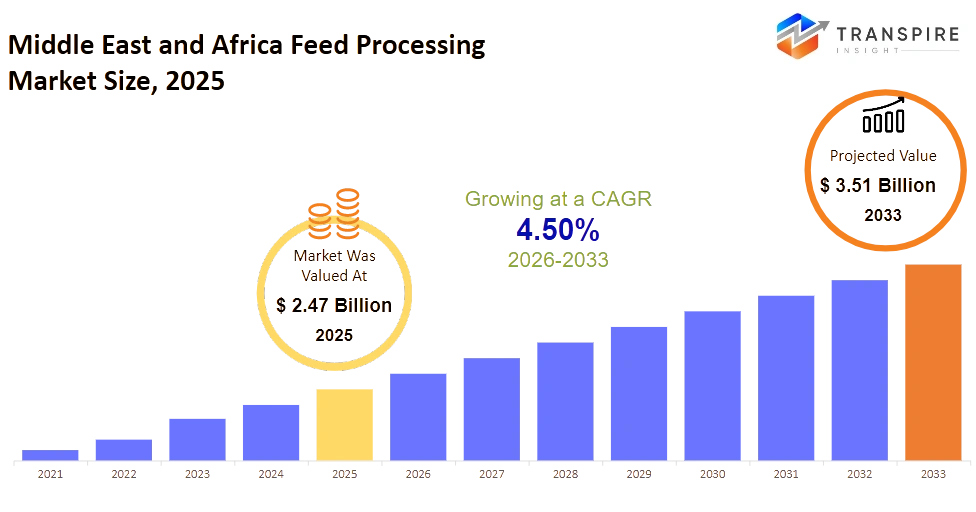
As per Transpire Insight Analysis the Middle East and Africa Feed Processing Market size is estimated at USD 2.47 Billion in 2025 and is anticipated to reach USD 3.51 Billion by 2033, growing at a CAGR of 4.50% from 2026 to 2033.
The Middle East and Africa Feed Processing Market kind of plays a big role in turning raw farm ingredients into a more consistent, nutritionally well balanced animal feed, for commercial livestock, poultry, aquaculture, and even pet food production. When feed processing is done efficiently it tends to boost feed quality, lowers waste, supports animal well being, and basically lets producers reach higher productivity while still keeping operating costs under control, more or less. In the last five years things have moved toward automated processing lines, precision dosing systems, and energy-sparing equipment, because many of the bigger feed manufacturers are now focusing on steadier output and better traceability, not just output.
Meanwhile, the disruption in global grain and feed ingredient supply chains after the Russia–Ukraine conflict seemed to push companies to invest in flexible processing technologies that can manage alternative raw materials and also optimize resource use, a lot. At the same time, commercial livestock farming is expanding and food security initiatives are growing in Gulf countries and parts of Africa, so investment in modern feed mills has picked up too. Put together these changes are basically reinforcing equipment uptake, lifting production efficiency, and building reliable revenue pathways for equipment suppliers and technology providers, even when the market feels a little uneven at times.
Middle East and Africa Feed Processing Market Size & Forecast:
- Middle East and Africa Feed Processing Market Size 2025: USD 2.47 Billion
- Expected Market Value 2033: USD 3.51 Billion
- Forecast CAGR: 4.50%
- Leading region in 2025:
- Fastest Growing region:
- Key Profile: Bühler Group, ANDRITZ, CPM, Clextral, Wenger Manufacturing, Muyang, Zhengchang, Famsun, Van Aarsen, GEA Group, SKIOLD, Bratney Companies, ABC Machinery, Alvan Blanch, KSE Process Technology
Key Market Insights
- The Middle East and Africa Feed Processing Market is forecast to reach USD 3.51 billion by 2033, largely supported by the modernization of feed manufacturing infrastructure, you know, the “everything gets upgraded” kind of trend.
- Saudi Arabia is leading the regional market, with an estimated 30–35% share in 2025 , backed by big commercial feed mills plus ongoing livestock investment programs.
- South Africa is expected to show the fastest pace of growth through 2033, mainly because poultry output keeps rising and feed mill modernization never really stops.
- Pelleting equipment holds the largest product share, since pellet feed boosts feed conversion efficiency, and also reduces transportation losses along the way.
- Grinding equipment stays in the second-largest spot, because tuning particle size really does impact feed quality, and the processing efficiency that comes with it.
- Extruders are projected to grow the quickest through 2033, with adoption climbing in aquaculture and in premium pet food production.
- In terms of application, feed manufacturing is the biggest segment. At the same time, pellet production keeps expanding as commercial operators push for standardized feed quality, more and more.
- For end users, commercial feed mills deliver the highest revenue share, while integrated livestock farms are increasing investment in in-house processing plants, even where space is tight.
- Key players, including Bühler Group, ANDRITZ, CPM, GEA Group, Famsun, and Van Aarsen are improving their market footing using digital automation, energy-efficient systems, regional partnerships, and tailored processing solutions.
- Digital monitoring, predictive maintenance, and automated ingredient dosing are helping production run more consistently, while lowering operating expenses at modern feed processing facilities.
What are the Key Drivers, Restraints, and Opportunities in the Middle East and Africa Feed Processing Market?
The main force that is shaping the Middle East and Africa Feed Processing Market is basically the ongoing growth in commercial livestock and poultry output, which is being backed by national food security strategies. Places like Saudi Arabia, the United Arab Emirates, and South Africa are putting money into newer feed manufacturing units, to lower reliance on imported animal products and also to boost local production efficiency. Because of this, feed producers tend to move toward automated grinding, blending, pelleting, and ingredient dosing systems, they make feed more uniform, cut down on raw material waste, and support higher plant output. When overall production efficiency goes up, manufacturers often see stronger operating margins, and that keeps demand steady for newer feed processing equipment along with digital plant technologies.
A big blockage, though, is the heavy capital spend that’s needed to build, or even just update, feed processing facilities. Modern processing lines usually bundle automated controls, precision weighing setups and energy-saving machinery, but all of that needs a lot of money before anything really runs smoothly. Smaller feed makers often struggle with finance access and they also have fewer skilled technical people available, so upgrades get postponed. On top of that, swings in grain prices and the higher cost of imported machines extend the time it takes to recover investment, this ends up slowing modernization across multiple developing areas and overall equipment take-up.
One notable chance is the shift toward smart feed mills with Industrial Internet of Things, usually called IIoT, plus artificial intelligence, and real-time production insights. These digital tools help with predictive maintenance, tune energy consumption, and improve production scheduling, all while still keeping a consistent feed quality standard.
What Has the Impact of Artificial Intelligence Been on the Middle East and Africa Feed Processing Market?
Artificial intelligence plus advanced digital tools are now reshaping feed processing work, and honestly it affects a lot of things like production accuracy, equipment reliability, and how efficient the whole operation feels. With AI‑based control systems, the grinding , mixing, pelleting, and drying parameters get watched all the time, then the system keeps tweaking the machine settings on the fly so the feed quality stays steady even when the raw material characteristics shift a bit. On top of that, computer vision checks pellets for uniformity and also spots defects before they reach packaging, so less material ends up wasted, and the final product stays more consistent.
Then there is machine learning which looks at equipment vibration, motor temperature and energy consumption, it tries to foresee maintenance needs before a mechanical failure really shows up. Predictive maintenance helps cut the surprise downtime, stretches equipment life, and reduces maintenance costs , while also supporting better production availability overall. AI‑driven production planning adds more value too, because it improves ingredient utilization, tightens inventory management, and helps with batch scheduling, that combination makes manufacturers lower their operating costs and raise overall plant productivity.
Even with all those gains, though, broad AI adoption is still held back because implementation costs can be high and many facilities don’t have strong digital infrastructure. Smaller feed manufacturers often do not have integrated sensors, they may not have historical production data, and they frequently miss the specialized technical know how required to use advanced analytics well. That gap ends up slowing the wider rollout across the regional feed processing industry.
Key Market Trends
- Feed manufacturers kinda drifted away from the old conventional processing lines toward more automated setups, helping with production accuracy, less waste, and generally lower operating costs across big commercial facilities— you know, where margins matter.
- Pelleting technology has also been taken up more widely since 2021 , especially as livestock producers push for better feed conversion ratios and pellets that stay consistent in commercial use.
- Energy-efficient grinding and drying equipment is now treated like a buying priority, because higher electricity prices are pushing plants to trim their day to day expenses.
- In several large feed mills , digital monitoring platforms have replaced manual production tracking, so managers can review real time equipment performance and make faster operational decisions, instead of waiting and then adjusting.
- At the same time, commercial aquaculture has been expanding across Egypt and Gulf countries, which increased investment in extrusion systems able to create specialized floating as well as sinking aquatic feed.
- Equipment suppliers have also expanded their regional service networks and technical support centers , so maintenance response times are shorter, and the longer term customer relationships hold stronger.
- Manufacturers have diversified how they process raw materials after global grain supply disruptions, so feed plants can use alternative ingredients without really losing product quality.
- Industrial Internet of Things solutions are more common now in newly commissioned feed mills, mainly for predictive maintenance and continuous production optimization, which is kind of the whole point.
- And finally, strategic collaborations between global equipment manufacturers and local distributors have improved market access, after sales support, and customized processing solutions that fit real plant conditions.
Middle East and Africa Feed Processing Market Segmentation
By Equipment Type
Grinding Equipment lays down the basics of feed production, because it takes raw stuff and reduces it into more uniform particle sizes, which helps mixing efficiency a lot and makes nutrient distribution feel steadier. Then Mixing Equipment comes in, to create repeatable feed formulations via careful blending of grains, vitamins, minerals , and additives. After that Pelleting Equipment still takes a pretty important role, since pellet feed tends to be easier to handle, store , and often improves feed conversion efficiency. Extruders are getting more common lately, especially in aquaculture and pet feed, where you really need precise control over product density and texture, not just something “close enough”.
Dryers & Coolers also play a part by keeping feed quality in check. They lower moisture and stretch storage life after pelleting or extrusion. Coating Equipment lets manufacturers add oils, enzymes, and nutritional supplements while not ruining pellet integrity. Screening Equipment takes care of oversized bits and the smaller fines, so the final product stays consistent before packaging. Other systems, like conveying solutions, weighing approaches, dosing method , and packaging lines, round it out by boosting plant output, supporting automation, and making processing run smoothly across modern feed manufacturing facilities.
By Feed Type
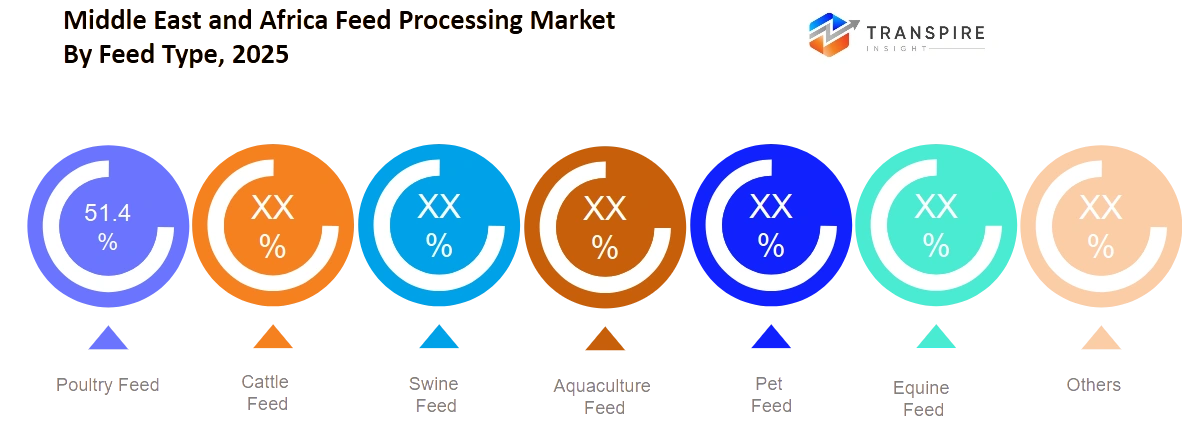
Poultry Feed is still the biggest part of the market, because expanding poultry production means using huge volumes of nutritionally balanced feed that is made with consistent quality standards . Meanwhile Cattle Feed stays as a significant segment, since dairy and beef producers keep putting emphasis on better animal health, and stronger production efficiency . Swine Feed supports commercial pig farming operations, where steady nutrition really affects growth performance, and the feed conversion results, so they stay on target . Aquaculture Feed keeps pushing ahead too, because more commercial fish farming is being built, and it relies on specialized floating as well as sinking feed products , kind of specific by design.
Pet Feed also rose fairly steadily, as premium pet nutrition gets more accepted in urban markets across the region . Equine Feed is used by racing, breeding and even recreational horse industries, and those groups want customized nutritional formulations , not one size fits all. The “others” category includes feed made for sheep , goats , camels , rabbits, and specialty livestock, which opens more opportunities for equipment manufacturers that can process diverse raw materials while still holding consistent production quality.
By Operation
Batch Processing still ends up being widely used, mainly because it gives a certain flexibility when you need to make several feed formulations in smaller runs while keeping ingredient control accurate. Continuous Processing has also really picked up in the big commercial feed mills, where they want production to keep going without interruption, with better throughput, plus reduced operating costs. Automated Processing keeps growing too, as manufacturers start using programmable control systems along with automated dosing and digital monitoring , so they can improve production consistency and limit manual involvement .
Manual Processing meanwhile keeps working for smaller feed manufacturers and rural production facilities, especially where spending on advanced equipment just isn’t realistic. Semi-Automated Processing is kind of the Middle ground, it combines mechanical equipment with operator supervision, and it lets people modernize bit by bit , without committing to a huge capital outlay. Other approaches include customized production systems for specialty feed applications, pilot plants, and research facilities where they need flexible processing layouts so different feed formulations can be handled.
By End User
Commercial Feed Mills hold the biggest slice, mainly because large-scale manufacturers feed livestock, poultry, aquaculture, and pet food producers with standardized rations, across the region. Integrated Livestock Farms are also leaning more into in-house feed processing—mostly to tighten cost control, keep feed quality steady, and lessen reliance on outside suppliers. Meanwhile Aquaculture Farms are turning to specialized processing gear so they can make nutritionally balanced feed that helps healthy fish growth and smoother, more efficient farming. Overall, these kinds of investments end up boosting production efficiency and also improving how feed is managed in practice.
Pet Food Manufacturers are still pushing to raise production capacity, since premium pet nutrition is getting more solid acceptance in urban markets. Contract Feed Producers offer tailored manufacturing services to agricultural businesses that want flexibility, without building their own processing plant. Other players cover research institutions, agricultural cooperatives, and specialty feed manufacturers, which often need adaptable processing solutions for a wider set of livestock production requirements.
By Application
Feed Manufacturing is the biggest application, mostly because commercial processing facilities are still focused on making nutritionally balanced animal feed. Feed Conditioning also matters, it helps moisture to spread more evenly and it readies the ingredients for efficient pelleting or extrusion, in a way that’s more steady. Pellet Production keeps moving up too, since livestock producers want durable pellets that help with storage and shipping, and also support feed conversion efficiency. Together these uses tend to raise productivity and at the same time cut down on material losses during the whole manufacturing step.
Ingredient Blending supports correct formulation by making sure grains, proteins, minerals, vitamins, and feed additives get distributed uniformly before the next stage. Feed Preservation stretches shelf life by using controlled drying, cooling, and moisture management methods that defend product quality during storage and transportation. Other work includes coating, quality inspection, packaging, and specialty processing, sort of to boost product performance and to respond to the changing needs of commercial feed manufacturers.
What are the Key Use Cases Driving the Middle East and Africa Feed Processing Market?
Commercial animal feed production stay as the main thing, you know, the big feed mills that make nutritionally balanced feed for poultry, cattle , and various livestock operations. They run with high-capacity processing equipment so the ingredient blending stays consistent, pellet formation stays precise and the overall production cycles move more efficiently. In the end manufacturers can boost feed quality while also trimming down material waste, and lowering operating costs a bit.
Then, aquaculture feed production and premium pet food manufacturing are getting more attention as secondary roles. For aquaculture farms, extrusion systems are needed to produce floating and sinking feed, but still with controlled nutritional content. Meanwhile, pet food manufacturers are putting money into more advanced processing technologies, mostly to keep product quality steady and support customized formulations aimed at premium consumer markets.
More emerging use cases are precision nutrition and digital feed manufacturing, and they’re now tied in with artificial intelligence plus Industrial Internet of Things platforms, and automated quality inspection systems. With those tools, operators can do real-time process tweaking, get predictive maintenance on equipment, and manage production in a more data driven way. This opens up new opportunities for manufacturers who want higher efficiency, better traceability, and more day to day operational flexibility across modern feed processing facilities, even when demand changes fast.
|
Report Metrics |
Details |
|
Market size value in 2025 |
USD 2.47 Billion |
|
Market size value in 2026 |
USD 2.58 Billion |
|
Revenue forecast in 2033 |
USD 3.51 Billion |
|
Growth rate |
CAGR of 4.50% from 2026 to 2033 |
|
Base year |
2025 |
|
Historical data |
2021 - 2024 |
|
Forecast period |
2026 - 2033 |
|
Report coverage |
Revenue forecast, competitive landscape, growth factors, and trends |
|
Regional scope |
Middle East and Africa (Saudi Arabia, United Arab Emirates, South Africa, Rest of Middle East and Africa) |
|
Key company profiled |
Bühler Group, ANDRITZ, CPM, Clextral, Wenger Manufacturing, Muyang, Zhengchang, Famsun, Van Aarsen, GEA Group, SKIOLD, Bratney Companies, ABC Machinery, Alvan Blanch, KSE Process Technology |
|
Customization scope |
Free report customization (country, regional & segment scope). Avail customized purchase options to meet your exact research needs. |
|
Report Segmentation |
By Equipment Type (Grinding Equipment, Mixing Equipment, Pelleting Equipment, Extruders, Dryers & Coolers, Coating Equipment, Screening Equipment, Others); By Feed Type (Poultry Feed, Cattle Feed, Swine Feed, Aquaculture Feed, Pet Feed, Equine Feed, Others); By Operation (Batch Processing, Continuous Processing, Automated Processing, Manual Processing, Semi-Automated Processing, Others); By End User (Commercial Feed Mills, Integrated Livestock Farms, Aquaculture Farms, Pet Food Manufacturers, Contract Feed Producers, Others); By Application (Feed Manufacturing, Feed Conditioning, Pellet Production, Ingredient Blending, Feed Preservation, Others) |
Which Regions are Driving the Middle East and Africa Feed Processing Market Growth?
Saudi Arabia seems to lead the Middle East and Africa Feed Processing Market, mostly because there is still some serious investment going into commercial livestock production, food security programs,and also newer feed manufacturing facilities. The government keeps pushing initiatives to strengthen local meat and dairy outputs so, that has encouraged many operators to install upgraded grinding, blending and pelleting equipment inside big feed mills. On top of that, logistics infrastructure is fairly well-developed, and feed ingredient imports stay steady which helps keep manufacturing running smoothly. Then there’s the part where already-established livestock producers keep operating, plus modernization programs keep going ,so it sort of supports the country’s leading standing in regional revenue.
South Africa stays as the second-largest regional contributor, mostly tied to a mature agricultural base and a commercial feed industry that is already well rooted. Growth momentum here comes from continued retrofits of existing processing plants, rather than jumping to huge new capacity builds. Poultry, dairy, and other livestock producers keep spending on more efficient processing tools, which in turn reduces operating expense, and improves overall feed quality. Also, the regulatory climate tends to stay stable, and experienced feed manufacturers create steady demand for advanced processing systems,automation, and similar solutions.
Egypt, however,is expected to show the fastest growth over the 2026–2033 forecast window, since commercial poultry and aquaculture activities keep expanding. With new feed mill investments, higher production capacity, and upgrades to agricultural infrastructure, equipment adoption has become faster across the country. More modern extrusion methods and automated processing technologies are becoming increasingly common too,as producers focus on productivity first and feed efficiency right after. This whole momentum then creates solid opportunities for equipment makers, technology providers, and investors, especially those looking for near-term deployment wins
Who are the Key Players in the Middle East and Africa Feed Processing Market and How Do They Compete?
Competition in the Middle East and Africa Feed Processing Market is sort of moderately consolidated, and still you see global equipment manufacturers vying on a bunch of aspects like technology, processing efficiency, automation abilities, plus after-sales service, not so much just price. Big suppliers keep pushing their regional distribution channels and technical backing, while they also work on energy-sparing equipment that reduces running costs and helps maintain better feed quality. Lately, digital supervision , predictive upkeep, and tailored plant engineering… these things really stand out, because commercial feed producers are upgrading their manufacturing lines and expecting smoother operations.
Bühler Group tends to sell integrated feed mill solutions, where grinding, mixing, pelleting, and digital process control kinda sit together in one production platform. They basically differentiate via advanced automation, energy-efficient machines, and process optimization software that makes it easier for manufacturers to improve productivity and keep feed consistency. ANDRITZ, on the other hand, comes with full feed and biomass processing systems, backed by strong engineering and a global service network. Their focus on customized plant layouts and high-efficiency pelleting techniques helps customers raise throughput, while also trimming operating expenses.
CPM strengthens its market standing through robust pelleting, grinding, and conditioning machinery, especially tuned for large-scale commercial production. Van Aarsen specializes more in modular feed mill systems, designed to give operational flexibility and make it easier to extend a plant later. GEA Group differentiates by its set of advanced drying and cooling options, plus automation technologies, which contribute to process stability and better energy efficiency.
Company List
• Bühler Group
• ANDRITZ
• CPM
• Clextral
• Wenger Manufacturing
• Muyang
• Zhengchang
• Famsun
• Van Aarsen
• GEA Group
• SKIOLD
• Bratney Companies
• ABC Machinery
• Alvan Blanch
• KSE Process Technology
Recent Development News
In April 2025, ANDRITZ secured a contract from Alwadi Poultry Farms Company to deliver a complete high-capacity feed mill in Riyadh, Saudi Arabia. The project expands poultry and ruminant feed production capacity while strengthening ANDRITZ's presence in the Middle East feed processing industry. Source:https://www.andritz.com/
In June 2025, Bühler Group opened its new Milling Academy in Uzwil, Switzerland. The advanced training center supports food and feed mill professionals with hands-on technical education, helping accelerate adoption of modern processing technologies across global markets. Source:https://www.buhlergroup.com
In May 2026, Bühler Group launched the Nutrex 7 Series extrusion platform for food and feed production. The new system improves hygiene, productivity, digital process control, and cleaning efficiency, enabling manufacturers to achieve higher operational performance and product consistency. Source:https://www.buhlergroup.com
What Strategic Insights Define the Future of the Middle East and Africa Feed Processing Market?
The Middle East and Africa Feed Processing Market seems to be moving, kinda steadily, toward much more automated and digitally connected and also energy efficient production set ups as commercial livestock, poultry, and aquaculture producers want better output and, more consistent feed quality too. The biggest push behind this change really comes from food security programs along with expanding commercial farming, plus the need to use resources in a more efficient way while also keeping production costs under control. In the next five to seven years, investment is very likely to shift away from just buying standalone equipment and move toward integrated processing systems that tie together automation, data analytics, and predictive maintenance, almost like one continuous workflow.
One smaller but still serious risk though is the region’s ongoing reliance on imported machinery and feed ingredients. If currencies swing, trade routes get disrupted, or supply chains get stuck, then equipment installation can get delayed and overall project costs can rise, which would reduce how much smaller manufacturers can actually modernize. Even with that, smart feed mills are showing real potential: they use artificial intelligence, Industrial Internet of Things platforms, and real time quality monitoring, and this is especially promising in Saudi Arabia, Egypt, and South Africa. Firms that build stronger localized service networks, adopt digital technologies, and keep flexible processing approaches will be more prepared to hold closer ties with customers and also capture longer term growth across the regional feed processing industry.
Middle East and Africa Feed Processing Market Report Segmentation
By Equipment Type
• Grinding Equipment
• Mixing Equipment
• Pelleting Equipment
• Extruders
• Dryers & Coolers
• Coating Equipment
• Screening Equipment
• Others
By Feed Type
• Poultry Feed
• Cattle Feed
• Swine Feed
• Aquaculture Feed
• Pet Feed
• Equine Feed
• Others
By Operation
• Batch Processing
• Continuous Processing
• Automated Processing
• Manual Processing
• Semi-Automated Processing
• Others
By End User
• Commercial Feed Mills
• Integrated Livestock Farms
• Aquaculture Farms
• Pet Food Manufacturers
• Contract Feed Producers
• Others
By Application
• Feed Manufacturing
• Feed Conditioning
• Pellet Production
• Ingredient Blending
• Feed Preservation
• Others
Frequently Asked Questions
Find quick answers to common questions.
The expected Middle East and Africa Feed Processing Market size for the market will be USD 3.51 Billion in 2033.
Key segments for the Middle East and Africa Feed Processing Market are By Equipment Type (Grinding Equipment, Mixing Equipment, Pelleting Equipment, Extruders, Dryers & Coolers, Coating Equipment, Screening Equipment, Others); By Feed Type (Poultry Feed, Cattle Feed, Swine Feed, Aquaculture Feed, Pet Feed, Equine Feed, Others); By Operation (Batch Processing, Continuous Processing, Automated Processing, Manual Processing, Semi-Automated Processing, Others); By End User (Commercial Feed Mills, Integrated Livestock Farms, Aquaculture Farms, Pet Food Manufacturers, Contract Feed Producers, Others); By Application (Feed Manufacturing, Feed Conditioning, Pellet Production, Ingredient Blending, Feed Preservation, Others).
Major Middle East and Africa Feed Processing Market players are Bühler Group, ANDRITZ, CPM, Clextral, Wenger Manufacturing, Muyang, Zhengchang, Famsun, Van Aarsen, GEA Group, SKIOLD, Bratney Companies, ABC Machinery, Alvan Blanch, KSE Process Technology.
The Middle East and Africa Feed Processing Market size is USD 2.47 Billion in 2025.
The Middle East and Africa Feed Processing Market CAGR is 4.50% from 2026 to 2033.
• Bühler Group
• ANDRITZ
• CPM
• Clextral
• Wenger Manufacturing
• Muyang
• Zhengchang
• Famsun
• Van Aarsen
• GEA Group
• SKIOLD
• Bratney Companies
• ABC Machinery
• Alvan Blanch
• KSE Process Technology
About the Authors

Chetan Dhatrak
I’m Chetan Dhatrak, a Senior Research Analyst at Transpire Insight, specializing in the Consumer Goods, Foods and Beverages industry. I focus on analyzing market trends, consumer behavior, competitive landscapes, and industry developments to deliver accurate, data-driven insights. My research at Transpire Insight is built on credible sources and in-depth analysis, helping businesses and readers better understand market dynamics, emerging opportunities, and evolving consumer preferences. I’m committed to creating reliable, well-researched content that supports informed decision-making and reflects the latest developments in the consumer goods and food & beverage sectors.

Chakradhar Khansole
Chakradhar serves as the Research Director at Transpire Insight, bringing over 8 years of experience in technology, innovation, and strategic market intelligence. He specializes in transforming complex market data into actionable business insights that enable organizations to make informed, growth-oriented decisions. Recognized for his strategic vision and analytical expertise, Chakradhar leads high-impact research initiatives, delivering comprehensive market assessments, competitive intelligence, and forward-looking industry analysis.
Recently Published Reports
-
Apr 2026
Baby Infant Formula Market
Baby Infant Formula Market Size, Share & Analysis Report By ype (Infant Milk, Follow On Milk, Specialty Baby Milk, Growing-Up Milk), By Ingredient (Carbohydrate, Fat, Protein, Minerals, Vitamins, and Others), By Product Form (Powder, Liquid, and Ready-to-feed), By Distribution Channels (Supermarket/Hypermarket, Specialty Store, Pharmacies, Online Retail, and Others), and Geography (North America, Europe, Asia-Pacific, Middle East and Africa, South and Central America), 2021 - 2031
-
Apr 2026
Edible Insects for Animal Feed Market
Edible Insects for Animal Feed Market Size, Share & Analysis Report By Type (Insect Powder, Insect Meal, Insect Bar, Insect Paste, Insect Oil, and Others), By Insect Type (Beetles, Cricket, Caterpillar, Hymenoptera, Orthoptera, Tree Bugs, and Others), By Application (Livestock, Pet Food, and Aquaculture), By Livestock Type (Poultry, Swine, and Others), and Geography (North America, Europe, Asia-Pacific, Middle East and Africa, South and Central America), 2021 - 2031
-
Apr 2026
Food Industry Disinfection and Bacterial Control Market
Food Industry Disinfection and Bacterial Control Market Size, Share & Analysis Report By Type (Chemical Disinfectants, Physical Disinfectants, and Biocides and Antimicrobials), By Application (Food Processing Equipment Surface Disinfection, Food Preparation Areas Surface Disinfection, Storage Areas Surface Disinfection, Anti-microbial Coatings Food Preservation, and Preservative Solutions Food Preservation), By End User (Meat and Poultry Processing, Dairy Processing, Seafood Processing, Bakery and Confectionery, Restaurants and Commercial Kitchens, and Food Service Providers), By Sales Channel (Online, Offline), and Geography (North America, Europe, Asia-Pacific, Middle East and Africa, South and Central America), 2021 - 2031
-
May 2026
Freeze Dried Food Market
Freeze Dried Food Market Size, Share & Analysis Report By Product Type (Fruits, Vegetables, Freeze-Dried Dairy Products, Freeze-Dried Meat and Seafood, Freeze-Dried Pet Food, and Prepared Meal), By Nature (Organic, and Conventional), By Form (Powdered, Granules, and Diced), By End Use (Breakfast Cereals, Dairy Products, Bakery & Confectionery, Nutritional Bars & Supplements, Powdered Beverages, Snacks, and Retail (Household)), and Geography (North America, Europe, Asia-Pacific, Middle East and Africa, South and Central America), 2021 - 2031