

Middle East and Africa Poultry Market Size & Forecast:
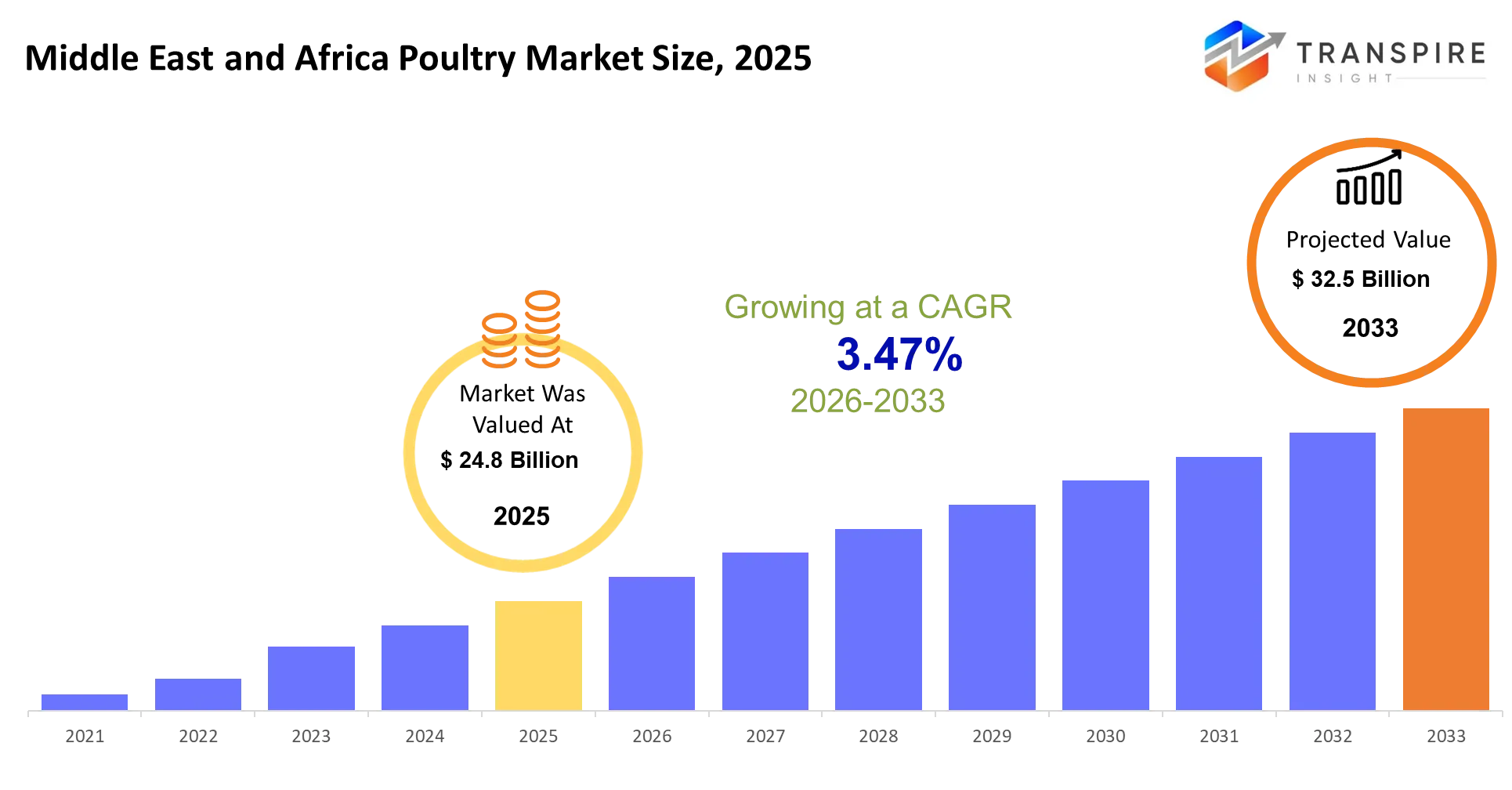
- Middle East and Africa Poultry Market Size 2025: USD 24.8 Billion
- Middle East and Africa Poultry Market Size 2033: USD 32.5 Billion
- Middle East and Africa Poultry Market CAGR: 3.47%
- Middle East and Africa Poultry Market Segments:By Type (Broilers, Layers, Turkeys, Ducks, Others); By Application (Meat Production, Egg Production, Processed Food, Animal Feed, Others); By End-User (Consumers, Food Industry, Retailers, Restaurants, Exporters, Others); By Distribution (Wet Markets, Supermarkets, Online, Others)
To learn more about this report,  Download Free Sample Report
Middle East and Africa Poultry Market Summary
The Middle East and Africa Poultry Market was valued at USD 24.8 Billion in 2025. It is forecast to reach USD 32.5 Billion by 2033. That is a CAGR of 3.47% over the period.
The Middle East and Africa poultry market basically works like a core protein supply system , where feed inputs get turned into affordable chicken and eggs for households retailers, hotels , and food service operators. In practice it helps keep food around and on time in areas where import dependence, and price swings , can mess up access to protein really fast. So it becomes this key part of urban consumption and also food security infrastructure, even when things are unstable.
Over the last 3 to 5 years , the market has been moving in a noticeable way, toward vertically integrated production and contract farming models. Fragmented smallholder systems are gradually being swapped out for industrial scale poultry complexes, kinda on a faster path than before. This acceleration happened after global supply chain disruptions from 2020 to 2022 showed how risky it is to rely too heavily on imported frozen poultry and feed commodities. Governments then stepped in with food security programs and incentives aimed at building domestic production capacity, you know , more locally.
Because of that , the growth now sits mainly with integrated producers that manage feed, breeding, processing, and cold-chain logistics all together. This setup lets them respond quicker to demand changes, plus keep biosecurity tighter, like more controlled. Revenue growth is more and more linked to scale efficiency and retail-aligned supply chains , not just spot-market trading. And that shift is reshaping investment priorities too, moving attention toward automation, feed optimization, and certified halal production systems, which are now kind of treated as a baseline.
Key Market Insights
- GCC region kind of dominated the Middle East and Africa Poultry Market with something like nearly 42% share in 2025, mainly because strong food security investment programs in Saudi Arabia and UAE kind of kicked in.
- Sub-Saharan Africa showed up as the fastest-growing region, with forecast acceleration through 2026–2033 due to urbanization and supermarket expansion, you know more retail outlets.
- Broilers took over 60% share in 2025 , so they were the dominant part of production thanks to quick growth cycles and high feed conversion efficiency.
- Layers landed as the second-largest segment , and that was supported by steady egg consumption across household and institutional demand channels.
- Meat production accounted for over 55% share, and it really reinforces its place as the main consumption application for the Middle East and Africa Poultry Market.
- Processed poultry emerged as the fastest-growing application after 2025, pulled along by convenience food demand in urban retail markets.
- Consumers stayed as the leading end-user segment, with over 50% share, showing strong household-level protein habits overall.
- Exporters also demonstrated rapid growth, as halal certification expanded trade flows between Africa, GCC, and those Asian import markets.
- JBS leaned on global scale, and it helped that its protein portfolio stayed diversified so the pricing could stay flexible, even when import-driven markets were kinda volatile.
- Meanwhile Tyson Foods upped the distribution relationships and pushed further into cold chain integration, to strengthen processed poultry supply strength for those urban retail hubs.
What are the Key Drivers, Restraints, and Opportunities in the Middle East and Africa Poultry Market?
The main thing that seems to shape the Middle East and Africa poultry market is basically the faster push for food security, plus import substitution rules in Gulf and African economies, which yeah sort of keeps rolling. In places like Saudi Arabia, the UAE, Egypt, and Nigeria, authorities have been expanding investment incentives for vertically coordinated poultry production, mainly after recurring worldwide supply chain hiccups, and that grain price volatility that just wont calm down. This change in direction, kind of set off quicker capacity growth in broiler farming, processing facilities, and cold chain logistics, so domestic output goes up, and frozen poultry dependence from Brazil and Europe goes down. Because of that, revenue gains are getting more and more clustered in bigger integrated producers that can actually satisfy biosecurity expectations and halal certification requirements, without too much hassle.
The biggest stop sign is feed cost dependence on imported maize and soybean meal, and that dependency is still baked in to regional supply lines, like structurally embedded. The issue continues because local feed crop output can’t really keep pace due to climatic limits and water scarcity across many producing countries. So producers end up being stuck facing global commodity swings, and also currency depreciation, which squeezes margins and makes expansion decisions happen later than planned. Smaller farms feel it first, since they do not really have the purchasing scale needed to hedge the input turbulence, and this ends up slowing broader move toward more formalized market activity.
A meaningful chance is the growth of contract farming ecosystems that connect with retail and QSR supply chains especially around Saudi Arabia and Egypt. Big retailers and food service operators are putting more money into traceable, tightly coordinated poultry networks, and these networks are supported by cold chain expansion together with digital inventory tools.This shift helps set up standardized production and more predictable demand forecasting, it then opens the door for scalable investment in automated poultry facilities across emerging production clusters, sort of like it all syncs.
What Has the Impact of Artificial Intelligence Been on the Middle East and Africa Poultry Market?
AI and more advanced digital tech are kinda increasingly reshaping poultry production systems across the Middle East and Africa, by pushing farm automation forward, biosecurity monitoring better, and even helping supply chain be more efficient. Nowadays, producers are rolling out AI enabled climate control contraptions in poultry houses, to keep track of temperature humidity and ventilation, more or less all the time, so there is less of that hand-on fuss and the birds keep feeling healthier. Also, computer vision tools are watching the flock behavior, and they catch early clues of disease or stress, in a way that leads to faster countermeasures, and usually less mortality risk in intensive broiler operations.
Machine learning models can also bring, in a way, predictive power they look at feed conversion ratios and growth trajectories, plus past farm results. Then they can somehow fine tune the feeding routines , and estimate production outputs.In practice, these systems let integrated producers adjust feed composition on the fly, boosting feed efficiency and cutting down input waste. Meanwhile, cold chain operators use predictive analytics too, to guess demand swings across retail and food service, which helps reduce spoilage and increases inventory turnover, or something close to that.
There are also pretty clear operational gains : many technologically advanced farms report reduced feed conversion ratios by using directional bands of roughly 3 to 8 percent, and automated processing facilities get better uptime because faults are caught early, before they become a mess. On top of that, regulatory compliance tends to improve too, since digital traceability platforms can smooth out the halal certification process and make food safety audits along export routes simpler to handle.
Still, adoption is not smooth everywhere, the main blocks are high upfront integration costs and limited digital infrastructure in rural farming areas. A lot of small and mid sized producers don’t have dependable data connectivity, so real time monitoring and advanced analytics don’t work as effectively as they should.
Key Market Trends
- GCC countries did in fact increase vertically integrated poultry production by more than 20% since 2023, which helped cut down on frozen imports and kind of stabilized domestic supply chains.
- Saudi Arabia in 2025 started expanding contract farming models, it was basically a move from fragmented farms toward centralized feed-optimized industrial operations, not just a small tweak.
- BRF also in 2025 strengthened halal export networks, that meant more certified poultry shipments reaching Middle East retail and food service buyers.
- Almarai expanded its domestic poultry capacity in 2025, and they integrated feed production with processing, so exposure to global grain price volatility would be reduced, at least more than before.
- On the African side, urban supermarkets increased the chilled poultry share since 2024, and that reduced reliance on wet markets in major cities like Lagos and Nairobi.
- Then in 2025 feed cost volatility rose sharply, largely due to maize import dependency, and it pushed producers toward localized feed sourcing strategies, kind of a practical response.
- Quick-service restaurant chains meanwhile expanded poultry procurement volumes by double digits since 2024, shifting the demand toward standardized processed meat supply.
- Cold-chain logistics investments went up across GCC and Egypt in 2025 too, improving shelf life , and it allowed broader distribution of chilled poultry products.
- Digital retail platforms across urban Africa also expanded poultry delivery services after 2024, which accelerated the shift toward online grocery purchasing behavior.
Middle East and Africa Poultry Market Segmentation
By Type
Broilers kind of keep the lead because their production loop is faster, and people want affordable meat protein, especially in the city areas and the nearby peri-urban neighborhoods. Layers hold a steadier secondary chunk, backed by everyday egg intake in home meals and also in food service setups. Turkeys and ducks stay more like a niche thing, with low market reach, mainly parked in particular cooking styles and cultural markets.
Broilers grow faster, not just because of genetics but also because retail interest is strong, contract farming arrangements make scaling easier, and vertically integrated production setups push better feed efficiency plus tighter cost control. Layers move along with the stable egg demand, while the other poultry types grow slower due to less consumer familiarity and supply networks that are weaker in practice. Feed optimization and biosecurity requirements are starting to guide production decisions across all categories, pretty noticeably.
Broilers will keep dominating as capital goes toward bigger integrated poultry complexes. Layers are likely to stay relevant in food security programs, most of all in price-sensitive regions. Investors will lean toward broiler systems where scalable automation shows up, and where cold-chain integration is baked in, whereas niche segments will probably stay confined to small, specialized demand pockets tied to culture.
By Application
Meat production leads the market because chicken consumption stays high as the main affordable protein source. Egg production sits in a strong follow-up position, supported by nutrition needs at home and institutional consumption too. Processed foods , animal feed, and other uses remain smaller, but they’re expanding gradually over time.
Meat production is growing because rapid urbanization, an increase in quick-service restaurants, and stronger retail penetration of chilled, and frozen poultry kind of all move together. Egg production stays steady too, mainly due to stable dietary inclusion across income groups, even when household habits change a bit. Processed food use-cases keep expanding because people lean more toward convenience focused ready-to-cook formats, and feed applications get a lift as integrated supply-chain models become more normal.
Meat production will keep its dominance as population growth and income growth keep protein demand steady. Processed food will outpace traditional segments, since retail modernization is speeding up. Investors will likely put more money into processing capacity expansion and cold-chain infrastructure to win value-added margins across urban consumption centers.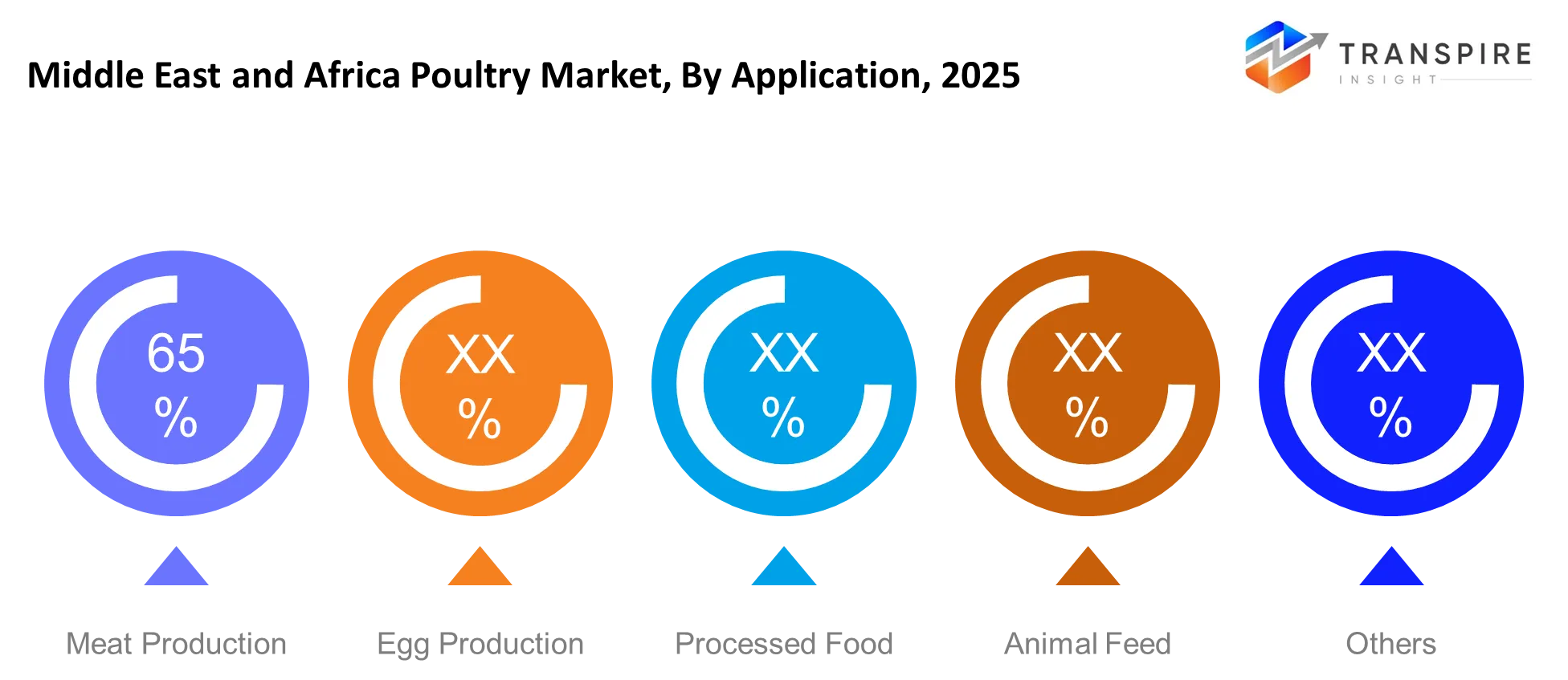
To learn more about this report, Download Free Sample Report
By End-User
Consumers are the biggest share since households consume poultry directly as a staple protein. Retailers and food industry players come right after, supported by supermarkets, hotels, and institutional catering that keeps ordering in volume. Exporters are smaller but still strategically important, tied to halal certification driven trade flows.
Consumer demand is pushed by affordability and changing dietary preferences, with poultry being chosen over red meat more often. Retailers gain influence through organized supermarket chains that standardize supply, quality controls, and portioning. Food industry demand rises with tourism, hospitality, and large-scale workforce catering programs, while exporters rely on certification compliance and trade agreements that have to be followed carefully.
Consumers will still be the backbone of demand , but retailers and exporters will start to have more say on pricing , and how supply chains actually work. The food industry demand part will keep rising , helped by tourism recovery , and also by infrastructure growth. At the same time investors seem to be leaning toward integrated supply setups that link production, straight into retail and export channels, almost like a loop that doesnt break.
By Distribution
Wet markets are still holding a big slice , mainly because traditional purchasing habits stay strong in a lot of African settings and in low income city neighborhoods. Supermarkets are moving quickly in Gulf countries and in the biggest African cities, mostly due to modern retail getting deeper. Online distribution is still kind of limited, but it is inching up in urban areas as logistics infrastructure improves and routing gets smoother.
Wet markets grow, but not at a flashy speed , still they stay tough and resilient in price sensitive regions where informal supply chains are common. Supermarkets keep expanding, driven by cold chain improvements, clearer branding , and standardized food safety requirements that are easier to audit. Online channels will keep growing too , especially as digital payments become more normal, and last mile delivery networks spread in metropolitan zones.
Overall, supermarkets are expected to gradually overtake wet markets in urban economies , as retail modernization picks up pace. Online channels should climb faster , even though they start from a low base, particularly in high income urban clusters. Investors will likely put more weight on cold chain logistics and digital retail infrastructure, because they want to catch the next distribution shift before it becomes obvious.
What are the Key Use Cases Driving the Middle East and Africa Poultry Market?
The main use case pushing poultry demand in the Middle East and Africa, is basically retail and home consumption of fresh plus frozen chicken, in particular via supermarkets and quick service retail places. As urban populations keep growing, and people lean toward an affordable protein, purchases stay high volume ,so this segment becomes the main demand motor across GCC and most African urban areas.
More room for expansion shows up in food service and institutional catering, specially in hotels, airlines, and huge workforce canteens tied to construction and oil and gas work. These channels, depend on a steady halal certified supply and processing that is standardized, which kinda pressures processors to scale up integrated production systems.
Also, you can see newer use cases, like poultry that is turned into value added products such as ready-to-cook meals and frozen marinated items, mostly because consumers want convenience. At the same time, export focused halal poultry supply chains are widening too, since African and Middle Eastern producers match international certification requirements, and that opens cross border trading chances.
|
Report Metrics |
Details |
|
Market size value in 2025 |
USD 24.8 Billion |
|
Market size value in 2026 |
USD 25.6 Billion |
|
Revenue forecast in 2033 |
USD 32.5 Billion |
|
Growth rate |
CAGR of 3.47% from 2026 to 2033 |
|
Base year |
2025 |
|
Historical data |
2021 - 2024 |
|
Forecast period |
2026 - 2033 |
|
Report coverage |
Revenue forecast, competitive landscape, growth factors, and trends |
|
Regional scope |
Middle East and Africa (Saudi Arabia, United Arab Emirates, South Africa, Rest of Middle East and Africa) |
|
Key company profiled |
Tyson Foods, BRF, JBS, Cargill, Perdue Farms, Sanderson Farms, Pilgrim’s Pride, Suguna Foods, Venky’s, Almarai, Al-Watania, CP Group, PHW Group, Foster Farms, Koch Foods |
|
Customization scope |
Free report customization (country, regional & segment scope). Avail customized purchase options to meet your exact research needs. |
|
Report Segmentation |
By Type (Broilers, Layers, Turkeys, Ducks, Others); By Application (Meat Production, Egg Production, Processed Food, Animal Feed, Others); By End-User (Consumers, Food Industry, Retailers, Restaurants, Exporters, Others); By Distribution (Wet Markets, Supermarkets, Online, Others) |
Which Regions are Driving the Middle East and Africa Poultry Market Growth?
The Middle East, especially the Gulf Cooperation Council, sort of ends up as the dominant region in the poultry market because there are strong policy driven food security plans , plus a lot of capital pushed into vertically integrated production setups. In Saudi Arabia and the UAE, officials actively back big poultry complexes, aiming to cut down import dependence and keep domestic supply steadier. Then there is also the whole cold chain side, pretty advanced logistics, and retail distribution channels that are already well developed. All that together keeps the leadership going. There’s also a mature surrounding ecosystem: feed suppliers, processors, and branded retail channels , which basically sustain high volume , quality checked poultry production.
North Africa feels more stability oriented , with Egypt and Morocco often acting as key players in keeping regional poultry supply consistent. Compared with the Gulf, the growth story here is less about huge state backed integration and more about steady private sector expansion , along with incremental upgrades in capacity. Regulatory rules tend to change slowly, so producers can actually plan long term investments in feed mills and processing facilities. That kind of calm, allows continuous domestic consumption growth too, and it ends up making the region a dependable contributor to overall market revenues.
Sub-Saharan Africa is the fastest growing area, largely linked to rising urbanization and newer investments in commercial poultry farming infrastructure. As retail supermarkets expand and cold chain logistics improve in places like Nigeria and Kenya, consumption patterns shift toward processed poultry products. More recent investments in feed mills, plus contract farming models that came in after 2024, help production run more efficiently and also lower import reliance.For investors, this region offers high-volume growth potential, though it requires careful navigation of infrastructure gaps and price-sensitive demand through 2033.
Who are the Key Players in the Middle East and Africa Poultry Market and How Do They Compete?
The Middle East and Africa poultry market kind of shows a mixed, almost uneasy competitive structure where the bigger vertically integrated producers sit closer to the Gulf supply chains and they dominate, while smaller local producers are scattered and mainly serve the price-sensitive African urban markets. It feels like competition is getting more intense now, because the incumbents keep defending shelf space using scale efficiency, feed integration and halal compliance, and at the same time regional entrants are moving in through contract farming and those retail linked production models, which is i guess different than the old pathways. Cost leadership still matters a lot, but access is increasingly decided by control over feed sourcing, cold chain logistics, and certification standards more than people expected.
Almarai competes by leaning on full vertical integration, covering feed production, broiler farming, processing, and branded retail distribution in Saudi Arabia and wider GCC markets. This setup lowers exposure to outside feed price shocks and keeps the supply consistently halal certified, so it helps reinforce its position in premium retail channels. BRF leans more toward export oriented halal poultry supply, basically using global processing capacity plus certification systems to meet Middle East import demand in a steady way.
JBS builds advantage mainly via scale and a diversified protein portfolio, which allows more flexible pricing moves in export markets that deal with volatile demand cycles. CP Group strengthens its footing through technology driven intensive farming systems and integrated feed operations, then it connects into Asia-linked supply networks serving MEA importers. Suguna Foods is more about contract farming, scaling rural producer networks in India to push out cost competitive poultry for African and Middle Eastern buyers, and that creates some price pressure on traditional exporters, especially where margins were already tight.
Company List
- Tyson Foods
- BRF
- JBS
- Cargill
- Perdue Farms
- Sanderson Farms
- Pilgrim’s Pride
- Suguna Foods
- Venky’s
- Almarai
- Al-Watania
- CP Group
- PHW Group
- Foster Farms
- Koch Foods
Recent Development News
“In May 2025, BRF S.A. completed the merger of its operations with Marfrig, forming MBRF Global Foods Company. The consolidation created a larger integrated protein player with expanded poultry export capacity and stronger positioning across Middle East and African halal supply chains.https://en.wikipedia.org
“In March 2025, Almarai announced continued expansion of itspoultry production and distribution infrastructure in Saudi Arabia. The investment strengthens domestic food security and increases vertically integrated poultry supply for GCC retail and food service markets.https://en.wikipedia.org/
What Strategic Insights Define the Future of the Middle East and Africa Poultry Market?
The Middle East and Africa poultry market is slowly but unmistakably moving toward vertically integrated, feed-efficient production setups, driven by growing protein appetite, urbanization, and import substitution policies across Gulf and African economies. Over the next 5 to 7 years, production should consolidate around bigger operators, with governments putting more weight on food security and local supply resilience. This tends to cut reliance on unpredictable global poultry imports and at the same time strengthen domestic value chains, in a way that feels more “locked-in” over time.
A less noticeable risk is feed input dependence, especially for maize and soybean meal, and this can really show up when producers face currency swings and global commodity disturbances. Even if retail demand stays steady, margins can still get squeezed fast. On top of that, climate related disruptions in key exporting regions make cost stability harder to forecast, even in markets that are still growing nicely.
At the same time, there’s an opening that’s kind of easy to overlook: the expansion of contract farming ecosystems tied to supermarket-led supply chains in places like Saudi Arabia and Egypt. Retail modernization is reshaping how procurement gets done, so the whole standard moves, not just the suppliers. For operators, this can mean more traceable, biosecure poultry production that fits food safety regulations. The practical recommendation for market participants is to put money into localized feed production partnerships, and also strengthen integrated cold-chain logistics, so input costs become steadier while the business captures those more premium retail distribution routes.
Middle East and Africa Poultry Market Report Segmentation
By Type
- Broilers
- Layers
- Turkeys
- Ducks
- Others
By Application
- Meat Production
- Egg Production
- Processed Food
- Animal Feed
- Others
By End-User
- Consumers
- Food Industry
- Retailers
- Restaurants
- Exporters
- Others
By Distribution
- Wet Markets
- Supermarkets
- Online
- Others
Frequently Asked Questions
Find quick answers to common questions.
The Estimated Middle East and Africa Poultry Market size is USD 32.5 Billion in 2033.
Key Segments for the Middle East and Africa Poultry Market are By Type (Broilers, Layers, Turkeys, Ducks, Others); By Application (Meat Production, Egg Production, Processed Food, Animal Feed, Others); By End-User (Consumers, Food Industry, Retailers, Restaurants, Exporters, Others); By Distribution (Wet Markets, Supermarkets, Online, Others).
Major Middle East and Africa Poultry Market players are Tyson Foods, BRF, JBS, Cargill, Perdue Farms, Sanderson Farms, Pilgrim’s Pride, Suguna Foods, Venky’s, Almarai, Al-Watania, CP Group, PHW Group, Foster Farms, Koch Foods.
The current Middle East and Africa Poultry Market size is USD 24.8 Billion in 2025.
The Middle East and Africa Poultry Market CAGR is 3.47% from 2026 to 2033.
- Tyson Foods
- BRF
- JBS
- Cargill
- Perdue Farms
- Sanderson Farms
- Pilgrim’s Pride
- Suguna Foods
- Venky’s
- Almarai
- Al-Watania
- CP Group
- PHW Group
- Foster Farms
- Koch Foods
Recently Published Reports
-
Apr 2026
Baby Infant Formula Market
Baby Infant Formula Market Size, Share & Analysis Report By ype (Infant Milk, Follow On Milk, Specialty Baby Milk, Growing-Up Milk), By Ingredient (Carbohydrate, Fat, Protein, Minerals, Vitamins, and Others), By Product Form (Powder, Liquid, and Ready-to-feed), By Distribution Channels (Supermarket/Hypermarket, Specialty Store, Pharmacies, Online Retail, and Others), and Geography (North America, Europe, Asia-Pacific, Middle East and Africa, South and Central America), 2021 - 2031
-
Apr 2026
Edible Insects for Animal Feed Market
Edible Insects for Animal Feed Market Size, Share & Analysis Report By Type (Insect Powder, Insect Meal, Insect Bar, Insect Paste, Insect Oil, and Others), By Insect Type (Beetles, Cricket, Caterpillar, Hymenoptera, Orthoptera, Tree Bugs, and Others), By Application (Livestock, Pet Food, and Aquaculture), By Livestock Type (Poultry, Swine, and Others), and Geography (North America, Europe, Asia-Pacific, Middle East and Africa, South and Central America), 2021 - 2031
-
Apr 2026
Food Industry Disinfection and Bacterial Control Market
Food Industry Disinfection and Bacterial Control Market Size, Share & Analysis Report By Type (Chemical Disinfectants, Physical Disinfectants, and Biocides and Antimicrobials), By Application (Food Processing Equipment Surface Disinfection, Food Preparation Areas Surface Disinfection, Storage Areas Surface Disinfection, Anti-microbial Coatings Food Preservation, and Preservative Solutions Food Preservation), By End User (Meat and Poultry Processing, Dairy Processing, Seafood Processing, Bakery and Confectionery, Restaurants and Commercial Kitchens, and Food Service Providers), By Sales Channel (Online, Offline), and Geography (North America, Europe, Asia-Pacific, Middle East and Africa, South and Central America), 2021 - 2031
-
Apr 2026
Freeze Dried Food Market
Freeze Dried Food Market Size, Share & Analysis Report By Product Type (Fruits, Vegetables, Freeze-Dried Dairy Products, Freeze-Dried Meat and Seafood, Freeze-Dried Pet Food, and Prepared Meal), By Nature (Organic, and Conventional), By Form (Powdered, Granules, and Diced), By End Use (Breakfast Cereals, Dairy Products, Bakery & Confectionery, Nutritional Bars & Supplements, Powdered Beverages, Snacks, and Retail (Household)), and Geography (North America, Europe, Asia-Pacific, Middle East and Africa, South and Central America), 2021 - 2031