
Middle East and Africa Commercial Security System Market Summary
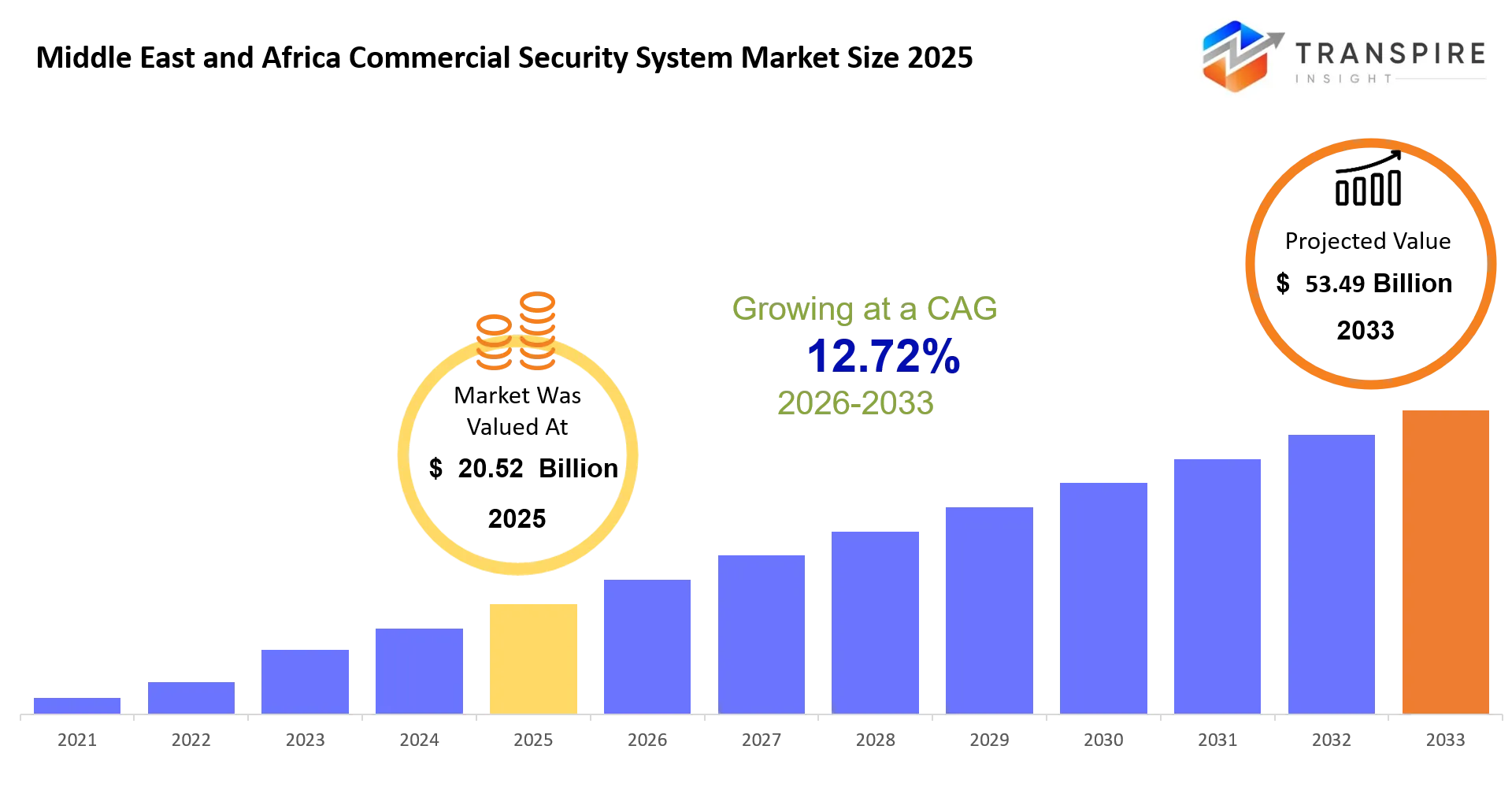
As per Transpire Insight Analysis the Middle East and Africa Commercial Security System Market size is estimated at USD 20.52 Billion in 2025 and is anticipated to reach USD 53.49 Billion by 2033, growing at a CAGR of 12.72% from 2026 to 2033.
In the Middle East and Africa, the Commercial Security System Market basically helps businesses, public institutions, plus industrial sites stay safe by protecting people, valuable assets, and that critical infrastructure part. . It does this using an integrated mix of surveillance, access control, intrusion detection, fire safety functions, and a security management platform kind of approach. In practical terms, these tools help organizations block unwanted entry, lower operational hazards, improve how fast teams handle incidents, and align with the ever-tightening safety rules that now come with most commercial spaces.
Over the last five years the market has not just grown, it also changed direction too, moving away from standalone hardware setups toward AI enabled, cloud connected, and interlinked security environments. These newer setups tend to fold in video analytics, biometric authentication, and centralized monitoring into one broader ecosystem. That shift really picked up after the COVID-19 pandemic, when the demand for contactless access control grew, and remote facility supervision became more normal but it also showed, how much organizations need resilient digital security infrastructure Big smart city projects across Saudi Arabia, the UAE, and South Africa have also played a role, since they fold commercial security into urban development work, often at scale. And because many organizations now focus more on operational continuity and live threat detection, spending keeps tilting toward intelligent security platforms. That, in turn, supports recurring software revenues along with the traditional hardware installations, which creates steadier long-term market value.
Middle East and Africa Commercial Security System Market Size & Forecast:
- Middle East and Africa Commercial Security System Market Size 2025: USD 20.52 Billion
- Expected Market Value 2033: USD 53.49 Billion
- Forecast CAGR: 12.72%
- Leading country in 2025: Saudi Arabia
- Fastest-growing country: United Arab Emirates (UAE)
- Key Profile: Hikvision, Dahua Technology, Bosch Security Systems, Honeywell, Johnson Controls, Axis Communications, Motorola Solutions, Hanwha Vision, Genetec, Avigilon, Suprema, Milestone Systems, HID Global, Gallagher Security, Schneider Electric
Key Market Insights
- The Middle East and Africa Commercial Security System Market is forecast to grow, from around USD 20.52 billion in 2025 to about USD 53.49 billion by 2033, mostly on the back of digital security modernization and related efforts that feel like they never really slow down.
- In the GCC region, those countries are basically leading the whole scene, with an estimated share above 45% in 2025. This is supported by smart city programmes, plus steady infrastructure investments, and a general push toward upgraded public safety tools.
- Meanwhile Africa is expected to show the quickest rise through 2033. The main drivers are commercial construction, banking expansion, and urban surveillance initiatives , all moving at the same time so growth looks very „stacked“.
- When it comes to products, video surveillance systems still sit in front, holding roughly 38% of the market share. That dominance is reinforced by AI-powered video analytics, and also high-resolution IP camera setups that are being rolled out more often than before.
- Next comes access control systems, ranking as the second-largest segment. At the same time, cloud-based integrated security platforms are anticipated to expand the fastest during the forecast period , because organizations like the scalability and centralized management style.
- By application, office buildings and commercial complexes make up close to 30% of deployments. Healthcare facilities and educational institutions are also adopting intelligent security , though at an accelerating pace that is hard to ignore.
- Looking at end users, large enterprises remain the primary category. Still, SMEs are increasingly shifting toward subscription-driven cloud security services, to cut down upfront spending and avoid heavy capital costs.
- Key players such as Hikvision, Dahua Technology, Bosch Security Systems, Honeywell, Axis Communications, and Genetec keep investing in AI analytics, cybersecurity, and unified security platforms. They also seem to be betting on platforms that can „talk“ to each other more smoothly.
- Strategic partnerships with regional system integrators and government agencies are helping major global vendors strengthen their footprint across Gulf and African markets, and to align with local procurement realities.
- Overall, the commercial security industry is increasingly layering facial recognition, edge AI, cybersecurity, and IoT-enabled monitoring into day-to-day operations. The goal is pretty straightforward: improve operational efficiency, lower reaction times, and make response teams move faster, even when conditions get messy.
What are the Key Drivers, Restraints, and Opportunities in the Middle East and Africa Commercial Security System Market?
Government backed smart city programs, along with tighter infrastructure security rules, are basically turning into the most powerful reason why commercial security spending is growing across the Middle East and Africa. Big efforts like NEOM, the Red Sea Global ecosystem, Expo driven builds, airports, logistics hubs, finance zones, and industrial parks all tend to need a bundle of capabilities at once, think integrated surveillance, biometric access control, outer perimeter protection, and centralized command rooms. Meanwhile a lot of organizations are swapping older analog setups for AI enabled IP surveillance and cloud managed platforms, this is said to boost threat spotting while also lowering the day to day monitoring bills. In practice those decisions lift both hardware sales and the ongoing software plus maintenance income, and they end up widening the whole commercial loop for security suppliers.
Still, the main structural problem is cost and complexity. It is not easy to connect newer security platforms to older building infrastructure without causing headaches. Many workplaces keep running a patchwork of CCTV style surveillance, access control, and fire protection systems that were installed by different vendors, across different years. If they want a full swap, they often need network upgrades, stronger cybersecurity controls, experienced integration work, and then even training for employees. On top of that, budget pressure across several African economies keeps postponing modernization attempts, so adoption stays slower than it ideally could be even when the operational advantages are obvious.
Artificial intelligence plus cloud native security administration looks like the next big growth window. Organizations are increasingly asking for unified platforms, where video analytics, access management, cybersecurity monitoring, and predictive threat identification sit inside one shared interface.
What Has the Impact of Artificial Intelligence Been on the Middle East and Africa Commercial Security System Market?
Artificial intelligence has changed commercial security from slow passive watching into a more proactive way of handling threats across office buildings, retail spaces, airports, industrial facilities and even financial institutions. With AI video analytics , suspicious behavior can be spotted automatically, abandoned objects flagged, perimeter breaches noticed, unauthorized access tries detected and occupancy patterns mapped without needing someone to stare at screens 24/7. Meanwhile intelligent access control now mixes facial recognition, behavioral analytics, and biometric authentication so it can boost safety and also day to day operations . Security operation centers then rely on automated event prioritization, so false alarms drop, and emergency response speeds up faster.
Machine learning models help with predictive maintenance too, by tracking how cameras work, how storage behaves, the network equipment state, and access control hardware health before anything major breaks. At the same time, AI methods can also improve video compression, manage bandwidth allocation, and handle edge processing more smartly, reducing storage needs while keeping image fidelity. For many organizations this leads to better system availability, quicker incident review, lower operating expenditures, and stronger alignment with commercial security expectations. Plus, when it connects with IoT sensors, centralized monitoring becomes easier, across multiple facilities from one single cloud based dashboard.
Still, AI rollouts aren’t fully smooth, because integration costs are high, cybersecurity risk needs constant attention, data privacy rules can be strict, and infrastructure varies a lot in several developing markets.
Key Market Trends
- Since 2021, enterprises have gone faster with migration from analog CCTV over to AI-powered IP surveillance platforms, and the whole centralized cloud management thing too kind of became normal.
- Contactless biometric access control expanded quite a bit after COVID-19 , basically swapping out the usual card based authentication across offices, healthcare facilities and educational institutions sometimes.
- In Saudi Arabia and the UAE, smart city projects have been growing and yes, they often fold in commercial security for transportation, utilities , and mixed-use infrastructure builds.
- Security vendors have also been steering more funding toward edge AI cameras that do analytics locally, which cuts down latency and reduces how much cloud bandwidth they need, like a lot.
- Cybersecurity turned into a main purchasing requirement too, because more buyers now ask for encrypted communications, plus zero-trust security architectures, without compromise.
- Manufacturers increasingly blend surveillance, access control, fire protection, and building management into one unified security ecosystem, instead of keeping everything as standalone products that don’t really talk to each other.
- Regional distributors broadened their partnerships with global vendors including Hikvision, Bosch Security Systems, Honeywell, Axis Communications, and Genetec so they could strengthen implementation capacity in the field.
- Security-as-a-Service, the subscription style business model, has picked up serious traction, mainly because it lowers upfront capital expenditure and makes software upgrades feel less complicated.
- AI-powered analytics are now able to reduce false alarm rates by more than 70% in many enterprise deployments, while also boosting response efficiency through automated event classification, so teams don’t waste time.
- And commercial buyers increasingly lean toward scalable cloud platforms that can handle multi-site operations, remote monitoring, and predictive security intelligence without getting messy.
Middle East and Africa Commercial Security System Market Segmentation
By Product Type
Video Surveillance Systems take the biggest portion of the market, mainly because continuous monitoring helps in crime prevention , gives operational visibility, and makes evidence gathering easier across different commercial properties. Access Control Systems manage who can enter using biometric readers, smart cards, as well as mobile credentials , which ends up improving workplace safety and visitor handling in a smoother way. Intrusion Detection Systems watch for abnormal entry attempts using motion sensors, alarms, and other connected detection devices, and they are meant to enable faster response times when something happens. Fire Protection Systems also play a key role in building safety , using smoke detection, fire alarms, suppression equipment, and emergency notification technology that aligns with the needed regulatory requirements.
Perimeter Security Systems guard the outdoor edges with fencing sensors, thermal cameras, radar, and intelligent monitoring solutions, especially for larger locations. Security Management Software ties together multiple security devices through centralized oversight, structured reporting, and event management features. Integrated Security Systems bring surveillance, access control, fire safety, and intrusion detection into one coordinated platform , so teams can run things more efficiently. Other offerings cover emergency communication systems, security drones, advanced sensor arrays, and niche protection technologies created for particular commercial settings.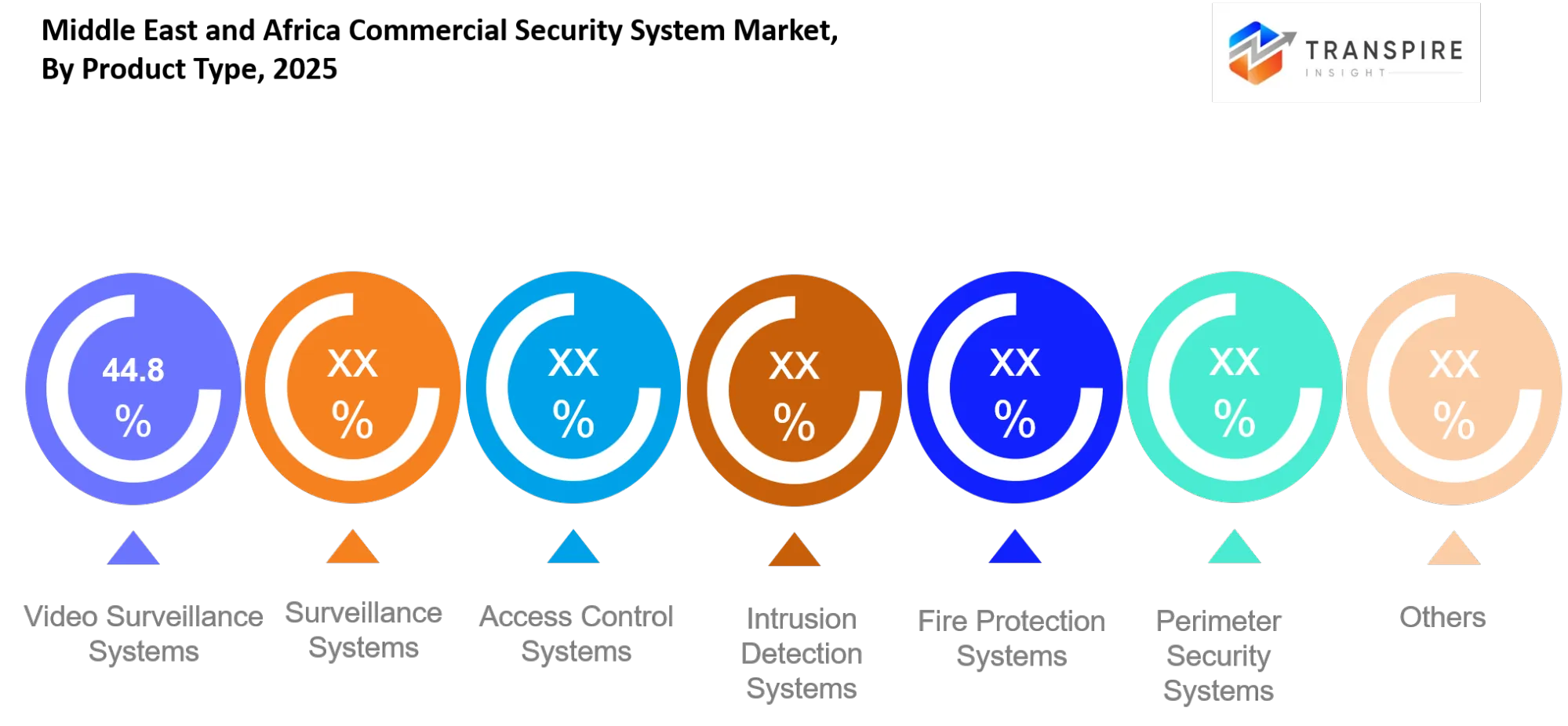
By Deployment
Cloud based security has seen strong acceptance now, mainly because centralized monitoring, remote access, and subscription models cut down infrastructure costs, yet they also boost day to day operational flexibility. On premise security still suits organizations that need full data ownership, strict internal policies, and dedicated infrastructure. Hybrid security mixes cloud connectivity with local setups, so you get a more balanced mix of performance, protection, and scaling across various business sites. AI based security further improves threat detection, using intelligent video analytics, facial recognition, and automated event classification, which in turn helps speed up responses.
IoT enabled security links cameras, sensors, alarms, and access devices into one monitoring network that gives real time operational visibility. Edge security systems handle security data near the connected devices, which lowers latency and enables quicker incident detection without relying too much on cloud services. This advanced edge processing also trims bandwidth use, and generally makes response work more efficient. Other options include customized deployment models built for industry specific operational needs as well as compliance requirements.
By Application
Office Buildings end up with the highest deployment volume , mostly because every day staff movement kinda needs dependable surveillance. At the same time , visitor management and controlled access must work across multiple entry points, not just one. Retail Stores rely on intelligent monitoring to cut theft risks, help keep customers safe, and also keep business continuity on track. Banking & Financial Institutions usually demand more advanced surveillance, biometric authentication and secure monitoring, to guard financial assets and also protect sensitive customer data from exposure. Healthcare Facilities focus on patient safety via controlled access, emergency monitoring , and nonstop defense of the medical infrastructure.
Educational Institutions use integrated security to safeguard students, staff ,and campus areas while they also boost emergency readiness. Industrial Facilities typically roll out perimeter protection, surveillance, and intrusion detection so production assets and critical infrastructure stay protected. Hospitality establishments implement security systems for guest safety, property safeguarding, and smoother facility management. Others can include logistics centers, entertainment venues , transport hubs, plus mixed-use commercial developments that require specialized protection too.
By End User
Commercial Enterprises are basically the biggest customer group, mainly because offices, shopping centers, business parks, and corporate campuses need broad security coverage for everyday activities. Government Organizations also put money into surveillance, perimeter defense, and access control so administrative buildings and public infrastructure stay protected. Healthcare Providers roll out integrated security across the whole facility, to guard patients, staff, sensitive documentation, and medical equipment, all at once, not just in one area. Retail Chains tend to focus on loss prevention, inventory defense, and customer wellbeing using intelligent monitoring with centralized oversight
Financial Institutions keep strong protection with biometric verification, high-definition video systems, and safe monitoring across branches and automated banking zones. Educational Institutions enhance safety on campus with controlled entry, emergency messaging, and ongoing surveillance. Manufacturing Companies protect production lines, warehouses, and restricted operational zones with integrated security systems. Others, like transportation operators, hospitality businesses, utility providers, and commercial service organizations, still count as well.
By Component
Hardware is basically the base, the foundation, for real commercial security, via cameras, sensors, access readers, control panels, alarm systems, network devices, and the recording gear that gets installed across different facilities. Software then handles the whole show for surveillance, access rights permissions, alarm coordination, analytics reporting, plus the centralized command side so operations run more efficiently . Security Services usually cover system design, setup, consulting, integration , and ongoing technical support so the deployment actually stays dependable across commercial projects.
Monitoring Services focus on ongoing watchfulness, incident confirmation, emergency coordination, and quick response through dedicated monitoring centers. Maintenance Services keep that security infrastructure running smoothly with routine inspections, upgrades, preventive servicing, and equipment swaps whenever it really should be replaced. Analytics Platforms take what the cameras and sensors are saying, and turn it into usable intelligence, using artificial intelligence, behavioral analysis, and predictive monitoring features. With continuous analytics the team can make decisions quicker, and threat identification is supported faster across commercial sites.
Other areas cover things like cybersecurity solutions, communication platforms, storage technologies, and specialist support services that add on to a full, complete security deployment—though sometimes those pieces are treated like separate systems, in practice they’re meant to work as one.
What are the Key Use Cases Driving the Middle East and Africa Commercial Security System Market?
Office buildings kind of stay at the front of the pack, because daily business work usually needs nonstop observation, secure staff entry, visitor check in, and quick action during emergencies. When these systems are tied together they can lessen day to day hiccups while also making building oversight better, plus keeping regulatory compliance on track over big commercial sites.
Retail groups and banking organizations are still pushing forward with more intelligent surveillance, biometric sign in, and centralized oversight. The aim is to cut down loss, guard high value inventory, and keep customers safer, and honestly this trend keeps gathering steam. At the same time healthcare operators are rolling out stricter access controls and video monitoring to protect sensitive medical zones, pharmaceutical storage areas, and the patient care floors.
Now AI driven video analytics, cloud managed command centers, and even autonomous perimeter monitoring are starting to show up across smart cities, logistics parks and data centers. There are also additional openings for smart occupancy watching and predictive threat sensing as digital infrastructure work grows throughout the Middle East and Africa.
|
Report Metrics |
Details |
|
Market size value in 2025 |
USD 20.52 Billion |
|
Market size value in 2026 |
USD 23.13 Billion |
|
Revenue forecast in 2033 |
USD 53.49 Billion |
|
Growth rate |
CAGR of 12.72% from 2026 to 2033 |
|
Base year |
2025 |
|
Historical data |
2021 - 2024 |
|
Forecast period |
2026 - 2033 |
|
Report coverage |
Revenue forecast, competitive landscape, growth factors, and trends |
|
Regional scope |
Middle East and Africa (Saudi Arabia, United Arab Emirates, South Africa, Rest of Middle East and Africa) |
|
Key company profiled |
Hikvision, Dahua Technology, Bosch Security Systems, Honeywell, Johnson Controls, Axis Communications, Motorola Solutions, Hanwha Vision, Genetec, Avigilon, Suprema, Milestone Systems, HID Global, Gallagher Security, Schneider Electric |
|
Customization scope |
Free report customization (country, regional & segment scope). Avail customized purchase options to meet your exact research needs. |
|
Report Segmentation |
By Product Type (Video Surveillance Systems, Access Control Systems, Intrusion Detection Systems, Fire Protection Systems, Perimeter Security Systems, Security Management Software, Integrated Security Systems, Others); By Deployment (Cloud-Based Security, On-Premise Security, Hybrid Security, AI-Based Security, IoT-Enabled Security, Edge Security Systems, Others); By Application (Office Buildings, Retail Stores, Banking & Financial Institutions, Healthcare Facilities, Educational Institutions, Industrial Facilities, Hospitality, Others); By End User (Commercial Enterprises, Government Organizations, Healthcare Providers, Retail Chains, Financial Institutions, Educational Institutions, Manufacturing Companies, Others); By Component (Hardware, Software, Security Services, Monitoring Services, Maintenance Services, Analytics Platforms, Others) |
Which Regions are Driving the Middle East and Africa Commercial Security System Market Growth?
The Gulf Cooperation Council kind of shows up as the biggest regional market, with Saudi Arabia and the United Arab Emirates pretty much leading the way. There are very strict government security rules, plus big smart city initiatives, more and more commercial real estate activity, and ongoing funding for airports ports financial districts and industrial zones… all that helps keep deployment of advanced surveillance and access control systems moving without much break. At the same time, national digital transformation efforts push organizations to use AI-enabled monitoring, united command centers, and cloud based security platforms across both public infrastructure and private sites. And there’s also a fairly mature setup of global technology vendors, certified system integrators cybersecurity specialists, and local distribution channels that keeps strengthening regional momentum.
South Africa still lands as the second-largest contributor, mainly because commercial security spending tends to follow a different rhythm than in the Gulf area. Instead of leaning mostly on huge mega infrastructure projects, the demand is carried by long standing banking, retail, mining, healthcare, and corporate segments that regularly upgrade their current security framework. When you add stable private sector funding, insurance expectations, and the long experience with electronic security tools, you get replacement cycles for surveillance and access control and integrated security platforms that are more or less predictable. So it becomes a steadier kind of revenue channel, not just for external manufacturers but also for regional service providers.
The rest of Africa is expected to move the quickest in the 2026 to 2033 window, as commercial building work, digital infrastructure undertakings, and city growth speed up across places like Kenya, Egypt, Nigeria, and Morocco.
Who are the Key Players in the Middle East and Africa Commercial Security System Market and How Do They Compete?
Competition still looks moderately consolidated, but the bigger multinational tech providers aren’t just fighting on hardware prices or anything like that. They tend to go at it using innovation, integrated platforms and basically regional service capabilities, with a lot of focus on how things work together on site. At the same time customers are increasingly judging vendors by cybersecurity performance plus their artificial intelligence strengths, cloud management approach, interoperability, and also long term technical support. Because for huge commercial projects it’s rarely “just buy equipment and go”, regional partnerships with distributors and certified system integrators matter as much, and sometimes more, since deployment maintenance and lifecycle management are what actually make or break the timeline.
Hikvision stands out with a broad range of AI powered surveillance cameras, intelligent video analytics and integrated security management platforms, covering everything from office buildings to smart cities, more or less. The company is also pushing its open ecosystem direction, by improving third party software integration and widening sensing technologies while simultaneously reinforcing its regional partner network, which is a big deal in practice.
Bosch Security Systems competes by offering high reliability enterprise security solutions that blend video surveillance, intrusion detection, fire protection and building automation inside one unified architecture. Its cybersecurity capabilities are strong and it aligns closely with international security standards, so Bosch is often more competitive in government facilities, transportation infrastructure, healthcare environments, and critical industrial settings.
Company List
• Hikvision
• Dahua Technology
• Bosch Security Systems
• Honeywell
• Johnson Controls
• Axis Communications
• Motorola Solutions
• Hanwha Vision
• Genetec
• Avigilon
• Suprema
• Milestone Systems
• HID Global
• Gallagher Security
• Schneider Electric
Recent Development News
In March 2026, Hanwha Vision entered a strategic partnership with Ambarella. The collaboration will develop next-generation AI video security technologies by combining Hanwha Vision's surveillance expertise with Ambarella's AI semiconductor capabilities, strengthening intelligent video analytics for enterprise security applications.https://en.yna.co.kr
In March 2026, Hanwha Vision launched the BLAZE Hybrid AI Video Management System. The new platform integrates on-premise performance with cloud-based federation and AI-powered investigations, improving multi-site commercial security management.https://hanwhavisionamerica.com
In February 2025, Hikvision launched its AI-enabled Video Door Phone Multi-Apartment Solution. The platform combines facial recognition, cloud connectivity, centralized management, and intelligent automation to strengthen access control for commercial and multi-tenant properties.https://www.hikvisionindia.com
What Strategic Insights Define the Future of the Middle East and Africa Commercial Security System Market?
The market seems to be moving toward these fully integrated security ecosystems, where artificial intelligence, cloud computing, cybersecurity, and even building management sort of all run through one unified digital platform… not separate standalone systems. And yeah this structural change will likely come from commercial digitalization, smart infrastructure spending, and also the increasing demand for centralized operational visibility across several facilities at once.
There’s also a less obvious risk that is kinda easy to overlook: growing dependence on only a few global hardware suppliers. That could leave commercial projects more exposed to supply chain disruptions, cybersecurity limitations, and geopolitical trade policies that impact whether certain technologies even remain available.
But honestly, there’s an opportunity too. AI-enabled edge security platforms are starting to look promising for data centers, logistics hubs, and smart industrial parks across Africa, especially since investment in digital infrastructure keeps accelerating there. Market participants should focus on open platform architectures, boost their cybersecurity strength, and grow partnerships with regional system integrators, so interoperability improves without too much friction, while also building recurring software revenue plus managed service income over the next few years.
Middle East and Africa Commercial Security System Market Report Segmentation
By Product Type
• Video Surveillance Systems
• Access Control Systems
• Intrusion Detection Systems
• Fire Protection Systems
• Perimeter Security Systems
• Security Management Software
• Integrated Security Systems
• Others
By Deployment
• Cloud-Based Security
• On-Premise Security
• Hybrid Security
• AI-Based Security
• IoT-Enabled Security
• Edge Security Systems
• Others
By Application
• Office Buildings
• Retail Stores
• Banking & Financial Institutions
• Healthcare Facilities
• Educational Institutions
• Industrial Facilities
• Hospitality
• Others
By End User
• Commercial Enterprises
• Government Organizations
• Healthcare Providers
• Retail Chains
• Financial Institutions
• Educational Institutions
• Manufacturing Companies
• Others
By Component
• Hardware
• Software
• Security Services
• Monitoring Services
• Maintenance Services
• Analytics Platforms
• Others
Frequently Asked Questions
Find quick answers to common questions.
The Expected Middle East and Africa Commercial Security System Market size for the Market will be USD 53.49 Billion in 2033.
Key Segments for the Middle East and Africa Commercial Security System Market are By Product Type (Video Surveillance Systems, Access Control Systems, Intrusion Detection Systems, Fire Protection Systems, Perimeter Security Systems, Security Management Software, Integrated Security Systems, Others); By Deployment (Cloud-Based Security, On-Premise Security, Hybrid Security, AI-Based Security, IoT-Enabled Security, Edge Security Systems, Others); By Application (Office Buildings, Retail Stores, Banking & Financial Institutions, Healthcare Facilities, Educational Institutions, Industrial Facilities, Hospitality, Others); By End User (Commercial Enterprises, Government Organizations, Healthcare Providers, Retail Chains, Financial Institutions, Educational Institutions, Manufacturing Companies, Others); By Component (Hardware, Software, Security Services, Monitoring Services, Maintenance Services, Analytics Platforms, Others).
Major Middle East and Africa Commercial Security System Market Players are Hikvision, Dahua Technology, Bosch Security Systems, Honeywell, Johnson Controls, Axis Communications, Motorola Solutions, Hanwha Vision, Genetec, Avigilon, Suprema, Milestone Systems, HID Global, Gallagher Security, Schneider Electric .
The Current Middle East and Africa Commercial Security System Market size is USD 20.52 Billion in 2025.
The Middle East and Africa Commercial Security System Market CAGR is 12.72% from 2026 to 2033.
• Hikvision
• Dahua Technology
• Bosch Security Systems
• Honeywell
• Johnson Controls
• Axis Communications
• Motorola Solutions
• Hanwha Vision
• Genetec
• Avigilon
• Suprema
• Milestone Systems
• HID Global
• Gallagher Security
• Schneider Electric
About the Authors

Mayur Shinde
I am Mayur Shinde, a Senior Research Analyst at Transpire Insight, specializing in the Automotive & Transportation and Information & Communication Technology (ICT) Industry. My work focuses on analyzing emerging market trends, technological advancements, competitive landscapes, and industry developments to deliver accurate, data-driven insights. I am passionate about transforming complex market information into clear, actionable content that helps businesses, professionals, and decision-makers stay informed and make confident strategic decisions.

Chakradhar Khansole
Chakradhar serves as the Research Director at Transpire Insight, bringing over 8 years of experience in technology, innovation, and strategic market intelligence. He specializes in transforming complex market data into actionable business insights that enable organizations to make informed, growth-oriented decisions. Recognized for his strategic vision and analytical expertise, Chakradhar leads high-impact research initiatives, delivering comprehensive market assessments, competitive intelligence, and forward-looking industry analysis.
Recently Published Reports
-
Apr 2026
3D Optical Profiler Market
3D Optical Profiler Market Size, Share & Analysis Report By Type (Desktop 3D Optical Profiler, and Portable 3D Optical Profiler), By Technology (Confocal Technology, and White Light Interference), By End-Use Industry (Manufacturing, Research Institutions, Automotive, Aerospace and Defense, Medical Devices, and Other), and Geography (North America, Europe, Asia-Pacific, Middle East and Africa, South and Central America), 2021 - 2031
-
Apr 2026
Depth Sensor Market
Depth Sensor Market Size, Share & Analysis Report By Type (Infrared Depth Sensors, Time-of-Flight (ToF) Sensors, Stereo Vision Sensors, Structured Light Sensors, Ultrasonic Depth Sensors), By Application (Automotive, Robotics, Gaming, Consumer Electronics, Industrial Automation, Healthcare, Security & Surveillance, Others), By End Users (Automotive Manufacturers, Consumer Electronics Companies, Healthcare Providers, Industrial Companies, Security Agencies, Gaming Companies, Robotics Companies, Others), and Geography (North America, Europe, Asia-Pacific, Middle East and Africa, South and Central America), 2021 – 2031
-
Apr 2026
Digital Manufacturing Market
Digital Manufacturing Market Size, Share & Analysis Report By Component (Hardware, Software, and Services), By Technology (Robotics, 3D Printing, Internet of Things (IoT), and Others), By Application (Automotive and Transportation, Aerospace and Defense, Consumer Electronics, Industrial Machinery, and Others), By Process Type (Computer-Based Designing, Computer-Based Simulation, Computer 3D Visualization, Analytics, and Others), and Geography (North America, Europe, Asia-Pacific, Middle East and Africa, South and Central America), 2021 – 2031
-
Apr 2026
Digital Visa Services Market
Digital Visa Services Market Size, Share & Analysis Report By Type (Individual Travelers, Group Travelers), By Application (Tourism, Business Travel, Others), and Geography (North America, Europe, Asia-Pacific, Middle East and Africa, South and Central America), 2021 – 2031