

Middle East and Africa Clinical Microbiology Market Size & Forecast:
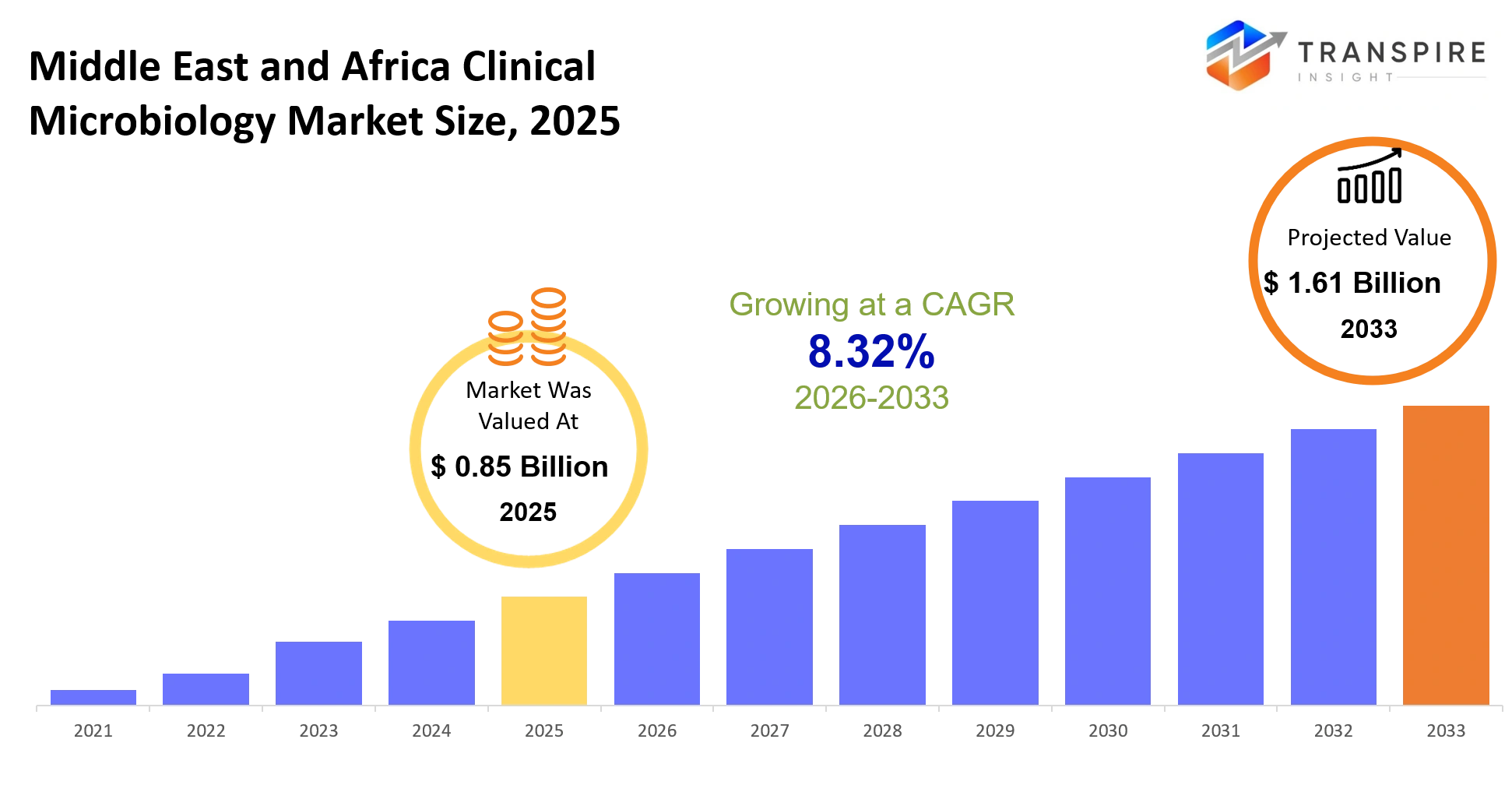
- Middle East and Africa Clinical Microbiology Market Size 2025: USD 0.85 Billion
- Middle East and Africa Clinical Microbiology Market Size 2033: USD 1.61 Billion
- Middle East and Africa Clinical Microbiology Market CAGR: 8.32%
- Middle East and Africa Clinical Microbiology Market Segments: By Product Type (Instruments, Reagents, Culture Media, Assays, Software, Consumables, Others); By Application (Bacterial Infections, Viral Infections, Fungal Infections, Parasitic Diseases, Antimicrobial Testing, Others); By End User (Hospitals, Diagnostic Laboratories, Research Institutes, Academic Centers, Others); By Technology (Molecular Diagnostics, Immunoassays, Microscopy, Culture-Based Methods, Others)
Middle East and Africa Clinical Microbiology Market Summary
The Middle East and Africa Clinical Microbiology Market was valued at USD 0.85 Billion in 2025. It is forecast to reach USD 1.61 Billion by 2033. That is a CAGR of 8.32% over the period.
Clinical microbiology has this kinda crucial role in finding infectious pathogens, helping with treatment calls, and also backing infection control programs in hospitals , labs , and even broader public health systems. In real life healthcare, microbiology tests help clinicians spot bacterial, viral, fungal and parasitic infections more quickly, which lowers that whole diagnostic doubt and tends to support better patient outcomes. Over the last five years, the market sort of moved away from older culture based testing, toward molecular diagnostics, and automated laboratory workflows that spit out faster, and often more precise results.
The COVID-19 pandemic was a big push, kind of like it made the limits obvious, meaning diagnostic capacity gaps were exposed, and then a lot more money went into lab infrastructure, surveillance networks, and molecular testing platforms across the Middle East and Africa. Growth still keeps going , because healthcare providers now focus harder on quick pathogen identification , plus antimicrobial resistance monitoring. Higher healthcare spending, more robust infectious disease surveillance efforts, and broader use of automation technologies are raising test volumes too, which improves lab efficiency , and it also keeps creating long term revenue chances for microbiology solution providers around the region.
Key Market Insights
- Saudi Arabia and the UAE together, kind of like racked up an estimated 35%+ regional market share in 2025 ,this was mainly backed by pretty advanced healthcare infrastructure, you know the usual story.
- Meanwhile the Middle East is pulling in most of the regional revenue, and African healthcare markets are basically the fastest growing target opportunity through 2033.
- On the product side, reagents moved out first with roughly 30% market share in 2025, because of recurring consumption across diagnostic workflows, no surprise there.
- Instruments stayed as the second biggest segment as hospitals kept expanding their automated microbiology laboratory capacity.
- As for technology, molecular diagnostics should be the fastest-growing tech segment through 2033 , largely pushed by the need for quicker pathogen identification.
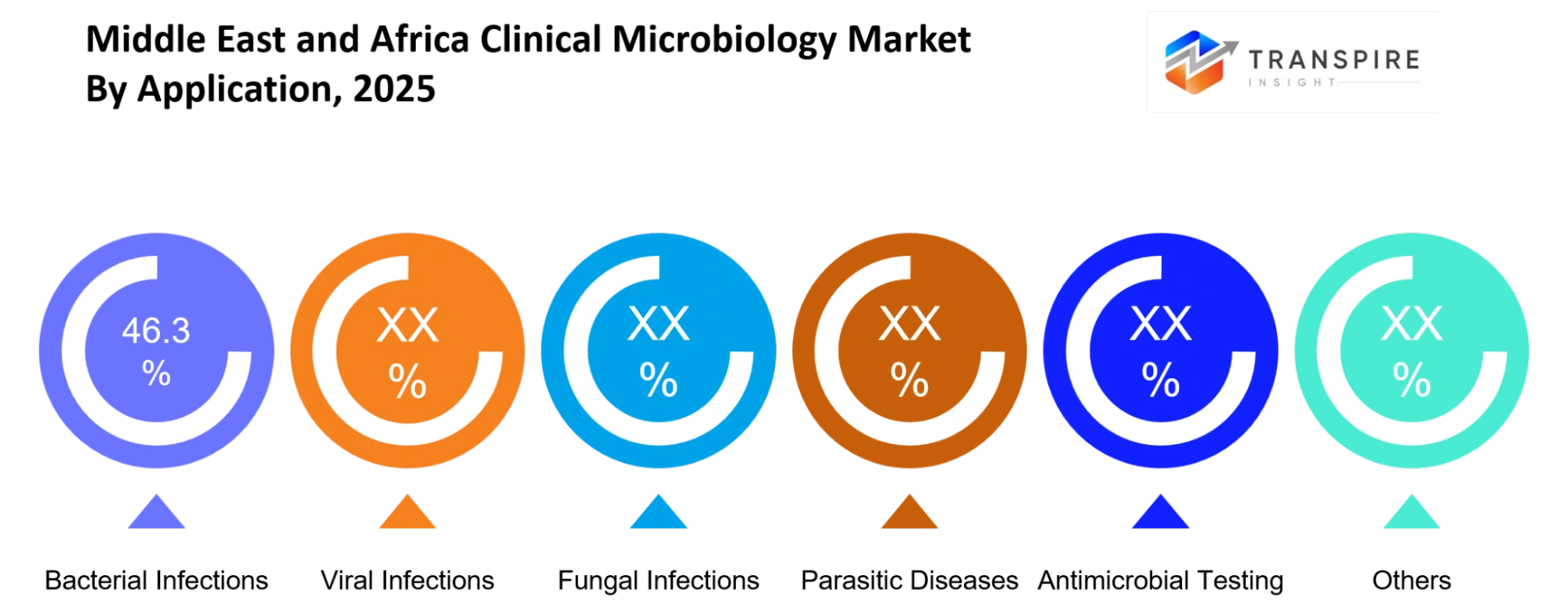
- For applications, bacterial infection testing made up over 40% of demand in 2025, with high testing volumes doing the heavy lifting.
- Antimicrobial susceptibility testing is also accelerating, especially as governments strengthen antimicrobial resistance surveillance, frameworks and all.
- Hospitals were the leading end user segment with about 45% market share in 2025, supported by centralized diagnostic services.
- Diagnostic laboratories are seeing the quickest expansion too, because outsourced testing volumes keep climbing across major healthcare systems.
- Companies such as bioMérieux ,Thermo Fisher Scientific, BD, Roche , Abbott, and Qiagen are going after automation, multiplex testing, and a wider regional reach approach.
What are the Key Drivers, Restraints, and Opportunities in the Middle East and Africa Clinical Microbiology Market?
The strongest growth driver is the shift toward rapid molecular diagnostics and, kind of, automated microbiology workflows. In practice, healthcare providers increasingly expect faster pathogen identification to back targeted treatment choices, and also shorten hospital stays. The investments after the COVID-19 pandemic really widened laboratory infrastructure. At the same time, antimicrobial resistance monitoring programs added extra testing requirements, so the whole ecosystem had more to do. When the turnaround times speed up, clinical outcomes get better, and that pushes healthcare systems to adopt higher value diagnostic platforms, which then directly supports revenue growth for manufacturers and laboratory service providers
Still, the biggest restraint is basically uneven healthcare infrastructure across multiple African countries. Advanced microbiology setups need dedicated lab facilities, trained people, quality assurance systems in place, and stable funding sources. Those needs become a kind of structural obstacle, because workforce development and laboratory modernization don’t happen overnight. They take years of investment. Also, limited access to advanced testing equipment slows down technology adoption, lowers testing capacity, and suppresses possible market revenue in underserved regions
A noticeable opportunity is in expanding decentralized molecular testing along with digital laboratory networks. Things like portable PCR platforms, automated identification systems, and cloud connected laboratory management solutions can push advanced diagnostics beyond the major urban centers. There is also rising investment in healthcare modernization in countries such as Saudi Arabia, the UAE, and South Africa. So, the overall environment looks supportive for technology rollout, and for wider deployment over time
What Has the Impact of Artificial Intelligence Been on the Middle East and Africa Clinical Microbiology Market?
Artificial intelligence is, kind of transforming clinical microbiology laboratories, by boosting diagnostic speed, helping workflow flow, and making better use of lab resources. AI powered image analysis systems can quietly interpret microscopy images, spot microbial growth patterns, and assist staff during everyday screening, even when it feels repetitive. At the same time, advanced software platforms can also help with specimen prioritization, which reduces bottlenecks and makes turnaround time improve, not only a little bit.
Machine learning models are now frequently used to forecast antimicrobial resistance patterns and to sift through large microbiological datasets coming from hospitals and diagnostic networks. With these tools, laboratories can recognize emerging infection trends earlier and back up more informed treatment decisions. AI enabled laboratory information systems additionally help optimize instrument scheduling, lower manual errors, and increase overall productivity. Together, these changes support higher throughput and a more efficient use of diagnostic resources, in general.
Digital technologies further help with predictive maintenance of automated analyzers, by flagging equipment performance anomalies before a failure shows up. This, in turn reduces downtime and keeps operations more stable. Still, adoption is, unfortunately, constrained by high implementation costs, fragmented healthcare IT infrastructure and limited access to large regional datasets needed to train accurate algorithms. Because of that, deployment moves slower, especially in smaller healthcare facilities and in developing healthcare markets across the region.
Key Market Trends
- From 2021 to 2025 molecular diagnostics seemed to rise quite a lot, as labs started prioritizing faster pathogen detection , you know, basically rapid identification.
- Automated microbiology systems saw more than 20% extra deployments in major reference laboratories since that pandemic period , compared to before.
- At the same time antimicrobial resistance monitoring programs expanded through the Gulf countries, which created a bigger need for susceptibility testing solutions and such.
- Multiplex PCR test panels started replacing multiple single target tests, and that shift cut diagnostic turnaround time by as much as 50% .
- Saudi Arabia and the UAE also pushed healthcare modernization initiatives, and that clearly accelerated lab equipment purchasing somewhere in 2024–2026.
- Meanwhile AI aided microscopy plus image analysis tools, moved from the pilot phase into more routine use in many laboratories.
- Larger hospital groups began consolidating microbiology testing into centralized labs, to boost efficiency , and also to strengthen quality control.
- Diagnostic labs further broadened outsourcing partnerships, leading to fresh revenue for providers focused on specialized testing.
- And global companies like bioMérieux, Roche, and BD increased their attention on integrated workflow solutions rather than standalone instruments.
- Finally cloud linked laboratory information systems picked up momentum, since healthcare providers wanted standardized reporting and surveillance features, almost everywhere.
Middle East and Africa Clinical Microbiology Market Segmentation
By Product Type
Instruments kind of form the operational foundation of microbiology laboratories, and they also help support the whole testing flow through automated identification, susceptibility testing, and even sample processing systems too. Reagents are usually the recurring laboratory expenditure, because every diagnostic procedure wants specialized chemicals and specific testing materials, so it adds up over time. Culture media stays essential for microbial growth and isolation, especially for routine diagnostic applications, where things need to be repeatable.
Assays help with fast detection and characterization of infectious agents via standardized testing procedures. Software solutions assist labs in managing data, reporting, workflow optimization, and quality control activities. Consumables create steady demand due to regular replacement needs, while the “others” category includes specialized products, designed for niche diagnostic applications and research activities, not as general as the usual items.
By Application
Bacterial infections really are the biggest application area, mostly because healthcare facilities routinely do testing for respiratory , bloodstream, urinary tract and hospital acquired infections. Viral infection diagnostics keep growing too, as healthcare systems strengthen surveillance capabilities for respiratory illnesses and also emerging infectious diseases. Fungal infection testing is also there to help with diagnosis especially in immunocompromised patient populations, and often in critical care settings.
Parasitic disease diagnostics still matter across several African healthcare systems, since endemic diseases keep affecting public health outcomes in a pretty direct way. Antimicrobial testing plays a central role in treatment optimization and resistance monitoring programs, it is not just a background activity. The others category covers specialized microbiological investigations, sometimes chosen for unique clinical and epidemiological requirements, so it’s not really “one size fits all.”
By End User
Hospitals make up the biggest portion of testing activity, largely because patient volumes are high and diagnostics are more centralized, in practice. Diagnostic laboratories then run a lot of microbiological analysis for hospitals, clinics, and broader health care networks, helping enable those large scale testing operations. Research institutes chip in through infectious disease investigations, antimicrobial resistance studies, and diagnostic innovation initiatives.
Meanwhile, academic centers back up training, research efforts, and the evaluation of new diagnostic technologies. With ongoing investment into lab infrastructure, testing capabilities get stronger across these kinds of institutions too, sort of. The “others” group covers public health organizations and specialized healthcare facilities that are involved in microbiological diagnostics as well as surveillance work.
By Technology
Molecular diagnostics keeps gaining prominence because it delivers high sensitivity , faster turnaround times and broad pathogen detection abilities. Immunoassays work as efficient screening and confirmation tools in several infectious diseases. Meanwhile microscopy still has a role that’s pretty important, especially in routine lab environments, and also in resource limited healthcare contexts.
Culture based methods continue serving as a central technology for microbial isolation, identification, and susceptibility testing. A lot of laboratories depend on culture techniques, to reach definitive diagnosis and to guide treatment decisions. Then the “others” category is basically where emerging and specialized technologies fit in, these have been developed to respond to changing diagnostic needs, and to improve overall lab efficiency goals in the near term .
What are the Key Use Cases Driving the Middle East and Africa Clinical Microbiology Market?
The main use case kind of revolves around diagnosing bacterial infections in hospitals and those diagnostic laboratories too. In practice it means rapid identification of pathogens and antimicrobial susceptibility testing helps clinicians make more targeted treatment decisions, which then reduces unnecessary antibiotic use and honestly improves patient management outcomes. Also there are high testing volumes tied to respiratory, bloodstream, and healthcare-associated infections, so the demand for microbiology solutions really stays pretty strong.
Another angle that is growing involves viral disease surveillance and antimicrobial resistance monitoring programs. National public health agencies, research institutes, and reference laboratories are increasingly using advanced diagnostic technologies to map disease transmission patterns and to evaluate resistance trends across the healthcare systems.
On top of that, emerging applications show up as genomic surveillance, outbreak investigation, and even integrated digital microbiology platforms. Advanced molecular testing, plus artificial intelligence and data analytics, seems to support earlier detection of emerging pathogens and it strengthens public health preparedness efforts across the region as a whole.
|
Report Metrics |
Details |
|
Market size value in 2025 |
USD 0.85 Billion |
|
Market size value in 2026 |
USD 0.92 Billion |
|
Revenue forecast in 2033 |
USD 1.61 Billion |
|
Growth rate |
CAGR of 8.32% from 2026 to 2033 |
|
Base year |
2025 |
|
Historical data |
2021 - 2024 |
|
Forecast period |
2026 - 2033 |
|
Report coverage |
Revenue forecast, competitive landscape, growth factors, and trends |
|
Regional scope |
United States; Canada; Mexico; United Kingdom; Germany; France; Italy; Spain; Denmark; Sweden; Norway; China; Japan; India; Australia; South Korea; Thailand; Brazil; Argentina; South Africa; Saudi Arabia; United Arab Emirates |
|
Key company profiled |
bioMérieux, Thermo Fisher Scientific, Danaher, BD, Abbott, Roche, Qiagen, Bio-Rad, Agilent, Siemens Healthineers, Bruker, Merck, Hardy Diagnostics, HiMedia, Sysmex |
|
Customization scope |
Free report customization (country, regional & segment scope). Avail customized purchase options to meet your exact research needs. |
|
Report Segmentation |
By Product Type (Instruments, Reagents, Culture Media, Assays, Software, Consumables, Others); By Application (Bacterial Infections, Viral Infections, Fungal Infections, Parasitic Diseases, Antimicrobial Testing, Others); By End User (Hospitals, Diagnostic Laboratories, Research Institutes, Academic Centers, Others); By Technology (Molecular Diagnostics, Immunoassays, Microscopy, Culture-Based Methods, Others) |
Which Regions are Driving the Middle East and Africa Clinical Microbiology Market Growth?
The Middle East, kinda represents the leading regional market. This is mostly because of substantial healthcare investments, more advanced laboratory infrastructure, and fairly strong government support for healthcare modernization. Saudi Arabia and the United Arab Emirates are still expanding diagnostic capabilities via national healthcare transformation programs. Also, significant funding for laboratory automation and molecular diagnostics helps reinforce market leadership. Strong hospital networks plus regulatory oversight, they also make adoption of advanced microbiology technologies continue steadily.
South Africa lands as the second-largest contributor, but it feels different from the Gulf markets. There is a well-established public health and research ecosystem there. Extensive infectious disease monitoring programs keep testing demand steady across healthcare institutions. Strong academic and research collaboration, that backs continuous technology utilization too. And then consistent investment in diagnostic capacity helps maintain a reliable revenue base for suppliers.
The fastest growth is expected across emerging African healthcare markets, where healthcare infrastructure development is accelerating. More international funding, laboratory modernization initiatives, and infectious disease surveillance programs are generating fresh opportunities for technology deployment. Expanded access to molecular diagnostics is boosting testing capabilities beyond just major urban centers. Overall, these developments create interesting opportunities for investors and diagnostic technology providers through 2033.
Who are the Key Players in the Middle East and Africa Clinical Microbiology Market and How Do They Compete?
Competition is sort of moderately concentrated, and you can see multinational diagnostic companies going head to head mostly via technology innovation, automation capabilities, testing accuracy, and these integrated lab workflows that just keep coming up. Most market players seem to focus on building a full diagnostic ecosystem—like instruments, reagents, software, and data management capabilities all together, not as separate bits. And yeah, lately the competition is tilting more toward workflow efficiency and turnaround time rather than just equipment sales alone.
bioMérieux stands out with integrated microbiology platforms plus its advanced antimicrobial susceptibility testing solutions. They’re still pushing forward on automation capabilities and tightening laboratory workflow integration, aiming to boost efficiency in a practical way. BD, on the other hand, leans heavily on automated microbiology systems and specimen management technologies, which help with high throughput lab operations. With a wide diagnostic portfolio, it gets a pretty solid place across both hospital environments and reference laboratory settings.
Thermo Fisher Scientific uses its molecular diagnostics know how along with a broad set of laboratory infrastructure offerings. Roche puts emphasis on molecular testing platforms, and also on integrated diagnostic ecosystems designed for quick infectious disease detection. Qiagen focuses on sample preparation and molecular diagnostics, and its edge comes from workflow efficiency plus diagnostic accuracy, more or less.
Regional expansion, strategic partnerships, and investment in automation are pretty common strategies across major participants, because everyone is basically trying to gain a stronger position in the market, however they can.
Company List
- bioMérieux
- Thermo Fisher Scientific
- Danaher
- BD
- Abbott
- Roche
- Qiagen
- Bio-Rad
- Agilent
- Siemens Healthineers
- Bruker
- Merck
- Hardy Diagnostics
- HiMedia
- Sysmex
Recent Development News
In April 2026, QIAGEN launched the QIAstat-Dx BCID GPF Plus AMR Panel. The CE-IVDR-certified syndromic testing panel enables identification of 20 bloodstream infection pathogens and 10 antimicrobial resistance markers in about one hour, strengthening rapid clinical microbiology diagnostics and supporting faster treatment decisions.http://corporate.qiagen.com
In April 2026, bioMérieux launched the BIOFIRE® SPOTFIRE® molecular testing solution for the pharmaceutical industry. The platform introduces rapid mycoplasma detection capabilities that improve microbiological quality control processes and accelerate decision-making across biopharmaceutical manufacturing operations.http://www.biomerieux.com
In November 2025, BD received FDA 510(k) clearance and CE-IVDR certification for its Enteric Bacterial Panel and Enteric Bacterial Panel Plus on the BD COR™ System. The certification expanded high-throughput molecular microbiology testing capabilities, enabling more efficient detection of gastrointestinal bacterial pathogens and supporting laboratory automation initiatives.https://investors.bd.com
What Strategic Insights Define the Future of the Middle East and Africa Clinical Microbiology Market?
The market is moving toward more automated, digitally linked, and molecular-leaning diagnostic ecosystems, you know, the kind where everything kind of flows together. Behind this shift there is a push for faster detection of infectious diseases, better antimicrobial resistance monitoring and more data-guided healthcare choices. Providers are starting to care less about just “having tests somewhere”, and more about diagnostic tempo and useful clinical takeaways.
There is also a less obvious concern though, it’s the reliance on imported diagnostic equipment, reagents, and those specialized lab parts. If the supply chain gets uneven or if currency values swing, procurement costs can rise and deployment may slow, especially in health systems that are already price sensitive. There’s another issue, advanced testing isn’t spread evenly, it’s often concentrated in a handful of big healthcare centers.
Still, a real opportunity is showing up with decentralized molecular diagnostics, aided by artificial intelligence and cloud based laboratory networks. These approaches can push advanced testing services into under served regions, while also strengthening surveillance reach. Market players should focus on diagnostic platforms that can scale, build regional relationships, and run workforce training programs. That’s how they can build steadier competitive advantages and keep capturing long term growth chances across the Middle East and Africa.
Middle East and Africa Clinical Microbiology Market Report Segmentation
By Product Type
- Instruments
- Reagents
- Culture Media
- Assays
- Software
- Consumables
- Others
By Application
- Bacterial Infections
- Viral Infections
- Fungal Infections
- Parasitic Diseases
- Antimicrobial Testing
- Others
By End User
- Hospitals
- Diagnostic Laboratories
- Research Institutes
- Academic Centers
- Others
By Technology
- Molecular Diagnostics
- Immunoassays
- Microscopy
- Culture-Based Methods
- Others
Frequently Asked Questions
Find quick answers to common questions.
The expected Middle East and Africa Clinical Microbiology Market size for the market will be USD 1.61 Billion in 2033.
Key segments for the Middle East and Africa Clinical Microbiology Market are By Product Type (Instruments, Reagents, Culture Media, Assays, Software, Consumables, Others); By Application (Bacterial Infections, Viral Infections, Fungal Infections, Parasitic Diseases, Antimicrobial Testing, Others); By End User (Hospitals, Diagnostic Laboratories, Research Institutes, Academic Centers, Others); By Technology (Molecular Diagnostics, Immunoassays, Microscopy, Culture-Based Methods, Others).
Major Middle East and Africa Clinical Microbiology Market players are bioMérieux, Thermo Fisher Scientific, Danaher, BD, Abbott, Roche, Qiagen, Bio-Rad, Agilent, Siemens Healthineers, Bruker, Merck, Hardy Diagnostics, HiMedia, Sysmex.
The Middle East and Africa Clinical Microbiology Market size is USD 0.85 Billion in 2025.
The Middle East and Africa Clinical Microbiology Market CAGR is 8.32% from 2026 to 2033.
- bioMérieux
- Thermo Fisher Scientific
- Danaher
- BD
- Abbott
- Roche
- Qiagen
- Bio-Rad
- Agilent
- Siemens Healthineers
- Bruker
- Merck
- Hardy Diagnostics
- HiMedia
- Sysmex
About the Authors

Pankaj Ghogare Patil
I am Pankaj Ghogare Patil, a Senior Research Analyst at Transpire Insight, specializing in the Pharmaceutical, Chemicals & Materials, Healthcare IT, and Biotechnology industry. My expertise lies in conducting comprehensive market research, analyzing industry trends, evaluating competitive landscapes, and translating complex data into actionable insights. At Transpire Insight, I closely follow emerging technologies, regulatory developments, and market innovations to create accurate, well-researched, and informative content that helps businesses and professionals make informed decisions. I am committed to producing credible, evidence-based articles that reflect industry best practices while making technical topics accessible and valuable for a broad audience.

Chakradhar Khansole
Chakradhar serves as the Research Director at Transpire Insight, bringing over 8 years of experience in technology, innovation, and strategic market intelligence. He specializes in transforming complex market data into actionable business insights that enable organizations to make informed, growth-oriented decisions. Recognized for his strategic vision and analytical expertise, Chakradhar leads high-impact research initiatives, delivering comprehensive market assessments, competitive intelligence, and forward-looking industry analysis.
Recently Published Reports
-
Apr 2026
AI in Diabetic Retinopathy Market
AI in Diabetic Retinopathy Market Size, Share & Analysis Report By Type (Screening AI Systems, Diagnostic AI Systems, and Predictive AI Models), By Application Segment (Hospitals, Ophthalmology Clinics, Diagnostic Centers, and Research and Development), and Geography (North America, Europe, Asia-Pacific, Middle East and Africa, South and Central America), 2021 - 2031
-
Apr 2026
Psychometric Tests Market
Psychometric Tests Market Size, Share & Analysis Report By Type (Personality Tests, Ability/Aptitude Tests, Skill/Knowledge Tests, and Others), By Application (Talent Acquisition and Talent Management), and Geography (North America, Europe, Asia-Pacific, Middle East and Africa, South and Central America), 2021 – 2031
-
Apr 2026
Rare Biological Sample Collection Market
Rare Biological Sample Collection Market Size, Share & Analysis Report By Type (Isolation Kits & Reagent, Blood Collection Tubes, and Others), By Application (Oncology, Transcriptomics, Pharmacogenomics, and Others), and Geography (North America, Europe, Asia-Pacific, Middle East and Africa, South and Central America), 2021 – 2031
-
Jul 2026
Diabetic Retinopathy Market
Diabetic Retinopathy Market Size, Share & Analysis Report By Type (Proliferative Diabetic Retinopathy, and Diabetic Macular Edema (DME)), By Treatment Type (Anti VEGF Drug, Steroid Implants, Laser Surgeries, and Vitrectomy), and Geography (North America, Europe, Asia-Pacific, Middle East and Africa, South and Central America), 2021 – 2031
Our Clients







