

Asia Pacific Molecular Weight Marker Market Size & Forecast:
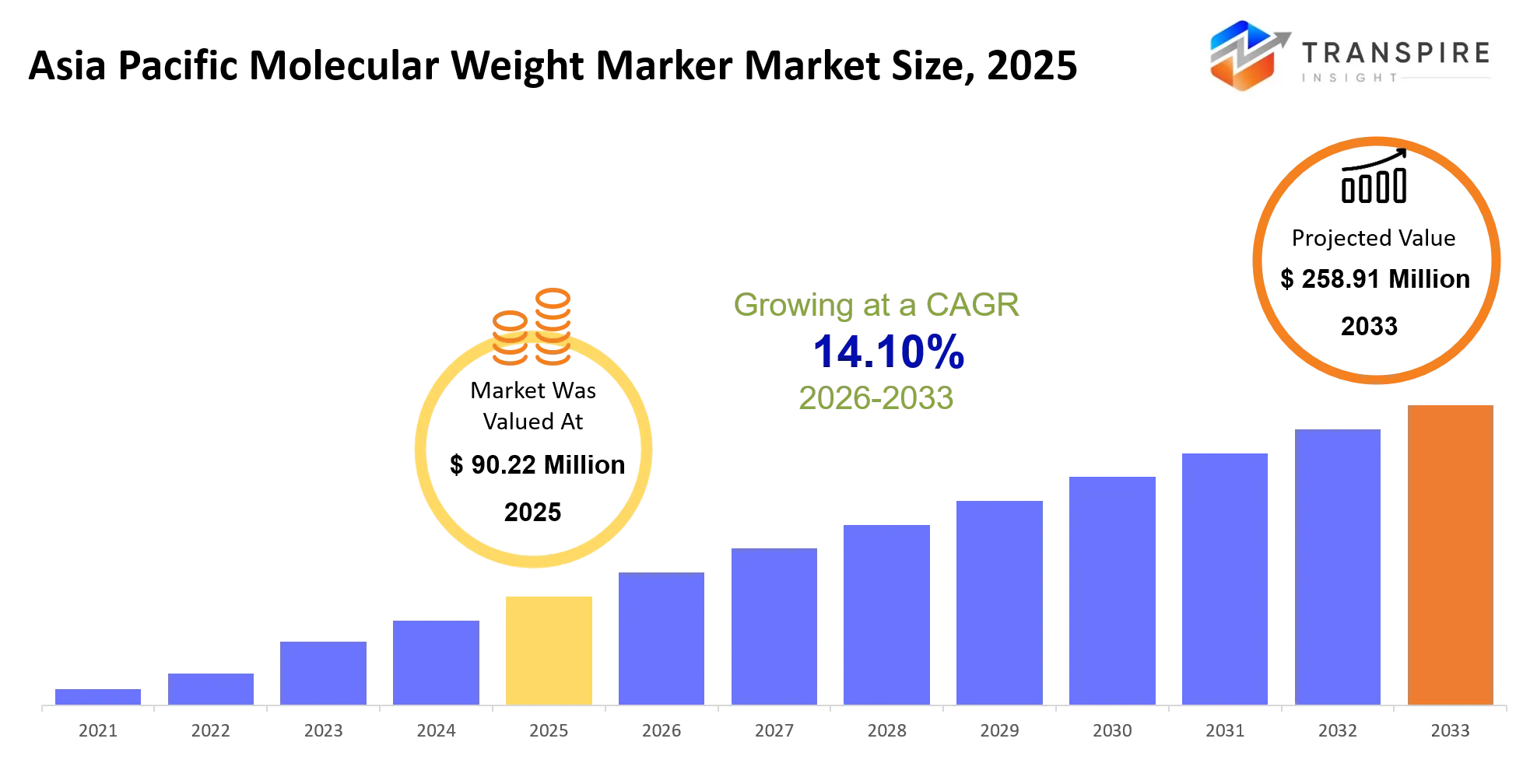
- Asia Pacific Molecular Weight Marker Market Size 2025: USD 90.22 Million
- Asia Pacific Molecular Weight Marker Market Size 2033: USD 258.91 Million
- Asia Pacific Molecular Weight Marker Market CAGR: 14.10%
- Asia Pacific Molecular Weight Marker Market Segments: By Type (DNA Markers, RNA Markers, Protein Markers, Prestained Markers, Unstained Markers, Fluorescent Markers, Others); By Application (PCR, Gel Electrophoresis, Sequencing, Cloning, Proteomics, Genomics, Others); By End User (Research Institutes, Pharmaceutical Companies, Biotechnology Companies, Academic Labs, Diagnostic Labs, Others); By Product Format (Ready-to-Use, Concentrated, Lyophilized, Others)
To learn more about this report,  Download Free Sample Report
Asia Pacific Molecular Weight Marker Market Summary
The Asia Pacific Molecular Weight Marker Market was valued at USD 90.22 Million in 2025. It is forecast to reach USD 258.91 Million by 2033. That is a CAGR of 14.10% over the period.
Molecular weight markers are sort of the quiet backbone in a lot of labs, they help people figure out the size of DNA, RNA, and protein fragments while doing electrophoresis runs. In practice, these markers work like reference standards, so researchers can compare their samples with known bands, and then get more accurate measurements during the workflow. They also pop up in genetic research, clinical diagnostics, pharmaceutical development, and yes, even in biotechnology quality control, where consistency really counts and matters. For labs across the Asia Pacific, where genomic and proteomic data is being processed in larger and larger volumes, dependable molecular weight markers now feel pretty essential, mainly to keep experimental results reproducible and validated.
In the past five years, the whole market picture has shifted in a noticeable way, more toward precision genomics and more automated laboratory workflows. With the rise of next generation sequencing, plus cell and gene therapy studies, and newer molecular diagnostics, the demand keeps moving toward high performance marker products that can work with advanced analytical platforms. Then COVID-19 sort of acted as a large push, speeding up investments in molecular testing infrastructure and lab modernization across places like China, India, Japan, and South Korea. That wave of spending didn’t just add short term capacity, it expanded overall lab output, strengthened research capability, and also generated ongoing demand for consumables including molecular weight markers. Now, as research institutions and diagnostic labs keep scaling up, those repeat purchases of markers are turning into steadier revenue growth throughout the region.
Key Market Insights
- Asia Pacific Molecular Weight Marker Market revenue is expected to nearly triple from 2025 to 2033, with strong biotech and life science investments behind it , though you can feel the pace is quickening.
- In 2025 , China still leads the regional landscape, holding about 35% market share, mainly because of large scale genomics programs and steady research funding that never really slows down.
- India, on the other hand , looks like the fastest-moving regional market through 2033, driven by more diagnostic lab networks and a growing wave of biotechnology startups, kind of like a chain reaction.
- In terms of product type, DNA ladder items take up nearly 45% of total market share. This happens mostly because they’re broadly used across PCR and sequencing workflows, pretty much everywhere the basics still matter.
- Protein markers come next as the second-largest segment , supported by pharmaceutical research efforts and biologics development activities that keep expanding.
- As for products, prestained molecular weight markers are projected to be the fastest-growing category through 2033, largely due to workflow efficiency advantages, so labs don’t waste as much time.
- When it comes to end users , research laboratories contribute over 40% of market revenue, meaning they’re the largest end user group.
- For application trends, clinical diagnostics is emerging as the quickest expanding application segment as molecular testing gets more integrated into healthcare systems.
- Major players, like Thermo Fisher Scientific, Bio-Rad, Merck, QIAGEN, and Agilent Technologies, are leaning into portfolio expansion and laboratory automation, not just selling markers but trying to sell a whole approach.
- More importantly, companies are also sharpening their competitive stance via advanced marker formulations, regional distribution collaborations, digital laboratory integration, and genomics-centric product innovation, which sounds simple but it’s really a multi-layer strategy.
What are the Key Drivers, Restraints, and Opportunities in the Asia Pacific Molecular Weight Marker Market?
The strongest force driving market expansion is basically the rapid uptake of molecular biology methods across research, pharmaceutical, and clinical settings ,and somehow this keeps snowballing. Government supported genomics programs, falling sequencing costs , and more capital poured into biotechnology facilities have expanded lab testing volumes by a lot. When more institutions start doing PCR, electrophoresis, sequencing validation, and protein analysis more often, the use of molecular weight markers goes up in step. That also means recurring revenue, because these markers are consumables ,theyre needed in normal laboratory operations, kind of like everyday necessities rather than optional gear.
The biggest brake on growth is that advanced laboratory infrastructure is not evenly spread across developing Asia Pacific economies. High-end molecular research spaces need specialized equipment, trained scientists, and quality assurance systems, and all of that comes with significant upfront capital expenditure. This kind of structural limitation can’t be fixed overnight either , because lab maturity depends on sustained investments in education, physical infrastructure, and regulatory frameworks. So, adoption tends to stay clustered in major urban research centers. This naturally restricts broader market penetration, and it can slow revenue expansion in less developed regions within those emerging markets.
One major future opening comes from precision medicine, plus cell and gene therapy development. In places like China, Japan, South Korea, and Singapore, investment in next generation treatments and genomic healthcare is increasing. These directions need careful nucleic acid and protein characterization, and that pushes demand toward very specialized molecular weight markers.
What Has the Impact of Artificial Intelligence Been on the Asia Pacific Molecular Weight Marker Market?
Artificial intelligence is a kind of reshaping laboratory operations tied to molecular biology workflows across Asia Pacific, and it is not subtle. More and more modern labs are now leaning on AI powered image analysis software. It helps interpret electrophoresis gels, sort of automate band detection,and it also boosts how accurately fragment size gets estimated. With these tools, labs see fewer manual interpretation mistakes, plus they can push samples through faster in both research settings and diagnostic environments.
At the same time machine learning algorithms are being folded into lab information management systems. The idea is to anticipate reagent consumption, steer inventory management, and generally tune workflow scheduling. In pharma and biotech facilities, predictive analytics can also flag instrument maintenance needs ahead of time, before a failure really shows up. That reduces downtime and supports day to day operational efficiency. On top of that, AI assisted quality control systems are able to spot odd patterns in electrophoresis results quickly, so labs can cut down repeat testing and still keep up with regulatory expectations.
So overall the outcome is faster sample processing, better lab productivity, stronger data consistency, and lower operational costs. These advantages hit especially hard in high volume genomics and proteomics labs, where thousands of samples are handled every year.
Still, AI adoption has limitations, and some of them are stubborn. A lot of labs do not yet have standardized datasets, which makes it hard to train reliable models. Integration costs are another issue, particularly for smaller institutions. Also, protocol differences between labs, variations in imaging conditions,and equipment configurations can all make model accuracy drift. In practice this becomes a hurdle for rolling out AI broadly across very different laboratory environments.
Key Market Trends
- Since 2021, genomics research funding across the big Asian economies has, you know, expanded a lot , so adoption of DNA ladder products has moved out of niche use and into broader lab routines.
- Prestained protein markers have seen something like over 20% more lab penetration since 2020, mostly because workflow visibility got better, and it’s just easier to follow what’s happening in the run.
- Pharmaceutical companies are increasingly choosing high resolution markers. This is tied to biologics and biosimilar development programs that are ramping up across Asia , faster than before.
- Automation in research laboratories rose by about 30% between 2021 and 2025. That has improved electrophoresis workflow efficiency in a way people can actually notice.
- Since the pandemic, clinical diagnostic labs have accelerated investments in molecular testing capacity, which then creates fresh and recurring demand for consumables that keep getting used.
- Manufacturers are moving toward ready to use marker formulations, because they cut down preparation time, and they also reduce handling errors , even when teams are busy.
- Firms like Thermo Fisher Scientific and Bio-Rad have broadened genomics oriented product portfolios. The goal is to support advanced sequencing workflows, without forcing labs to constantly retool.
- Regional biotechnology startups are also increasingly sourcing premium grade molecular markers for cell therapy and gene editing use cases , not just basic research.
- Strategic collaborations between diagnostics providers and research institutions have tightened up. In practice it helps product validation and commercialization pathways move along more smoothly.
- Digital laboratory management systems are showing up more often, and they support integrated quality control along with reagent tracking practices , which keeps things aligned across teams.
Asia Pacific Molecular Weight Marker Market Segmentation
By Type
The type segment kinda shows the different molecular weight marker products that get used across life science research, diagnostics and biotechnology activities, and honestly it’s not just one niche. DNA Markers make up a substantial share because accurate DNA fragment sizing is still essential for genetic analysis, PCR validation, and also a lot of molecular biology studies. Keeping the use of electrophoresis techniques consistent across labs is still helping, and that continues to support demand for these products.
RNA Markers back RNA analysis workflows and they help researchers check transcript size as well as integrity during gene expression studies. Protein Markers stay important for protein separation and characterization procedures, especially in pharmaceutical and biotechnology research. Prestained Markers tend to gain preference because visible tracking during electrophoresis boosts workflow efficiency and makes result interpretation a bit easier. Unstained Markers keep getting used in applications where flexible staining methods are needed after separation, so they’re more adaptable. Fluorescent Markers support advanced detection systems, with enhanced sensitivity and accuracy, and that’s why many teams like them. Others include specialized marker products that are built for particular laboratory and research requirements.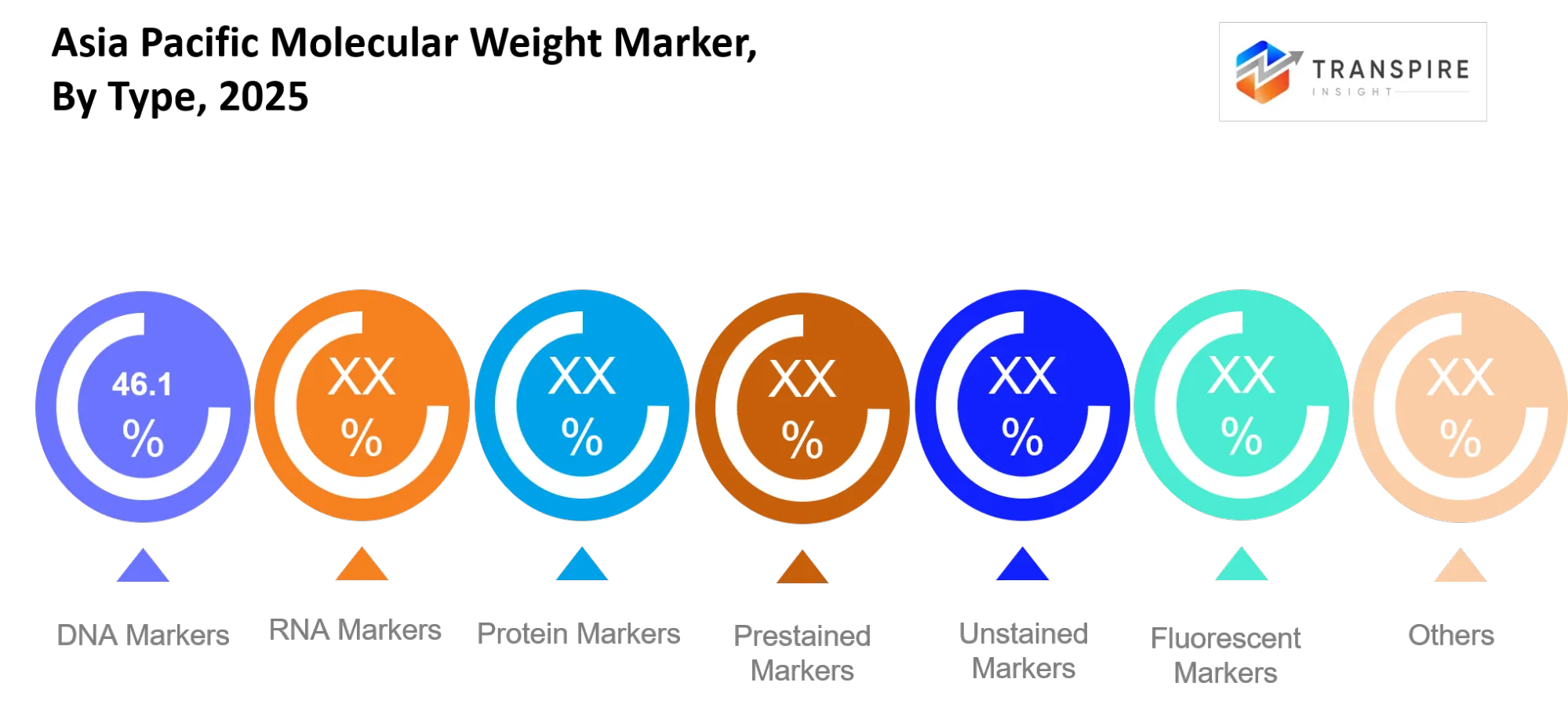
To learn more about this report, Download Free Sample Report
By Application
The application segment shows a sort of wide spread use of molecular weight markers across molecular biology, biotechnology, and even diagnostic workflows. PCR feels like a major application here because fragment checking and amplification assessment are still pretty critical steps in genetic testing ,and research work. In practice laboratories lean on these molecular markers to help confirm experimental accuracy, and also to keep those quality standards steady.
Gel Electrophoresis keeps pulling in solid demand since molecular weight markers work as handy reference tools for figuring out fragment size, more or less. Sequencing uses markers too, mainly to support sample preparation and validation activities prior to the real analysis. Cloning processes also depend on accurate fragment identification, which is what lets genetic manipulation work out and helps with construct development. In proteomics, molecular markers are used for protein separation and characterization ,so the study results stay interpretable. For genomics research, the utilization is extensive because of big scale genetic analysis and sequencing programs. Then there are others—more specialized laboratory applications—where molecular sizing and analytical verification are basically required before moving on.
By End User
That end user segment kind of mirrors the broad set of orgs that are using molecular weight markers in everyday research , testing, and development tasks. Research Institutes are a big slice here, since scientific investigations often need dependable nucleic acid together with protein evaluation. Ongoing funding in biological research programs helps keep product use consistent across this area .
Pharmaceutical Companies lean on molecular weight markers while doing drug discovery, development and also quality control work. Biotechnology Companies keep strong demand going via genetic engineering, cell biology, and more advanced therapeutic research efforts. Academic Labs show up as a meaningful contributor through educational research initiatives and hands-on scientific training activities . Diagnostic Labs use these molecular markers to improve testing accuracy and also make sure results are validated correctly in clinical routines. Others, like contract research organizations, industrial laboratories, and specialized testing facilities , all need trustworthy molecular analysis tools.
By Product Format
The product format segment kind of shows the different packaging and preparation options that laboratories can use, depending on workflow needs and storage preferences. Ready-to-Use products keep getting strong adoption because they are immediately usable, so prep time drops a bit and it feels more convenient day to day. Research plus diagnostic facilities usually pick these formats too, mainly to fit high throughput lab environments.
Concentrated formats give more room, since labs can make their own working solutions that match very specific experimental requirements. Lyophilized products also get noticed because the long shelf life and better storage stability make long-term inventory management way easier. On top of that, these formats help with transportation too, and they lower the risks connected to product breakdown during storage. Other options include specialized formulations developed for odd or unique laboratory protocols, for advanced analytical systems, and for certain research purposes that need customized performance characteristics.
What are the Key Use Cases Driving the Asia Pacific Molecular Weight Marker Market?
The main thing people use molecular weight markers for is nucleic acid work, especially in genomics and other molecular biology labs. When researchers run gel electrophoresis they rely on these markers, to check DNA piece sizes and to confirm PCR products , plus they help along with sequencing prep steps. That particular use case has the strongest demand because it sits at the center of everyday genetic research and also molecular diagnostics.
Outside of the “core” research environment, molecular weight markers are now showing up more often in pharma development and in biotech manufacturing. Protein characterization, biologics development, and quality assurance testing all need dependable molecular size readings. So contract research organizations, alongside biopharmaceutical companies, have become key buyers as these uses keep broadening.
More recently people are also pushing into cell and gene therapy development, synthetic biology , and precision medicine programs that are more advanced. These efforts need very accurate nucleic acid and protein analysis, which makes room for niche marker products. In practice it means markers built for next generation lab workflows and high sensitivity analytical methods.
|
Report Metrics |
Details |
|
Market size value in 2025 |
USD 90.22 Million |
|
Market size value in 2026 |
USD 102.82 Million |
|
Revenue forecast in 2033 |
USD 258.91 Million |
|
Growth rate |
CAGR of 14.10% from 2026 to 2033 |
|
Base year |
2025 |
|
Historical data |
2021 - 2024 |
|
Forecast period |
2026 - 2033 |
|
Report coverage |
Revenue forecast, competitive landscape, growth factors, and trends |
|
Regional scope |
Asia Pacific (India, China, Japan, Australia, South Korea, Rest of Asia Pacific) |
|
Key company profiled |
Thermo Fisher Scientific, Bio-Rad, Merck, Agilent Technologies, Takara Bio, New England Biolabs, Promega, QIAGEN, GenScript, Lonza, Cytiva, HiMedia, Roche, BioLabs, Santa Cruz Biotechnology |
|
Customization scope |
Free report customization (country, regional & segment scope). Avail customized purchase options to meet your exact research needs. |
|
Report Segmentation |
By Type (DNA Markers, RNA Markers, Protein Markers, Prestained Markers, Unstained Markers, Fluorescent Markers, Others); By Application (PCR, Gel Electrophoresis, Sequencing, Cloning, Proteomics, Genomics, Others); By End User (Research Institutes, Pharmaceutical Companies, Biotechnology Companies, Academic Labs, Diagnostic Labs, Others); By Product Format (Ready-to-Use, Concentrated, Lyophilized, Others) |
Which Regions are Driving the Asia Pacific Molecular Weight Marker Market Growth?
China still looks like the main regional player, mostly because it is putting a lot of money into biotechnology, plus it has this huge academic research scene, and also a pretty deep genomics setup. With government backing for life science innovation, labs keep growing quicker and the research work has moved ahead, so everything kind of feeds the cycle. On top of that, there’s a solid domestic manufacturing network, which helps produce scientific consumables without too many gaps. Altogether, these pieces keep China in a leadership role in the region.
Japan sits as the second-largest contributor, and it feels a bit different than China. Japan leans more toward high-value research, pharmaceutical innovation, and advanced healthcare use cases. The biotechnology sector there is more established, so it creates relatively stable demand for top-tier molecular biology products. They also have solid regulatory structures, plus ongoing spending on research, which keeps the market steadier over time. Japanese labs tend to run with high expectations for analytical precision and product reliability, which supports that reputation.
India, meanwhile, is coming in as the fastest-growing market across the forecast window. A lot of the recent momentum seems tied to more biotechnology startups, more genomic study programs, and bigger investments in diagnostic infrastructure. Government programs that push biotech innovation have also made the research ecosystem stronger. For investors and suppliers, India is becoming a serious opportunity for expansion between 2026 and 2033, mainly since lab capacity keeps on rising and more projects are getting funded.
Who are the Key Players in the Asia Pacific Molecular Weight Marker Market and How Do They Compete?
In the Asia Pacific molecular weight marker market competition is kinda moderately consolidated, with the big global life science players taking sizeable market shares, and then the regional suppliers try to stay competitive mostly via pricing, and more localised distribution. People still buy based on product quality , analytical accuracy, how well it works with more advanced workflows, plus the level of technical support. Lately innovation is becoming a big deal for competitive positioning, because labs are now using more sophisticated genomic and proteomic techniques, and they want everything to keep up.
Thermo Fisher Scientific kind of stands out by offering a broad portfolio for molecular biology, and also by fitting smoothly into automated laboratory platforms. Their approach is about making the workflow simpler and keeping things compatible across different genomics applications. Bio-Rad competes using deep electrophoresis know-how, and a wide range of marker products for both research setups, and clinical environments. The company’s strong footprint in protein analysis is, in practice, an important edge.
QIAGEN leans on its molecular diagnostics strengths, and its genomic workflow experience, to build integrated solutions that go beyond just consumables. Merck emphasizes premium lab reagents and high-performance research products, while Takara Bio has that solid position in Asia using specialized molecular biology solutions. All these players keep expanding through product innovation, strategic collaborations, improved automation capabilities, and they keep building out their regional distribution network, in a pretty steady way.
Company List
- Thermo Fisher Scientific
- Bio-Rad
- Merck
- Agilent Technologies
- Takara Bio
- New England Biolabs
- Promega
- QIAGEN
- GenScript
- Lonza
- Cytiva
- HiMedia
- Roche
- BioLabs
- Santa Cruz Biotechnology
Recent Development News
In November 2025, QIAGEN unveiled QIAsymphony Connect, a next-generation automated nucleic acid purification platform. The launch strengthens laboratory automation capabilities and supports higher-throughput genomic workflows across research and diagnostics markets.https://corporate.qiagen.com
What Strategic Insights Define the Future of the Asia Pacific Molecular Weight Marker Market?
The Asia Pacific molecular weight marker market is heading somewhere that feels like it’s being pushed by precision medicine, genomics-fueled care, and lab environments that are getting more automated day by day. I mean, the real driver is the need for molecular analysis that stays highly reproducible across research work, diagnostics , and even advanced therapeutics. As labs start handling bigger datasets and more tangled biological specimens, the demand is likely to tilt toward premium markers that are better at accuracy, steadiness, and overall fit with day-to-day workflows.
There is also a quieter danger, more like a market that could become too clustered around just a few major global suppliers. If supply chains get disrupted, if raw materials get tight, or if manufacturing bottlenecks hit, product availability and pricing could shift across the whole region. Yet at the same time, there’s an opening that’s starting to show up in cell and gene therapy production, where specialized molecular profiling tools matter a lot for quality control plus regulatory checks.
For companies in this space, the practical move is to pour effort into high-performance marker solutions that slot in smoothly with automated , digital lab systems. And while doing that, it helps to strengthen regional manufacturing and distribution networks so the region can stay resilient and respond faster to customers.
Asia Pacific Molecular Weight Marker Market Report Segmentation
By Type
- DNA Markers
- RNA Markers
- Protein Markers
- Prestained Markers
- Unstained Markers
- Fluorescent Markers
- Others
By Application
- PCR
- Gel Electrophoresis
- Sequencing
- Cloning
- Proteomics
- Genomics
- Others
By End User
- Research Institutes
- Pharmaceutical Companies
- Biotechnology Companies
- Academic Labs
- Diagnostic Labs
- Others
By Product Format
- Ready-to-Use
- Concentrated
- Lyophilized
- Others
Frequently Asked Questions
Find quick answers to common questions.
The Expected Asia Pacific Molecular Weight Marker Market size for the Market will be USD 258.91 Million in 2033.
Key Segments for the Asia Pacific Molecular Weight Marker Market are By Type (DNA Markers, RNA Markers, Protein Markers, Prestained Markers, Unstained Markers, Fluorescent Markers, Others); By Application (PCR, Gel Electrophoresis, Sequencing, Cloning, Proteomics, Genomics, Others); By End User (Research Institutes, Pharmaceutical Companies, Biotechnology Companies, Academic Labs, Diagnostic Labs, Others); By Product Format (Ready-to-Use, Concentrated, Lyophilized, Others).
Major Asia Pacific Molecular Weight Marker Market Players are Thermo Fisher Scientific, Bio-Rad, Merck, Agilent Technologies, Takara Bio, New England Biolabs, Promega, QIAGEN, GenScript, Lonza, Cytiva, HiMedia, Roche, BioLabs, Santa Cruz Biotechnology.
The Current Asia Pacific Molecular Weight Marker Market size is USD 90.22 Million in 2025.
The Asia Pacific Molecular Weight Marker Market CAGR is 14.10% from 2026 to 2033.
- Thermo Fisher Scientific
- Bio-Rad
- Merck
- Agilent Technologies
- Takara Bio
- New England Biolabs
- Promega
- QIAGEN
- GenScript
- Lonza
- Cytiva
- HiMedia
- Roche
- BioLabs
- Santa Cruz Biotechnology
About the Authors

Pankaj Ghogare Patil
I am Pankaj Ghogare Patil, a Senior Research Analyst at Transpire Insight, specializing in the Pharmaceutical, Chemicals & Materials, Healthcare IT, and Biotechnology industry. My expertise lies in conducting comprehensive market research, analyzing industry trends, evaluating competitive landscapes, and translating complex data into actionable insights. At Transpire Insight, I closely follow emerging technologies, regulatory developments, and market innovations to create accurate, well-researched, and informative content that helps businesses and professionals make informed decisions. I am committed to producing credible, evidence-based articles that reflect industry best practices while making technical topics accessible and valuable for a broad audience.

Chakradhar Khansole
Chakradhar serves as the Research Director at Transpire Insight, bringing over 8 years of experience in technology, innovation, and strategic market intelligence. He specializes in transforming complex market data into actionable business insights that enable organizations to make informed, growth-oriented decisions. Recognized for his strategic vision and analytical expertise, Chakradhar leads high-impact research initiatives, delivering comprehensive market assessments, competitive intelligence, and forward-looking industry analysis.
Recently Published Reports
-
Apr 2026
Cord Blood Banking Services Market
Cord Blood Banking Services Market Size, Share & Analysis Report By Type of Service (Collection, Processing, Storage), By Bank Type (Private Banks, Public Banks, and Hybrid Banks), By Component (Cord Blood, and Cord Tissue), By End User (Hospitals, Research Institutions, Biotechnology Companies, and Others) and Geography (North America, Europe, Asia-Pacific, Middle East and Africa, South and Central America), 2021 - 2031
-
Apr 2026
ELISA Processors Market
ELISA Processors Market Size, Share & Analysis Report By Type (Optical Filter ELISA Analyzer, and Optical Grating ELISA Analyzers), By Mode (Automated ELISA Analyzers, and Semi-Automated ELISA Analyzers), By Applications (Immunology, Vaccine development, Drug Monitoring, and Others), By End Users (Biotechnology Companies, Pharmaceutical Companies, Contract Research Organization, and Diagnostic Laboratories) and Geography (North America, Europe, Asia-Pacific, Middle East and Africa, South and Central America), 2021 - 2031
-
May 2026
Microscope Slide Scanner Market
Microscope Slide Scanner Market Size, Share & Analysis Report By Type (Portable Microscope Slide Scanner, and Desktop Microscope Slide Scanner), By Application (Biological Research, Medicine, Veterinary, and Other) and Geography (North America, Europe, Asia-Pacific, Middle East and Africa, South and Central America), 2021 - 2031
-
Apr 2026
Microwave Cookware Market
Microwave Cookware Market Size, Share & Analysis Report By Material Type (Plastic, Glass, Ceramic, Silicone, and Metal), By Application (Cooking, Reheating, and Defrosting), By End User (Household, Commercial (Restaurants, Hotels, and Cafes), and Food Service Industry), By Sales Channel (Online Retail, Offline Retail (Supermarkets, Hypermarkets, Specialty Stores), and Direct Sales (Company Outlets)) and Geography (North America, Europe, Asia-Pacific, Middle East and Africa, South and Central America), 2021 - 2031