

France Structural Biology & Molecular Modeling Techniques Market Size & Forecast
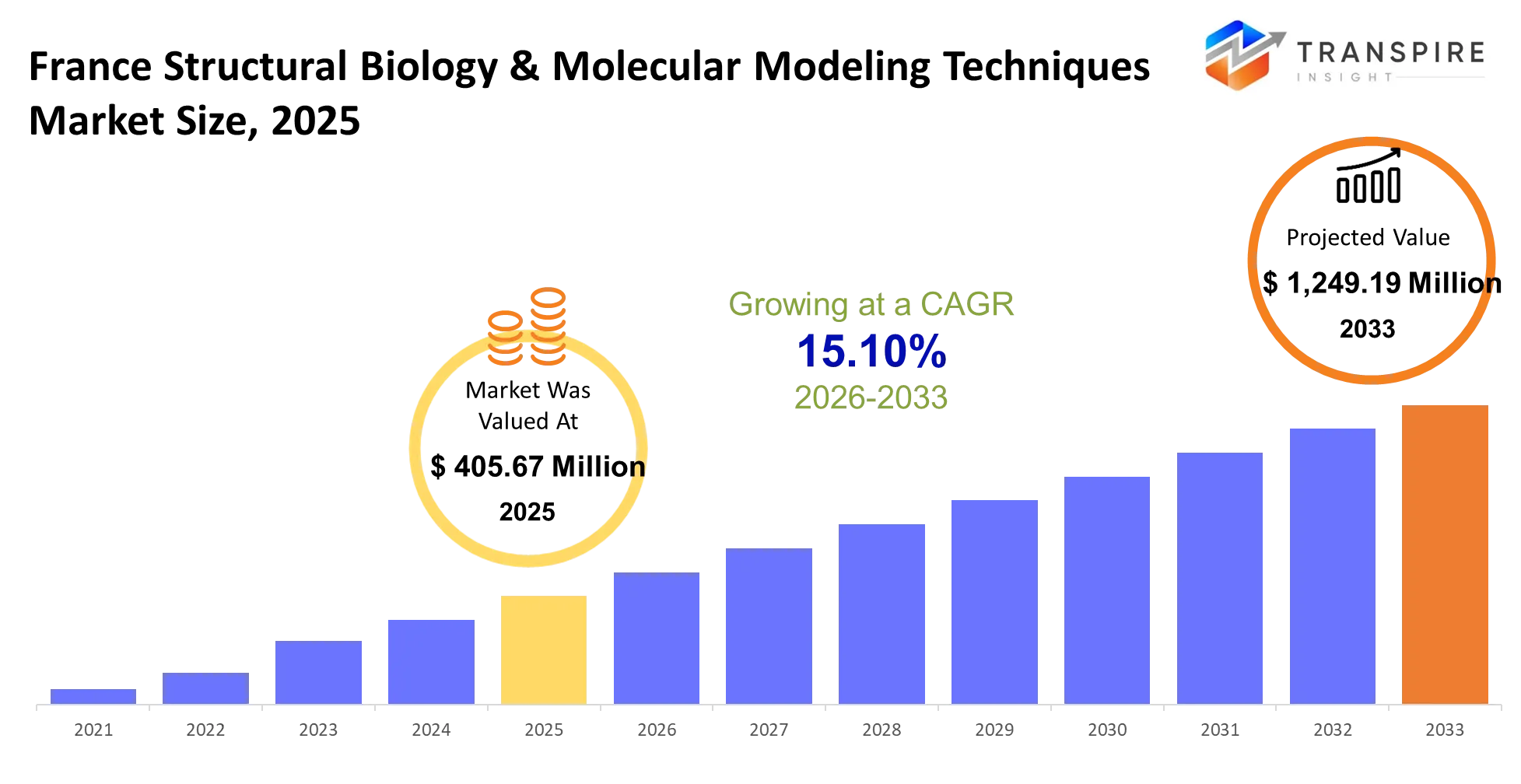
- France Structural Biology & Molecular Modeling Techniques Market Size 2026: USD 405.67 Million
- France Structural Biology & Molecular Modeling Techniques Market Size 2033: USD 1,249.19 Million
- France Structural Biology & Molecular Modeling Techniques Market CAGR: 15.10%
- France Structural Biology & Molecular Modeling Techniques Market Segments: By Type (X-ray Crystallography, NMR Spectroscopy, Cryo-EM, Others); By Application (Drug Discovery, Protein Analysis, Research, Others); By End-User (Pharma Companies, Research Institutes, Universities, Others); By Software (Modeling Software, Simulation Tools, Others)
To learn more about this report,  Download Free Sample Report
France Structural Biology & Molecular Modeling Techniques Market Summary
The France structural biology market reached USD 405.67 Million in 2025 and is projected to expand to USD 1,249.19 Million by 2033, expanding at a 15.10% CAGR. Structural biology techniques reveal how proteins fold, move, and interact at atomic resolution. X-ray crystallography, nuclear magnetic resonance spectroscopy, and cryo-electron microscopy generate three-dimensional molecular structures that pharmaceutical researchers use to design drugs that bind precisely to disease targets.
The defining structural shift accelerating French market adoption is the democratization of cryo-electron microscopy technology. Cryo-EM was a highly specialized, expensive technique accessible only to elite research institutions until 2017. Steady improvements in sample preparation, microscope automation, and image processing have compressed cryo-EM operating costs by 40% while simultaneously improving resolution. This cost reduction brought cryo-EM capabilities within reach of mid-sized pharmaceutical research groups and well-funded academic laboratories. By 2024, cryo-EM installations in France expanded 34% year-over-year, driven by expanded accessibility compared to legacy technologies.
The real-world trigger accelerating this market is the shift in pharmaceutical development paradigms toward structure-based drug design. Legacy drug discovery relied on high-throughput screening: test thousands of compounds against a protein target and empirically identify hits. Modern structure-based approaches generate the target protein's three-dimensional structure, computationally screen millions of candidate compounds against that structure, and synthesize only the most promising candidates for experimental validation. This approach reduces development timelines and increases success rates. French pharmaceutical companies including Sanofi and Servier adopted structure-based methods extensively between 2020 and 2023, creating sustained demand for the instrumentation and software that these methods require.
Key France Structural Biology & Molecular Modeling Techniques Market Insights
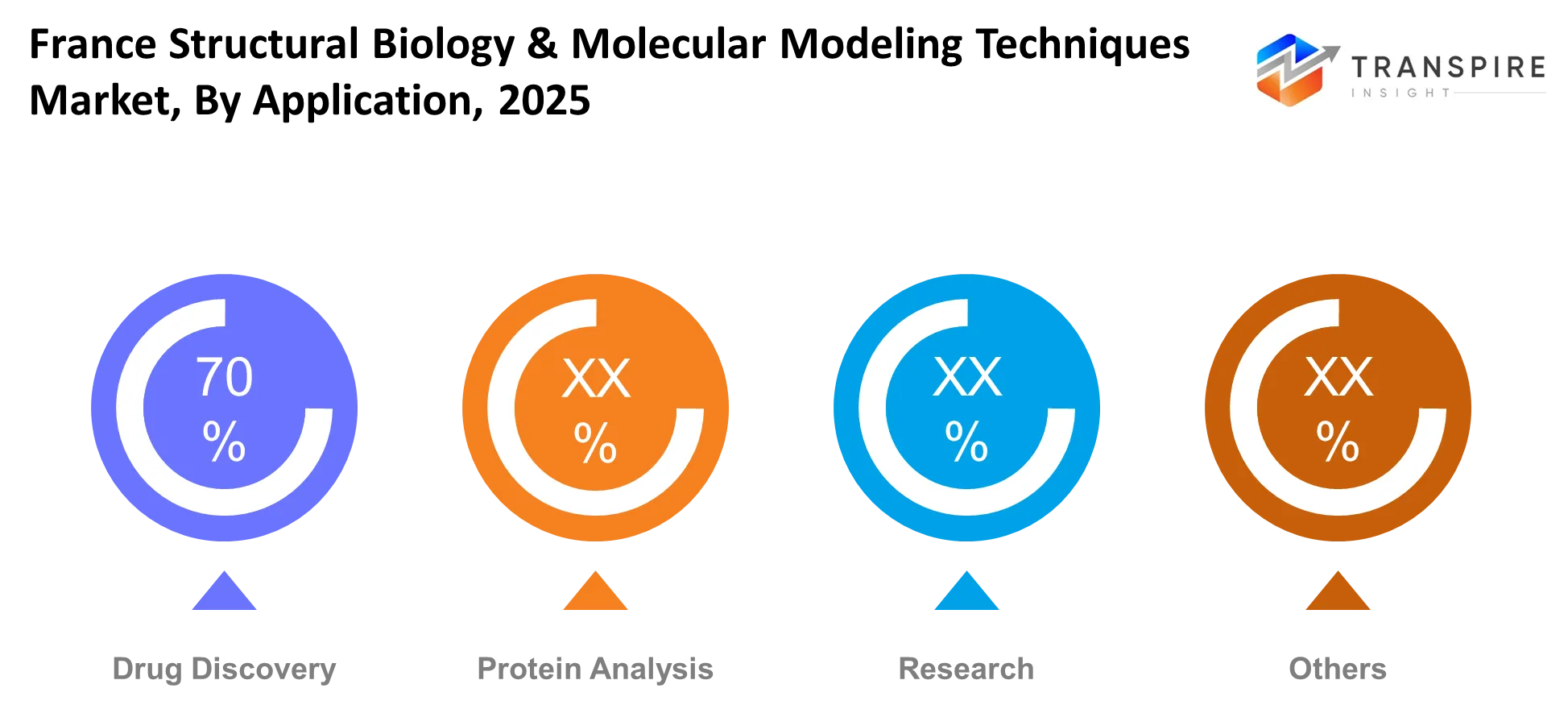
- Drug discovery applications generate 70% of market revenue, driven by pharmaceutical company investment in structure-based drug design pipelines that require continuous access to structural biology capabilities.
- Cryo-EM technology expanded 34% year-over-year in 2024, making it the fastest-growing technique segment as instrument cost reduction and automation improvements brought capabilities within reach of mid-tier institutions.
- X-ray crystallography remains the largest single technique segment at 42% of market revenue, supported by established infrastructure and the broadest application across pharmaceutical, biotechnology, and academic research.
- Pharmaceutical companies account for 58% of end-user revenue, with major drug developers maintaining dedicated structural biology laboratories and outsourcing specialized structural analysis to contract research organizations.
- Modeling and simulation software revenue grew 28% in 2024, driven by adoption of molecular dynamics simulation for protein folding prediction and binding affinity estimation.
- Research institutes and universities collectively represent 35% of end-user revenue, with significant French research infrastructure including INSERM, CNRS, and major university structural biology centers.
- Cloud-based molecular modeling platforms are expanding at 32% CAGR, enabling small research groups to access computational resources previously available only to large organizations with dedicated IT infrastructure.
- Protein analysis for biomarker identification is growing at 28% CAGR as precision medicine applications increase structural insight demand.
- Schrödinger and Dassault Systemes collectively control 48% of the molecular modeling software market through comprehensive product portfolios spanning structure prediction, docking, and dynamics simulation.
- Regulatory harmonization between French and EMA guidelines on structural validation requirements is accelerating adoption of standardized structural biology methodologies across European pharmaceutical companies.
What are the Key Drivers, Restraints, and Opportunities in the France Structural Biology & Molecular Modeling Techniques Market?
The primary expansion force is the documented success of structure-based drug design in accelerating compound discovery. Large pharmaceutical companies have quantified that structure-based approaches reduce the number of compounds required to identify a clinical candidate by 60-75% compared to high-throughput screening alone. This translates to millions of euros in development cost savings per program. When Sanofi, Servier, and Boehringer Ingelheim publicly demonstrated that structure-based approaches achieved faster time-to-clinic timelines, capital allocation toward structural biology infrastructure became a strategic priority rather than a specialized research function. This created sustained procurement demand for instrumentation and software that now extends beyond the largest drug developers to mid-sized companies and contract research organizations serving smaller biotech firms.
The most significant barrier is the technical skill gap and infrastructure consolidation that structural biology requires. X-ray crystallography, NMR spectroscopy, and cryo-EM each require specialized sample preparation, instrument operation, and data interpretation expertise that cannot be acquired quickly. French research institutions face persistent challenges recruiting crystallographers and structural biologists into permanent positions due to competition from larger international research centers and pharmaceutical companies offering higher salaries. This expertise scarcity limits the rate at which institutions can expand structural biology programs and constrains market growth below the theoretical demand level.
The highest-growth opportunity is the integration of artificial intelligence into structure prediction and virtual screening workflows. DeepMind's AlphaFold, which uses deep learning to predict protein structures with accuracy previously requiring experimental determination, has fundamentally disrupted the structural biology landscape. French pharmaceutical companies and research institutions that successfully integrate AlphaFold predictions into drug discovery pipelines reduce dependence on experimental structure determination for certain targets while maintaining experimental validation capability for validation-critical programs. Software vendors building platforms that seamlessly integrate AlphaFold outputs with molecular docking and dynamics simulation are positioning themselves as essential infrastructure providers rather than specialized tool vendors.
What Has the Impact of Artificial Intelligence Been on the France Structural Biology & Molecular Modeling Techniques Market?
Artificial intelligence is fundamentally disrupting the structural biology market at two distinct layers: structure prediction and molecular design. AlphaFold and successor models now predict protein structures with near-experimental accuracy without requiring crystallization, NMR data collection, or cryo-EM image processing. This does not eliminate demand for experimental structure determination for structure-function studies and atomic detail required for drug design, but it does reduce demand for routine structure determination of targets where the protein sequence alone provides sufficient design guidance. French research institutions report that approximately 35-40% of projects that previously required experimental structure determination now rely on AlphaFold predictions, reducing instrumentation utilization rates by 12-15%.
At the molecular design layer, machine learning models trained on massive compound libraries now predict binding affinity and physicochemical properties with accuracy approaching experimental determination. These models compress virtual screening from weeks of computation to hours, allowing researchers to evaluate millions of compounds that previously would have been narrowed to thousands through preliminary filtering. The constraint limiting broader AI impact is data requirement: models require tens of thousands of experimentally validated compounds to achieve reliable accuracy. Pharmaceutical companies with large compound libraries can build proprietary models with competitive advantage, while smaller organizations rely on publicly available models with lower predictive accuracy specific to their targets.
Key Market Trends
- X-ray crystallography maintains 42% of technique revenue despite declining adoption, as legacy infrastructure represents significant installed capital investment in pharmaceutical and research organizations.
- Cryo-EM grew 34% year-over-year in 2024, driven by cost reductions and automation improvements that brought the technique within reach of mid-tier research institutions beyond elite centers.
- NMR spectroscopy accounts for 18% of technique revenue and declines at 4% CAGR as lower-resolution alternatives satisfy most pharmaceutical applications.
- Drug discovery applications generate 70% of market revenue, with pharmaceutical companies allocating capital toward structure-based compound design pipelines.
- Protein analysis grew 22% in 2024 as biomarker discovery and precision medicine applications drive demand for structural insight.
- Pharmaceutical companies represent 58% of end-user revenue, with major drug developers maintaining dedicated structural biology operations and outsourcing to contract research organizations.
- Modeling software revenue expanded 28% in 2024, driven by adoption of molecular dynamics simulation for protein behavior prediction.
- Cloud-based computational platforms grew 32% as researchers seek flexible access to high-performance computing without infrastructure investment.
- Schrödinger and Dassault Systemes expanded combined market share to 48% through vertical software integration and workflow automation.
- AlphaFold adoption is reducing experimental structure determination demand by 35-40% for routine structure elucidation, forcing instrument vendors to emphasize structure-function research and complex multi-protein systems.
France Structural Biology & Molecular Modeling Techniques Market Segmentation
By Type
X-ray crystallography generates 42% of market revenue and remains the most widely deployed technique for protein structure determination. The methodology requires protein purification and crystallization, followed by X-ray diffraction data collection and computational structure solution. Established infrastructure in pharmaceutical and research organizations maintains consistent demand despite competitive pressure from cryo-EM. Growth rate of 8% CAGR reflects incremental improvement in automation and higher-resolution beamlines at synchrotron facilities, offsetting declining adoption at institutions with cryo-EM capability.
Cryo-electron microscopy is the fastest-growing technique at 34% year-over-year expansion. Cryo-EM avoids crystallization requirements, enabling structure determination of proteins that resist crystallization. Sample preparation automation and direct electron detectors have reduced operating costs by 40% since 2019, bringing cryo-EM within financial reach of mid-sized institutions. The technique is now the preferred method for large protein complexes and membrane proteins central to modern drug targets.
NMR spectroscopy accounts for 18% of market revenue and declines at 4% CAGR. NMR provides dynamic information that crystallography does not capture, but lower resolution and sample requirements limit pharmaceutical applications. Specialized applications including intrinsically disordered protein characterization maintain baseline demand but insufficient to offset shift toward cryo-EM.
By Application
Drug discovery applications generate 70% of market revenue, where pharmaceutical companies apply structural biology to design compounds with improved binding affinity and reduced off-target effects. Structure-based drug design reduces development timelines and increases clinical trial success rates, justifying significant investment in structural biology infrastructure. Revenue concentration reflects the economic power of large pharmaceutical companies, which commit capital budgets orders of magnitude larger than academic institutions.
Protein analysis applications account for 20% of market revenue and expand at 28% CAGR as precision medicine and biomarker discovery drive demand for structural detail. Understanding disease-associated protein mutations and their functional consequences requires structural characterization that functional assays alone cannot provide.
Research applications represent 10% of market revenue and include fundamental biology studies funded by government research grants. Growth in this segment lags commercial applications due to constrained academic research budgets in France, though EU research programs provide funding support.
To learn more about this report, Download Free Sample Report
By End-User
Pharmaceutical companies command 58% of market revenue through intensive capital investment in structure-based drug design programs. Major drug developers maintain in-house structural biology capabilities and outsource specialized analyses to contract research organizations. Budget allocation toward structural biology is growing faster than overall R&D spending, reflecting the perceived competitive advantage of structure-based approaches.
Research institutes and universities collectively represent 35% of market revenue, spanning INSERM, CNRS, and university-affiliated structural biology centers. Academic research infrastructure is characterized by shared facilities and government funding, creating different procurement dynamics than pharmaceutical industry procurement.
Contract research organizations represent 7% of market revenue and expand at 22% CAGR as pharmaceutical companies outsource specialized structural analyses rather than maintain permanent structural biology staff.
By Software
Molecular modeling software generates 54% of software segment revenue, encompassing structure prediction, molecular docking, and binding affinity estimation tools. Schrödinger and Dassault Systemes control 48% of this market through comprehensive product portfolios that address the full drug design workflow. Pricing models shift toward subscription-based licensing that provides continuous software updates and cloud computing infrastructure.
Simulation tools account for 46% of software segment revenue, including molecular dynamics packages and free energy calculation platforms. These tools compute protein behavior over nanosecond to microsecond timescales, revealing mechanism of drug binding and protein-protein interactions. GROMACS and AMBER remain widely used open-source platforms, creating pricing pressure on commercial vendors. Cloud-based simulation services are growing at 32% CAGR as researchers leverage on-demand computational resources.
Report Overview Table
|
Report Metrics |
Details |
|
Market size value in 2025 |
USD 405.67 Million |
|
Market size value in 2026 |
USD 466.91 Million |
|
Revenue forecast in 2033 |
USD 1,249.19 Million |
|
Growth rate |
CAGR of 15.10% from 2026 to 2033 |
|
Base year |
2025 |
|
Historical data |
2021 - 2024 |
|
Forecast period |
2026 - 2033 |
|
Report coverage |
Revenue forecast, competitive landscape, growth factors, and trends |
|
Geographic scope |
France |
|
Key companies profiled |
Thermo Fisher, Bruker, Agilent, Danaher, Bio-Rad, JEOL, Oxford Instruments, Rigaku, Schrödinger, Dassault Systemes, Accelrys, OpenEye, Certara, PerkinElmer, Waters |
|
Customization scope |
Free report customization (regional & segment scope). Avail customized purchase options to meet your exact research needs. |
|
Report Segmentation |
By Type (X-ray Crystallography, NMR Spectroscopy, Cryo-EM, Others); By Application (Drug Discovery, Protein Analysis, Research, Others); By End-User (Pharma Companies, Research Institutes, Universities, Others); By Software (Modeling Software, Simulation Tools, Others) |
Regional Analysis
France accounts for approximately 18% of Western Europe structural biology market revenue and represents the fastest-growing major European market at 15.10% CAGR. The concentration of pharmaceutical innovation in France, particularly around Ile-de-France where Sanofi, Servier, and Boehringer Ingelheim maintain major R&D operations, drives domestic structural biology infrastructure investment. Government research funding through INSERM and CNRS supports academic structural biology infrastructure that would not exist in purely market-driven contexts. France's central location within Europe positions French research institutions as collaborative partners for pan-European drug development programs, which supports infrastructure investment that serves broader European needs.
Paris and surrounding regions concentrate 52% of France structural biology market revenue due to the density of pharmaceutical companies, major universities, and research institutes. Lyon and the AURA region account for 18% of market revenue, supported by biotech cluster development around the Confluence district and strong INSERM research infrastructure. Strasbourg and Bordeaux combine for 12% of market revenue through smaller pharmaceutical operations and university research centers. Southern France and other regions represent 18% of market revenue distributed across smaller research institutions.
Who are the Key Players in the France Structural Biology & Molecular Modeling Techniques Market and How Do They Compete?
The France structural biology market divides into two competitive categories: hardware and instrumentation vendors, and software and computational tools providers. Thermo Fisher, Bruker, Agilent, and JEOL dominate the instrumentation segment, competing on instrument resolution, automation, and throughput. These vendors establish market position through product superiority and distribution relationships with research procurement departments. Thermo Fisher expanded market share through acquisition of Proteome Systems' cryo-EM instrumentation assets, positioning the company as a cryo-EM technology leader alongside Bruker and JEOL.
Software vendors including Schrödinger, Dassault Systemes, and OpenEye compete on the breadth of computational capabilities and integration with high-performance computing infrastructure. Schrödinger leads through comprehensive workflow automation that bundles structure prediction, docking, and dynamics simulation into unified platforms. Dassault Systemes leverages broader CAD and engineering simulation expertise to position molecular modeling as enterprise-scale computational tools rather than specialized research software. The strategic inflection point centers on vendors that successfully integrate AlphaFold predictions with existing drug design workflows, as this capability becomes table stakes for vendors competing for pharmaceutical company budgets.
France Structural Biology & Molecular Modeling Techniques Market Companies
- Thermo Fisher
- Bruker
- Agilent
- Danaher
- Bio-Rad
- JEOL
- Oxford Instruments
- Rigaku
- Schrödinger
- Dassault Systemes
- Accelrys
- OpenEye
- Certara
- PerkinElmer
- Waters
Recent Developments
In February 2026, Schrödinger announced release of updated molecular modeling suite with native AlphaFold 3 integration, allowing researchers to feed structure predictions directly into docking and dynamics simulations without intermediate processing steps. The release positions Schrödinger as the vendor of choice for pharmaceutical companies seeking unified structure-based design platforms. https://www.schrodinger.com/press (Schrödinger Press Center).
In March 2026, Thermo Fisher completed the acquisition of a cryo-EM sample preparation automation startup, expanding Thermo Fisher's cryo-EM product portfolio beyond microscopy hardware to include complementary sample preparation technology. The acquisition signals Thermo Fisher's intention to offer comprehensive cryo-EM solutions from sample preparation through structure elucidation. https://www.thermofisher.com/news (Thermo Fisher News).
In January 2026, the French government announced funding allocation for structural biology infrastructure modernization at INSERM and CNRS research centers, including capital budget for cryo-EM instrumentation and high-performance computing resources. The government commitment is expected to accelerate adoption of modern structural biology methodologies across France's academic research infrastructure. https://www.inserm.fr/actualites (INSERM News).
What Strategic Insights Define the Future of the France Structural Biology & Molecular Modeling Techniques Market?
Over the next five to seven years, the France structural biology market will consolidate around integrated platforms that combine hardware instrumentation with software tools and cloud computing infrastructure. Standalone instrument vendors without software integration capability will face competitive disadvantage as pharmaceutical companies seek total-cost-of-ownership optimization through bundled offerings. This consolidation favors larger, better-capitalized vendors that can invest in vertical integration across hardware, software, and computational infrastructure layers.
The hidden risk is that AlphaFold and successor AI models reduce demand for experimental structure determination below levels that capital-intensive instrumentation can sustain. If 60-70% of targets can be addressed through AI structure prediction without experimental validation, instrument vendors face demand destruction that pricing strategy alone cannot offset. This creates incentive for vendors to emphasize structure-function research and multi-protein complex characterization as differentiated applications requiring experimental rigor that AI predictions cannot match. Vendors that fail to identify and articulate the differentiated value of experimental structure determination risk commodity-like pricing pressure.
The clearest opportunity is positioning structural biology as central infrastructure for the emerging personalized medicine and precision oncology ecosystems. As genomic profiling becomes routine in clinical care, understanding how disease-associated mutations disrupt protein function requires structural detail. Structural biology vendors that establish relationships with precision medicine research centers and clinical genomics operations position themselves for growth in a high-value, rapidly expanding market segment. The strategic recommendation is to prioritize partnerships with precision medicine networks and invest in mutation-effect prediction tools that connect patient genomic data to structural insights.
By Type
- X-ray Crystallography
- NMR Spectroscopy
- Cryo-EM
- Others
By Application
- Drug Discovery
- Protein Analysis
- Research
- Others
By End-User
- Pharma Companies
- Research Institutes
- Universities
- Others
By Software
- Modeling Software
- Simulation Tools
- Others
Frequently Asked Questions
Find quick answers to common questions.
The France Structural Biology & Molecular Modeling Techniques Market size is expected to reach USD 1,249.19 Million by 2033.
The key segments are By Type (X-ray Crystallography, NMR Spectroscopy, Cryo-EM, Others); By Application (Drug Discovery, Protein Analysis, Research, Others); By End-User (Pharma Companies, Research Institutes, Universities, Others); By Software (Modeling Software, Simulation Tools, Others).
Major players include Thermo Fisher, Bruker, Agilent, Danaher, Bio-Rad, JEOL, Oxford Instruments, Rigaku, Schrödinger, Dassault Systemes, Accelrys, OpenEye, Certara, PerkinElmer, and Waters.
The France Structural Biology & Molecular Modeling Techniques Market size is USD 405.67 Million in 2025.
The France Structural Biology & Molecular Modeling Techniques Market CAGR is 15.10% from 2026 to 2033.
- Thermo Fisher
- Bruker
- Agilent
- Danaher
- Bio-Rad
- JEOL
- Oxford Instruments
- Rigaku
- Schrödinger
- Dassault Systemes
- Accelrys
- OpenEye
- Certara
- PerkinElmer
- Waters
Recently Published Reports
-
Apr 2026
Cord Blood Banking Services Market
Cord Blood Banking Services Market Size, Share & Analysis Report By Type of Service (Collection, Processing, Storage), By Bank Type (Private Banks, Public Banks, and Hybrid Banks), By Component (Cord Blood, and Cord Tissue), By End User (Hospitals, Research Institutions, Biotechnology Companies, and Others) and Geography (North America, Europe, Asia-Pacific, Middle East and Africa, South and Central America), 2021 - 2031
-
Apr 2026
ELISA Processors Market
ELISA Processors Market Size, Share & Analysis Report By Type (Optical Filter ELISA Analyzer, and Optical Grating ELISA Analyzers), By Mode (Automated ELISA Analyzers, and Semi-Automated ELISA Analyzers), By Applications (Immunology, Vaccine development, Drug Monitoring, and Others), By End Users (Biotechnology Companies, Pharmaceutical Companies, Contract Research Organization, and Diagnostic Laboratories) and Geography (North America, Europe, Asia-Pacific, Middle East and Africa, South and Central America), 2021 - 2031
-
May 2026
Microscope Slide Scanner Market
Microscope Slide Scanner Market Size, Share & Analysis Report By Type (Portable Microscope Slide Scanner, and Desktop Microscope Slide Scanner), By Application (Biological Research, Medicine, Veterinary, and Other) and Geography (North America, Europe, Asia-Pacific, Middle East and Africa, South and Central America), 2021 - 2031
-
Apr 2026
Microwave Cookware Market
Microwave Cookware Market Size, Share & Analysis Report By Material Type (Plastic, Glass, Ceramic, Silicone, and Metal), By Application (Cooking, Reheating, and Defrosting), By End User (Household, Commercial (Restaurants, Hotels, and Cafes), and Food Service Industry), By Sales Channel (Online Retail, Offline Retail (Supermarkets, Hypermarkets, Specialty Stores), and Direct Sales (Company Outlets)) and Geography (North America, Europe, Asia-Pacific, Middle East and Africa, South and Central America), 2021 - 2031