

Middle East and Africa Chartered Air Transport Market Size & Forecast:
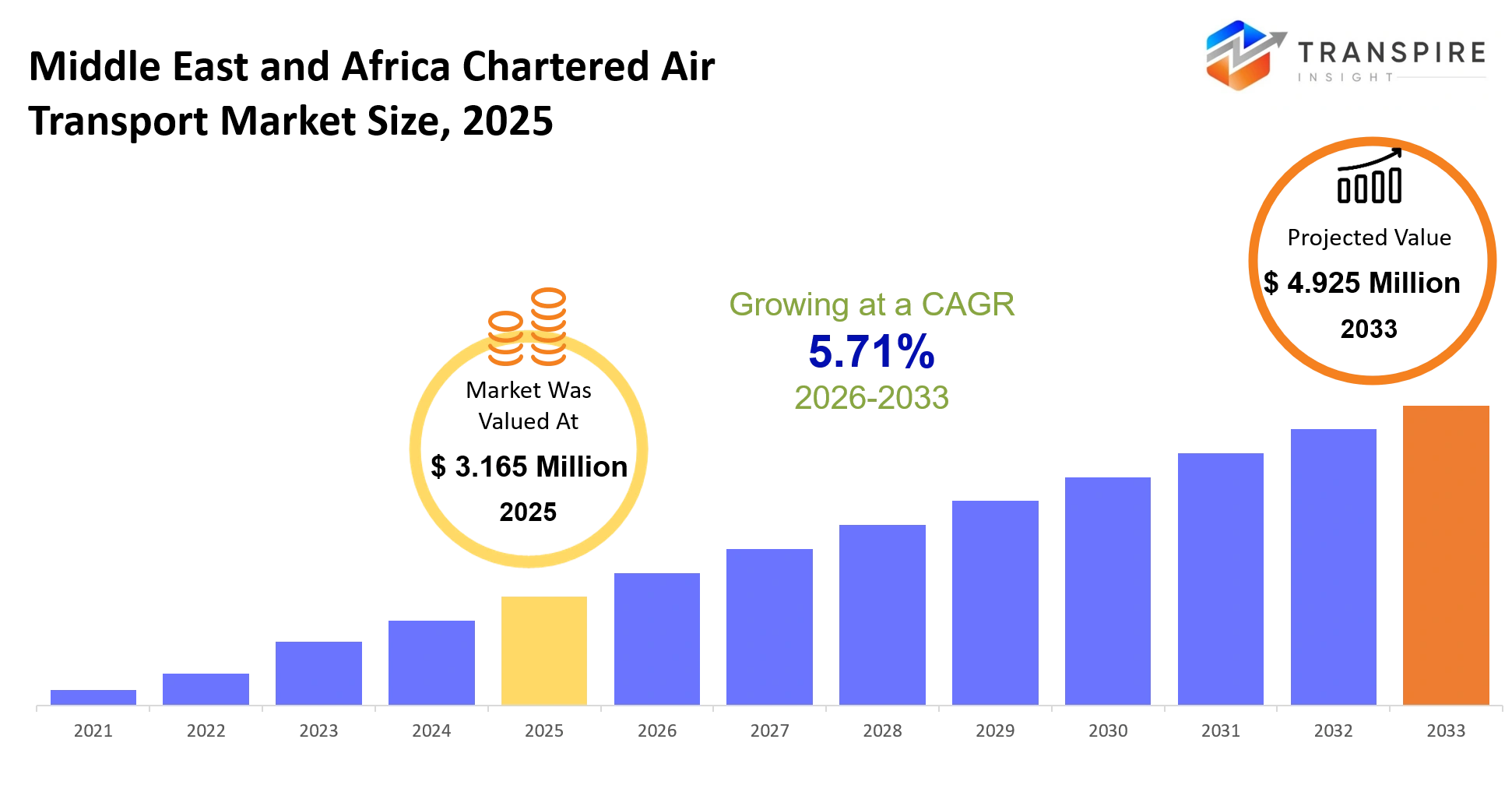
- Middle East and Africa Chartered Air Transport Market Size 2025: USD 3.165 Million
- Middle East and Africa Chartered Air Transport Market Size 2033: USD 4.925 Million
- Middle East and Africa Chartered Air Transport Market CAGR: 5.71%
- Middle East and Africa Chartered Air Transport Market Segments: By Aircraft Type (Business Jets, Turboprops, Helicopters, Air Ambulance Aircraft, Cargo Aircraft, Luxury Jets, Regional Aircraft, Others); By Service Type (Private Charter, Corporate Charter, Air Ambulance Services, Cargo Charter, Government Charter, Tourism Charter, Event Charter, Others); By End User (Corporates, HNWIs, Government Agencies, Healthcare Organizations, Logistics Companies, Tourism Operators, Defense Sector, Others); By Booking Mode (Direct Booking, Charter Brokers, Online Platforms, Travel Agencies, Corporate Contracts, Mobile Apps, Subscription Services, Others)
Middle East and Africa Chartered Air Transport Market Summary
The Middle East and Africa Chartered Air Transport Market was valued at USD 3.165 Million in 2025. It is forecast to reach USD 4.925 Million by 2033. That is a CAGR of 5.71% over the period.
The Middle East and Africa Chartered Air Transport Market has, in a sense, become pretty vital for moving passengers , executives, medical teams, urgent cargo, and even government staff when the usual commercial airline timetables can’t really match what the mission needs. Charter services bring that extra kind of flexibility, speed, privacy , and the ability to go straight to destinations where commercial connectivity is, let’s say, limited. So yeah they are used a lot for business travel, fast emergency response, energy sector activities, and tourism, all around the region.
In the last five years, the entire market kind a shifted, more structural, toward on-demand digital booking platforms and integrated fleet management systems, which help make aircraft access feel easier, and they tend to lift utilization levels. During COVID-19 and the disruptions that came after, the push toward private plus charter flights, sped up especially for corporations, healthcare organizations, and also high-net-worth travelers. Beyond that, the increasing investment in business aviation infrastructure across the Gulf countries, tied with ongoing tourism projects and cross-border business activity, keeps boosting how much charter flights are actually used. As operators increase their fleet availability and roll out technology-enabled booking services, the revenue potential is also getting stronger, with more flight frequencies, better premium service options , and improved access to destinations that were previously underserved across the region.
Key Market Insights
- The Middle East and Africa charter Air Transport Market keeps getting dominated by Gulf Cooperation Council countries, they hold something like 58% of the regional revenue in 2025, give or take.
- In the African charter aviation slice, growth is expected to be the quickest regional momentum all the way through 2033, mostly because of connectivity gaps and mining-sector activity that never really slows down.
- Business Jets are sitting at almost 35% of total market revenue, and that’s largely tied to executive travel demand plus corporate mobility needs, which makes sense.
- On the services side, Corporate Charter services is the top category with more than 30% share in 2025, helped along by multinational business operations and all the logistics that come with them.
- Air Ambulance Services are also among the fastest-moving segments, mainly fueled by the expansion of healthcare infrastructure and the medical evacuation requirements.
- When you look at end users, corporates still are the largest group, they generate about 32% of charter flight demand across the region overall.
- Online booking adoption has grown by more than 20% since 2021, which is helping with better aircraft utilization and stronger customer acquisition results.
- Operators are increasingly rolling out AI-enabled fleet scheduling , along with predictive maintenance tools, to cut downtime and squeeze more productivity out of assets.
- Strategic expansion by NetJets, VistaJet, Luxaviation, Jet Aviation, and Qatar Executive is also making the competition sharper across premium aviation services.
- And partnerships tied to luxury tourism projects, energy companies, and government agencies keep opening up fresh revenue channels for charter operators.
What are the Key Drivers, Restraints, and Opportunities in the Middle East and Africa Chartered Air Transport Market?
The strongest growth driver is kind of the expansion of business aviation activity across Gulf economies and these emerging African commercial hubs. Big investments in tourism, finance, energy, and infrastructure projects have really lifted the need for flexible transportation solutions that sidestep the constraints of scheduled airline networks. In places like Saudi Arabia, the UAE, and Qatar, large-scale developments have pushed executive travel requirements higher, so there’s more demand for charter operators that can deliver direct, time-sensitive connectivity. This pattern directly helps revenue growth, with higher flight utilization and more premium service offerings.
Still, there is a major structural restraint that keeps showing up, mainly the high operational cost tied to aircraft acquisition , maintenance, crew training, insurance, and airport infrastructure. Those costs cannot be pulled down quickly because they’re linked to aviation safety standards, regulatory compliance obligations, and capital-intensive assets. And in several parts of Africa, limited secondary airport infrastructure also restricts operational efficiency. So, some potential customers keep leaning on commercial aviation alternatives, which lowers market penetration and slows down revenue expansion.
One major opportunity sits in the rapid development of digital charter marketplaces and membership-based aviation services. Tech-enabled booking systems let operators improve fleet utilization while making charter travel more accessible to a wider customer set. Plus, countries investing in aviation infrastructure modernization—especially Saudi Arabia and the United Arab Emirates—are setting up better conditions for fleet expansion and service innovation.
What Has the Impact of Artificial Intelligence Been on the Middle East and Africa Chartered Air Transport Market?
Artificial intelligence is kind of changing charter aviation operations in a big way, mostly by making scheduling more efficient, improving aircraft utilization, helping with maintenance planning, and smoothing out customer service management. Lately, operators are using AI-powered fleet management platforms more and more, so they can automate flight scheduling, push better routing decisions, and line up aircraft availability with customer requests, kind of in real time. In practice, these systems seem to cut down on empty-leg flights and raise overall fleet productivity.
On another note, machine learning models are also helping predictive maintenance programs. They look at engine performance, flight hours, component wear patterns, plus other operational data. Then operators can spot potential failures before they happen. With this, unscheduled maintenance events drop, aircraft stay in service more often, and maintenance costs don’t climb as fast. Some operators say maintenance-related downtime can fall anywhere from 10% to 20% after they adopt predictive analytics solutions , which is not small.
There’s also advanced analytics that assist with fuel optimization, by suggesting more efficient routes and flight profiles. That helps operators reduce operating expenses, while also pushing sustainability goals at the same time. And then there are AI-driven customer platforms, those can speed up quotation turnaround, improve booking accuracy, and support service personalization.
Even so, adoption is still held back. The integration costs are high, and the data environment can be fragmented. Smaller operators in particular may not have enough historical operational data to train more sophisticated AI models properly. Plus, digital infrastructure levels vary across multiple African markets, and that continues to slow down how quickly advanced technology gets deployed.
Key Market Trends
- Online charter booking transactions went up by roughly 25% from 2021 to 2025, which kind of loosened the dependence on the usual brokerage channels.
- Gulf based operators apparently boosted fleet capacity by almost 15% since 2022, for tourism as well as business travel initiatives.
- Air ambulance usage climbed a lot, once healthcare providers started pushing quicker city-to-city patient moving solutions.
- AI driven maintenance programs helped cut surprise aircraft downtime by about 10–20% among more technologically mature operators.
- Saudi Arabia’s aviation investment efforts have kept pushing private aviation infrastructure growth across a bunch of airports since 2023.
- VistaJet and Qatar Executive also expanded their long haul fleet options, to handle intercontinental charter demand a bit more effectively.
- Memberships that run on a subscription style model started catching on with frequent corporate travelers, mainly because operating costs feel more steady.
- Across Africa, charter providers are increasingly aiming at mining, energy and humanitarian operations, especially where scheduled airline coverage stays pretty thin.
- Sustainability programs nudged operators toward newer aircraft models, with better fuel efficiency and reduced emissions.
- Finally, strategic partnerships between charter companies and high end luxury tourism developments strengthened the premium travel pull across Gulf locations.
Middle East and Africa Chartered Air Transport Market Segmentation
By Aircraft Type
Business Jets keep generating a lot of revenue , mainly because executives need quick movement, discretion , and a kind of direct link between major commercial hubs. Luxury Jets also fit premium expectations for high-net-worth travelers and VIP clients who want a tailored experience , you know. Regional Aircraft work well on medium distances, especially where regular connectivity is still kind of thin or limited.
Turboprops offer a sensible and cost-effective fix for short-hauls , and they even reach smaller airports more easily. Helicopters help with offshore energy activities , emergency travel, and the urban mobility kinds of needs. Air Ambulance Aircraft stay crucial for med evacuation services , while Cargo Aircraft move urgent freight as well as specialized goods. Others include those specialized aviation platforms built around unusual operational requirements.
By Service Type
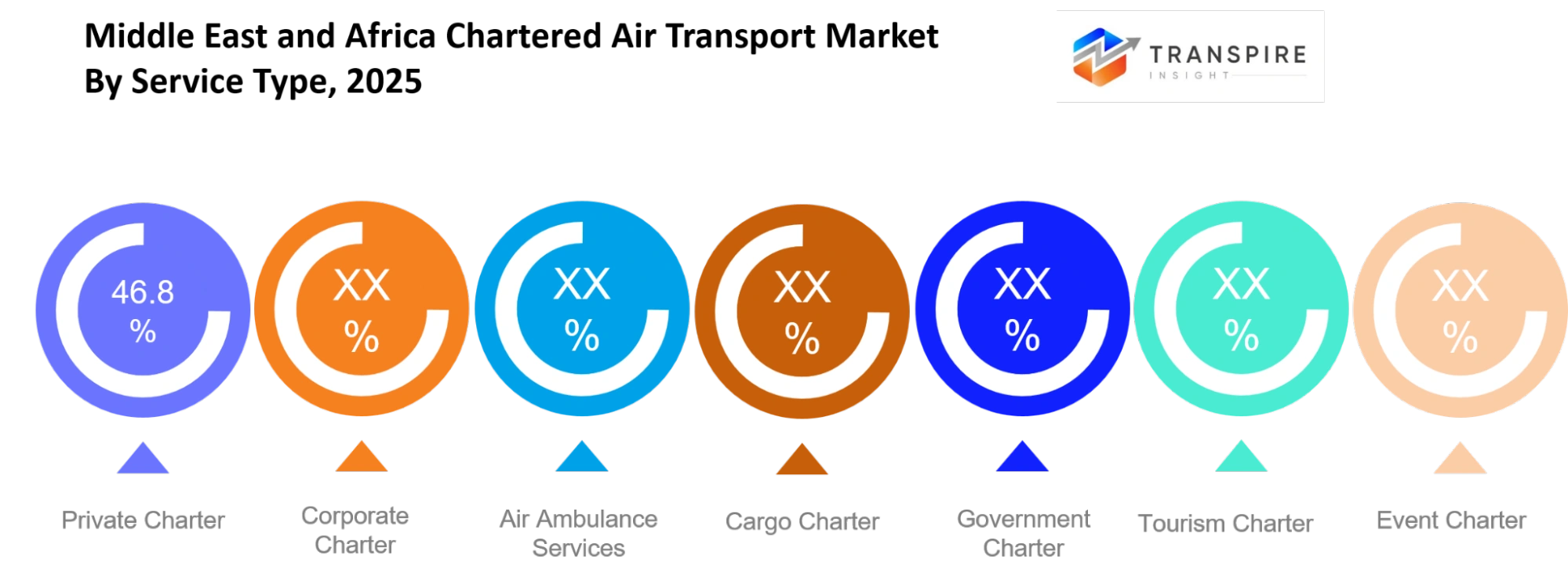
Private Charter services kinda pull in individuals + groups that want flexibility, privacy, and a travel plan that feels customized. For corporate Charter operations, it is more about executive mobility, business conversations, and project-driven transportation needs across different industries, y'know. Then government Charter services tend to cover official travel, diplomatic missions, and the day to day administrative movements.
Air Ambulance Services are built for fast medical transportation, like moving patients, healthcare professionals and even emergency response teams when it matters. Cargo Charter services focus on transporting time sensitive freight and high value goods across tricky routes and less than easy schedules. Tourism Charter operations work with luxury trips and easier access to destinations. Event Charter services fit for bigger crowds, sports activities, and special occasions. There are also other options, like niche aviation services that get tuned to very specific customer needs.
By End User
Corporates account for a substantial share of charter utilization, because efficient travel supports decision making, project execution, and client engagement. High net worth Individuals tend to prize privacy, convenience, and direct route availability. Government Agencies use charter solutions for administrative tasks, diplomatic efforts, and even emergency operations.
Healthcare Organizations rely on dedicated aviation services for medical evacuations and specialized patient transport. Logistics Companies employ charter aircraft for time sensitive cargo movements and supply chain continuity. Tourism Operators use charter services to sustain premium travel packages and get access to remote destinations. Defense Sector demand still matters a lot for operational mobility and strategic transportation needs. Others , represent specialized institutional or commercial users.
By Booking Mode
Direct Booking is still a preferred option for customers who want a direct connection with operators and a more tailored, bespoke kind of service setup. Charter Brokers keep doing their part too, they basically match customer needs with aircraft that are there, at the same time they make the whole procurement process much easier, and not as heavy.
Online Platforms have been growing fast, mostly because digitalization has improved transparency. You can see pricing more clearly, and booking feels easier overall. Travel Agencies also matter, they help leisure and premium tourism clients by offering integrated travel planning services, like a one-stop thing. Corporate Contracts give recurring access arrangements for frequent users, so it is less hassle each time. Mobile Apps help simplify booking management and flight coordination, while Subscription Services bring predictable access models for travelers who come back regularly. Then you also have others, like emerging digital and hybrid booking solutions that are still evolving.
What are the Key Use Cases Driving the Middle East and Africa Chartered Air Transport Market?
Corporate mobility still feels like the main thing across the whole region. Executives, investors, and project teams often need direct movement between business centers, industrial areas, and more remote operational sites, and yes the regular commercial flight timetables really can cause delays. That flexible routing , plus the time savings , is kinda why charter aviation tends to be so valuable particularly for energy, finance and infrastructure organizations.
Then there are medical evacuations and specialized cargo transport, these show up as secondary but still pretty important. Healthcare providers use dedicated aircraft to move patients and medical staff fast. At the same time, logistics teams lean on charter services for urgent deliveries, critical equipment, and those high-value items that basically need immediate handoff.
More up and coming uses include luxury tourism transportation tied to big destination developments and premium hospitality initiatives. Also the demand is rising for aviation membership programs, plus digitally enabled on demand charter options, which helps widen access to private aviation beyond the usual customer groups.
|
Report Metrics |
Details |
|
Market size value in 2025 |
USD 3.165 Million |
|
Market size value in 2026 |
USD 3.339 Million |
|
Revenue forecast in 2033 |
USD 4.925 Million |
|
Growth rate |
CAGR of 5.71% from 2026 to 2033 |
|
Base year |
2025 |
|
Historical data |
2021 - 2024 |
|
Forecast period |
2026 - 2033 |
|
Report coverage |
Revenue forecast, competitive landscape, growth factors, and trends |
|
Regional scope |
United States; Canada; Mexico; United Kingdom; Germany; France; Italy; Spain; Denmark; Sweden; Norway; China; Japan; India; Australia; South Korea; Thailand; Brazil; Argentina; South Africa; Saudi Arabia; United Arab Emirates |
|
Key company profiled |
NetJets, VistaJet, Flexjet, Air Charter Service, Jet Aviation, ExecuJet, Luxaviation, Chapman Freeborn, Royal Jet, Qatar Executive, Falcon Aviation, Empire Aviation, DC Aviation, Global Jet, Jetex |
|
Customization scope |
Free report customization (country, regional & segment scope). Avail customized purchase options to meet your exact research needs. |
|
Report Segmentation |
By Aircraft Type (Business Jets, Turboprops, Helicopters, Air Ambulance Aircraft, Cargo Aircraft, Luxury Jets, Regional Aircraft, Others); By Service Type (Private Charter, Corporate Charter, Air Ambulance Services, Cargo Charter, Government Charter, Tourism Charter, Event Charter, Others); By End User (Corporates, HNWIs, Government Agencies, Healthcare Organizations, Logistics Companies, Tourism Operators, Defense Sector, Others); By Booking Mode (Direct Booking, Charter Brokers, Online Platforms, Travel Agencies, Corporate Contracts, Mobile Apps, Subscription Services, Others) |
Which Regions are Driving the Middle East and Africa Chartered Air Transport Market Growth?
The Gulf region still comes across as the main driver of market revenue, I mean its the dominant contributor overall. Strong aviation infrastructure , supportive business aviation policies , and a lot of investment into tourism plus commercial development keep the leadership in place. Saudi Arabia, the UAE, and Qatar are still out front, they continue expanding airport capacity and pushing premium aviation facilities. And honestly, having a mature ecosystem of operators, maintenance providers, and aviation service companies only makes the regional competitiveness more solid.
South Africa is basically the next big contributor, it ranks as the second most significant . Here the growth dynamics feel different from the Gulf, because market performance leans more on diversified economic activity , corporate travel needs, and already established aviation services. Stable business aviation demand from mining, finance, and industrial sectors helps maintain consistent charter utilization. Plus well-developed airport infrastructure supports reliable day to day operational performance.
Looking at the broader African region, it is expected to show the fastest growth through 2033 . Infrastructure investments, more commercial activity , and limited scheduled airline connectivity have created the kind of conditions where charter aviation adoption is easier. Demand is growing from mining, energy, humanitarian, and logistics operations, and that demand is accelerating fleet deployment. So this momentum is turning into a pretty attractive situation for operators , investors , and aviation service providers who want long-term expansion across the region.
Who are the Key Players in the Middle East and Africa Chartered Air Transport Market and How Do They Compete?
Competition is still kinda moderately fragmented, global business aviation companies are running head to head with regional specialists, in practice it looks messy but it works. What really drives the contest is service quality, fleet availability, geographic reach, aircraft variety, and the whole digital booking experience. More operators now try to win by delivering a premium customer experience and tech-enabled operational efficiency, not simply by chasing the lowest price, period.
VistaJet sets itself apart with a global fleet access model, so customers can book aircraft without getting tied to ownership commitments, you see. Qatar Executive leans on long range business jet capabilities plus very strong connectivity, especially via the Gulf region, which helps draw corporate travelers and ultra-high-net-worth people. Royal Jet concentrates on premium VIP aviation services and tailored charter experiences, basically reinforcing its place inside luxury travel.
Jet Aviation competes by bundling integrated aviation services , like maintenance, aircraft management, and charter operations, and somehow the synergies end up mattering a lot. Luxaviation keeps expanding through strategic partnerships and international network growth, while also maintaining premium service standards throughout. Chapman Freeborn instead focuses on complicated charter logistics and cargo solutions, which gives them room to differentiate in mission critical transportation projects, not just passenger movement.
All of these moves help operators keep customers longer, make fleet utilization better, and capture new opportunities across many different end-user groups without narrowing too early.
Company List
- NetJets
- VistaJet
- Flexjet
- Air Charter Service
- Jet Aviation
- ExecuJet
- Luxaviation
- Chapman Freeborn
- Royal Jet
- Qatar Executive
- Falcon Aviation
- Empire Aviation
- DC Aviation
- Global Jet
- Jetex
Recent Development News
In January 2025, Qatar Executive announced the delivery of two additional Gulfstream G700 aircraft. The expansion increased its G700 fleet to six aircraft and strengthened ultra-long-range charter capabilities across international markets.
Source:https://www.qatarexec.com.qa
In December 2025, Qatar Executive announced a full-fleet Starlink installation program across its Gulfstream and Bombardier aircraft. The initiative enhances inflight connectivity and strengthens the premium service proposition for business aviation customers.
Source:https://www.qatarairways.com
In August 2025, VistaJet received approval from Saudi Arabia's General Authority of Civil Aviation to operate domestic charter flights within the Kingdom. The authorization expanded market access and supported Saudi Arabia's aviation liberalization strategy.
Source:https://www.reuters.com
What Strategic Insights Define the Future of the Middle East and Africa Chartered Air Transport Market?
The market looks like it is drifting toward a more tech forward, service minded operating model , where digital reservation platforms, AI based fleet optimization and membership style access programs start to become the heart of a real competitive edge. This change is also being pulled along by what customers expect now, quicker booking, more visibility, and the ability to tap into aviation access flexibly without having to commit to ownership , you know like full buy in.
There is also a less obvious downside, like the way the market may end up too concentrated around a small set of premium aviation hubs, especially in the Gulf. If operators lean too heavily on only a couple of high traffic centers, they can get hit by regulatory shifts, economic swings, or simple capacity bottlenecks, and that can weigh on regional growth prospects in ways people might not see coming.
On the flip side, a decent opportunity is showing up through digitally linked charter ecosystems across parts of Africa that are still underserved. If airport infrastructure keeps improving, mobile booking keeps spreading, and regional economic integration moves faster, the available customer base could grow a lot over the next ten years or so.
So in practice, market players should focus spending on digital platforms, predictive maintenance know-how, and partnership networks that actually span the region. The operators who blend technology-led operational efficiency with wider geographic reach , will likely be the ones most ready to grab future expansion and protect long term profitability.
Middle East and Africa Chartered Air Transport Market Report Segmentation
-
By Aircraft Type
- Business Jets
- Turboprops
- Helicopters
- Air Ambulance Aircraft
- Cargo Aircraft
- Luxury Jets
- Regional Aircraft
- Others
-
By Service Type
- Private Charter
- Corporate Charter
- Air Ambulance Services
- Cargo Charter
- Government Charter
- Tourism Charter
- Event Charter
- Others
-
By End User
- Corporates
- HNWIs
- Government Agencies
- Healthcare Organizations
- Logistics Companies
- Tourism Operators
- Defense Sector
- Others
-
By Booking Mode
- Direct Booking
- Charter Brokers
- Online Platforms
- Travel Agencies
- Corporate Contracts
- Mobile Apps
- Subscription Services
- Others
Frequently Asked Questions
Find quick answers to common questions.
The expected Middle East and Africa Chartered Air Transport Market size for the market will be USD 4.925 Million in 2033.
Key segments for the Middle East and Africa Chartered Air Transport Market are By Aircraft Type (Business Jets, Turboprops, Helicopters, Air Ambulance Aircraft, Cargo Aircraft, Luxury Jets, Regional Aircraft, Others); By Service Type (Private Charter, Corporate Charter, Air Ambulance Services, Cargo Charter, Government Charter, Tourism Charter, Event Charter, Others); By End User (Corporates, HNWIs, Government Agencies, Healthcare Organizations, Logistics Companies, Tourism Operators, Defense Sector, Others); By Booking Mode (Direct Booking, Charter Brokers, Online Platforms, Travel Agencies, Corporate Contracts, Mobile Apps, Subscription Services, Others)
Major Middle East and Africa Chartered Air Transport Market players are NetJets, VistaJet, Flexjet, Air Charter Service, Jet Aviation, ExecuJet, Luxaviation, Chapman Freeborn, Royal Jet, Qatar Executive, Falcon Aviation, Empire Aviation, DC Aviation, Global Jet, Jetex
The Middle East and Africa Chartered Air Transport Market size is USD 3.165 Million in 2025.
The Middle East and Africa Chartered Air Transport Market CAGR is 5.71% from 2026 to 2033.
- NetJets
- VistaJet
- Flexjet
- Air Charter Service
- Jet Aviation
- ExecuJet
- Luxaviation
- Chapman Freeborn
- Royal Jet
- Qatar Executive
- Falcon Aviation
- Empire Aviation
- DC Aviation
- Global Jet
- Jetex
About the Authors

Mayur Shinde
I am Mayur Shinde, a Senior Research Analyst at Transpire Insight, specializing in the Automotive & Transportation and Information & Communication Technology (ICT) Industry. My work focuses on analyzing emerging market trends, technological advancements, competitive landscapes, and industry developments to deliver accurate, data-driven insights. I am passionate about transforming complex market information into clear, actionable content that helps businesses, professionals, and decision-makers stay informed and make confident strategic decisions.

Chakradhar Khansole
Chakradhar serves as the Research Director at Transpire Insight, bringing over 8 years of experience in technology, innovation, and strategic market intelligence. He specializes in transforming complex market data into actionable business insights that enable organizations to make informed, growth-oriented decisions. Recognized for his strategic vision and analytical expertise, Chakradhar leads high-impact research initiatives, delivering comprehensive market assessments, competitive intelligence, and forward-looking industry analysis.
Recently Published Reports
-
Apr 2026
ATV & UTV Market
ATV & UTV Market Size, Share & Analysis Report By Type (ATV, and UTV), By Variants (Less Than 400 CC, 400 CC To 800 CC, and More Than 800 CC), and Geography (North America, Europe, Asia-Pacific, Middle East and Africa, South and Central America), 2021 - 2031
-
Apr 2026
Automotive Central Gateway Module Market
Automotive Central Gateway Module Market Size, Share & Analysis Report By Type (Ethernet Central Gateway Module, CAN Central Gateway Module, LIN Central Gateway Module, and FlexRay), By Application (Powertrain Control, Body Control, Infotainment System, Advanced Driver Assistance Systems (ADAS), and Others), By End User (Passenger Vehicles, and Commercial Vehicles), and Geography (North America, Europe, Asia-Pacific, Middle East and Africa, South and Central America), 2021 - 2031
-
Apr 2026
Automotive Engine Oil Filter Market
Automotive Engine Oil Filter Market Size, Share & Analysis Report By Filter Type (Fuel Filter, Engine Oil Filter, Hydraulic Oil Filter, and Others), By Filter Media (Cellulose, Synthetic, and Micro), By Sales Channel (OEMs, and Aftermarket), By Vehicle Type (Passenger Cars, Light Commercial Vehicles, Heavy Duty Trucks, Buses and Coaches, and Off-road Vehicles), and Geography (North America, Europe, Asia-Pacific, Middle East and Africa, South and Central America), 2021 - 2031
-
Apr 2026
Automotive Parts Aluminium Die Casting Market
Automotive Parts Aluminium Die Casting Market Size, Share & Analysis Report By Production Process (Pressure Die Casting, Vacuum Die Casting, Squeeze Die Casting, Gravity Die Casting), By Application (Body Parts, Engine Parts, Transmission Parts, Battery And Related Components, Other Application Types), and Geography (North America, Europe, Asia-Pacific, Middle East and Africa, South and Central America), 2021 - 2031
Our Clients



