

Middle East and Africa Bio-seeds Market Size & Forecast:
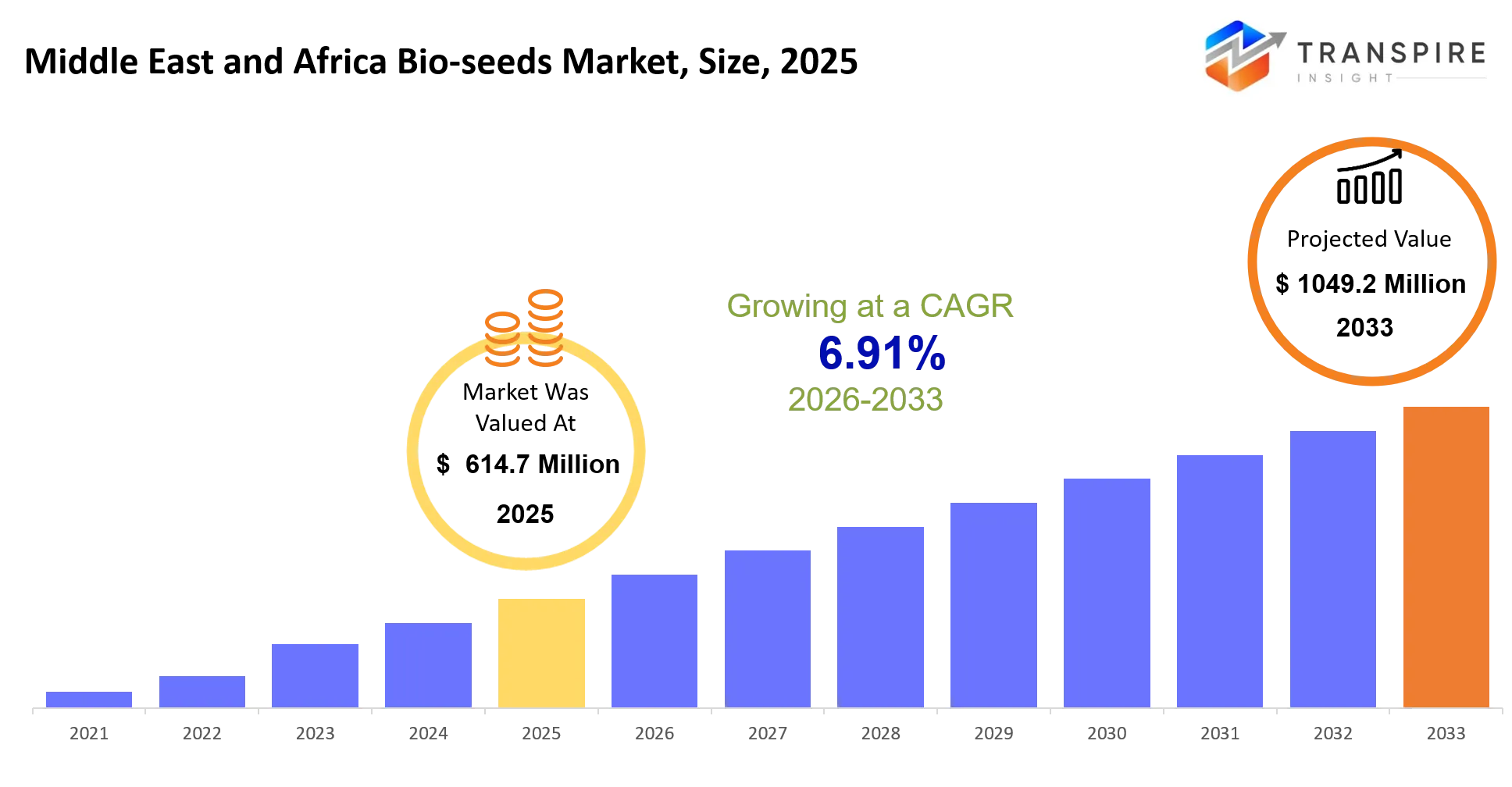
- Middle East and Africa Bio-seeds Market Size 2025: USD 614.7 Million
- Middle East and Africa Bio-seeds Market Size 2033: USD 1049.2 Million
- Middle East and Africa Bio-seeds Market CAGR: 6.91%
- Middle East and Africa Bio-seeds Market Segments: By Seed Type (Cereals Seeds, Oilseeds, Fruits & Vegetables Seeds, Pulses Seeds, Forage Crop Seeds, Cotton Seeds, Specialty Crop Seeds, Others); By Trait Type (Herbicide Tolerance, Disease Resistance, Drought Tolerance, Insect Resistance, Heat Resistance, Salinity Resistance, Yield Enhancement, Others); By Cultivation Type (Organic Farming, Conventional Farming, Protected Cultivation, Greenhouse Farming, Precision Farming, Sustainable Farming, Contract Farming, Others); By End User (Farmers, Agribusinesses, Seed Companies, Cooperatives, Government Programs, Research Institutes, Commercial Growers, Others)
Middle East and Africa Bio-seeds Market Summary
The Middle East and Africa Bio-seeds Market was valued at USD 614.7 Million in 2025. It is forecast to reach USD 1049.2 Million by 2033. That is a CAGR of 6.91% over the period.
Bio-seeds let farmers grow crops that are, you know, more able to handle pests, illnesses, drought, and those shifting weather patterns. they also cut back the reliance on a bunch of chemical inputs which is kind of a big deal. In the Middle East and across Africa, these seeds matter a lot because many areas are dealing with limited water, stressed soils, and real food security issues. Over the last 5 years, the market has been moving away from choosing seed types only for conventional yield, more toward climate-resilient and trait-enhanced biological seed varieties.
One major, almost structural shift has been the growth of sustainable farming policies and food self-sufficiency initiatives in places like Saudi Arabia, the United Arab Emirates, and South Africa. But also, during and after the COVID-19 period, supply chain disruptions made agricultural imports feel more fragile, so investors started putting more money into local crop performance. Put it all together, climate strain plus government backed agricultural modernization, plus the pressure to increase farm efficiency, is basically speeding up adoption. it is also pushing wider commercial cultivation, and opening fresh revenue paths for seed developers and agribusiness companies across the whole region.
Key Market Insights
- South Africa seems to be dominating the Middle East and Africa Bio- seeds Market, with an estimated 28% market share in 2025, mostly backed by more advanced commercial farming methods that just keep scaling up.
- Meanwhile the Gulf Cooperation Council countries show up as the fastest-growing regional cluster through 2033, pushed by food security investments, along with controlled environment agriculture that is a bit more managed than usual.
- When it comes to seed types, cereals seeds are taking close to 32% of the industry revenue in 2025, which basically makes them the biggest slice of the market.
- Fruits and vegetables seeds come in next, holding the second-largest share, thanks to greenhouse cultivation that keeps expanding, plus higher-value crop production that farmers seem to want right now.
- For traits, drought-tolerant bio- seeds are expected to grow above 8% per year all the way to 2033, and they’re predicted to beat most other categories.
- Disease-resistant varieties make up around 24% of trait related demand, which lets growers limit crop losses and also cut production costs in a practical way.
- Also, organic and sustainable farming applications have expanded by more than 15% since 2021, and that trend is strengthening the need for biological seed solutions, in a very direct manner.
- On the end-user side, commercial growers are still the top group, accounting for nearly 35% of market consumption in 2025, though smaller farms may follow as adoption rises.
- Key companies like Bayer, Corteva, Syngenta, BASF, and UPL are continuing strategic expansion through localized breeding programs and regional distribution partnerships, so they stay close to local demand.
- Finally digital farming tools and precision agriculture technologies are starting to influence seed choice more and more, which then improves field performance and helps shape crop planning decisions, even when seasons get tricky.
What are the Key Drivers, Restraints, and Opportunities in the Middle East and Africa Bio-seeds Market?
The most powerful force behind market expansion is basically the rising need for climate-resilient farming output. You see more drought episodes, then rainfall that comes in uneven ways, and arable land quality that keeps slipping, so governments plus commercial growers have started looking for crop varieties that can hold yields even when conditions get rough. In the Gulf, national food security programs, and across Africa , agricultural modernization pushes, have boosted spending in advanced seed technologies. When farmers end up with more dependable harvests and they cut down on crop losses, adoption keeps climbing, which sort of directly strengthens revenue growth for seed suppliers and biotechnology developers.
A big structural hitch is that access to advanced agricultural infrastructure is still limited. A lot of rural areas keep working with constrained irrigation systems, storage places that arent enough, and only small access to agronomic advisory support. Because of these gaps, premium bio-seed technologies dont perform as effectively and farmers dont switch as quickly. And the problem is hard to untangle fast, because building infrastructure needs serious investment from both public and private sides. So market penetration stays uneven across multiple African economies , which then caps the overall revenue upside.
A major future opening is bio-seeds made for drought tolerance, salt resistance, and heat endurance. Across the Arabian Peninsula, plus water-stressed parts of Africa, there is a growing demand for crop types that are tuned for hostile field conditions. Investments in site-specific breeding programs, genomic selection approaches, and public-private research partnerships are helping create good conditions for next-generation seed development.
What Has the Impact of Artificial Intelligence Been on the Middle East and Africa Bio-seeds Market?
Artificial intelligence is kind of transforming seed development, crop planning, and the whole agricultural decision-making across the Middle East and Africa. Seed producers are now more often relying on machine learning models to read genetic traits, look at weather and environmental conditions, and then connect that with historical crop performance records. In practice, these systems let researchers spot desirable traits like drought resilience, disease resistance, and yield steadiness quicker than the usual conventional breeding methods, even when the trial cycle would otherwise be longer.
There are also AI powered analytics platforms that back operational optimization, by checking soil state, weather forecasts, irrigation needs, and what is happening in the fields in real time. Precision agriculture setups mix satellite images, drone observation, and predictive algorithms so they can recommend seed varieties that fit particular locations. The effect is that resources get used better, yields stay more consistent, and growers often see reduced input expenses.
On the predictive side, models can estimate crop stress risk, anticipate possible disease flare ups, and fine tune planting calendars, which helps farmers lean toward better harvest outcomes. Some commercial farms even mention measurable decreases in water consumption and fertilizer use, thanks to data-guided crop management routines.
Still, adoption is held back, because implementation costs are high, digital infrastructure can be thin or missing in rural areas, and localized agricultural datasets are not always available or consistent. When reliable field-level data is lacking, predictive performance can shift a lot across different climates and soil types. That makes it harder to roll out AI enabled seed optimization systems at a wider scale.
Key Market Trends
- Since 2021, adoption of drought tolerant seed varieties kinda expanded around 18% across water stressed farming regions, overall.
- Bayer and Corteva bumped up investments in climate resilient breeding programs between 2024 and 2026, to back regional crop adaptation, more or less.
- Greenhouse farming acreage kept growing steadily across Gulf countries, which boosted demand for specialized vegetable as well horticultural seeds.
- Precision agriculture adoption, also improved seed selection practices, and digital farming platforms started gaining traction among commercial growers after 2023.
- Disease resistant seed varieties took a bigger share of planting decisions, because growers tried to cut down on chemical treatment expenses.
- Localized breeding programs moved from experimental initiatives into commercial scale operations in several African agricultural markets, quite directly.
- Partnerships between seed companies and agricultural research institutes increased noticeably during 2024 and 2025, no doubt.
- Organic cultivation projects spread across premium export oriented farming operations, and that encouraged wider use of biological seed technologies, gradually.
- Governments were linking food security targets more often with investments in advanced crop genetics and resilient seed systems.
- Regional distributors then strengthened supply networks after pandemic era disruptions showed vulnerabilities in imported agricultural inputs, clearly.
Middle East and Africa Bio-seeds Market Segmentation
By Seed Type
Cereals Seeds still have a pretty big role, because staple crops like wheat, maize, sorghum and barley basically stay key for regional food production. The demand leans toward kinds that can handle unstable rainfall, and still keep a pretty steady yield even in tough field conditions, yes. Oilseeds Seeds also keep getting picked up a lot, mainly because the need for edible oils is growing, and so is agricultural processing.
Fruits & Vegetables Seeds do well when greenhouse farming shows up, plus with protected cultivation programs and commercial horticulture projects. Pulses Seeds back food security efforts and soil fertility upkeep, while Forage Crop Seeds fit into livestock production systems. Cotton Seeds remain relevant in certain ag economies, and Specialty Crop Seeds, and Others cover those more specific cultivation needs like export openings or high value crop production, depending on the region.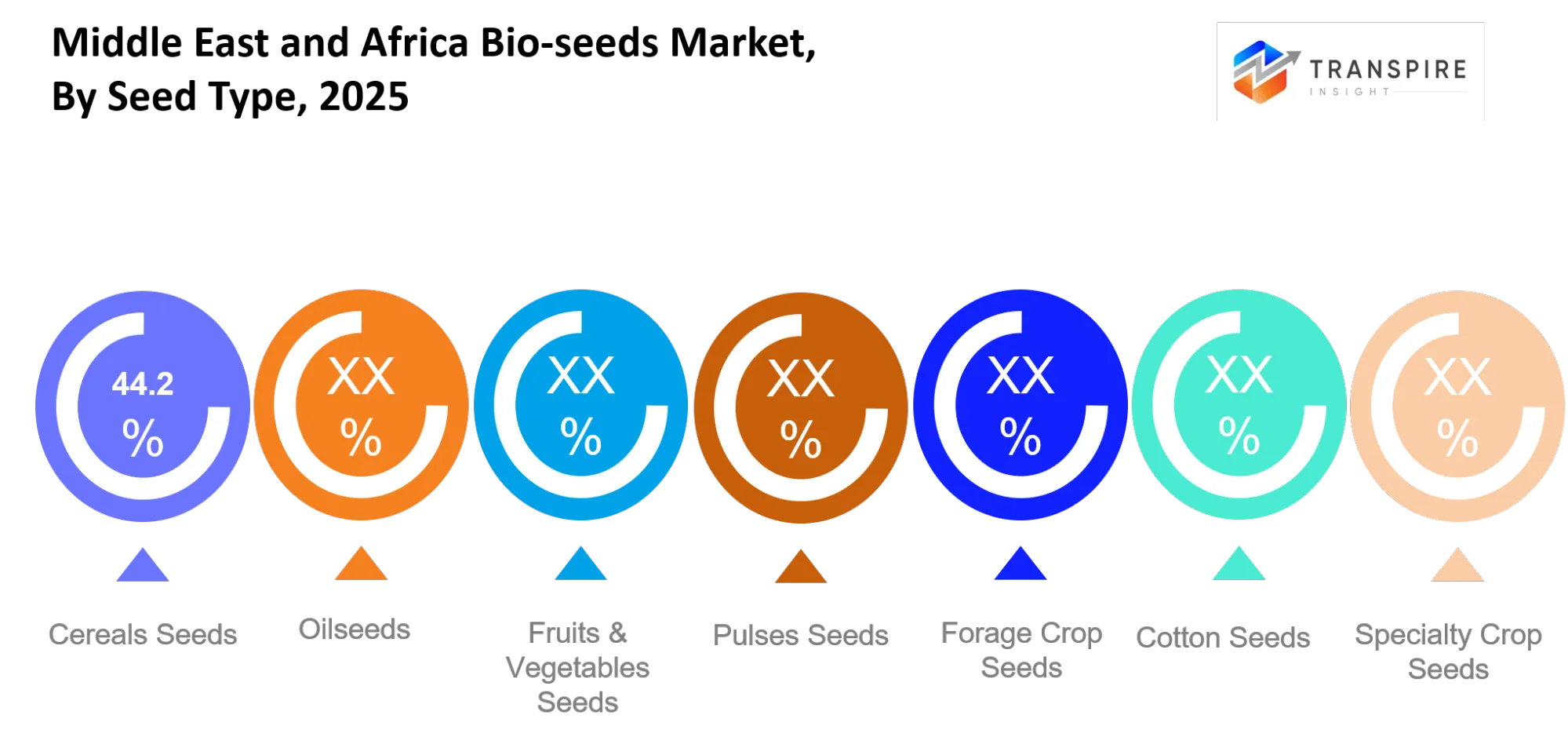
By Trait Type
Herbicide Tolerance keeps pulling in attention where weed control efficiency ,really impacts farm profitability, basically the money part. Disease Resistance still matters a lot too, since fungal and bacterial plus viral problems can drag down harvest volumes quite a bit. Drought Tolerance also gets more investment because water stress keeps showing up again and again across many places.
On the protection side, Insect Resistance helps keep crops safe and lessens reliance on chemical interventions, which is good in practice. Heat Resistance and Salinity Resistance are becoming even more important as the climate gets harsher. And of course Yield Enhancement stays right at the center of commercial production goals ,while the Others category includes up-and-coming biological traits and region specific genetic characteristics that are tuned for more specialized farming environments.
By Cultivation Type
Organic Farming kind of helps with premium farming output and export oriented growing systems, it’s like a steady advantage. Conventional Farming still ends up being the biggest cultivation type, mainly because large scale agricultural enterprises keep leaning on their well known production approach. Protected Cultivation and Greenhouse Farming also keep growing steadily, especially in areas where water limitations show up, plus where climatic conditions can be quite harsh and uncomfortable.
Precision Farming, by its nature strengthens seed performance through data led crop management and better resource allocation. Sustainable Farming nudges farmers toward durable seed technologies, the kind that supports long term productivity without too much drama. Contract Farming backs a coordinated production setup between growers and buyers, whereas Others include specialized cultivation models, more tuned to local farm needs.
By End User
Farmers count as a major consumer group, because seed selection directly affects productivity, crop quality, and the whole profitability picture. Meanwhile agribusinesses increasingly lean on advanced seed technologies, to boost supply chain reliability and keep agricultural output more consistent. Seed Companies actually put resources into breeding programs and product development, kind of initiatives that keep showing up every season.
Then cooperatives help smaller farming communities get access to improved seed varieties, it’s sort of a shared pathway. On top of that Government Programs back adoption through food security approaches, agricultural development initiatives, and farmer assistance schemes. Research Institutes add new ideas plus field testing activity, while Commercial Growers tend to focus on operational efficiency by using advanced crop genetics. There are also others, like specialized agricultural organizations and niche production enterprises, that operate in more particular ways.
What are the Key Use Cases Driving the Middle East and Africa Bio-seeds Market?
The biggest use case kinda revolves around staple crop production, especially cereals grown for food security and day to day home consumption. Bio-seeds can help sustain yields when drought shows up, when pests start pressuring things, and when the weather just does its usual messy swing. so yeah they become basically a must-have for big farming operations that run at scale.
More adoption is also starting to pop up in commercial horticulture and greenhouse cultivation, which is kind of interesting. Vegetable growers, and export-driven farms too, they’re increasingly choosing specialized seed varieties that let them deliver steady quality, extend shelf life a bit, and generally raise the market value. You can pretty clearly see agribusinesses plus commercial growers as key players behind these applications.
Then there are the newer use cases, like growing on saline soils, and climate-adaptive farming projects. Research groups and agricultural development programs are looking at advanced genetic traits that make cultivation possible in marginal environments. Today these areas are still relatively modest , but they might turn into real growth lanes during the forecast period.
|
Report Metrics |
Details |
|
Market size value in 2025 |
USD 614.7 Million |
|
Market size value in 2026 |
USD 657.1 Million |
|
Revenue forecast in 2033 |
USD 1049.2 Million |
|
Growth rate |
CAGR of 6.91% from 2026 to 2033 |
|
Base year |
2025 |
|
Historical data |
2021 - 2024 |
|
Forecast period |
2026 - 2033 |
|
Report coverage |
Revenue forecast, competitive landscape, growth factors, and trends |
|
Regional scope |
United States; Canada; Mexico; United Kingdom; Germany; France; Italy; Spain; Denmark; Sweden; Norway; China; Japan; India; Australia; South Korea; Thailand; Brazil; Argentina; South Africa; Saudi Arabia; United Arab Emirates |
|
Key company profiled |
Bayer, Corteva, Syngenta, BASF, Limagrain, KWS, Sakata Seed, Takii Seed, East-West Seed, Rijk Zwaan, Advanta Seeds, Mahyco, Bioseed, UPL, Enza Zaden |
|
Customization scope |
Free report customization (country, regional & segment scope). Avail customized purchase options to meet your exact research needs. |
|
Report Segmentation |
By Seed Type (Cereals Seeds, Oilseeds, Fruits & Vegetables Seeds, Pulses Seeds, Forage Crop Seeds, Cotton Seeds, Specialty Crop Seeds, Others); By Trait Type (Herbicide Tolerance, Disease Resistance, Drought Tolerance, Insect Resistance, Heat Resistance, Salinity Resistance, Yield Enhancement, Others); By Cultivation Type (Organic Farming, Conventional Farming, Protected Cultivation, Greenhouse Farming, Precision Farming, Sustainable Farming, Contract Farming, Others); By End User (Farmers, Agribusinesses, Seed Companies, Cooperatives, Government Programs, Research Institutes, Commercial Growers, Others) |
Which Regions are Driving the Middle East and Africa Bio-seeds Market Growth?
South Africa basically leads the regional revenue build up, because it has advanced agricultural infrastructure kind of already in place, plus established commercial farming operations, and strong uptake of more modern seed technologies. With large scale grain and horticultural output, the market demand keeps getting pulled toward trait enhanced seed varieties. Research institutions, distribution networks, and agribusiness investment are sort of building that whole ecosystem, which keeps supporting market leadership year after year. And the consistent tech adoption, yeah it keeps reinforcing longer term competitiveness too
Then you’ve got the Gulf region, it shows up as the second biggest contributor , but it’s doing that through a different growth route. Instead of relying on lots of open arable land, food security strategies, controlled environment agriculture projects, and government backed farming investments push adoption along. Places like Saudi Arabia and the United Arab Emirates tend to focus on productivity optimization more than anything, plus resource efficiency, and that sort of stable policy support keeps the market moving forward in a steady way
East Africa meanwhile is showing the strongest growth momentum. Agricultural modernization programs, better access to farm technologies, and a bigger shift toward commercial cultivation have really boosted adoption rates. Investments in irrigation systems and climate resilient agriculture also made the conditions more favorable for advanced seed deployment. So overall, this momentum creates major opportunities for seed developers investors and technology providers through 2033
Who are the Key Players in the Middle East and Africa Bio-seeds Market and How Do They Compete?
Competition still looks pretty consolidated, but it’s not totally, you know, one side only—multinational seed developers run alongside regional specialists and local breeding organizations. When people really measure who’s winning, it usually comes down to product performance, climate adaptation ability, breeding know-how and distribution reach. More and more companies seem to shift toward crop varieties that match the local environmental reality, instead of just pushing the same, standardized global product everywhere.
Bayer, for example, leans on extensive biotechnology research, plus advanced breeding programs, and then digital agriculture integration that’s kind of woven into the whole approach. They keep adding to climate-resilient crop portfolios and they also work together with agricultural stakeholders to push better field performance. Corteva puts a spotlight on genetic innovation and these localized seed development strategies, aimed at drought and disease pressure that shows up across the region.
Syngenta blends seed genetics with crop protection expertise, so the outcome is integrated production solutions for commercial growers. BASF, on the other hand, invests heavily in advanced breeding technologies and sustainable farming applications. UPL is expanding via partnerships, regional distribution networks and integrated biological product offerings that complement seed technologies rather than replace them. Overall, these ways of doing things—kind of differentiated on purpose—help the companies hold onto their market position and grab the newer agricultural opportunities that are starting to appear.
Company List
- Bayer
- Corteva
- Syngenta
- BASF
- Limagrain
- KWS
- Sakata Seed
- Takii Seed
- East-West Seed
- Rijk Zwaan
- Advanta Seeds
- Mahyco
- Bioseed
- UPL
- Enza Zaden
Recent Development News
In March 2026, Bayer launched new climate-resilient vegetable seed varieties designed for arid and semi-arid agricultural conditions. The development strengthened crop adaptation strategies for water-constrained farming environments and expanded advanced seed offerings in emerging markets.https://www.bayer.com (Bayer)
In February 2026, Corteva Agriscience expanded collaborative breeding initiatives focused on drought-tolerant crop development. The program accelerated research efforts aimed at improving productivity in regions facing prolonged water stress.https://www.corteva.com (Corteva Agriscience)
In October 2025, Syngenta announced expanded investment in seed innovation and regional crop development programs. The initiative enhanced localized breeding capabilities and supported adaptation to changing climatic conditions across developing agricultural markets.https://www.syngenta.com (Syngenta)
What Strategic Insights Define the Future of the Middle East and Africa Bio-seeds Market?
The market is drifting toward really specific, climate adjusted seed solutions rather than those big, one size fits all product lineups , you know. The most solid “why” behind this shift is basically the pressure to keep farm output steady even as environmental stress goes up, while also hitting national food security goals. In the next five to seven years, firms that have deep regional breeding chops and kind of localized research efforts will probably pull in far more value than everyone else.
There’s also a risk that gets talked about less than it should, like, market concentration in the advanced breeding tech and the genetic material side of things. If you end up relying on only a handful of major global suppliers, then agricultural systems can get squeezed by pricing pressure, and at the same time face supply interruptions , which is not a small issue. Still, there’s a big opening too: seeds that are tuned for salty ground, heat heavy conditions, and water limited farming, especially throughout Gulf nations and the drier parts of Africa.
A sensible strategy move is to widen partnerships between seed developers, research institutes, and local agricultural organizations. These collaborations can speed up the release of region specific varieties, raise how quickly farmers actually adopt them, and help build sharper competitive strength in a space that’s getting defined by climate resilience together with agricultural productivity.
Middle East and Africa Bio-seeds Market Report Segmentation
-
By Seed Type
Cereals Seeds
Oilseeds Seeds
Fruits & Vegetables Seeds
Pulses Seeds
Forage Crop Seeds
Cotton Seeds
Specialty Crop Seeds
Others -
By Trait Type
Herbicide Tolerance
Disease Resistance
Drought Tolerance
Insect Resistance
Heat Resistance
Salinity Resistance
Yield Enhancement
Others -
By Cultivation Type
Organic Farming
Conventional Farming
Protected Cultivation
Greenhouse Farming
Precision Farming
Sustainable Farming
Contract Farming
Others -
By End User
Farmers
Agribusinesses
Seed Companies
Cooperatives
Government Programs
Research Institutes
Commercial Growers
Others
Frequently Asked Questions
Find quick answers to common questions.
The Expected Middle East and Africa Bio-seeds Market size for the Market will be USD 1049.2 Million in 2033.
Key Segments for the Middle East and Africa Bio-seeds Market are By Seed Type (Cereals Seeds, Oilseeds, Fruits & Vegetables Seeds, Pulses Seeds, Forage Crop Seeds, Cotton Seeds, Specialty Crop Seeds, Others); By Trait Type (Herbicide Tolerance, Disease Resistance, Drought Tolerance, Insect Resistance, Heat Resistance, Salinity Resistance, Yield Enhancement, Others); By Cultivation Type (Organic Farming, Conventional Farming, Protected Cultivation, Greenhouse Farming, Precision Farming, Sustainable Farming, Contract Farming, Others); By End User (Farmers, Agribusinesses, Seed Companies, Cooperatives, Government Programs, Research Institutes, Commercial Growers, Others).
Major Middle East and Africa Bio-seeds Market Players are Bayer, Corteva, Syngenta, BASF, Limagrain, KWS, Sakata Seed, Takii Seed, East-West Seed, Rijk Zwaan, Advanta Seeds, Mahyco, Bioseed, UPL, Enza Zaden.
The Current Middle East and Africa Bio-seeds Market size is USD 614.7 Million in 2025.
The Middle East and Africa Bio-seeds Market CAGR is 6.91% from 2026 to 2033.
- Bayer
- Corteva
- Syngenta
- BASF
- Limagrain
- KWS
- Sakata Seed
- Takii Seed
- East-West Seed
- Rijk Zwaan
- Advanta Seeds
- Mahyco
- Bioseed
- UPL
- Enza Zaden
About the Authors

Pankaj Ghogare Patil
I am Pankaj Ghogare Patil, a Senior Research Analyst at Transpire Insight, specializing in the Pharmaceutical, Chemicals & Materials, Healthcare IT, and Biotechnology industry. My expertise lies in conducting comprehensive market research, analyzing industry trends, evaluating competitive landscapes, and translating complex data into actionable insights. At Transpire Insight, I closely follow emerging technologies, regulatory developments, and market innovations to create accurate, well-researched, and informative content that helps businesses and professionals make informed decisions. I am committed to producing credible, evidence-based articles that reflect industry best practices while making technical topics accessible and valuable for a broad audience.

Chakradhar Khansole
Chakradhar serves as the Research Director at Transpire Insight, bringing over 8 years of experience in technology, innovation, and strategic market intelligence. He specializes in transforming complex market data into actionable business insights that enable organizations to make informed, growth-oriented decisions. Recognized for his strategic vision and analytical expertise, Chakradhar leads high-impact research initiatives, delivering comprehensive market assessments, competitive intelligence, and forward-looking industry analysis.
Recently Published Reports
-
May 2026
Healthcare Polymer Packaging Market
Healthcare Polymer Packaging Market Size, Share & Analysis Report By Packaging Type (Syringes, IV Bottles and Pouches, Clamshells, Blisters, Bottles & Jars, Containers, Tubes, IV Parental Packaging, Others), By Type (Regulated, Non-regulated), By Polymer Type (LDPE (Low-Density Polyethylene), HDPE (High-Density Polyethylene), Homo-polymer (Homo), Random Copolymer (Random), Block Copolymer (Block), PET, Polystyrene, Polyvinyl Chloride, Polyamide/EVOH, Others), and Geography (North America, Europe, Asia-Pacific, Middle East and Africa, South and Central America), 2021 - 2031
-
Apr 2026
Hydrophilic Tape (Waterstop) Market
Hydrophilic Tape (Waterstop) Market Size, Share & Analysis Report By Type (Bentonite-Based Hydrophilic Tape, Rubber-Based Hydrophilic Tape), By Application (Residential Buildings, Commercial Buildings, Infrastructure Projects), and Geography (North America, Europe, Asia-Pacific, Middle East and Africa, South and Central America), 2021 - 2031
-
Apr 2026
Metalens Market
Metalens Market Size, Share & Analysis Report By Type (Visible Light Metalens, and Infrared Metalens), By Application (Consumer Electronics, Automotive Electronics, Industrial, Medical, and Others), and Geography (North America, Europe, Asia-Pacific, Middle East and Africa, South and Central America), 2021 - 2031
-
Apr 2026
PBT Resin Market
PBT Resin Market Size, Share & Analysis Report By Type (Reinforced PBT Resin, Unreinforced PBT Resin), By Processing Method (Injection Molding, Extrusion, Blow Molding, Others), By End-User (Automotive, Electrical & Electronics, Consumer Appliances, Industrial Machinery, Medical Devices, Packaging, Others), and Geography (North America, Europe, Asia-Pacific, Middle East and Africa, South and Central America), 2021 - 2031