

United States Gluten-Free Cereals Market Size & Forecast:
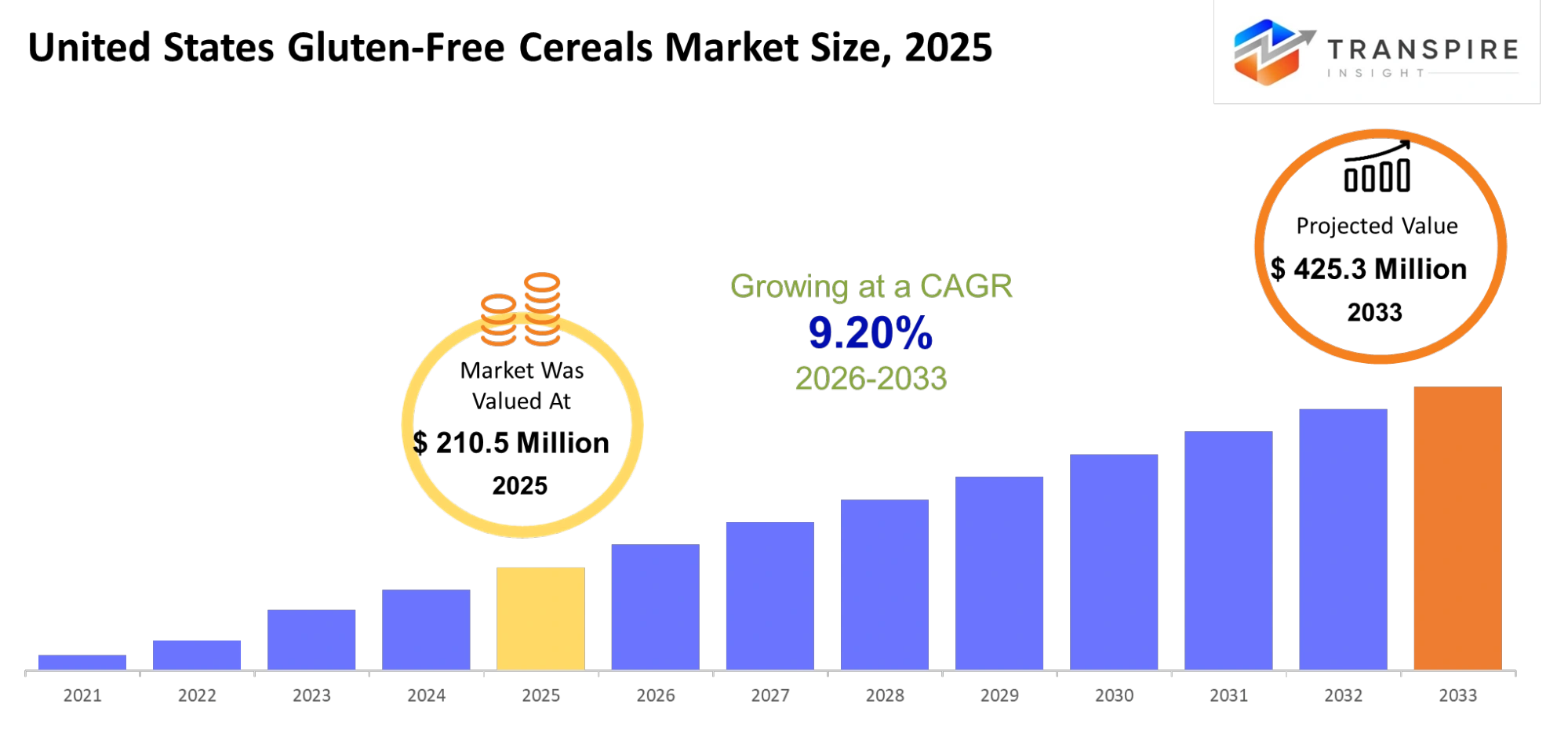
- United States Gluten-Free Cereals Market Size 2025: USD 210.5 Million
- United States Gluten-Free Cereals Market Size 2033: USD 425.3 Million
- United States Gluten-Free Cereals Market CAGR: 9.20%
- United States Gluten-Free Cereals Market Segments:By Product Type (Corn-based Cereals, Rice-based Cereals, Oat-based Cereals, Multi-grain Cereals), By Distribution Channel (Supermarkets & Hypermarkets, Health Food Stores, Online Retail).
To learn more about this report,  Download Free Sample Report
United States Gluten-Free Cereals Market Summary:
The United States Gluten-Free Cereals Market size is estimated at USD 210.5 Million in 2025 and is anticipated to reach USD 425.3 Million by 2033, growing at a CAGR of 9.20% from 2026 to 2033. The United States Gluten-Free Cereals Market is experiencing continuous growth because more people understand their dietary restrictions and gluten intolerance cases are increasing. Health-aware consumers are now looking for breakfast products which contain no allergens and use clean-label ingredients.
The demand for gluten-free cereals has increased because consumers now prefer rice and corn and quinoa and oats as their main ingredients. The market growth in urban areas is being driven by people who want to experience new lifestyles which provide them access to delicious yet healthy food options.The United States Gluten-Free Cereals Market develops through innovation and product diversification.
Major companies improve their products by adding high-protein components and fiber-rich materials to their food products which improve both taste and texture and nutritional content. The rising demand for plant-based diets together with functional foods creates market opportunities for companies to produce gluten-free cereals that contain added nutrients. The strong distribution systems of physical stores together with the fast expansion of online shopping platforms make these items easier to obtain which results in ongoing market expansion.
What Has the Impact of Artificial Intelligence Been on the United States Gluten-Free Cereals Market?
The United States gluten-free cereals market experiences its current transformation through artificial intelligence which enables businesses to make better decisions based on data and develop their market intelligence systems. The United States gluten-free cereal market uses machine learning together with predictive analytics to help companies understand consumer preferences and dietary patterns and buying habits with improved accuracy.
The United States gluten-free cereals market enables brands to identify emerging demand patterns through their artificial intelligence applications which help them develop better market strategies by combining product positioning with observed market changes. Artificial intelligence drives United States gluten-free cereals market operations to achieve better production efficiency through its smart automated systems and supply chain optimization methods.
The manufacturing process uses AI-powered systems to streamline operations while decreasing waste and maintaining product quality. The technological advancements which reduce operational expenses and enhance distribution efficiency create benefits for the United States gluten-free cereals market. The ability of AI to create product personalization through its development of customized nutritional profiles enables companies to create unique brand identities which help them succeed in competitive markets.
Key Market Trends & Insights:
- The gluten-free cereal market in the United States experiences strong market demand because more people develop gluten intolerance and choose breakfast foods which contain no allergens and provide essential nutrients.
- The industry experiences rapid growth because people are adopting plant-based diets and companies are developing new cereal products which contain high protein and fiber content.
- Businesses use predictive analytics and intelligent automated systems to improve their production processes while creating products that match the changing preferences of their customers.
- The Midwest region leads the United States gluten-free cereal market because it has strong manufacturing capabilities which produce approximately 35% of market share for 2025.
- The West region stands as the fastest expanding area which will grow at a CAGR of 9% until 2030 because health-conscious urban consumers drive market development.
- Ready-to-eat gluten-free cereals dominate with over 60% share in 2025 because their convenience matches the needs of people who lead busy lives.
- Hot gluten-free cereals hold the second-largest share because people want to eat both traditional breakfast foods and healthy breakfast foods.
- Granola-based gluten-free cereals represent the fastest-growing segment which fitness-focused consumers will start to adopt through 2030.
- The United States gluten-free cereals market shows its highest share through household consumption which accounts for 70% of the market because people eat breakfast every day.
- The segment for on-the-go snacking applications shows the fastest growth because portable packaging innovations meet the needs of people with active lifestyles.
- Retail consumers lead the market with a significant share because more people understand gluten-free diets and clean-label products.
- Health-conscious millennials represent the fastest-growing end-user category which drives demand for functional and fortified cereal products.
United States Gluten-Free Cereals Market Segmentation
By Product Type
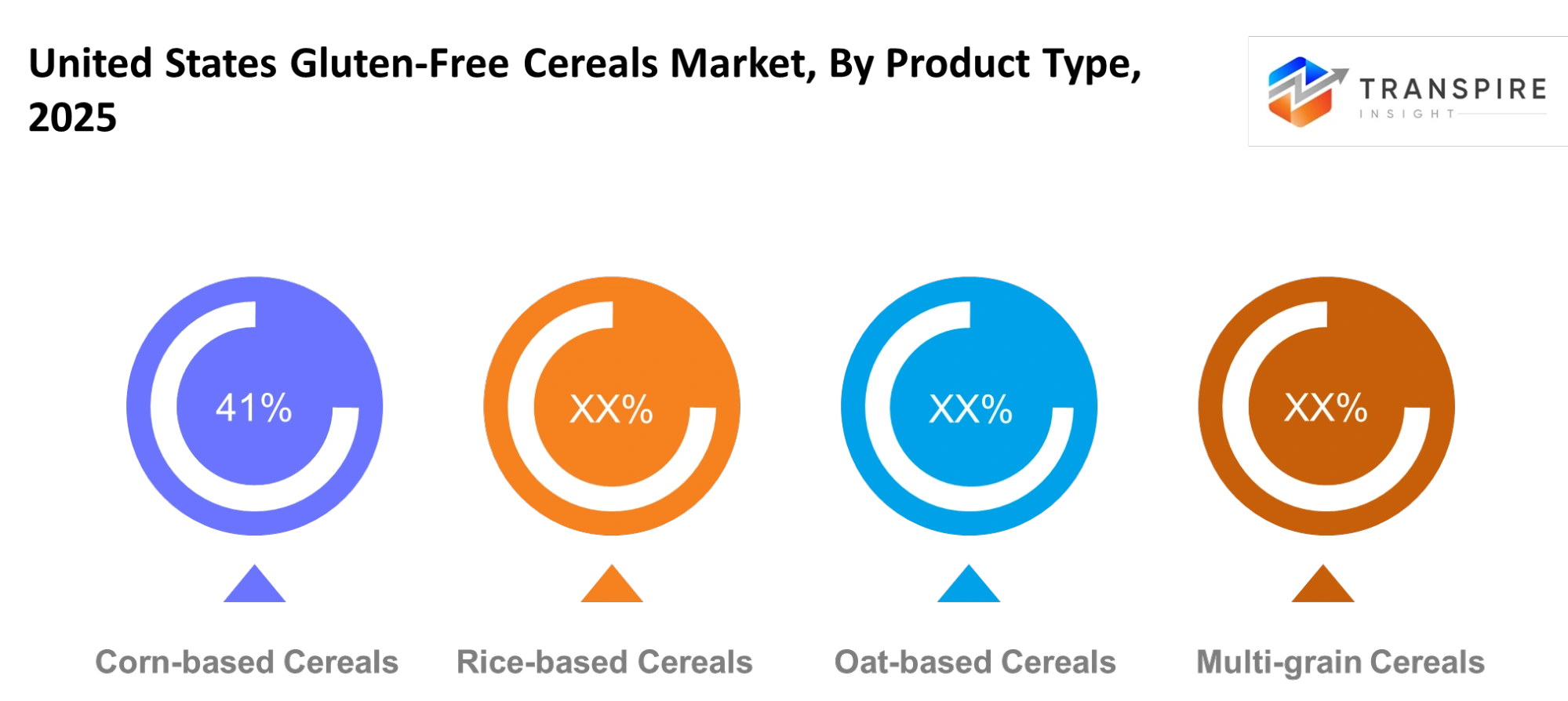
Corn-based cereals maintain a strong market position because they are affordable and most people prefer to eat them. Rice-based cereals follow closely rice-based cereals which provide a mild taste that people of all ages can easily digest. Oat-based cereals attract customers because they provide dietary fiber and support heart health which helps their demand to increase. Multi-grain cereals use different types of grains to create better nutritional value which attracts customers who want to maintain good health.
Different dietary requirements and taste preferences exist in each product category which helps to create balanced market demand. The corn and rice segments will maintain their market leadership because they offer cheaper prices and consumers already know these products. The demand for oat-based and multi-grain products will experience rapid expansion because more people want to buy functional foods. The company will increase its product selection through ongoing development work which will maintain customer interest.
To learn more about this report, Download Free Sample Report
By Distribution Channel
Supermarkets and hypermarkets remain the primary distribution channel because they provide customers with product visibility and customers can easily access their stores. Health food stores cater to a niche audience who seek organic products and specialty gluten-free products that meet their higher quality standards.
The online retail sector experiences rapid growth because it offers customers convenient shopping options together with an extensive range of products and its ability to offer low prices. Digital platforms enable brands to connect with specific consumer groups in a more efficient manner.
The growth of all distribution channels will receive support from the changing shopping habits of consumers. Supermarkets will maintain their market lead because of their extensive store network and the trust consumers place in them. Online retail will experience its quickest growth period because more people are adopting digital technologies while home delivery services become more popular. Health food stores will continue to serve premium segments focused on specialized dietary choices.
What are the Main Challenges for the United States Gluten-Free Cereals Market Growth?
The gluten-free cereals market in the United States experiences major technical and operational difficulties which prevent companies from delivering consistent products that taste good without using gluten-based ingredients. The development of desired product qualities requires manufacturers to use multiple complex components which results in greater dependence on unique production materials.
The production process experiences additional risks because of supply chain restrictions on certified gluten-free raw materials. The existing problems of the united states gluten-free cereals market operations result in operational limitations which hinder business expansion.The united states gluten-free cereals market faces manufacturing and commercialization obstacles which stem from the requirement to implement complete production process segregation for cross-contamination prevention.
Food manufacturers experience higher costs because they must follow food safety standards and labeling requirements. Small-scale companies encounter production expansion challenges because they must meet both high capital needs and certification standards. The gluten-free cereal market in the United States faces growth obstacles which result in product development delays and decreased profit potential.
The adoption of gluten-free cereals in the United States faces major obstacles because price-sensitive customers view these products as expensive specialty items. The market for the product remains restricted because some consumer groups lack basic knowledge about the product. The market expansion process faces obstacles because companies experience shortages of qualified skilled workers and proper technological systems needed for production. The limitations of various market segments create obstacles which hinder the speed of market adoption and expansion.
Country Insights
The United States gluten-free cereals market demonstrates consistent market differences that result from consumer dietary knowledge and their income levels. Urban areas show increased demand because customers choose breakfast foods that have visible ingredient information. The combination of retail expansion and improved product display will enable products to maintain their visibility throughout the store.
The growth of the market will depend on both current lifestyle preferences and the availability of gluten-free items throughout different parts of the world. The growth of organized retail and online shopping platforms will enable businesses to reach markets that currently have low market coverage. Manufacturers will develop products according to local tastes to enhance product attractiveness in specific markets. Stable supply chains will provide essential support to achieve equal growth across different areas.
The West and Northeast regions exhibit strong demand because their residents show better health knowledge and higher financial resources. The premium and organic gluten-free cereal markets in these regions will continue to expand because they have better product availability than other areas. The combination of retail networks and specialty stores will create new opportunities for product distribution. Fitness-oriented and health-oriented customers will continue to show strong demand for the product.
Midwest and South regions experience slow market growth which retail expansion and consumer education initiatives currently support. The region will gain more customers because affordable product options become available to consumers. Online retail expansion will create better access to a wide range of product options. Through their regional expansion plans brands will build market share which will help them maintain their competitive strength.
Recent Development News
In April 2026, Leading Gluten-Free Food Companies Drive Innovation in U.S. Market: Major gluten-free food producers, including cereal manufacturers, were highlighted in April 2026 for driving innovation in the U.S. gluten-free food sector. The recognition reflects continued investment in expanding gluten-free product lines and improving formulation technologies for specialty consumers.
Source: https://www.fortunebusinessinsights.com
In February 2026, Post Holdings Raises 2026 Outlook After Strong Q1 Financial Results: Post Holdings reported strong first-quarter fiscal 2026 financial results with $2.2 billion in net sales and raised its full-year outlook. The company’s breakfast cereal segment, including specialty and gluten-free cereal offerings, remains a major contributor to its U.S. packaged foods business.
Source: https://www.prnewswire.com
|
Report Metrics |
Details |
|
Market size value in 2025 |
USD 210.5 Million |
|
Market size value in 2026 |
USD 229.65 Million |
|
Revenue forecast in 2033 |
USD 425.3 Million |
|
Growth rate |
CAGR of 9.20% from 2026 to 2033 |
|
Base year |
2025 |
|
Historical data |
2021 – 2024 |
|
Forecast period |
2026 – 2033 |
|
Report coverage |
Revenue forecast, competitive landscape, growth factors, and trends |
|
Country scope |
United States |
|
Key company profiled |
General Mills Inc., Kellogg Company, Nature’s Path Foods, Bob’s Red Mill Natural Foods, Post Holdings Inc., Nestlé SA, Freedom Foods Group Ltd., B&G Foods Inc., Enjoy Life Foods, The Hain Celestial Group, Purely Elizabeth LLC, Barbara’s Bakery Inc., Glutino Food Group, Nairn’s Oatcakes Ltd., Arrowhead Mills. |
|
Customization scope |
Free report customization (country, regional & segment scope). Avail customized purchase options to meet your exact research needs. |
|
Report Segmentation |
By Product Type (Corn-based Cereals, Rice-based Cereals, Oat-based Cereals, Multi-grain Cereals), By Distribution Channel (Supermarkets & Hypermarkets, Health Food Stores, Online Retail). |
How Can New Companies Establish a Strong Foothold in the United States Gluten-Free Cereals Market?
New entrants can establish their presence in the United States gluten-free cereals market through the creation of products that serve unmet requirements in high-protein and low-sugar and allergen-free product categories. Brands achieve differentiation through their special product offerings which meet either diabetic or child-based dietary requirements.
Market expansion requires businesses to use clear product labeling combined with clean ingredient lists and transparent practices which help build customer trust. The innovation strategies of the company match the current market trends and the growing demand for health-related products.
The gluten-free cereal market in the United States requires product innovation and technological differentiation as vital elements for business achievement. Companies can use smart manufacturing together with data-driven insights to create gluten-free products which maintain their original texture and flavor and shelf life. Companies can improve their distribution network and brand recognition through partnerships with ingredient suppliers and health-oriented retailers. Partnerships between businesses and nutrition specialists or health organizations enable organizations to develop dietary solutions which establish trustworthiness with their desired customers.
The United States gluten-free cereal market presents new business opportunities which existing companies are using through their innovative business strategies. Purely Elizabeth develops organic cereals which contain high nutrition value while Magic Spoon uses direct-to-consumer approaches to market its high-protein and low-carb products.
The three shown examples demonstrate how businesses can achieve competitive advantage through their use of innovative methods and targeted marketing and digital channels. Sustainable business growth will become easier for new businesses which create distinctive products through their effective management of distribution operations.
Key United States Gluten-Free Cereals Market Company Insights
The United States gluten-free cereals market shows strong competitive activity which the rising demand for healthier breakfast options supports. Established brands and new companies will use product quality and pricing and ingredient transparency as their primary methods to attract customers. The company will expand its market presence through continuous product improvements and its increasing availability at different retail locations.
The competitive environment will become more aggressive as businesses spend money on building their brands and developing new products to stay in the public eye. The market needs clean-label products that taste better to determine their purchasing options. The company will use retail expansion together with its online presence to reach more customers. Companies need to create distinct products because it will help them achieve sustainable business expansion.
Major companies in the market use their extensive distribution systems together with their ongoing product development to maintain powerful market positions. Brands will achieve competitiveness through their dedication to organic products and their development of fortified cereals that feature special taste profiles. Different customer groups will increase their purchasing behavior because of the company's pricing strategy and promotional initiatives.
New brands will acquire visibility by focusing on specific market needs which include cereals containing high protein or low sugar content. The market will experience faster entry through direct-to-consumer channels and online retail access. The combination of partnerships and unique product features will help companies build their brand identity. The company must keep developing new solutions to maintain its edge in the market.
Company List
- General Mills Inc.
- Kellogg Company
- Nature’s Path Foods
- Bob’s Red Mill Natural Foods
- Post Holdings Inc.
- Nestlé SA
- Freedom Foods Group Ltd.
- B&G Foods Inc.
- Enjoy Life Foods
- The Hain Celestial Group
- Purely Elizabeth LLC
- Barbara’s Bakery Inc.
- Glutino Food Group
- Nairn’s Oatcakes Ltd.
- Arrowhead Mills.
What are the Key Use-Cases Driving the Growth of the United States Gluten-Free Cereals Market?
The demand for gluten-free cereals in the United States market is expanding because people use these products as their main breakfast food while they need to avoid gluten due to celiac disease or gluten intolerance. The healthcare community through its dietary guidelines recommends gluten-free cereals as a safer alternative for people who need to avoid traditional products.
The United States gluten-free cereals market maintains its active demand through hospitals and wellness programs and nutrition plans which use this product.The United States gluten-free cereals market receives strong support through its second main application which provides busy urban residents with easy-to-use ready-to-eat meals. Students and working professionals now select gluten-free cereals because they provide quick meals which help them meet their health objectives.
Product advancement through single-serve packaging and fortified formulations enables products to deliver better user experience while supplying enhanced nutritional benefits.The United States gluten-free cereals market expands because it serves as a key component in the fitness and lifestyle nutrition markets. Health-conscious people and athletes now use high-protein gluten-free cereals which contain fiber as part of their weight control and performance nutrition plans.
Manufacturers now create specialized products which meet current consumer needs because this trend helps companies create products which will sustain their business operations.The United States gluten-free cereals market experiences increased demand because of plant-based diets and clean-label consumption patterns which have become popular. Consumers who want to eat clean natural food that has not been artificially processed are showing interest in cereals that use quinoa and millet as alternative grain options. The current application of this technology creates fresh possibilities for businesses to develop new products which will lead to future growth.
United States Gluten-Free Cereals Market Report Segmentation
By Product Type
- Corn-based Cereals
- Rice-based Cereals
- Oat-based Cereals
- Multi-grain Cereals
By Distribution Channel
- Supermarkets & Hypermarkets
- Health Food Stores
- Online Retail
Frequently Asked Questions
Find quick answers to common questions.
The approximate United States Gluten-Free Cereals Market size for the market will be USD 425.3 Million in 2033.
The key segments of the United States Gluten-Free Cereals Market are By Product Type (Corn-based Cereals, Rice-based Cereals, Oat-based Cereals, Multi-grain Cereals), By Distribution Channel (Supermarkets & Hypermarkets, Health Food Stores, Online Retail).
Major players in the United States Gluten-Free Cereals Market are General Mills Inc., Kellogg Company, Nature’s Path Foods, Bob’s Red Mill Natural Foods, Post Holdings Inc., Nestlé SA, Freedom Foods Group Ltd., B&G Foods Inc., Enjoy Life Foods, The Hain Celestial Group, Purely Elizabeth LLC, Barbara’s Bakery Inc., Glutino Food Group, Nairn’s Oatcakes Ltd., Arrowhead Mills.
The current market size of the United States Gluten-Free Cereals Market is USD 210.5 Million in 2025.
The United States Gluten-Free Cereals Market CAGR is 9.20%.
- General Mills Inc.
- Kellogg Company
- Nature’s Path Foods
- Bob’s Red Mill Natural Foods
- Post Holdings Inc.
- Nestlé SA
- Freedom Foods Group Ltd.
- B&G Foods Inc.
- Enjoy Life Foods
- The Hain Celestial Group
- Purely Elizabeth LLC
- Barbara’s Bakery Inc.
- Glutino Food Group
- Nairn’s Oatcakes Ltd.
- Arrowhead Mills.
Recently Published Reports
-
Dec 2024
Baby Infant Formula Market
Baby Infant Formula Market Size, Share & Analysis Report By ype (Infant Milk, Follow On Milk, Specialty Baby Milk, Growing-Up Milk), By Ingredient (Carbohydrate, Fat, Protein, Minerals, Vitamins, and Others), By Product Form (Powder, Liquid, and Ready-to-feed), By Distribution Channels (Supermarket/Hypermarket, Specialty Store, Pharmacies, Online Retail, and Others), and Geography (North America, Europe, Asia-Pacific, Middle East and Africa, South and Central America), 2021 - 2031
-
Jan 2025
Edible Insects for Animal Feed Market
Edible Insects for Animal Feed Market Size, Share & Analysis Report By Type (Insect Powder, Insect Meal, Insect Bar, Insect Paste, Insect Oil, and Others), By Insect Type (Beetles, Cricket, Caterpillar, Hymenoptera, Orthoptera, Tree Bugs, and Others), By Application (Livestock, Pet Food, and Aquaculture), By Livestock Type (Poultry, Swine, and Others), and Geography (North America, Europe, Asia-Pacific, Middle East and Africa, South and Central America), 2021 - 2031
-
Jan 2025
Food Industry Disinfection and Bacterial Control Market
Food Industry Disinfection and Bacterial Control Market Size, Share & Analysis Report By Type (Chemical Disinfectants, Physical Disinfectants, and Biocides and Antimicrobials), By Application (Food Processing Equipment Surface Disinfection, Food Preparation Areas Surface Disinfection, Storage Areas Surface Disinfection, Anti-microbial Coatings Food Preservation, and Preservative Solutions Food Preservation), By End User (Meat and Poultry Processing, Dairy Processing, Seafood Processing, Bakery and Confectionery, Restaurants and Commercial Kitchens, and Food Service Providers), By Sales Channel (Online, Offline), and Geography (North America, Europe, Asia-Pacific, Middle East and Africa, South and Central America), 2021 - 2031
-
Jan 2025
Freeze Dried Food Market
Freeze Dried Food Market Size, Share & Analysis Report By Product Type (Fruits, Vegetables, Freeze-Dried Dairy Products, Freeze-Dried Meat and Seafood, Freeze-Dried Pet Food, and Prepared Meal), By Nature (Organic, and Conventional), By Form (Powdered, Granules, and Diced), By End Use (Breakfast Cereals, Dairy Products, Bakery & Confectionery, Nutritional Bars & Supplements, Powdered Beverages, Snacks, and Retail (Household)), and Geography (North America, Europe, Asia-Pacific, Middle East and Africa, South and Central America), 2021 - 2031