

France Cellulose Fiber Market Size & Forecast:
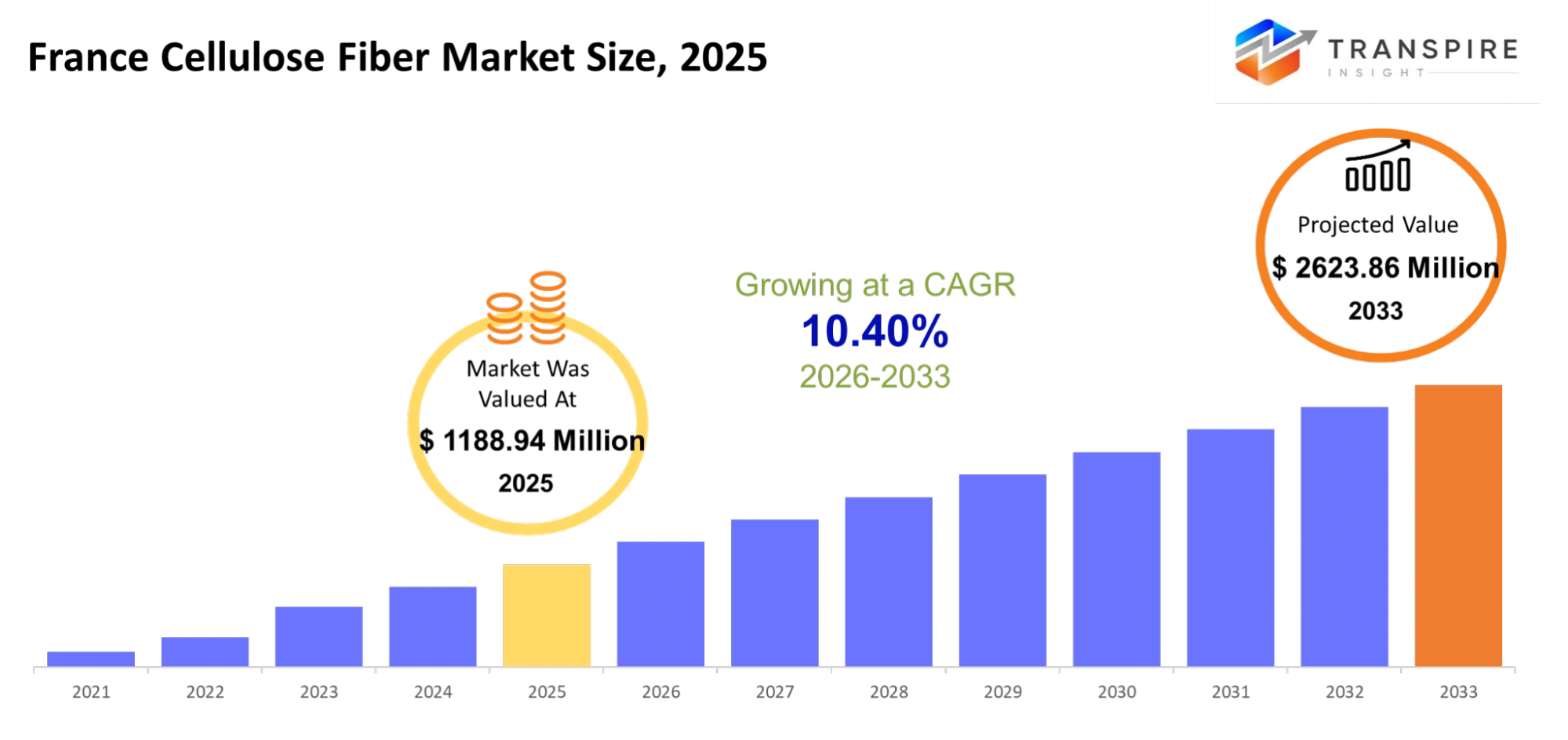
- France Cellulose Fiber Market Size 2025: USD 1188.94 Million
- France Cellulose Fiber Market Size 2033: USD 2623.86 Million
- France Cellulose Fiber Market CAGR: 10.40%
- France Cellulose Fiber Market Segments: By Type (Natural Cellulose Fiber, Man-made Cellulose Fiber),By Application (Textiles, Hygiene Products, Industrial Materials).
To learn more about this report,  Download Free Sample Report
France Cellulose Fiber Market Summary:
The France Cellulose Fiber Market size is estimated at USD 1188.94 Million in 2025 and is anticipated to reach USD 2623.86 Million by 2033, growing at a CAGR of 10.40% from 2026 to 2033.The French market for cellulose fiber maintains steady growth because the country prioritizes sustainable development and supports environmentally sustainable materials. People consider cellulose fibers which come from wood pulp and cotton as valuable materials because they can be broken down by nature and restored from their original state and produce minimal environmental damage. The French workforce shows increasing preference for cellulose fibers because industries are replacing synthetic petroleum-derived materials with these natural substances.
The textile industry requires more products which drives market growth because of its increasing demand. French consumers are becoming more conscious of sustainable fashion, leading to higher adoption of fibers such as viscose, modal, and lyocell. The materials provide users with comfortable clothing which allows them to breathe while maintaining environmentally friendly characteristics that make them appropriate for both casual wear and high-end fashion. Brands that follow circular economy principles will succeed through their sustainable sourcing methods which create demand for their products.
The cellulose fiber market expands because both paper and packaging industries and textile businesses use cellulose fibers. People are increasingly choosing cellulose-based packaging solutions because of their worries about plastic waste and the strict regulations that govern single-use plastics. Industries use these fibers for their biodegradable packaging needs and hygiene products and nonwoven materials which they use for medical and personal care applications.
Fiber processing technology and innovation combine to create new market opportunities for business growth. The development of manufacturing techniques enables companies to produce high-quality cellulose fibers which they use for multiple applications including insulation and filtration and all other purposes.
What Has the Impact of Artificial Intelligence Been on the France Cellulose Fiber Market?
AI technology is transforming the France cellulose fiber market by providing organizations with better ways to make decisions and enhance their entire value chain operations. The implementation of AI technology in the France cellulose fiber market enables organizations to process extensive data sets which help them identify market patterns and obtain practical business intelligence.
AI-powered tools are significantly enhancing demand forecasting and production optimization within the France cellulose fiber market. Manufacturers can use advanced algorithms to forecast demand changes, helping them reduce waste and improve the efficiency of raw material consumption, thereby achieving better cost performance. Smart automation technology improves production efficiency by reducing human mistakes which results in more consistent products and higher production capacity.
AI technology has become essential for supply chain management and innovative development in the France cellulose fiber market. Predictive analytics enables companies to monitor their logistics operations, inventory levels and distribution networks in real time which helps them decrease delays and cut their operational expenses. AI-powered research and development processes are speeding up the development of new cellulose-based materials which have higher performance attributes.
Key Market Trends & Insights:
- The France cellulose fiber market is experiencing continuous growth because consumers now show increased demand for sustainable materials and environmentally friendly textile products.
- The market will continue to grow until 2030 at a compound annual growth rate of 5 to 7 per cent, driven by effective regulatory support and advanced product development.
- The northern and industrial areas of France control almost 35 percent of the cellulose fiber market because their established production centers. The sustainable textile industry in southern France will drive economic growth through its environmentally friendly textile production facilities which will develop at a 6.5 percent annual growth rate between 2025 and 2030.
- Viscose fiber dominates the france cellulose fiber market with approximately 40 percent share in 2024 because of high demand in textile manufacturing. The second largest market share belongs to lyocell fiber because of its environmentally friendly production method which premium apparel brands increasingly adopt.
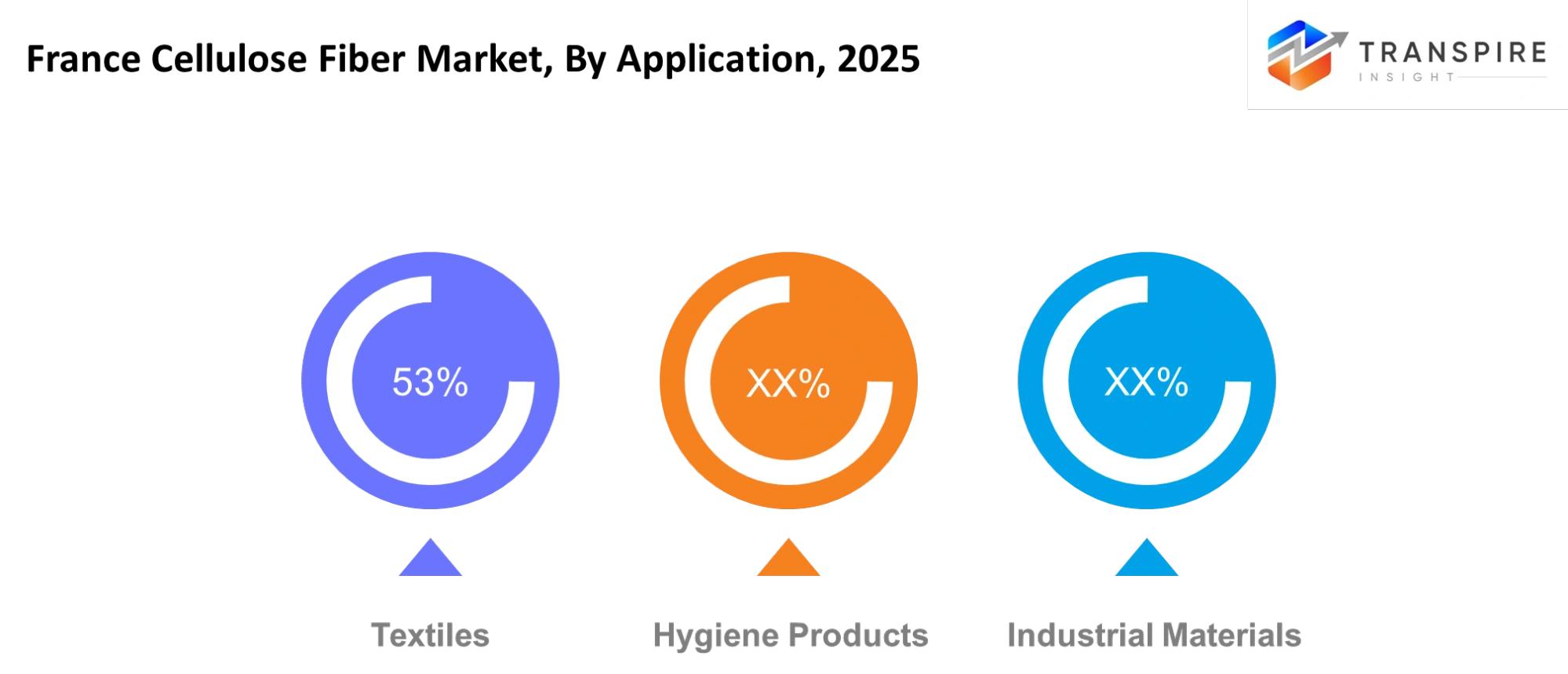
- The modal fiber sector represents the fastest expanding market, which will experience continuous growth at a rate of more than 7% until 2030 because consumers increasingly seek soft and durable textile materials. The France cellulose fiber market experiences its highest demand from textile applications, which account for more than 50% of total market requirements in 2024, as sustainable fashion practices become more popular.
- The packaging industry and nonwoven products experience market growth because biodegradable products and plastic-free solutions meet customer requirements.
- In France cellulose fiber market the apparel industry controls 45% of end-user demand because consumers prefer eco-friendly products.
- The healthcare and hygiene sectors represent the fastest-growing end-user category because they experience rapid expansion from increased demand for nonwoven and disposable products. The main companies operating in the French cellulose fiber industry include Lenzing AG Aditya Birla Group, Sappi Limited UPM-Kymmene Corporation and Eastman Chemical Company.
- These companies focus their efforts on developing product innovations which include advanced biodegradable fibers to secure a major market share of the France cellulose fiber market.
- The company develops a competitive advantage through its strategic partnerships and expansion of operational capacity which also enables it to improve its market presence across various locations. Companies achieve cost efficiency and long-term growth through the implementation of smart automation and AI-driven production and sustainable sourcing methods.
France Cellulose Fiber Market Segmentation
By Type:
Natural cellulose fiber includes materials derived directly from plants such as cotton and wood pulp which provide users with biodegradable materials that bring comfort. Strong demand will come from textile and hygiene industries where softness and breathability remain important. Natural cellulose fiber production depends on agricultural output together with sustainable forestry practices. Environmental regulations will promote responsible sourcing practices which require supply chains to use certified raw materials.
The creation of man-made cellulose fiber involves chemical processing that transforms natural sources into three distinct products which include viscose and lyocell, and modal. The fibers will deliver enhanced strength together with consistent properties and multiple industrial applications. The market will expand because more people want environmentally friendly options that replace synthetic materials. Production processes will gain benefits through processing technology advances which will enhance operational efficiency while decreasing ecological footprint.
By Application:
The growing interest in comfortable biodegradable textiles which people use for their clothing and home furnishing needs has established textiles as the most important material in the market. The fashion industry will use cellulose-based fibers for everyday clothes and high-end fashion according to current industry trends. Manufacturers will focus on delivering products which meet consumer demands through their dedication to creating durable high-quality products.
Hygiene products include wipes, diapers, and sanitary items which need to meet high absorbency requirements while maintaining safety standards. Rising awareness about health and cleanliness will drive consistent demand in this segment. The environmental issues, which companies face, and the compliance requirements, which exist, will result in increased adoption of biodegradable materials. Product innovation will improve hygiene applications through enhanced performance and user comfort.
To learn more about this report, Download Free Sample Report
What are the Main Challenges for the France Cellulose Fiber Market Growth?
The France cellulose fiber market experiences several technical and operational difficulties, which create obstacles to its complete market expansion. Cellulose fiber production needs advanced chemical treatments with precise control systems for its production of lyocell fibres. Manufacturers find it hard to maintain product quality and performance standards when their production facilities operate at full capacity. The France cellulose fiber market faces supply chain obstacles which arise from sustainable raw material needs that include certified wood pulp.
The France cellulose fiber market faces major obstacles from two factors which include manufacturing restrictions and product commercialization challenges. The production process requires high expenses because it depends on energy-consuming operations and needs sustainable production methods, which result in lower profit margins. The strict environmental regulations in France and throughout Europe make compliance more expensive, resulting in delays for businesses in introducing new products. The combination of these factors creates hurdles for business development that particularly affect small and medium-sized manufacturers who need to grow their operations and develop new products.
The France cellulose fiber market faces adoption difficulties because various industries still depend on less expensive synthetic materials. The limited infrastructure which exists for large-scale processing and recycling of cellulose-based materials prevents widespread acceptance of these materials. Advanced production methods cannot be efficiently implemented due to a lack of skilled workers and technical knowledge. The existing market restrictions prevent a quick shift to sustainable materials despite growing public awareness of their advantages.
Country Insights
Northern and eastern industrial zones continue to show strong activity because their existing manufacturing facilities and dependable raw material sources. The textile and paper industries will create constant demand for these regions. The logistics networks which have been built show capacity to deliver products and handle supply operations. The system will enable continuous production through its unchanging infrastructure.
The southern regions show increasing sustainability efforts which receive backing from environmental regulations and growing consumer environmental knowledge. The market demand for environmentally friendly textiles and packaging materials that decompose will increase steadily. The development of local businesses will generate economic growth for the entire area. The implementation of cleaner production technologies will enhance manufacturing standards while boosting future business expansion opportunities.
The western areas develop sustainably because they combine industrial activities with commercial development. The packaging and hygiene industries will experience unchanging demand because customers will always require their products. The strong access between ports and transportation networks will create new business opportunities through enhanced trade connections. Different applications used in various sectors will create stable results throughout different industries.
The central regions of the country are becoming industrial centers because more factories establish themselves there and infrastructure progress continues. The manufacturing sector will boost demand because new factories will start their operations throughout this area. The industrial sector will expand as government initiatives and regional development programs provide the resources industrial enterprises require. The organization will build stronger production capabilities through improved resource access and better supply chain management systems.
Recent Development News
- In March 2026, Lenzing AG hosted a high-level policy roundtable to promote bio-based cellulose fibers as key to Europe’s clean industrial transition, highlighting scalability challenges and regulatory needs.https://www.lenzing.com
- In April 2026, Sappi Limited announced a €40–€50 per ton price increase for graphic paper products across Europe due to rising costs and supply chain volatility impacting profitability. https://www.sappi.com
|
Report Metrics |
Details |
|
Market size value in 2025 |
USD 1188.94 Million |
|
Market size value in 2026 |
USD 1312.35 Million |
|
Revenue forecast in 2033 |
USD 2623.86 Million |
|
Growth rate |
CAGR of 10.40% from 2026 to 2033 |
|
Base year |
2025 |
|
Historical data |
2021 - 2024 |
|
Forecast period |
2026 - 2033 |
|
Report coverage |
Revenue forecast, competitive landscape, growth factors, and trends |
|
Regional scope |
United States; Canada; Mexico; United Kingdom; Germany; France; Italy; Spain; Denmark; Sweden; Norway; China; Japan; India; Australia; South Korea; Thailand; Brazil; Argentina; South Africa; Saudi Arabia; United Arab Emirates |
|
Key company profiled |
Lenzing AG, Aditya Birla Group, Sateri, Tangshan Sanyou Chemical Fiber, Kelheim Fibres, Grasim Industries, Xinxiang Chemical Fiber, Fulida Group, Nanjing Chemical Fiber, Birla Cellulose, Yibin Grace Group, Toray Industries, Teijin, Svenska Cellulosa, Eastman Chemical. |
|
Customization scope |
Free report customization (country, regional & segment scope). Avail customized purchase options to meet your exact research needs. |
|
Report Segmentation |
By Type (Natural Cellulose Fiber, Man-made Cellulose Fiber),By Application (Textiles, Hygiene Products, Industrial Materials). |
How Can New Companies Establish a Strong Foothold in the France Cellulose Fiber Market?
New companies can establish a strong foothold in the French cellulose fiber market by focusing on niche segments that are underserved or rapidly growing. New companies can use biodegradable packaging and medical nonwovens and sustainable fashion materials to enter markets that match current market growth and industry trends. The establishment of an eco-friendly value proposition which meets regulatory requirements will enable businesses to stand out from their competitors.
The success of companies in the French cellulose fiber market depends on their ability to differentiate themselves through innovation and advanced technology. New companies should invest in advanced processing methods, such as closed-loop production systems and low-emission manufacturing, to reduce costs and environmental impact. The combination of predictive analytics with smart automation technology enables organizations to achieve better operational productivity and consistent product quality.
Strategic partnerships and collaborations can accelerate entry into the france cellulose fiber market by providing access to distribution networks, raw materials, and technical expertise. The company needs to partner with textile manufacturers and packaging firms and healthcare suppliers to develop solutions which can solve industry problems while expanding its business.
The development of strong market entry strategies requires organizations to establish manufacturing facilities in local markets while creating complete visibility of their supply chain and developing pricing strategies that are market competitive.
Key France Cellulose Fiber Market Company Insights
Lenzing AG, Aditya Birla Group, and Sateri maintain leadership positions because they consistently produce sustainable fibers while operating worldwide supply chains. The business will expand its market presence through investments which include environmentally friendly technology and certified material sourcing. The company will increase its revenue through its entry into high-end textile markets. The company will maintain its unique competitive edge through its ongoing research and development efforts.
Tangshan Sanyou Chemical Fiber, Kelheim Fibres, and Grasim Industries use production efficiency together with multiple product options to meet continuous market requirements. The company will improve its market position through expense control and production process efficiency. The business will achieve sustainable development through its partnerships with textile companies and hygiene product manufacturers. The company will increase its operational footprint through its entry into fresh markets.
Xinxiang Chemical Fiber, Fulida Group, and Nanjing Chemical Fiber increase their business operations through the development of new production capabilities and better technological processes. The company will enhance its productivity and production quality through its investment in modern manufacturing solutions. The company will draw more customers through its competitive price approach. The company will achieve revenue stability through its focus on international sales opportunities.
Teijin, Svenska Cellulosa, and Eastman Chemical maintain their market leadership through their research on advanced technologies and specialized fiber development. The business will establish itself in new sectors through its expansion into industrial and technical markets.
Company List
- Lenzing AG
- Aditya Birla Group
- Sateri
- Tangshan Sanyou Chemical Fiber
- Kelheim Fibres
- Grasim Industries
- Xinxiang Chemical Fiber
- Fulida Group
- Nanjing Chemical Fiber
- Birla Cellulose
- Yibin Grace Group
- Toray Industries
- Teijin
- Svenska Cellulosa
- Eastman Chemical.
What are the Key Use-Cases Driving the Growth of the France Cellulose Fiber Market?
The France cellulose fiber market is experiencing growth because the textile industry needs sustainable fabrics, which have become important to their production processes. The apparel industry uses cellulose-based fibers which include viscose and lyocell, because these materials offer breathability and softness and they decompose naturally. Fashion brands are shifting toward eco-friendly materials to meet regulatory standards and consumer expectations, which directly supports growth in the france cellulose fiber market.
The France cellulose fiber market relies on hygiene and healthcare applications as its main development application. Nonwoven cellulose fibers provide high absorbency and safety features, which make them suitable for use in wipes, diapers and medical disposables. The healthcare sector is adopting hygienic practices together with biodegradable products at an increasing rate. The market segment keeps growing because hospitals and personal care brands choose sustainable materials that ensure safe use.
The France cellulose fiber market depends on packaging applications because industries are starting to reject single-use plastics. Biodegradable packaging solutions use cellulose fibers which provide both strength and environmental advantages. The growth of e-commerce and food delivery services drives higher demand for sustainable packaging solutions, creating new business opportunities for producers.
The France cellulose fiber market expands through industrial applications which include filtration and insulation and reinforcement materials. These fibers offer construction and manufacturing industries durable materials which can be used in technical applications.
France Cellulose Fiber Market Report Segmentation
By Type
- Natural Cellulose Fiber
- Man-made Cellulose Fiber
By Application
- Textiles
- Hygiene Products
- Industrial Materials
Frequently Asked Questions
Find quick answers to common questions.
The approximate France Cellulose Fiber Market size for the market will be USD 2623.86 Million in 2033.
Key segments for the France Cellulose Fiber Market are By Type (Natural Cellulose Fiber, Man-made Cellulose Fiber),By Application (Textiles, Hygiene Products, Industrial Materials).
Major France Cellulose Fiber Market players are Lenzing AG, Aditya Birla Group, Sateri, Tangshan Sanyou Chemical Fiber, Kelheim Fibres, Grasim Industries, Xinxiang Chemical Fiber, Fulida Group, Nanjing Chemical Fiber, Birla Cellulose, Yibin Grace Group, Toray Industries, Teijin, Svenska Cellulosa, Eastman Chemical.
The France Cellulose Fiber Market size is USD 1188.94 Million in 2025.
The France Cellulose Fiber Market CAGR is 10.40%
- Lenzing AG
- Aditya Birla Group
- Sateri
- Tangshan Sanyou Chemical Fiber
- Kelheim Fibres
- Grasim Industries
- Xinxiang Chemical Fiber
- Fulida Group
- Nanjing Chemical Fiber
- Birla Cellulose
- Yibin Grace Group
- Toray Industries
- Teijin
- Svenska Cellulosa
- Eastman Chemical.
Recently Published Reports
-
May 2026
Healthcare Polymer Packaging Market
Healthcare Polymer Packaging Market Size, Share & Analysis Report By Packaging Type (Syringes, IV Bottles and Pouches, Clamshells, Blisters, Bottles & Jars, Containers, Tubes, IV Parental Packaging, Others), By Type (Regulated, Non-regulated), By Polymer Type (LDPE (Low-Density Polyethylene), HDPE (High-Density Polyethylene), Homo-polymer (Homo), Random Copolymer (Random), Block Copolymer (Block), PET, Polystyrene, Polyvinyl Chloride, Polyamide/EVOH, Others), and Geography (North America, Europe, Asia-Pacific, Middle East and Africa, South and Central America), 2021 - 2031
-
Apr 2026
Hydrophilic Tape (Waterstop) Market
Hydrophilic Tape (Waterstop) Market Size, Share & Analysis Report By Type (Bentonite-Based Hydrophilic Tape, Rubber-Based Hydrophilic Tape), By Application (Residential Buildings, Commercial Buildings, Infrastructure Projects), and Geography (North America, Europe, Asia-Pacific, Middle East and Africa, South and Central America), 2021 - 2031
-
Apr 2026
Metalens Market
Metalens Market Size, Share & Analysis Report By Type (Visible Light Metalens, and Infrared Metalens), By Application (Consumer Electronics, Automotive Electronics, Industrial, Medical, and Others), and Geography (North America, Europe, Asia-Pacific, Middle East and Africa, South and Central America), 2021 - 2031
-
Apr 2026
PBT Resin Market
PBT Resin Market Size, Share & Analysis Report By Type (Reinforced PBT Resin, Unreinforced PBT Resin), By Processing Method (Injection Molding, Extrusion, Blow Molding, Others), By End-User (Automotive, Electrical & Electronics, Consumer Appliances, Industrial Machinery, Medical Devices, Packaging, Others), and Geography (North America, Europe, Asia-Pacific, Middle East and Africa, South and Central America), 2021 - 2031