

Middle East and Africa Automatic Number Plate Recognition System Market Size & Forecast:
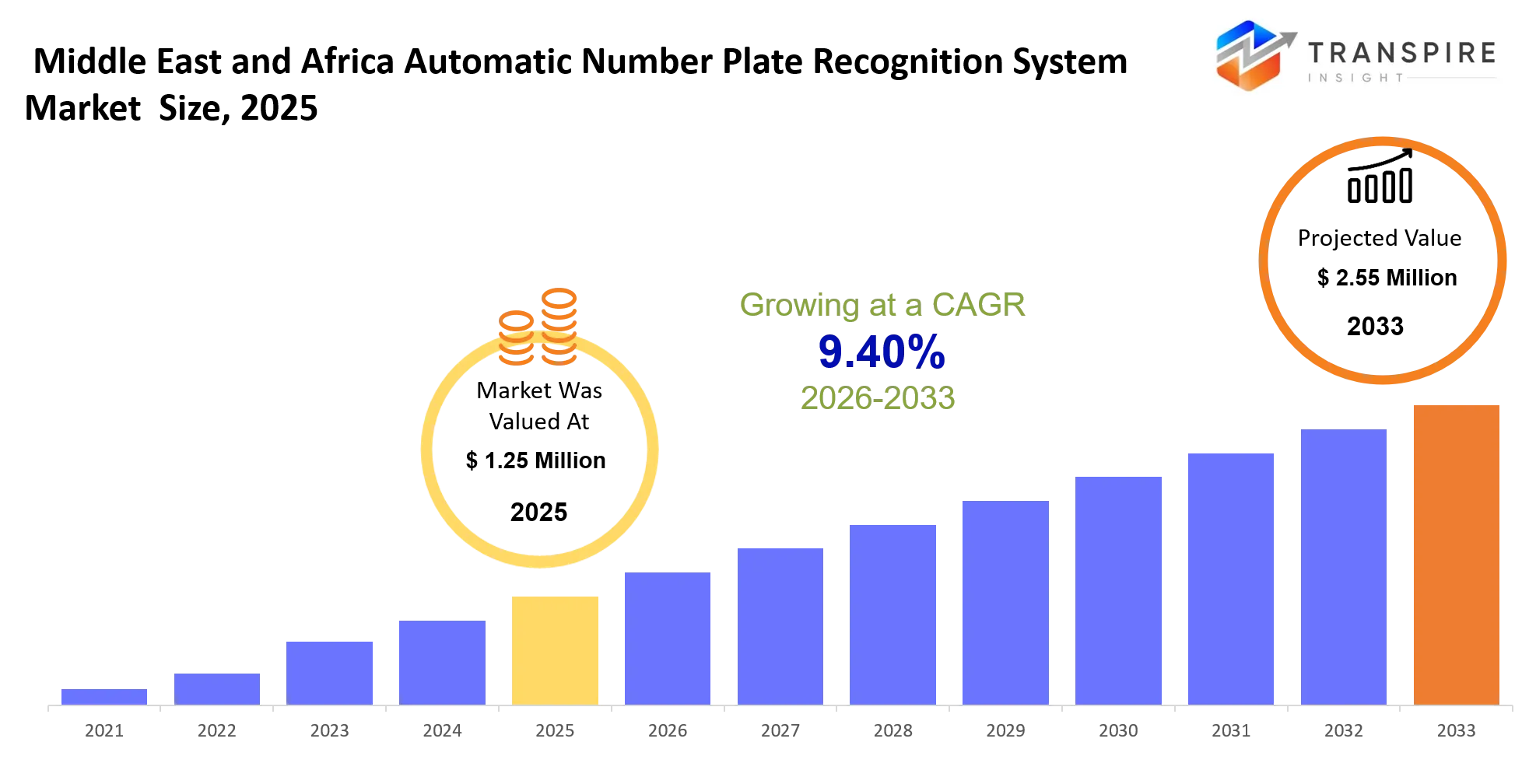
- Middle East and Africa Automatic Number Plate Recognition System Market Size 2025: USD 1.25 Million
- Middle East and Africa Automatic Number Plate Recognition System Market Size 2033: USD 2.55 Million
- Middle East and Africa Automatic Number Plate Recognition System Market CAGR: 9.40%
- Middle East and Africa Automatic Number Plate Recognition System Market Segments: By Component (Hardware, Software, Services, Others); By Application (Traffic Management, Law Enforcement, Parking Management, Toll Collection, Others); By Deployment (Fixed Systems, Mobile Systems, Cloud-Based Systems, Others); By End User (Government, Transportation Authorities, Commercial Facilities, Others)
To learn more about this report,  Download Free Sample Report
Middle East and Africa Automatic Number Plate Recognition System Market Summary
The Middle East and Africa Automatic Number Plate Recognition System Market was valued at USD 1.25 Million in 2025. It is forecast to reach USD 2.55 Million by 2033. That is a CAGR of 9.40% over the period.
In the Middle East and Africa, the Automatic Number Plate Recognition System Market matters a lot for modern transport and public safety, basically because it lets operators do real-time vehicle identification, watch traffic, support parking automation, streamline toll collection, and back up law enforcement actions, not just in one place but across city streets and intercity routes too. With ANPR systems, authorities can ease congestion, raise road safety levels, help with vehicle access control that’s more or less automatic and also improve security visibility where they need it most.
Over the last five years, things changed from mostly standalone camera- based setups to more AI enabled and cloud linked platforms that can process vehicle data in real time, and in many cases faster then before, at least for the most common use cases. You can see this push clearly in smart city initiatives around the Gulf and in other places where digital transportation programs are expanding. A big turning point arrived after increased investments in intelligent transportation systems, especially tied to post- pandemic urban mobility modernization work and big infrastructure builds. Since governments and transportation agencies are trying to gain operational efficiency, ANPR deployments are getting wrapped into larger traffic management ecosystems. That kind of integration helps raise enforcement accuracy, cuts down on manual monitoring expenses, and opens up recurring revenue streams through software subscriptions, analytics services, and long term system upkeep agreements.
Key Market Insights
- Gulf Cooperation Council nations are expected to hold around 45%+ market share in 2025, fueled by smart city upgrades and intelligent transportation spending … you know, that kind of push.
- In the Middle East , regional revenue is still the biggest driver, mainly because the road infrastructure is more mature and public security modernization programs are scaling up on a large scale.
- Africa meanwhile is projected to be the fastest-growing regional market through 2033, as urban traffic monitoring initiatives keep widening, and traffic management programs are getting more attention.
- On the segment side, hardware stays the main segment, with roughly 50% market share in 2025, largely tied to camera and sensor rollout needs.
- Then software comes in as the second-biggest portion, since agencies adopt analytics, vehicle tracing, and centralized monitoring platforms.
- Cloud-based deployments are also set to rise at above 11% per year through 2033, as transportation authorities move away from legacy environments.
- Traffic management applications account for close to 35% of market revenue because congestion monitoring keeps expanding and automated enforcement programs are rolling out.
- Law enforcement applications are growing quickly too, as AI-enabled vehicle identification boosts investigation and surveillance functions.
- Overall, government agencies represent more than 40% of market demand, driven by investment in national security and transportation digitization.
- Key players like Kapsch TrafficCom, Siemens, Genetec, Bosch, NEC, and Thales are putting money into AI analytics, cloud platforms, and regional partnerships, kinda across the board.
What are the Key Drivers, Restraints, and Opportunities in the Middle East and Africa Automatic Number Plate Recognition System Market?
The strongest kind of growth push comes from government investment into intelligent transportation systems, and also smart city builds that are a bit more connected than before. In places like the UAE and Saudi Arabia, digital mobility programs have sped up and they lean on automated vehicle identification for traffic enforcement, congestion control, and security surveillance. Because of this, there’s been a kind of steady purchasing wave for cameras, analytics tools, and joined up traffic platforms. As transport authorities start digitizing their day to day work, ANPR helps cut the manual enforcement costs while making vehicle tracking more precise, and it really backs up higher adoption rates, plus that recurring service income.
The most important obstacle is still the heavy upfront spending needed for big deployments. To do it well, you need high-resolution cameras, reliable communication networks data centers, and smooth integration with existing transportation systems. A lot of municipalities across parts of the developing African markets keep hitting budget constraints, along with infrastructure gaps that cannot be fixed fast enough. These long lasting structural limits tend to slow down procurement timelines, shrink how much can be deployed at once, and they can lower the near term revenue chances for vendors.
Cloud native ANPR platforms feel like a major doorway for growth. More agencies are looking for centralized systems that link multiple checkpoints, parking areas, and enforcement networks into one place, not several separate things. With AI based analytics plus cloud management, they can track vehicles in near real time over wider regions, without needing extensive local infrastructure in every location.
What Has the Impact of Artificial Intelligence Been on the Middle East and Africa Automatic Number Plate Recognition System Market?
Artificial intelligence has kinda changed automatic number plate recognition systems , from basic vehicle identification into more clever traffic and security platforms. These days modern AI methods run vehicle classification, plate reading, odd-behavior detection, and traffic watching with very little hands-on work. Transportation agencies lean on this to handle thousands of vehicle entries in real time, and still boost day to day operational efficiency.
Machine learning models now push recognition accuracy even in tricky situations like dim lighting, fast traffic flows, dust, or just nasty weather. AI enabled setups can estimate congestion trends, spot suspicious vehicle maneuvers, and tune how enforcement resources are used. On top of that, advanced analytics help with predictive maintenance too, by noticing camera performance trouble before real failures happen. This can lower downtime and also maintenance spending.
Cloud connected ANPR systems with AI have made traffic monitoring work better , they also cut down on false reads and improve regulatory compliance across transportation corridors. With real-time analytics, incidents get handled quicker and road capacity is used more effectively.
Still, there are adoption hurdles. The integration costs can be pretty high , especially when someone tries to connect AI applications with older transportation infrastructure. Data quality problems, uneven camera placement, and limited technical knowhow in some regions can also drag down the algorithm results and stretch out rollout schedules.
Key Market Trends
- Investments for smart cities across the Gulf region went up, and with that, ANPR integration inside transport projects climbed by over 30% from 2021 through 2025, maybe even faster in some places.
- After 2023, AI-enabled vehicle recognition systems started swapping out conventional rule based software in a lot of new installations.
- At the same time, cloud managed monitoring platforms got more popular, since transportation authorities wanted a single kind of control across several locations, which, honestly, makes operations feel less messy.
- Real time enforcement also improved a lot , and modern setups can reach recognition accuracy above 95% in controlled environments.
- Digital toll collection initiatives kept expanding along major transport corridors, and this opened fresh chances for automated vehicle identification technologies to get used at scale.
- Transportation agencies now more often procure integrated traffic solutions rather than only standalone camera placements, because the whole pipeline matters.
- Security concerns also nudged procurement decisions. Buyers leaned toward cybersecurity focused vendors that can handle encrypted data management, so that sensitive records don’t just sit exposed.
- During 2024 and 2025 partnerships between technology providers and transportation authorities increased quite notably, largely to speed up infrastructure modernization and related upgrades.
- Companies like Genetec, Kapsch TrafficCom, Bosch, and NEC expanded their AI analytics capabilities inside transportation monitoring portfolios.
- Meanwhile, mobile ANPR deployments grew too, as law enforcement agencies looked for flexible surveillance solutions without building permanent infrastructure first.
Middle East and Africa Automatic Number Plate Recognition System Market Segmentation
By Component
Hardware is basically the base layer for automatic number plate recognition deployments, mostly via cameras, sensors, processors and communication hardware. High resolution imaging devices help keep vehicle identification more accurate in all kinds of traffic flows, and also in different weather or light settings. As investments keep going into intelligent transportation efforts, that supports hardware purchasing across road corridors, parking areas, and even border check points.
Software steps in with vehicle recognition tasks, analytics, database control, and the whole reporting side. Then there are the services, which cover installation, maintenance, integration, and also technical advice or consulting. The Others bucket covers supporting technologies, plus some special system components, that improve day to day operational output and make it easier to deploy in different scenarios and with different constraints.
By Application
Traffic Management is this pretty big application space, mostly because transportation agencies need real time vehicle awareness to bring down congestion and boost road utilization. Automated identification functions help with traffic stream tuning and also incident handling. Big city hubs keep spending money on smart traffic control systems, all the time.
Law Enforcement then uses ANPR for vehicle following, criminal inquiries, and security operations. Parking Management backs automated gate access, invoice processing, and occupancy surveillance. Toll Collection allows smooth vehicle handling and revenue capture. Other uses show up too, like border monitoring, campus safety, and specialized transport use cases.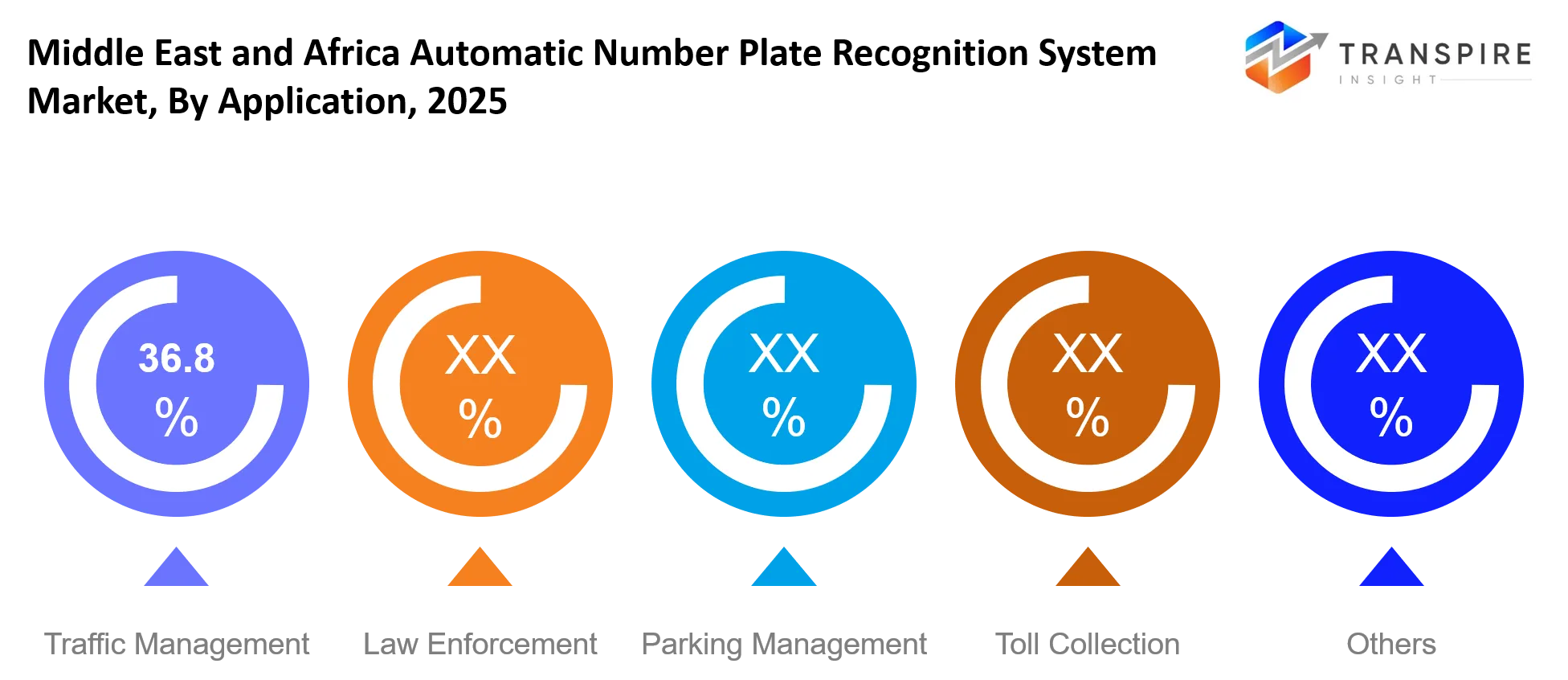
To learn more about this report, Download Free Sample Report
By Deployment
Fixed Systems are still widely in use along highways, by intersections, at toll plazas and in permanent monitoring sites. This steady infrastructure helps enable continuous vehicle tracking and gives support for enforcement operations. Over time, long-term government transportation projects keep funding this general deployment pattern.
Mobile Systems bring a bit more flexibility, for temporary monitoring needs, and for law enforcement activities that move around. Cloud-Based Systems enable centralized management, remote access and scalable analytics features across many different locations. Other options exist too, like hybrid deployment models that are built around particular operational needs and even regional infrastructure conditions.
By End User
Government orgs drive a lot of market momentum by pouring money into public safety, transportation modernization, and city mobility efforts . National and local authorities end up deploying ANPR tech to boost day to day efficiency and also strengthen security muscle, in a practical way. Over time, the broader infrastructure planning (not just the short term) keeps on supporting procurement activity ,and it keeps moving.
Transportation authorities rely on vehicle recognition systems for traffic observation, toll handling, and enforcement style use cases . Commercial facilities put in automated access control along with parking management solutions, so things stay organized even when it gets busy. Other places too, like schools and industrial sites, plus specialized security environments that want vehicle identification capabilities are also looking at these tools, and they often want similar results.
What are the Key Use Cases Driving the Middle East and Africa Automatic Number Plate Recognition System Market?
Traffic management stays the main use case because transportation authorities need ongoing vehicle monitoring to reduce congestion and make the road network more efficient. Automated vehicle identification helps with real-time traffic insight, incident response, and even enforcement activities across big urban corridors, not just one segment or another.
Other uses keep growing too, especially in law enforcement and parking management. Police departments lean on vehicle recognition systems to locate suspect vehicles and strengthen their investigative capacity. At the same time, commercial properties often roll out automated access control plus parking solutions, so operations run smoother and there’s less manual handling to deal with.
New opportunities are showing up as well, like smart border monitoring integrated mobility platforms, and connected transportation ecosystems. AI-driven vehicle analytics along with cloud-based monitoring services are getting a lot more attention because governments are pursuing broader transportation digitization goals and regional infrastructure modernization programs, which kind of ties everything together.
|
Report Metrics |
Details |
|
Market size value in 2025 |
USD 1.25 Million |
|
Market size value in 2026 |
USD 1.36 Million |
|
Revenue forecast in 2033 |
USD 2.55 Million |
|
Growth rate |
CAGR of 9.40% from 2026 to 2033 |
|
Base year |
2025 |
|
Historical data |
2021 - 2024 |
|
Forecast period |
2026 - 2033 |
|
Report coverage |
Revenue forecast, competitive landscape, growth factors, and trends |
|
Regional scope |
Middle East and Africa (Saudi Arabia, United Arab Emirates, South Africa, Rest of Middle East and Africa) |
|
Key company profiled |
Siemens, Kapsch TrafficCom, Jenoptik, Q-Free, Bosch, Hikvision, Dahua, NEC, Thales, Conduent, Cubic, Motorola Solutions, Verra Mobility, Swarco, Genetec |
|
Customization scope |
Free report customization (country, regional & segment scope). Avail customized purchase options to meet your exact research needs. |
|
Report Segmentation |
By Component (Hardware, Software, Services, Others); By Application (Traffic Management, Law Enforcement, Parking Management, Toll Collection, Others); By Deployment (Fixed Systems, Mobile Systems, Cloud-Based Systems, Others); By End User (Government, Transportation Authorities, Commercial Facilities, Others) |
Which Regions are Driving the Middle East and Africa Automatic Number Plate Recognition System Market Growth?
The Middle East actually leads market revenue generation because there’s substantial investment going into smart city development, transport digitization, and also public security modernization. Saudi Arabia and the UAE , for example, keep deploying more intelligent transportation infrastructure across big urban hubs. With strong government backing plus advanced road networks, the conditions stay pretty favorable for ANPR adoption. And when you connect ANPR into those wider smart mobility ecosystems, the regional position gets even more strengthened, almost like it compounds.
South Africa shows up as a key contributor in the African market, mainly due to its already established transportation infrastructure and the ongoing traffic management initiatives. The growth pattern looks different from Gulf countries , because many deployments lean toward operational efficiency and security improvement, rather than pushing huge smart city rollouts. Since transportation investment stays stable, technology adoption tends to move in a steadier way. Municipal authorities keep upgrading monitoring capabilities in major city locations, bit by bit, and it adds up.
Looking at the bigger African region, it’s expected to see the fastest expansion through 2033. Urbanization plus road infrastructure expansion , and transportation modernization programs, have sped up technology take-up. Fresh investments in digital mobility as well as public safety systems are opening doors for solution providers. If market players enter earlier, they can benefit from the growing deployment activity and those longer-term infrastructure development programs, which tends to keep demand consistent over time.
Who are the Key Players in the Middle East and Africa Automatic Number Plate Recognition System Market and How Do They Compete?
Competition is still kinda moderately fragmented, you have global transportation tech providers, security solution specialists, and surveillance equipment makers all going head to head on both government and transportation projects. What really tends to drive contract awards are the technology capabilities, system integration know-how, analytics performance, and then the longer-term service support. Lately vendors seem to compete more by pushing AI innovation and cloud based service offerings, not so much hardware alone.
Kapsch TrafficCom sort of stands out with intelligent transportation systems and integrated mobility solutions, where they stitch together traffic management, tolling, and enforcement capabilities. They keep expanding their regional footprint, through infrastructure partnerships and transportation modernization projects. Genetec meanwhile puts emphasis on cloud-managed vehicle intelligence platforms and more advanced analytics, which helps with real-time investigations and deployments that can scale. Ongoing software upgrades keep improving platform functionality and day to day operational efficiency.
Bosch uses its imaging technology expertise, plus AI analytics and transportation infrastructure integration. NEC leans into biometric and AI powered identification technologies, aiming at high accuracy recognition use cases. Siemens ties together transportation automation capabilities with digital infrastructure know-how, so they can deliver integrated mobility solutions that line up with smart city development efforts.
Company List
- Siemens
- Kapsch TrafficCom
- Jenoptik
- Q-Free
- Bosch
- Hikvision
- Dahua
- NEC
- Thales
- Conduent
- Cubic
- Motorola Solutions
- Verra Mobility
- Swarco
- Genetec
Recent Development News
In May 2025, Kapsch TrafficCom secured a major tunnel management project from Sharjah Roads & Transport Authority. The project strengthens regional transportation technology deployment and includes potential future integration of AI-driven traffic management capabilities.https://www.kapsch.net
In February 2025, Genetec launched AutoVu Cloudrunner in Australia and New Zealand. The cloud-based vehicle investigation platform combines advanced vehicle analytics with solar-powered ALPR technology, highlighting ongoing innovation in ANPR ecosystems.https://www.genetec.com
In May 2025, Genetec introduced advanced mapping tools for its Cloudrunner platform. The enhancement improves vehicle investigation efficiency by enabling visualization of ANPR data through interactive mapping capabilities.https://www.genetec.com/
What Strategic Insights Define the Future of the Middle East and Africa Automatic Number Plate Recognition System Market?
The market is moving toward integrated mobility intelligence platforms where vehicle recognition functions sort of sit next to traffic analytics, cloud computing, and AI based decision support systems. The main push behind this change is the growing need for transportation authorities to handle higher vehicle volumes using data driven infrastructure rather than, you know, manual enforcement methods.
There’s also a less visible risk in the background, tied to cybersecurity worries , privacy rules , and cross-border data governance. If requirements get tighter, procurement cycles may drag on longer and compliance costs could climb for technology providers. On top of that, market concentration around a small set of advanced platform vendors can create dependency issues for big public-sector projects.
Still, a promising opening is showing up in AI powered cloud platforms that can link traffic management, tolling, parking, and law enforcement operations inside one unified transportation ecosystem. Early investment in scalable software architectures, cybersecurity capabilities, and regional partnerships will help players take stronger positions for the long run. Firms that emphasize interoperability, and recurring service models, will generally be in a better position to maintain sustainable revenue growth over the next decade.
Middle East and Africa Automatic Number Plate Recognition System Market Report Segmentation
By Component
- Hardware
- Software
- Services
- Others
By Application
- Traffic Management
- Law Enforcement
- Parking Management
- Toll Collection
- Others
By Deployment
- Fixed Systems
- Mobile Systems
- Cloud-Based Systems
- Others
By End User
- Government
- Transportation Authorities
- Commercial Facilities
- Others
Frequently Asked Questions
Find quick answers to common questions.
The Expected Middle East and Africa Automatic Number Plate Recognition System Market size for the Market will be USD 2.55 Million in 2033.
Key Segments for the Middle East and Africa Automatic Number Plate Recognition System Market are By Component (Hardware, Software, Services, Others); By Application (Traffic Management, Law Enforcement, Parking Management, Toll Collection, Others); By Deployment (Fixed Systems, Mobile Systems, Cloud-Based Systems, Others); By End User (Government, Transportation Authorities, Commercial Facilities, Others).
Major Middle East and Africa Automatic Number Plate Recognition System Market Players are Siemens, Kapsch TrafficCom, Jenoptik, Q-Free, Bosch, Hikvision, Dahua, NEC, Thales, Conduent, Cubic, Motorola Solutions, Verra Mobility, Swarco, Genetec.
The Current Middle East and Africa Automatic Number Plate Recognition System Market size is USD 1.25 Million in 2025.
The Middle East and Africa Automatic Number Plate Recognition System Market CAGR is 9.40% from 2026 to 2033.
- Siemens
- Kapsch TrafficCom
- Jenoptik
- Q-Free
- Bosch
- Hikvision
- Dahua
- NEC
- Thales
- Conduent
- Cubic
- Motorola Solutions
- Verra Mobility
- Swarco
- Genetec
About the Authors

Pankaj Ghogare Patil
I am Pankaj Ghogare Patil, a Senior Research Analyst at Transpire Insight, specializing in the Pharmaceutical, Chemicals & Materials, Healthcare IT, and Biotechnology industry. My expertise lies in conducting comprehensive market research, analyzing industry trends, evaluating competitive landscapes, and translating complex data into actionable insights. At Transpire Insight, I closely follow emerging technologies, regulatory developments, and market innovations to create accurate, well-researched, and informative content that helps businesses and professionals make informed decisions. I am committed to producing credible, evidence-based articles that reflect industry best practices while making technical topics accessible and valuable for a broad audience.

Chakradhar Khansole
Chakradhar serves as the Research Director at Transpire Insight, bringing over 8 years of experience in technology, innovation, and strategic market intelligence. He specializes in transforming complex market data into actionable business insights that enable organizations to make informed, growth-oriented decisions. Recognized for his strategic vision and analytical expertise, Chakradhar leads high-impact research initiatives, delivering comprehensive market assessments, competitive intelligence, and forward-looking industry analysis.
Recently Published Reports
-
May 2026
Healthcare Polymer Packaging Market
Healthcare Polymer Packaging Market Size, Share & Analysis Report By Packaging Type (Syringes, IV Bottles and Pouches, Clamshells, Blisters, Bottles & Jars, Containers, Tubes, IV Parental Packaging, Others), By Type (Regulated, Non-regulated), By Polymer Type (LDPE (Low-Density Polyethylene), HDPE (High-Density Polyethylene), Homo-polymer (Homo), Random Copolymer (Random), Block Copolymer (Block), PET, Polystyrene, Polyvinyl Chloride, Polyamide/EVOH, Others), and Geography (North America, Europe, Asia-Pacific, Middle East and Africa, South and Central America), 2021 - 2031
-
Apr 2026
Hydrophilic Tape (Waterstop) Market
Hydrophilic Tape (Waterstop) Market Size, Share & Analysis Report By Type (Bentonite-Based Hydrophilic Tape, Rubber-Based Hydrophilic Tape), By Application (Residential Buildings, Commercial Buildings, Infrastructure Projects), and Geography (North America, Europe, Asia-Pacific, Middle East and Africa, South and Central America), 2021 - 2031
-
Apr 2026
Metalens Market
Metalens Market Size, Share & Analysis Report By Type (Visible Light Metalens, and Infrared Metalens), By Application (Consumer Electronics, Automotive Electronics, Industrial, Medical, and Others), and Geography (North America, Europe, Asia-Pacific, Middle East and Africa, South and Central America), 2021 - 2031
-
Apr 2026
PBT Resin Market
PBT Resin Market Size, Share & Analysis Report By Type (Reinforced PBT Resin, Unreinforced PBT Resin), By Processing Method (Injection Molding, Extrusion, Blow Molding, Others), By End-User (Automotive, Electrical & Electronics, Consumer Appliances, Industrial Machinery, Medical Devices, Packaging, Others), and Geography (North America, Europe, Asia-Pacific, Middle East and Africa, South and Central America), 2021 - 2031