

Global Design Software for Packaging Market Size & Forecast:
- Global Design Software for Packaging Market Size 2025: USD 2.46 Billion
- Global Design Software for Packaging Market Size 2033: USD 5.42 Billion
- Global Design Software for Packaging Market CAGR: 10.40%
- Global Design Software for Packaging Market Segments: By Type (3D Packaging Design Software, Label Design Software, Structural Packaging Design Tools, CAD Packaging Software, AI-powered Packaging Platforms, Cloud-based Design Platforms, Others); By Application (Food Packaging, Pharmaceutical Packaging, Consumer Goods Packaging, Industrial Packaging, E-commerce Packaging, Others); By End-User (Packaging Designers, Manufacturers, Brand Owners, Printing Companies, Others); By Deployment (Cloud-based Platforms, On-premise Software, Hybrid Solutions, Mobile-integrated Platforms, Others).

To learn more about this report,  Download Free Sample Report
Global Design Software for Packaging Market Summary:
The Global Design Software for Packaging Market size is estimated at USD 2.46 billion in 2025 and is anticipated to reach USD 5.42 billion by 2033, growing at a CAGR of 10.40% from 2026 to 2033. Design Software for Packaging gives a closer connection between graphic concepts and physical manufacturing.
Over the years, the Global Design Software for Packaging Marketing has grown significantly. The industry has transformed away from flat 2D vector layouts. It now depends heavily on interactive 3D digital twins, real-time machine vision quality checks, and virtual reality store-shelf environments.
A critical structural change involves the fast adoption of AI-driven aesthetic evaluation models alongside 3D-printing data pipelines. This was intrigued by intense pressure on consumer packaged goods (CPG) brands to swap petroleum plastics for complex bio-based materials, which demand accurate structural simulation.
Key Market Insights:
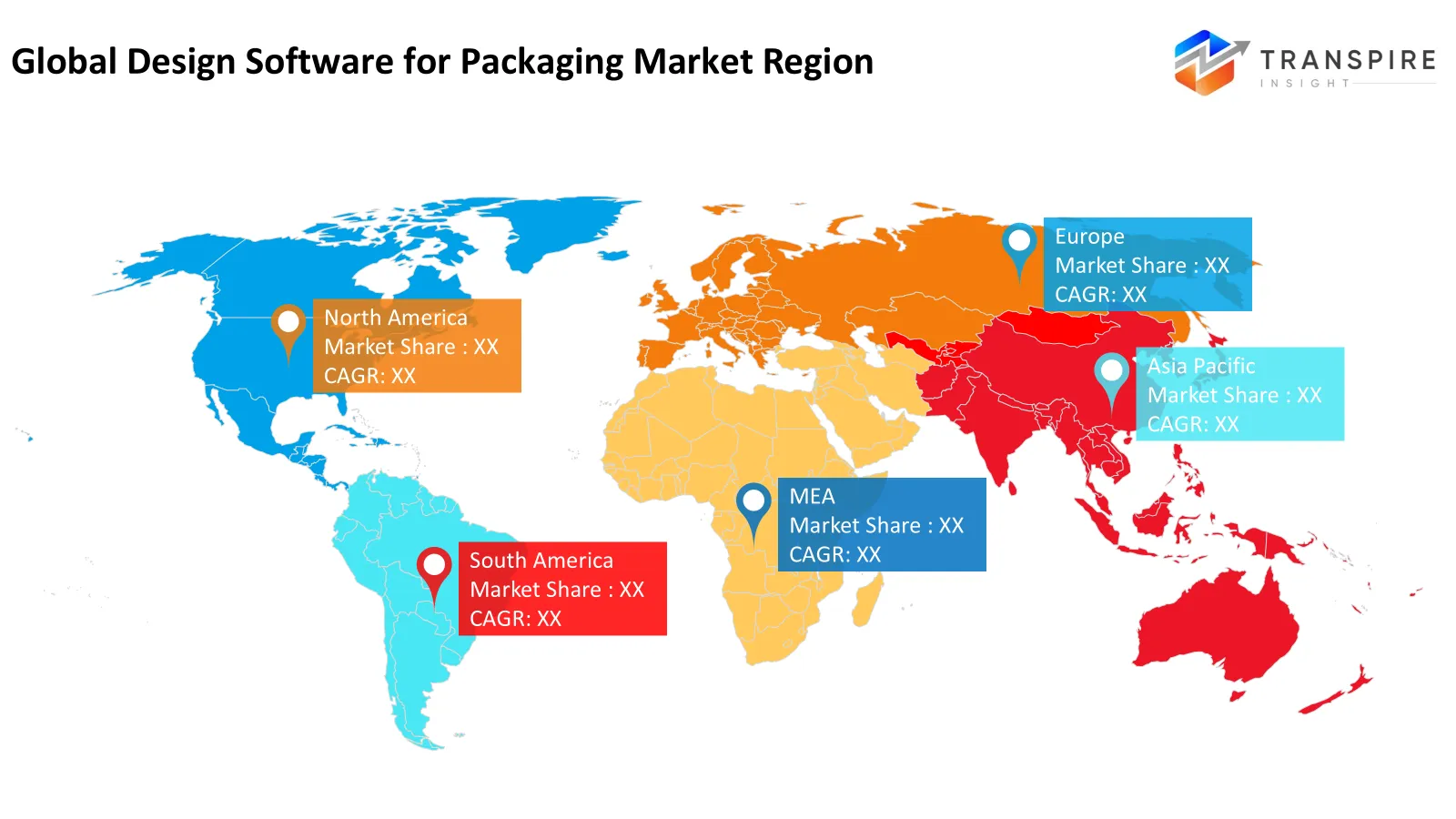
- North America is the dominant region with a market share of 38%.
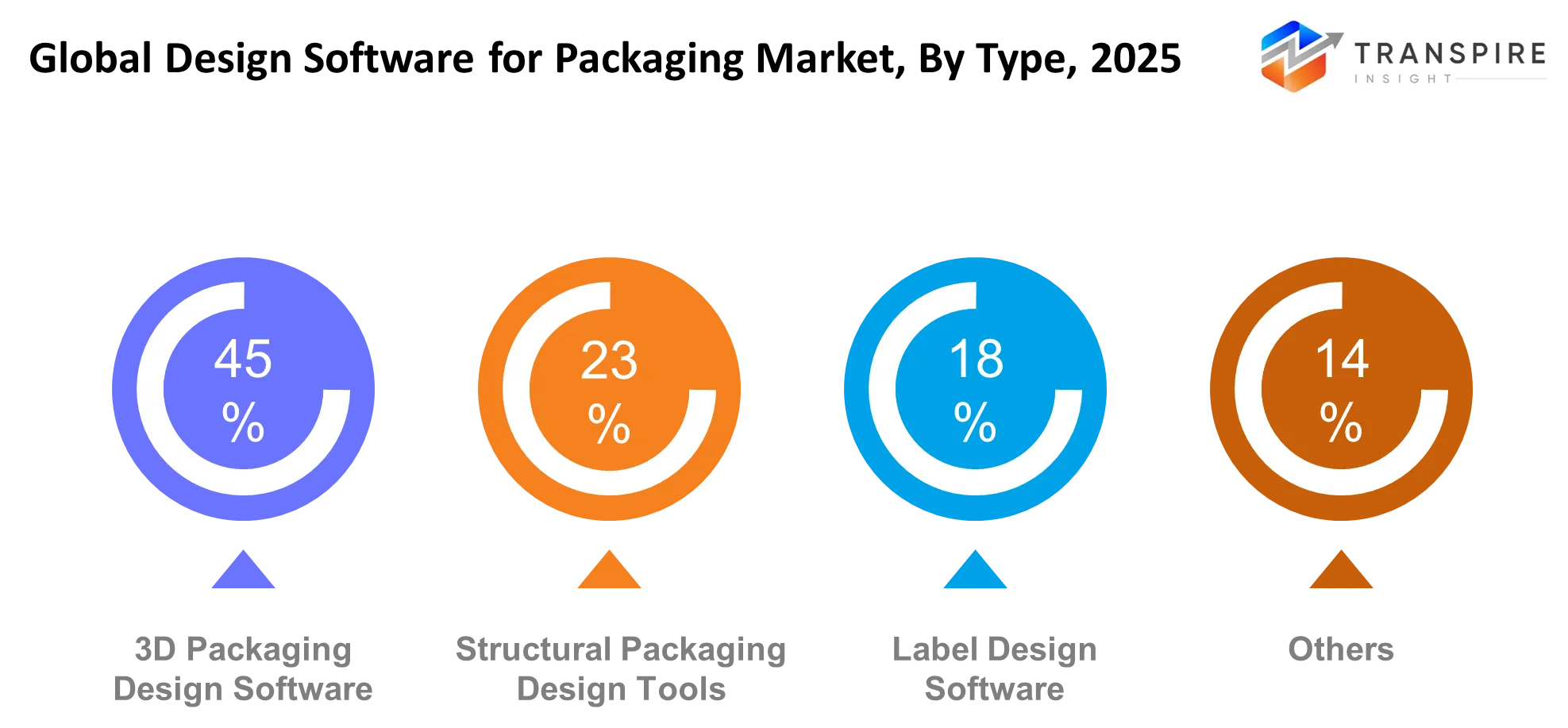
- 3D Packaging Design Software is the dominant segment with a market share of 45%.
- Structural Packaging Design Tools has a market share of 23% segment.
- Europe has a market share of 28%.
- Asia-Pacific accounts for 26% of the market share.
- Label Design Software consists of 18% of the market segment.
- ROW consists of 8% of the market share.
What are the Key Drivers, Restraints, and Opportunities in the Global Design Software for Packaging Market?
Drivers
New Eco-Friendly Materials have been introduced. Governments banned plastics are shifting towards paper and plant-based packaging. These types of materials break and bend differently. Companies are buying design software to test how these new materials behave on screen before making real boxes. Some of the major emerging drivers are that thousands of small, direct-to-consumer (DTC) brands are starting up online and stopping costly printing mistakes. In April 2026, direct-to-consumer (DTC) brands increasingly adopted advanced packaging design software and digital tools to create custom packaging faster and more cost-effectively for online sales.
Restraints
One of the problems with this Design Software for the packaging market is that running advanced 3D testing software requires very strong and costly computers. It is a main technical issue. Moving files between these two types of software still causes errors.
Opportunities
There are numerous opportunities in this market. A designer can just type the product size, and AI will immediately make the perfect 3D shape. Large consumer brands in North America are already investing in this to speed up brainstorming.
What Has the Impact of Artificial Intelligence Been on the Global Design Software for Packaging Market?
The role of AI in packaging design has revolutionized the industry by transforming the way packaging is developed from manual to automated processes. The designers today are able to get a 3D structural layout that can be produced immediately.
AI's predictive prowess extends beyond structural generation to the manufacturing floor. The advanced algorithms can virtually stress-test a package design before it's even in a physical printer. The software mimics the actual warehouse environment and accurately predicts how a bio-based material will bend, stack, or tear under pressure, thereby avoiding catastrophic structural failures during delivery.
Recently, AI-powered packaging design has been introduced by Pacdora. The features that enable users to generate marketable packaging solutions based on textual cues. Featuring over 6,000 3D packaging mockups and AI-generated image creation, the tool allows brands to rapidly generate packaging concepts, product visuals, and marketing materials without in-depth design expertise. In May 2026, packaging design platform Pacdora introduced enhanced AI-powered packaging design capabilities that allow users to create production-ready packaging designs from text prompts.
Key Market Trends
- To comply with the international and global recycling laws (such as the PPWR from the European Union), software developers are creating real-time carbon-footprint calculators and layer analysis modules directly into the design suites.
- Brands are moving away from mixed single-stream plastics and toward single-material streams, with software to identify material compliance issues before production.
- A simple box template drawing to a full three-dimensional calculation of shipping spaces.
- Today, sophisticated geometric algorithms are employed in the product design phase to automatically plan box layouts on modern structural platforms for pallets and shipping trucks.
- New software systems are being used to reduce box volume and overall shipping costs as companies seek to minimize transport expenses, which are no longer tied to weight, but to box size.
- As carrier fuel charges are based on box size instead of weight, companies are turning to software systems to reduce box volume and overall shipping costs.
- Switching from hand-drawing flattening templates (dielines) to instant automated creation of layout.
Global Design Software for Packaging Market Segmentation
By Type
The packaging market design software is experiencing a radical structural change as brands have shifted from the drawing board to an integrated digital world. To understand this landscape in totality, the market needs to be segmented by software type, starting with the huge market share to be captured by the 3D packaging design software market, which is projected to control a huge forty-five per cent of the market share.
Structural packaging design tools follow the market leader as the basic blueprint layer of the global supply chain. These specialised platforms focus solely on spatial engineering; they compute exact folding tolerances, interlocking flaps, and material stress distributions.
Label design software is the primary visual communication and regulatory compliance tool on the store shelf, accounting for 18% of the market. The motivation for this section's development is the ever-stricter regulations for labeling globally, requiring codes, nutritional information, and language-specific text tracks to be placed dynamically.
The traditional CAD packaging software still holds a strong market position as the legacy backbone of industrial cutting lines and tooling die creation. It's a continually expanding logic that's built into its longstanding integration with the heavy manufacturing hardware, where precision down to the millimetre and durability to the file are paramount, while visual effects are not.
AI-driven packaging platforms are the fastest-growing part of the packaging market, growing at a whopping thirteen point seven percent per year. These platforms are disrupting the market by automating the tedious initial steps in structural design and brainstorming structural shapes.
Cloud-based design platforms are highly collaborative and shift intensive 3D rendering from the local environment to the browser. Their growth logic is directly tied to the decentralized nature of modern-day consumer goods supply chains, where designers in one country, brand managers in another, and factories in a third need to work in step.
The other segment of the market type category consists of highly niche tools, such as haptic feedback simulation software, barcode verification modules, and ink-formulation utilities, accounting for the remaining fourteen percent of the market.
To learn more about this report, Download Free Sample Report
By Application
Food packaging design software holds a highly vital market position due to its massive, daily volume across global grocery chains. The unique growth logic of this category is dictated by strict food safety regulations and the fragile shelf life of fresh produce, which require software to model complex moisture barriers and precise gas-exchange holes.
Pharmaceutical packaging design software occupies a strictly regulated market position where any structural or printing error can lead to severe health and legal consequences.
Consumer goods packaging software maintains a highly dynamic market position by serving the hyper-competitive world of personal care, cosmetics, and household electronics.
Industrial packaging design software holds a highly functional market position that prioritizes rugged physical protection, high-volume shipping density, and raw material efficiency over visual brand aesthetics.
E-commerce packaging software occupies a rapidly expanding market position born from the global boom in home delivery services and direct-to-consumer digital brands.
The other segment covers specialized industrial sectors like military-grade transport cases, hazardous chemical drums, and boutique agricultural bulk bins.
By End-User
By end-users, the packaging designers are the main users of the market, as they are the users who have to daily deal with raw conceptual ideas and transform them into structured digital assets. They have very special growth logic, which focuses on velocity and creative freedom, and requires software that eliminates tedious technical calculations, allowing them to concentrate on aesthetics with high fidelity and unique container silhouettes.
Manufacturers and packaging converters dominate the market. They are the last people who turn digital files into a cardboard and plastic reality. As the financial decision makers who approve packaging concepts and pay for software licenses, brand owners and corporate marketing teams occupy a very influential market position. The special growth logic is born of the need to shorten the time to market and make a realistic “shelf preview” prior to expensive production runs.
The printing company is in the most technical of market sectors where it is only concerned with the accuracy of the ink, in-plate optimisation and compliance with colour. Their unique growth model is motivated by eliminating the downtime in the press, and they heavily depend on prepress software plugins to detect color trapping and layout misalignments before committing to using physical plates.
On the other side of the end-user spectrum are independent compliance auditors, structural engineering students, and regional environmental research laboratories. The philosophy of growth here is based on independent verification and academic research into alternative bio-molded packaging forms. With tighter constraints on environmental tracking, these secondary users will increasingly rely on packaging software to conduct objective sustainability audits of consumer goods before they hit public shelves.
By Deployment
Cloud-based platforms are gaining swift market dominance. Due to the limitless scalable computing power in the absence of huge hardware investments. In the future, cloud deployment will become the universal standard, rendering traditional software installations obsolete as browser engines become powerful enough to handle complex physics simulations seamlessly.
On-premise software has a very small market share today. It is most popular among the large enterprise corporations, as well as pharmaceutical manufacturers, where security is paramount. The growth logic for keeping software local relies entirely on data privacy, strict intellectual property control, and the need for zero-latency connection to physical factory machinery.
By blending the best of both worlds, hybrid solutions fill a very practical segment of the market, providing the best of both on-premise data security and cloud-based sharing and collaboration. The hybrid systems will become the migration path for legacy printer factories, which will increasingly shift their back-end operations to the online world over time.
Platforms that are integrated with mobility are in a young, agile market position. It is because they support rapid on-the-go inspections, executive decision-making, and field sales demonstrations.
The other segment covers highly isolated, air-gapped terminal networks in defense contracting and proprietary container laboratories, which wraps up the deployment category. The growth logic here is the opposite: extreme data classification, cybersecurity defenses at the level of a fortress, and no connection to the outside at all.
What are the Key Use Cases Driving the Global Design Software for Packaging Market?
Packaging design software is driven primarily by the large Food & Beverage (F&B) and Fast Moving Consumer Goods (FMCG) industry. In this case, the main application is rapid prototyping and artwork automation. Using 3D visualization and CAD software, brands quickly generate virtual models and significantly reduce material waste by avoiding the production of physical samples. While also drastically reducing the time to market in order for new products to be available on the supermarket shelves.
Meanwhile, the surge of e-commerce and electronics is growing the application of this software. Nowadays, designers use sophisticated algorithms to “right-size” boxes and to optimize structures within them. This particular application guarantees the safety of products during the shipping process and reduces extra space, shipping costs, and material costs.
Last but not least, tightening regulations, such as the EU's Packaging and Packaging Waste Regulation (PPWR), are paving the way for a new use case: eco-compliance simulation. The carbon footprint and recyclability of new materials, such as seaweed or compostable bioplastics, are now being measured and analyzed with software to ensure that the new designs can meet the legal requirements before production.
Report Metrics
|
Report Metrics |
Details |
|
Market size value in 2025 |
USD 2.46 Billion |
|
Market size value in 2026 |
USD 2.711 Billion |
|
Revenue forecast in 2033 |
USD 5.42 Billion |
|
Growth rate |
CAGR of 10.40% from 2026 to 2033 |
|
Base year |
2025 |
|
Historical data |
2021 - 2024 |
|
Forecast period |
2026 - 2033 |
|
Report coverage |
Revenue forecast, competitive landscape, growth factors, and trends |
|
Regional scope |
United States; Canada; Mexico; United Kingdom; Germany; France; Italy; Spain; Denmark; Sweden; Norway; China; Japan; India; Australia; South Korea; Thailand; Brazil; Argentina; South Africa; Saudi Arabia; United Arab Emirates |
|
Key company profiled |
Esko, Adobe, ArtiosCAD, Autodesk, CorelDRAW, Canva, Packmage, EngView Systems, Hybrid Software, TOPS Pro, Studio by Esko, SAP, Oracle, Tilia Labs, and NiceLabel. |
|
Customization scope |
Free report customization (country, regional & segment scope). Avail customized purchase options to meet your exact research needs. |
|
Report Segmentation |
By Type (3D Packaging Design Software, Label Design Software, Structural Packaging Design Tools, CAD Packaging Software, AI-powered Packaging Platforms, Cloud-based Design Platforms, Others); By Application (Food Packaging, Pharmaceutical Packaging, Consumer Goods Packaging, Industrial Packaging, E-commerce Packaging, Others); By End-User (Packaging Designers, Manufacturers, Brand Owners, Printing Companies, Others); By Deployment (Cloud-based Platforms, On-premise Software, Hybrid Solutions, Mobile-integrated Platforms, Others). |
Which Regions are Driving the Global Design Software for Packaging Market Growth?
North America has the largest market share at 38% of the total global smart packaging market, which is mainly attributed to the well-established tech infrastructure and the quick adoption of smart packaging solutions in the region. The region has a well-established ecosystem, with leading consumer goods companies and software providers working closely together to create new production lines that are fully automated. Hybrid Software introduced several new innovations driven by AI technology for packaging production, such as improvements to its Artflow workflow software. The launch enables packaging firms to speed packaging development cycles, boost productivity, and automate packaging design processes. In March 2026, Hybrid Software unveiled new AI-driven innovations for packaging production at Interpack 2026, including enhancements to its Artflow workflow software. The launch helps packaging companies automate design processes, improve productivity, and accelerate packaging development cycles.
Europe is second with 28% of the global market, but rules on sustainability are ensuring it is firmly in control of its expansion. In North America, operational speed and digital technology are paramount, whereas in Europe, it is the law that is driving a transition towards circular economies and environmentally friendly materials. Demand has remained constant because the retail sector is very stable and consumers are aware of the importance of waste reduction, with brands updating old designs to comply with regional regulations. This provides a predictable and resilient software market as it has set the stage for corporate environmental responsibility.
Hybrid Software announced an extensive program for its Fusion Packaging Summit 2026, bringing together packaging converters, printers, brands, and technology partners to showcase the future of packaging design, visualization, and workflow software. In February 2026,Hybrid Software announced an extensive program for its Fusion Packaging Summit 2026, bringing together packaging converters, printers, brands, and technology partners to showcase the future of packaging design, visualization, and workflow software.
The fastest-growing region is Asia-Pacific, with a CAGR of 14.5%. The recent surge of domestic e-commerce networks and a significant decentralization of production centers throughout India, China, and the Southeast Asian countries have triggered this phenomenal speed-up. The area is rapidly moving from the traditional mass production of standard parts to the high-end structural packaging design based on brand. Packaging development solutions will be presented at NRF 2026 APAC, and AI-powered product design has been announced. The development enables brands to speed up product commercialization, enhance packaging compliance, and reduce time-to-market.
To learn more about this report, Download Free Sample Report
Who are the Key Players in the Global Design Software for Packaging Market and how do they Compete?
As the packaging design software market is competitive, divided into two segments, industrial giants, offering end-to-end packaging production software, and a versatile creative suite suited for packaging layout. Companies compete mostly based on structural precision, workflow automation, and accessibility to the different parts of the value chain.
Esko and its specific tools, such as ArtiosCAD and Studio, rule the roost, providing high-quality, integrated systems for structural 3D CAD design to prepress automation for high-volume manufacturers. Likewise, Hybrid Software and EngView Systems have a niche innovation strategy, with emphasis on specialization in die-making, structural packaging, and automated production workflows. In the meantime, enterprise giants such as SAP and Oracle take the strategy of a niche bundle with packaging data embedded in larger supply chain and ERP systems to make supply chain logistics easier.
Adobe and CorelDRAW, however, offer the industry benchmark of graphic design and vector artwork, and are offered as horizontal innovations that complement the technical CAD structural innovations of the company. For smaller brands, Canva takes a more aggressive approach with low-cost and easy-to-access designs, providing intuitive and template-based designs that make basic aesthetics of packaging accessible for everyone. Lastly, there are players, such as Packmage and TOPS Pro, that specialize in optimizing the structure according to templates and the efficiency of pallet design, which can further reduce shipping costs.
Key Global Design Software for Packaging Market Companies
- Esko
- Adobe
- ArtiosCAD
- Autodesk
- CorelDRAW
- Canva
- Packmage
- EngView Systems
- Hybrid Software
- TOPS Pro
- Studio by Esko
- SAP
- Oracle
- Tilia Labs
- NiceLabel
Recent Development News
In April 2026, packaging design software company Pacdora launched AI Creation, a new tool that generates packaging artwork directly on production-ready dielines. The software combines AI-generated graphics with packaging structure and print requirements, helping brands create packaging designs faster and reduce design errors.
(Source- https://finance.yahoo.com)
In May 2026, Amtech Software acquired Clarico Systems and launched its Amtech Intelligence AI platform for packaging manufacturers. The acquisition adds AI-powered estimating and quoting capabilities, helping packaging companies reduce quoting time, improve accuracy, and increase operational efficiency.
(Source- https://www.labelsandlabeling.com)
What Strategic Insights Define the Future of the Global Design Software for Packaging Market?
AI, cloud-based collaboration, and 3D visualization are set to define the future of the Global Design Software for Packaging Market. A shift from traditional design tools to intelligent platforms that automate artwork creation, streamline approvals, and speed time to market has begun in the market. Brands continue to be under pressure to accelerate the time to market, and software solutions that support AI-driven workflows and real-time collaboration stand to benefit.
However, the one thing that is not visible is the possibility of increased reliance on AI-generated designs, which could pose issues with brand differentiation, design accuracy, and regulatory compliance. Excessive automation may also limit the creativity of packaging formats.
One new opportunity is in packaging design software and digital printing, sustainability analytics, and supply chain systems integration. This can assist companies to maximize materials, lower waste, and enhance manufacturing performance.
Global Design Software for Packaging Market Segmentation
By Type
- 3D Packaging Design Software
- Label Design Software
- Structural Packaging Design Tools
- CAD Packaging Software
- AI-powered Packaging Platforms
- Cloud-based Design Platforms
- Others
By Application
- Food Packaging
- Pharmaceutical Packaging
- Consumer Goods Packaging
- Industrial Packaging
- E-commerce Packaging
- Others
By End-User
- Packaging Designers
- Manufacturers
- Brand Owners
- Printing Companies
- Others
By Deployment
- Cloud-based Platforms
- On-premise Software
- Hybrid Solutions
- Mobile-integrated Platforms
- Others.
Regional Outlook
North America
- United States
- Canada
- Mexico
Europe
- Germany
- United Kingdom
- France
- Spain
- Italy
- Rest of Europe
Asia Pacific
- Japan
- China
- Australia & New Zealand
- South Korea
- India
- Rest of Asia Pacific
South America
- Brazil
- Argentina
- Rest of South America
Middle East & Africa
- Saudi Arabia
- United Arab Emirates
- South Africa
- Rest of the Middle East & Africa
Frequently Asked Questions
Find quick answers to common questions.
The expected Global Design Software for Packaging Market size will be USD 5.42 billion in 2033.
Key segments for the Global Design Software for Packaging Market are By Type (3D Packaging Design Software, Label Design Software, Structural Packaging Design Tools, CAD Packaging Software, AI-powered Packaging Platforms, Cloud-based Design Platforms, Others); By Application (Food Packaging, Pharmaceutical Packaging, Consumer Goods Packaging, Industrial Packaging, E-commerce Packaging, Others); By End-User (Packaging Designers, Manufacturers, Brand Owners, Printing Companies, Others); By Deployment (Cloud-based Platforms, On-premise Software, Hybrid Solutions, Mobile-integrated Platforms, Others).
Major Global Design Software for Packaging Market players are Esko, Adobe, ArtiosCAD, Autodesk, CorelDRAW, Canva, Packmage, EngView Systems, Hybrid Software, TOPS Pro, Studio by Esko, SAP, Oracle, Tilia Labs, and NiceLabel.
The Global Design Software for Packaging Market size is USD 2.46 billion in 2025.
The Global Design Software for Packaging Market is expected to grow at a CAGR of 10.40% from 2026 to 2033.
- Esko
- Adobe
- ArtiosCAD
- Autodesk
- CorelDRAW
- Canva
- Packmage
- EngView Systems
- Hybrid Software
- TOPS Pro
- Studio by Esko
- SAP
- Oracle
- Tilia Labs
- NiceLabel
About the Authors

Kartik bhong
I am Kartik Bhong, a Senior Research Analyst at Transpire Insight, specializing in the Packaging, Manufacturing, and Construction industry. My work focuses on analyzing market trends, emerging technologies, industry regulations, and competitive landscapes to deliver accurate, data-driven insights. I am passionate about transforming complex industry information into clear, practical content that helps businesses, professionals, and decision-makers stay informed and make confident strategic decisions. Through continuous research and a strong commitment to accuracy, I strive to create reliable, well-researched content that reflects the latest developments across these dynamic industries and supports the vision of Transpire Insight in delivering valuable market intelligence.

Chakradhar Khansole
Chakradhar serves as the Research Director at Transpire Insight, bringing over 8 years of experience in technology, innovation, and strategic market intelligence. He specializes in transforming complex market data into actionable business insights that enable organizations to make informed, growth-oriented decisions. Recognized for his strategic vision and analytical expertise, Chakradhar leads high-impact research initiatives, delivering comprehensive market assessments, competitive intelligence, and forward-looking industry analysis.
Recently Published Reports
-
Apr 2026
Pharmaceutical Cold Chain Packaging Market
Pharmaceutical Cold Chain Packaging Market By Material (Plastic,(Polyethylene (PE), Polypropylene (PP), Polyethylene Terephthalate (PET), Expanded Polystyrene (EPS), Polyurethane (PU),Others), Paper, Metal, Others), By Product (Small Boxes, Pallets, Large Sized Pallet Containers, Others), By End Use (Biopharmaceutical Companies, Clinical Research Organizations, Hospitals, Research Institutes, Logistics and Distribution Companies, Others)”, By Industry Analysis, Size, Share, Growth, Trends, and Forecasts 2026-2033
-
Apr 2026
Active & Intelligent Packaging Market
Active & Intelligent Packaging Market By Type (Active Packaging, Smart Packaging), By Material (Polymer-Based, Paper & Board-Based, Metal-Based, Glass-Based), By Technology (Time-Temperature Indicators, Freshness Indicators, RFID, Antimicrobial Packaging, Modified Atmosphere Packaging), By Application (Food & Beverages, Pharmaceutical, Cosmetics & Personal Care, Electronics & Consumer Goods, Others), By Industry Analysis, Size, Share, Growth, Trends, and Forecasts 2026-2033
-
Apr 2026
Biodegradable Cut Flower Packaging Market
Biodegradable Cut Flower Packaging Market By Material Type (Paper & Paperboard, Biodegradable Plastics, Natural Fibers, Molded Pulp, Others), By Product Type (Sleeves, Wraps, Boxes & Cartons, Bags & Pouches, Inserts & Holders), By Application (Roses, Carnations, Tulips, Chrysanthemums, Mixed Flowers, Others) and By Distribution Channel (Direct Sales, Distributors & Wholesalers, Online Channels), By Industry Analysis, Size, Share, Growth, Trends, and Forecasts 2026-2033
-
May 2026
Pharmaceutical Packaging Market
Pharmaceutical Packaging Market By Material Type (Plastic, Glass, Metal, Paper & Paperboard, Others), By Packaging Type (Bottles, Blister Packs, Vials, Ampoules, Pouches & Sachets, Others) and By End User (Hospitals & Clinics, Retail Pharmacies, Online Pharmacies, Pharmaceutical Manufacturers), By Industry Analysis, Size, Share, Growth, Trends, and Forecasts 2026-2033