

Middle East and Africa Automatic Checkweigher Market Summary
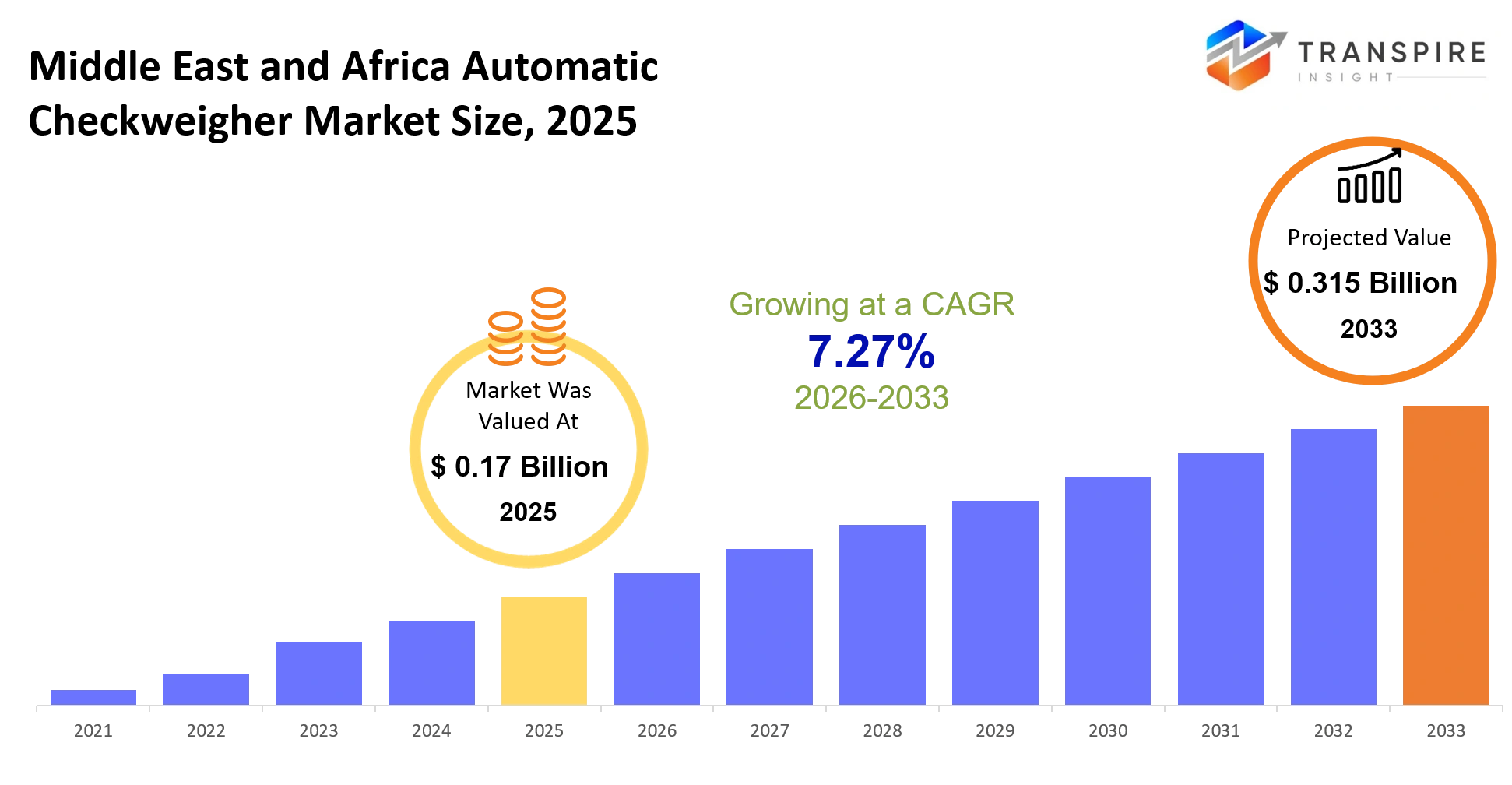
As per Transpire Insight Analysis the Middle East and Africa Automatic Checkweigher Market size is estimated at USD 0.17 Billion in 2025 and is anticipated to reach USD 0.315 Billion by 2033, growing at a CAGR of 7.27% from 2026 to 2033.
The Middle East and Africa Automatic Checkweigher Market sort of plays a key role in helping manufacturers ensure product mass during fast production runs, so they can catch underfilled or overstuffed packs before they end up with customers, while also cutting down on waste, and the regulatory headaches that follow. Many food processors, pharmaceutical makers, beverage companies, and consumer goods producers lean on these systems because it supports better quality assurance along with smoother production efficiency. Over the last five years, it looks like the market has moved away from standalone weighing machines and more toward integrated inspection systems, where weight verification is bundled with vision inspection ,and some data analytics as well.
Then along came the COVID-19 pandemic, plus the later supply chain problems, which really sped up investments in factory automation, since manufacturers were trying to keep output steady with fewer manual steps. At the same time, tighter food safety rules and pharmaceutical quality expectations across Gulf regions have pushed more companies to install automated inspection equipment. As these changes keep unfolding, production consistency is getting better, product recalls are going down, and equipment suppliers plus system integrators are seeing more steady revenue chances.
Middle East and Africa Automatic Checkweigher Market Size & Forecast:
- Middle East and Africa Automatic Checkweigher Market Size 2025: USD 0.17 Billion
- Expected Market Value 2033: USD 0.315 Billion
- Forecast CAGR: 7.27%
- Leading region in 2025:
- Fastest Growing region:
- Key Profile: Mettler Toledo, Ishida, Minebea Intec, Anritsu, Bizerba, Wipotec, Thermo Fisher Scientific, Marel, Loma Systems, Yamato Scale, Cassel Messtechnik, Avery Weigh-Tronix, Cardinal Scale, Sesotec, CI Precision
Key Market Insights
- The Middle East and Africa Automatic Checkweigher market is expected to get to USD 0.315 Billion by 2033, from about USD 0.17 Billion in 2025, all kinda backed by factory automation.
- In 2025 Saudi Arabia together with the UAE basically dominate the scene, they hold around 43% market share, mainly pushed by food manufacturing and pharmaceutical investments .
- South Africa looks like the quickest mover through 2033, supported by modernization of food processing facilities , and more streamlined lines. For the type side , In-Motion checkweighers take the lead with roughly 46% market share, these units fit well in high volume packaging setups and continuous production streams.
- Combination checkweighers still sit in second place, they basically tie metal detection and X-ray inspection into one combined platform, so operators get less switching and more coverage.
- Then there are AI enabled inspection systems , they are projected to show the fastest growth between 2026 and 2033, helping with better defect detection , and deeper production analytics.
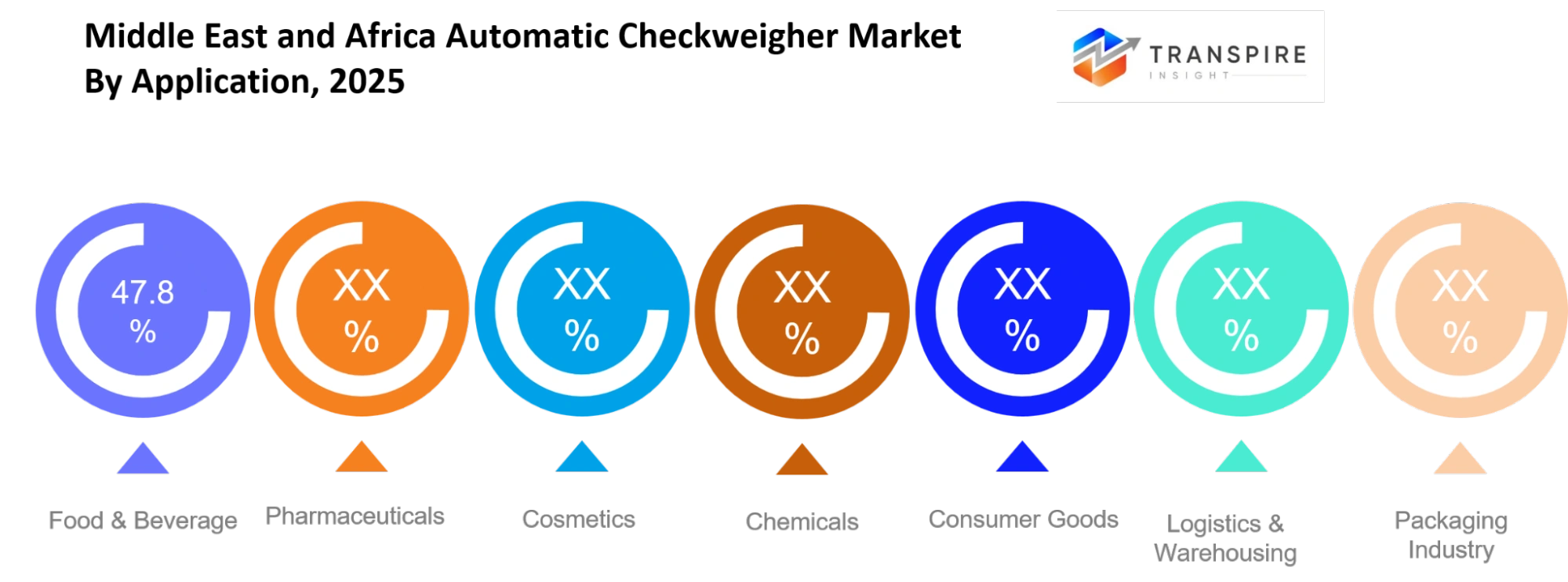
- On the application layer, Food and beverage stays in front with nearly 55% share, because packaged food output and export quality rules are getting stricter.
- Pharmaceutical manufacturing, however, is getting momentum fastest , largely due to serialization obligations and tight quality regulations that companies can’t really ignore.
- For end users, food processing companies are still the main group, while contract packaging organizations keep expanding adoption across the region, somewhat steadily.
- Key players like Mettler Toledo, Minebea Intec, Ishida, Anritsu, WIPOTEC, and Bizerba are also extending their portfolios, through AI-enabled inspection, regional partnerships and smart manufacturing solutions, all at once.
What are the Key Drivers, Restraints, and Opportunities in the Middle East and Africa Automatic Checkweigher Market?
The main growth driver is the fast automation of food processing and pharmaceutical manufacturing across Middle East and Africa, for real. In Saudi Arabia and UAE governments are pushing industrial modernization via national diversification programs and so manufacturers are also expanding packaged food together with pharmaceutical output to cover rising local needs plus export opportunities. With those investments, companies need automated weight verification systems that help move lines faster, cut down product giveaway, and also back up compliance with both regional and global quality requirements. So equipment suppliers typically gain from better equipment sales, software upgrades, and long-running maintenance agreements.
The biggest structural hassle still seems to be the heavy capital cost tied to advanced automatic checkweighers, specially AI-enabled models and vision-integrated systems. A lot of small and medium manufacturers keep running older packaging lines. Those setups often demand costly changes before any new inspection equipment can be installed, and that kind of thing slows technology take up. It also drags modernization efforts and it ends up dampening equipment replacement cycles across multiple African markets.
One real opportunity shows up with the expansion of smart manufacturing and Industry 4.0 programs across Gulf countries. More manufacturers are linking inspection equipment with Manufacturing Execution Systems MES, cloud analytics platforms, and digital quality management tools. In this way, verification becomes not only inspection, but also ongoing visibility, which can be very useful for continuous improvement.
What Has the Impact of Artificial Intelligence Been on the Middle East and Africa Automatic Checkweigher Market?
Artificial intelligence is changing automatic checkweighing systems, kinda like it helps them “think” a bit more, and that means smarter inspection, automated quality control, and even real time production tuning across many different manufacturing sites. In practical terms, AI based systems keep watching weight signals all the time, they catch rejection trends, conveyor behavior issues, and normal variations in output. Then they can tweak operating settings on the fly without having to stop the line, which is a big deal in continuous production.
Also, machine learning models are good at spotting small signs of trouble, like subtle equipment wear, conveyor misalignment, and sensor drift, before any real failure shows up. That makes maintenance teams schedule fixes earlier instead of waiting for that sudden, unexpected downtime event. At the same time, advanced digital tools help the checkweighers work together with other technologies. For example vision inspection systems, Manufacturing Execution Systems, and Industrial Internet of Things platforms can all be integrated so the whole process feels more coherent, not just separate devices doing isolated tasks.
With that kind of setup, manufacturers get ongoing insight into production efficiency, reject rate numbers, Overall Equipment Effectiveness, and whether they’re meeting regulatory compliance. There is also less product giveaway, plus packaging tends to stay more consistent over time. Many facilities say they see measurable results like better uptime, reduced maintenance expenses, and quality checks that go faster once AI assisted inspection platforms are in place.
Still, full scale AI adoption isn’t totally straightforward. It often gets limited by the relatively high cost of integrating everything, especially when connecting older, legacy machinery to newer digital infrastructure. Smaller manufacturers may not have enough production data to train the machine learning models properly. And if industrial connectivity is inconsistent from plant to plant, then the full payoff from cloud based predictive analytics can be muted. Because of this, adoption tends to move slower outside large manufacturing enterprises.
Key Market Trends
- After 2021 manufacturers kind of moved away from just standalone weighing machines, and instead leaned into integrated inspection setups that blend weight verification, vision based checking, and metal detection together. So it’s not only weighing anymore, more like a all in one thing, you know.
- Since 2022, AI powered quality inspection platforms became more and more common, helping teams do predictive maintenance and also automate production tuning, in a way that feels continuous rather than reactive.
- In the Gulf, food manufacturers sped up investments in automated packaging lines after the post pandemic supply chain issues, but also because labor availability was tricky at the time.
- Pharmaceutical businesses have also been adopting precision checkweighers more often, mainly to back serialization, meet regulatory compliance, and handle export certification needs across GCC markets, yes.
- Cloud-connected inspection equipment has grown as well, which lets manufacturers watch production performance remotely, and makes it easier to plan preventive maintenance on time instead of guessing.
- Equipment suppliers are increasingly presenting modular systems, those make upgrades simpler without a full replacement of entire packaging lines, that lowers modernization costs, mostly.
- And after 2023, strategic partnerships between automation providers and regional distributors grew bigger, strengthening after sales support and technical services, which seems to matter a lot for uptime.
- Vision guided inspection when combined with checkweighing has improved defect detection, while also cutting down false rejects, especially in high speed production conditions where mistakes are expensive.
- Manufacturers more and more analyze production data using Industrial IoT platforms, to reduce product giveaway and lift Overall Equipment Effectiveness, like actual measurable gains.
- Globally, firms such as Mettler Toledo, Ishida, WIPOTEC, Minebea Intec, Bizerba, and Anritsu keep expanding their intelligent inspection portfolios for regional manufacturing industries.
Middle East and Africa Automatic Checkweigher Market Segmentation
By Product Type
In Motion Checkweighers kind of hold a leading position because continuous output lines need weight verification, but they cannot just stop the product stream. In food processing plants , beverage manufacturers , and pharmaceutical production facilities, these systems are used to keep throughput steady while also cutting down product giveaway and that sort of waste. High Speed Checkweighers work well in situations where thousands of items pass through packaging lines every hour. Combination Checkweighers add extra value too, by bringing weight inspection together with metal detection , or even X-ray inspection, so multiple quality checks happen inside one production step.
Then there are Intermittent Checkweighers which stay a good option for lower output lines, where careful measurement timing can give better accuracy for selected products. Multi Lane Checkweighers support plants that run several packaging lanes at once , boosting output without needing additional floor space. Compact Checkweighers fit smaller manufacturing sites where the install area stays tight, while Heavy Duty Checkweighers handle larger industrial goods with higher weight limits. Also, you’ll find other units, like specialized equipment built for unusual packaging formats, and for industry specific production needs, depending on the workflow.
By Technology
Strain Gauge Technology keeps getting used in a lot of production facilities, mostly because it has dependable performance, steady measurements, and it runs in a cost effective way. Load Cell Technology also stays widely adopted since it delivers consistent weighing accuracy across different packaging environments, which is kinda the whole point for production. Electromagnetic Force Restoration offers high precision for pharmaceutical manufacturing as well as premium packaged products, where even a small weight variation really cannot be tolerated . Each one of these technologies handles different production needs, depending on speed , accuracy and how things behave during operation
AI-Based Inspection keeps growing too, since manufacturers want automated quality analysis and predictive maintenance features. Vision-Integrated Systems mix optical inspection with weight verification, so they can spot packaging defects and labeling errors at the same time, without much fuss. Dynamic Weighing Systems help continuous production by measuring products while they are moving along conveyor belts, which reduces production delays. Hybrid Systems bring together multiple sensing technologies to push inspection performance higher, while Others cover specialized weighing technologies that are designed for customized industrial uses, sometimes very niche .
By Application
Food & Beverage is actually the biggest use case, mainly because packaged food producers must keep accurate fill levels, limit waste, and follow food safety rules, it’s not optional. Pharmaceuticals take up a substantial portion as well, since exact product weight helps support dosage accuracy and regulatory compliance when medicine is produced. Cosmetics companies then, rely on automatic weight verification to keep package consistency steady and cut down customer frustrations, especially across those premium product lines. For Consumer Goods manufacturers, inspection systems are used to raise production quality across household and personal care products , basically everything people buy for daily routines.
Chemicals need dependable weight verification too, so safe packaging is maintained and industrial materials meet regulatory compliance requirements. In Logistics & Warehousing, facilities are increasingly putting in automated weighing equipment, so parcel verification happens faster before shipment. Packaging Industry sites often use checkweighers to improve filling accuracy across several customer production lines. Other areas, like agricultural products, industrial materials, and specialty manufacturing, still require dependable inline weight inspection, because the tolerances can be pretty strict, and that’s why.
By End User
Food manufacturers make up the biggest portion, mainly due to continuous production, strict quality standards , and export expectations that really rely on precise weight checks. Pharmaceutical Companies are also a major customer set, since regulatory compliance demands steady product weight and also complete production records. Packaging companies install advanced inspection tools for handling several customer needs while still keeping production timelines efficient. Chemical manufacturers often use automated weighing setups, so packaging becomes more uniform and day-to-day safety is improved.
On the logistics side, providers are using automatic checkweighers more often to confirm shipment correctness before things go out, which also helps lower the risk of handling mistakes. Retail distribution centers apply automated weighing systems to speed up inventory verification and shipping workflows across large throughput lines. Other players include cosmetics producers , consumer goods manufacturers, and contract manufacturing organizations that want better quality control throughout the packaging process.
By Distribution Channel
Direct Sales still show up as the go to distribution option, mainly because the manufacturers commonly need a sort of tailored equipment choice, installation help, and some technical consultation before they even decide to purchase. OEM Supply also helps a lot, since the production line manufacturers tend to fold checkweighers straight into the overall packaging systems they ship out, right before delivery to customers. Industrial Distributors, in turn, widen where the product can be found across regional markets, and they do it by giving technical support, maintenance services, and replacement parts. System Integrators make things work together by helping manufacturers link weighing hardware with automation software, plus the broader factory control platforms, so it feels more seamless.
Online Industrial Suppliers keep getting more acceptance too, because digital procurement is becoming more common especially for standardized equipment, and for replacement components. Dealers stay involved with local customers through product demonstrations, installation assistance , and after sales service across fast growing industrial markets. Others include value added resellers, and also specialized automation providers that focus on industry specific manufacturing applications.
What are the Key Use Cases Driving the Middle East and Africa Automatic Checkweigher Market?
Food processing still, kind of stays the main use, because packaged food manufacturers have to check product weight before items go out, and they have to do this while following tight regulatory rules and retail specs . In other words, automated weight inspection cuts down on product giveaway , helps lower the number of rejected batches, and keeps output steadier across big, high-volume packaging sites.
Pharmaceutical production plus contract packaging operations keep growing in adoption, since precise weight verification ramps up quality assurance and also fits serialization needs. At the same time, logistics providers and distribution centers apply automatic weighing systems too, to verify parcel weights before shipment. That improves inventory accuracy, and oddly enough it also reduces those annoying transport disputes.
More chances keep showing up via smart manufacturing facilities, where inspection equipment is tied into digital production management platforms. Export-focused manufacturers , together with advanced packaging facilities, are also rolling in AI-enabled quality inspection, aiming for better traceability, faster predictive maintenance, and real-time production tuning across the whole forecast period .
|
Report Metrics |
Details |
|
Market size value in 2025 |
USD 0.17 Billion |
|
Market size value in 2026 |
USD 0.183 Billion |
|
Revenue forecast in 2033 |
USD 0.315 Billion |
|
Growth rate |
CAGR of 4.32% from 2026 to 2033 |
|
Base year |
2025 |
|
Historical data |
2021 - 2024 |
|
Forecast period |
2026 - 2033 |
|
Report coverage |
Revenue forecast, competitive landscape, growth factors, and trends |
|
Regional scope |
Middle East and Africa (Saudi Arabia, United Arab Emirates, South Africa, Rest of Middle East and Africa) |
|
Key company profiled |
Mettler Toledo, Ishida, Minebea Intec, Anritsu, Bizerba, Wipotec, Thermo Fisher Scientific, Marel, Loma Systems, Yamato Scale, Cassel Messtechnik, Avery Weigh-Tronix, Cardinal Scale, Sesotec, CI Precision |
|
Customization scope |
Free report customization (country, regional & segment scope). Avail customized purchase options to meet your exact research needs. |
|
Report Segmentation |
By Product Type (In-Motion Checkweighers, Intermittent Checkweighers, Combination Checkweighers, High-Speed Checkweighers, Multi-Lane Checkweighers, Compact Checkweighers, Heavy-Duty Checkweighers, Others); By Technology (Strain Gauge Technology, Electromagnetic Force Restoration, Load Cell Technology, AI-Based Inspection, Vision-Integrated Systems, Dynamic Weighing Systems, Hybrid Systems, Others); By Application (Food & Beverage, Pharmaceuticals, Cosmetics, Chemicals, Consumer Goods, Logistics & Warehousing, Packaging Industry, Others); By End User (Food Manufacturers, Pharmaceutical Companies, Packaging Companies, Logistics Providers, Chemical Manufacturers, Retail Distribution Centers, Others); By Distribution Channel (Direct Sales, OEM Supply, Industrial Distributors, System Integrators, Online Industrial Suppliers, Dealers, Others) |
Which Regions are Driving the Middle East and Africa Automatic Checkweigher Market Growth?
The Gulf Cooperation Council, especially Saudi Arabia and the United Arab Emirates , sort of makes up the largest regional market for automatic checkweighers. Strong food safety regulations, an ongoing expansion of pharmaceutical manufacturing, plus national industrial diversification programs under things like Saudi Vision 2030 keep pushing investment toward automated production lines. There are modern industrial zones, better logistics infrastructure, and well connected ports—like Jeddah Islamic Port and Jebel Ali Port—helping support high-volume manufacturing and export work that needs accurate inline inspection equipment. Also, a solid web of automation suppliers, packaging specialists, and system integrators keeps reinforcing that long term market strength across the Gulf area.
South Africa comes in as the second-largest regional contributor, but the trajectory looks a bit different than what you see across Gulf economies. Here, market expansion is backed by a well established food processing industry, reliable retail supply chains, and steady spending on production modernization, not really massive greenfield manufacturing builds. Food manufacturers, beverage makers, and packaging companies are still swapping older inspection equipment for digital weighing systems. That change helps with day to day efficiency and product consistency. Because the replacement cycle stays steady, equipment suppliers can count on dependable revenue prospects, even if broader industrial growth is a little more moderate.
Meanwhile, the Rest of the Middle East and Africa, including Egypt, Kenya, Morocco, and selected East African economies, is expected to show the fastest growth during the forecast period .
Who are the Key Players in the Middle East and Africa Automatic Checkweigher Market and How Do They Compete?
Competition still looks fairly concentrated, but the big global inspection tech manufacturers aren’t really fighting it out on price alone. Instead they push product innovation, measurement accuracy, software unification, plus regional service ability, which feels more practical than just discounting. Buyers are also getting more picky, they look at equipment dependability, lifecycle support, predictive maintenance functions, and how well things fit with automated production lines. And then, honestly , regional distributors and system integrators end up weighing in too, because they bring installation, calibration, operator instruction, and that long-run maintenance coverage people like.
Mettler Toledo stands out with super accurate weighing know-how paired with advanced data management software, designed to slot into digital manufacturing systems without much friction. Ishida leans into a broader packaging + inspection approach, so customers can line up checkweighers, X-ray inspection, and packaging gear in one production setting, while also scaling via regional distribution partnerships and further automation investments. Minebea Intec leans hard on precision measurement, industrial robustness, and adherence to international quality norms, so their offerings tend to feel especially fitting for pharmaceutical and food production sites.
Wipotec competes by crafting modular, high-speed inspection platforms that blend dynamic weighing, labeling, serialization, and vision inspection into flexible production arrangements. Bizerba, meanwhile, improves its competitive position with integrated weighing, labeling, and industrial software solutions, helping boost production traceability across everyday manufacturing operations.
Company List
• Mettler Toledo
• Ishida
• Minebea Intec
• Anritsu
• Bizerba
• Wipotec
• Thermo Fisher Scientific
• Marel
• Loma Systems
• Yamato Scale
• Cassel Messtechnik
• Avery Weigh-Tronix
• Cardinal Scale
• Sesotec
• CI Precision
Recent Development News
In April 2026, Ishida announced the launch of its new DACS-AS checkweigher range at Interpack 2026. The new inspection platform expands high-speed weight verification capabilities while supporting Industry 5.0 connectivity and improved regulatory compliance for food manufacturers.https://www.ishidaeurope.com
In March 2026, Wipotec introduced the HC-A checkweigher for precise weight classification. The product improves dynamic weighing accuracy for high-throughput manufacturing applications and strengthens the company's intelligent inspection portfolio.https://www.wipotec.com
In December 2025, Ishida announced the acquisition of RobotGrader AB. The acquisition expands Ishida's automation capabilities in protein processing and strengthens integrated inspection and robotic packaging solutions for food manufacturers.https://www.ishidaeurope.com
What Strategic Insights Define the Future of the Middle East and Africa Automatic Checkweigher Market?
The market is heading toward fully connected inspection ecosystems, where automatic checkweighers are operating side-by-side with vision inspection, serialization, robotics, and cloud production analytics rather than just working as standalone quality control gear. This kind of structural shift is mostly pushed by smart manufacturing investments, stricter product tracing demands, and the practical goal to boost operational efficiency across food, pharmaceutical, and everyday consumer goods.
But there is also a less obvious risk that seems to be quietly growing: more reliance on imported precision sensors, electronic parts, and automation software. That reliance could end up making manufacturers more vulnerable to supply interruptions and even higher equipment costs, especially when global trade becomes uncertain.
At the same time, there’s an opening that’s starting to look promising. AI enabled remote diagnostics, along with predictive maintenance as a service, could become a strong differentiator. This is especially true for the fast growing manufacturing areas across the Gulf region and North Africa.
For companies trying to enter this space, it would be wise to focus on localized technical assistance, easy to use digital service platforms, and close partnerships with regional automation integrators. Done right, this should help build durable customer trust while also reducing how complicated deployments can get in the field.
Middle East and Africa Automatic Checkweigher Market Report Segmentation
By Product Type
• In-Motion Checkweighers
• Intermittent Checkweighers
• Combination Checkweighers
• High-Speed Checkweighers
• Multi-Lane Checkweighers
• Compact Checkweighers
• Heavy-Duty Checkweighers
• Others
By Technology
• Strain Gauge Technology
• Electromagnetic Force Restoration
• Load Cell Technology
• AI-Based Inspection
• Vision-Integrated Systems
• Dynamic Weighing Systems
• Hybrid Systems
• Others
By Application
• Food & Beverage
• Pharmaceuticals
• Cosmetics
• Chemicals
• Consumer Goods
• Logistics & Warehousing
• Packaging Industry
• Others
By End User
• Food Manufacturers
• Pharmaceutical Companies
• Packaging Companies
• Logistics Providers
• Chemical Manufacturers
• Retail Distribution Centers
• Others
By Distribution Channel
• Direct Sales
• OEM Supply
• Industrial Distributors
• System Integrators
• Online Industrial Suppliers
• Dealers
• Others
Frequently Asked Questions
Find quick answers to common questions.
The expected Middle East and Africa Automatic Checkweigher Market size for the market will be USD 0.315 Billion in 2033.
Key segments for the Middle East and Africa Automatic Checkweigher Market are By Product Type (In-Motion Checkweighers, Intermittent Checkweighers, Combination Checkweighers, High-Speed Checkweighers, Multi-Lane Checkweighers, Compact Checkweighers, Heavy-Duty Checkweighers, Others); By Technology (Strain Gauge Technology, Electromagnetic Force Restoration, Load Cell Technology, AI-Based Inspection, Vision-Integrated Systems, Dynamic Weighing Systems, Hybrid Systems, Others); By Application (Food & Beverage, Pharmaceuticals, Cosmetics, Chemicals, Consumer Goods, Logistics & Warehousing, Packaging Industry, Others); By End User (Food Manufacturers, Pharmaceutical Companies, Packaging Companies, Logistics Providers, Chemical Manufacturers, Retail Distribution Centers, Others); By Distribution Channel (Direct Sales, OEM Supply, Industrial Distributors, System Integrators, Online Industrial Suppliers, Dealers, Others).
Major Middle East and Africa Automatic Checkweigher Market players are Mettler Toledo, Ishida, Minebea Intec, Anritsu, Bizerba, Wipotec, Thermo Fisher Scientific, Marel, Loma Systems, Yamato Scale, Cassel Messtechnik, Avery Weigh-Tronix, Cardinal Scale, Sesotec, CI Precision.
The Middle East and Africa Automatic Checkweigher Market size is USD 0.17 Billion in 2025.
The Middle East and Africa Automatic Checkweigher Market CAGR is [confirmed CAGR]% from 2026 to 2033.
• Mettler Toledo
• Ishida
• Minebea Intec
• Anritsu
• Bizerba
• Wipotec
• Thermo Fisher Scientific
• Marel
• Loma Systems
• Yamato Scale
• Cassel Messtechnik
• Avery Weigh-Tronix
• Cardinal Scale
• Sesotec
• CI Precision
About the Authors

Kartik bhong
I am Kartik Bhong, a Senior Research Analyst at Transpire Insight, specializing in the Packaging, Manufacturing, and Construction industry. My work focuses on analyzing market trends, emerging technologies, industry regulations, and competitive landscapes to deliver accurate, data-driven insights. I am passionate about transforming complex industry information into clear, practical content that helps businesses, professionals, and decision-makers stay informed and make confident strategic decisions. Through continuous research and a strong commitment to accuracy, I strive to create reliable, well-researched content that reflects the latest developments across these dynamic industries and supports the vision of Transpire Insight in delivering valuable market intelligence.

Chakradhar Khansole
Chakradhar serves as the Research Director at Transpire Insight, bringing over 8 years of experience in technology, innovation, and strategic market intelligence. He specializes in transforming complex market data into actionable business insights that enable organizations to make informed, growth-oriented decisions. Recognized for his strategic vision and analytical expertise, Chakradhar leads high-impact research initiatives, delivering comprehensive market assessments, competitive intelligence, and forward-looking industry analysis.
Recently Published Reports
-
Apr 2026
Handling and Lifting Equipment Market
Handling and Lifting Equipment Market Size, Share & Analysis Report By Product (Cranes and Hoists, Forklifts, Conveyor Systems, Aerial Work Platforms, Others), By Application (E-Commerce, Automotive and Railway, Food and Beverages, Aviation, Others), and Geography (North America, Europe, Asia-Pacific, Middle East and Africa, South and Central America), 2021 - 2031
-
Apr 2026
HVAC Equipment Market
HVAC Equipment Market Size, Share & Analysis Report By Heating Equipment Type (Boilers and Furnaces, Heat Pumps, and Unitary Heaters), By Ventilation Equipment (Air Handling Units, Humidifiers and Dehumidifiers, Air Filters, and Fan Coiling Units), By Air Conditioning Equipment (Unitary Air Conditioners, Room Air Conditioners, Packaged Terminal Air Conditioners, and Chillers), By End User (Commercial, Residential, Industrial, and others), and Geography (North America, Europe, Asia-Pacific, Middle East and Africa, South and Central America), 2021 – 2031
-
Apr 2026
Refrigeration Valves Market
Refrigeration Valves Market Size, Share & Analysis Report By Type (Solenoid Valves, Expansion Valves, Check Valves, Service Valves, Others), By Application (Commercial Refrigeration, Industrial Refrigeration, Transport Refrigeration, Residential Refrigeration, Air Conditioning Systems), By End User (Food and Beverage Industry, Pharmaceutical Industry, HVAC Industry, Chemical Industry, Others), and Geography (North America, Europe, Asia-Pacific, Middle East and Africa, South and Central America), 2021 – 2031
-
Apr 2026
E-Commerce Packaging Materials Market
E-Commerce Packaging Materials Market By Material Type (Corrugated Boxes, Paper & Paperboard, Foam & Cushioning Materials, Plastic Packaging, Flexible Packaging, Protective Packaging, Others), By Product(Primary Packaging, Secondary Packaging, Tertiary Packaging), By Packaging Function (Protective Packaging, Branding & Presentation Packaging, Transit & Logistic Packaging, Sustainable Packaging, Tamper Evidence Packaging), By End-User (Retail & Consumer Goods, Electronic Appliances, Food & Beverages, Healthcare & Pharmaceutical, Fashion & Apparel, Home & Furnishing, Others); By Industry Analysis, Size, Share, Growth, Trends, and Forecasts 2021-2033