

MEP Services Market Summary:
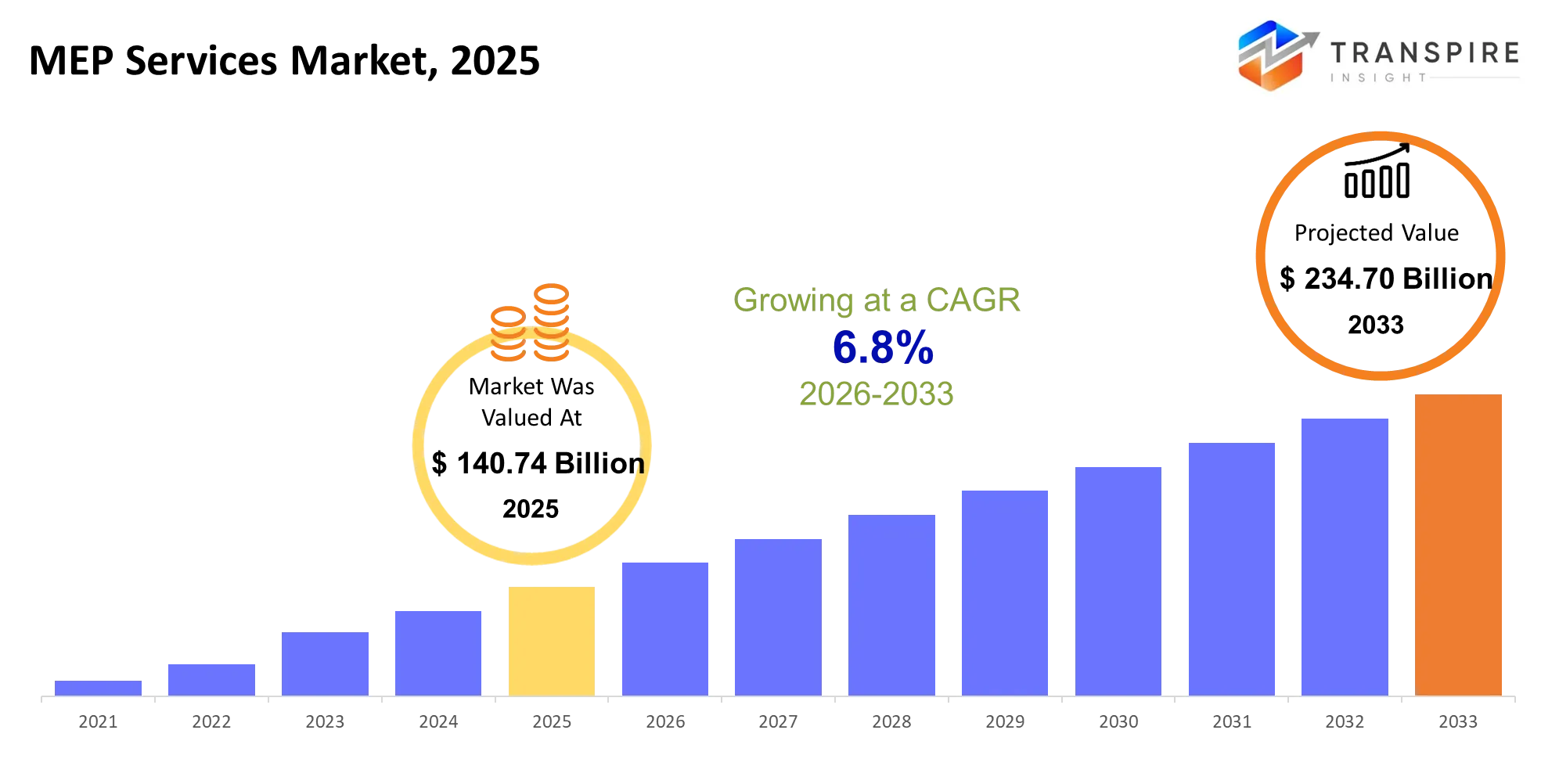
As per Transpire Insight Analysis, the MEP Services Market size is estimated at 140.74 billion in 2025 and is anticipated to reach USD 234.70 billion by 2033, growing at a CAGR of 6.8% from 2026 to 2033.
The MEP services market supports the design, installation, integration and maintenance of the electrical and plumbing systems that make buildings work. These services include power distribution, heating and cooling, water supply, fire safety and building controls for homes, offices, factories and other large projects. Over the past three to five years, the market has shifted from basic installation to connected systems, energy-efficient upgrades, and long-term maintenance. Building owners care more about running costs, comfort inside the building and how well everything works. Data centres, hospitals and high-tech manufacturing places need advanced and complicated systems. A big change is when building automation is added to HVAC systems. The growth of systems and the need to keep important places running have made this change happen faster. Because of this, more people are looking at how efficient the systems are, how long they stay working and how well the equipment performs over time, not just how much construction is happening.
Keyword Market Size & Forecast:
- Market Size 2025: USD 140.74 Billion
- Expected Market Value (2033): USD 234.70 Billion
- Forecast CAGR (2026–2033): 6.8%
- Leading Region in 2025: Asia Pacific
- Fastest Growing Region: North America
- Key Company Profiles: EMCOR Group, Comfort Systems USA, Quanta Services, AECOM, Jacobs, Turner Construction, Skanska, Bouygues Construction, Johnson Controls, Siemens, Schneider Electric, Honeywell, CBRE, JLL, Arup
Key Market Insights:
The industry is rapidly moving towards integrated building infrastructure, energy efficiency and technology-driven facility management.
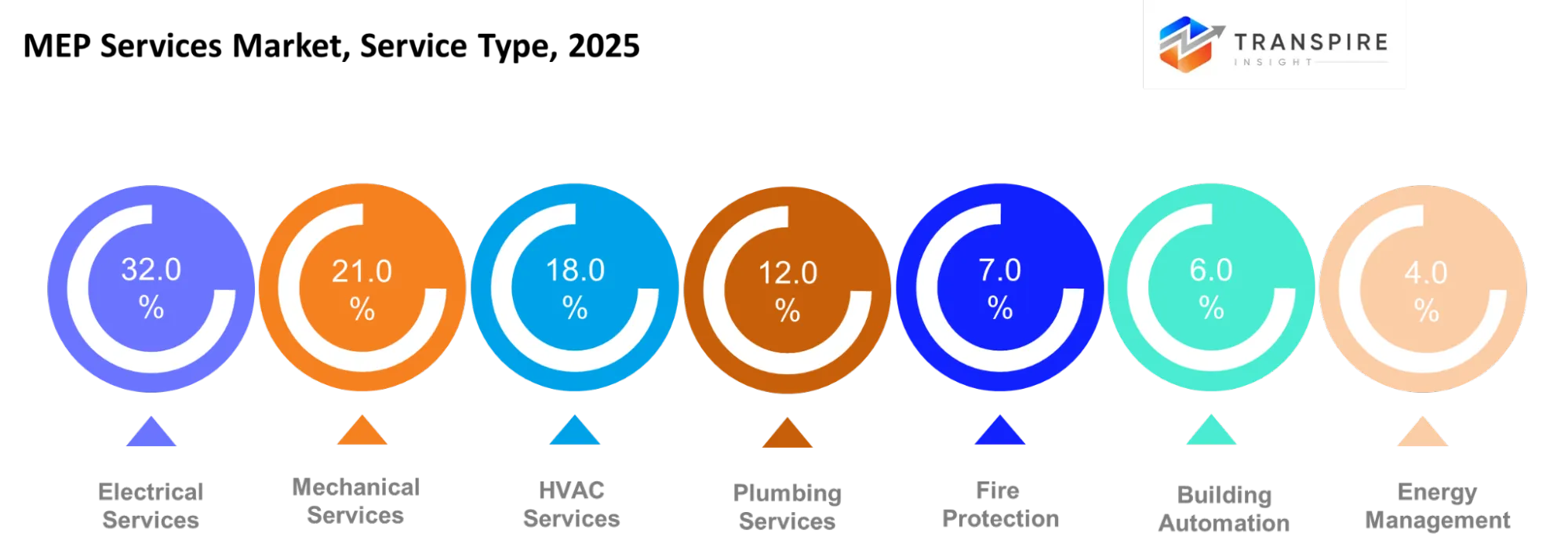
- The electrical services hold 32.0%, made possible through investments in power distribution, backup systems and the most modern electrical infrastructure.
- Mechanical services represent 21.0% of the market share, as companies such as EMCOR Group enhance their knowledge in complex installations in industry and commerce.
- HVAC services account for 18.0% of the market, as building owners install efficient cooling, ventilation and temperature control systems.
- The market share of plumbing services is 12.0%, made possible through modern water distribution and sanitation infrastructure.
- Fire protection services represent 7.0% of the market, as building safety requirements continue to increase.
- Building automation represents 6.0% of the market, made possible through the increasing installation of building management systems by companies such as Siemens and Johnson Controls.
What are the Key Drivers, Restraints, and Opportunities in the MEP Services Market?
Drivers
The MEP Services Market is driven by investments in data centres, healthcare, industrial, and commercial buildings where reliable power distribution, cooling, ventilation, and fire protection are important. The fast-growing demand for cloud-based solutions and AI infrastructure increases the demand for effective electrical installations and precision cooling systems. There is an opportunity to integrate design, installation, and maintenance provided by a contractor. Also, there is increased demand for engineering and commissioning services for newly constructed buildings and existing infrastructure.
Restraints
The shortage of qualified electricians, HVAC workers, plumbers, and commissioning experts is a serious barrier to market growth because the work requires coordinated labour force teams, and the lack of such people may cause additional costs, longer implementation periods, and margin pressure for the contractor. Also, expensive investments in advanced control and energy-efficient technology make the retrofit decision harder.
Opportunities
There are further opportunities arising from building modernisation, energy management and integrated service contracts. Owners are actively retrofitting instead of only investing in new assets. In the HVAC sector, this could include everything from the use of smart controls, efficient lighting and integrated real-time energy management systems to lower operating costs and improve performance. Contractors who use BIM, prefab and building automation are set to win more and bigger projects worldwide.
|
Driver |
Relative Impact on Growth (%) |
Geographic Relevance |
Impact Timeline |
Demand Strength |
Growth Mechanism |
Key Beneficiaries |
Major Constraint |
|
Rising Construction and Infrastructure Development |
27% |
Asia Pacific, North America, Middle East |
Short-term |
High |
Expands MEP installation across new construction projects |
MEP contractors, equipment manufacturers, construction companies |
High project costs and construction delays |
|
Increasing Demand for Energy-Efficient Buildings |
23% |
Europe, North America, Asia Pacific |
Medium-term |
High |
Drives efficient HVAC, lighting, and electrical system upgrades |
HVAC manufacturers, energy service providers, building owners |
High initial investment and retrofit expenses |
|
Growing Adoption of Smart Building Technologies |
19% |
North America, Europe, Asia Pacific |
Medium-term |
High |
Integrates automated controls and intelligent building systems |
Automation vendors, MEP consultants, facility managers |
Integration complexity and cybersecurity risks |
|
Stricter Building Regulations and Sustainability Standards |
17% |
Europe, North America, Middle East |
Long-term |
High |
Encourages compliant installations and sustainable building systems |
MEP engineering firms, green technology providers, developers |
Regulatory variations and compliance costs |
|
Expansion of Data Centers and Industrial Facilities |
14% |
North America, Asia Pacific, Europe |
Long-term |
High |
Increases demand for specialized cooling and power infrastructure |
Data center MEP contractors, electrical suppliers, industrial developers |
Skilled labour shortages and infrastructure costs |
|
Total |
100% |
What Has the Impact of Artificial Intelligence Been on the MEP Services Market?
The use of artificial intelligence in MEP services will be through the provision of assistance to building operators in transitioning from reactive to data-driven management of systems. AI in HVAC systems will be able to analyse occupancy data, weather data, temperature and equipment data to ensure that heating, cooling and ventilation happen according to the real-time condition of the building. AI in the electrical systems will be able to detect any abnormal load, possible faults and power distribution issues. Predictive maintenance is also one of the areas that will be positively impacted through AI. Monitoring vibration, temperature, pressure and operation cycles in equipment such as chillers, pumps, motors and air handling units will help in predicting any wear before failure happens. Predictive maintenance will help with planned maintenance and troubleshooting by service providers. Engineers will be able to test operations through digital twins and building management systems. The success of AI in MEP services will be contingent on the reliability of sensor data, compatibility of the equipment and integration with building management systems. High costs of initial investments, cybersecurity issues and lack of skilled personnel will hinder its adoption in some buildings.
Instance
June 2026,Trimble launched an AI feature for MEP estimation where they can be able to detect objects on construction drawings, detect electrical symbols and automatically calculate material quantities. Such innovations assist in decreasing the amount of manual work and increasing efficiency in MEP estimations.
Key Market Trends:
The market is shifting from the conventional installation of buildings to the adoption of technology-driven infrastructure management.
- BIM software usage is not just limited to design but is also used by MEP contractors to plan installations, resolve clashes, and avoid rework.
- MEP prefabrication is increasingly being considered by contractors to increase installation speeds, deal with labour shortages, and deliver quality installations.
- Construction of data centres is increasing the need for dedicated electrical distribution systems, backup power, and precise cooling systems.
- Smart maintenance services are increasingly replacing the old-fashioned reactive maintenance model through use of connected sensors for equipment monitoring and fault detection.
- Building renovations and retrofits are increasingly becoming significant as property owners renovate their existing electrical systems.
MEP Services Market Segmentation
By service type
Electrical services have become the leading category in the MEP Services Market, taking up 32.0%, because of the crucial nature of power distribution, lighting, electrical installation and backup systems in construction projects. Mechanical services constitute 21.0% of the total market, which is due to equipment installation, ventilation needs and mechanical needs in industry. HVAC services make up 18.0%, owing to the need for heating, cooling and indoor air quality in commercial and institutional buildings. Plumbing constitutes 12.0% of the market, while fire protection accounts for 7.0%. Building automation makes up 6.0%, and energy management takes up 4.0%. HVAC and building automation are forecasted to see greater growth compared with other categories.
By building type
The commercial buildings provide a source of demand for a massive investment in MEP services in office buildings, shopping centres, and office blocks. The residential buildings require safe and functional electrical, plumbing, and ventilation systems for the homes and apartments, while the industrial buildings require their own dedicated plant and equipment in order to allow for manufacturing activities. The hospitals and educational buildings will require a backup power supply, ventilation and safety systems. Hospitality requires emphasis on comfort and reliability of service.
By Project Type
New build is still a strong source of demand for an MEP design, installation, and commissioning. The retrofit projects are now gaining momentum, since the property owners are replacing the old electrical, heating, ventilation, air conditioning and safety systems. There are regular sources of income in maintenance services. The design-build and EPC contracts permit the integrated approach in project execution, and consulting advisors can assist in designing the system.
By system
HVAC will be the largest end-user since HVAC systems play a role in affecting the level of comfort and the amount of energy consumed in the buildings. The distribution of electrical power is needed for consistent supply of electrical power while plumbing and fire protection are key components of building operation and safety. Security and building management systems are increasingly becoming significant with respect to their integration with monitoring and access control systems. The renewable energy systems and solar power and energy storage are driving forces.
By end users
The MEP services will be important for real estate projects where the aim is property development and management of the building system. Factory facilities will require good mechanical, electrical and HVAC services. There will be strict ventilation and backup power needs for hospitals while governments carry out infrastructural projects. Energy efficiency is a priority in the retail and hospitality sectors.
By contract type
Design- Build & EPC contracts are generally needed for planning co-ordination between engineering, procurement and installation of large-scale projects. Turnkey contracts enable the clients to obtain systems – completed and functional – through a singular provider. Maintenance contracts may even involve recurring revenues generated by means of repair, investigation and servicing of equipment, whereas consulting services enable the provision of technical planning and study related to a challenge.
What are the Key Use Cases Driving the MEP Services Market?
Use Cases of Electrical Services in the MEP Services Market Include Power Supply, Power Backup Systems, Lighting and Electrically Safe Environment in Commercial, Industrial and Residential Buildings. The use of these services becomes extremely important in data centres, hospitals and manufacturing plants where continuous power supply is crucial. Extended Use Cases are HVAC Installation and Service, Plumbing Systems and Fire Protection Systems, Energy Management Systems and Building Automation. Such use cases are increasingly used at a coordinated level in office spaces, hotels, campuses and medical facilities. New Use Cases are Smart Retrofit Buildings, Electric Vehicle Charging Stations, Renewable Energy, Advanced Data Centre Cooling and Equipment Monitoring from Remote Locations. These use cases are motivating service providers to blend their skills in trades with digital engineering and life cycle services.
|
Report Metrics |
Details |
|
Market size value in 2025 |
USD 140.74 Billion |
|
Market size value in 2026 |
USD 150.30 Billion |
|
Revenue forecast in 2033 |
USD 234.70 Billion |
|
Growth rate |
CAGR of 6.8% from 2026 to 2033 |
|
Base year |
2025 |
|
Historical data |
2021 - 2024 |
|
Forecast period |
2026 - 2033 |
|
Report coverage |
Revenue forecast, competitive landscape, growth factors, and trends |
|
Regional scope |
United States; Canada; Mexico; United Kingdom; Germany; France; Italy; Spain; Denmark; Sweden; Norway; China; Japan; India; Australia; South Korea; Thailand; Brazil; Argentina; South Africa; Saudi Arabia; United Arab Emirates |
|
Key company profiled |
EMCOR Group, Comfort Systems USA, Quanta Services, AECOM, Jacobs, Turner Construction, Skanska, Bouygues Construction, Johnson Controls, Siemens, Schneider Electric, Honeywell, CBRE, JLL, Arup |
|
Customization scope |
Free report customization (country, regional & segment scope). Avail customized purchase options to meet your exact research needs. |
|
Report Segmentation |
Service Type (Mechanical Services, Electrical Services, Plumbing Services, HVAC Services, Fire Protection, Building Automation, Energy Management); Building Type (Residential, Commercial, Industrial, Healthcare, Education, Hospitality, Infrastructure); Project Type (New Construction, Renovation, Retrofit, Maintenance, Design-Build, EPC, Consulting); System (HVAC, Electrical Distribution, Plumbing, Fire Protection, Security, Building Management, Renewable Energy); End User (Real Estate, Manufacturing, Healthcare, Government, Hospitality, Retail, Data Centers); Contract Type (Design-Build, EPC, Turnkey, Maintenance Contract, Consulting, Outsourcing, Integrated Services) |
Which Regions are Driving the MEP Services Market Growth?
North America
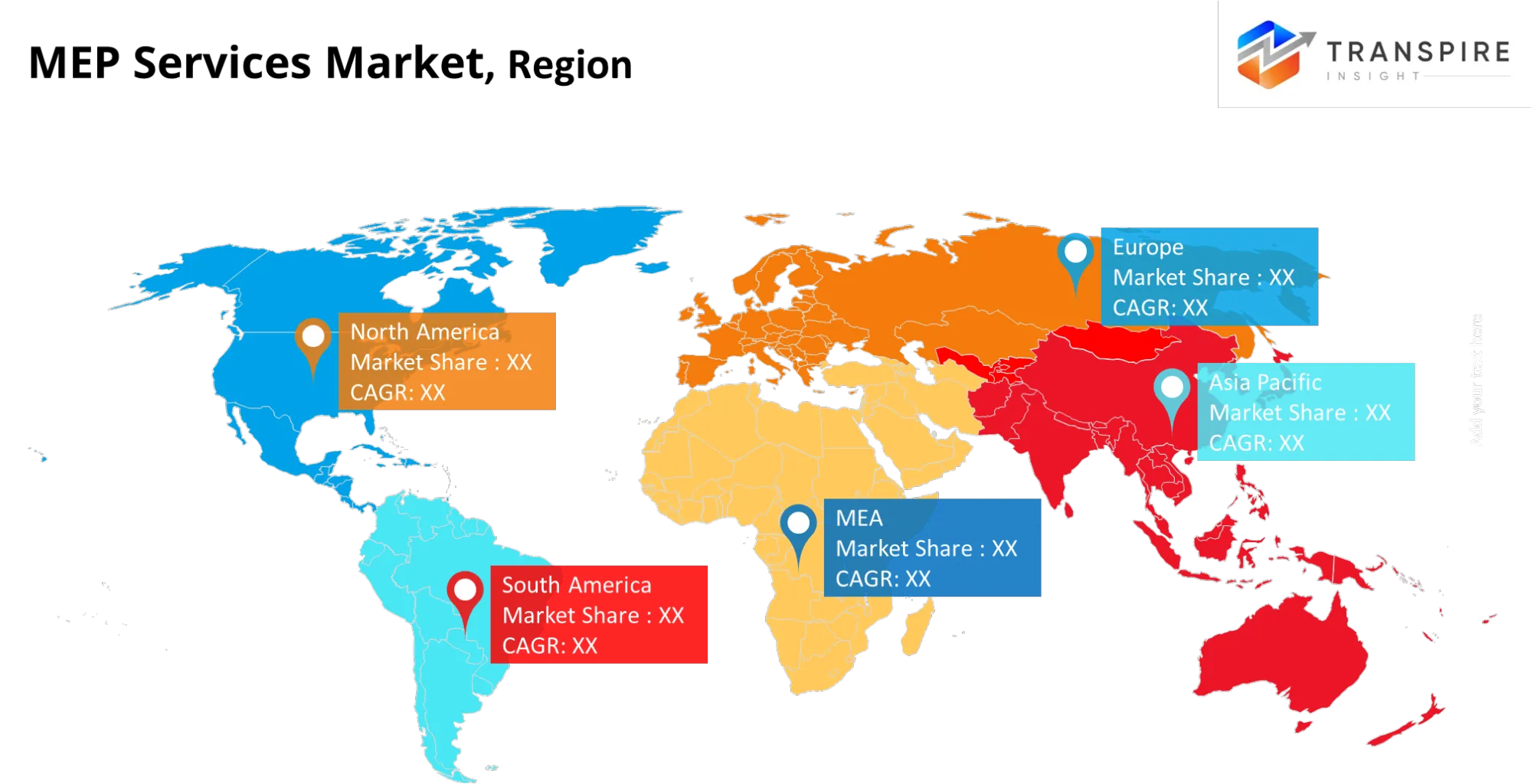
North America holds a share of 25.07%, fuelled by investments in commercial infrastructure, healthcare facilities, industrial development and data centres. The U.S. has a significant presence through advanced building systems, development in digital infrastructure and increased need for reliable electrical and cooling systems. Other factors driving the regional market include experienced engineering contractors and increasing use of building automation and energy-efficient systems. With a projected CAGR of around 8.0%, North America is the fastest-growing regional market due to investments in AI infrastructure, facility renovations and advanced building systems.
In January 2026, Jacobs received a contract award from Hut 8 for its engineering, procurement and construction management services for the River Bend data centre in Louisiana, USA. The project is designed to cater to the growing demand for electrical, mechanical cooling, and MEP services for AI data centres. https://www.jacobs.com/newsroom/press-release/jacobs-appointed-engineering-procurement-and-construction-management-lead
Europe
Europe constitutes 22.56% of the MEP Services Market, aided by established commercial infrastructure, industrial facilities and renovation programs in the building sector. Efforts towards energy efficiency and decarbonization have compelled property owners to renovate HVAC systems, electrical infrastructure and building management systems. Experienced engineering consultancies, specialised contractors and stringent construction standards further add to the favourable factors. Renovation activities and modernisation of old buildings offer a consistent demand for MEP services.
June 2026, PM Group won a contract worth €1.75 million from University College Cork, Ireland, to deliver MEP engineering services at the Tyndall National Institute. This project is an indication of the growing demand for specialized MEP engineering services in the research, semiconductor and manufacturing industry segments. https://eutenders.initask.com/notice/426258-2026
Asia Pacific
Asia Pacific is the largest market for the MEP Services Market with a 41.47% share due to factors like a high rate of urbanisation and growth in construction and industrial infrastructure. Nations such as China, India, Japan, and South Korea are contributing through investment in manufacturing plants, transportation infrastructure, housing units, and large-scale commercial construction projects. The region also has increased capacity for data centres and the use of advanced building technologies. More opportunities will arise due to infrastructure spending and energy-efficient building systems.
July 2026,Leighton Asia's Data Center MEP Contract: Leighton Asia received a contract from NTT Data Centers for the fit out works for its Bangkok data center campus, Thailand. The project requires MEP services in form of mechanical, electrical and plumbing installation works. https://www.hochtief.com/news-media/press-releases/press-release/leighton-asia-awarded-works-for-a-data-centre-project-in-thailand
Who are the Key Players in the MEP Services Market and how do they compete?
The competition in the Market is driven by speciality contractors, engineering consulting firms and players in the building technologies space. Competition in the market involves competition in terms of project delivery, technical prowess, geographical reach, safety record and complexity management of MEP systems throughout the lifetime of the building. Electrical and mechanical contractors compete in terms of speed and speciality, whereas integrated service providers aim to cater to customers looking for a one-stop solution from design to installation and maintenance. The EMCOR Group specialises in electrical and mechanical construction and facilities services, especially for data centres, healthcare and industrial buildings. The company's acquisition of Miller Electric helped strengthen its electrical portfolio in key growing areas. Johnson Controls provides an edge to itself in HVAC equipment, building automation and interconnected services platforms through digital management and energy optimisation of customers' businesses. The competitive edge provided by Siemens is electrification, automation and smart-building software through its partnerships.
Engineering firms such as WSP and AECOM compete through multi-disciplinary design, consulting and project management services, and enhance their expertise through acquisitions.
MEP Services Market companies
- EMCOR Group
- Comfort Systems USA
- Quanta Services
- AECOM
- Jacobs
- Turner Construction
- Skanska
- Bouygues Construction
- Johnson Controls
- Siemens
- Schneider Electric
- Honeywell
- CBRE
- JLL
- Arup
|
Company |
Est. Revenue Share Range |
Key Offerings |
Strategic Positioning |
Geographic Strength |
Technology Focus |
|
EMCOR Group |
Estimated 0.5–1.0% |
Mechanical contracting, electrical systems, HVAC, building maintenance |
Integrated MEP contracting and facilities leadership |
North America, Europe |
Building automation, energy optimization, digital monitoring |
|
Equans |
Estimated 0.4–0.8% |
HVAC installation, electrical engineering, plumbing, technical maintenance |
Integrated multi-technical services and project delivery |
Europe, North America, Asia Pacific |
Smart buildings, energy management, connected systems |
|
VINCI Energies |
Estimated 0.4–0.8% |
HVAC, electrical engineering, fire protection, building maintenance |
Decentralized engineering and integrated solutions |
Europe, Asia Pacific, Africa |
Smart building systems, automation, energy efficiency |
|
SPIE |
Estimated 0.3–0.6% |
HVAC services, electrical installation, technical facility management, energy services |
Technical services specialization and lifecycle maintenance |
Europe, Middle East, Africa |
Energy monitoring, building controls, predictive maintenance |
|
Comfort Systems USA |
Estimated 0.2–0.5% |
HVAC, plumbing, electrical contracting, piping systems |
Specialist mechanical contracting and acquisition-led expansion |
North America |
Modular construction, HVAC controls, building automation |
|
Johnson Controls |
Estimated 0.2–0.5% |
HVAC systems, fire protection, building controls, technical maintenance |
Premium building systems and lifecycle service integration |
North America, Europe, Asia Pacific |
AI-enabled controls, smart buildings, connected HVAC |
|
Siemens Smart Infrastructure |
Estimated 0.2–0.5% |
Building automation, electrical distribution, fire safety, HVAC controls |
Technology-led building infrastructure integration |
Europe, North America, Asia Pacific |
IoT, digital twins, AI automation, energy management |
|
CBRE Group |
Estimated 0.2–0.4% |
MEP maintenance, technical facilities management, building engineering, energy management |
outsourced facilities management leadership |
North America, Europe, Asia Pacific |
Smart facilities, building analytics, predictive maintenance |
|
JLL |
Estimated 0.1–0.3% |
Technical facility management, HVAC maintenance, electrical operations, building optimization |
Integrated property and technical facilities management |
North America, Europe, Asia Pacific |
Smart building platforms, IoT monitoring, energy analytics |
|
AECOM |
Estimated 0.1–0.2% |
MEP engineering design, building systems consultancy, commissioning, project management |
Engineering-led design and complex project delivery |
North America, Europe, Asia Pacific |
BIM, digital engineering, building performance modelling |
Recent Development News
In February 2026, Johnson Controls released the new generation of Smart Ready YORK Chillers, featuring integrated connectivity and analytics using artificial intelligence technology for better management of the equipment. https://www.johnsoncontrols.com/media-center/news/press-releases/2026/02/02/johnson-controls-launches-smart-ready-chillers-for-dayone-connectivity-and-32-percent-fewer-unplanne
In November 2025, Siemens formed a strategic partnership with Samsung C&T to integrate the capabilities of EPC project delivery with digitalisation, electrification and automation solutions. The partnership will start with infrastructure projects in Saudi Arabia, Thailand, and Canada, such as airports, hospitals, buildings and data centres. https://press.siemens.com//en/pressrelease/siemens-and-samsung-ct-partner-drive-next-generation-infrastructure-projects
What Strategic Insights Define the Future of the MEP Services Market?
The future of the MEP Services Market would depend increasingly on the incorporation of electrical infrastructures, effective HVAC systems, and intelligent building management systems. Installation-based contractors will face growing competition from those providing end-to-end engineering, automation, and lifecycle maintenance services. A potential risk would be the lack of qualified technical experts that could impact time-to-completion, quality, and profitability of the projects despite the good project demand. The problem with the integration of modern controls into old building infrastructure will also be another issue. However, an upcoming market opportunity would be upgrading the old commercial and industrial buildings with the help of smart retrofitting, energy management systems, and predictive maintenance systems. Firms should focus on digital engineering, workforce development, prefabrication and partnerships.
Service Type
- Mechanical Services
- Electrical Services
- Plumbing Services
- HVAC Services
- Fire Protection
- Building Automation
- Energy Management
Building Type
- Residential
- Commercial
- Industrial
- Healthcare
- Education
- Hospitality
- Infrastructure
Project Type
- New Construction
- Renovation
- Retrofit
- Maintenance
- Design-Build
- EPC
- Consulting
System
- HVAC
- Electrical Distribution
- Plumbing
- Fire Protection
- Security
- Building Management
- Renewable Energy
End User
- Real Estate
- Manufacturing
- Healthcare
- Government
- Hospitality
- Retail
- Data Centers
Contract Type
- Design-Build
- EPC
- Turnkey
- Maintenance Contract
- Consulting
- Outsourcing
- Integrated Services
By Regional Analysis
North America
- US
- Canada
- Mexico
Europe
- Germany
- UK
- France
- Italy
- Spain
- Russia
- Rest of Europe
Asia Pacific
- China
- Japan
- India
- South Korea
- Australia
- Rest of Asia Pacific
South America
- Brazil
- Argentina
- Rest of South America
Middle East & Africa
- UAE
- Saudi Arabia
- Qatar
- South Africa
- Rest of the Middle East & Africa
Frequently Asked Questions
Find quick answers to common questions.
The MEP services market size was valued at USD 140.74 billion in 2025 and is poised to reach USD 234.70 billion by 2033, expanding at a 6.8% CAGR.
Key segments for the MEP services market are Service Type (Mechanical Services, Electrical Services, Plumbing Services, HVAC Services, Fire Protection, Building Automation, Energy Management); Building Type (Residential, Commercial, Industrial, Healthcare, Education, Hospitality, Infrastructure); Project Type (New Construction, Renovation, Retrofit, Maintenance, Design-Build, EPC, Consulting); System (HVAC, Electrical Distribution, Plumbing, Fire Protection, Security, Building Management, Renewable Energy); End User (Real Estate, Manufacturing, Healthcare, Government, Hospitality, Retail, Data Centers); Contract Type (Design-Build, EPC, Turnkey, Maintenance Contract, Consulting, Outsourcing, Integrated Services)
Growth is primarily driven by increasing construction of residential and commercial buildings, rising infrastructure investments, and growing demand for energy-efficient building systems. The adoption of smart building technologies, HVAC solutions, and advanced electrical and plumbing systems further supports market expansion.
The market is led by major manufacturers including EMCOR Group, Comfort Systems USA, Quanta Services, AECOM, Jacobs, Turner Construction, Skanska, Bouygues Construction, Johnson Controls, Siemens, Schneider Electric, Honeywell, CBRE, JLL, Arup
Asia Pacific is leading the MEP services market with a 41.47% market share because of the quick urbanization, high investment in the development of infrastructure and construction of commercial and residential buildings. The region’s position in the market will get further bolstered by industrial growth, intelligent building concepts, and demand for efficient HVAC systems.
The opportunities in the MEP services market are numerous as there is a steady rise in the use of smart building technology, energy-efficient HVAC solutions, and sustainable construction, among others. Investment in the growth of infrastructural facilities is bringing new avenues for MEP service providers.
- EMCOR Group
- Comfort Systems USA
- Quanta Services
- AECOM
- Jacobs
- Turner Construction
- Skanska
- Bouygues Construction
- Johnson Controls
- Siemens
- Schneider Electric
- Honeywell
- CBRE
- JLL
- Arup
About the Authors

Mayur Shinde
I am Mayur Shinde, a Senior Research Analyst at Transpire Insight, specializing in the Automotive & Transportation and Information & Communication Technology (ICT) Industry. My work focuses on analyzing emerging market trends, technological advancements, competitive landscapes, and industry developments to deliver accurate, data-driven insights. I am passionate about transforming complex market information into clear, actionable content that helps businesses, professionals, and decision-makers stay informed and make confident strategic decisions.

Chakradhar Khansole
Chakradhar serves as the Research Director at Transpire Insight, bringing over 8 years of experience in technology, innovation, and strategic market intelligence. He specializes in transforming complex market data into actionable business insights that enable organizations to make informed, growth-oriented decisions. Recognized for his strategic vision and analytical expertise, Chakradhar leads high-impact research initiatives, delivering comprehensive market assessments, competitive intelligence, and forward-looking industry analysis.
Recently Published Reports
-
Apr 2026
3D Optical Profiler Market
3D Optical Profiler Market Size, Share & Analysis Report By Type (Desktop 3D Optical Profiler, and Portable 3D Optical Profiler), By Technology (Confocal Technology, and White Light Interference), By End-Use Industry (Manufacturing, Research Institutions, Automotive, Aerospace and Defense, Medical Devices, and Other), and Geography (North America, Europe, Asia-Pacific, Middle East and Africa, South and Central America), 2021 - 2031
-
Apr 2026
Depth Sensor Market
Depth Sensor Market Size, Share & Analysis Report By Type (Infrared Depth Sensors, Time-of-Flight (ToF) Sensors, Stereo Vision Sensors, Structured Light Sensors, Ultrasonic Depth Sensors), By Application (Automotive, Robotics, Gaming, Consumer Electronics, Industrial Automation, Healthcare, Security & Surveillance, Others), By End Users (Automotive Manufacturers, Consumer Electronics Companies, Healthcare Providers, Industrial Companies, Security Agencies, Gaming Companies, Robotics Companies, Others), and Geography (North America, Europe, Asia-Pacific, Middle East and Africa, South and Central America), 2021 – 2031
-
Apr 2026
Digital Manufacturing Market
Digital Manufacturing Market Size, Share & Analysis Report By Component (Hardware, Software, and Services), By Technology (Robotics, 3D Printing, Internet of Things (IoT), and Others), By Application (Automotive and Transportation, Aerospace and Defense, Consumer Electronics, Industrial Machinery, and Others), By Process Type (Computer-Based Designing, Computer-Based Simulation, Computer 3D Visualization, Analytics, and Others), and Geography (North America, Europe, Asia-Pacific, Middle East and Africa, South and Central America), 2021 – 2031
-
Apr 2026
Digital Visa Services Market
Digital Visa Services Market Size, Share & Analysis Report By Type (Individual Travelers, Group Travelers), By Application (Tourism, Business Travel, Others), and Geography (North America, Europe, Asia-Pacific, Middle East and Africa, South and Central America), 2021 – 2031