Healthcare Claim Management Market Summary:
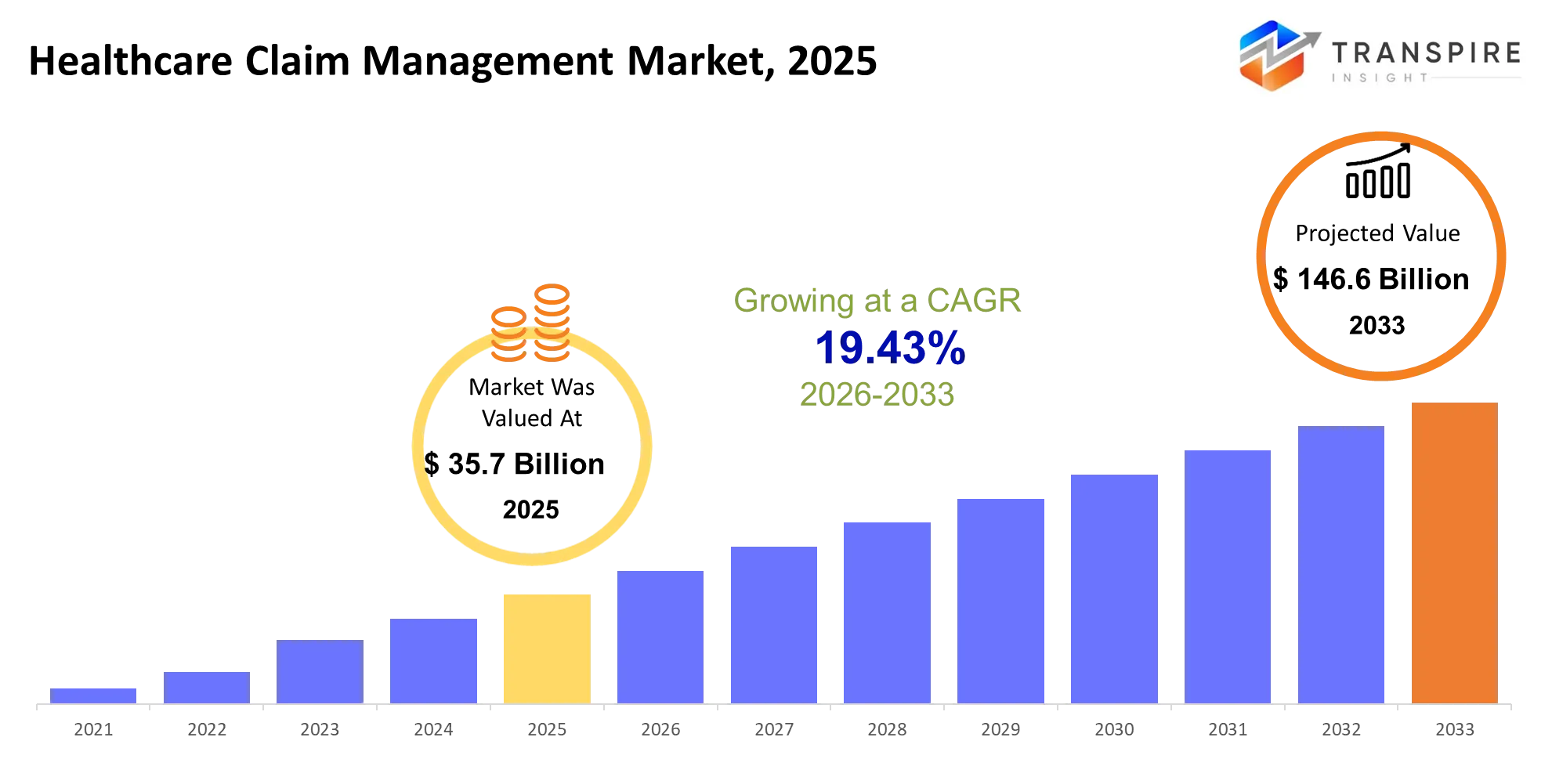
As per the Transpire Insight, The Healthcare Claim Management Market size is estimated at USD 35.7 billion in 2025 and is anticipated to reach USD 146.6 billion by 2033, growing at a CAGR of 19.43% from 2026 to 2033.
Healthcare claim management is about moving bills from care to cash-verifying coverage, ensuring clinical and coding accuracy, getting claims to payers, adjudicating amounts, finding errors, and handling denials and appeals. For health systems and insurers, performance here affects cash flow and staffing, as well as how long patients must wait for coverage decisions. Over the past three to five years, the industry has transitioned from batch to connected workflows on a shifting cloud ecosystem of platforms, APIs, automation, and analytics. The biggest structural change is policy-led interoperability. U.S. payers will have to meet prior-authorisation decisions on schedule starting in January 2026, the same deadline for API needs. Administrative friction is the trigger; denials and appeals have been the largest revenue cycle leakage source for 48% of medical-group leaders in a January 2026 MGMA poll. Claims volume, disjointed records, and complex payer rules create rework; automation can shrink cycles, prevent avoidable denials, and protect collections, spurring platform use.
Healthcare Claim Management Market Size & Forecast:
- Market Size 2025: USD 35.7 Billion
- Expected Market Value (2033): USD 146.6 Billion
- Forecast CAGR (2026–2033): 19.43%
- Leading Region in 2025: North America
- Fastest Growing Region: Asia Pacific
- Key Company Profiles: Optum, Cognizant, Change Healthcare, Oracle, IBM, Accenture, TCS, Wipro, Infosys, Xerox, Conduent, HCLTech, Cognizant TriZetto, EXL, Genpact.
Key Healthcare Claim Management Market Insights:
The market is moving from back-office claim processing to AI-powered revenue-integrity ecosystems, where interoperability, denial prevention, and real-time payer-provider data exchange will provide competitive advantages.
- Despite being the main purchase category at 55.0%, software is also getting AI adjudication and denial-prediction capabilities directly in claims workflows.
- Payer pressure for manual review reduction and to achieve first-pass resolution is driving the fastest-growing software capability, AI-based claim automation, at 13.6% CAGR.
- Services make up 16.0% of the total and are becoming more and more outsourced, with providers implementing larger teams of in-house providers for simpler exception handling, appeals, and payer follow-up.
- Consulting accounts for 7.5% of the market, with interoperability readiness, workflow redesign, and compliance planning ahead of electronic prior-authorisation mandates driving the growth.
- Implementation and integration account for 12.0%, with hospitals and TPAs linking EHRs, clearinghouses, payer APIs, and legacy billing systems.
- Cognizant's TriZetto Unify now opens headless APIs to AI agents, with electronic prior authorisation as its first live workflow.
- Optum is continuing to grow its real-time payer-provider claims connectivity efforts via its Microsoft partnership and AI Marketplace programs.
- Oracle is moving forward with claims functionality native to EHRs that integrates clinical documentation and financial adjudication, minimizing duplicate data entry.
- Cloud and SaaS deployment are becoming default choices, with over 60% of new platform purchases expected to be cloud-native or cloud-hybrid.
What are the Key Drivers, Restraints, and Opportunities in the Healthcare Claim Management Market?
Driver:
The principal growth driver is the shift from reactive denial handling to pre-submission claim intelligence. Rising denial rates, coding complexity, and payer documentation requirements have made manual claims review costly and slow. AI-based validation, automated coding checks, and predictive denial scoring allow providers to correct errors before submission, reducing rework, appeal volume, and accounts receivable days. For vendors, this increases adoption of software, analytics modules, and integration services; for providers, it protects reimbursement and improves cash flow.
Restraint:
Billing, EHR, payer, and clearinghouse systems use inconsistent codes and formats. Integration costs slow implementation and can create duplicate workflows. Smaller clinics may lack technical staff or claim volumes to justify deployments. Privacy, cybersecurity, model governance, and inaccurate automated decisions require human review, limiting straight-through processing.
Opportunity:
The next growth unlock is compliance-driven electronic prior authorisation. CMS requires impacted payers to implement FHIR-based prior-authorisation APIs from January 2027, while its 2026 proposal extends electronic prior authorisation to drugs and proposes tighter decision timelines. Vendors that offer API-native, auditable platforms for hospitals, payers, and pharmacy networks can capture implementation, integration, and analytics revenue—especially in the United States and interoperability-focused European and Asia-Pacific markets.
|
Driver |
Relative Impact on Growth (%) |
Geographic Relevance |
Impact Timeline |
Demand Strength |
Growth Mechanism |
Key Beneficiaries |
Major Constraint |
|
AI and automation to prevent denials and streamline claims processing |
28% |
North America; expanding in India and Asia Pacific |
Short-term (≤2 years) |
High |
AI detects errors, automates adjudication, accelerates payment, reduces rework. |
Hospitals, payers, RCM vendors, claims software providers |
Fragmented data, model governance, integration costs, human oversight requirements |
|
Regulatory push for electronic prior authorisation and interoperable claims workflows |
23% |
North America, particularly the United States |
Short-term (≤2 years) |
High |
APIs standardise authorisation data exchange and shorten decision cycles. |
Health plans, providers, EHR vendors, interoperability platforms |
Legacy systems, uneven payer readiness, implementation deadlines, drug exclusions |
|
Rising claims volumes and growing demand for scalable digital processing |
19% |
Asia Pacific and North America |
Medium-term (2–4 years) |
High |
Higher transaction volumes increase demand for scalable processing platforms. |
Insurers, TPAs, hospitals, cloud and claims platform vendors |
Diverse coding rules, cross-border privacy laws, payer-specific formats |
|
Administrative cost pressure and healthcare workforce shortages |
16% |
North America and Europe |
Short-term (≤2 years) |
High |
Labour shortages and rising admin costs prompt workflow automation and outsourcing. |
RCM outsourcers, hospitals, insurers, automation vendors |
Budgets, procurement delays, change resistance, uncertain automation returns |
|
Expanding public coverage and increasingly complex benefit administration |
14% |
Asia Pacific, North America, and emerging markets |
Long-term (≥4 years) |
Medium |
Growing coverage and benefit complexity increase eligibility checks and adjudication volumes. |
Government schemes, insurers, TPAs, public hospitals, members |
Funding limits, uneven digital infrastructure, fraud-control requirements |
What Has the Impact of Artificial Intelligence Been on the Healthcare Claim Management Market?
AI is shifting claim management from a backwards-looking process of paper chasing and follow-up to work that proactively promises revenue integrity. In automation, natural language processing retrieves information from clinical notes, referral letters, and payer correspondence. Robotic process automation manages claim routing, field validation and status requests. Machine learning scoring predicts coding quality, eligibility, documentation quality, and payer-specific rules before the claim is submitted, thus alerting staff to high-risk claims.
The predictive value of AI is most evident in denied-claim prevention and fraud detection: AI can identify high-risk claims, make suggestions for coding or document corrections, and detect unusual billing and suspicious provider behaviour. Reported results include lower denial rates, faster cycle times, and higher accuracy, with one report citing 21.4% fewer denied claims and days in AR for the AI-assisted coding and billing models. Operationally, these tools reduce manual steps, speed reimbursement, and free staff to handle unusual, more complex cases. However, AI adoption remains limited due to costs of integration, legacy system incompatibility, and inaccuracy. AI recommendations are not error-free, making necessary human review to assess false automated denials, coding suggestions,and fraud alerts, with consequences forcompliance, appeal, and access.
In September 2026, GenHealth.ai secured $16.5 million in a Series A funding round led by Flare Capital Partners. This investment will scale their healthcare AI agents that automate medical back-office workflows, including eligibility checks, prior authorizations, medical billing, and claim denial resolution.
https://newmarketpitch.com/blogs/news/digital-health-list-deals
Key Healthcare Claim Management Market Trends:
Claims operations are moving from reactive to proactive correction or prevention at submission, where provider revenue and payer accuracy are protected by improved data. The top platforms are more likely to integrate clinical records, authorisation, adjudication, payment, and appeals into a traceable workflow.
- To comply with the decision time requirements of CMS, payers and providers are replacing manual prior authorisation with FHIR-based electronic workflows.
- AI is shifting the focus of denial management upstream and finding documentation and coding issues before they ever hit the payers.
- Cloud and SaaS deployment is growing as providers look to scalable updates, remote access, and reduced infrastructure ownership.
- Payer-provider data exchange is evolving from an integration option to a competitive necessity.
- The fraud detection landscape is shifting from a retrospective audit to real-time anomaly detection of claims, provider conduct, and billing practices.
- Generative AI is being introduced to exception handling, drafting of appeal letters and summarising payers' communications, with the final adjudication control remaining with the human.
- Integrated platforms are becoming increasingly popular over standalone billing tools, as they integrate eligibility, authorisation, adjudication and analytics.
- There is a growing demand for auditable, standards-based claims systems from public payers and government health programs.
- National-records integration and scalable claim platforms are filling the need for digital-health reforms in Asia-Pacific.
Healthcare Claim Management Market Segmentation
Component:
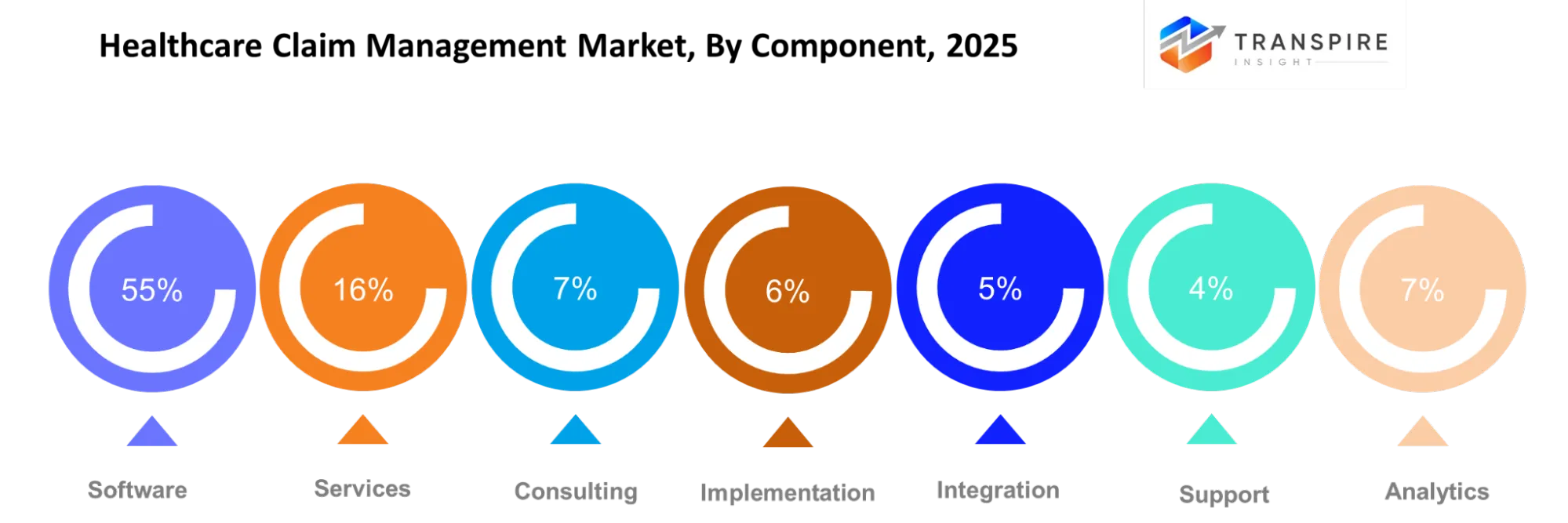
Software leads the market at 55.0% share, since it delivers the core workflow engine that captures, validates, adjudicates, and denies claims. Services has a 16.0% share, indicating strong downstream demand for outsourcing, managed operations and revenue-cycle services. Consulting accounts for 7.5% of the revenue cycle market, as organisations seek to redesign processes for consumerism, interoperability and artificial intelligence. Implementation makes up 6.5% of the revenue cycle market and integration 5.5%, with both benefiting from demand for electronic health records, payer APIs and legacy-system integration. Support has a 4.0% share; analytics, 3.5%; and other categories, 2.0%. The artificial-intelligence-based claims automation subsegment is the fastest-growing at a CAGR of 13.6%, thanks to use cases in denial prevention, coding validation, and predictive adjudication.
Claim Type:
Medical and hospital claims dominate because they generate the highest transaction volumes, involve complex coding, and must comply with multiple payer-specific reimbursement rules. These claims require continuous validation of diagnoses, procedures, coverage, and documentation. Pharmacy claims are expanding as electronic prior authorisation becomes more widely adopted, while dental, vision, disability, and long-term-care claims remain important specialised workflows. Each requires distinct benefit structures, documentation standards, and adjudication rules, creating sustained demand for configurable claim-management platforms.
Deployment:
Cloud and SaaS models are gaining share because they offer scalability, continuous feature updates, remote accessibility, and lower upfront infrastructure investment. These advantages are particularly valuable for hospitals, insurers, and TPAs managing fluctuating claim volumes. On-premise systems persist among large hospitals, insurers, and government organisations that require direct control over sensitive patient and financial data. Hybrid and private-cloud models are increasingly preferred because they balance regulatory compliance, data security, and the flexibility needed for AI-driven claims automation.
Application:
Claim processing and claim adjudication form the operational core of healthcare claim management, ensuring accurate validation, coding, and reimbursement decisions. However, fraud detection, eligibility verification, denial management, payment management, and audit and compliance are growing faster as organizations prioritize revenue protection and regulatory readiness. AI-enabled tools now identify high-risk claims before submission, verify coverage in real time, and prioritise appeals. This shifts claim management from reactive payment recovery toward proactive revenue-integrity management across provider and payer workflows.
End User:
Hospitals, health insurance companies, and third-party administrators are the primary adopters because they process the highest claim volumes and face intense pressure to reduce denials, delays, and administrative costs. Clinics, government programs, pharmaceutical companies, and employers represent expanding demand as value-based care, self-funded employer plans, and pharmacy benefit programs require greater payment visibility. These users increasingly seek platforms that connect eligibility, authorisation, adjudication, and compliance reporting within a single workflow rather than relying on disconnected billing tools.
Enterprise Size:
Large enterprises and hospital networks lead adoption because they manage complex claim portfolios, multi-site operations, and strict compliance requirements. Their scale justifies investment in AI-based automation, analytics, and integrated revenue-cycle platforms. SMEs, insurance groups, healthcare providers, and third-party administrators are adopting cloud-based, subscription-priced platforms that reduce capital expenditure and simplify implementation. This shift is broadening market access, enabling smaller organisations to access enterprise-grade claim automation, denial analytics, and interoperability capabilities without maintaining costly in-house infrastructure.
What are the Key Use Cases Driving the Healthcare Claim Management Market?
The core use case is software-led claim processing and adjudication, anchored by the component segment’s 55.0% share. Providers validate coding and coverage before submission, reducing rework. AI-based claim automation is projected to grow at a 13.6% CAGR.
Adjacent applications include fraud detection for anomalies, payment management for remittance reconciliation, and denial management for rejection analysis and appeals. Insurers, TPAs, and government programs use these tools across medical, pharmacy, and hospital claims.
Emerging use cases include API-enabled prior authorisation, cross-payer exchange, and AI-supported documentation review. CMS timelines and API requirements encourage connected workflows; India’s NHCX work supports common-format claims exchange. These capabilities connect eligibility through settlement and improve operational visibility for all.
|
Report Metrics |
Details |
|
Market size value in 2025 |
USD 35.7 Billion |
|
Market size value in 2026 |
USD 42.3 Billion |
|
Revenue forecast in 2033 |
USD 146.6 Billion |
|
Growth rate |
CAGR of 19.43% from 2026 to 2033 |
|
Base year |
2025 |
|
Historical data |
2021 - 2024 |
|
Forecast period |
2026 - 2033 |
|
Report coverage |
Revenue forecast, competitive landscape, growth factors, and trends |
|
Regional scope |
United States; Canada; Mexico; United Kingdom; Germany; France; Italy; Spain; Denmark; Sweden; Norway; China; Japan; India; Australia; South Korea; Thailand; Brazil; Argentina; South Africa; Saudi Arabia; United Arab Emirates |
|
Key companies profiled |
Optum, Cognizant, Change Healthcare, Oracle, IBM, Accenture, TCS, Wipro, Infosys, Xerox, Conduent, HCLTech, Cognizant TriZetto, EXL, Genpact. |
|
Customization scope |
Free report customization (country, regional & segment scope). Available customized purchase options to meet your exact research needs. |
|
Report Segmentation |
Component (Software, Services, Consulting, Implementation, Integration, Support, Analytics, Others)Claim Type (Medical Claims, Hospital Claims, Pharmacy Claims, Dental Claims, Vision Claims, Disability Claims, Long-Term Care Claims, Others)Deployment (Cloud, On-Premise, Hybrid, SaaS, Private Cloud, Public Cloud, Hosted, Others)Application (Claim Processing, Claim Adjudication, Fraud Detection, Eligibility Verification, Payment Management, Denial Management, Audit & Compliance, Others)End User (Hospitals, Health Insurance Companies, TPAs, Clinics, Government Programs, Pharmaceutical Companies, Employers, Others)Enterprise Size (Large Enterprises, SMEs, Government Organizations, Hospital Networks, Insurance Groups, Healthcare Providers, Third-Party Administrators, Others) |
Which Regions are Driving the Healthcare Claim Management Market Growth?
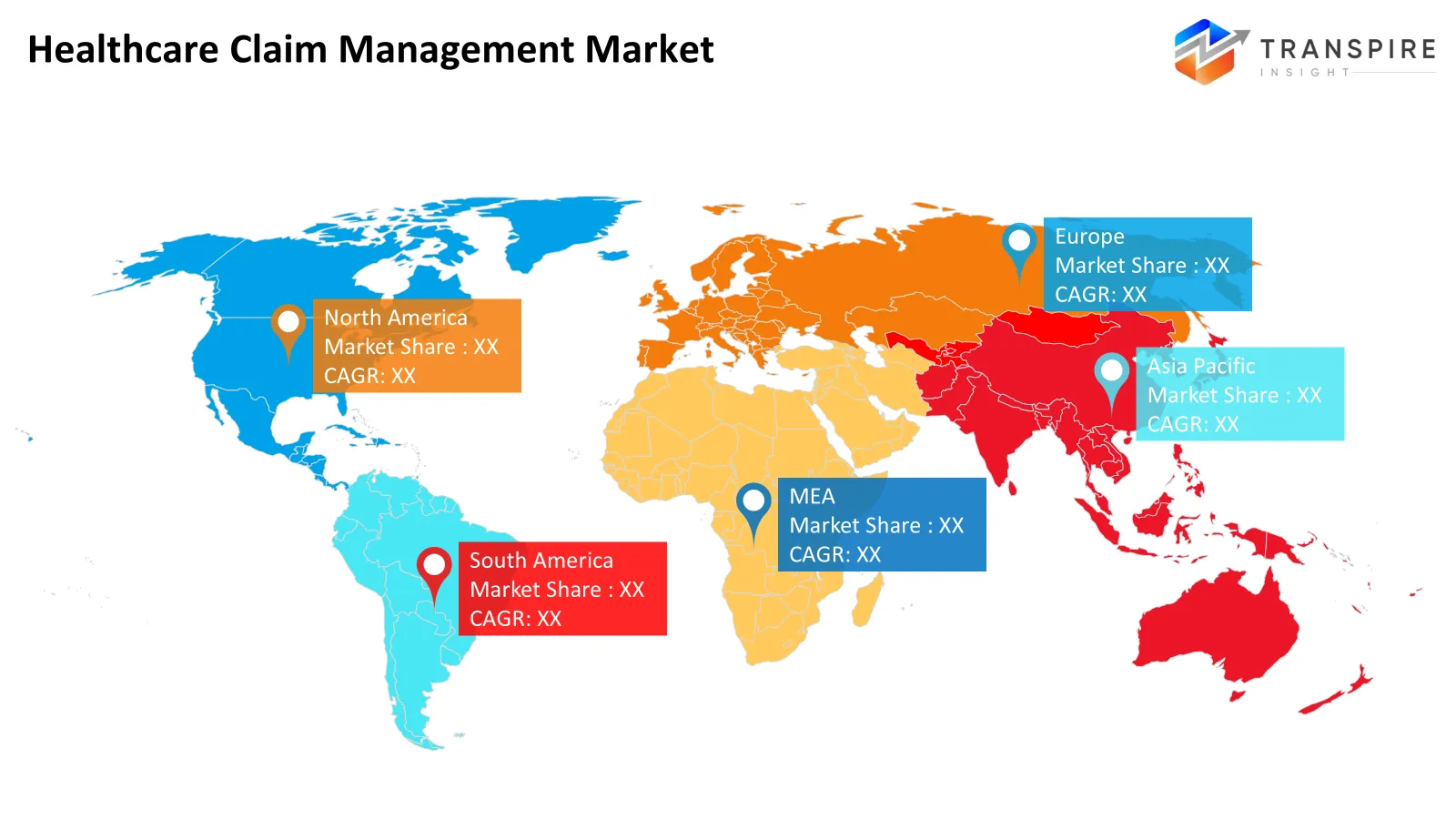
North America is the largest region at 58.0% of the market, as a result of high insurance penetration, complicated multi-payer reimbursement rules, and extensive use of revenue cycle and EHR systems. Because of the presence of an established vendor ecosystem, a comprehensive clearinghouse network, and regulation to move PA and claims data electronically, North America is witnessing requirements from the Centers for Medicare and Medicaid Services to make payers decide faster and use FHIR-based interoperability to link payer decision-making and hospital/insurer/TPA upgrades into a continuous cycle.
In September 2026, UF Health partnered with R1 RCM to deploy an AI-native revenue cycle operating model. The deployment leverages R1's Phare OS platform to mitigate mounting reimbursement complexities and drive automated, real-time clinical and financial decision-making across their health systems.
Europe is a mature digital market with 21.5% insurance penetration, below North America, supported by established public systems, and with a slower rate of adoption of health information technology. European health data space has a single framework for access and exchange of electronic health data. Asia Pacific 14.0% Latin America 3.8% Middle East & Africa 2.7% Insurance penetration varies between regions, and levels of digital enablement are variable. Regulatory coordination in Europe supports slow rollout, with platforms being configurable to meet payment regimes.
In October 2026, the European Commission officially enacted three new implementing regulations for the European Health Data Space (EHDS). This structural action establishes mandatory, cross-border digital rules for the MyHealth@EU platform.
Asia Pacific at 14.8% CAGR, with a 14.0% market share, followed by Latin America at 3.8% and Middle East and Africa at 2.7%. A new trend of recent countries' expansion in India, China, Japan, South Korea, and Australia reflects advancements in digital health ID, cashless insurance networks, nationwide claims infrastructure, and wider private insurance. In the future, opportunities include mobile-first claims submission, fraud detection analytics, and a cloud-native platform to scale to government programs and private insurers seeing rapid growth.
In June 2026, Star Health and Allied Insurance Company Limited partnered with Amplify Health to deploy AI-led claims intelligence and healthcare analytics capabilities across its operations.
Who are the Key Players in the Healthcare Claim Management Market, and how do they compete?
Competing underneath core claims and data-sharing networks, and service providers harnessed to streamline or operate flows. Buyers focus on adjudication quality, configurability, interoperability, compliance, value, and clean-claim efficiency. Optum and Change Healthcare supply network scale integrated with linked APIs; Oracle supplies rules-based adjudication and cloud deployment; IBM supplies AI-led operational restructuring.
Cognizant, Cognizant Tri Zetto combine Facets, QNXT with agentic automation for pended claim work. Accenture offers transformation, claims ops; TCS, payer IP, interoperability; Wipro, BPaaS, health hedge; Infosys, payer platform, ops; HCLTech, modernisation, GenAI Claim Assist. Growth is based on combining managed delivery. Xerox specialises in document intake; Conduent combines volume-based administration with high configurability in their core systems; EXL specialises in payment-integrity analytics; and Genpact is becoming more big automation and process redesign. Service companies grow by outsourcing and wrapping analytics and automation around client architectures. They will be judged on outcomes and the extent to which AI can be used with accountable governance. They win on outcomes, risk automation, and payer-agnostic support.
Key Players are:
- Optum
- Cognizant
- Change Healthcare
- Oracle
- IBM
- Accenture
- TCS
- Wipro
- Infosys
- Xerox
- Conduent
- HCLTech
- Cognizant TriZetto
- EXL
- Genpact
Healthcare Claim Management Market — Enhanced Competitive Benchmarking
|
Company |
Est. Revenue Share Range |
Key Offerings |
Strategic Positioning |
Geographic Strength |
Technology Focus |
|
Optum |
Estimated 8–12% |
Claims editing; payment integrity; claims pricing; payer operations tools |
Scale leader in payment integrity and payer tools |
North America; selected international payer markets |
AI-assisted edits, analytics, payment integrity automation |
|
Cognizant TriZetto |
Estimated 7–11% |
Facets; QNXT; NetworX; claims workflow automation |
Installed-base platform leader with full-stack administration |
North America; selective international markets |
Core claims engines, agent workflows, governed automation |
|
Conduent |
Estimated 4–7% |
HSP Payer Suite; claims intake; claims administration; payment recovery |
High-volume claims administration and public-plan operations |
North America; selective international delivery |
OCR, AI intake, configurable adjudication, workflow automation |
|
Oracle |
Estimated 3–6% |
Oracle Health Insurance Claims Adjudication and Pricing; Claims Administration Cloud; provider pricing |
Configurable enterprise core for multinational payer modernization |
North America; Europe; Asia Pacific |
Rules-based adjudication, REST APIs, SaaS deployment |
|
HealthEdge |
Estimated 3–6% |
HealthRules Edge; Payment Accuracy Edge; payer-source integration |
Specialist challenger focused on modern health-plan cores |
North America; selective international markets |
Cloud-native claims engine, embedded AI, auto-adjudication |
|
Accenture |
Estimated 3–6% |
Payer claims processing; claims operations; administration transformation; managed services |
Transformation and managed-services partner for large payers |
North America; Europe; Asia Pacific |
Process automation, analytics, cloud migration, operating models |
|
Infosys BPM |
Estimated 2–4% |
Claims adjudication; adjustments; audit; overpayment recovery |
Cost-efficient claims operations and payer process outsourcing |
North America; Asia Pacific; Europe |
AI-enabled workflows, adjudication support, audit analytics |
|
Wipro |
Estimated 2–4% |
PayerAI; claims operations; payer-system modernization; PLEXIS-related solutions |
Payer operations and platform modernization specialist |
North America; Asia Pacific; Europe |
PayerAI automation, analytics, core-system integration |
|
Tata Consultancy Services |
Estimated 2–4% |
Claims-system modernization; payer operations; claims analytics; quality engineering |
Large-scale modernization and operations transformation partner |
North America; Europe; Asia Pacific |
AI pattern detection, cloud migration, quality automation |
|
EXL |
Estimated 1–3% |
Payer claims services; payment integrity; subrogation; claims analytics |
Analytics-led payment integrity and claims operations specialist |
North America; Asia Pacific; Europe |
Predictive models, machine learning, anomaly detection |
Recent Development News
- In March 2026, Optum Real partnered with Microsoft to add AI and cloud capabilities for claims, reimbursement, documentation, and prior authorisation. The collaboration is intended to reduce manual work and help providers resolve coverage and payment issues earlier. https://www.healthcarefinancenews.com/news/optum-real-microsoft-partner-ai-claims-and-reimbursement
- In April 2026, RapidClaims launched RapidRecovery, a denial management solution with automated root-cause analysis, appeals workflows, and predictive prevention. The product extends its platform across the claims lifecycle and aims to speed denial resolution and reduce revenue loss for healthcare providers. https://www.businesswire.com/news/home/20260413723244/en/RapidClaims-Expands-RCM-Platform-with-RapidRecovery-Completing-an-Integrated-Revenue-Cycle-from-Clean-Claim-to-Denial-Resolution
- In February 2026, UiPath launched agentic AI healthcare solutions featuring specialised modules for automated claim denial prevention and resolution. This technology optimises the billing process by reducing administrative burdens and minimising payment delays for providers and payers through advanced medical record analysis. https://www.uipath.com/newsroom/uipath-launches-agentic-solutions-for-healthcare-vive2026
What Strategic Insights Define the Future of the Healthcare Claim Management Market?
The industry moves to integrated, interoperable, AI-driven claims ecosystems where eligibility, authorisation, claims adjudication, and claims denial prevention become one continuous process. Software will retain its 55.0% share, with most of the value to be gained from analytics, integration and AI automation, rather than simple claims capture. A risk exists of AI-driven adjudication or fraud detection models denying valid claims without insight into a transparent human review process, creating more appeals, delays in care and compliance investigations – more so as AI shifts from decision aids to autonomous workflow execution. The AI pricing model enables: Compliance-led electronic prior authorisation vendors that have FHIR-native API's, audit trails, and payer/provider connectivity in North America, Europe, and the Asia Pacific region. Vendors should market outcomes such as decreased denial rates, cycle time, and increased auto-adjudication, not licensing, and providers and payers should look for agnostic, modular platform architectures built on APIs that can absorb AI advances without needing to replace the entire system.
Key Segmentations are:
Component
- Software
- Services
- Consulting
- Implementation
- Integration
- Support
- Analytics
- Others
Claim Type
- Medical Claims
- Hospital Claims
- Pharmacy Claims
- Dental Claims
- Vision Claims
- Disability Claims
- Long-Term Care Claims
- Others
Deployment
Cloud
- On-Premise
- Hybrid
- SaaS
- Private Cloud
- Public Cloud
- Hosted
- Others
Application
- Claim Processing
- Claim Adjudication
- Fraud Detection
- Eligibility Verification
- Payment Management
- Denial Management
- Audit & Compliance
- Others
End User
- Hospitals
- Health Insurance Companies
- TPAs
- Clinics
- Government Programs
- Pharmaceutical Companies
- Employers
- Others
Enterprise Size
- Large Enterprises
- SMEs
- Government Organizations
- Hospital Networks
- Insurance Groups
- Healthcare Providers
- Third-Party Administrators
- Others
By Regional Analysis
North America
- US
- Canada
- Mexico
Europe
- Germany
- UK
- France
- Italy
- Spain
- Russia
- Rest of Europe
Asia Pacific
- China
- Japan
- India
- South Korea
- Australia
- Rest of Asia Pacific
South America
- Brazil
- Argentina
- Rest of South America
Middle East & Africa
- UAE
- Saudi Arabia
- Qatar
- South Africa
- Rest of the Middle East & Africa
Frequently Asked Questions
Find quick answers to common questions.
The healthcare claims management market size was valued at USD 35.7 billion in 2025 and is poised to reach USD 146.6 billion by 2033, expanding at a 19.43% CAGR.
Key segments for the healthcare claims management market are Component (Software, Services, Consulting, Implementation, Integration, Support, Analytics, Others)Claim Type (Medical Claims, Hospital Claims, Pharmacy Claims, Dental Claims, Vision Claims, Disability Claims, Long-Term Care Claims, Others)Deployment (Cloud, On-Premise, Hybrid, SaaS, Private Cloud, Public Cloud, Hosted, Others)Application (Claim Processing, Claim Adjudication, Fraud Detection, Eligibility Verification, Payment Management, Denial Management, Audit & Compliance, Others)End User (Hospitals, Health Insurance Companies, TPAs, Clinics, Government Programs, Pharmaceutical Companies, Employers, Others)Enterprise Size (Large Enterprises, SMEs, Government Organizations, Hospital Networks, Insurance Groups, Healthcare Providers, Third-Party Administrators, Others).
Growth is primarily driven by rising claim volumes, costly denials and rework, stricter prior-authorisation timelines, and adoption of AI, automation, and interoperable claims systems.
The market is led by major manufacturers, including Optum, Cognizant, Change Healthcare, Oracle, IBM, Accenture, TCS, Wipro, Infosys, Xerox, Conduent, HCLTech, Cognizant TriZetto, EXL, Genpact.
North America holds 58.0% of the market, supported by large insurance programs, high claim volumes, mature payer-provider networks, and investment in claims technology.
Opportunities include AI-based denial prevention, API-enabled payer-provider data exchange, cloud claims platforms, and integrated tools for adjudication, payment, and appeals.
- Optum
- Cognizant
- Change Healthcare
- Oracle
- IBM
- Accenture
- TCS
- Wipro
- Infosys
- Xerox
- Conduent
- HCLTech
- Cognizant TriZetto
- EXL
- Genpact
About the Authors

Pankaj Ghogare Patil
I am Pankaj Ghogare Patil, a Senior Research Analyst at Transpire Insight, specializing in the Pharmaceutical, Chemicals & Materials, Healthcare IT, and Biotechnology industry. My expertise lies in conducting comprehensive market research, analyzing industry trends, evaluating competitive landscapes, and translating complex data into actionable insights. At Transpire Insight, I closely follow emerging technologies, regulatory developments, and market innovations to create accurate, well-researched, and informative content that helps businesses and professionals make informed decisions. I am committed to producing credible, evidence-based articles that reflect industry best practices while making technical topics accessible and valuable for a broad audience.

Chakradhar Khansole
Chakradhar serves as the Research Director at Transpire Insight, bringing over 8 years of experience in technology, innovation, and strategic market intelligence. He specializes in transforming complex market data into actionable business insights that enable organizations to make informed, growth-oriented decisions. Recognized for his strategic vision and analytical expertise, Chakradhar leads high-impact research initiatives, delivering comprehensive market assessments, competitive intelligence, and forward-looking industry analysis.
Recently Published Reports
-
Apr 2026
AI in Diabetic Retinopathy Market
AI in Diabetic Retinopathy Market Size, Share & Analysis Report By Type (Screening AI Systems, Diagnostic AI Systems, and Predictive AI Models), By Application Segment (Hospitals, Ophthalmology Clinics, Diagnostic Centers, and Research and Development), and Geography (North America, Europe, Asia-Pacific, Middle East and Africa, South and Central America), 2021 - 2031
-
Apr 2026
Psychometric Tests Market
Psychometric Tests Market Size, Share & Analysis Report By Type (Personality Tests, Ability/Aptitude Tests, Skill/Knowledge Tests, and Others), By Application (Talent Acquisition and Talent Management), and Geography (North America, Europe, Asia-Pacific, Middle East and Africa, South and Central America), 2021 – 2031
-
Apr 2026
Rare Biological Sample Collection Market
Rare Biological Sample Collection Market Size, Share & Analysis Report By Type (Isolation Kits & Reagent, Blood Collection Tubes, and Others), By Application (Oncology, Transcriptomics, Pharmacogenomics, and Others), and Geography (North America, Europe, Asia-Pacific, Middle East and Africa, South and Central America), 2021 – 2031
-
Jul 2026
Diabetic Retinopathy Market
Diabetic Retinopathy Market Size, Share & Analysis Report By Type (Proliferative Diabetic Retinopathy, and Diabetic Macular Edema (DME)), By Treatment Type (Anti VEGF Drug, Steroid Implants, Laser Surgeries, and Vitrectomy), and Geography (North America, Europe, Asia-Pacific, Middle East and Africa, South and Central America), 2021 – 2031
Our Clients